CAF member WAYNE SOINI will give a talk at the Cape Ann Museum, 11 a.m., Tuesday, May 23. He will reveal his research into Gloucester’s role during the Spanish-American War of 1898, and the monument that stands at the corner of Pleasant and Prospect streets. No reservations needed. VETERANS and CAM members attend FREE. Public admission $10. This is a Gloucester400+ event.
Spread The GMG Love By Sharing With These Buttons:
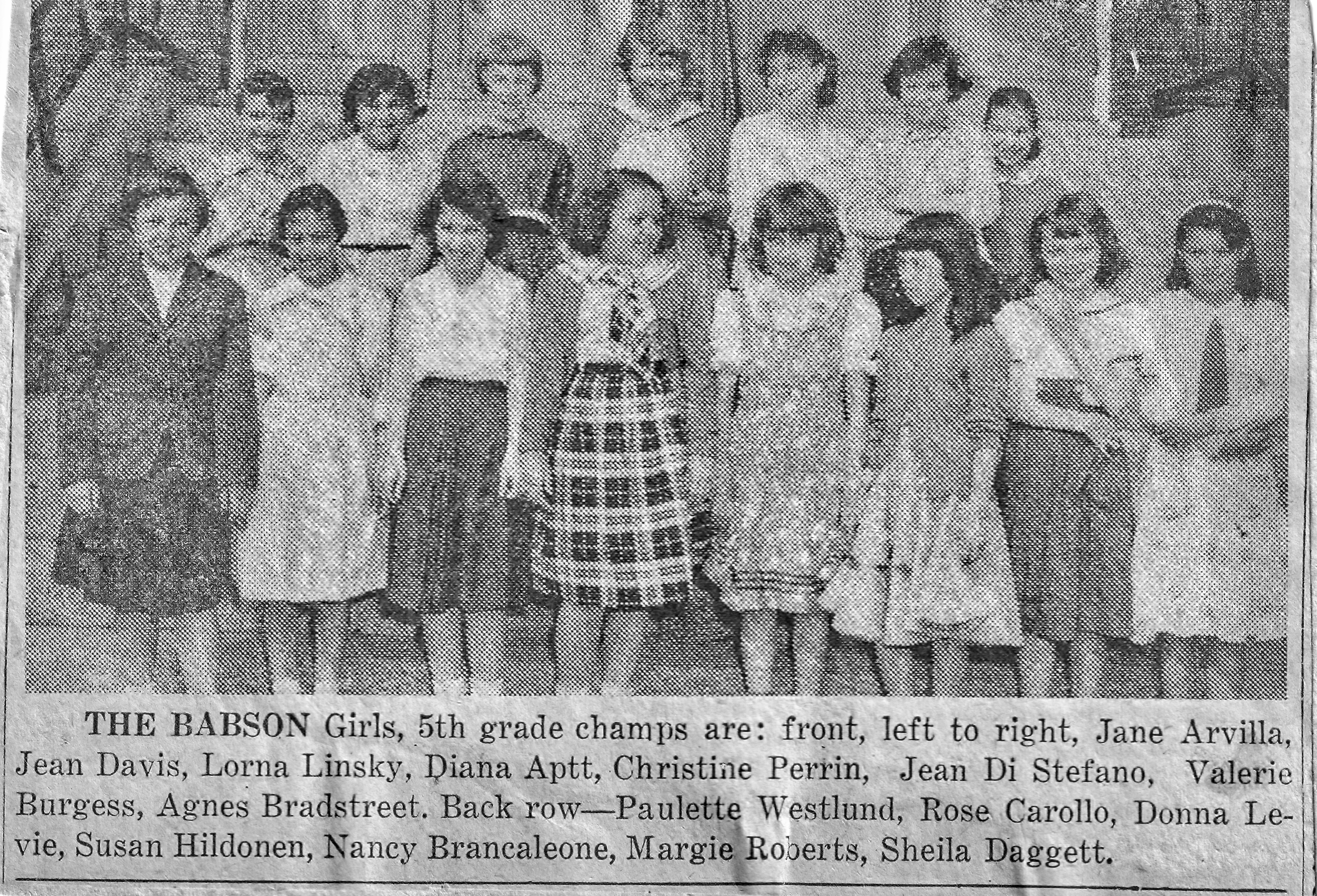
The Babson Girls, 5th Grade champs are: front to left Jane Arvilla, Jean Davis, Lorna Linsky, Diana Aptt, Christine Perrin, Jean Di Stefano, Valerie Burgess, Agnes Bradstreet. Back Row – Paulette Westlund, Rose Carrollo, Donna Levie, Susan Hildonen, Nancy Brancaleone, Margie Roberts, Sheilla Daggett.
Photo Provided by Christine (Perrin) Simoes
Spread The GMG Love By Sharing With These Buttons:
46 Magnolia Ave, Gloucester, MA 01930-5132, United States
Duration: 1 hr 30 min
Public · Anyone on or off Facebook
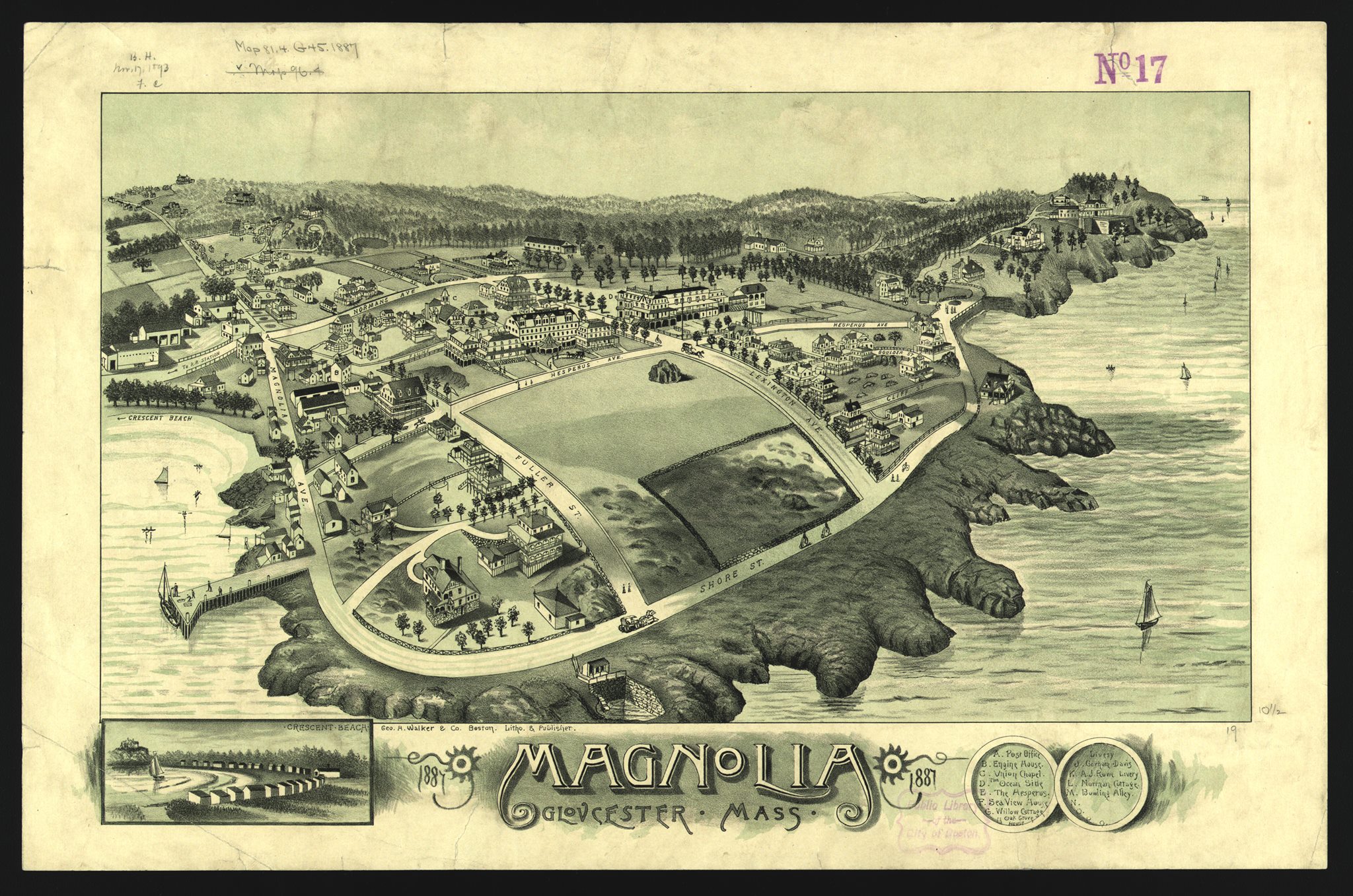
Join us at the Magnolia Historical Museum where local historian, Beth Welin, will present a lecture program, “Life Styles of the Rich and Famous in 20th Century Magnolia.” Images from Magnolia’s past will be shared as Beth leads a discussion about the former hotels and businesses frequented by the wealthy visitors to Magnolia during the “Gilded Age.” Utilizing old maps, postcards and photos, we will go back in time as we make our way down our village streets which formerly hosted elegant hotels and exclusive shops. Please come and join in the discussion by sharing your own memories of earlier Magnolia!
• Light refreshments served.
• $5 donation encouraged.
• Walk-ins welcome, but please RSVP to help with planning purposes!
Spread The GMG Love By Sharing With These Buttons:
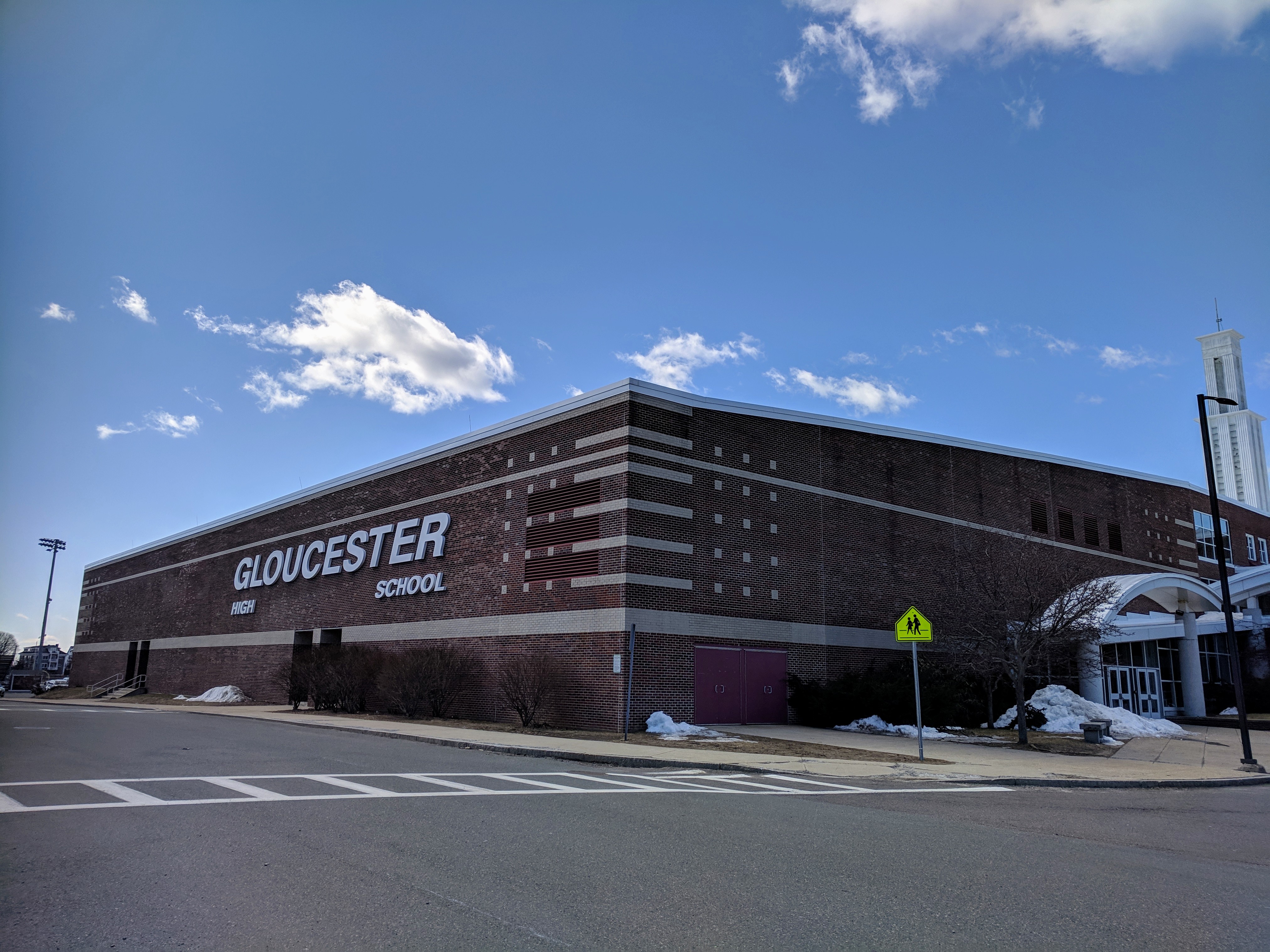
Gloucester, Mass. A great teacher at Gloucester High School, Shaun Goulart, creates a local history scavenger hunt/trivia game for his 9th grade students that takes place weekly for 6 weeks.
ANSWERS TO SHAUN GOULART’S LOCAL HISTORY SCAVENGER HUNT TRIVIA WEEK SIX. THIS CHALLENGE IS THE FINAL WEEK IN THE SERIES. GO BACK HERE IF YOU WANT TO SEE WEEK 6 QUESTIONS ONLY.
The challenge Week 6 was to locate the historic map on Cape Ann Museum’s Fitz Henry Lane on Line and study it closely to comb through location prompts. This is a great family activity for all ages. It’s a bit eye spy or Where’s Waldo mixed with atlas map fun. The students were tasked with photographing the same sites as they appear today and creating a labeled presentation.
Visit CAPE ANN MUSEUM FITZ HENRY LANE ON LINE resource and scroll down to the correct map here
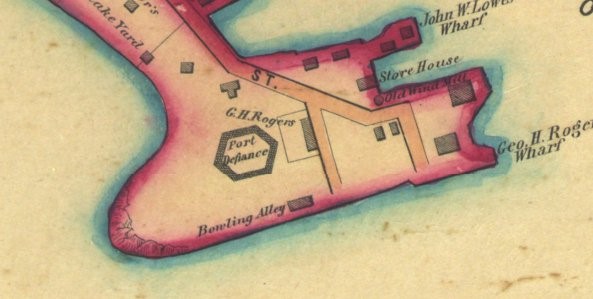
Map of the Towns of Gloucester and Rockport (detail of Harbor Village) Henry Francis Walling (F. Walling)
1851
44 x 34 in. Henry Francis Walling, Map of the Towns of Gloucester and Rockport, Essex Co. Massachusetts. Philadelphia, A. Kollner, 1851 Cape Ann Museum Library & Archive “Map of the Towns of Gloucester and Rockport, Massachusetts. H.F. Walling, Civil Engineer. John Hanson, Publisher. 1851. Population of Gloucester in 1850 7,805. Population of Rockport in 1850 3,213.” Map detail = segment of Harbor Village portion of map showing Lane-Winter property on Duncan’s Point.
Question – find on 1851 historic map
ANSWER- NOW (2019)
1
Duncan’s Point
Maritime Gloucester / Railways (former FG Low’s & Eli F. Stacy’s whf)
2
Five Pound Island
State Fish Pier
3
Front Street (present sign must be in picture)
Main and Short
4
Middle Street (present sign must be in picture)
Middle Street
5
High Street
School Street and Proctor
6
Fort Defiance
The Fort
7
Vincent’s Cove
West End Main Street and Rogers section all fill / Gorton’s, Americold, etc
8
Town House
Legion
9
Gloucester House
Brick building corner of Washington and Main (Puritan House)
10
Two cemeteries
1)cemetery next to Amvets on Prospect 2)St. Ann’s
11
Hospital
up Granite Street veers right to Blyman
12
Town Landing
Same (St. Peter’s)
13
Two bowling alleys
1)on Stacy Boulevard (see Cordage manufactury below)
2) on the Fort
14
3 schools
study the map!
1)by Univ Church and Eng H& School on Church off Middle on old map
2)looks like where Central Grammar is
3)Prospect and School where apartments are now
4)corner Washington and Gould Ct.
15
Train station
Roughly train platform now
16
Engine house
Beyond train platform- roughly where Stop & Shop is on RR Ave
17
Canal Street
Stacy Boulevard (Tavern side)
18
Cordage Manufacturing
Ditto
19
Beach Street
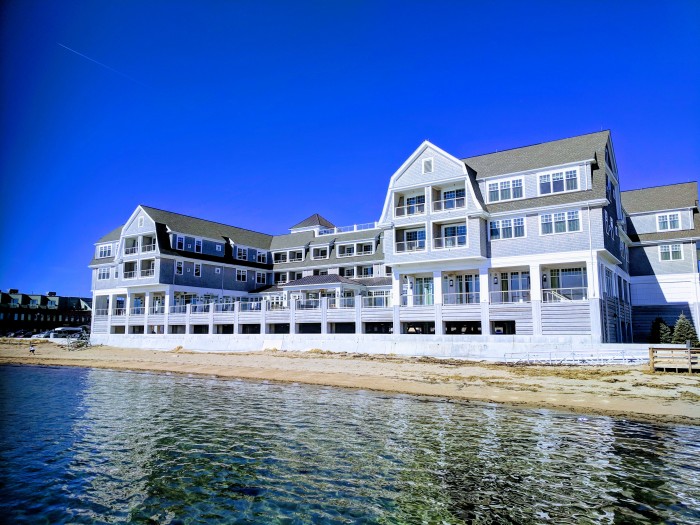
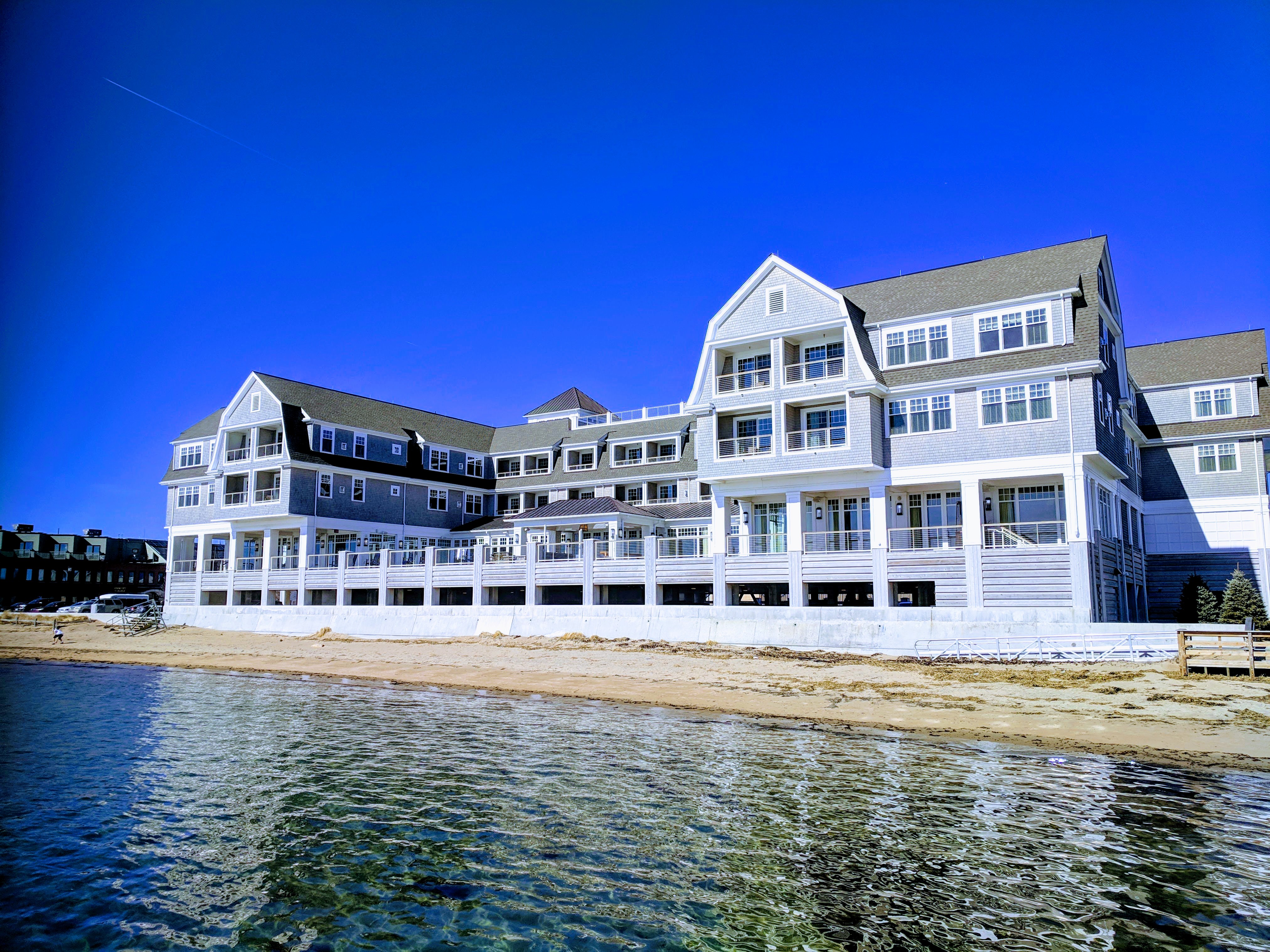
Commercial Street (behind Beauport Hotel back to water)
For six weeks I’ve been posting local history trivia questions from Shaun Goulart’s creative weekly scavenger project for his 9th grade history class at Gloucester High School one week behind the students’ pace.
This is the final week! The questions are posted today and answers posted Thursday. Good luck!
Mr. Goulart’s Local History Scavenger Hunt Week 6 (4/14)
Gloucester, Mass. A great teacher at Gloucester High School, Shaun Goulart, creates a local history scavenger hunt/trivia game for his 9th grade students that takes place weekly for 6 weeks. We’re taking the challenge paced one week after the students.
ANSWERS TO SHAUN GOULART’S LOCAL HISTORY SCAVENGER HUNT TRIVIA WEEK FIVE
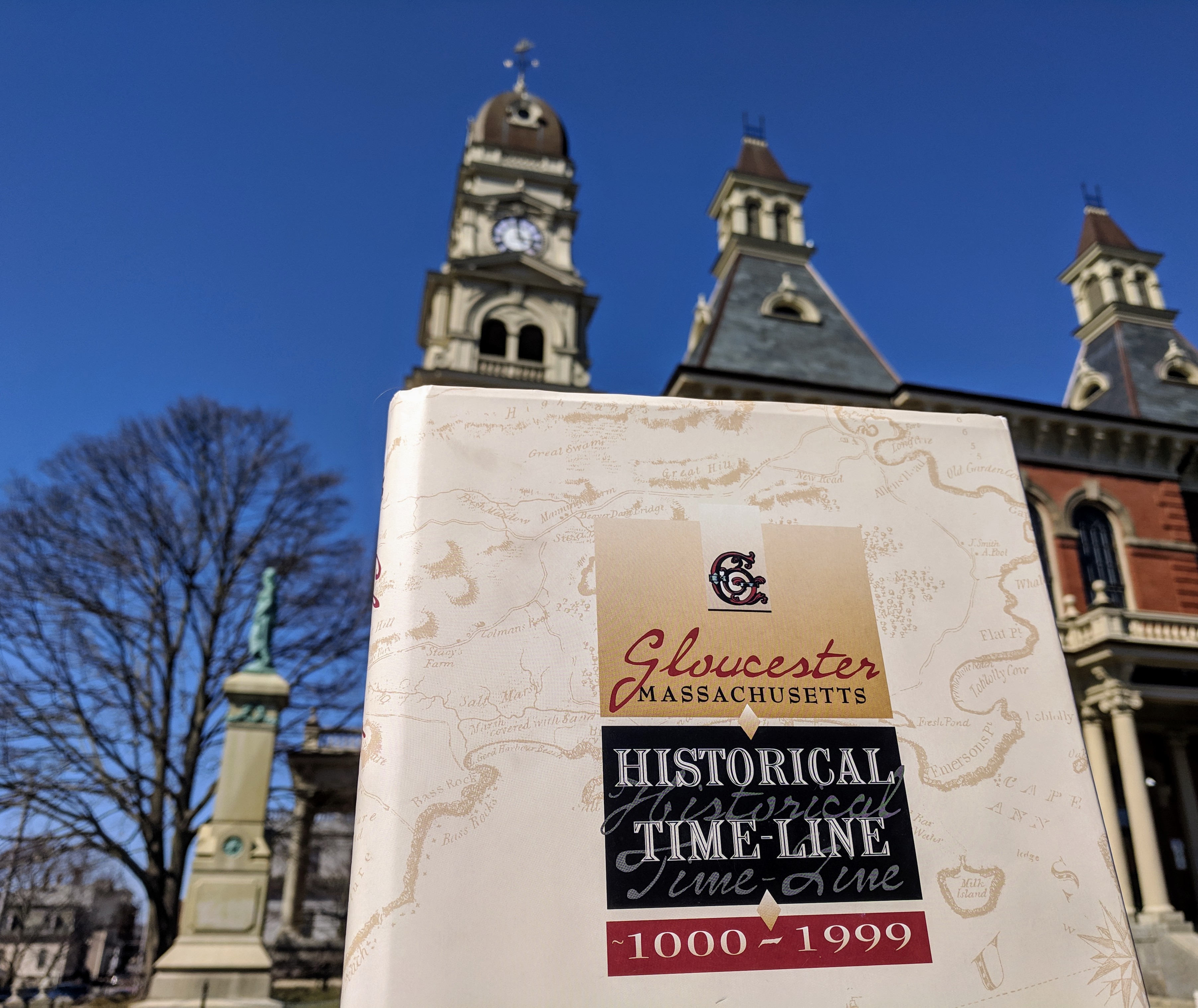
1)What year was there an ordinance to establish a Police department in Gloucester? ANSWER: 1873 (according to the Gloucester Time Line archives book and the great Gloucester police website here : “In 1799, Isaac Elwell was appointed Inspector of Police. This was a term first used in Boston 14 years earlier to describe the men appointed to keep track of the night watchmen who patrolled the city after dark watching for fires. Constables assisted Elwell and other men who followed him as Inspector of Police until about 1847 when a petition was received by the Selectmen asking for some additional policemen to assist the Inspector of Police. Around 1850 the first night police were used. Only a few of the policemen were paid as the rest either served without compensation or were only paid for working during special occasions. In 1873, a city ordinance establishing a police department was put into effect with nine officers under the leadership of City Marshal William Cronin.”)
Gloucester Massachusetts Historical Time-line 1000-1999 Mary Ray, ed. Sarah Dunlap Gloucester City Archives published in 2002. You can purchase this book from the Archives.
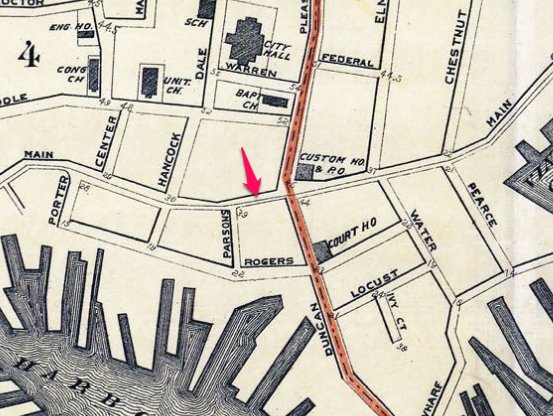
2)The original building used as a jail prior to 1889 was located on Rogers Block, take a picture of this area present day with a member in it. ANSWER: Main Street (harbor side) from Duncan to Porter
Rogers block = Main Street (from Porter to Duncan) detail from 1891 Walker map
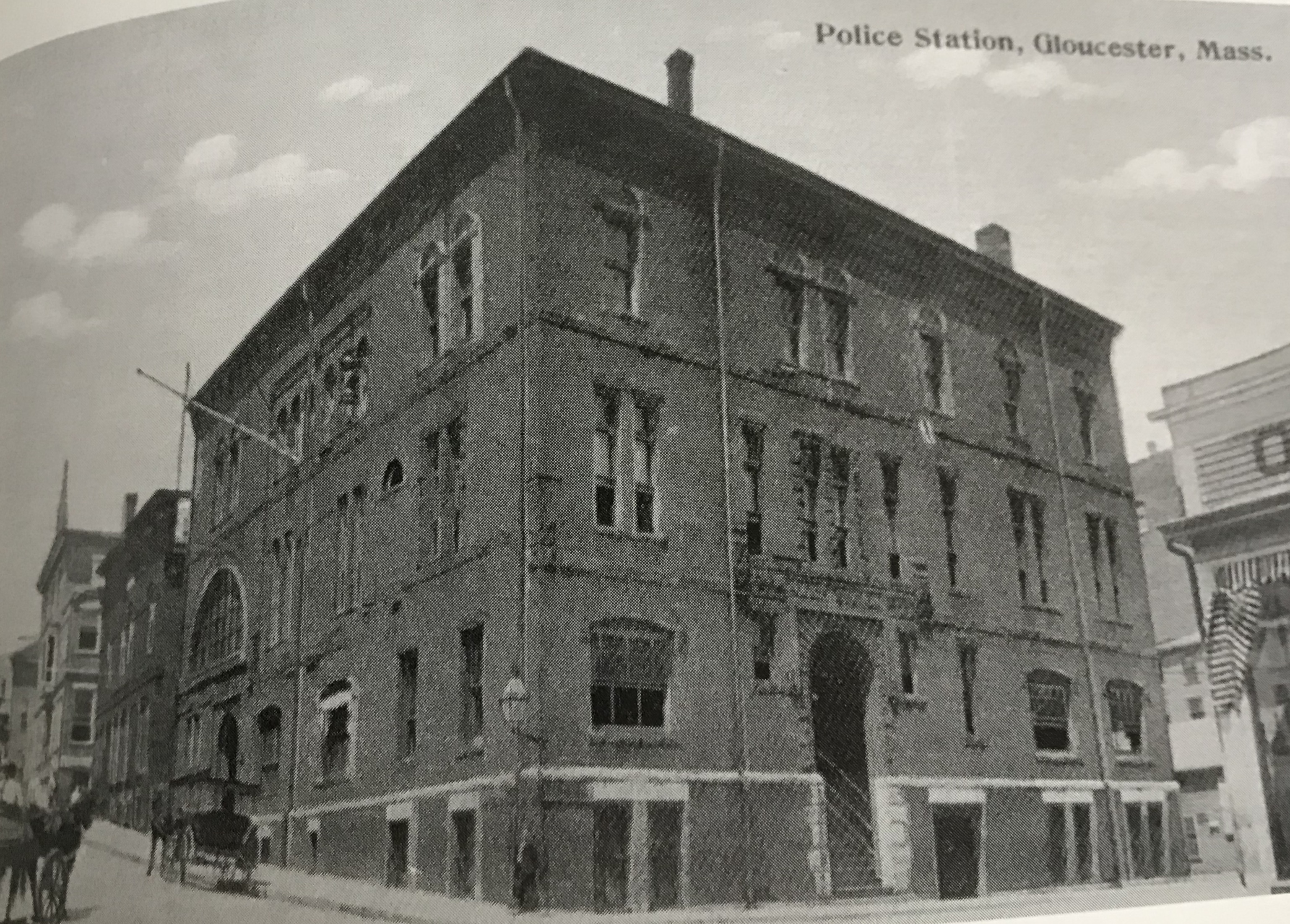
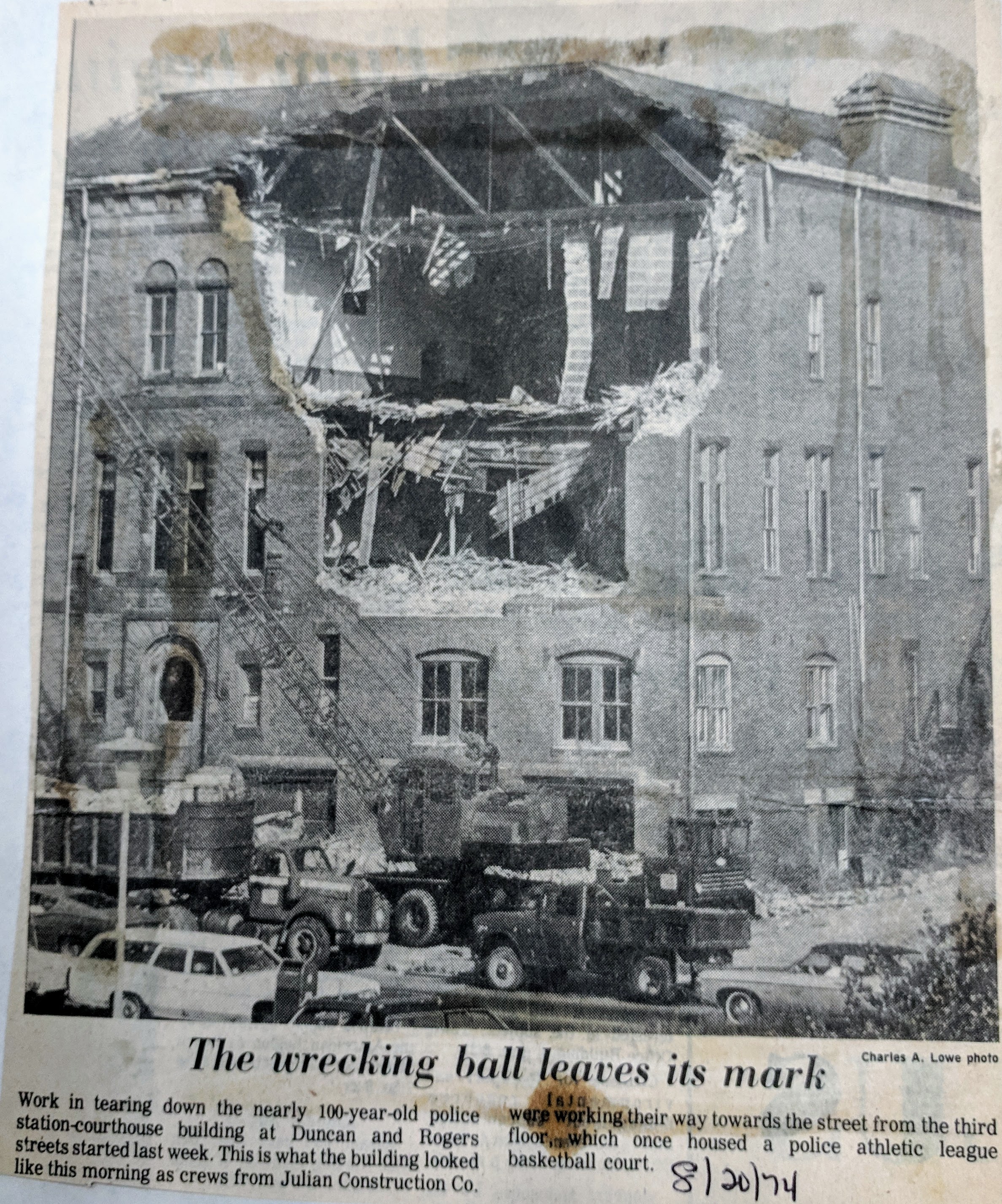
3)Where was the first Gloucester police station built in 1889, take a picture with a member in it at the location. ANSWER: corner of Duncan and Roger
former site police station at Duncan & Rogers (now lot)
detail from 1899 Stadley Map
1899 “new” police station from Pringle history
4)Veterans of what war had a hall for them located on the third floor of the building? ANSWER: Spanish American in the police station that was built in 1899. City Hall Read about bronze veteran tribute plaques (including Spanish American) at City Hall here
from Mr. Goulart Old Police station built in 1899 at the corner of Duncan and Roger (2019 = police parking lot)
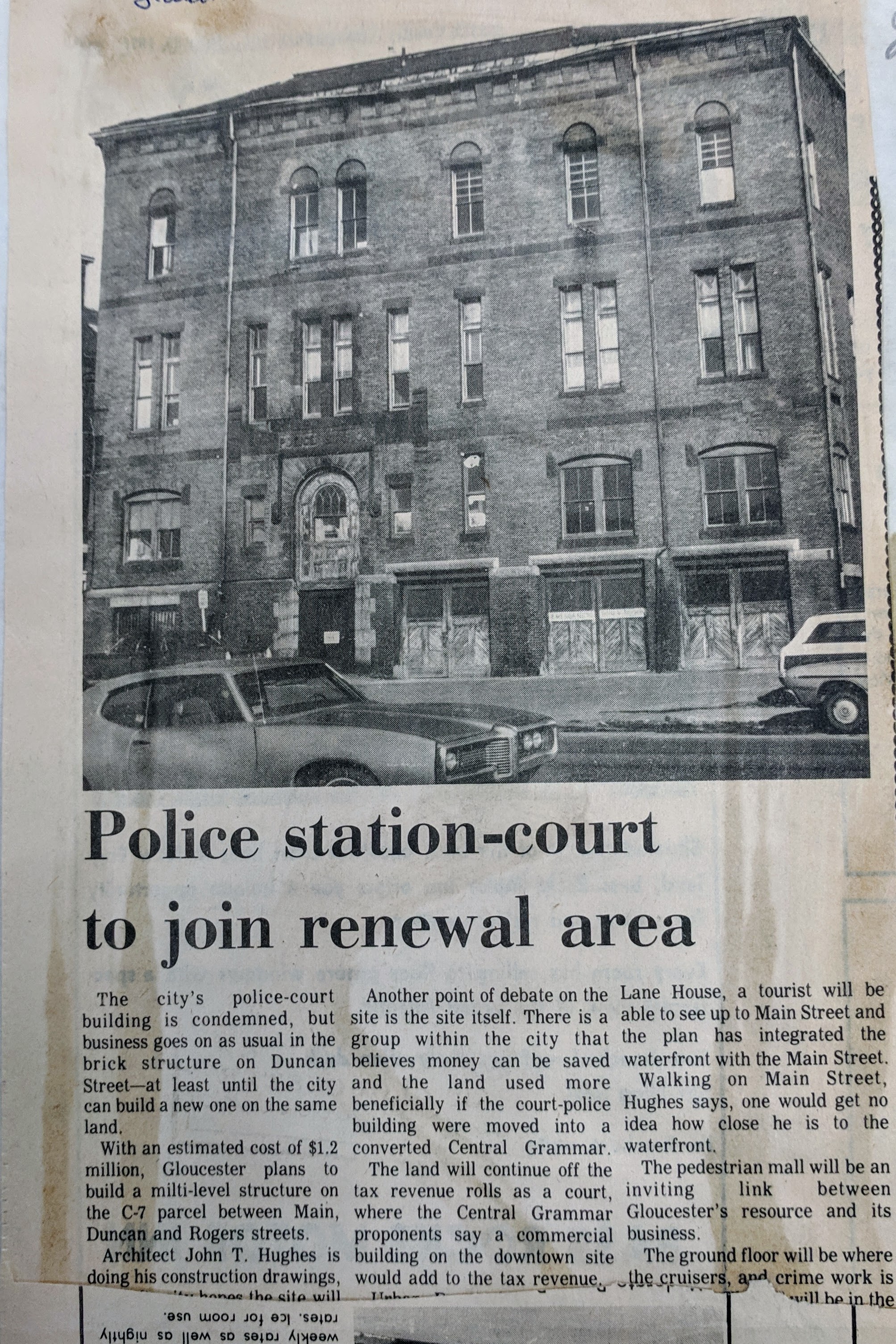
1971/1973 newspaper clipping from Sawyer Free
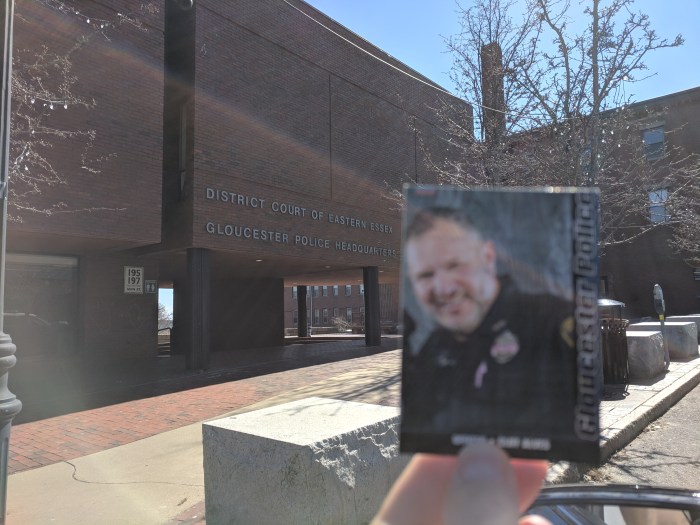
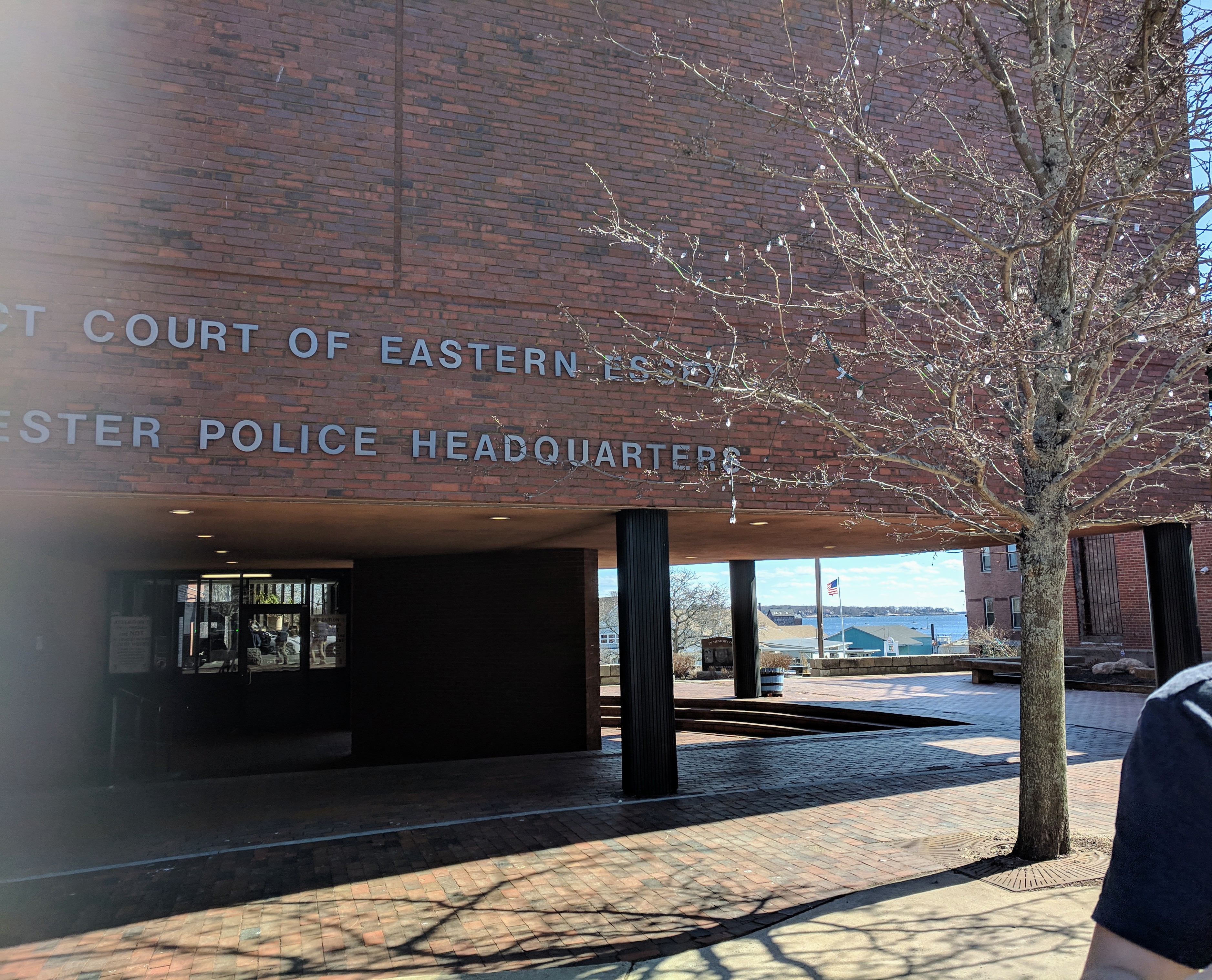
5)What year was the present day police station erected? Take a picture of it with a member in it. ANSWER: 1973
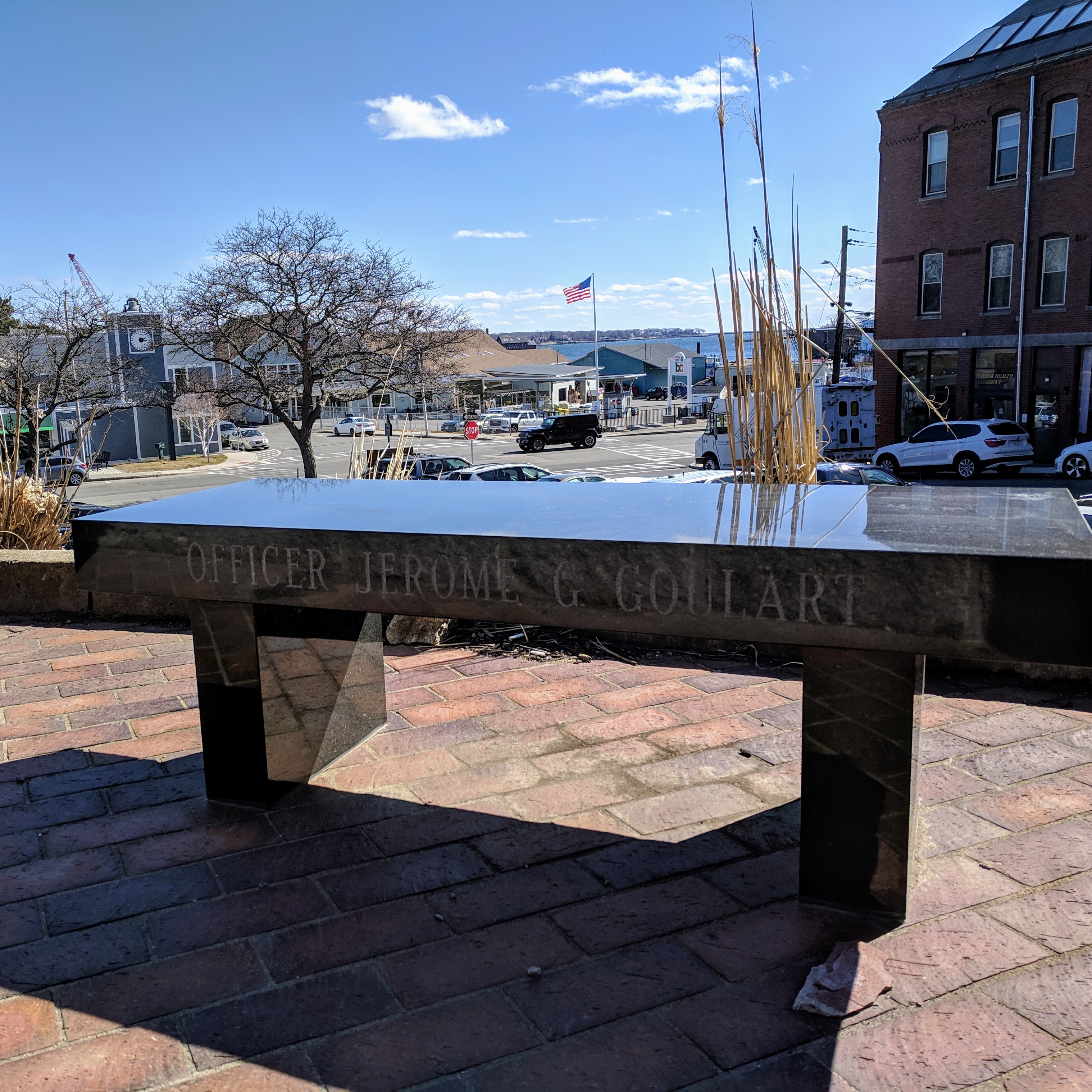
6)Go to the exterior of the police station and take a picture with an object that would be personal to Mr. Goulart (keyword: Goulart) ANSWER: Officer Jerome G. Goulart memorial bench
7)Take a picture with a Gloucester Police officer in uniform. Answ. How cool are these officer baseball cards!
8)Ask the cop: What is the code word for “lunch break” over the radio. Submit the answer. ANSWER: 1093
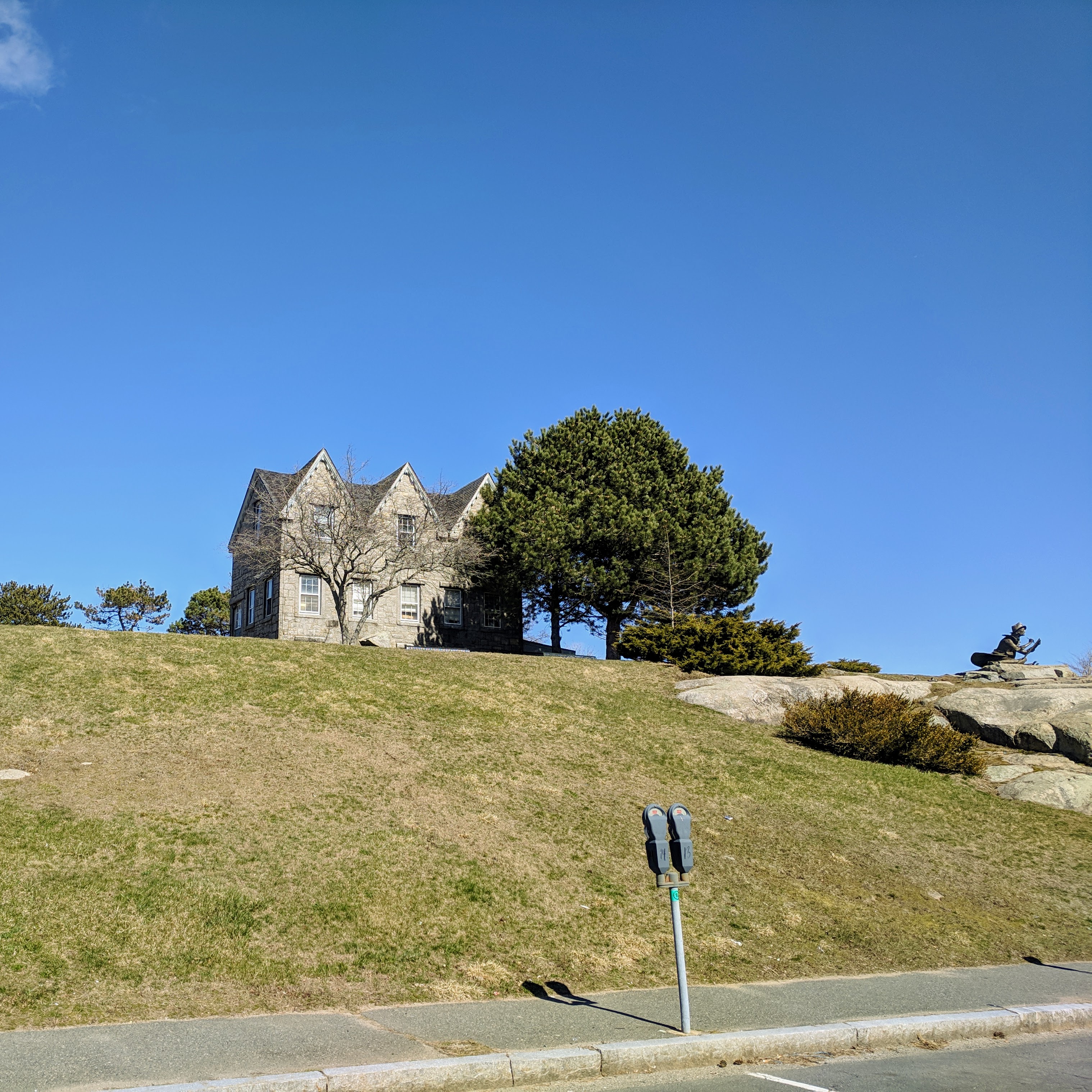
9)For a brief time the “Old Stone Jug” served as a jail, take a picture in front of it with a member in it. What is this building known as? ANSWER: Fitz Henry Lane former house and studio
10) Where does the term cop come from? ANSWER: not definitive though according to snopes meaning “nab” closest: “Instead, the police-specific use of “cop” made its way into the English language in far more languid fashion. “Cop” has long existed as a verb meaning “to take or seize,” but it didn’t begin to make the linguistic shifts necessary to turn it into a casual term for “police officer” until the mid-19th century. The first example of ‘cop’ taking the meaning “to arrest” appeared in print around 1844, and the word then swiftly moved from being solely a verb for “take into police custody” to also encompassing a noun referring to the one doing the detaining. By 1846, policemen were being described as “coppers,” the ‘-er’ ending having been appended to the “arrest” form of the verb, and by 1859 “coppers” were also being called “cops,” the latter word a shortening of the former.”- snopes
Over six weeks I’m posting local history trivia questions from Shaun Goulart’s creative weekly scavenger project for his 9th grade history class at Gloucester High School– except we’ll be one week behind the students’ pace. He explains that the “questions are multi-layered and usually have an image required in the submission. All questions will deal with Gloucester’s local history. I recommended to the students to utilize friends and family so your student may be reaching out to you for help. It is a competition and the prizes will be calculated into the Term 4 grade” for the students.
Mr. Goulart’s Local History Trivia Scavenger Hunt Week 5 – Police week
Local History Scavenger Hunt Week 5 (3/31)
What year was there an ordinance to establish a Police department in Gloucester?
The original building used as a jail prior to 1889 was located on Rogers Block, take a picture of this area present day with a member in it.
Where was the first Gloucester police station built in 1889, take a picture with a member in it at the location.
Veterans of what war had a hall for them located on the third floor of the building?
What year was the present day police station erected? Take a picture of it with a member in it.
Go to the exterior of the police station and take a picture with an object that would be personal to Mr. Goulart (keyword: Goulart)
Take a picture with a Gloucester Police officer in uniform.
Ask the cop: What is the code word for “lunch break” over the radio. Submit the answer.
For a brief time the “Old Stone Jug” served as a jail, take a picture in front of it with a member in it. What is this building known as?
Gloucester, Mass. Great teacher at Gloucester High School, Shaun Goulart, creates a local history scavenger hunt trivia game for his 9th grade students that takes place weekly for 6 weeks. We’re taking the challenge paced one week after the students.
ANSWERS TO SHAUN GOULART’S LOCAL HISTORY TRIVIA WEEK FOUR
How did you do? Week two delved into Gloucester’s famous inventors. Stop here if you prefer to go back to see Week 4 questions only
Mr. Goulart’s Local History Trivia Scavenger Hunt Week 4 Inventors
1.John Hays Hammond Jr. “Jack”
Go to the location of his home and take a picture with a member in it.
What did he invent?
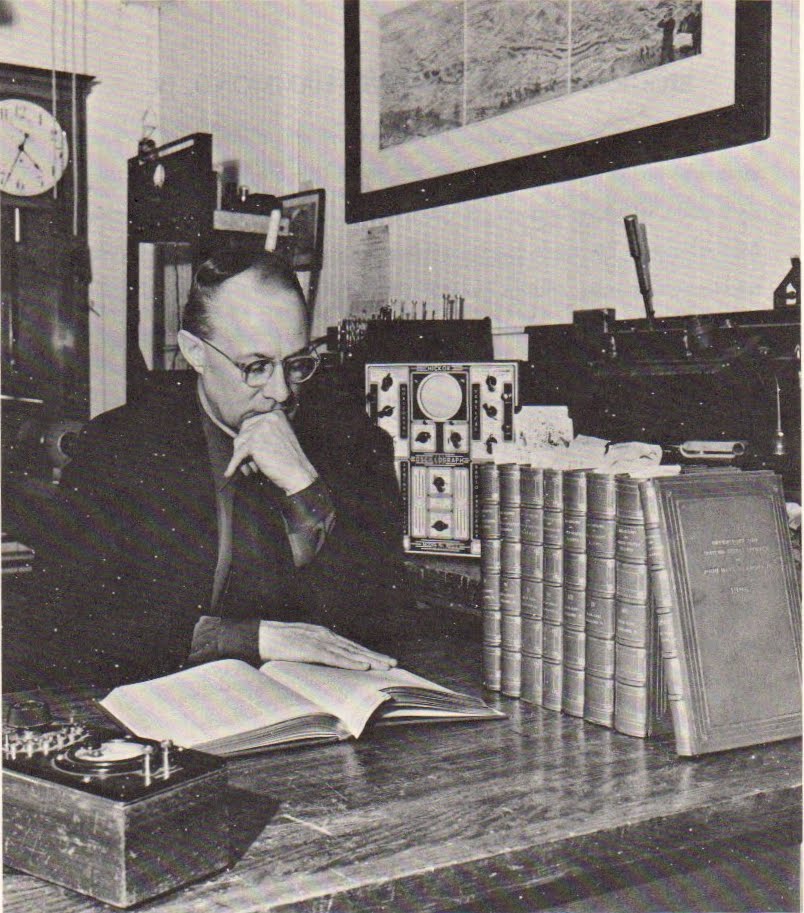
Answer: “Over the course of his professional career, he was awarded over 800 foreign and domestic patents resulting from over 400 of his inventions. Many of these began in radio control before extending to electronics, naval weapons, national defense, as well as various consumer products.” – Hammond Castle
“In connection with his radio researches Jack obtained most important patents for receiving and broadcasting and these he sold to RCA…” John Hays Hammond, Sr
Hammond Castle – I hope that one day the Trustees and Historic New England add this as a shared property among their preservation jewels, along with the Natalie Hammond property and much of the parents’ estate, Lookout Hill, with some portion of admission for the City. At one point Hammond Castle was one of the top attractions in Massachusetts.
2.Clarence Birdseye
Go to the location where his company was and take a picture with a member in it.
Go to the location of his grave and take a picture with a member in it.
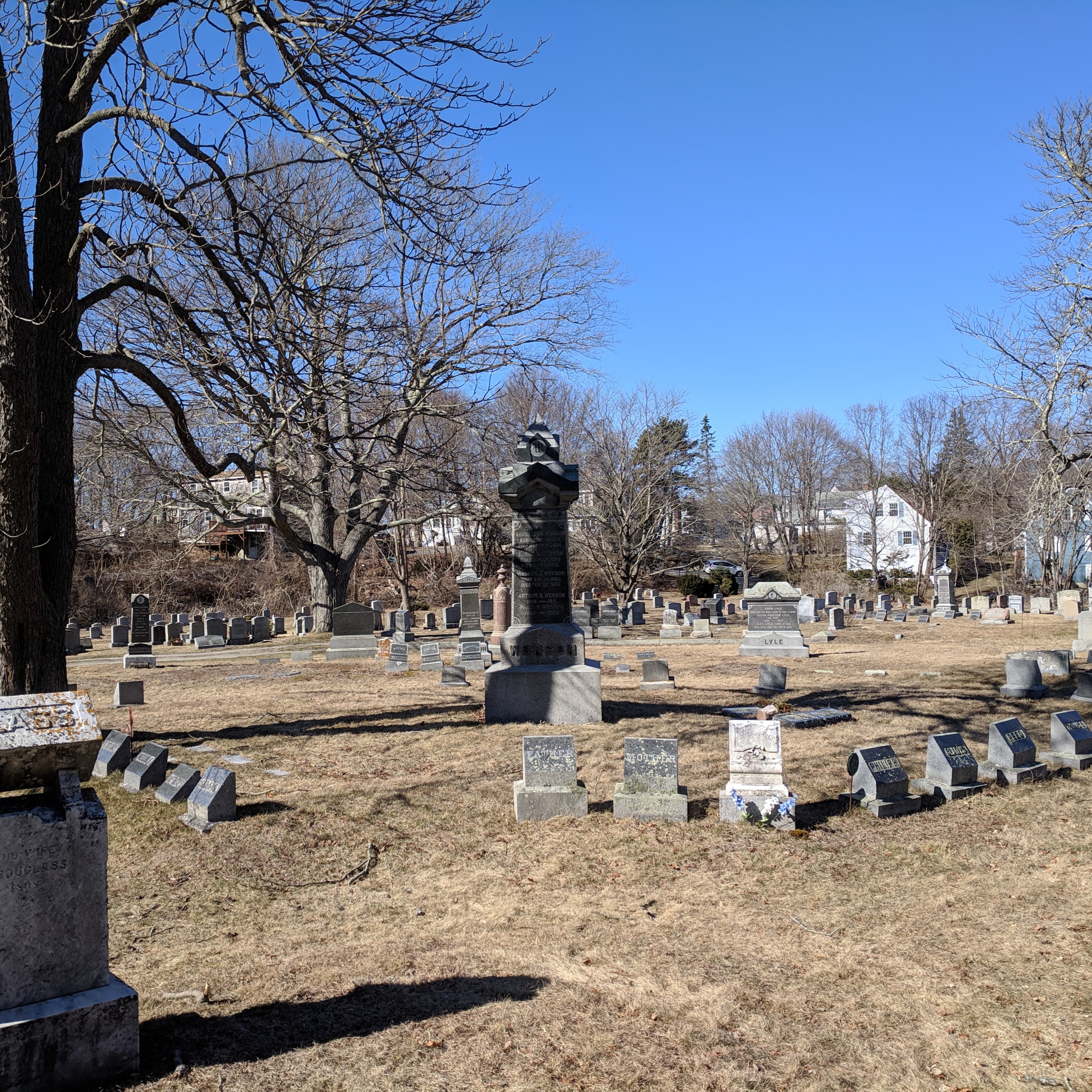
Answer: Mt. Pleasant cemetery
What did he invent?
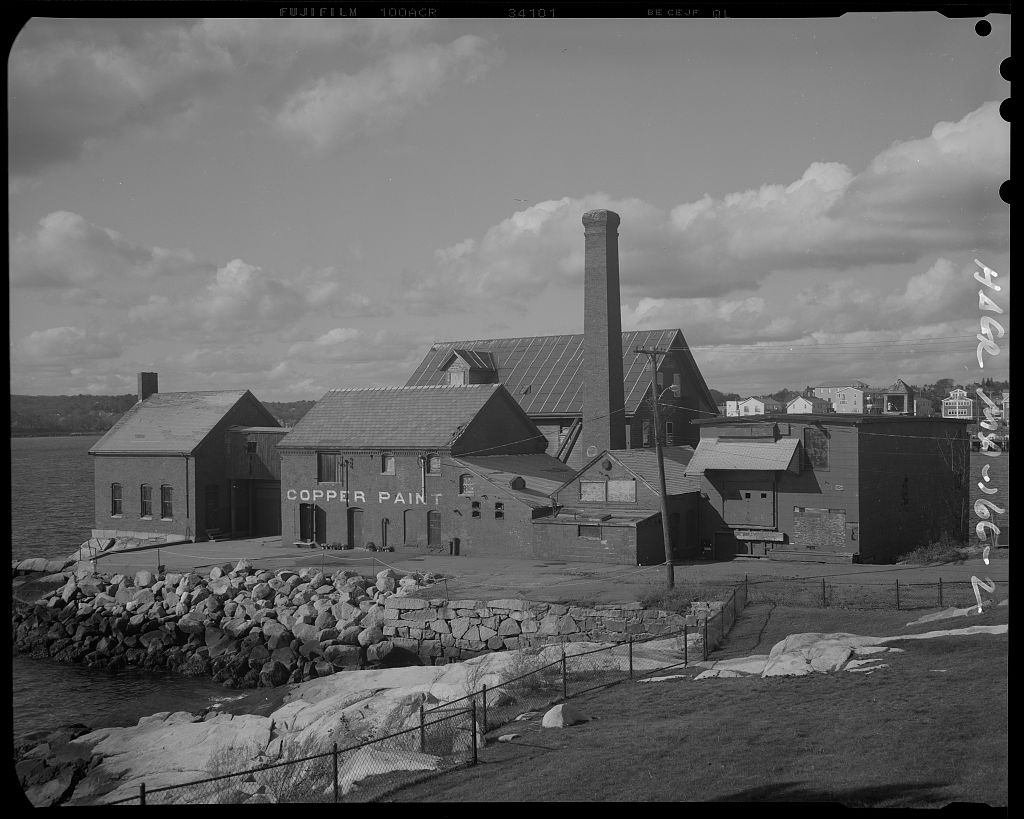
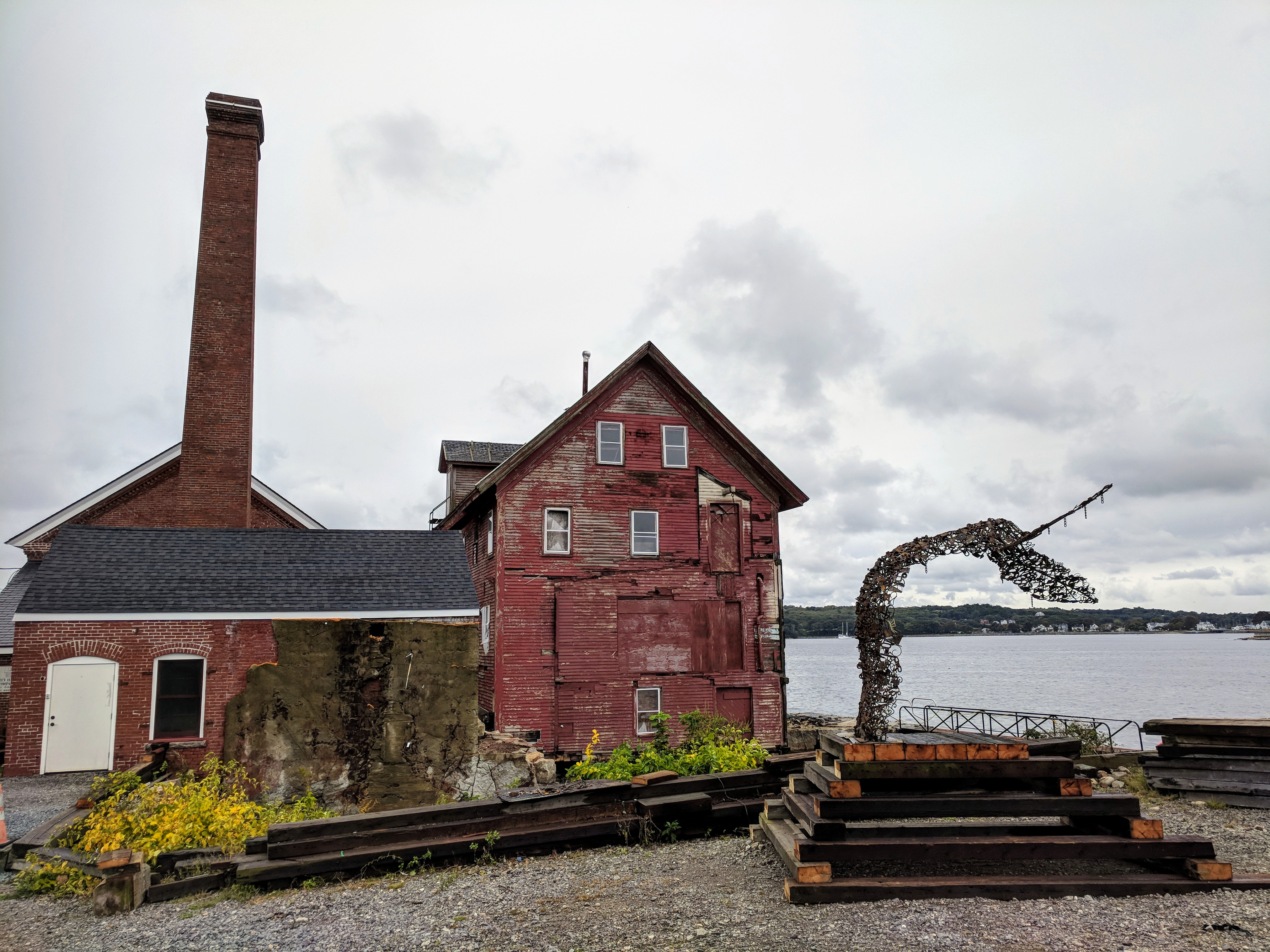
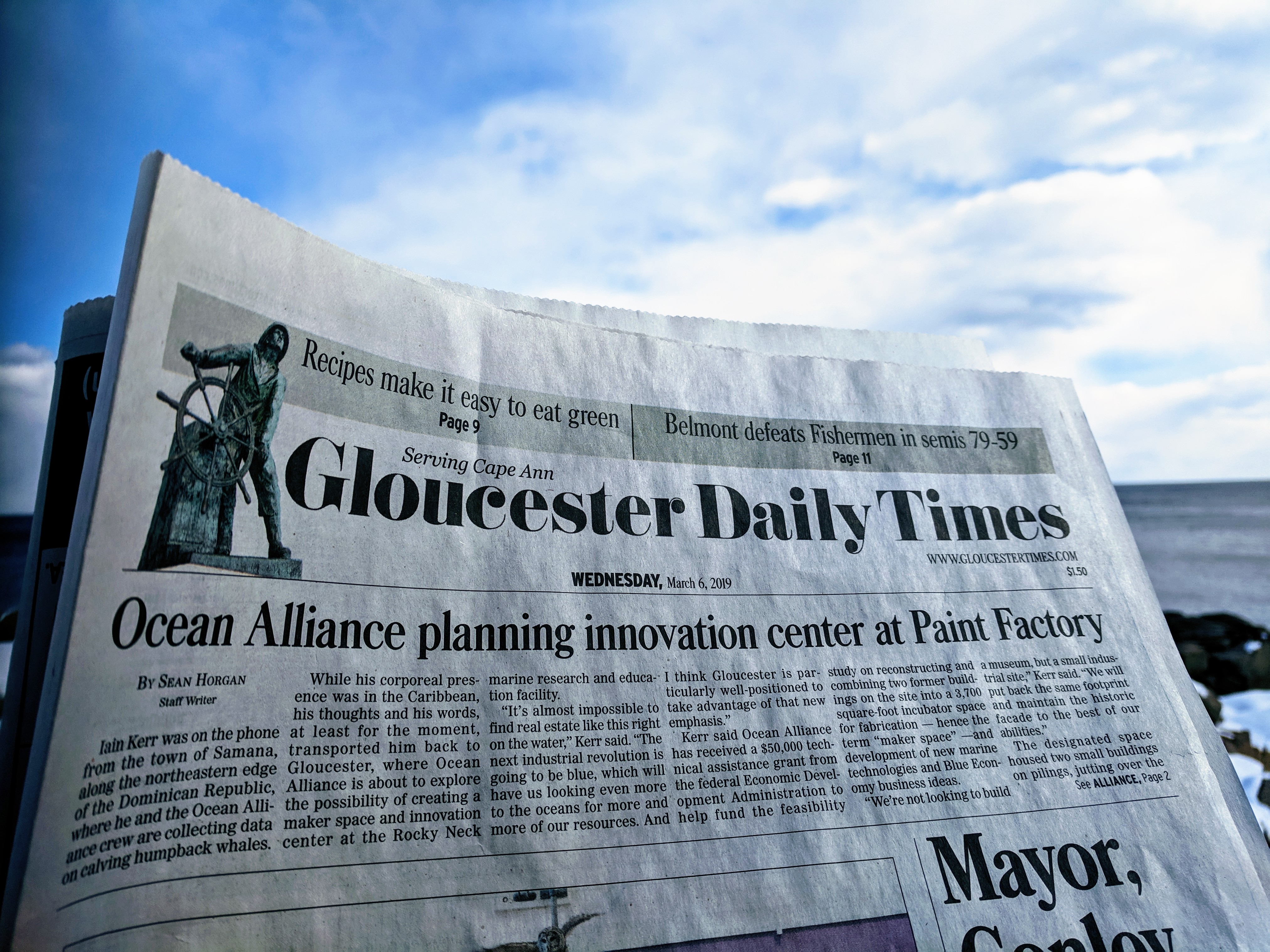
Answer: Augustus S Wonson invented antifouling copper paint to protect boats. Tarr & Wonson’s was established in 1863. The former factory and harbor icon is now Ocean Alliance.
Over six weeks I’m posting local history trivia questions from Shaun Goulart’s creative weekly scavenger project for his 9th grade history class at Gloucester High School– except we’ll be one week behind the students’ pace. He explains that the “questions are multi-layered and usually have an image required in the submission. All questions will deal with Gloucester’s local history. I recommended to the students to utilize friends and family so your student may be reaching out to you for help. It is a competition and the prizes will be calculated into the Term 4 grade” for the students.
Mr. Goulart’s Local History Trivia Scavenger Hunt Week 4 Inventors
1.John Hays Hammond Jr.
Go to the location of his home and take a picture with a member in it.
What did he invent?
2.Clarence Birdseye
Go to the location where his company was and take a picture with a member in it.
What did he invent?
3.Augustus H. Wonson
Go to the location of his grave and take a picture with a member in it.
What did he invent?
4.William Nelson Le Page
Go to the location where his company was after it moved from Rockport and take a picture with a member in it.
What did he invent?
Go to the location of Le Page’s company co-founder Ruben Brooks’ manor and take a picture with a member in it.
Gloucester, Mass.- Great teacher at Gloucester High School, Shaun Goulart, creates a local history scavenger hunt trivia game for his 9th grade students that takes place weekly for 6 weeks. We’re taking the challenge one week after the students. Good luck!
ANSWERS TO SHAUN GOULART’S LOCAL HISTORY TRIVIA WEEK THREE
How did you do? Week three was all about some famous Gloucester FIRSTS and there were many locations. Stop here if you prefer to go back to see Week 3 questions only.
1)The location of Gloucester’s first “Four Year High School”
Principal Albert Bacheler CENTRAL GRAMMAR
2)The location of Gloucester’s first Brick Building?
PURITAN HOUSE built in 1810by Col. James Tappan* is a historic house at 3 Washington Street and 2 Main Street. Also known as: Tappan’s Hotel, Gloucester Hotel (“Tappan’s Folly”), Atlantic House, Mason House, Community House, Capt Bills (1960s-70s), Puritan House & Pub (1977), Blackburn Tavern (1978-00s) *Tappan was taught by Daniel Webster
Excerpt from prior GMG post (read it here) about scenic tours by bike 1885: “And now let’s take our wheel for a short run along our harbor road to East Gloucester, and note the many points of interest on the way. The start is made at the Gloucester Hotel–the headquarters of all visiting wheelmen in the city–at the corner of Main and Washington streets; from thence the journey takes us over the rather uneven surface of Main street, going directly toward the east. In a few minutes we pass the Post Office on the left, and soon leave the noisy business portion of the street behind us, then, e’re we are aware of it, we reach and quickly climb the slight eminence known as Union Hill…” This brick building at Main and Washington now features Tonno Restaurant. Notice the chimneys and same stairs as when it was the Gloucester Hotel. The Blackburn Tavern sign was just marketing; this building has no connection. Blackburn’s Tavern is now Halibut Point restaurant at the other end of Main Street.
3)The first schoolmaster and town clerk’s house. (private property do not trespass)
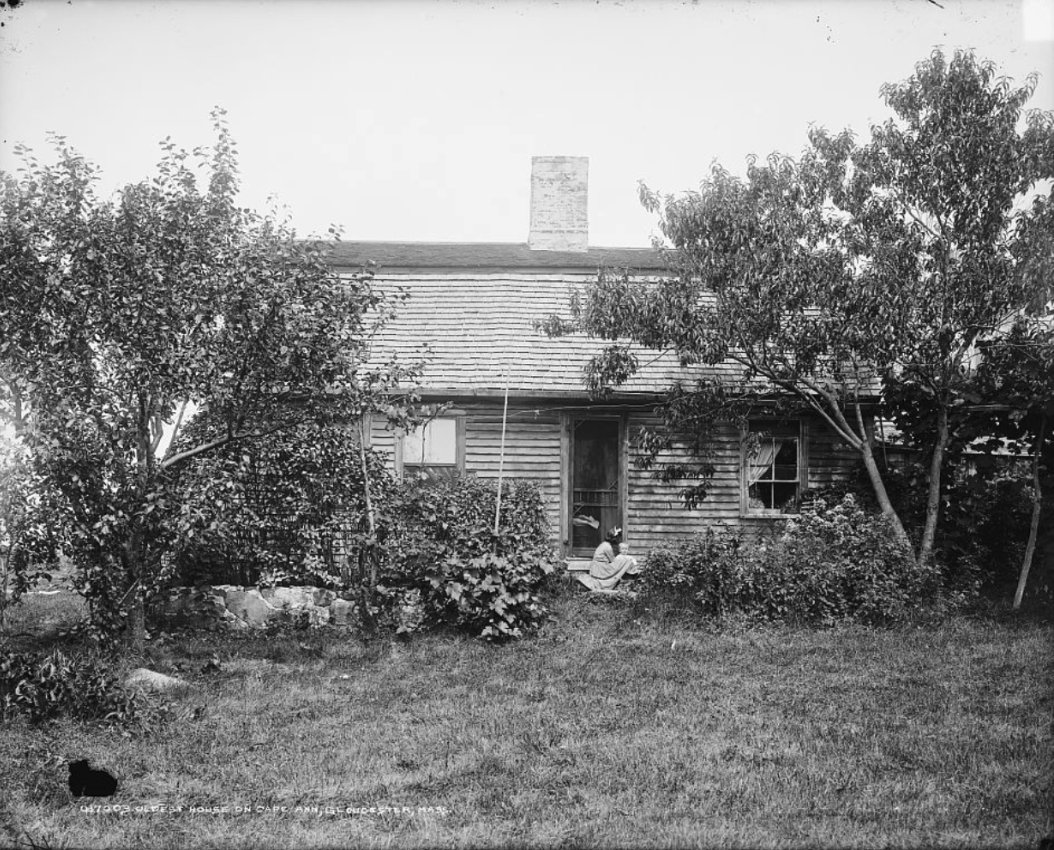
“RIGG’S HOUSE” 27 Vine Street (Annisquam) Thomas Riggs House purchased in 1661
oldest house on Cape Ann, Gloucester, MA
4)A list of the first recorded Gloucester fishermen lost at sea. (Hint: 1716)
Look under the year on cenotaph surrounding Man At Wheel
Mayor Romeo Theken, annual Fisherman’s Memorial Service, 2016
5)The location of the first carillon built in America.
Gloucester, Mass.- Great teacher at Gloucester High School, Shaun Goulart, creates a local history scavenger hunt trivia game for his 9th grade students that takes place weekly for 6 weeks. We’re taking the challenge one week after the students. Good luck!
ANSWERS TO SHAUN GOULART’S LOCAL HISTORY TRIVIA WEEK TWO
How did you do? Week two delved into scenes of historic battles. I’ve added some background. Stop here if you prefer to go back to see Week 2 questions only from 3/17/19
WEEK 2: DEFENDING GLOUCESTER Location #1
Who was the first governor of Massachusetts Bay Colony? ANSWER – ROGER CONANT
Go to the location of the fort named after him and take a picture with a member in it. *Stage Fort Park “Fisherman’s Field”
Bronze tribute plaques embedded in Tablet Rock at Stage Fort Park detail the site’s history and were commissioned and unveiled at different times. The monumental and stunning Founders plaque from 1907 on Tablet Rock itself is in fantastic condition. Two DAR plaques were inlaid on the glacial outcroppings past half moon beach on the way to the cannons. The Fisherman’s Field (ca.1930) is so worn it’s nearly indecipherable, though that’s part of its charm. The plaque compels close inspection, lingering and discovery. It’s a fun family activity for anyone who likes a challenge. For those who want help reading the content, I transcribed it back in 2010. Scroll down below the “read more” break in this post to open.
Stage Fort Fisherman’s Field plaque honoring all actions. My attribution is Harriet Hyatt_plaque refers to restoration of area 1930 by DAR
Revolutionary War tribute commissioned by DAR and installed 2013
During which war did it receive this name? ANSWER – FORT CONANT during the Civil War
When you zoom in on this 1901 photograph, you can see the big ‘Battery K’- for the Spanish American War (Camp Hobson) Fort conant during Civil War
Scrutiny
1901 before the Tablet
Gloucester vs Plymouth / Captain John Hewes vs Miles Standish
DAR plaques marvelous glacial outcroppings Stage Fort Park
Founders Plaque
Gloucester HarborWalk #32
Location #2
location 2 courtesy photos
Take a picture at Fort Point with the former location of the Coast Guard Aviation Station behind you (must be visible in the picture) ANSWER – TEN POUND ISLAND
What was the fort called on Fort Point? ANSWER – FORT DEFIANCE Fort Point Hill, Fort Lillie (Lily)
Name a war it was utilized in. ANSWER – Efforts to fortify as early as 1703 (see Pringle) ATTACK OF CAPTAIN LINDSAY (OR LINZEE) 1775 –population about 5000 –REVOLUTIONARY WAR, WAR OF 1812, CIVIL WAR
“In 1743, what is known as the old fort on Commercial Street, now encroached upon and surrounded by buildings, was completed. On this point, well selected strategically, is a hill which effectually commands the inner harbor. In 1742 and 1742, the General Court appropriated 527 pounds to defray the cost of fortification. Breastworks were thrown up and eight 12-pounders placed in position in the fort. The immediate cause of its erection was the fear of French incursions, but these fears were never realized. An effort had been made as early as 1703 to fortify the place, but the petition of the selectmen to the General Court for an appropriation for the purpose was refused. The petition shows that he harbor, even at that early date was extensively frequent for shelter, and was “very seldom free from vessels.”
“In order to be better prepared for future assaults breastworks were thrown up at Stage Fort, the Cut, Duncan’s Point and Fort Point. This, however was the last attack by sea or land that the people experienced.”
Location #3
From Fort Point go to the location of the seven-gun earthwork battery and barracks in ramparts field. Take a picture with the old towers in the background (do not go on private property) ANSWER – EASTERN POINT FORT by eminent domain, Ramparts Field Road Fort Hill
Name a war it was utilized in ANSWER – CIVIL WAR
“Immediate action was taken toward the erection of fortifications. Land at Eastern Point, belonging to Thomas Niles was acquired by the government, and earthwork fort erected and manned…”
Screenshot
Screenshot Google Earth with all three above locations in it and circle them. Submit the image.
Over six weeks I’m posting local history trivia questions from Shaun Goulart’s creative weekly scavenger project for his 9th grade history class at Gloucester High School– except we’ll be one week behind the students’ pace. He explains that the “questions are multi-layered and usually have an image required in the submission. All questions will deal with Gloucester’s local history. I recommended to the students to utilize friends and family so your student may be reaching out to you for help. It is a competition and the prizes will be calculated into the Term 4 grade” for the students.
Mr. Goulart’s LOCAL HISTORY TRIVIA WEEK TWO
WEEK 2 of 6: DEFENDING GLOUCESTER
Location #1
Who was the first governor of Massachusetts Bay Colony?
Go to the location of the fort named after him and take a picture with a member in it.
During which war did it receive this name?
Location #2
Take a picture at Fort Point with the former location of the Coast Guard Aviation Station behind you (must be visible in the picture)
What was the fort called on Fort Point?
Name a war it was utilized in.
Location #3
From Fort Point go to the location of the seven-gun earthwork battery and barracks in ramparts field. Take a picture with the old towers in the background (do not go on private property)
Name a war it was utilized in?
Screenshot
Screenshot Google Earth with all three above locations in it and circle them. Submit the image.
Gloucester, Mass.- Great teacher at Gloucester High School, Shaun Goulart, creates a local history scavenger hunt trivia game for his 9th grade students that takes place weekly for 6 weeks. We’re taking the challenge one week after the students. Good luck!
ANSWERS TO SHAUN GOULART’S LOCAL HISTORY TRIVIA WEEK ONE
How did you do? Week one delved into the history of Cape Pond Ice. More than one player “had to call a friend”, Scott Memhard, owner of Cape Pond Ice and City Councilor. He kindly shared supplemental archival material included in this post. Stop here if you prefer to go back to see questions only from 3/10/19 Week One trivia questions
Continue to scroll for the answers.
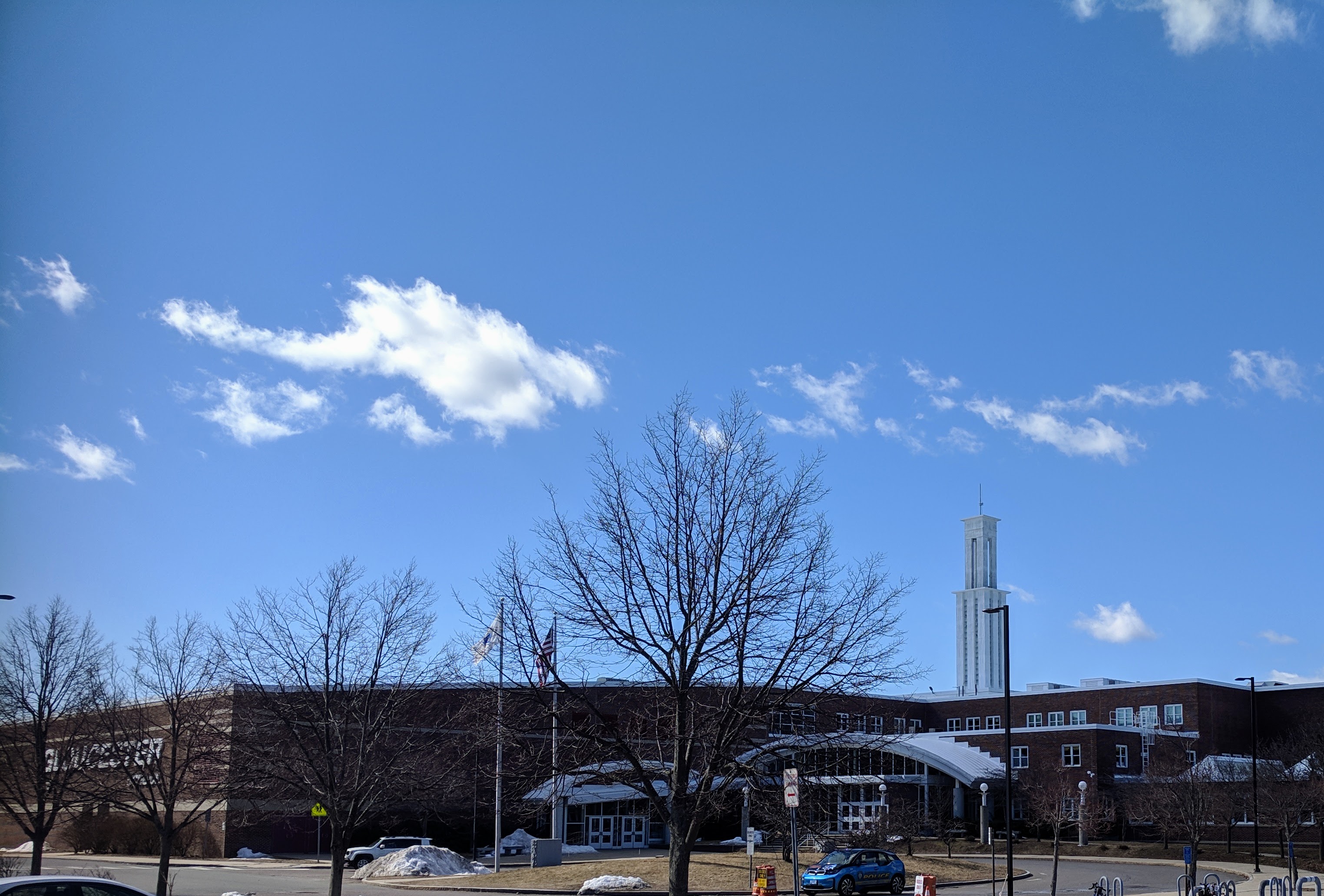
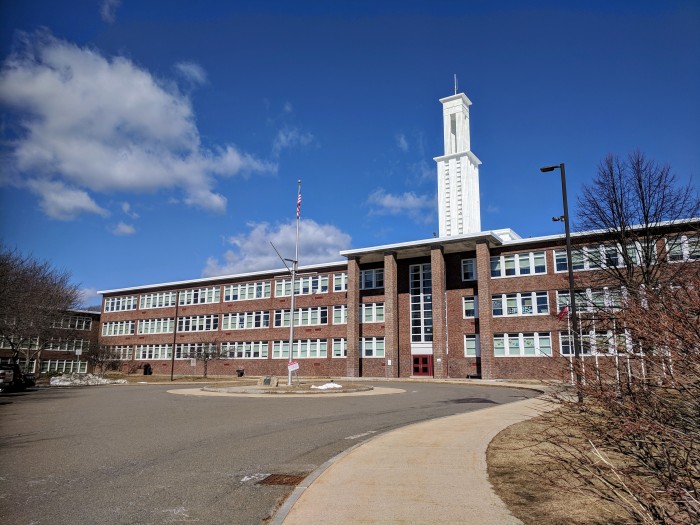
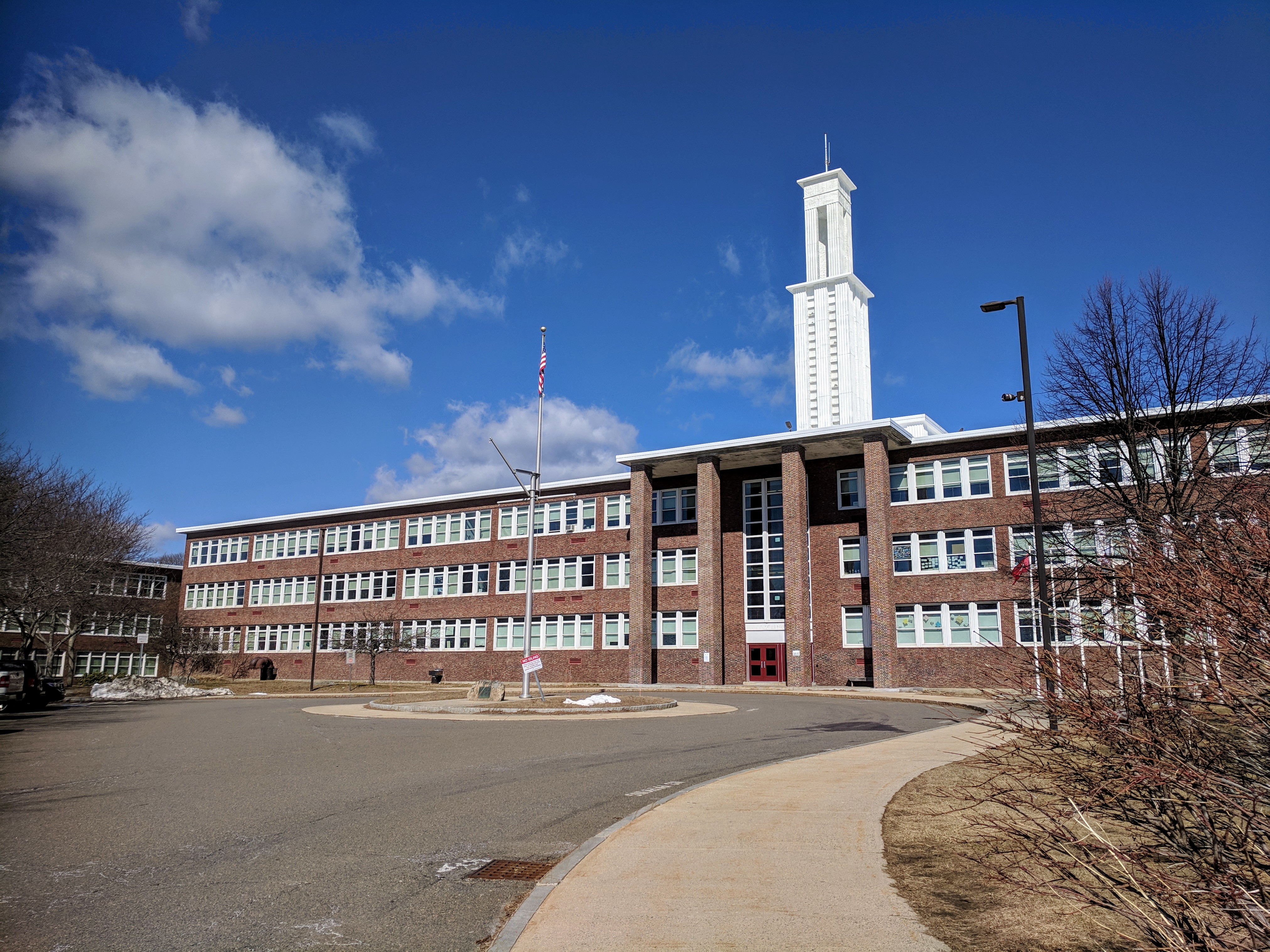
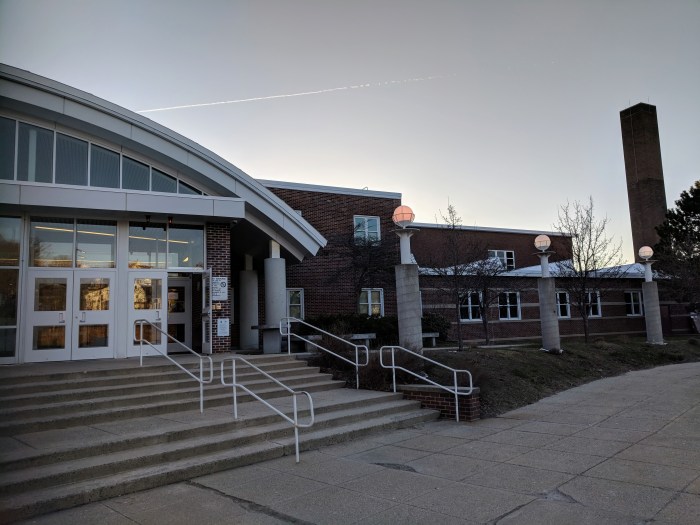
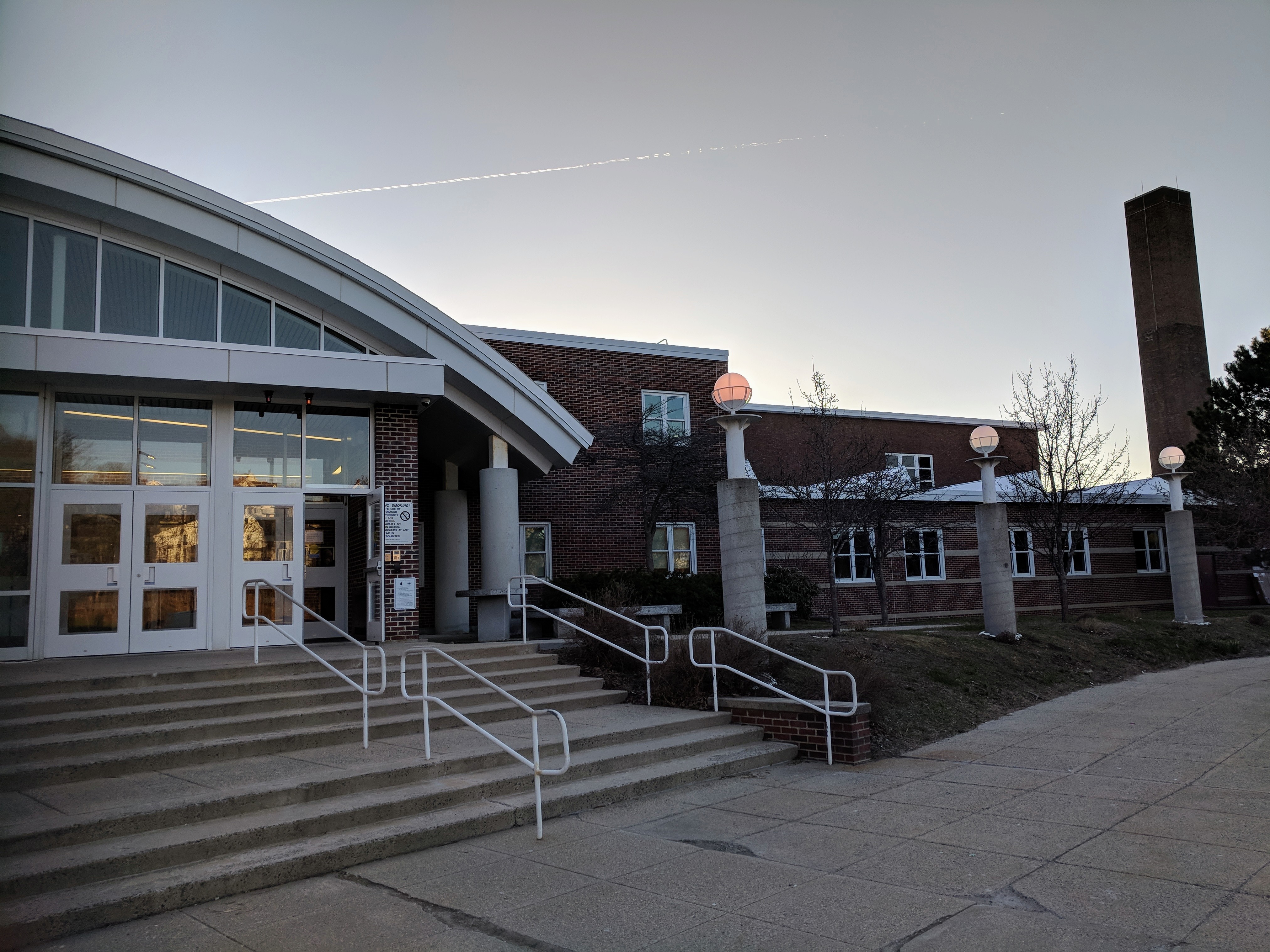
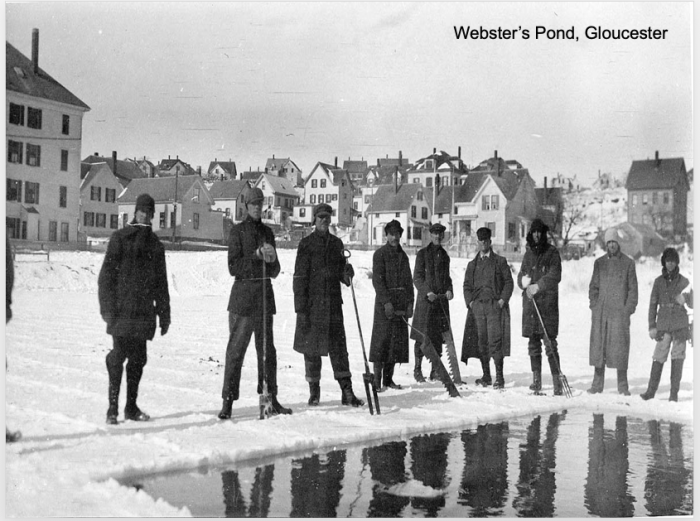
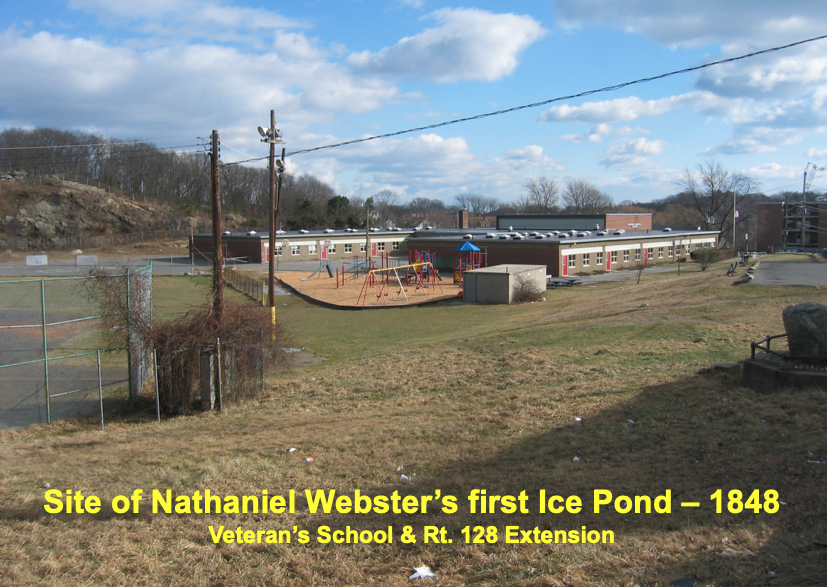
1)In 1848 a blacksmith named Nathaniel R. Webster started a company by damming a local brook. What did the brook become known as? ANSWER. VETERANS ELEMENTARY SCHOOL CAMPUS
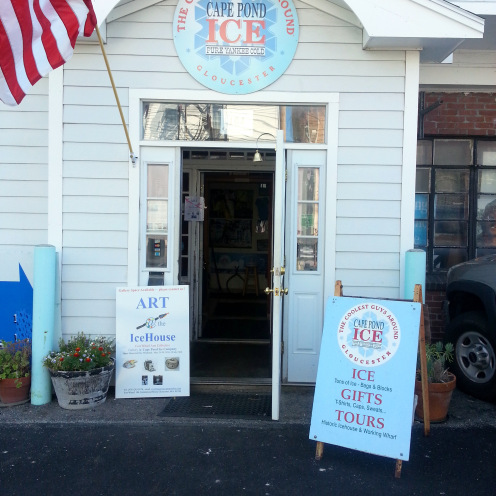
2)What did Webster’s company become known as? ANSWER. CAPE POND ICE
3)Take a picture at the present day location of the company
4)Take a picture of the street named after him with a member in it. ANSWER. WEBSTER STREET
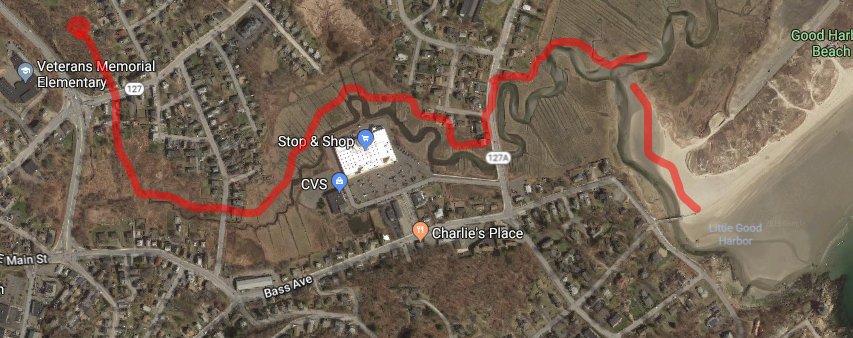
5)What is in place of the brook today? MATTOS FIELD- ABOVE = FRAT CLUB AND BELOW EVENTUALLY LEADS INTO LITTLE RIVER AT GOOD HARBOR BEACH
6)Take a picture at the location of the old dam with a member in front. ANSWER. THE SCHOOL
PART II
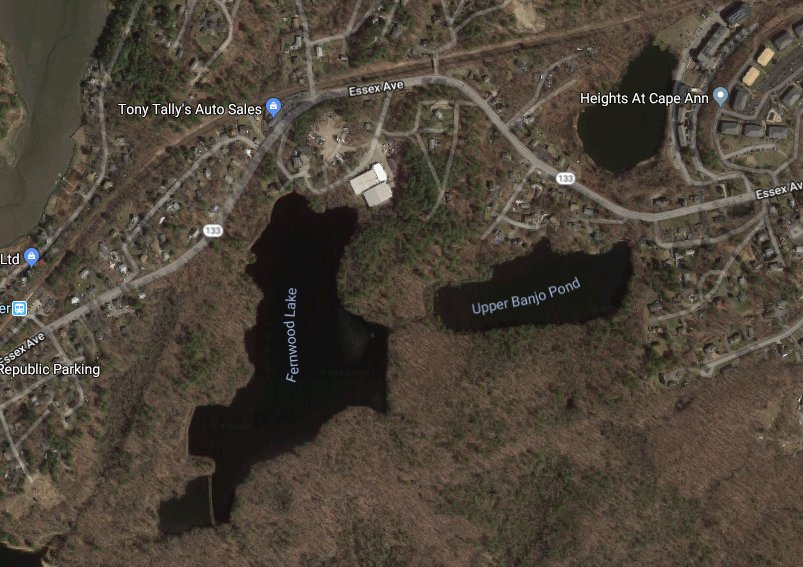
7)A competitor to Webster named Francis W. Homans in 1876 created a 32 acre man-made lake. What is the lake known as? ANSWER. FERNWOOD LAKE
8)Submit a screenshot of a map of the lake (Google Maps or Google Earth)
9)What year did the two companies merge? ANSWER. 1908
Courtesy photos below from Scott Memhard, Cape Pond Ice, Cape Ann Museum
Courtesy photo from David Collins-
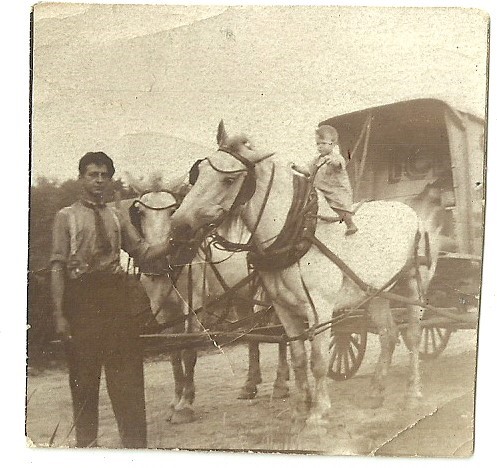
“My grandfather, Millard Collins, Sr., worked for one of the ice houses for a while. He died in 1918 at age 29 in the Spanish Flu pandemic. At that time he was working for LePages’s and had taken a leave of absence to care for his brother, Jacob, who had contracted the flu first. Jacob died October 17, 1918, and my grandfather died October 28, 1918…”
“I’m enclosing a picture of my grandfather and his horse-drawn ice wagon. You can see the word “ICE” faintly written on the inside back of the wagon. The youngster atop the horse is my father, who was born in July,1912, so I date the picture to about 1913 or so.”
Knowing how much Gloucester fans enjoy history and hearing when it’s integrated into the school curriculum, I thought GMG readers would like to know about a Local History Trivia game 2019 by Gloucester High School teacher, Shaun Goulart, AND to give it a go!
And who doesn’t like a great teacher story?
For the next six weeks I’ll post local history trivia questions from Shaun Goulart’s creative weekly scavenger hunt project for his 9th grade history class at Gloucester High School– except we’ll be one week behind the students’ pace. He explains that the “questions are multi-layered and usually have an image required in the submission. All questions will deal with Gloucester’s local history. I recommended to the students to utilize friends and family so your student may be reaching out to you for help. It is a competition and the prizes will be calculated into the Term 4 grade” for the students. No thoughts about what the prize could be for this tandem run.
I’ll post the quiz just after the students’ weekly deadline, and post the answers the following Wednesday. Leave your answers in the comments below( or email) — first all correct submission will earn top points.
The GMG point structure for Shaun Goulart’s local history trivia hunt 2019 will be as follows:
First submission correct on first day, Sunday = 5 points
Submitted Correctly first day, Sunday = 4 points
Submitted Correctly second day, Monday = 3 points
Submitted Correctly third day, Tuesday = 2 points
Submitted Correctly Wednesday = 1 point
LOCAL HISTORY TRIVIA WEEK ONE
1)In 1848 a blacksmith named Nathaniel R. Webster started a company by damming a local brook. What did the brook become known as?
2)What did Webster’s company become known as?
3)Take a picture at the present day location of the company (selfie or with a member in it)
4)Take a picture of the street named after him with a member in it.
5)What is in place of the brook today?
6)Take a picture at the location of the old dam with a member in front.
PART II
7)A competitor to Webster named Francis W. Homans in 1876 created a 32 acre man-made lake. What is the lake known as?
8)Submit a screenshot of a map of the lake (Google Maps or Google Earth)
9)What year did the two companies merge?
*We’ll see how the photo part plays out. Maybe there’s a bonus for great photos 🙂
What fun from teacher Shaun Goulart! The answers could be anywhere out there
Spread The GMG Love By Sharing With These Buttons:
March 5, 2019 Message from Iain Kerr – update on Ocean Alliance research trip off the coast of the Dominican Republic studying breeding humpback whales
“It gives me great pleasure to advise you that our last 3 days on the water have been fantastic, each day better than the previous. The weather has fallen into a typical trade wind scenario, calm in the early morning and picking up as the day goes on. We were on the boat this morning by 6:15 and had the pleasure of watching a sunrise at sea (with a whale of course).
Today we had our 1st sample by 7:15 am and had our 9th sample by 9:00 am, by 12:30 (when the winds picked up) we had collected a total of 14 samples bringing our expedition total to 54. Our goal was 50 samples, so we are now ahead of the game with 3 days to go. As the sun rose we were with a mother, calf and escort, we collected two Snot samples from each whale so we could have comparable samples, then we collected another sample from each whale flying at a higher altitude than the first set so that we can try to determine what effect height might have on the success/productivity of the biological data (snot) that gets onto the dish.
Angie Sremba is here from Dr. Scott Bakers lab at Oregon State, Angie has been focusing on the DNA analysis. She brought us some exciting information with regards to how our biological data capabilities have (successfully) evolved over time. It is important to remember here that part of this whole process is developing the collection tools and protocols and while Dr. Bakers lab is developing the preservation and analysis protocols. In summary in 2016 we had a 39% success rate with regards to sexing the animals from the DNA and a 55% success rate on the mitochondrial DNA. In 2018 we had a 92% success rate with regards to sexing the animals from the DNA and a 96% success rate with the mitochondrial DNA. This is clearly exciting as it demonstrates that we are learning and getting better on all fronts.
Another exciting data point today was the collection of some whale feces, the whales here are not feeding so it is unusual to find feces in this location. I think this is another amazing benefit of using drones for whale research, the drone saw the whale defecation (look very carefully for the brown stain in the last photo) and Britta and Andy were ready to collect it. This will prove invaluable in trying to put into context the hormone levels that we collect in the blow.
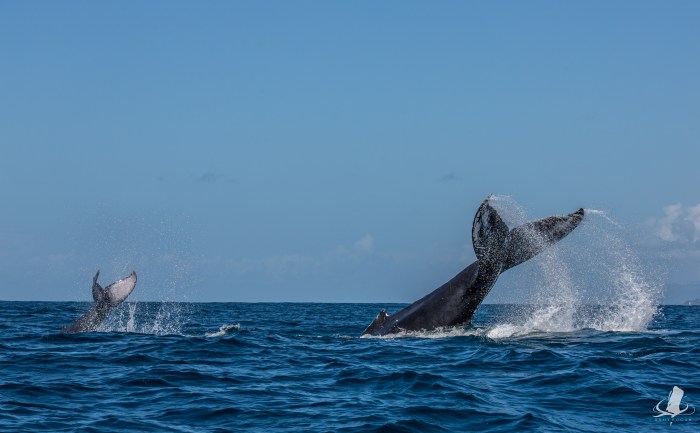
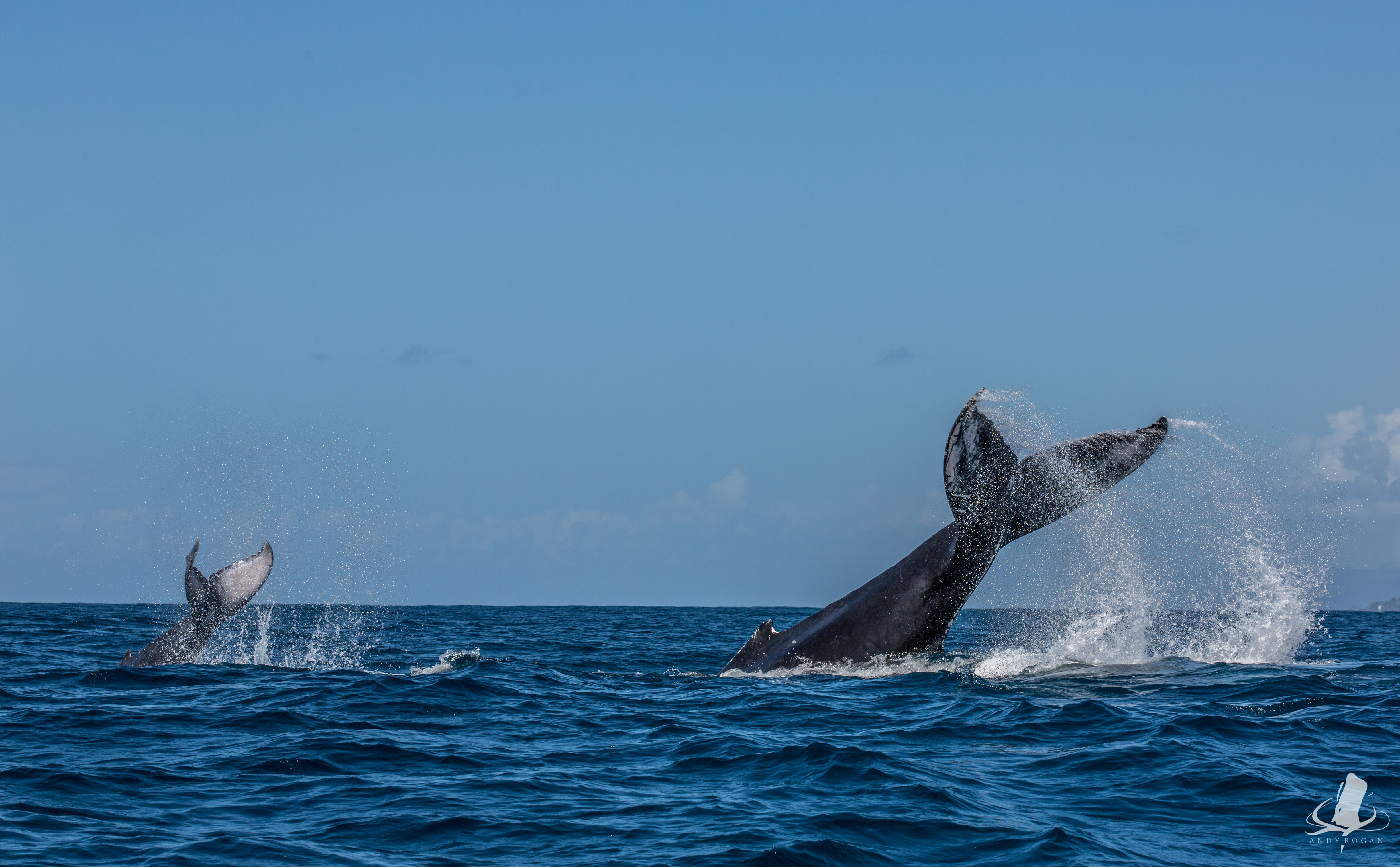
We had a number of fun whale moments today but one of the best ones was a mother and Calf lob tailing together (lifting their tails up and crashing them down onto the water). The mother would throw her tail down with an enormous crash and then the baby would do the same hardly making a splash. Andy caught one of these moments on camera (see attached photo).
Today we also did some sea trials with EarBot, after this expedition I will have four days at home and then Chris and I go to Cabo San Lucas with EarBot to work on a BBC special, so we need to make sure that EarBot is in tip top shape. Last but not least I am happy to report that this blog is supported by some amazing photos from Christian Miller and Andy Rogan.
I fly out on Thursday, so I plan to do one more blog tomorrow. I hope to report on some more EarBot and Hydrophone recordings so I can attach some Humpback whale songs from the DR, and attach a few more amazing photos.
“We had a number of fun whale moments today but one of the best ones was a mother and Calf lob tailing together (lifting their tails up and crashing them down onto the water). The mother would throw her tail down with an enormous crash and then the baby would do the same hardly making a splash.” courtesy photo by Andy Rogan for Ocean Alliance
courtesy photos for Ocean Alliance by Christian Miller:
Spread The GMG Love By Sharing With These Buttons:
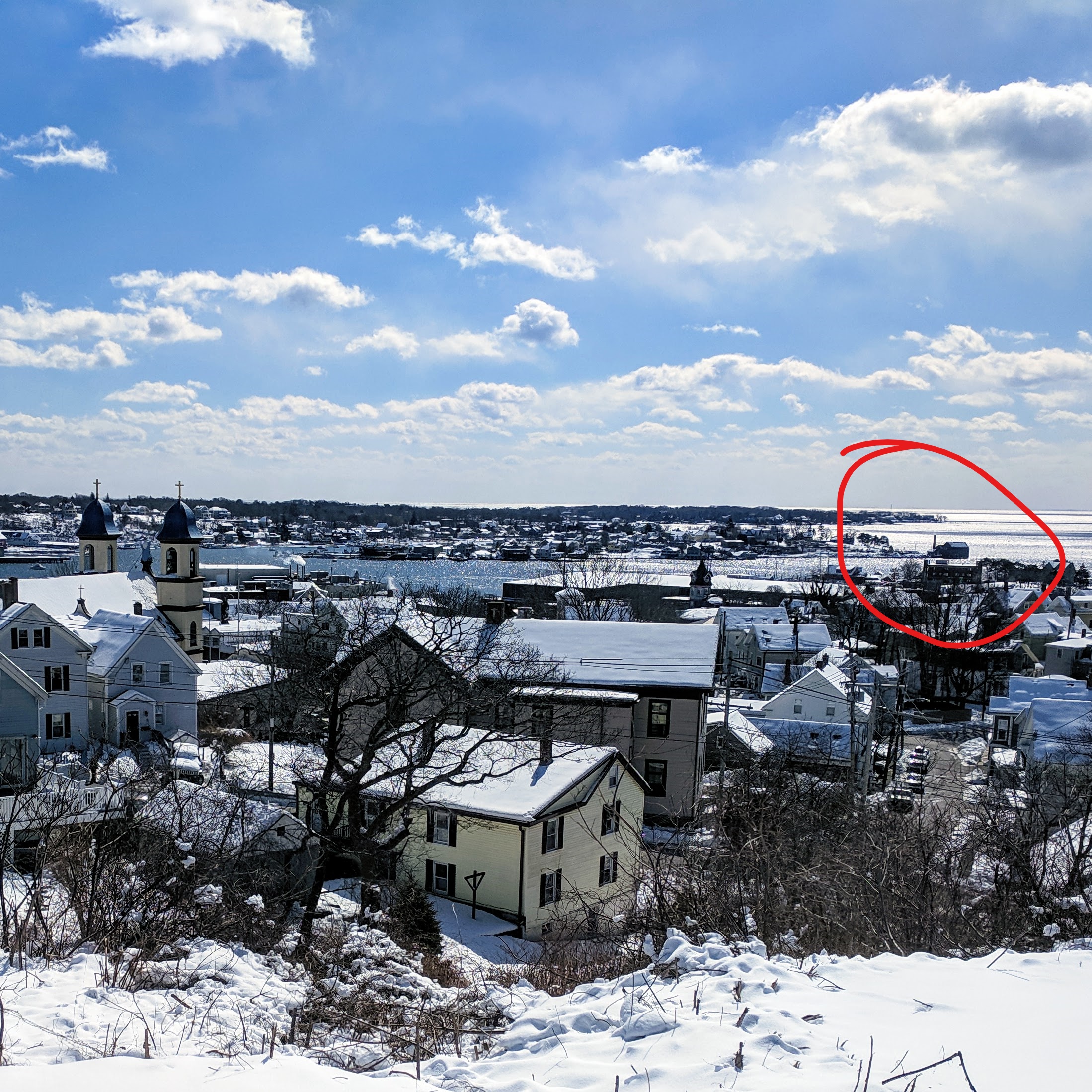
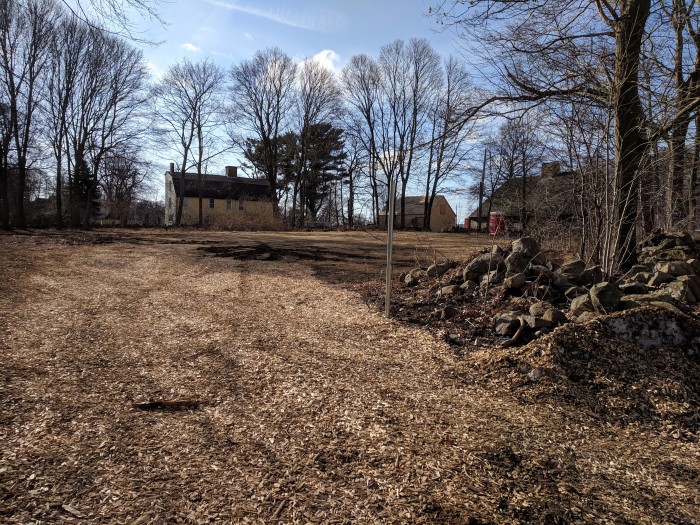
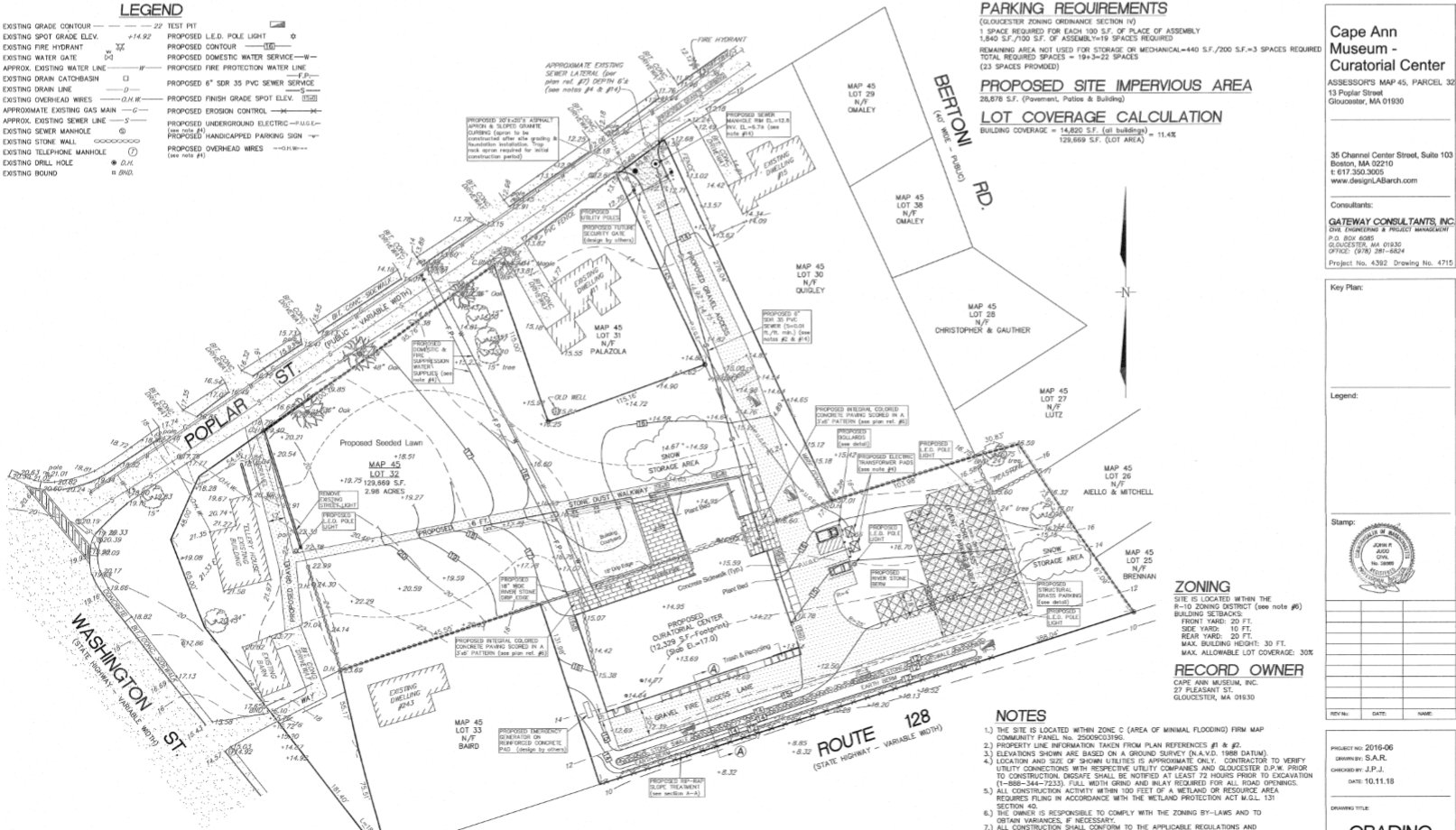
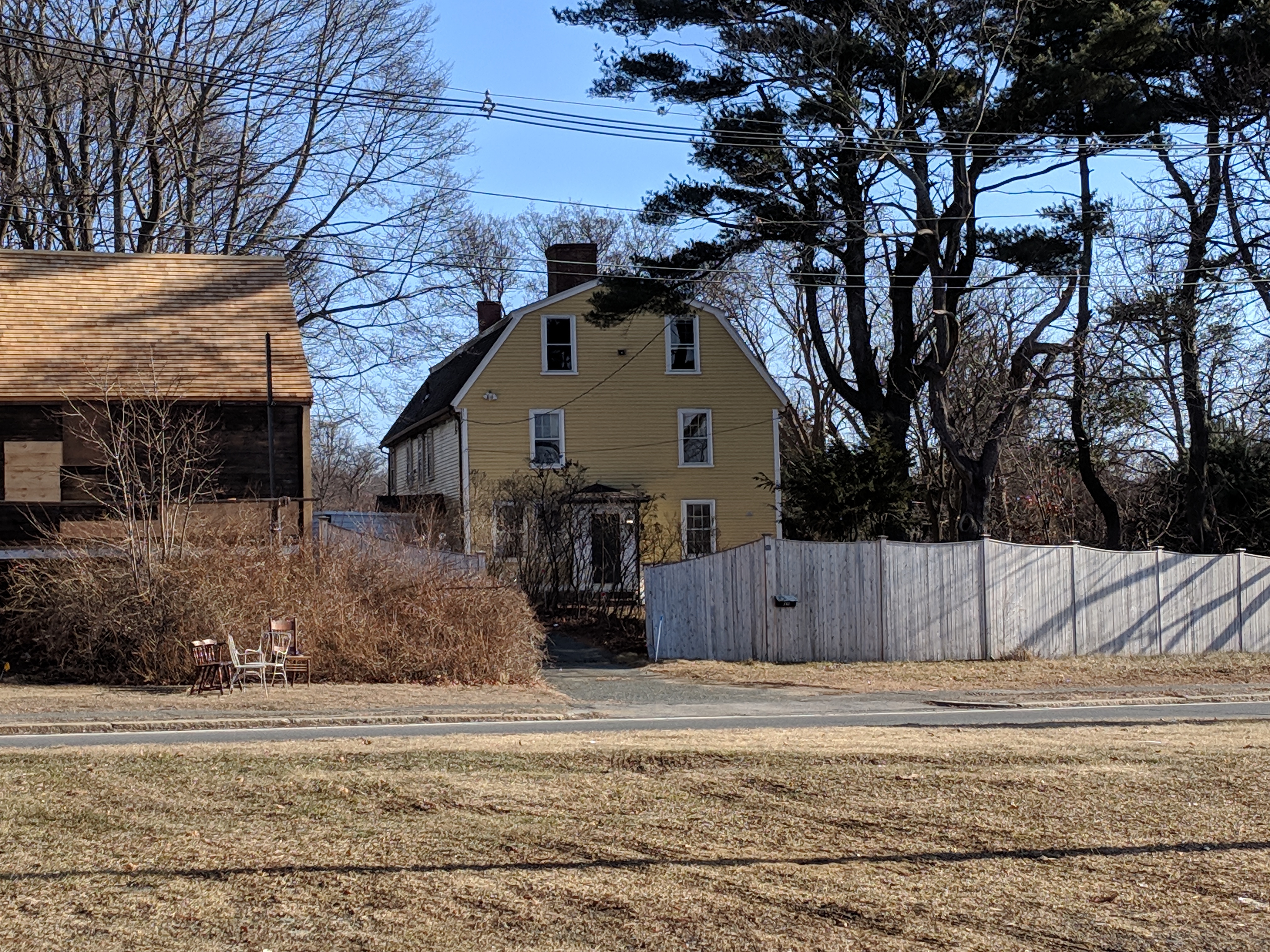
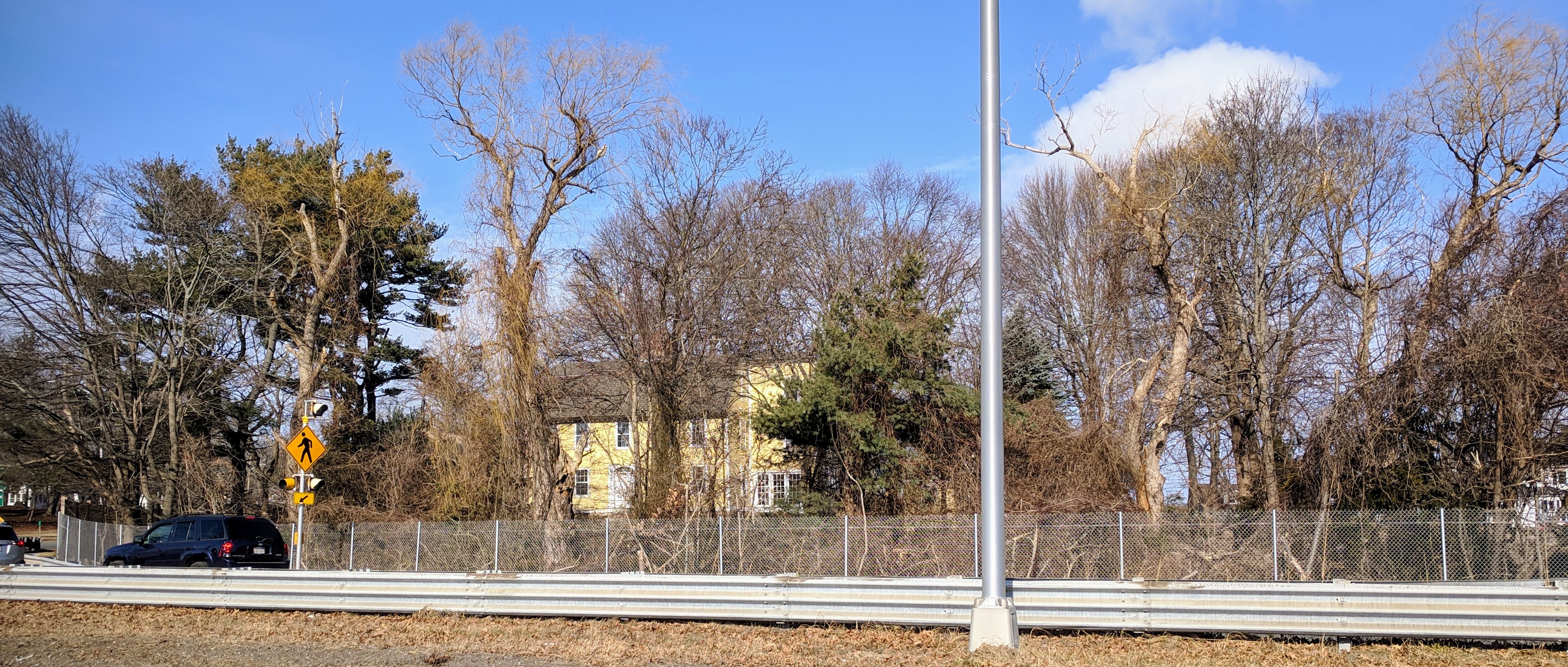
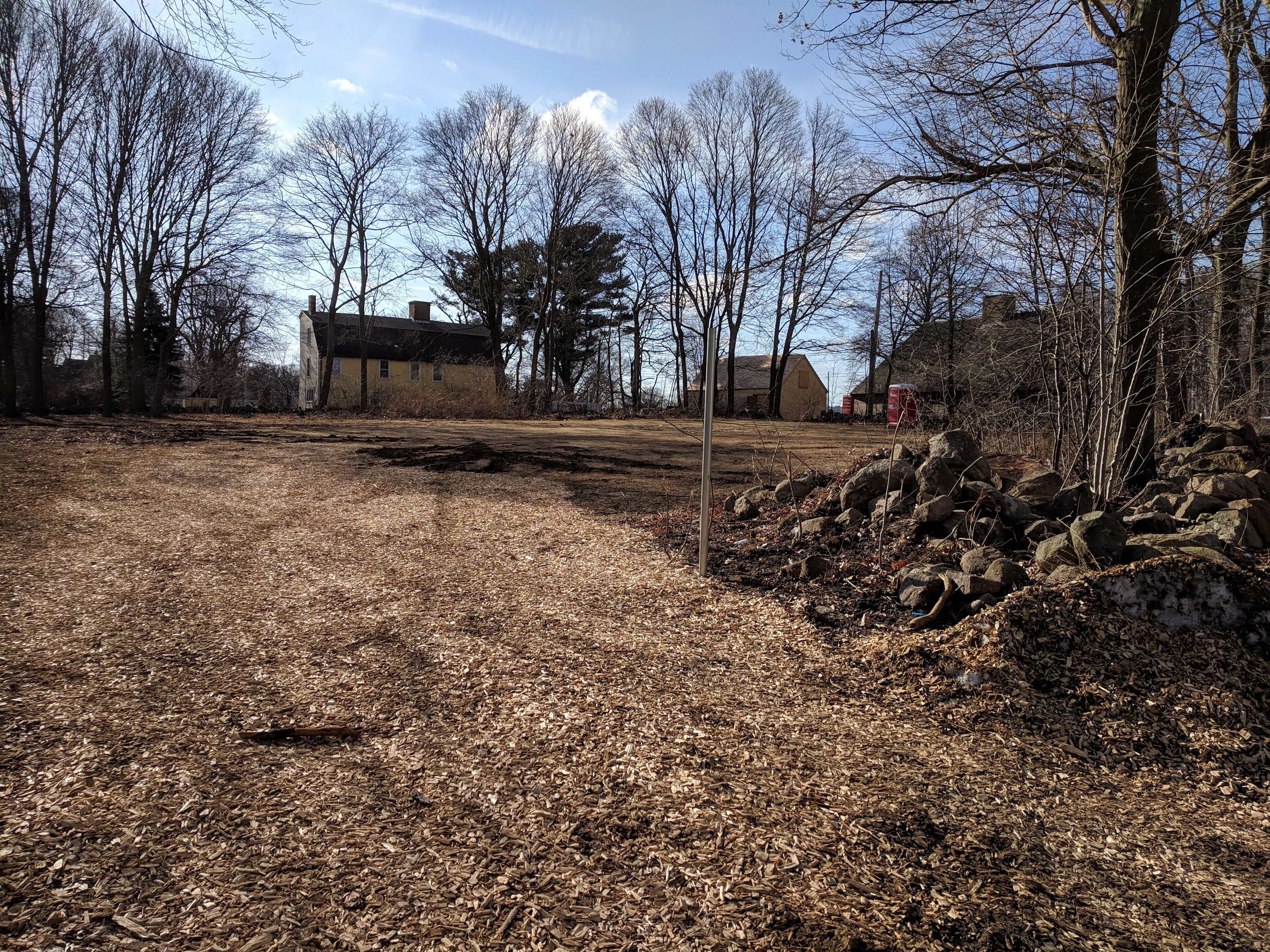
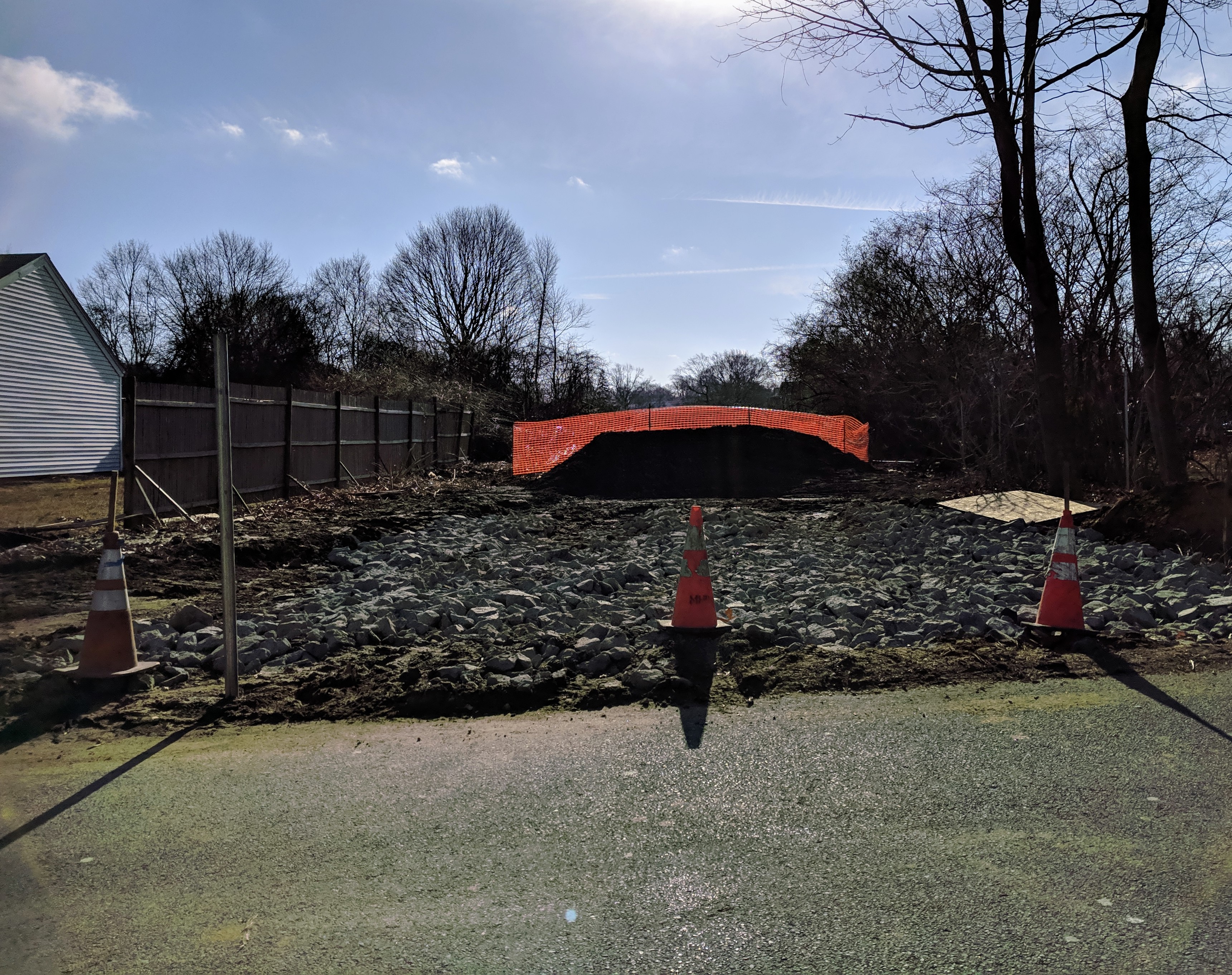
Signs of clearing for the exciting Cape Ann Museum addition for a curatorial center on the White-Ellery property January 2019 Gloucester, Massachusetts
Courtney Richardson at the Cape Ann Museum shares information about an upcoming special event at the museum:
Lecture – Life on the Edge: The Ecology of Crane Beach, Saturday Jan. 19th, 3PM
The Cape Ann Museum, in collaboration with The Trustees, is pleased to present a lecture about the natural history and ecological significance of Crane Beach with ecologist Jeff Denoncour. This program is offered in conjunction with the special exhibition Sky/Horizon/Light: Perspectives on Crane Beach. This program is free for Museum members, Trustees members, Cape Ann residents or with Museum admission. Reservations required. For more information visit capeannmuseum.org or call 978-283-0455 x10.
When one thinks of Crane Beach, the sea, sun, and sand might be the first things that come to mind. But how did the forces of nature create the stunning landscape? What’s special about this incredible barrier beach and marshlands it protects? How do The Trustees protect special places and care for our vulnerable coast? Join Jeff Denoncour, an ecologist with The Trustees, for a dive into the natural history and ecological significance of Crane Beach, how they protect our coastal resources, and examples of success stories resulting from their work.
Jeff Denoncour is the Eastern Region Ecologist with The Trustees where he manages and monitors ecological resources on its properties in Eastern Massachusetts. Jeff grew up on Cape Ann and has spent most of his life living along the coast. He has 11 years of experience managing rare and endangered shorebirds that nest on beaches. For the past eight years, he has been managing the Shorebird Protection Program on Crane Beach, as well as other natural resources that make the Crane Beach such a treasured place.
This program is offered in conjunction with Sky/Horizon/Light: Perspectives on Crane Beach a special exhibition of the paintings of Dorothy “Doffie” Arnold. The works on view at the Cape Ann Museum offer an ever changing vista of Crane Beach as observed across Ipswich Bay from Arnold’s studio in Bay View (Gloucester). Painted in the 1980s, these acrylics on paper are part of larger series of works by Arnold that take as their subject the intersection of water, land and light viewed from a single vantage point over a period of years. With a low horizon line, a sky that is often turbulent and waters that range from placid to racing, the paintings reflect the strong influence of nature on the artist and her work.
A 1980 graduate of the School of the Museum of Fine Arts, Boston, Dorothy Arnold maintained studios in Cambridge and Gloucester. While much of her work is large scale, the Crane Beach paintings measure just 11×15 inches. Her work, which includes landscapes, still lives, figure studies and abstractions, was the subject of an international retrospective in 2001–2003. It was Arnold’s wish to exhibit her art locally in an effort to strengthen the community’s appreciation of the culture and traditions of the area.












































 Good Morning Gloucester