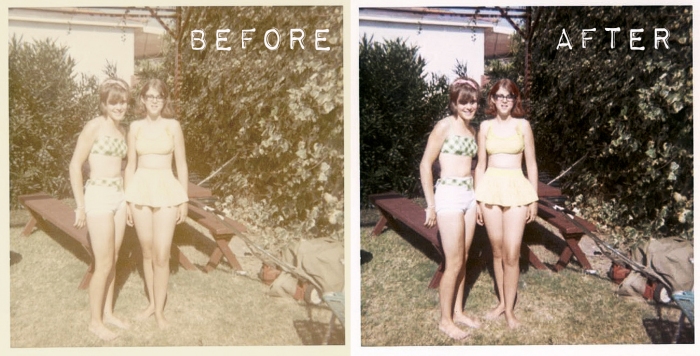
Dylan Thomas once wrote, “Time passes. Listen. Time passes.”
While this is true, it doesn’t have to be true for the thousands upon thousands of pixels that make up your most treasured memories.
Whether they are five years old, or fifty years old; printed photographs are quite vulnerable to the elements. Not unlike other relics of a bygone non-digital era, photographs require just as much maintenance as your beloved vintage vinyl!
When caring for your photos, I can offer you two powerful words of advice; preventative maintenance. Here are some useful tips to help you get started.
1. Paper and Plastic: While photo albums are a great way to preserve your memories, always remember to check the paper quality of the album before placing the photographs inside it. Acidity levels in the paper can destroy your photos over time; erasing the color and detail. When shopping for an album, look for “acid-free” or “archival-safe” labels on the album , stay away from “magnetic pages” and avoid using corrosive adhesives. Keep the same idea in mind when considering the plastic sleeves, common in most photo albums. While plastic sleeves are a great way to keep your photos “fresh”, if you’re not using “lignin free” plastic, your photos will erode over time, become stuck to the plastic more easily and may even develop a yellow or orange hue. If you choose to store your photos in a photo box, the same rules apply… make sure the box is acid-free!
2. Air Supply and Climate Control: Dry air is optimal for photo preservation. Too much humidity will damage untreated, non framed photos and cause mildew. The damage caused by mildew or mold is usually permanent because it grows by “digesting” the cellulose in the paper backing of the photo. At the very least, it will cause permanent staining. I know this sounds weird, but treat your photos as you would treat yourself. Do not store them in a cold, damp basement or a stuffy, hot attic (remember that heat rises and a high temperature accelerates deterioration). Store your photos in an environment that feels comfortable to your own skin. Extreme climate fluctuations are a photo’s worst enemy.
3. The Flat Truth: Keep your photos flat. Do not roll them or fold them. Some people have a tendency of rolling up an awkwardly shaped or too-long photograph and then using a rubber-band to secure it. I cannot stress this enough… DO NOT ROLL YOUR PHOTOS. They will become exceedingly brittle over time, making the restorative process of “humidification” very difficult. Rubber-bands contain sulphur, which will degrade photographic emulsion.
4. Don’t Be Afraid of the Dark: Light can and will hurt your pictures! If you must hang your framed originals, try to hang them in subdued light and use an anti-UV frame, avoiding direct sunlight at all costs. If possible though, it is advisable to display copies and keep your originals in the dark.
5. Hands Off: Do not handle your photos with bare hands. Always wear gloves, preferably of the cotton variety. Oils from your fingers, even after being meticulously washed, will replenish themselves and stick to the photographs. The acids in the oils will, over time, damage your pictures. (FYI… It is possible to permanently brand a fingerprint into a photograph, simply from handling it) I’d like to point out that you should also avoid using adhesives or fasteners such as rubber cement, pressure-sensitive tape or paper clips. Paper clips, especially, will scratch your photos very easily.
Are you cringing yet… thinking about all those old photos you inherited from your great grandmother and stuffed in an old shoebox from the 1970s, which now sits, collecting dust and who knows what else, up in the attic, wedged between a box of broken Christmas lights and a rusty trunk… containing even more photographs, just sort of rolled up, secured with rubber-bands or stacked in a chaotic heap of disorderly haste?! Fear not.
While there are a number of DIY tricks for photographic restoration, (which I just may be so inclined to do another blog post about in the future), there are also professionals, like myself, out there who can help you bring your damaged photographs “back to life” with digital restoration.
And who am I, exactly? My name is Vignette-Noelle Lammott and I am a recent transplant to the glorious community of Cape Ann, via Chicago. My business, which I launched this past October, is called Retrocognitive Restorations. Though I have been restoring photographs professionally for only a few years, I have studied tarnished beauty, all of my life. An antique shop enthusiast, I surround myself with old things, and can often be found rummaging through dusty used bookstores or scouting around local flea markets and estate sales. I like to think of what I do as more than just retouching your old snaps, but rather, restoring your most treasured memories.
Email me to set up a free consultation. I offer several packages, depending on how many photographs you need done and whether they are true vintage or relatively recent. You can view some samples of these packages at my website http://retrocognitiverestorations.webs.com. And don’t forget to look me up on Facebook, for even more free advice on photocare as well as some stunning “before and afters”.
http://www.facebook.com/pages/Retrocognitive-Restorations/153407968084023
Vignette-Noelle Lammott
Owner at Retrocognitive Restorations
773.396.0557
http://www.retrocognitiverestorations.webs.com
Spread The GMG Love By Sharing With These Buttons:





































 Good Morning Gloucester