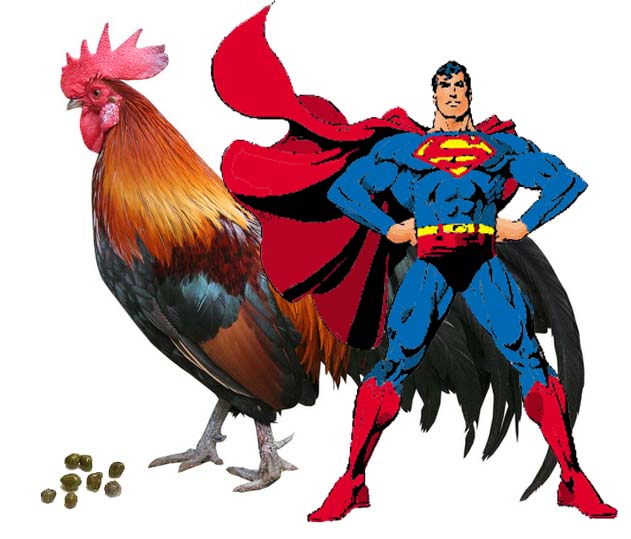
That we can get into some very lofty discussions over here at Madfish Wharf on Rocky Neck? This morning Wendie Demuth and I were talking about cooking bluefish, after Adam Bolonsky said he was going bluefishing and would bring us one if he was successful. I said I had only cooked bluefish once, baked with mayonnaise and capons. Wendie said there was no such thing as a capon, except to describe a superhero after he has gotten dressed, and I must have meant capers, which is what I had meant. But in fact, capons are roosters that have been castrated to improve the quality of their flesh for food.
Caponization is the process of turning a rooster into a capon, and can be done by surgically removing the rooster’s testes, or may also be accomplished through the use of estrogen implants. With either method, the sex hormones normally present in roosters are no longer effective. Caponization must be done before the rooster matures, so that it develops without the influence of sex hormones. Capons, due to the lack of sex hormones, are not as aggressive as normal roosters. This makes capons easier to handle, and allows capons to be kept together since their reduced aggressiveness prevents them from fighting.
The lack of sex hormones results in meat that is less gamy in taste. Capon meat is also more moist, tender, and flavorful than that of a hen or rooster, which is due not only to the hormonal differences during the capon’s development but is also because capons are not as active as roosters, which makes their meat more tender and fatty. Superman is protecting this rooster from caponization.
Capers on the other hand are the unripened flower buds of Capparis spinosa, a prickly, perennial plant native to the Mediterranean and some parts of Asia. Their use dates back beyond 3000 B.C. where they are mentioned as a food in the Sumerian cuneiform Gilgamesh, an ancient retelling of a great flood and ark legend. The small, green herb buds lend a piquant sour and salty flavor to salads, dressings, sauces, vegetables and a variety of main dishes. They add a nice flavor to bluefish, and probably to capons too, and can be enjoyed by superheroes everywhere, with our without their capon, and whether or not they are trying to solve capers.
E.J. Lefavour
www.khanstudiointernational.com


 Good Morning Gloucester
Hi EJ,
I always think of the Epic of Gilgamesh as the first buddy-story. His relationship with Enkidu seems to me to be central. The flood only comes at the end.
I love capers, I think I make a mean chicken picata, but what if I used a capon instead of a hen….
LikeLike
I think capon picata would be awesome – just keep in mind what that poor rooster had to go through to become a delicious capon; he never gets to strut his stuff and be a cock.
LikeLike
Marcella Hazan has an AMAZING recipe for bluefish baked over thinly sliced potatoes with garlic, olive oil and parsley– obscenely good!!!
LikeLike
Someone else (think it was Paul Morrison) told me a similar recipe. That one sounds better to me than mayo and capers.
LikeLike
It was me and it was Marcella’s recipe we follow. It really is my favorite way to do bluefish. All of the above thinly sliced potatoes, cook until done, even a little crispy on the edge in a big glass baking dish. Then lay a nice fresh bluefish fillet on top and cook (15-20 minutes maybe less) until the fillet is done. Even my kids eat this.
Marcella Hazan “Essentials” and “Cucina”. I think the dish is in Essentials which really is essential.
LikeLike
My mother did the coating of mayo and bake. Adding capers would be perfect. There is a 1973 Woods Hole Mother’s Recipe Book with my mom’s mayo bluefish recipe in it. Might be out of print. 😉
LikeLike