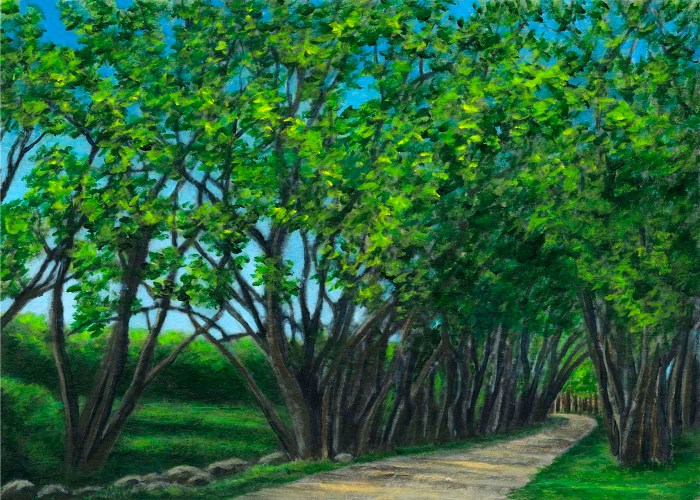
- Painting by E.J. Lefavour
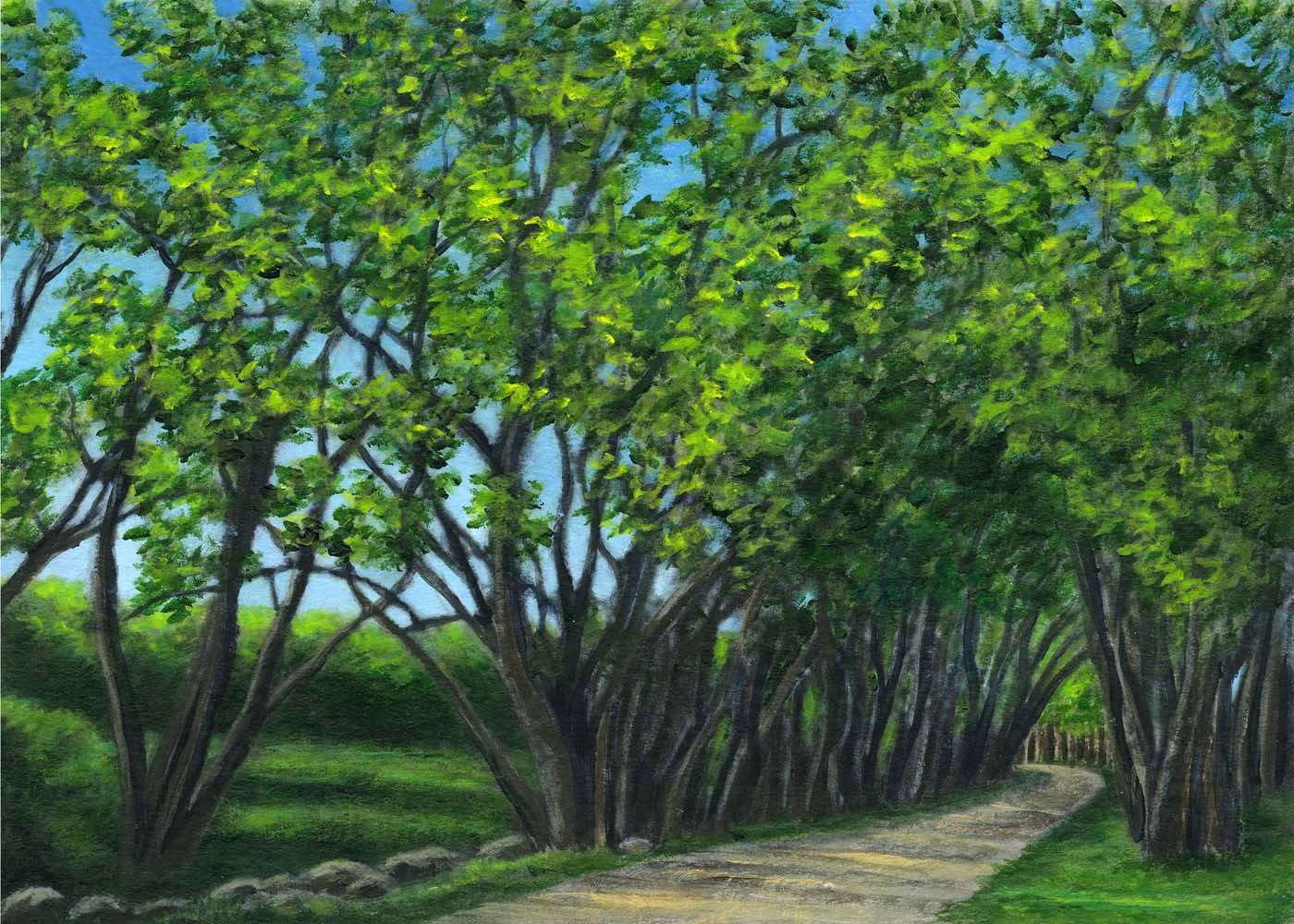
That sometime in the 1840’s there was a need for a road to be built on a bit of land, which was almost a swamp. Horses and oxen would sink in the mud and mire. At that time, the city did not provide roads, so the neighbors decided to build their own. They used stone from the local quarries for the paving; however, the land was too unstable to support stone. Discouraged by their failed efforts, one of the men suggested setting out willow trees, which easily reproduce from cuttings and were known for their rapid growth – the idea being that their roots, remarkable for their toughness, magnitude, length and tenacity of life, would meet across the road and make a foundation, thus reinforcing the road. From the swamp, they cut some willow switches. After gathering a good number of them, the men stuck the slender branches into the ground on each side of the roadway. These branches sprouted and thrived and their roots held the roadbed firm. In time, these willows, with their green and lovely plumes, became a Cape Ann landmark.
This painting was done from an old black and white photo of the Willows of Annisquam in winter at the suggestion of an older neighbor who remembers and loved the Willows. She also loaned me the Anne Kelly Lane book about the Willows. They were located on the stretch of Washington Street near where the Willow Rest and Riverdale Post Office are now, and most disappeared after a blight killed them off in the 1950’s, although if you look, you will still see a few along the roadside.
Going Thru the Willows
Two men planted twigs
On a road nearby the sea,
One by one they sprouted up
And grew into a tree
Love sought their shade at evening
And there breathed its early vows
And old and young alike
Would stroll beneath their boughs
Cape Ann loved the dangling plumes
Of the willows on the shore
But “going thru the willows”
Is now just a bit of lore?
(edited excerpts from “The Willows of Cape Ann” by Anne Kelly Lane)
E.J. Lefavour


 Good Morning Gloucester
VERY cool! 🙂
LikeLike
Oh, how I wish I could see these beautiful willows as they used to be – but thanks to your beautiful painting, they will live on for many more generations! Thank you for all the stories you share….I enjoy them very much!!
LikeLike
Beautiful!
LikeLike
Magnificent light in the painting…And a very interesting piece of lost history!
LikeLike
Thanks All. I wish they were still around for us to enjoy today. Mike, I’m pleased to hear that you thought the lighting was good, as that was challenging since I was working from an overcast B&W winter photo with no lighting per se or foliage on the trees.
LikeLike
I am amazed what you do with a photograph – you are truly a very talented lady.
LikeLike
Hi Ellen,
So impressed with your work. Your painting makes one wish they could “go through the willows” once again. Perhaps we’ll meet when I visit Cape Ann in the Spring. Anne
LikeLike
Thank you so much, Anne. I was likewise impressed and grateful for your work creating “The Willows of Annisquam” book. Without it, this post wouldn’t have been. My neighbor, Sarah Hackett, loaned me your book and encouraged me to paint the Willows, something she loved and remembered so fondly. Other than your book, I could find no written history of them, except a small mention in Pringle’s “History of Gloucester, Mass, Place of Interest, Chapter XIII” where he names Brown and Chard as the men who planted them in the 1840’s. I certainly hope we can meet when you visit in the spring.
LikeLike
I picked up , at a yard sale, a small fluted bowl with The Willows Annisquam in black transfer and marked on the bottom Made in England for SS Hartwell Gloucester Mass. I had no clue what this meant but the piece of bone china is clearly a souvenir piece of the late 1800’s or early 1900’s. Fun to find out what it means.
LikeLike