So much fun at the Bowl a thon at The Hive on Sunday. All of the bowls made at the Hive support the Empty Bowl Dinner for The Open Door.
Empty Bowl Dinner, May 8, 2014 4:00 pm at Cruiseport Gloucester, MA.
Category: Art

Community Stuff 3/24/14
Jude Abbe
Pet Portraits
Oil/Acrylic March 27 & 28
Rockport Art AssociationThis workshop will focus on getting an impressionistic portrait of your pet. Brushwork will be important in portraying short or long fur (or feathers). Color, values and composition, the basics of any painting, will be stressed. You will be working from your own photo – if possible, a clear photo showing your pet’s personality and coloring.
Christopher Zhang
Portrait Painting (including hands)
April 3-5
Rockport Art AssociationThis 3-day workshop (9am-4pm) will have an attractive young female model dressed beautifully for a seated or standing pose with studio light. Each day will start with the instructor’s demo in the morning and students will follow up in the afternoon. The instructor will not only show how to focus on the forms of the face and the body with different values and rough brush strokes, but also let the students learn the warm and cool coloring of the skin, the dress and the background. After three days of hard work, you’ll go home with a nice portrait. Open to all levels and all mediums. If you’ve never done portraits or figures before, it may be a little hard to begin with.


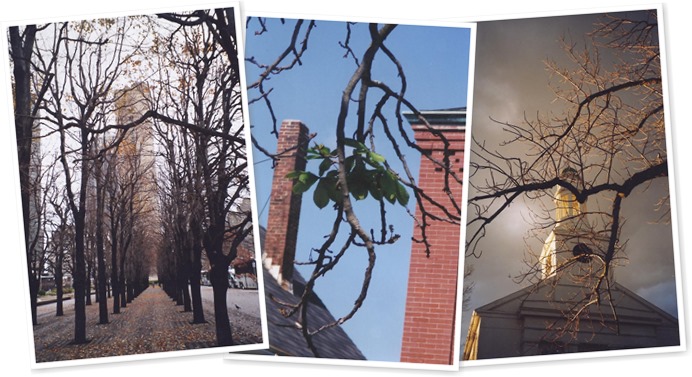
Rockport ART will present a solo photography show of works by exhibiting member Barbara Brewer beginning on Sunday, March 30th and continuing through April 10th.
Brewer is a self-taught photographer who was brought up with the family’s old wooden box Kodak and, to quote the artist . . . “has enjoyed capturing the moment through the camera’s eye ever since”. Her work often conjures up a nostalgia for the gentler times of the past through poetic moments of light, color, shape and composition. She enjoys the everyday scenes of nature and the sea, the architecture of old buildings or doors and windows. To Brewer, the mood and essence of the subject is more important than the detail.
Brewer has been an exhibiting member of the Association since 1996. Her work has received numerous prizes in exhibitions throughout the North Shore, including the Gloucester Daily Times Summer Sun Award in 1993 and 1994.
The public is invited to an artist reception on Sunday, March 30th from 2:00-4:00. Also on view are the Contributing Members Show, works done in the sketch groups and classes held at the Association, and the Winter Group Show of exhibiting members’ work.
The Association is open Wednesday – Sunday, and always free to the public. For more information on these shows and upcoming events, please visit www.rockportartassn.org or call 978-546-6604.
Spread The GMG Love By Sharing With These Buttons:

Cross Country Chronicle | Howard Liberman Farm Security Association FSA / OWI Gloucester Photos
Catherine Ryan Submits-
CROSS-COUNTRY CHRONICLE
Gloucester, MA in landmark FSA/OWI documentary photographs
Part 3
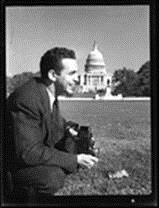
American Photographer HOWARD LIBERMAN
150 FSA/OWI photos in Gloucester, MA, September 1942

Hey, Joey,
Here is Part 3 in a series about Gloucester photographs in the legendary Farm Security Administration / Office of War Information (FSA/OWI) collection within the Library of Congress.
You can go back to Part 1 about artist Gordon Parks, and for some background about the program (1935-42).
Part 2 is about photographer Arthur Rothstein with a timeline and quick facts.
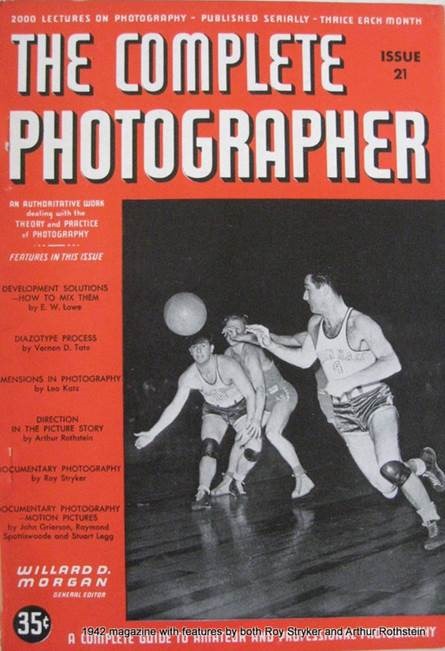
In 1942, the Farm Security Administration Historic Photographic section program was winding down as it transitioned and prioritized for WWII. It was temporarily folded into the Office of War Information before shutting down completely. (Gordon Parks was brought on board during this transition.) Director Roy Stryker was occupied with many directives including securing a safe haven for the FSA archives. He was also maintaining a network of contacts in the publishing world and private sectors, and writing. He contributed a chapter for Caroline Ware’s influential book, The Cultural Approach to History. There was magazine work such as the 1942 issue of The Complete Photographer which published articles by both Arthur Rothstein (“Direction in the Picture Story”) and Roy Stryker (“Documentary Photography”.)
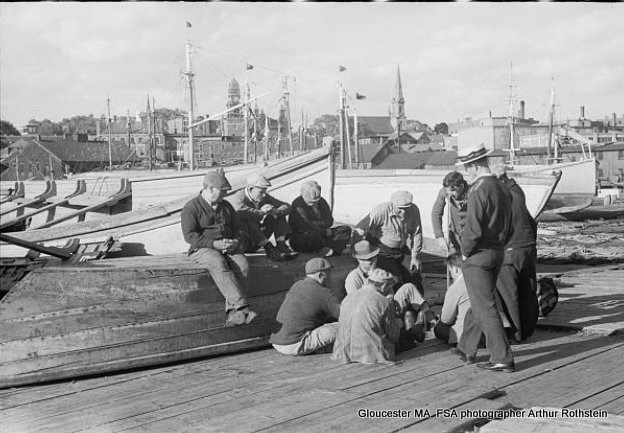
Rothstein had already left the FSA. In 1940, Peter E. Smith Publishers, Gloucester, MA, produced his photo book, Depression Years as Photographed by Arthur Rothstein. This compilation of photographs included the best known Gloucester image from his 1937 visit; was it one of the publisher’s, too.
In 1941, Elmer Davis was appointed as the Director of the newly created Office of War Information (OWI). In 1942, Davis hired Francis Edwin Brennan from FORTUNE magazine to head the Graphics Department of the OWI.
As Art Director of Fortune (1938-1942), Brennan commissioned famous covers by artists such as Otto Hagel and Fernand Leger. He was known in the industry as a serious art and publishing expert and was a favorite of Henry Luce.
It’s likely that Brennan was one contact for Howard Liberman’s engagement at OWI. In August of 1941 Brennan featured a FORTUNE magazine special portfolio of sample posters to showcase the development and potential of this media. Howard Liberman was one of the artists he commissioned; here’s his contribution for that issue:
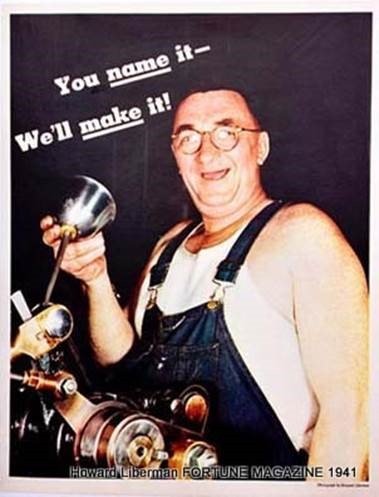
And here is a poster Liberman created for the OWI.

Liberman worked with color photography, too, which is a sub-collection at the Library of Congress, less known than the black and white. Color photography was available, but more expensive to process and for media publishers to print.
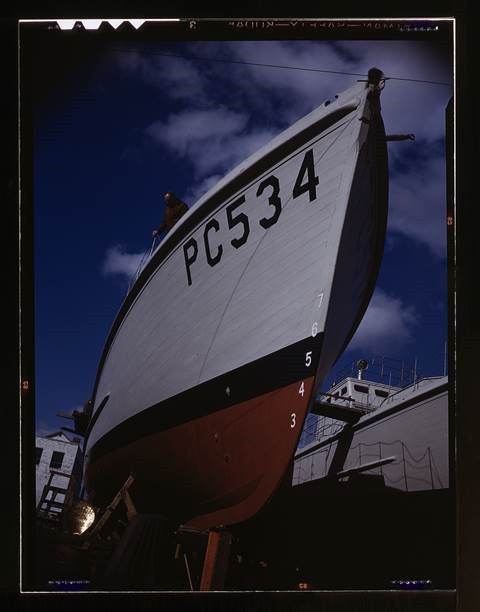
Howard Liberman was dispatched to Gloucester in September of 1942. His photographs show a clear emphasis on WWII dominant coverage, sometimes with an FSA take. The titles on Liberman’s OWI photos often lead with a heading. For Gloucester, many images have caption leads that begin with the patriotic category: VICTORY FOOD FROM AMERICAN WATERS.
In Gloucester, Howard Liberman spent a time on the docks and out with the crew of the OLD GLORY.
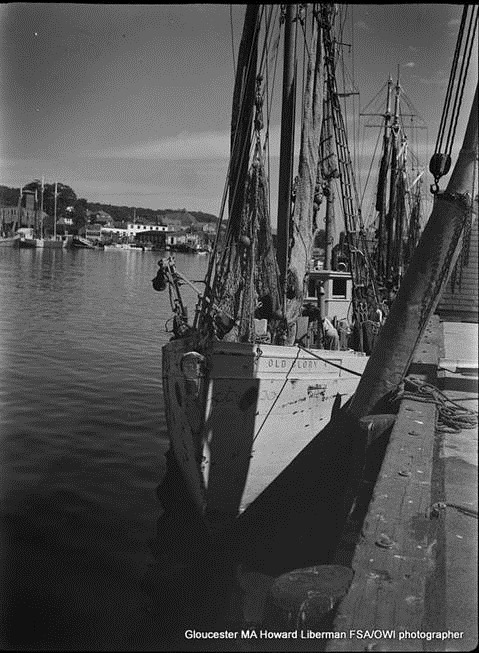
His captions seldom include surnames of the portrait subjects. They do have lengthy– sometimes general, sometimes quite specific– descriptions to support the category heading.
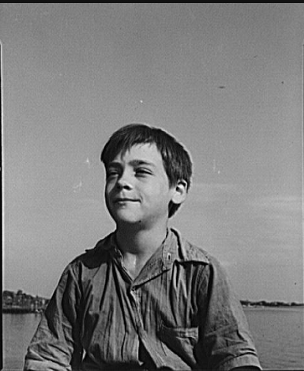
There are action and portrait shots of the crew catching rosefish during an Old Glory voyage.
“Victory food from American waters. At the docks in Gloucester, Massachusetts, crew members prepare their trawler for a week’s voyage. Most of the fishermen in the city come from a line of fishermen that dates back for centuries.”

“Victory food from American waters. Immediately after being caught rosefish are shoveled into the hold for packing the ice. Once called “goldfish” because of their brilliant color, the fish are finding a ready market because of their manifold uses–as food for humans, as fish meal and fish oil.”
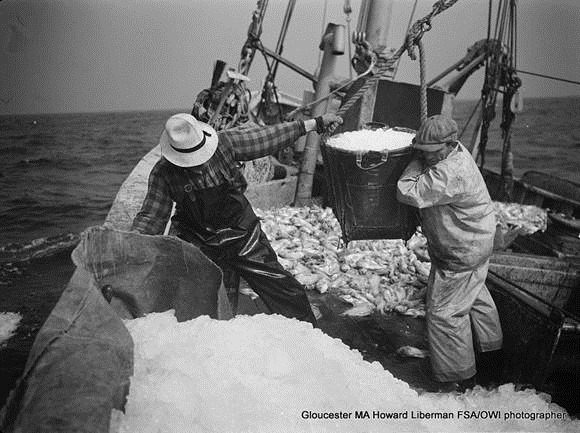
“Crew members throw overboard excess ice from Old Glory’s hold. Fishmen allow a proportion of one ton of ice to three tons of fish. When the catch is unusually large as on this trip, some ice is removed to make room for the fish.”
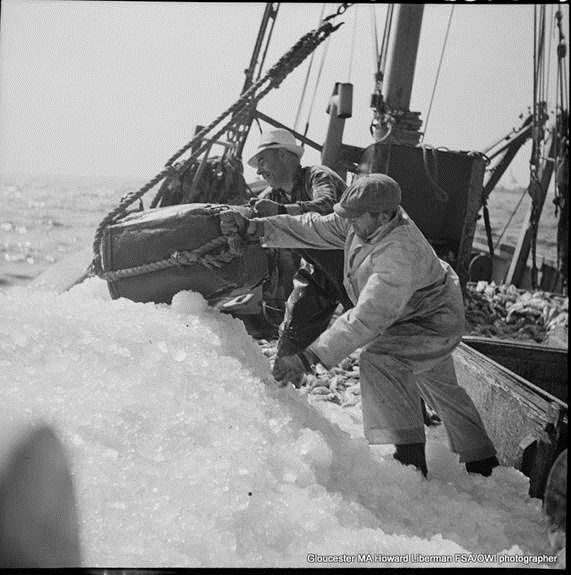
“Victory food from American waters. Decks are covered with tons of rosefish as the Old Glory reaches its capacity load. After two and one half days of fishing, a catch of 85,000 pounds has been hauled in”

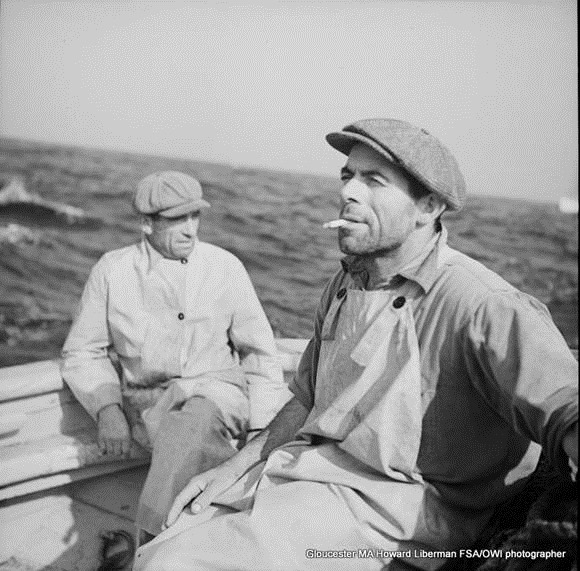
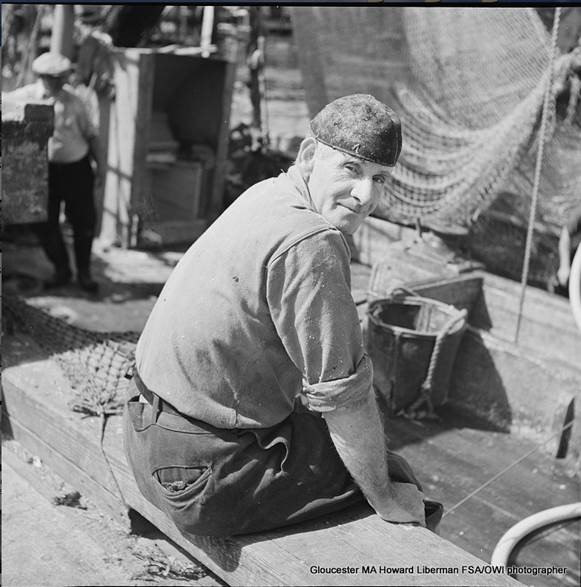
“Tomorrow’s fishermen–young Gloucester boys push wagons of rosefish from the unloading pier to the processing plant where the fish are filleted and frozen…Many of the boys will follow their forefathers and fishermen in New England waters”

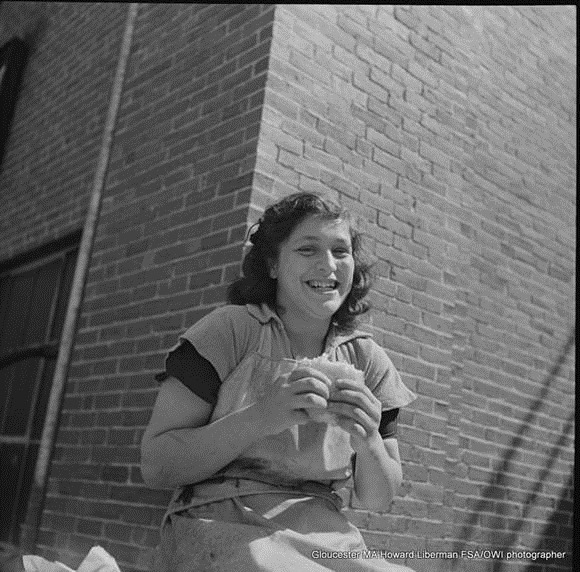
Look for ‘scenes’ such as Captain John Ribiera (surname spelled a couple of ways in the archive) at work and with his wife at home. 1942 census indicates “Oscar (Irene) fishermn Riberio” at 18 Perkins Street.

Note the picture of “the Pilot at the Wheel” above the stove


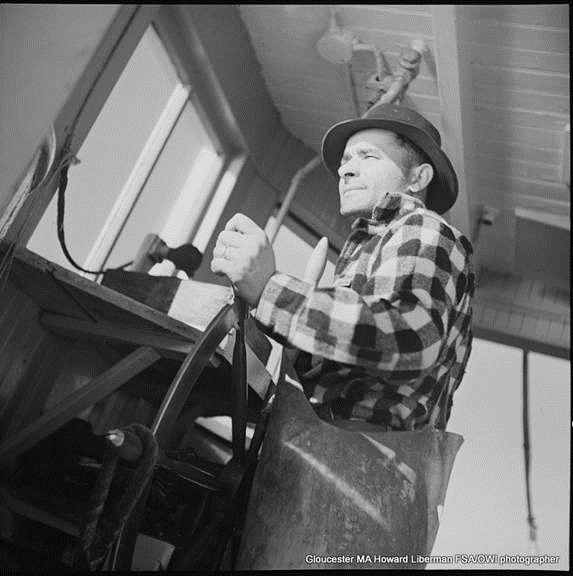
Another reminder to look for exhibits to see vintage prints in person, rather than the low resolution files I’m showing here. Various resolution options are available at the Library of Congress. Besides the formal details, check out the Captain’s eyes!
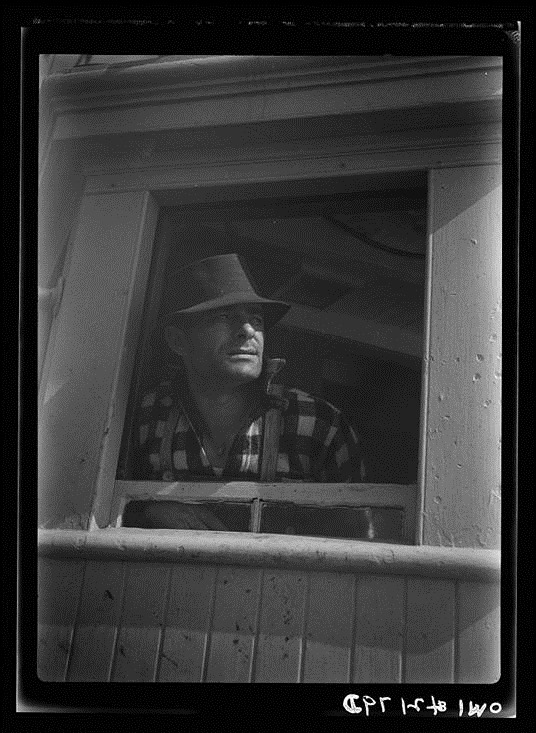
Binnacle blinded.

The “Mother of Good Voyages” statue in Captain John Riberia’s quarters on the fishing trawler “Old Glory”

There are a couple of Gloucester interiors (deteriorated negatives) of the Gloucester Mariners’ Association; they infer “captains welcome only.” One shows a gentleman playing cribbage; another shows Captain Ben Pine, the man who raced the schooner Gertrud Thebud.

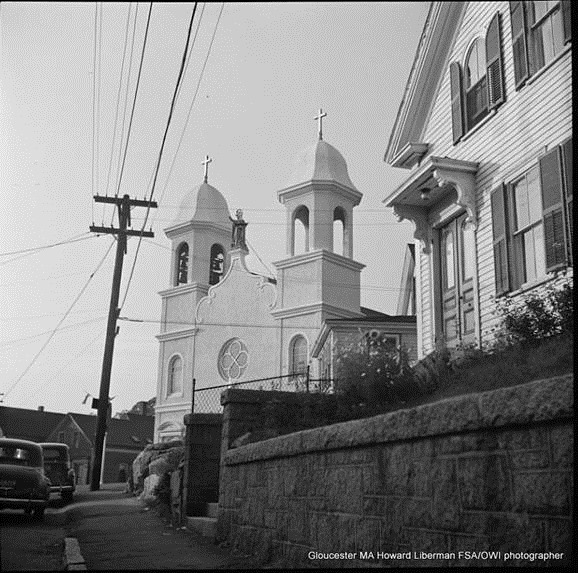
Joey, beautiful dangerous industry: shoveling fish into the rotary scaler at a fish packing plant.
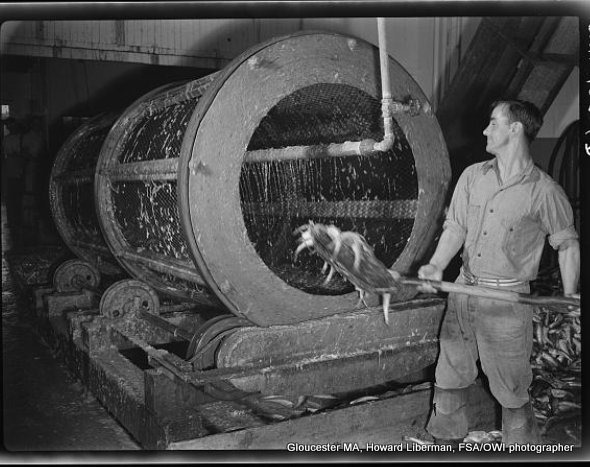
For assignments in other towns, typical headings for Liberman categories include:
Americans All; Subcontracting; School Boys in Training; Industrial Safety; Office Equipment Used by WPB; Women at War; Fuel Oil Consumption; Women Workers (see below making flags); Airports (ditto other industries); Military (e.g. Fort Belvoir); African American Aircraft Propeller Workers (ditto other jobs); Shipyard Workers; Bomber Plant Workers; Price Control; Production; Submarine Chasers; and Conversions (from this to look here it is now was a useful WWII product)
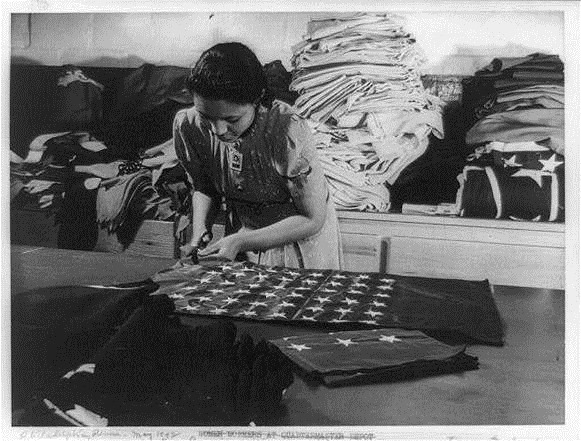
There are more than 50 additional Gloucester photos in the Library of Congress collection, and one Royden Dixon image from 1940.
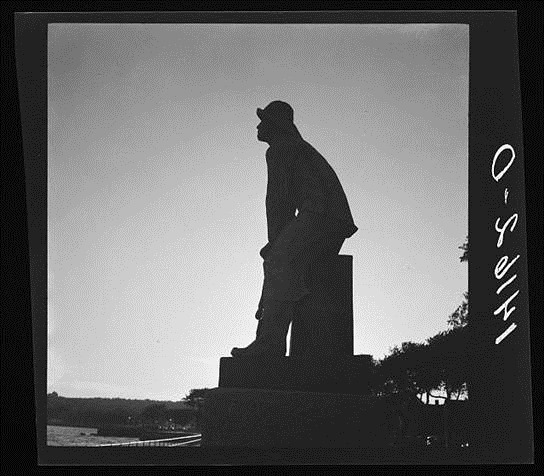
We are fortunate that so many talented artists worked on the FSA/OWI project, that a few visited Gloucester, and that so many folks across the county were willing to participate as subjects (easier during the War)
The municipal employees and the curators and staff who have worked on these collections (over decades) are superstars. Beverly Brannan is the curator of 20th C documentary photography at the Library of Congress.
For the FSA/OWI program, Director Roy Stryker proselytized that photography was perhaps the best tool for analyzing living history. He felt that photography as a fine art form and its gains in technical ease and advances coincided ideally with the timing of the FSA/OWI historical photographic section. He forecast rapid and constant increase in photography use and adapters. He was inspired by individual and private pioneering antecedents (Brady/Civil War, Hines/Russell Sage), and public ones such as the documentary photographs by William Jackson for the Department of the Interior.
Sometimes I think of Stryker’s Section work along a continuum of government spending on exploration that produced great contemporaneous historical records. The journals of Lewis & Clark. The work created by artists who participated in the NASA Art Program. These FSA photographs.
Stryker realized that there were collections of photography building up in municipalities big and small; how they were catalogued and assessed were critical to their use. Here in Gloucester, the Cape Ann Museum maintains a Historic Photo Collection containing over 100,000 images from 1840s through now. Photography is included among its permanent and temporary exhibits and what’s not on view can be researched at their archives.
GLOUCESTER PHOTOGRAPHY PRE, DURING AND POST FSA/OWI
There were many independent artists as well as staff photographers (local newspapers, businesses such as Gorton’s, etc.) working in photography here in Gloucester. Every decade has wonderful examples such as Herbert Turner, Alice Curtis (and other photographers that Fred Bodin features), and David Cox’s father, Frank L. Cox.
There were numerous visits from staff photographers of major publications like Life, Vogue, National Geographic, and more. Gordon Parks came back at least two more times; a few other celebrated staff photographers that came through include Luis Marden, Eliot Elisofon, Yale Joel, Co Rentmeester and Arthur Schatz.
No- photographic artists who also worked in photography is another long list, and would include Leonard Craske, Emil Gruppe, Philip Reisman, and many others.
Good Morning Gloucester features photography, that’s for sure.
-Catherine Ryan / all photos Library of Congress, FSA/OWI black and white photography collection
Spread The GMG Love By Sharing With These Buttons:

Trident Gallery
Pale Shadows: Cameraless Images by Pamela Ellis Hawkes
March 21 – April 20
Trident Gallery is pleased to present “Pale Shadows: Cameraless Images by Pamela Ellis Hawkes,” an exhibition of cyanotypes, tintypes, and pigment prints captured without a camera. Inspired by flickering shadows on her studio walls and by the earliest works of photography, made in the 1830s by inventor Henry Fox Talbot, who aspired to “fix a shadow” onto paper, Hawkes experiments with the cyanotype process to make photograms, images made by placing objects directly in contact with light-sensitive paper. In so doing, Hawkes joins other important contemporary photographers who have returned to “historical” or “alternative” photographic processes to refresh and develop their artistic visions. Hawkes’ vision questions the perceived realities within photographs; explores the elusive points of contact between reality, memory, and imagination; and participates in the ageless calling of artists to preserve and honor the ephemeral, to fix fleeting shadows and transmute loss into beauty.
Pale Shadows: Artist’s Reception at Trident Gallery
Saturday, March 29th, 5pm-7pm
Trident Gallery is pleased to host an artist’s reception in honor of Pamela Ellis Hawkes, as part of the Pale Shadows exhibition, on Saturday, March 29th from 5:00-7:00 p.m.
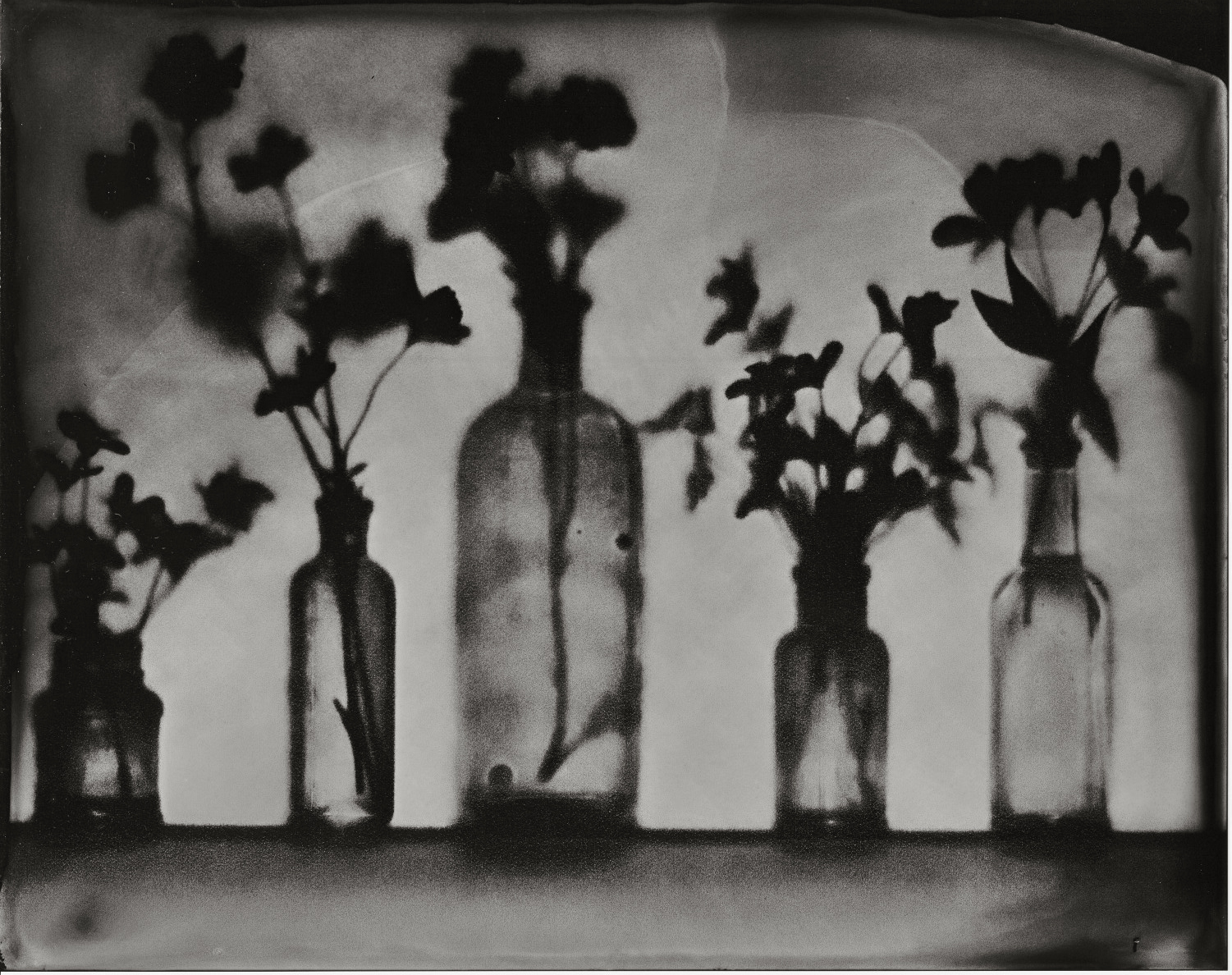
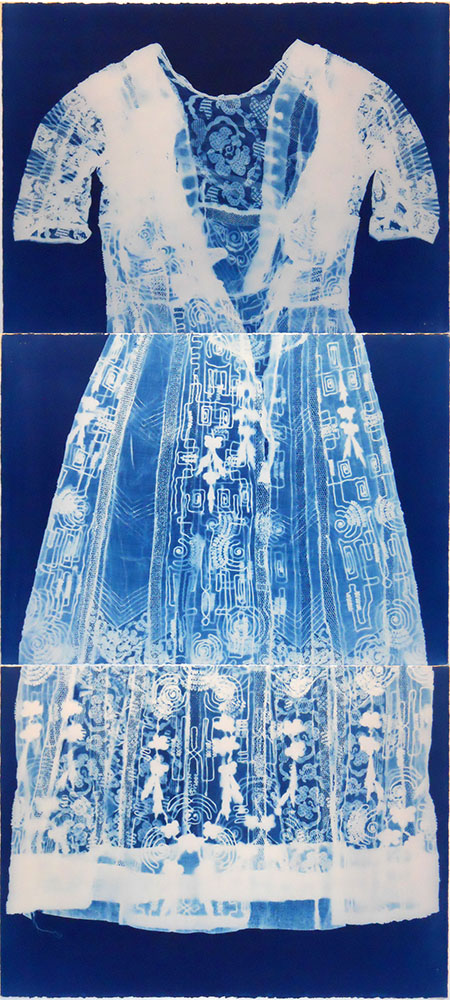
Image 1: Pamela Ellis Hawkes – Flowers & Bottles 4 – tintype
Image 2: Pamela Ellis Hawkes – Dress 1 – cyanotype
Spread The GMG Love By Sharing With These Buttons:

Ken Knowles New Works From the Studio
Here are some new works from the studio. Request size and prices.
Sincerely,
Ken Knowles
www.kenknowles.com
Spread The GMG Love By Sharing With These Buttons:

If you want to make a living playing music, you have to make a living playing music!
One of my favorite local stars, Inge Berge, shared a post on his Facebook page about this “Call For Performers” by the city of Yellowknife, NT in Canada:

As we head into Gloucester’s spring/summer/fall busy season, I’m glad he brought this topic up because that’s often when musicians are asked to play for free in return for “exposure.”
I don’t expect musicians to perform for free, because I don’t work for free. Actually, the last time I asked any musician to play without pay (except for passing the hat) was when Vickie and I were helping organize the first Block Parties in 2008, at which I played for free too. And that was only because everyone involved in starting the Block Parties donated their time. By last year (could have been 2012) the Block Parties had evolved to the point where the Block Party Committee raises money and pays musicians.
Don’t get me wrong, I do volunteer my time for various causes that I feel are worthwhile — and I sometimes work for trade. But in every trade case, I’m getting something in return for my work — something of equal value to the value of my work.
Next time somebody asks you to play for free, ask “What am I getting in trade?” If the answer is something like, “Oh, you’ll get great exposure,” my advice is just say no.
Lugging your gear into your car, driving to the venue, setting up, breaking down, loading your gear back into your car and driving home would be enough to demand some pay (at least what stage hands get). Then there’s performing, which (among other things) requires years of practice, tremendous dedication, a willingness to trust your artistic instincts and … talent. That should be reserved only for those occasions where the people who’ve asked you to perform value the fact that you’re digging deeper into the human soul than most people ever get and sharing what you find with the rest of us.
I could rattle off a dozen reasons why mere “exposure” is no where near enough compensation for performing — and the first one that comes to mind is that if you’re playing anywhere on Cape Ann, you can get plenty of free exposure right here on GMG and on gimmesound.com.
Plus, because you don’t want to play to an empty room, you’ll probably plug the event on your own social media pages, which gets free exposure for the people who’ve asked you to perform in the first place.
Feel free to share this post with everybody who asks you to play for free …
Spread The GMG Love By Sharing With These Buttons:

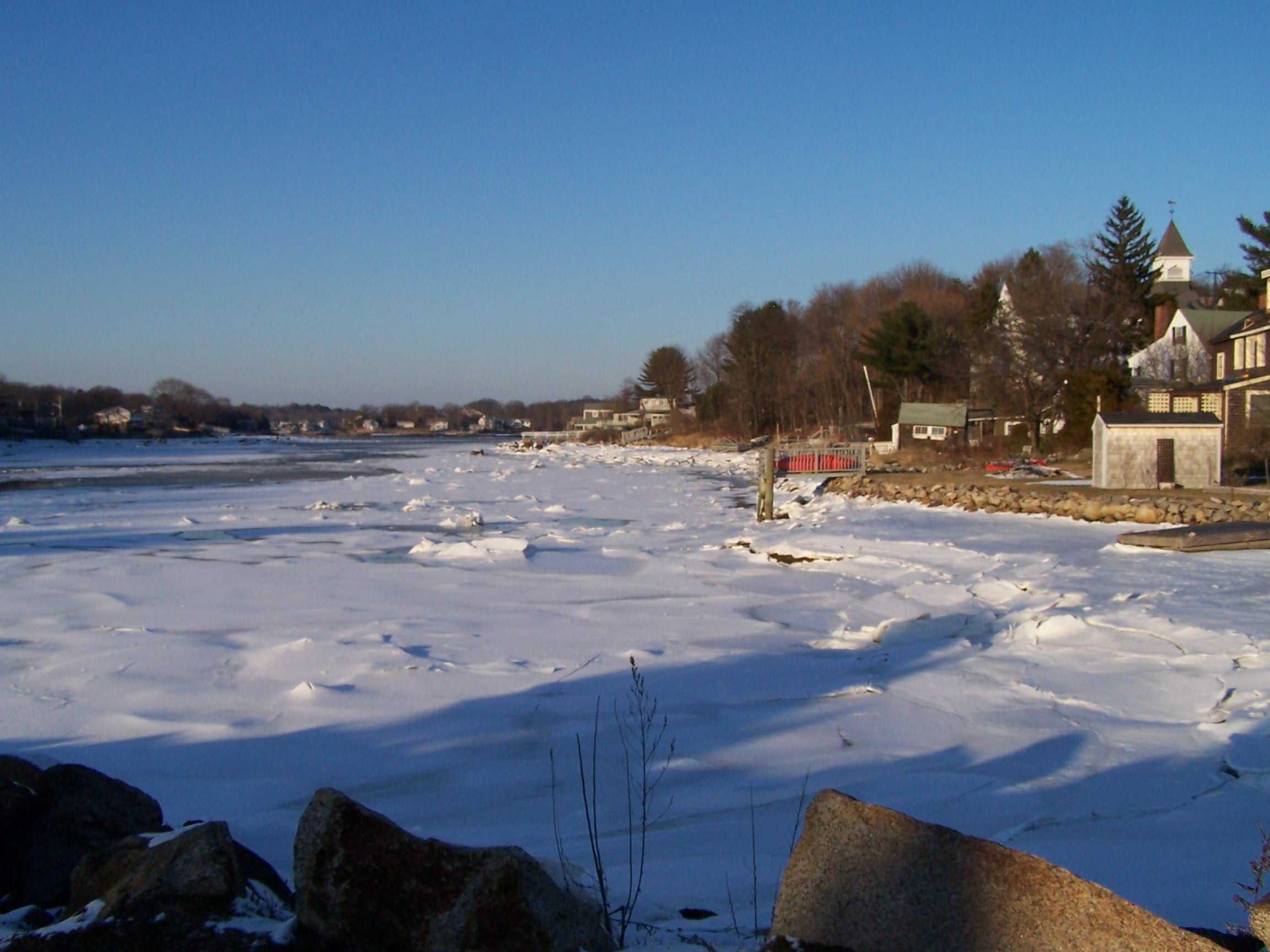
Mill River Winter
Mill River Winter
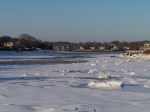
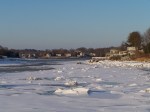
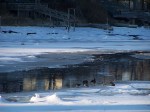
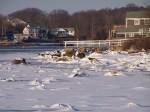
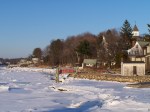

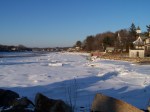
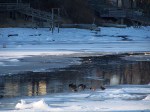
Spread The GMG Love By Sharing With These Buttons:

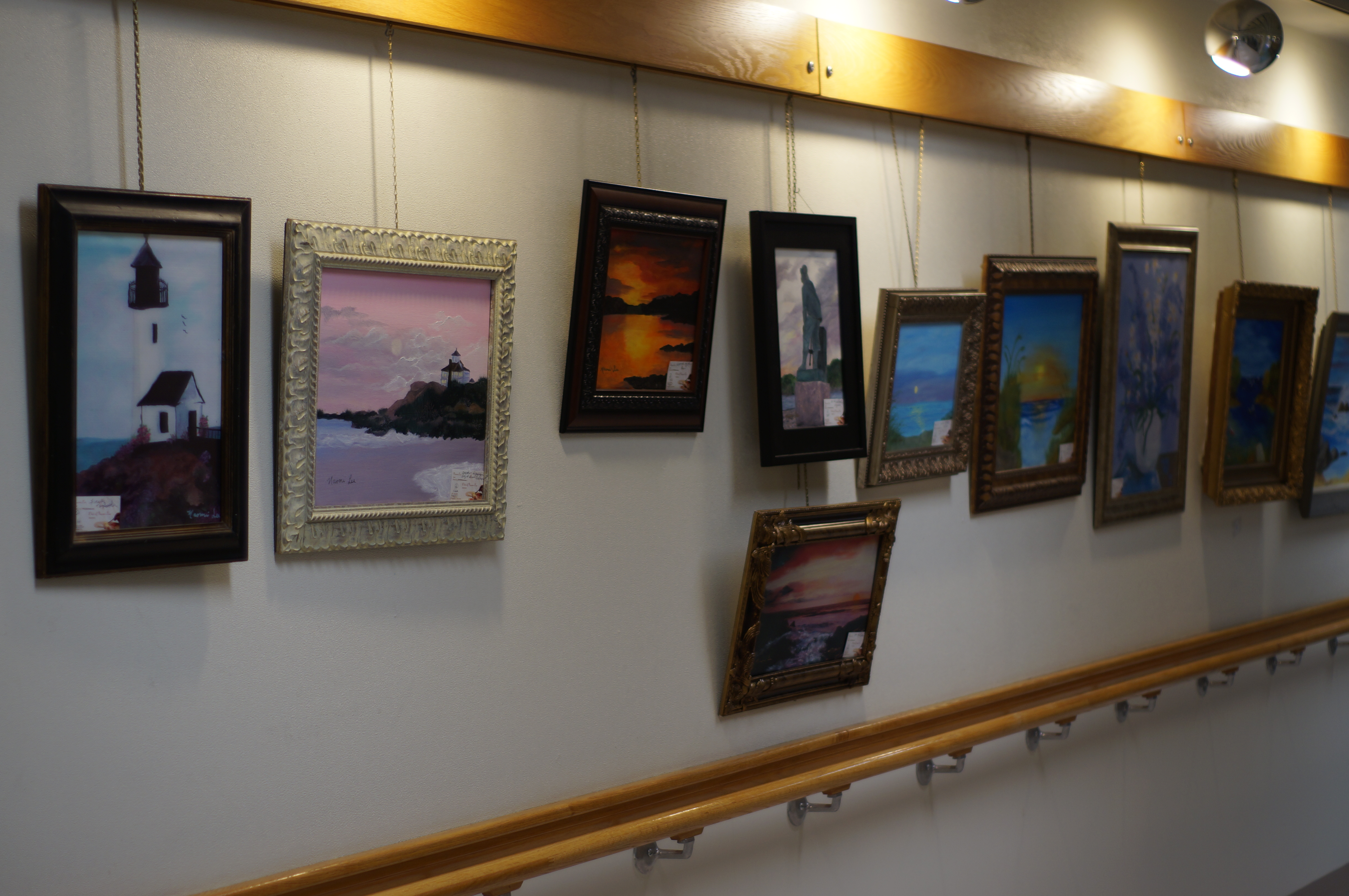
Local Artist Naomi Lee displays her work at Addison Gilbert Hospital Gallery from March 10th to 28th, 2014

Retired art teacher Naomi Lee has rediscovered her love for the arts over the past few years through painting. Naomi was an art teacher for over 20 years, specializing in pottery. She took an unconventional approach to teaching by really giving her students the freedom to create their own individual pieces.
Naomi resides in Gloucester, MA. She finds her inspiration in the beauty that nature creates and the local nautical surroundings. She believes in the calm of the moon, the warmth of the sun, the strength of the wind and the power of the sea. Her work mostly consists of seascape paintings.
Naomi is a member of The Beverly Guild of Artists, The Salem Art Association, The Magnolia Art Association, and takes part in The Marblehead Festival of Arts. She also offers greeting cards and some prints of her paintings for sale. Naomi can be contacted at 781-710-1080.
By Jamie Panarello
Naomi’s painting’s and reproductions are on display at:
Addidson Gilbert Hospital
298 Washington St
Phone number(978) 283-4000
Spread The GMG Love By Sharing With These Buttons:

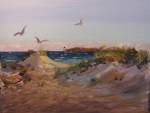
Found on the Hard Drive
I found this photo of a Painting I did of Annisquam Light seen from Wingaersheek Beach. I donated it a couple of years a go to a St. Ann’s School Auction. It reminded me a little of a Beautiful photo Marty posted recently.
16″x20″ Oil on Canvas
Spread The GMG Love By Sharing With These Buttons:

New Visions at Cape Ann Giclee
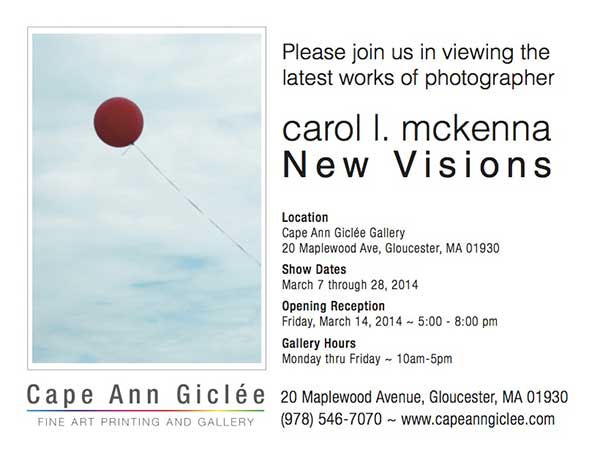
This Friday. Carol McKenna’s New Visions Opening Reception at Cape Ann Giclee. Don’t miss it. Openings at Cape Ann Giclee are always great.
E.J. Lefavour
Spread The GMG Love By Sharing With These Buttons:

David Cox vs Sports Illustrated
Catherine Ryan Submits-
Hey, Joey,
GMG photographers serve up passion and inspiration daily, so no surprise Joey recognizes local sports and talent on his blog.
Decisive shots by sports photographers freeze and interpret the best of sports moments: elements of beauty, determination, athleticism, emotion. GMG contributor, David Cox, is one hard-working pro photographer, known for just that. FOBs and residents know his shots of local school sports, crowds, events, nature and people.
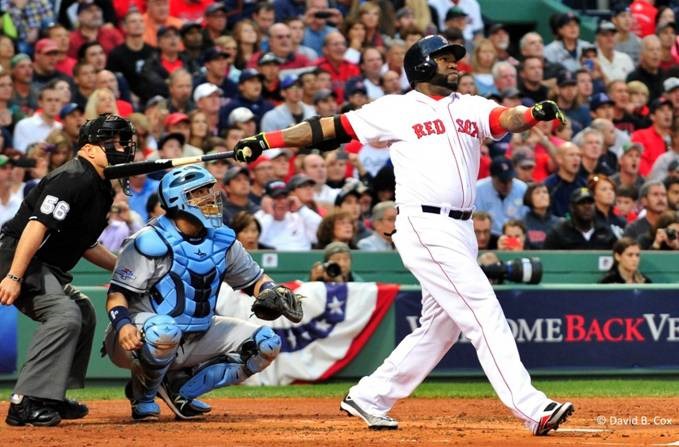

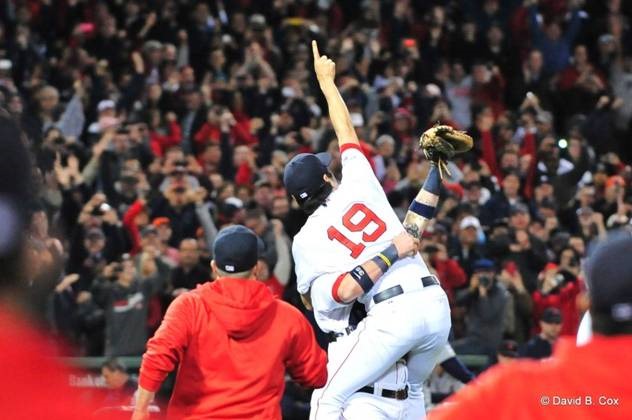
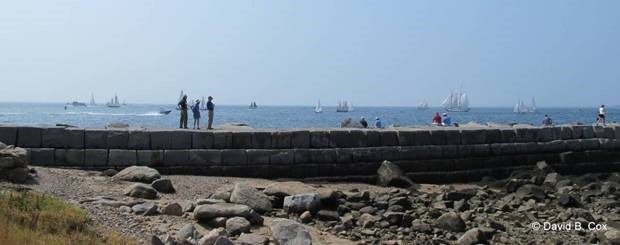
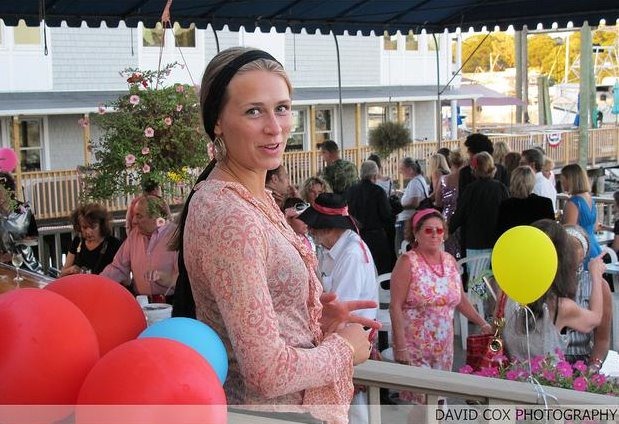
Both are great photos and deserve high resolution inspection. See the stands in David’s– all the ohs and awes. The second photo is by Damian Strohmeyer on assignment from Sports Illustrated, published in the October 14, 2013 issue, pp 30-31 double page spread. We could do this comparison for the Koji Uehara leap-lift seen round the world, seconds after the Red Sox advanced to the 2013 World Series Game (various angles made it on many “pictures of the year” lists for 2013.) Sports Illustrated, national print media, game on! When Cox has a chance to be in the right seat at the right time, he doesn’t miss.
More David Cox photo examples
Somehow David Cox can shoot a clean background and direct our focus to the main event. Not easy to do. We look exactly where it’s needed, and have the bonus luxury to take our time for any all-over mosaic or atmosphere.
David Cox, Gloucester’s BBB sports + more photographer. When he’s not crouching and climbing around for careful framing and action shots, he’s a fixture downtown as the proprietor of Main Street Arts and Antiques. You can visit there to see his art while browsing an eclectic mix of consignments. If you know David, his pictures and his store suit him.



Spread The GMG Love By Sharing With These Buttons:

Upcoming Workshops at the Cultural Center at Rocky Neck


Come express your creative side and check out the renovations at the Cultural Center.
E.J. Lefavour
Spread The GMG Love By Sharing With These Buttons:

National Geographic Travel Photography Seminar – Hartford
I signed up for this National Geographic Travel photo seminar. It is next Sunday in Hartford. Check the link for the details and if others sign up maybe we can figure a car pool.. http://bit.ly/1ifiS5L It says Fall Series 2013, but don’t believe that. The link takes you to the registration for next Sunday.

Spread The GMG Love By Sharing With These Buttons:

So I’m Going Through The Blogroll in the Right Hand Column and…
So I’m going through the GMG Blogroll (a list of links) in the right hand column of the blog (for those who subscribe and get the email version go to www.goodmorninggloucester.com and you can see what I’m talking about) and I start clicking through the list of links.
I hadn’t gone through the list for a while but what I found was that a huge number of the blogs that I link to in the GMG Blogroll either haven’t been updated in over a year or don’t even exist any more.
What a lot of people don’t realize is that it doesn’t matter how fantastic the content you create, there are a bazillion other websites out there that you are competing for eyeballs with. Many people think you can just create a website, register a domain and then magically a million people know about your blog and are anxious to find you. Well for probably 99.5% of people who start blogs my guess is that after pouring your heart and soul into it for a while and if it doesn’t pick up steam you look at your stats and it could be disheartening and you lose the drive to update it. Thud. End of story.
This isn’t to discourage anyone from starting a blog, but rather to celebrate the ones who have been doing it for a while and have kept at it.
This brings me to my buddy Bowsprite who I discovered back in the first months of creating GMG. How I found her and Marty’s son Brian and Bowsprite’s buddy Tugster was through a search for like minded bloggers who were blogging about industrial boats. They were all located in NY.
Monkeyfist (seated and facing away) Bowsprite and Tugster Visit Gloucester
Posted on November 17, 2009 by Joey C

Our Marty Luster actually moved here after a two or three day visit to Gloucester with his blogging son Brian (Marty wasn’t a part of GMG yet) whose blog A Movable Bridge hasn’t been updated in far too long.
But Bowsprite has kept at it.
My dream is to have her up here and take over one of the months at the Goettemann residency on Rocky neck so she could illustrate Gloucester’s industrial ships and share her deep love for Industrial waterfronts with us. I’ve even written on her behalf to the selection committee but it hasn’t happened yet. Maybe some day.
Anyway, Kudos To Bowsprite for keeping at it. You really ought to check out here site, her stories and her illustrations. She’s one of my favs and an incredibly kind soul.
Check out her waterbog here-
Bowsprite: A New York Harbor Sketchbook

and this from here visit to the dock to take a dip in Gloucester Harbor-
Bowsprite’s November Gloucester Harbor Swim 11/16/09
Posted on November 16, 2009 by Joey C
Bowsprite is an artist and blogger from the sixth borough in NY. Check out her incredible nautical illustrations by clicking this text
Who drives up from New Yawk to jump in Gloucester’s inner harbor for a leisurely swim in mid-November? Bowsprite, that’s who.
Related:
All It Takes Is One Visit Posted November 29, 2009 by Joey C
Welcome To Gloucester Marty! Posted on May 14, 2010 by Joey C
Spread The GMG Love By Sharing With These Buttons:

Gorgeous Works on Paper by American Realist Painter JEFF WEAVER
SIMPLY EXQUISITE ~Don’t miss this show!

Rockport Art Association
Jeff Weaver ~ Solo Exhibit
Opening Reception
Sunday, March 16, 2014, 2-4pm
Show runs through March 27, 2014
Artist Statement
“This show of works on paper consists of drawings in charcoal, pastel, and oil, as well as watercolor.
Some were done as sketches or studies for larger works, others as finished pieces in themselves.
The use of a variety of mediums helps me to take a fresh approach to familiar subjects””

Spread The GMG Love By Sharing With These Buttons:

Spring Art Show
Only 15 days til Spring…
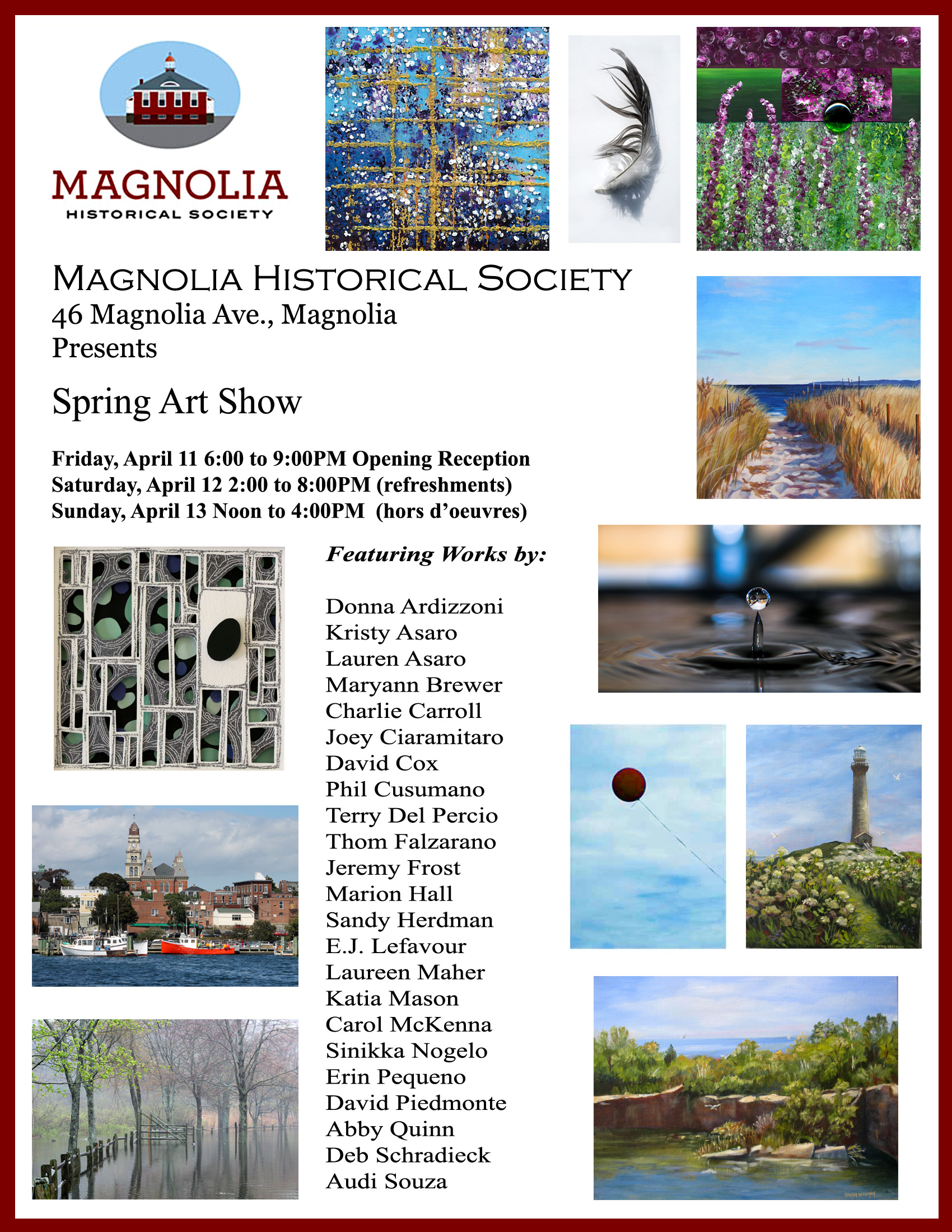
After that, there are only 21 more days until the Spring Art Show at the Magnolia Historical Society. From the icy grip of winter emerges a fresh new body of work by some of your favorite Cape Ann artists. While it may not be the first Art Show of Spring 2014, it is lining up to the best. Mark your calendars now, and pray we won’t have snow.
E.J. Lefavour
Spread The GMG Love By Sharing With These Buttons:

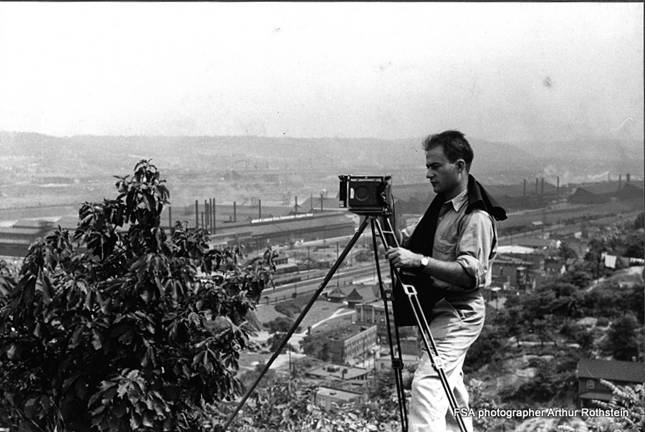
CROSS-COUNTRY CHRONICLE Catherine Ryan on Gloucester, MA in landmark FSA / OWI documentary photographs Part 2 Arthur Rothstein
| American Photographer ARTHUR ROTHSTEIN (1915-1985)19 FSA photos in Gloucester, MA, September 1937 | |
| Joey recently featured Wallflowers, by Gordon Parks on GMG which reminded me of the road less traveled within the historic collection of photographs archived at the Library of Congress and the New York Public Library. This post is Part 2 in a series on Gloucester images in this legendary Farm Security Administration / Office of War Information (FSA/OWI) collection. You can go back to Part 1 about Gordon Parks and for some background about the program. | |
 |
|
| Arthur Rothstein is one of Roy Stryker’s elite team of FSA/OWI photographers. There are over 10,000 photos by Rothstein alone in the massive collection. Rothstein became a premier American photo journalist and the Director of LOOK (1947-1971) and Parade magazines.Director Roy Stryker brought recent graduate Arthur Rothstein to WashingtonDC to set up a state of the art dark room for the new Resettlement Administration Historical Section. In his senior year at ColumbiaUniversity, Rothstein had worked with professors Tugwell and Roy Stryker.Rothstein was 20. Stryker had him out in the field almost immediately. The job meant he had to learn how to drive a car. |  |
 |
|
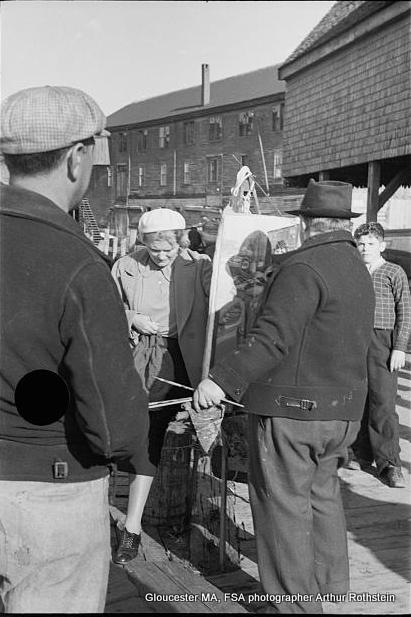
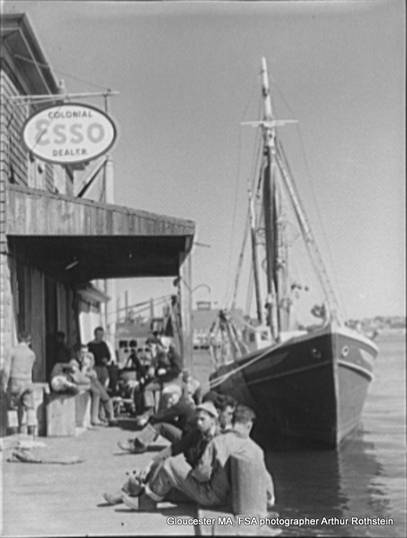
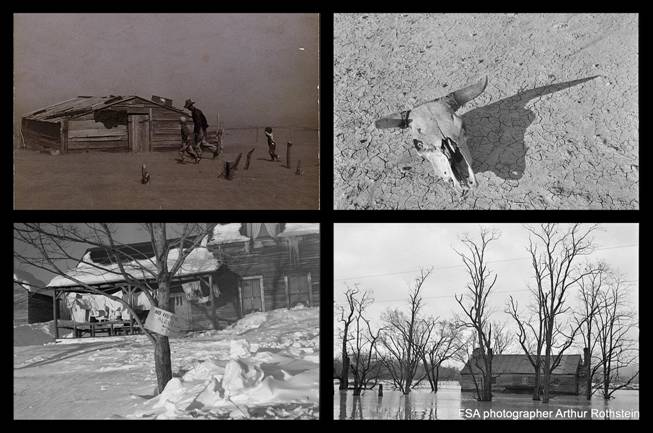
| In May 1936, Rothstein’s South Dakota Badlands drought images caused controversy then, and discussion still. Rothstein’s April 1936 Oklahoma photograph of a father and his two boys fleeing Mother Nature in CimmaronCounty may be the archetypal image of the Dust Bowl.Here are a few examples and flavor of a fraction of Rothstein’s FSA work (broad themes): Mother Nature/Disaster; migrant workers and flight (showing one from MT); Gees Bend; sense of humor.Those images are followed by a few he did in Gloucester. The people are not identified in the Arthur Rothstein Gloucester photos. He’s here in 1937, the same year that the movie adaptation of Captains Courageous is a big hit.
There’s an artist in action, seen from the back. Who is it?
|
|
| “Migratory workers returning from day’s work. Robstown camp, Texas. Everyday from twenty to thirty cars moving out from the Dakotas pass the Montana Highway Department’s port of entry.” | |
 |
|
 |
|
 |
|
 |
|
 |
|
 |
|
 |
|
 |
|
 |
|
| COLLECTION QUICK FACTS The Farm Security Administration/ Office of War (FSA/OWI)Director throughout = Roy Stryker acting akin to visionary art dealer
Photographers = Pioneers in the field of photo journalism, photography, including Dorothea Lange, Walker Evans, Arthur Rothstein, and GordonParks Library of Congress FSA/OWI collection = Nearly 280,000 objects as follows: black and white negatives (170,000+); black and white prints (100,000+); color photographs (1600+). New York Public Library has a substantial collection. 1937 Arthur Rothstein: 10,000+ images (FSA/OWI) / 19 images Gloucester.Mostly rural images. For example 1400+ images in MT and less than 40 total for MA 1942 Gordon Parks: 1600+ (FSA/OWI) / 220+ images Gloucester. Gloucester names to search for: Frank Mineo, the Alden, Vito Cannela, Vito Camella, Vito Coppola, Frank Domingos, Gaspar Favozza, Giacomo Frusteri, Vito Giocione, Pasquale Maniscaleo, Anonio Milietello, Anthony Parisi, Franasco Parisi, Dominic Tello, Antonio Tiaro, Lorenzo Scola, the Catherine C; Mary Machado, Isabell and Joseph Lopez, Dorothy and Macalo Vagos, Irene Vagos, Francis Vagos 1942 Howard Liberman: 700+ (FSA/OWI) / 150+ images Gloucester. Gloucester names to search for: John Ribiera and his wife, the vessel Old Glory There are many portraits and most are not identified. Please help. 1940 Dixon: 350+ (FSA/OWI) / one image of Gloucester; headed the lab in DC Occasionally when Stryker or the artist considered a photograph a reject, he would punch a hole through the negative. |
|
| TIMELINE FOR SOME SPECIFIC IMAGE CONTEXT (primarily pre 1950)1900W.E.B. Du Bois receives a gold medal at the 1900 Paris Exposition for curating and collaborating on a major exhibit featuring 500 photographs displaying the present conditions of African Americans
1908-1917 Along with an extensive visual archive, the FSA team was extremely versed and/or required to study images. One example: Lewis Hine, a NYC school teacher and sociologist who stirred American consciences with his photos. Margaret Sage, the widow of railroad magnate, Russell Sage, established an endowment to research social sciences still active today. Hine’s Ellis Island photographs landed a staff position with the Foundation. His work for them produced their first influential impact: the Pittsburgh Survey. From there, Hines was hired by the National Child Labor Committee and his photographs over the next decade were instrumental in changing child labor laws. Also Stieglitz, Charles White, Paul Strand, and many others. 1924 Russel Smith’s North America, Its People and the Resources, Development, and Prospects of the Continent as an Agricultural, Industrial and Commercial Area 1925 Tugwell with Stryker and Thomas Munro: American Economic Life 1931 Hines was hired to photograph the construction of the EmpireStateBuilding. Ironically, despite his importance and direct influence on future photographers, the arc of his career ends with hard times. He was not included with the FSA hires.. The reception of Hines work declined so much that he was forced to sell his house. MoMA rejected his archives. George Eastman House took them in 1951. 1930s/40s Paul Robeson. Period–International influence. 1931 The continued influence of Margaret Bourke-White. Her professional career took off in 1927. FORTUNE magazine sent her to cover Russia which published Eyes on Russia in 1931. 1932 Huge audience for Mervyn Leroy’s movie I Am A Fugitive from a Chain Gang 1934 FORTUNE magazine sends Margaret Bourke-White to cover the Dust Bowl 1935 Henri Cartier-Bresson exhibits in the US 1935-1937 The Resettlement Administration Historical Section’s photographic project is tasked with documenting the crisis state of rural poverty. The government hires Roy Stryker. Stryker hires the photographers. Many other Federal creative arts programs. 1935 The government sends Dorothea Lange to photograph migrant farm workers in CA. Lange, Walker Evans and Ben Shahn already established careers when hired for the FSA but not household names. 1935 Berenice Abbott Changing New York 1936 In November, LIFE magazine’s large-scale, photo dominant iteration is first published. LIFE sold more than 13 million copies per week 1936 The Plow that Broke the Plains, Pare Lorentz with Pauls Strand, Steiner, others 1937 The movie adaptation of Rudyard Kipling’s Captain’s Courageous is a huge hit. 1937 FSA/OWI Arthur Rothstein is sent to Gloucester. Depression era movie audiences purchased 60 million tickets per week. 1937 LOOK magazine starts publishing bi-weekly 1937 You Have Seen Their Faces, photo-book collaboration by Erskine Caldwell and Margaret Bourke White is wildly successful so much so that it pushes back the publication of Let Us Now Praise Famous Men by James Agee and Walker Evans (1941) 1937 The Resettlement Administration’s Historic Section folds into the Farm Security Administration (FSA). Stryker expands this photographic survey of Depression Era America, while publicizing the work of the FSA 1937/1939 Steinbeck’s Of Mice and Men is published in 1937. The movie adaptation opens 1939. 1938 FSA group exhibit at the International Photographic Salon, Grand Central Palace, New York featured a selection of bleak but respectful images. Reviews felt that the photographers avoided negative stereotypes. The tone of the exhibit was so influential that it was oft repeated. Stryker felt that well over ½ the images in the collection were affirmative and positive. 1938 Richard Wright hired for the WPA Writers Project guidebook for New York and wrote the part on Harlem. He received a Guggenheim Fellowship and was able to finish Native Son. 1938 Architectural Forum introduces Frank Lloyd Wright to American audiences. Managing Editor Ruth Goodhue was the first female at the head of any Time Inc publication, and a colleague of Stryker’s. Stryker credits RUTH GOODHUE* for propelling his encyclopedic quest to catalogue every day life with what sounds now like “a distinct sense of place”, 2014 placemaking terms. Her advice to Stryker echoes the later work of Jane Jacobs** “The Death and Life of Great American Cities”, the Main Street movement, and our current cultural district designations. Thirty years later Stryker credited numerous people, but he repeats his credit to Goodhue several times. Looking back, by the time 1940 rolls along, it’s Stryker’s creed. It’s thrilling how one inspirational comment can engender such a unique mobilization! 1939 An American Exodus, photo book collaboration by Dorothea Lange and Taylor 1939 FSA photos exhibited at the 1939 World’s Fair in New York City 1939/1940 Steinbeck’s Grapes of Wrath is published and is phenomenally successful. The 1940 movie adaptation is a blockbuster, too. 1941 Richard Wright and Edwin Rosskam produce Twelve Million Black Voices. Migration coverage went to the city. 1941 Movies Citizen Kane (trailer 1940) and How Green Was My Valley 1942 Artists for Victory 1942 Gordon Parks’ position within Stryker’s department is underwritten with the support of a Julius Rosenwald Fellowship. Rosenwald was a partner in Sears Roebuck. His foundation operated from 1917-1948 with the mandate to focus on the well-being of mankind and with a particular education outreach for African Americans. The endowment was to be spent down completely and it’s estimated that 70 million was given. Of particular note, from 1928-1948 open-ended grants were given to African American writers, researches, and intellectuals and the list is a Who’s Who of 1930s and 1940s. This is precisely the type awarded to Gordon Parks so that he could work at the famous FSA program. 1942 Gordon Parks in Gloucester May and June. Howard Liberman in Gloucester, September. 1943 May Four Freedoms Day; October 20 America in the War exhibits 1942-45 FSA absorbed by the Office of War Information (OWI), focus shifts to the domestic impact of WWII 1955 Edward Steichen’s Family of Man exhibit at the Museum of Modern Art includes many of the photos 1962 The Bitter Years 1935-1941: Rural America Seen by Photographers of the FSA Edward Steichen’s last and seminal exhibit as Director of the Museum of Modern Art is dedicated to Stryker and the FSA photographers. As with other FSA themed exhibits, photographs by Gordon Parks– and many other artists–were not included, still aren’t included. 1990/2000s Gees Bend quilts *Roy Stryker on Ruth Goodhue “Ruth Goodhue was the managing editor of “Architectural Forum.” Her father designed the very famous Nebraska capitol, a very unusual building. She was another one on my circuit. But I stopped to have breakfast with her, she was over at that time in the Chrysler Building with the Life complex there and I had breakfast with her and I went up to her office. She was the one that said — I’ll tell you this story because it’s how I reacted so often — “Roy Stryker, I wonder if all towns of 5,000 are alike, because they have the same boiler plate, they have the same radio programs, and so on?” Well, I had to go on a trip and when I got back I had an outline on small towns.” Also: “She was a charming woman and very bright and very proactive. And she said to me, “Are all little towns in America alike because they read the same boiler plate, listen to the same radios on the air, and because they eat the same breakfast food?” Proactive questions, just what I needed. I have a very bad habit of writing memos to myself; I love to put things down, write a page after page and take it home. By the time I got back to Washington, the photographers hadn’t been taking pictures of the little towns they went through. So then there grew an outline — a perfect bombardment of twenty-five pages, I guess. Did you stay overnight? Let’s begin to cover the main street of America, you know, just to see what the heck occurs on it.” **Jane Jacobs As writer and associate editor of The Iron Age, Jane Jacobs published “30,000 Unemployed and 7000 Empty Houses in Scranton, NeglectedCity”, an article which brought attention to her home town. This led to more freelance work and in 1943 a job writing features for the US Office of War Information (OWI). After 1945 and into the 1950s, Jacobs wrote and was editor for the State Department’s magazine branch, primarily for Amerika Illustrated, a Russian language magazine. In the public sector she went on to Architectural Forum. I wonder if Goodhue was a mentor for Jacobs or if they had any overlap. I certainly consider the FSA/OWI files as formative for her ideas — and Goodhue influenced that program. Gloucester connections: Charles Olson In New York City 1937, Charles Olson was hired by the government to work for the American Council of Nationalities Services, an agency that offered support programs for immigrants and refugees. He also wrote for the Office of War Information from 1942 – May of 1944. The timing overlaps with Jane Jacobs somewhat. Gloucester writer, Edward Dahlberg, introduced Olson to Alfred Stieglitz in New York City back in 1937. Goodhue and Cram Ruth Goodhue’s father, Bertram Grosvenor Goodhue, was a famous architect. Through his friendships with Ernest Fenollosa of the Boston Museum of Fine Arts and others in the orb of the Boston Society of Arts and Crafts (1897), he met architect Ralph Adams Cram. Goodhue and Cram partnered to form a successful architectural firm, in business together for over twenty years. They had great solo careers, too. Cram designed the Atwood Home, Gallery-on-the-Moors, in East Gloucester, and preliminary plans for the towers on Hammond Sr’s property, and the inspiration or more for Stillington Hall and others. |
|
| -Catherine Ryan / all photos Library of Congress, FSA/OWI black and white photography collection | |
Spread The GMG Love By Sharing With These Buttons:

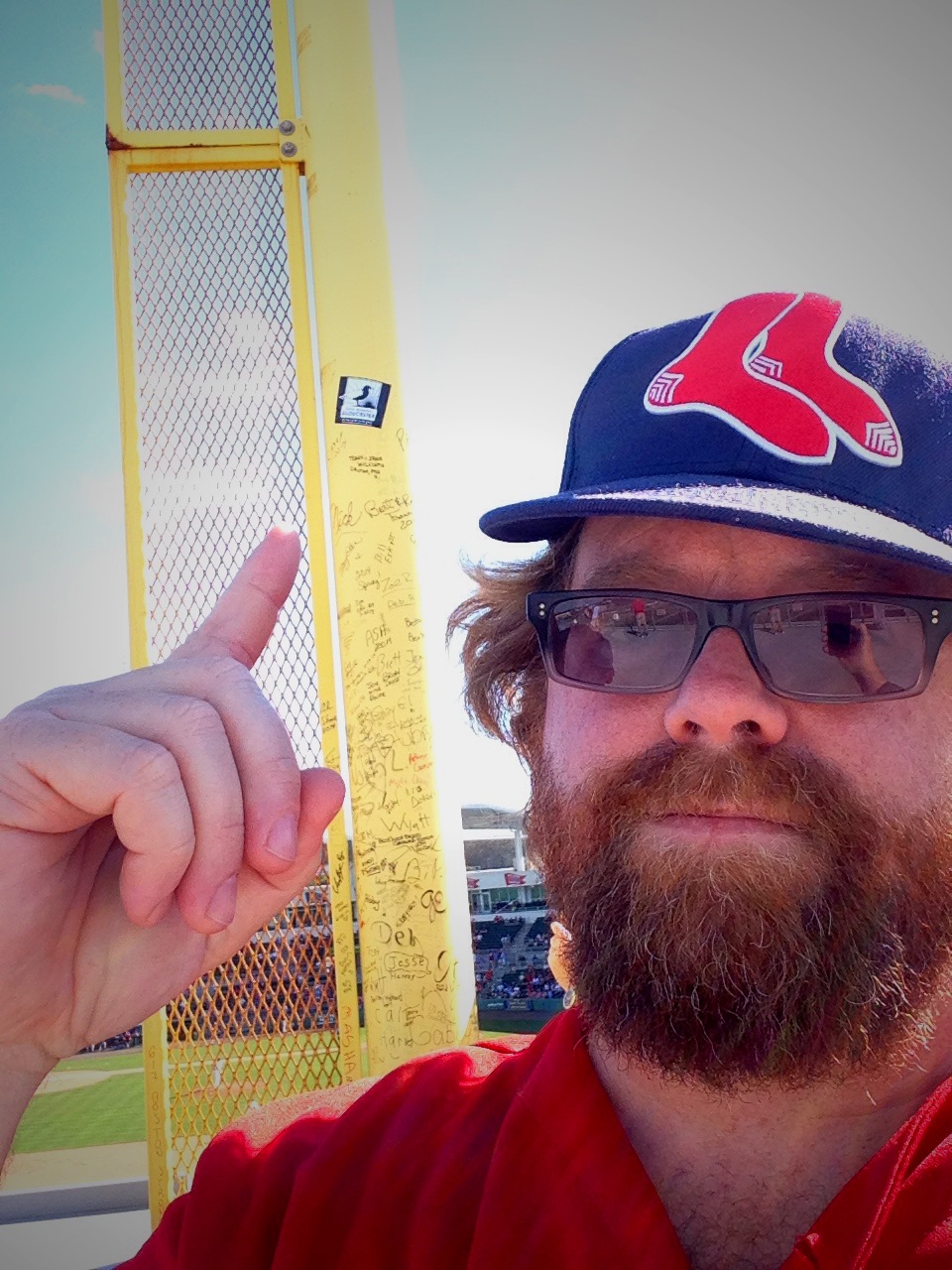
LIVE BLOGGING: FENWAY SOUTH
Step up ya sticka game folks! No more posing with the GMG stickas! STICK THEM WHERE IT COUNTS! I want to see folks leaving our mark, so stick em’ then pose or show us. Better yet, stick em’ and ask the FOB’s to guess where it’s at!
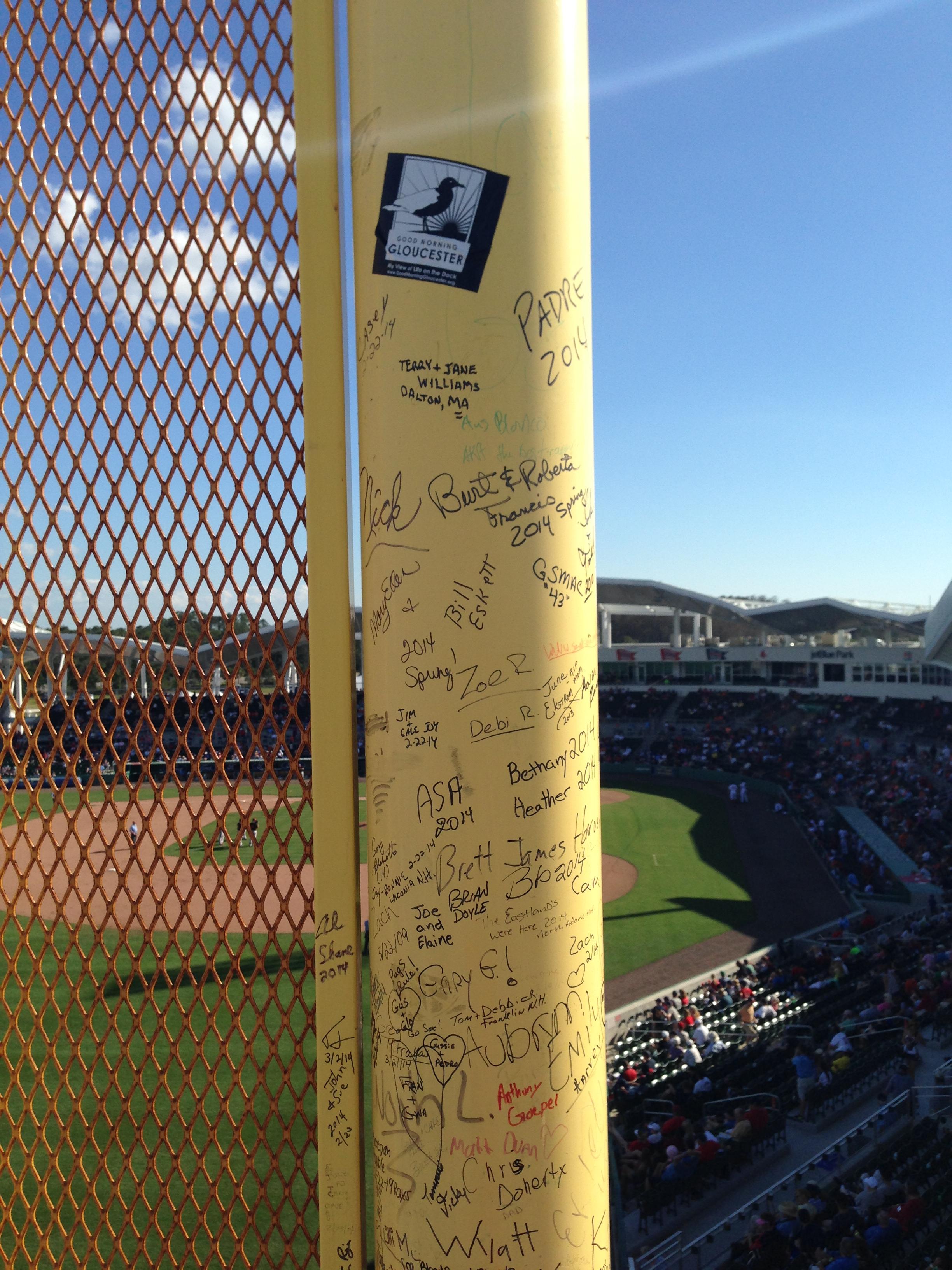
Game on.
Spread The GMG Love By Sharing With These Buttons:

She Always Returns
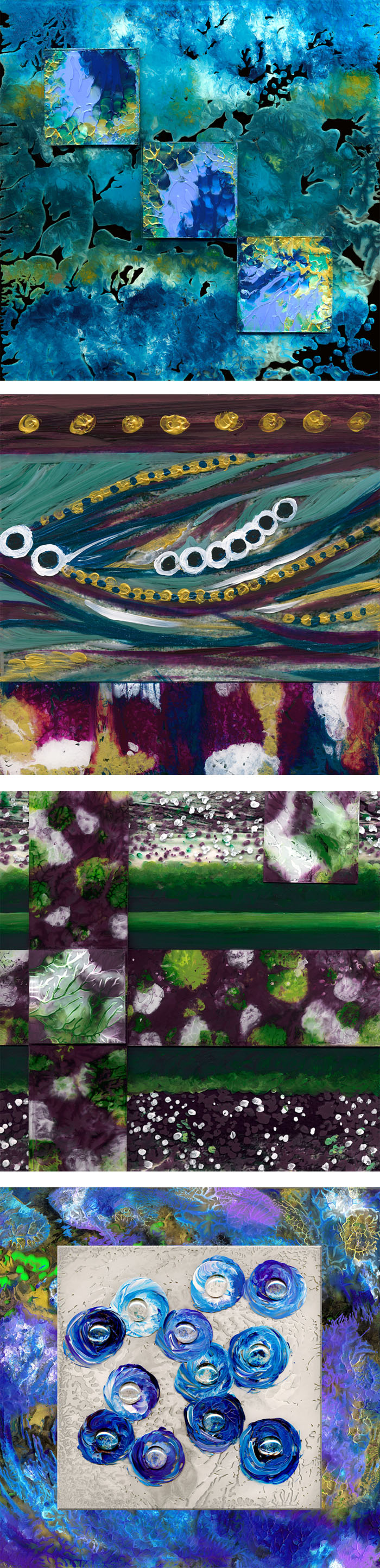
Normally winter is my time to be creative. My life’s path took me on some unexpected twists and turns this fall and winter, which made it impossible for me to get into my creative space. As I’m sure all creative people can attest, sometimes the muse goes away for a time. I used to fret, believing she might never return; but in her own time, she always does. She unexpectedly re-emerged a couple of weeks ago, and took me, as she always does, in a new direction. These are a few new pieces I have completed. This series is old and new. It is a mixed media combination of my abstract photos of last year, coupled with the glass painting of the prior year. While sorting things at my mother’s house, I came across a container of unused glass slides, which have and will make their way into many of these pieces. I have never worked in a square format before, which I am really enjoying, having been inspired by my artist friend, Tom Nihan’s work. All pieces are 8×8 multi-layered photos and glass paintings, and are whimsical and fun – just what I need now. In addition to brushes, I am using rubber ducks and ear plugs to paint with. Yes Paul, RD was instrumental in getting me going, although she has gotten a little messy with paint all over her bottom.
You can see some of my new work at the Spring Art Show at the Magnolia Historical Society Friday, April 11 from 6 till 9pm Opening, Saturday, April 12 2pm till 8pm and Sunday, April 13 Noon till 4pm. More details coming soon.
E.J. Lefavour
Spread The GMG Love By Sharing With These Buttons:

Catherine Ryan on #GloucesterMA in landmark Farm Security Administration / Office of War Information (FSA/OWI) documentary photographs. Part 1 GORDON PARKS
| CROSS-COUNTRY CHRONICLE
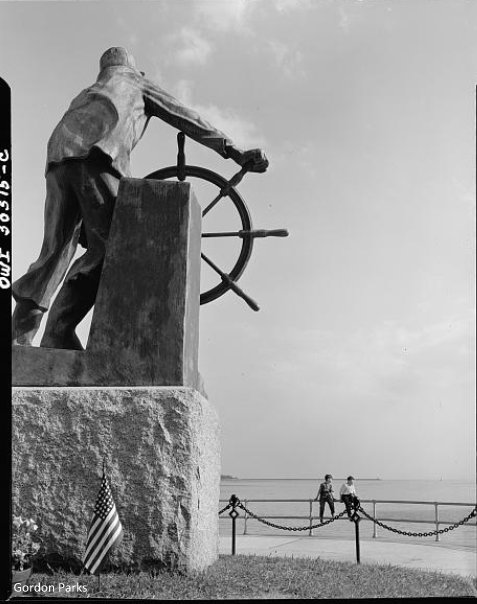
Catherine Ryan on Gloucester, MA in landmark Farm Security Administration/Office of War Information (FSA/OWI) documentary photographs. Part 1 Hey, Joey, Have a look at Gloucester from this important collection. First up—the Gordon Parks post. 1942. FOBs may recognize some of the faces, names, places. You recently featured the ‘American Gothic’Wallflowers, by this super artist on GMG which reminded me of the road less traveled within this historic collection of photographs archived at the Library of Congress and the New York Public Library. This post is Part 1 in a series on Gloucester images in this legendary FSA/OWI collection. If you are interested in the scope of any Gloucester material from this collection, we know that at least 4 of the FSA/OWI photographers came through Gloucester, MA. No surprise, each photographer took photo(s) of the Fisherman at the Wheel. They also show the impact of WWII. If you can id any of the Gloucesterpeople, please contact me. I’ve listed some known Gloucester names at the end of the post. In 1934 during the Great Depression, Fortune magazine dispatched Margaret Bourke-White to cover the Dust Bowl. She sent additional images to the New Masses and the Nation. In 1935, for one of its many New Deal programs, the US government sent photographers across the country on assignment. Initially their photographs were intended to illustrate the results of the country’s latest efforts to alleviate rural poverty. Ultimately, they created a legendary photographic record of 1935-1945. Here is a jaw-dropping list of established and future notables who Stryker hired for this incredible visual encyclopedia: Esther Bubley, John Collier, Walker Evans, Dorothea Lange, Russell Lee, GordonParks, Marion Post Walcott, Louise Rosskam, Arthur Rothstein, Ben Shahn, George Stoney, John Vachon, and Marion Post Walcott. Stryker also primed an extensive “orbit” of contacts and influence. What is the FSA/OWI collection? (See explanation at the end of this post.) |
| American Photographer GORDON PARKS (1912-2006)
119 FSA/OWI photos for Gloucester, MA, May and June 1942
|
| In 2012, the International Center of Photography in New York commemorated the centennial of GordonPark’s birth with a year-long installation featuring 50+ photos (one of the Gloucester ones was in there).
|
| Gordon Parks believed the positive reaction he received for some of his early fashion images was his first break (Melva Louis, Joe Louis’ first wife). This support pushed him to set up a photography portrait business in Chicago. He also photographed out in the streets. He was inspired by Norman Alley’s bombing of Panay coverage (1937). FSA/OWI photographer Jack Delano saw his work and urged him to try to enter Stryker’s program via a Rosenwald fellowship. He was 30 when he was brought on board and thrilled to join this famous group. He was the first African American to be hired by Stryker. He worked there less than two years as the program ended. He followed Stryker into a commercial job. Gordon Parks was a man of dazzling talents. His FSA/OWI photos hint at his many future creative pursuits. This work though was rarely seen. |
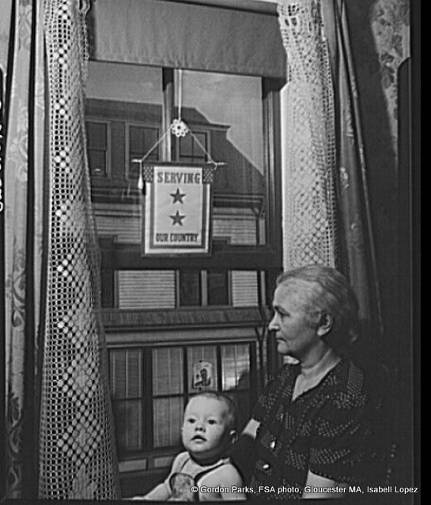
| You can see Parks skilled portrait photographs: leaders of faith, presidents of universities, people working and at home, such as Mrs. Isabell Lopez of Gloucester, mother of 6 holding her grandchild.
|
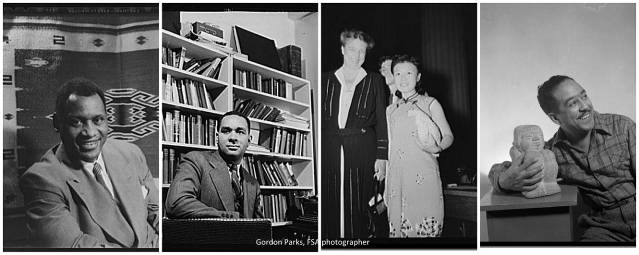
| There are celebrity portraits: Paul Robeson, Mrs. Roosevelt with Wang Yung, Langston Hughes, and Richard Wright. Portraits and fashion were his bread and butter back in Chicago, before landing a post with this famous group.
|
| You can see Gordon Parks the social activist. From left to right: pushing for safer streets, e.g. protection for our kids (devastating streetcar accidents); Jim Crow train FLA; his famous ‘American Gothic’ portrait of Ella Watson who cleaned nights at the FSA government office in Washington, DC. Parks thought this image heavy handed; there is essentially what amounts to a still-photo mini documentary of Ella Watson at home, with her family and at work for more of her story.
Gordon Parks did 1 Gloucester protection/safety photograph, a dangerous crossing.
|
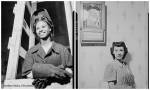
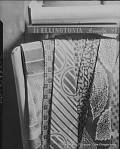
You can see Gordon Parks the fashion photographer. Welder on the left is Rosie the Riveter style; and on the right Mrs. Lopez’s daughter, at home Gloucester, MA. The still-lives are Duke Ellington’s colorful ties and one of Jay Thorpe’s Four Freedoms textiles.

|
| You can see Gordon Parks the humanist: ordinary big moments with Girls Scouts at a memorial service,Gloucester, MA; New York state camps where kids and staff are made up of diverse backgrounds; AldenCaptain and crew are relaxed, easy company together while in New York.
|
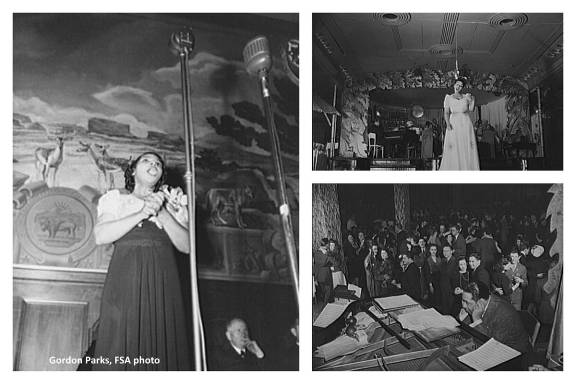
| You can glimpse Gordon Parks the musician/composer through the arts he selected to cover while on assignment for the FSA/OWI. Marian Anderson’s broadcast at a mural dedication commemorating her Lincoln Memorial concert. Duke Ellington and the Orchestra at the Hurricane Club Ballroom, in New York City, April 1943.
|
| There are also photos of Ellington trying to hear his band; Betty Rocha singing with the Orchestra; and individual portraits of musicians Rex Stewart, Ray Nance, Juan Tizol, Sunny Greer, and Johnny Hodges. The caption for Hodges includes the song title played during his portrait session, “Don’t Get around Much Anymore.” Parks also photographed the Club staff and customers
|
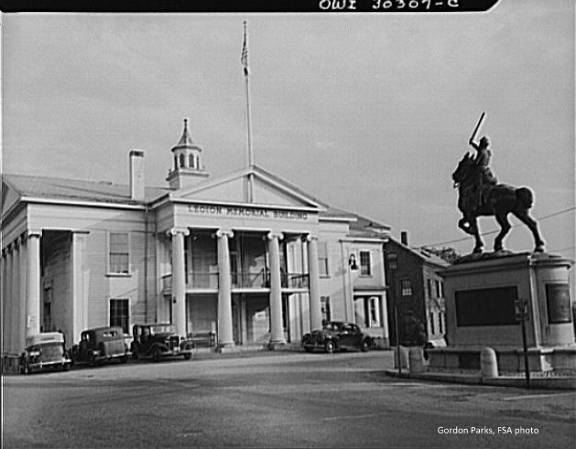
| You can see Gordon Parks the movie Director. Some of his FSA/OWI work looks ready for neorealist cinema. (Rome, Open City global 1946.) The image on the left features generations of the women of the Machado/Lopez family. The boys at the Leonard Craske Fisherman at the Wheel memorial are not identified (one close up).
The center mirror image reminds me of film school students and their emulation of Citizen Kane (1941) and other camera tricks. The image in the mirror is from one of Parks early assignments with the FSA. Mirrors and reflections tend toward symbolism anyhow. Parks is there photographing HowardUniversity. It feels like he snapped this on the sly when seen with the other ‘dailies’. It’s Thanksgiving Dinner and President of Howard University, Mordicai Johnson, is being served by an African American.
|
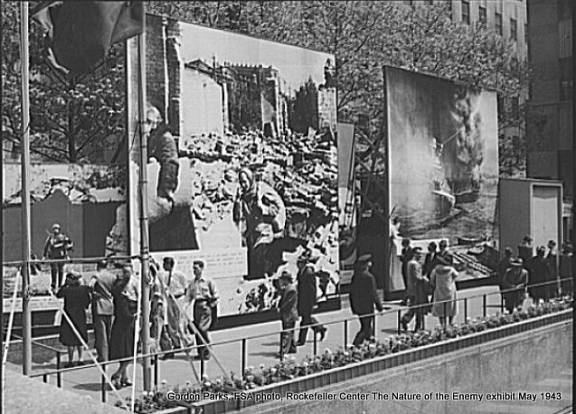
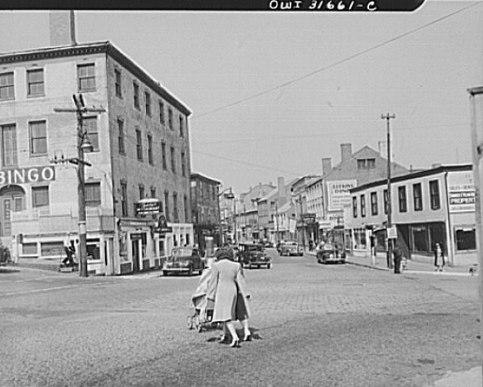
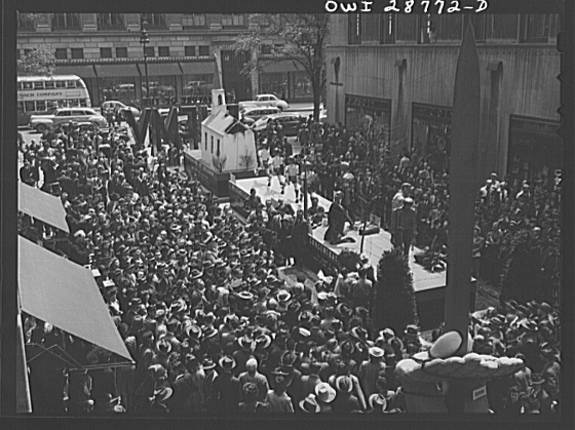
| There’s scene shots: movie-scale streets and crowd shots teeming in NYC or downtown Gloucester. Gordon Parks filed 50+ pictures for the Nature of the Enemy show, the second exhibition of the “This is Our War” series of outdoor installations on the promenade of RockefellerCenter, May – July, 1943. ForGloucester, it’s Memorial Day services. |
|

|
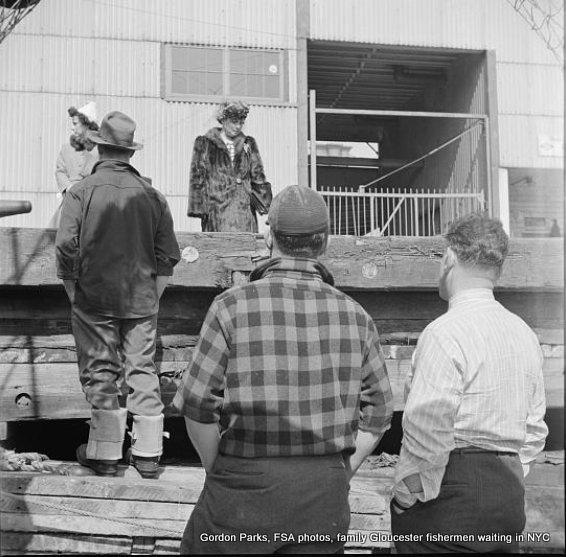
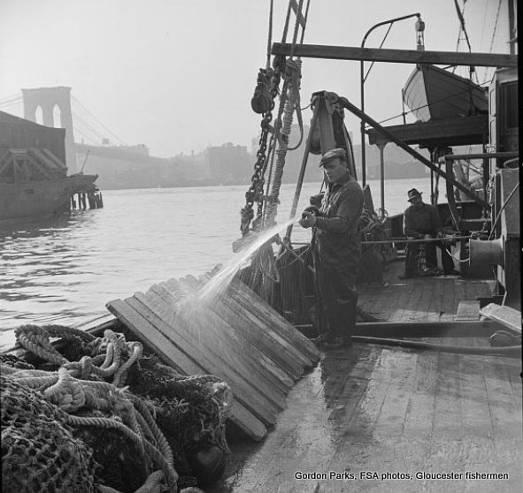
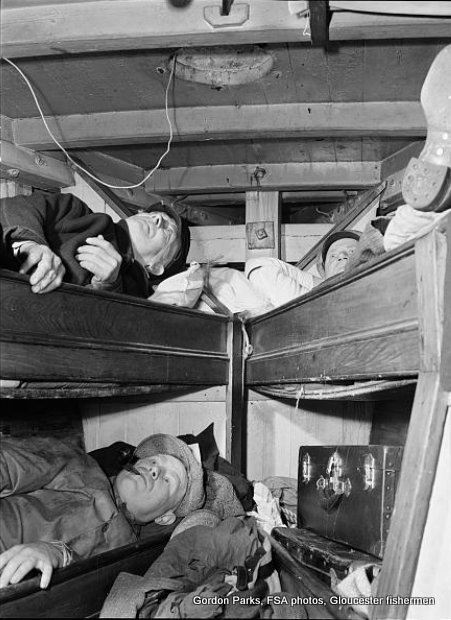
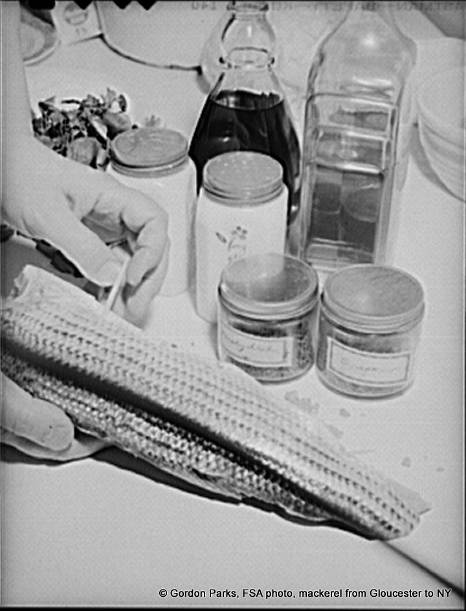
| You can see GordonParks the photo journalist and author through the captions he wrote. For the Gloucester FSA/OWI photos there is a complete photo-journalism expose where he tracks a journey from sea to plate that begins in Gloucester and ends up in New York. The collaboration of GMG Gloucester photographers Kathy Chapman and Marty Luster Fish on Fridays series is such an interesting connection.
|
| “The mackerel caught off the Gloucester coast ends up on the table of Mrs. Rose Carrendeno, NYC, for Friday’s supper. She prepared and served the fish that she bought earlier that day from Joseph DeMartino’s shop who buys his fish each morning from the Fulton Fish Market. She and her husband have three sons in the armed forces…She stops to chat with Mrs. DeMartino about the ration problems while Joseph DeMartino cleans the mackerel she has purchased.
“Fishermen’s families often make trips down from New England towns to be in New York when the ship arrives. The fishermen consider that nothing is too good for their families.” |
 |
 |
 |
 |
 |
 |
 |
| Close up of Mrs. Carrendeno’s ingredients for FOB
|
| What is the FSA/OWI collection?
President Franklin Delano Roosevelt selected a social economist from ColumbiaUniversity, Rexford Tugwell, as Undersecretary of Agriculture in 1934. One of Tugwell’s policy directives included new analysis of assistance for dislocated farmers. He enticed a protégé, economist Roy E. Stryker, to come with him toWashington to direct the Resettlement Administration’s Historical Section. Stryker was the perfect hire, and successfully eked out the program from 1935-1942. He believed photography would be the key tool. At Columbia, he was a master at amassing visuals and presentations to illustrate economic topics. While a Professor, he insisted his students get out and survey what’s around them, walk “the field”, “see.” The FSA/OWI photographers documented daily life, the effects of the Depression and WWII across the country, the problems our country was facing, Main Streets, landmarks, portraits, workers, communities and families. There is great range of intention, style, subject and theme across the collection. Some of the FSA/OWI photographs received nearly instantaneous and phenomenal fame. The reputation of this work was so respected, so known, that employment in this program would later open doors to grants and commercial jobs, and for several artists, launched long illustrious careers. Stryker promoted and protected these artists and the work as the best art dealers do: fleshing out projects, orchestrating exhibits, doggedly getting their work out there to be seen, and placing it in print– whether for church pamphlets or major media publications, or into galleries and collections. When he moved back to the private sector, he hired them. Unlike the art created for some other WPA-era agencies that was lost or destroyed, Stryker and his team had the foresight to try to protect all of it for perpetuity. At the closure of this program, he sought approval from President Roosevelt to transfer the master collection to the Library of Congress (nearly 280,000 items) as part of our National Archives, which was granted. Throughout the program he shipped boxes of prints to the New York Public Library (41,000 items) so that there would be an additional repository if a safe haven in Washington, DC, did not come together. As a result there have been two outstanding collections to study and access. (Other collections and institutions have smaller holdings of vintage prints.) The Library of Congress remains the primary source for use and research. Through the 1950s, one could check out vintage prints along with books at the NYPL. As with many collections, the same images were often requested over and over. The Library of Congress digitized their FSA/OWI collection in the late 1980s and has been deeply committed to ongoing technological updates. In 2005 the NYPL determined that 1000 photos in their collection were actually “new” discoveries; they put these on line in 2012. There are over 270,000 items in the Library of Congress Farm Security Administration/Office of War Information (FSA/OWI) archives, all digitized. IF you haven’t seen these images in person, look for exhibitions of the true vintage prints. There are many iconic photographs. Some capture a gap between ideals and reality. They have been studied, published and featured many times over. As the Gloucester images show, the collection is not solely images of farmers, rural problems, and Western states. -Catherine Ryan / – all photos Library of Congress, FSA/OWI black and white photography collection |
| To search Gordon Parks FSA/OWI photographs for Gloucester, type in key words
Fishermen on the ALDEN
Gordon Pew Fisheries worker, Joseph Lopez and his family
Search for Gloucester landmarks. There are two or three photos in Rockport: the Pewter Shop and the owner Mrs. Whitney |
 |







 Good Morning Gloucester