https://www.instagram.com/p/_75p2Ejyl8/
With all the wonderful recent Snowy Owl sightings in Gloucester, I have been reading much about the Snowies and in doing so came upon this great project being conducted by Norman Smith, Director of Mass Audubon’s Blue Hills Trailside Museum. Since 1981, Smith has been studying the Snowy Owls and as part of his research, he attaches bands and transmitters to the owls at Logan Airport, and then tracks their travels.
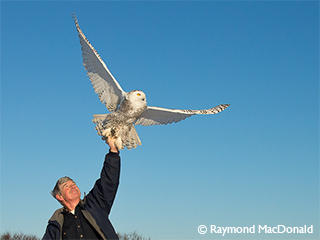
From the Mass Audubon website:
Snowy Owls and Airports
As snowy owls migrate north and south, they look for stopping places that resemble their home, the Arctic tundra. To them, the land around Logan Airport fits the bill. It’s low and flat, with short scruffy plants and grasses, and there’s an abundance of small mammals and birds to eat.
Logan airport has the largest known concentration of snowy owls in the Northeast. The birds usually show up at the airport in early November; the earliest date recorded is October 22. They leave in early April; the latest date recorded is July 7.
The airport owls help by scaring away other birds that might endanger aircraft. Unfortunately, they are large enough to pose a threat themselves. To protect both birds and jets, Smith safely captures and relocates snowy owls each year.
Tracking Snowy Owls
Since 1997, Smith has attached tiny transmitters to the healthiest owls he relocates. These transmitters send data such as location, temperature, and altitude, enabling researchers to learn more about:
- Snowy owl migration routes
- The rate at which they travel
- If and where they stop along the way
- Where they spend the breeding season
- Where they spend the winter
The transmitter batteries last 1-3 years, and the transmitter harnesses fall off once the batteries have worn out. Researchers have worked hard to determine the best size, weight, positioning, and attachment of the transmitters so that they don’t impact the behavior and health of the birds.
This project is a partnership with the US Geological Survey (USGS) and Boise State University (BSU).
Note: This work is performed with special permits. The public is not allowed to enter restricted airport property, or to capture any kind of owl or other raptor.
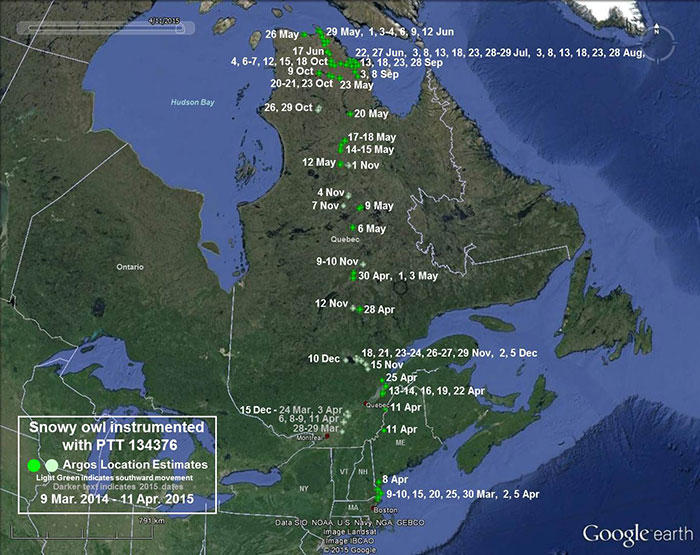
Migration movement of owl #134376 March 9, 2014- April 11, 2015.
More from Mass Audubon
Link to more very cool Snowy Owl migration maps.


 Good Morning Gloucester
Logan Airport? Can’t move their eyes? Who knew?! Fascinating! Thanks!!
LikeLiked by 1 person
I read that, rather than shaped like balls as in human eyeballs, owls eyes are rod shaped. So interesting!
LikeLike
This is very cool information. Awesome job
LikeLiked by 1 person
Thanks Chief!
LikeLike
Thanks Kim; fun info
LikeLiked by 1 person
Thank you Allen. Happy New Year to you!
LikeLike
I love the color of his eyes.
LikeLiked by 1 person
Mesmerizing eyes. Snowies can see very well at a distance, and also have extremely good hearing, but they are very far-sighted. Very intriguing creature!
LikeLike