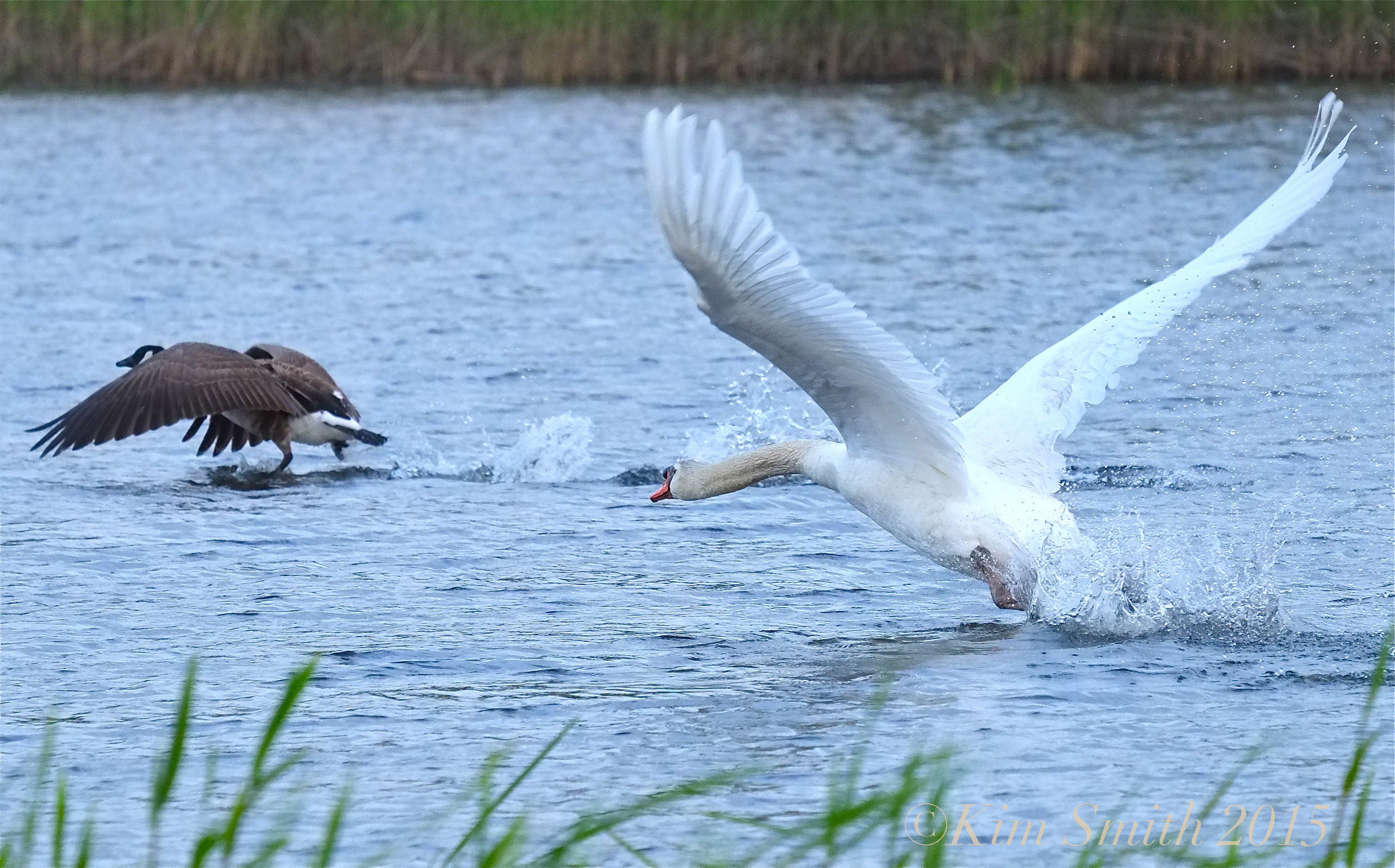
Don’t mess with Mama Swan!

Mute Swans are extraordinarily powerful birds and I have seen them turn on a dime, especially at this time of year when the cygnets are beginning to hatch. The above Canada Goose tried to make a landing but was immediately rebuffed, in no uncertain terms. Several times since, I have observed geese circling overhead, but as soon as the swan is seen, they immediately change course.
Spread The GMG Love By Sharing With These Buttons:
Related
Published by Kimsmithdesigns
Documentary filmmaker, photographer, landscape designer, author, and illustrator. "Beauty on the Wing: Life Story of the Monarch Butterfly" currently airing on PBS. Current film projects include Piping Plovers, Gloucester's Feast of St. Joseph, and Saint Peter's Fiesta. Visit my websites for more information about film and design projects at kimsmithdesigns.com, monarchbutterflyfilm.com, and pipingploverproject.org. Author/illustrator "Oh Garden of Fresh Possibilities! Notes from a Gloucester Garden."
View all posts by Kimsmithdesigns


 Good Morning Gloucester
CANADA goose. CANADA geese. C’mon, it isn’t like they have passports or play hockey! 😉
LikeLiked by 1 person
Yes, the swans are beautiful, biut they are an invasive species. The photo is a prime example of the fact that they displace native species, in this case, Cananda geese, from nesting and feeding grounds.
LikeLike
Interesting comment, thank you for sharing your opinion.
I often see swans peaceably feeding alongside mallards, buffleheads, mergansers, teals, and every other species of duck that frequents are local ponds and marshes. As a matter of fact, the swans go deeply and pull up vegetation from the bottom of the ponds, which is especially helpful to smaller dabbling ducks during the winter months when it becomes increasingly difficult for them to forage. These many species of ducks feed within inches of the swans. Occasionally, when they begin to get inundated by the little scavengers, the swans give a warning hiss, and than all returns to normal. Around the time of year when the cygnets hatch, swans become extremely protective of their nesting sight. For the remaining eleven months of the year they are more gregarious.
Thought provoking from wiki–
By the early 20th century, over-hunting and loss of habitat in the late 19th century and early 20th century had resulted in a serious decline in the numbers of this bird in its native range. The giant Canada goose subspecies was believed to be extinct in the 1950s until, in 1962, a small flock was discovered wintering in Rochester, Minnesota, by Harold Hanson of the Illinois Natural History Survey.[15] In 1964, the Northern Prairie Wildlife Research Center was built near Jamestown. Its first director, Harvey K. Nelson, talked Forrest Lee into leaving Minnesota. Forrest Lee would head the center’s Canada goose production and restoration program. Forrest soon had 64 pens with 64 breeding pairs of screened, high-quality birds. The project involved private, state and federal resources and relied on the expertise and cooperation of many individuals. By the end of 1981, more than 6,000 giant Canada geese had been released at 83 sites in 26 counties in North Dakota.[16] With improved game laws and habitat recreation and preservation programs, their populations have recovered in most of their range, although some local populations, especially of the subspecies occidentalis, may still be declining.[citation needed]
In recent years, Canada goose populations in some areas have grown substantially, so much so that many consider them pests for their droppings, bacteria in their droppings, noise, and confrontational behavior. This problem is partially due to the removal of natural predators and an abundance of safe, man-made bodies of water near food sources, such as those found on golf courses, in public parks and beaches, and in planned communities. Due in part to the interbreeding of various migratory subspecies with the introduced non-migratory giant subspecies, Canada geese are frequently a year-around feature of such urban environments.[17]
LikeLike