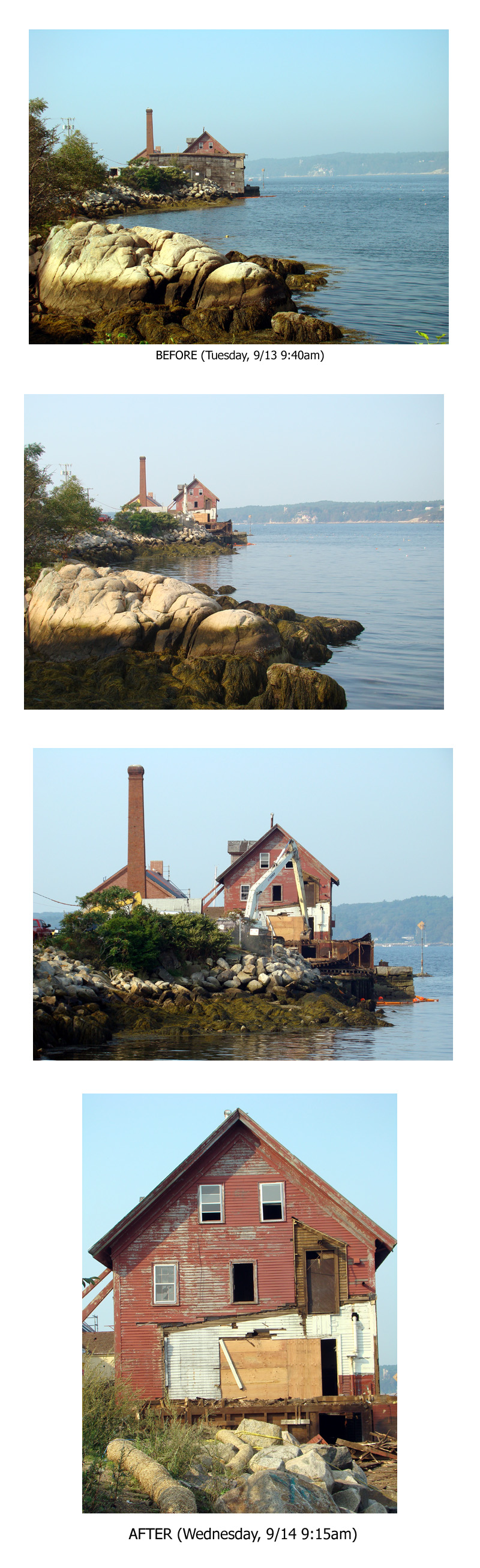
The first two photos are the same shot taken the morning of the demo and the morning after. There was still some final demo being done to take the building completely down. Personally, I like being able to see the character of the building that was hidden behind the falling down shed building (which BTW was a relatively new structure built in the 1930’s vs. the remainder of the manufactory that was built in the 1870’s). As long as the remaining structures can be restored, our Motif #1 will remain, and in my opinion be the better of the two, because most of it will still be the original versus a rebuilt replica of the original.
Ocean Alliance, who purchased the paint factory, is a 501(c)3 organization founded in 1971 by Roger Payne. Dr. Payne has conducted research on whales in all the oceans of the world, and has been an eloquent spokesman for their welfare for over three decades. In the early 1970s, he was among the first to sound the alarm about the threat of worldwide pollution of the oceans. In the January 1979 issue of National Geographic, Dr. Payne said, “Pollution has replaced the harpoon as a mortal threat to whales, and in its way can be far more deadly.”
Believing that rigorous science and widespread public education are basic requirements for long-term conservation, Dr. Payne founded Ocean Alliance for the purpose of carrying out both these global missions. Ocean Alliance has research partnerships in South America and a research vessel, Odyssey (a 93-foot, steel, ocean-going ketch), that operates in all the world’s oceans from her home base in Gloucester.
That Ocean Alliance owns the paint factory is a fait accompli. Whether they are able to complete this major restoration project so that the paint factory remains for years to come is yet to be seen. Rather than bemoaning what is done, we might all be better served by supporting and working with Ocean Alliance to accomplish their goal of restoring this iconic piece of Gloucester’s history and landscape.
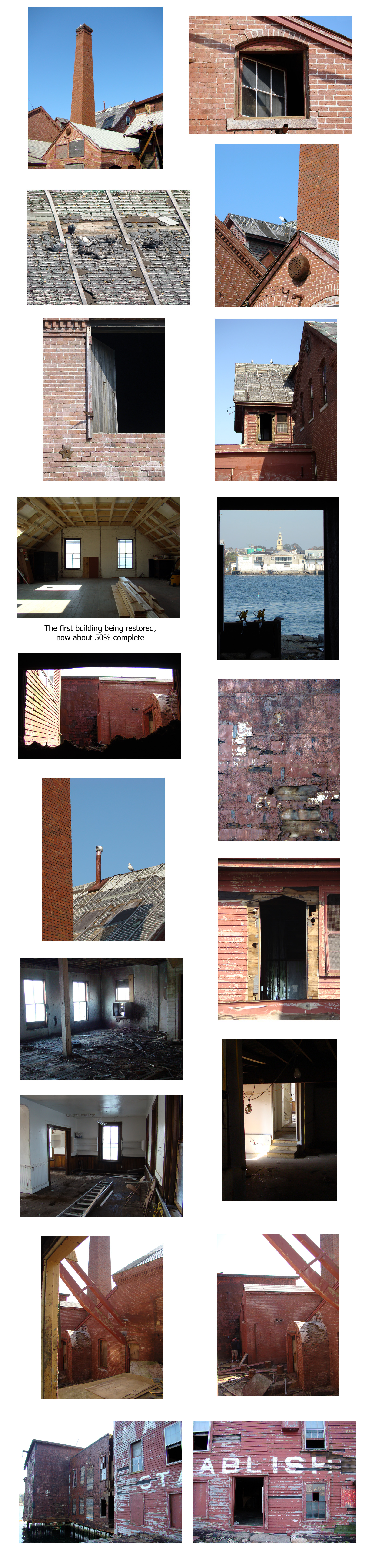
If you haven’t walked through the buildings or around the grounds recently, these shots will give you an idea of how much work there is to do, and what has been accomplished so far.
E.J. Lefavour


 Good Morning Gloucester
I can’t believe it is really happening! How exciting!
LikeLike
Thanks for your fine photos and, expecially you comments about the owner of the property, EJ. I agree with you that getting rid of the dilapadated shed and restoring the 1870s building is the way to go. More power to Dr. Payne and the Ocean Alliance for tackling this project which will be a win, win situation for Gloucester when/if completed as plans. I spent part of one summer putting labels on Tarr & Wonson Copper Paint in that building.
LikeLike
Wonderful, informative, positive post and pics (as usual). While it looks sad (and really jarring) right now to see the shed gone, I hope to look out onto the original buildings restored to their former glory for years to come. I will look into more ways to support the Ocean Alliance in their important work here.
Thanks, EJ, we are so lucky to have your wit, candor and wisdom.
Jenn
LikeLike
Hopefully that is their goal. how many years will it take? they still have to, or want to take down the main “Manufactory” building and have a place for their research vessel. There has to be a voice that pushes them to their “promised” goal of restoring those buildings as close as possible to the originals! not just kiss ass people who will take them at their word. How many years will it take?
LikeLike
Thanks Bill and Jenn. I personally love the paint factory as an historical and appealing Gloucester Harbor landmark. I certainly want to be able to see it for the rest of my days here and for future generations to enjoy. That’s so cool Bill that you worked there and have a firsthand personal experience working at Tarr & Wonson. I think it might be a nice and important project to solicit people’s firsthand stories of their experiences with the place – whether working there, or sitting on the rocks alongside it contemplating their sobriety, or fishing, or painting, photographing or whatever it might have been to make into a collection. What a great way to maintain the oral history as it exists in the memories of people today of the paint factory.
LikeLike
Thanks for turning this big change into a positive event and detailing the integrity now possible.
LikeLike
Great images and great history lesson…thanks E.J.
LikeLike