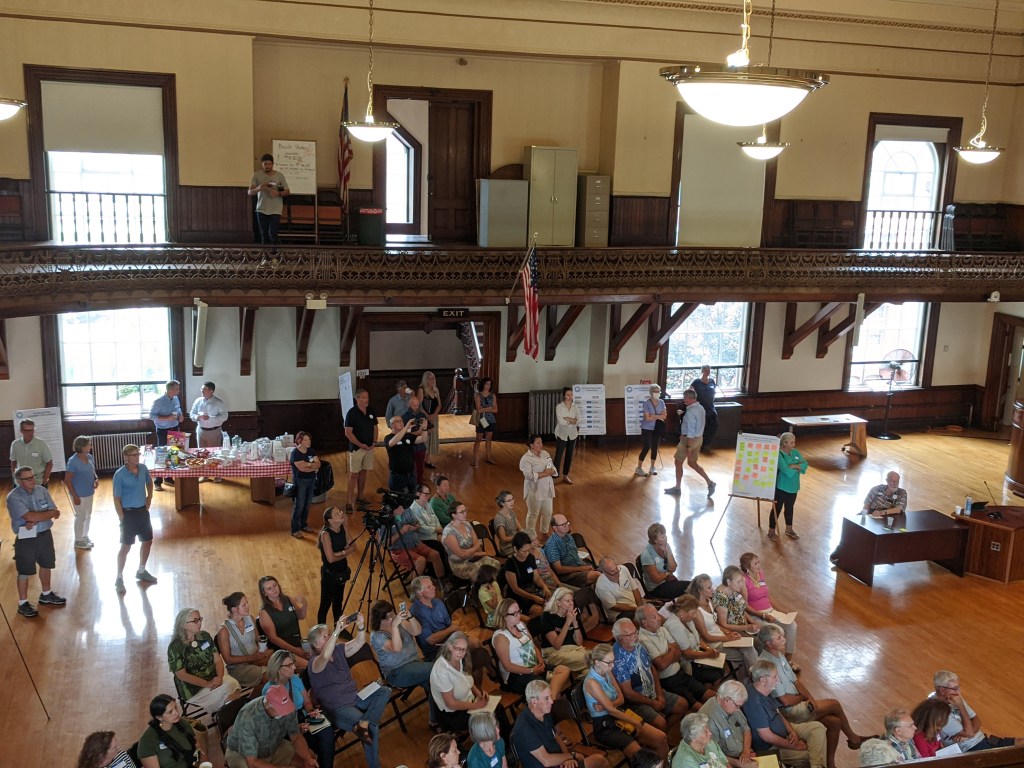
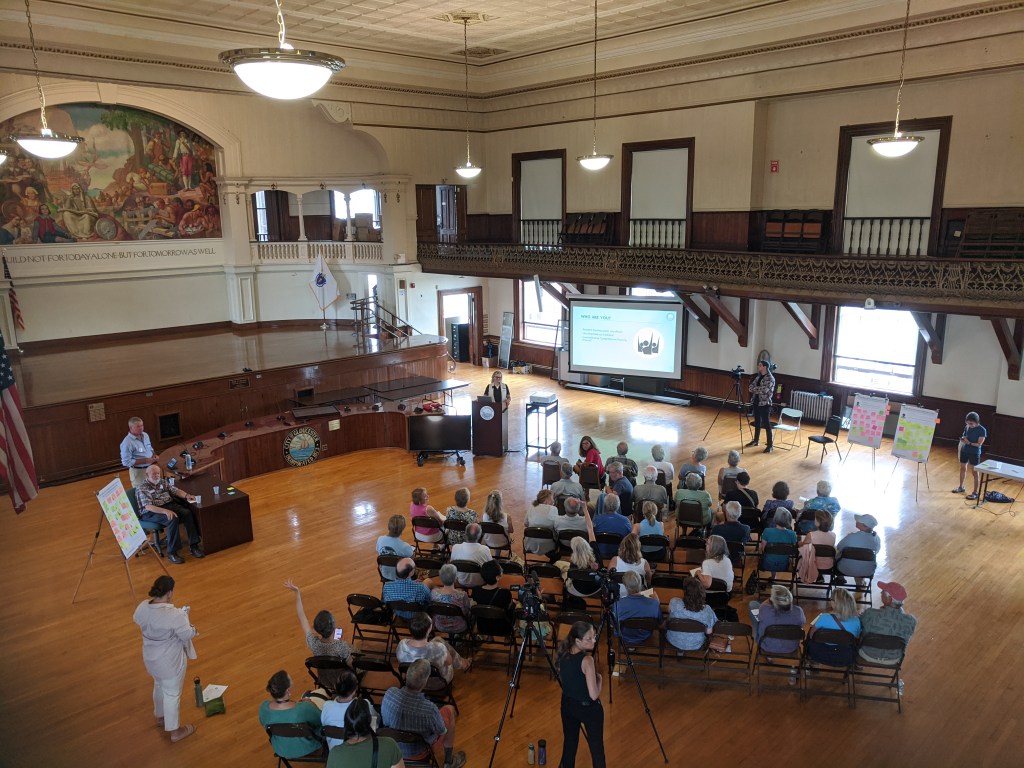
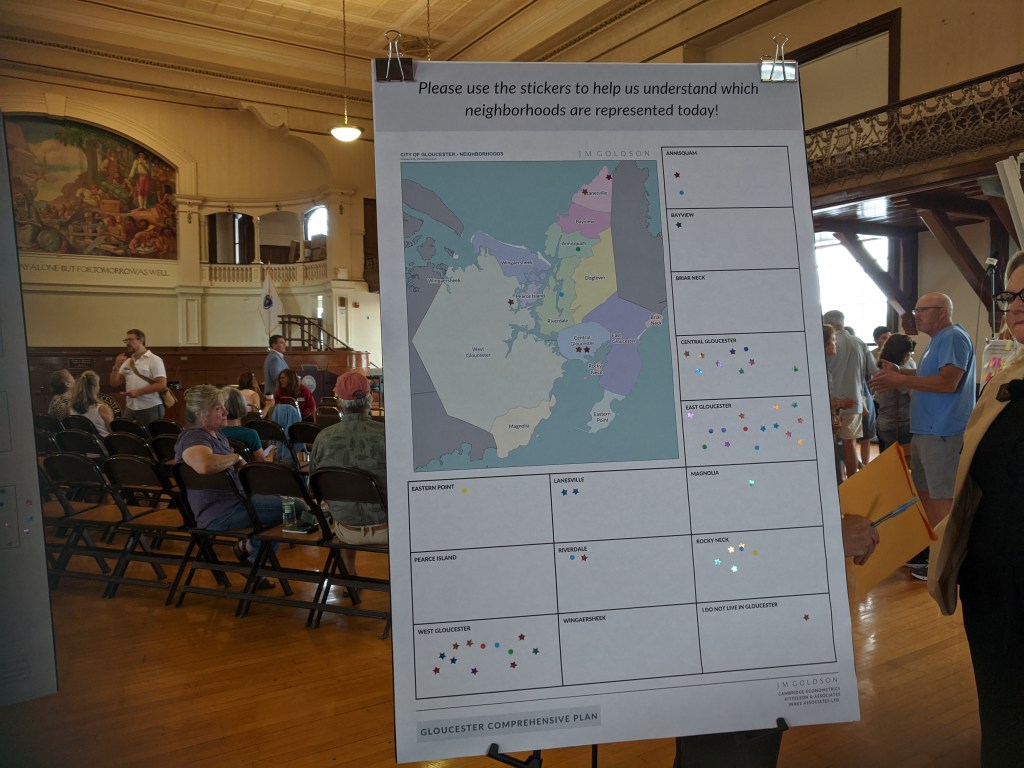
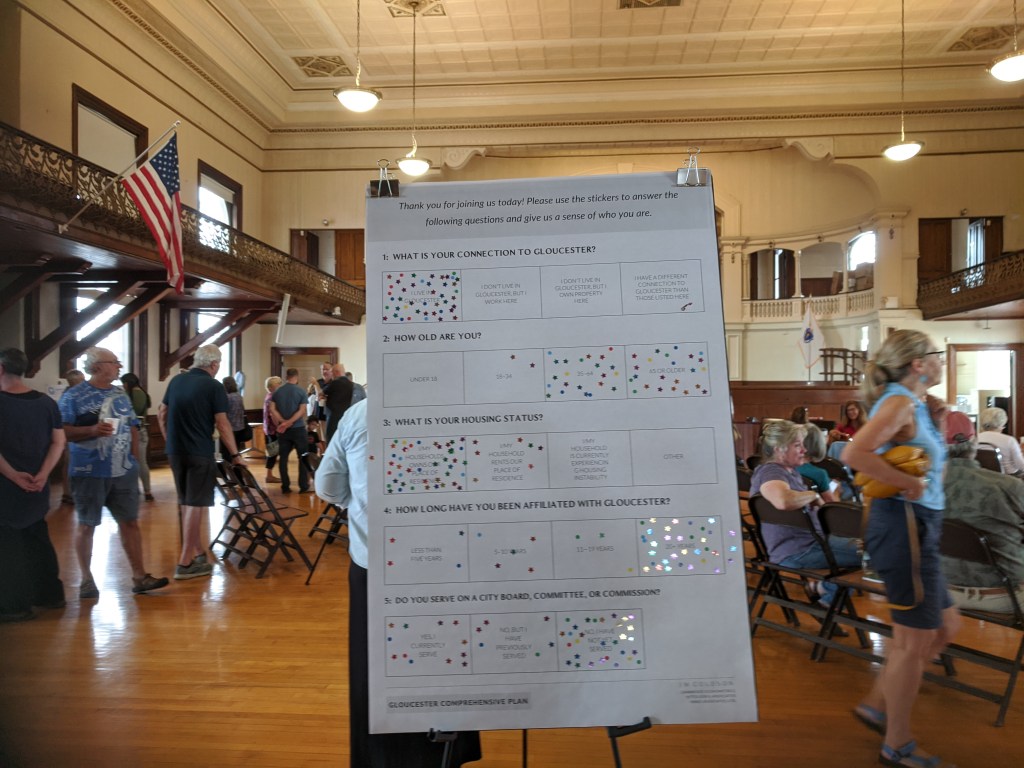
Committees, officials, residents at City Hall
for the comprehensive plan. Not live feed, (will be shown on YouTube and TV later.) and yes it’s hot.
My View of Life on the Dock
Committees, officials, residents at City Hall
for the comprehensive plan. Not live feed, (will be shown on YouTube and TV later.) and yes it’s hot.


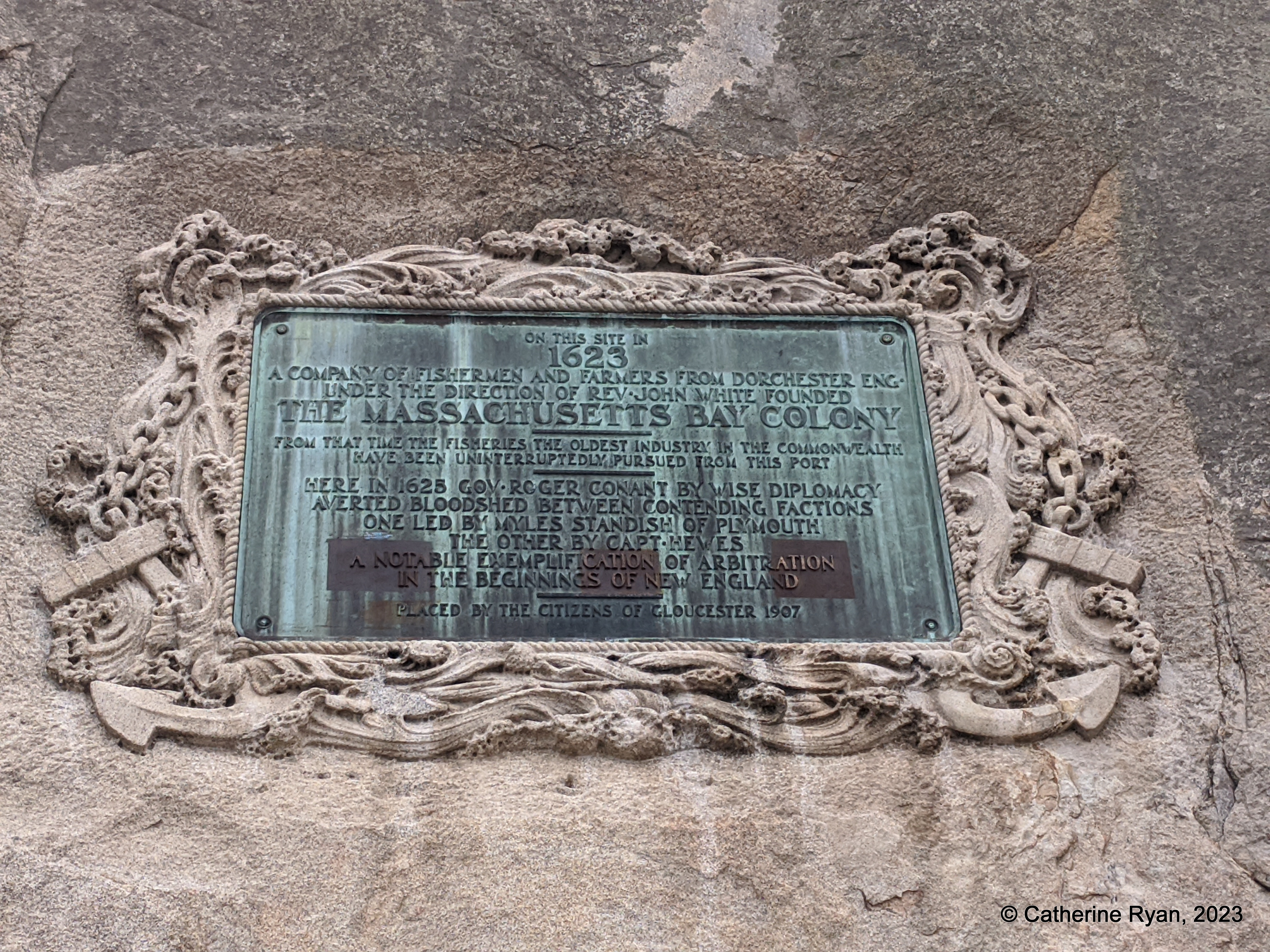
Gloucester, Mass. August 9, 2023.
Part 2. “NOTABLE”. “EXEMPLIFICATION”. “ARBITRATION”.
Three test patches are visible on the commemorative bronze plaque set into Tablet Rock. Along with surface patina aesthetic choices, test patches are left to cure or age to see their impact. When considering care and protection for public art, there is no singular approach. There is no other American commemorative tablet that’s so colossal, set into a glacial outcropping in this precise angle and manner, and susceptible to its surroundings and climate over this length of time. Hence the test patches.
Daedalus is a renowned sculpture conservation firm and will approach this work with respect.

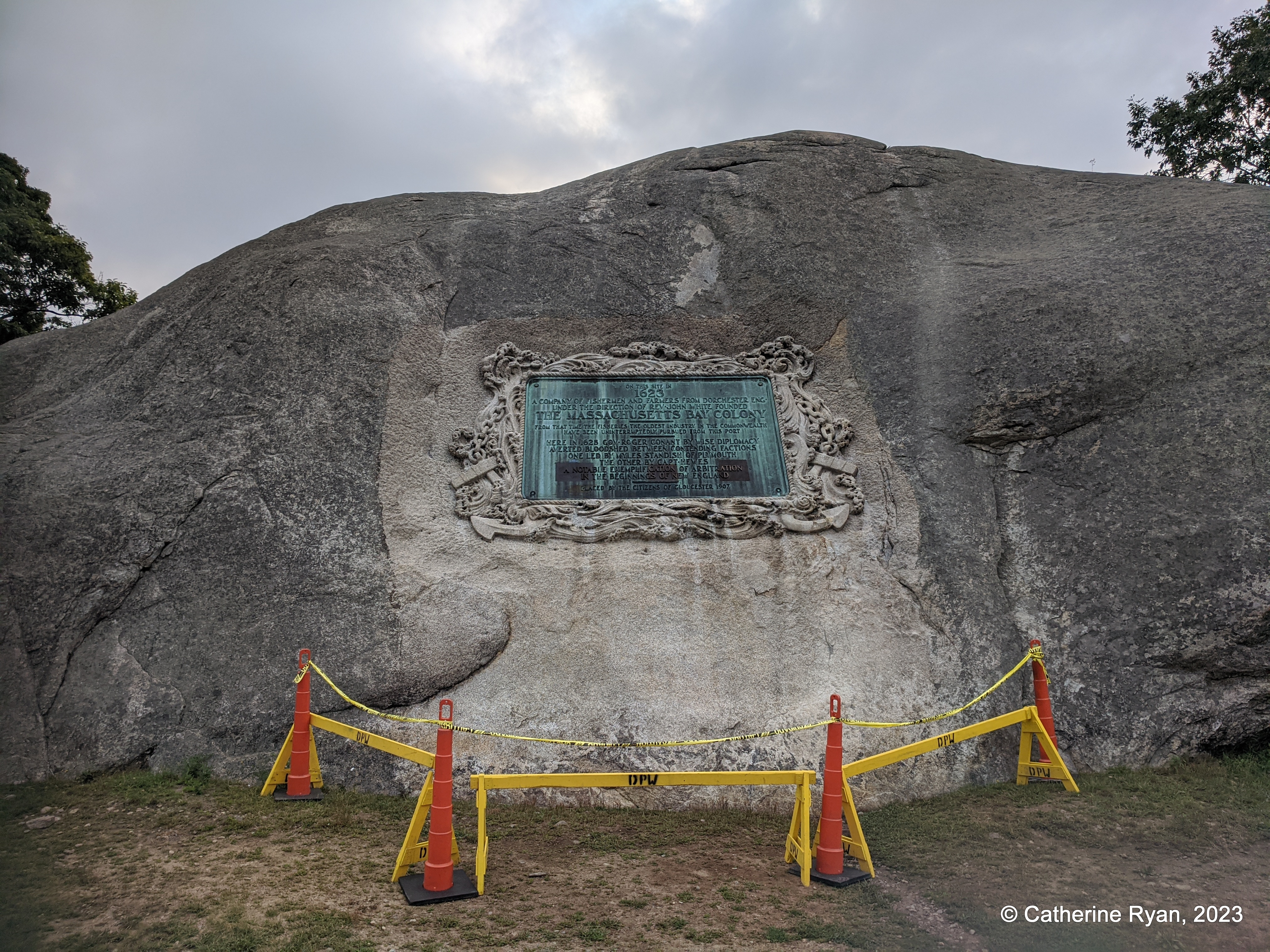
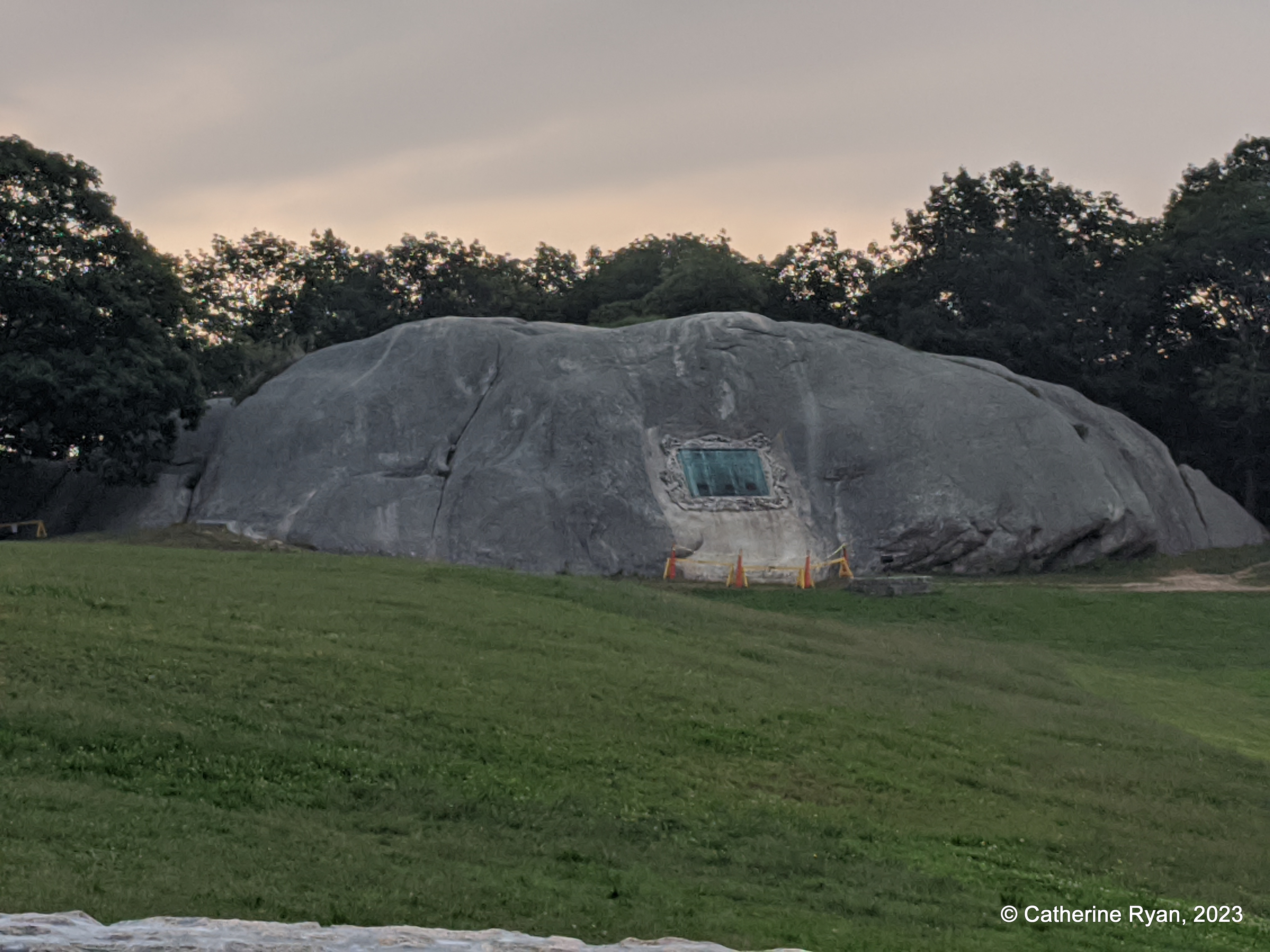

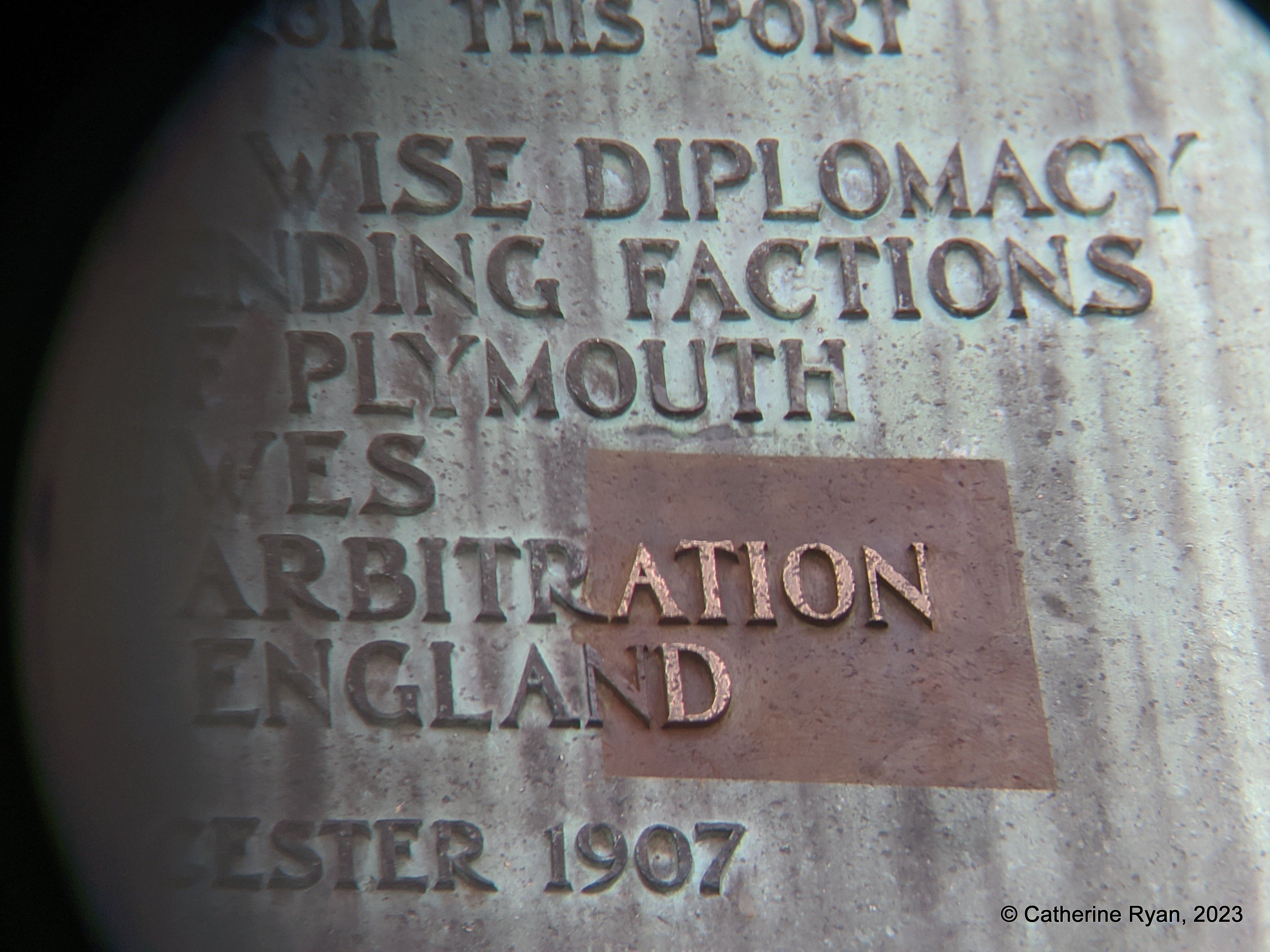
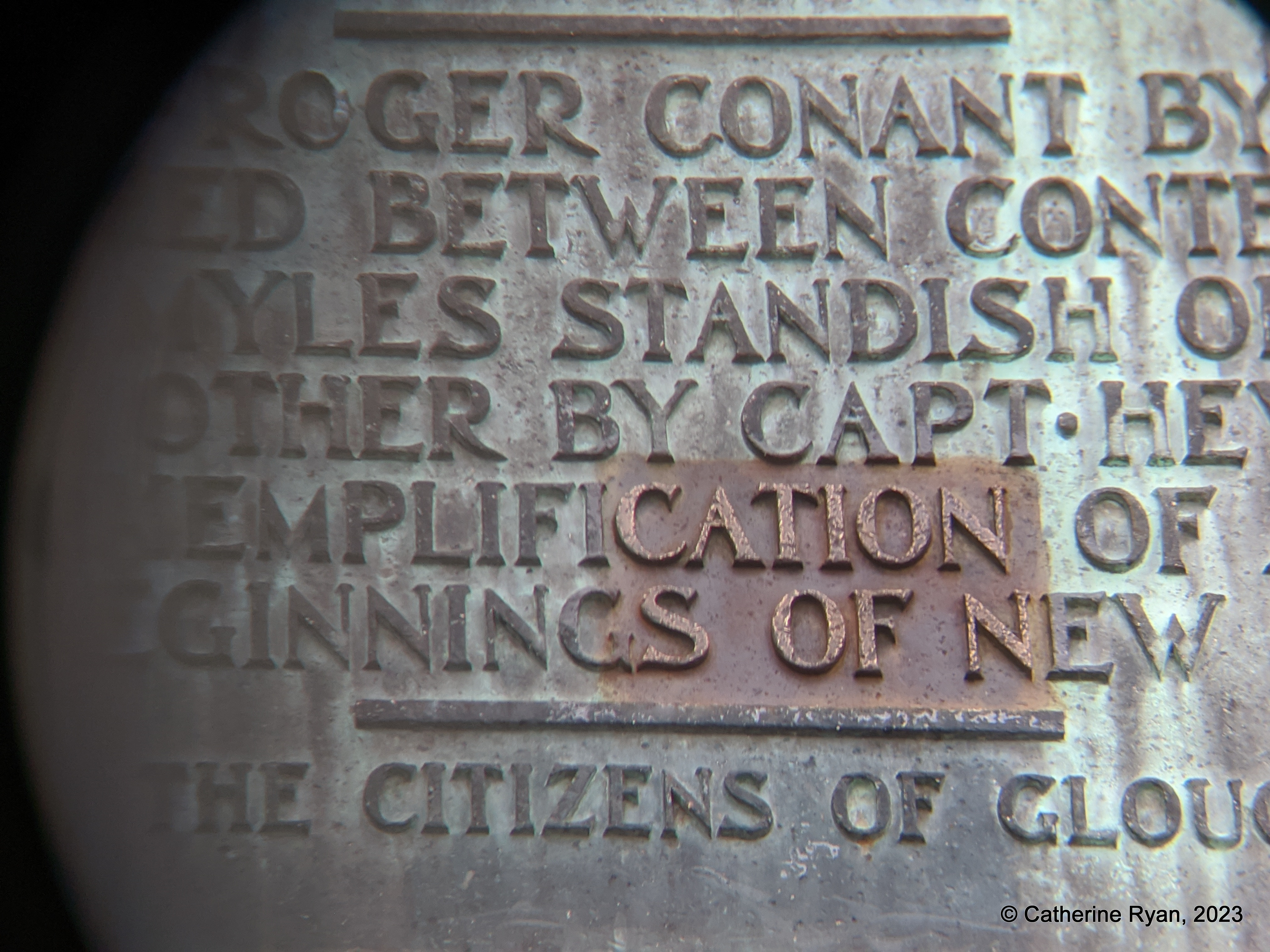


Money was raised to address the plaque and patination (some had preference for a brown finish) Gloucester Daily Times, 2016, and then that project was paused. As far as I know, funds were not returned nor redirected for restoration of the city’s art deemed in distress. At the time William Taylor addressed the verdigris:
“As an antique dealer for decades who dealt many times with bronzes and patinas I completely agree that the tablet should not be restored. While I applaud…well-meaning and generous inclinations not only does natural oxidization form a protective surface it looks appropriate and should not be fiddled with. Restoration is too expensive and absolutely not necessary. Cleaning it would remove many decades of well acquired history.
William Taylor, letter to the editor, GDT
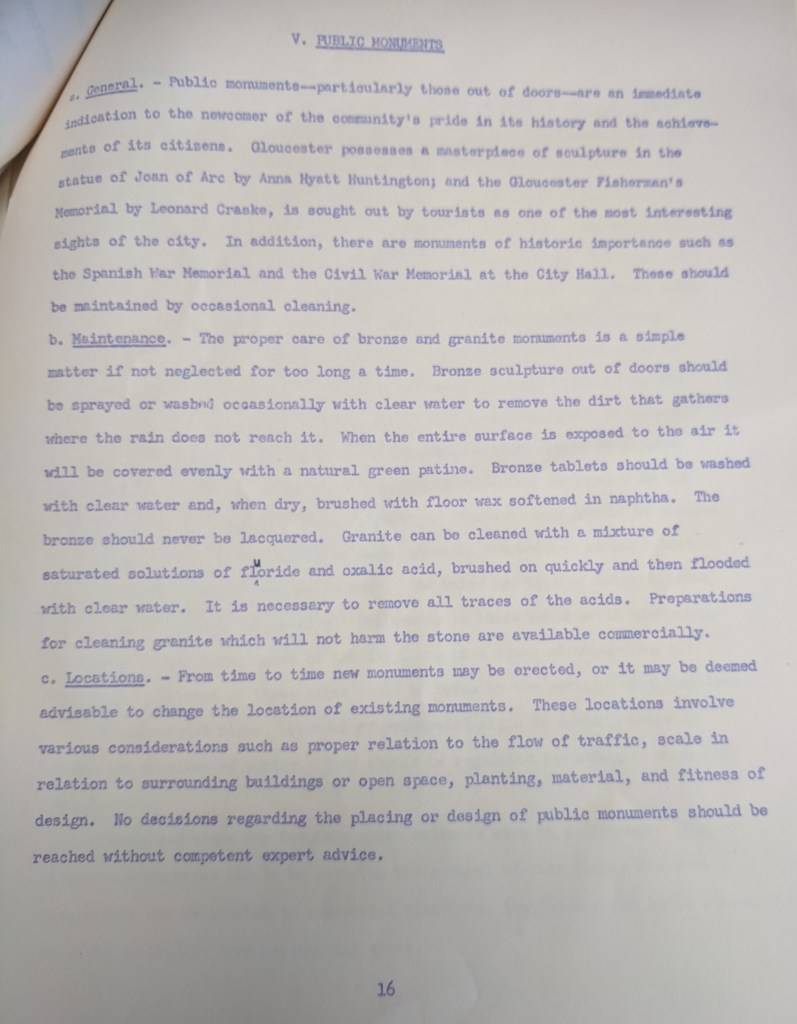
Restoration science about corrosion on bronze and copper vs. verdigris is fascinating. See Walker Hancock Comprehensive Plan 1958 related to patina. Some methods change. Some don’t.
Continue reading part one here .
Bronze tablet. Founders Plaque. Tablet Rock work 2023. Part 1 here

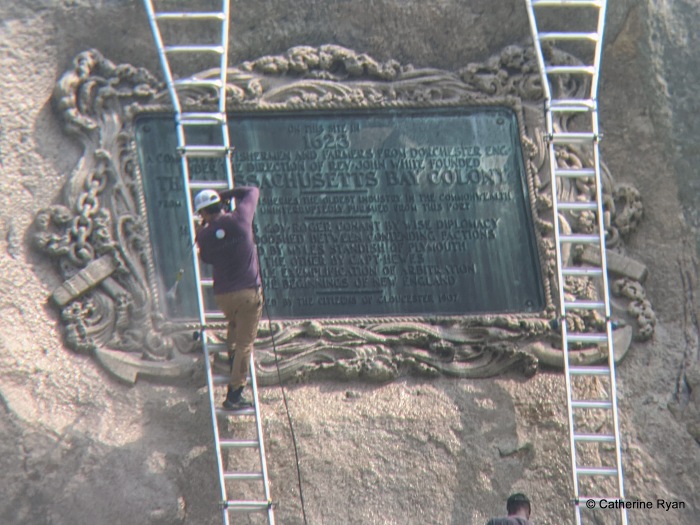
September 2023. Ladders up for Daedalus crew powerwashing the ‘founder’s plaque’ on Tablet Rock in Stage Fort Park.
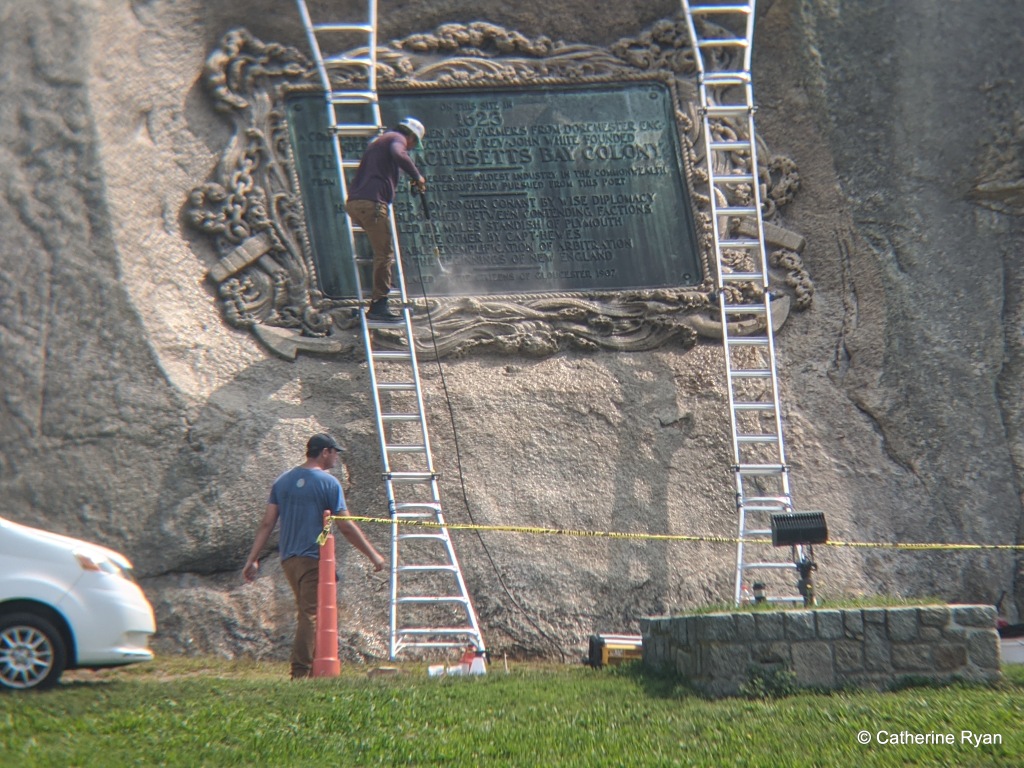
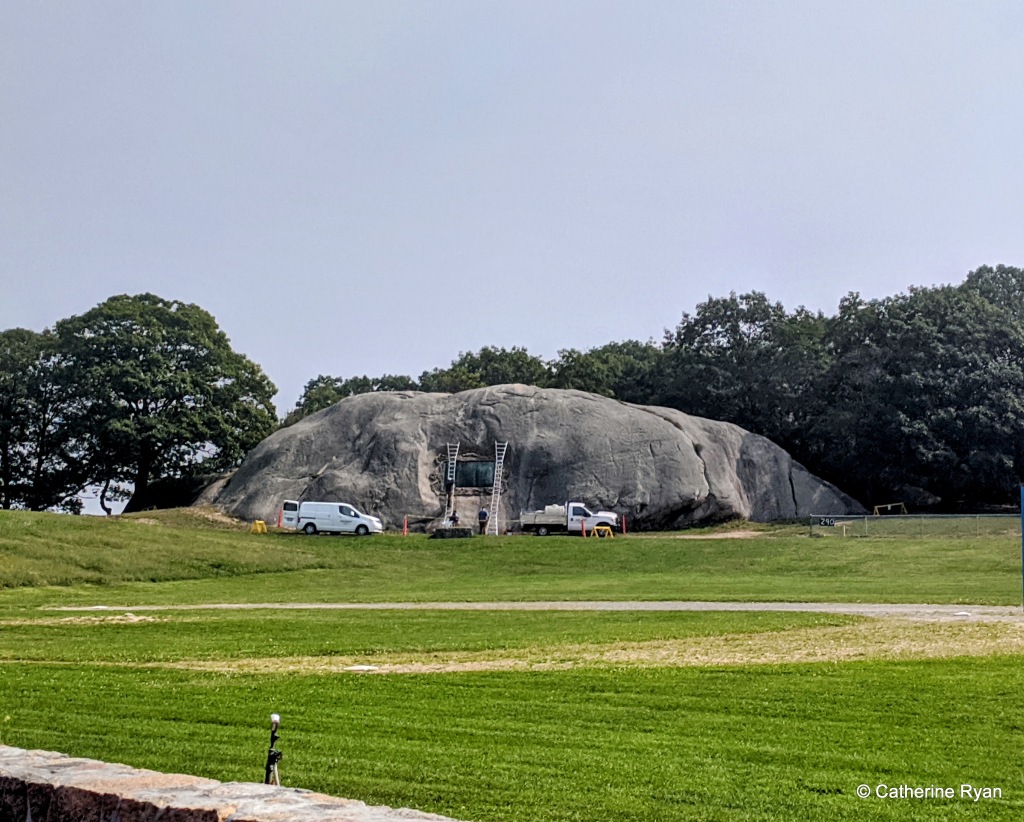
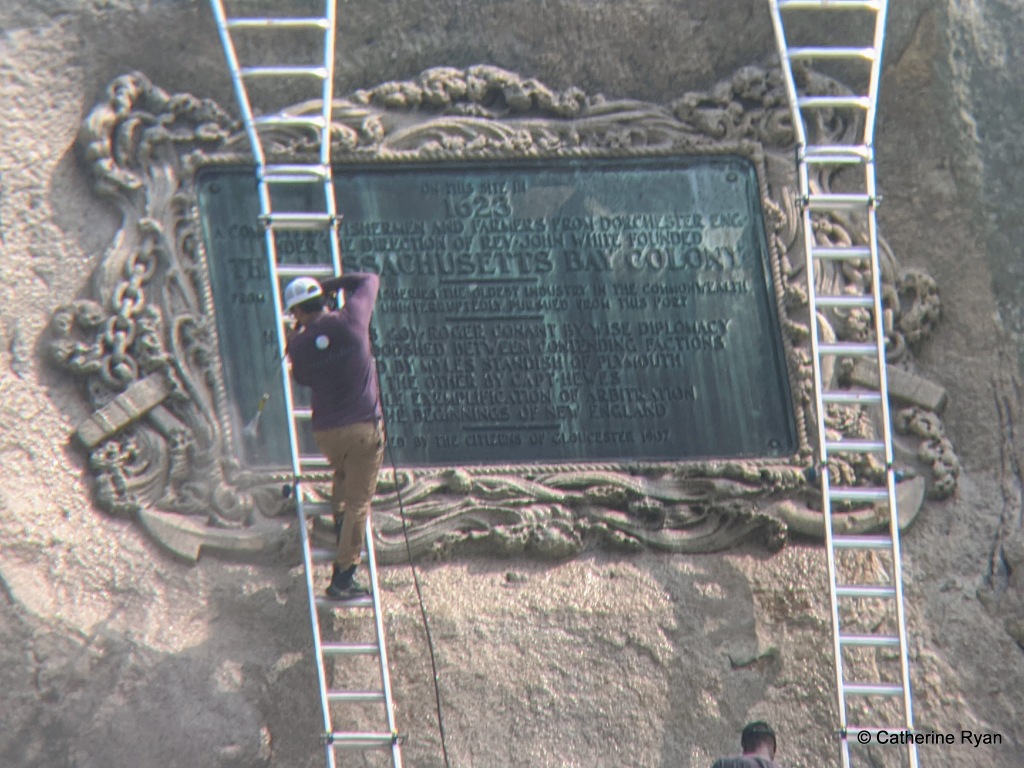
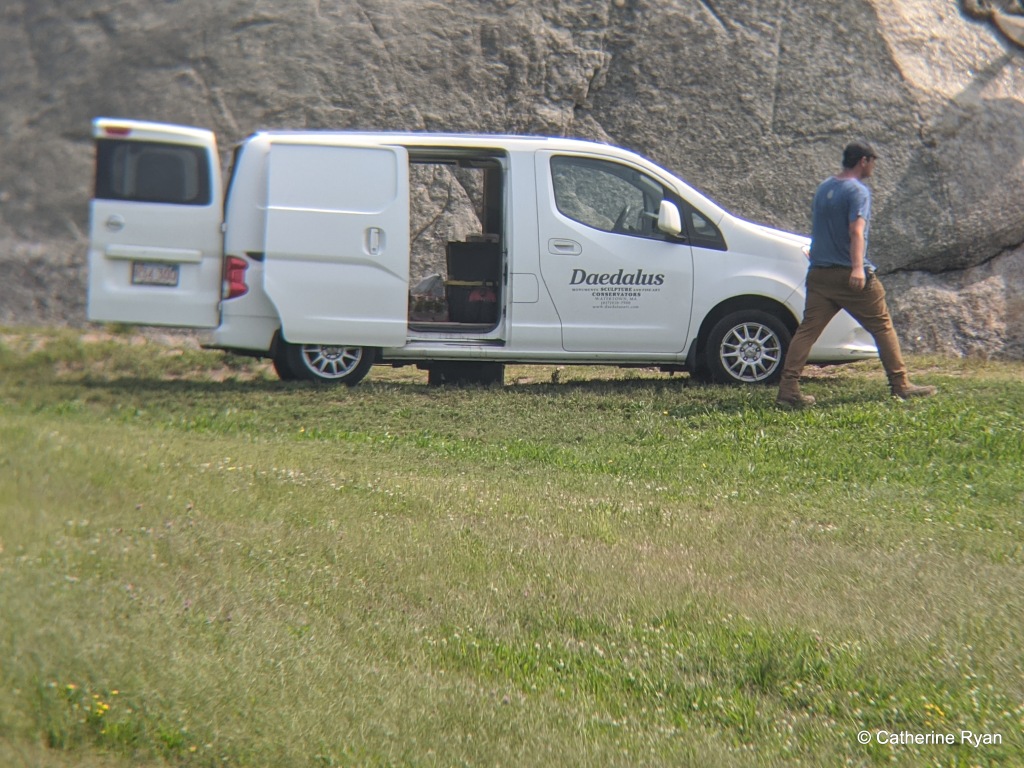
work in progress photos: Daedalus restoration
About
The enormous 20th Century plaque on Tablet Rock in Stage Fort Park commemorating the first permanent European settlement, the “Founding of the Massachusetts Bay Colony in 1623”, was dedicated in August 1907. James R. Pringle was designated to write the inscription. The execution of the design and bas relief border was by Eric Pape.
“The nautical scheme of decorative framework and embellishment was the composite suggestion” of various committees dating as far back as the 1880s.
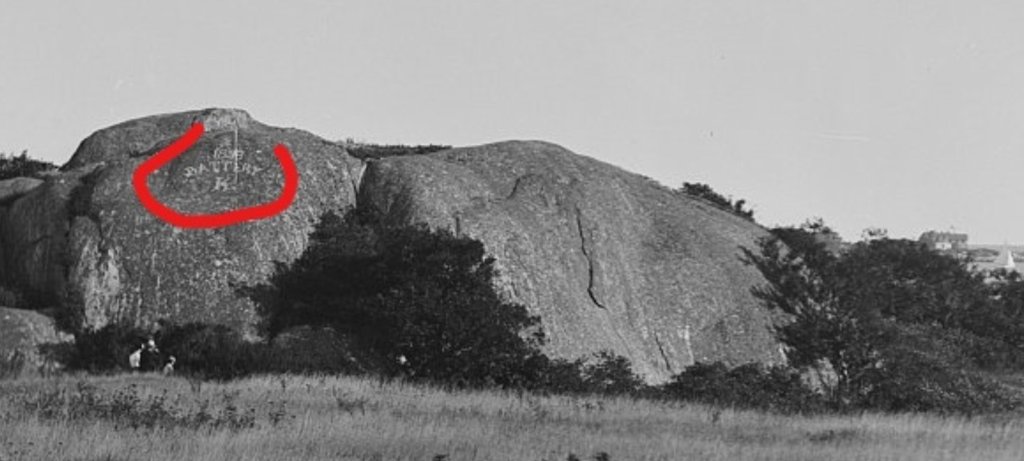
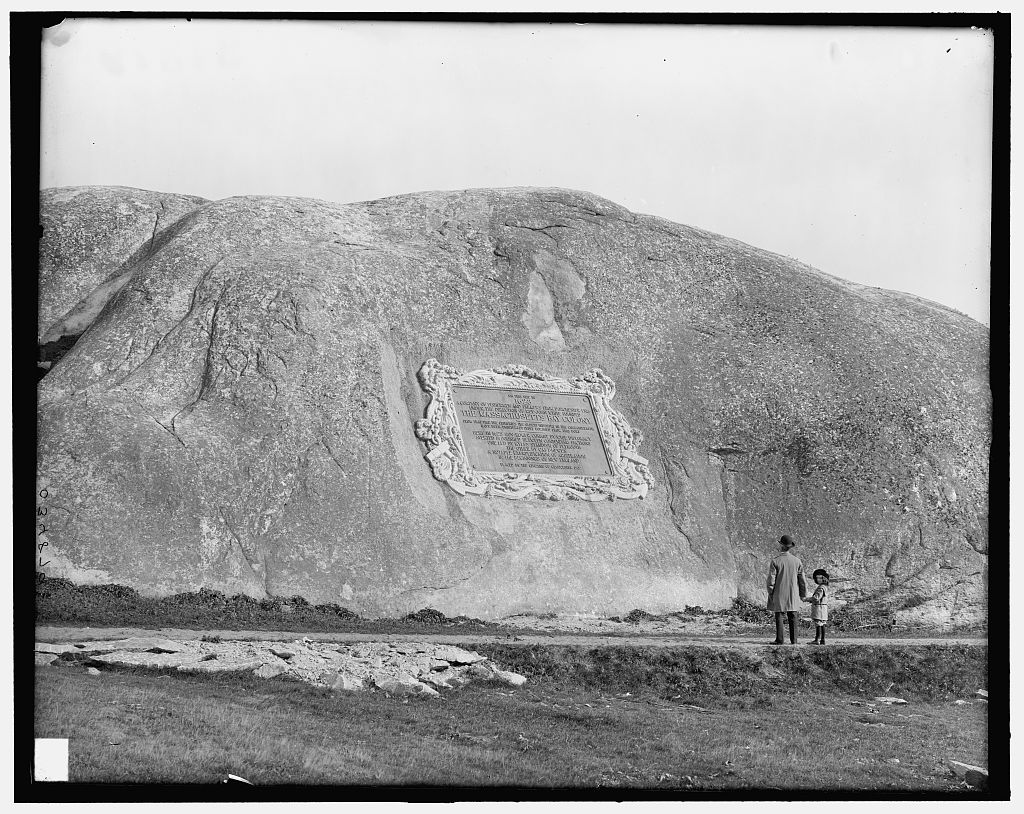
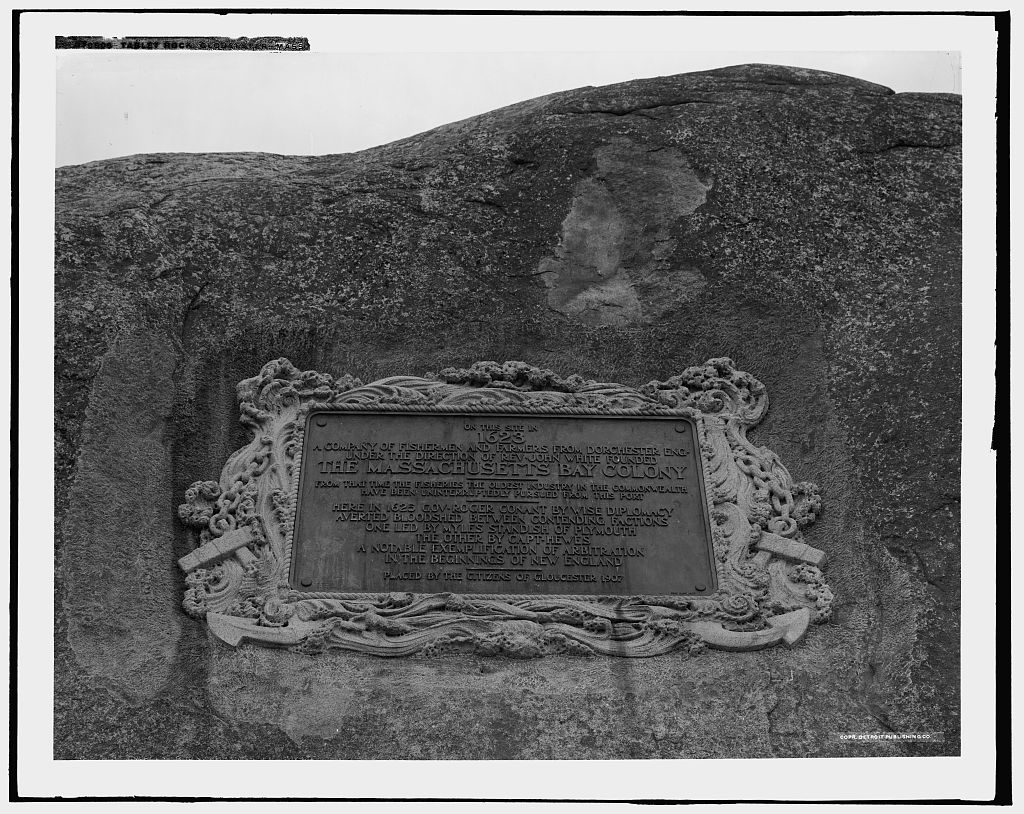
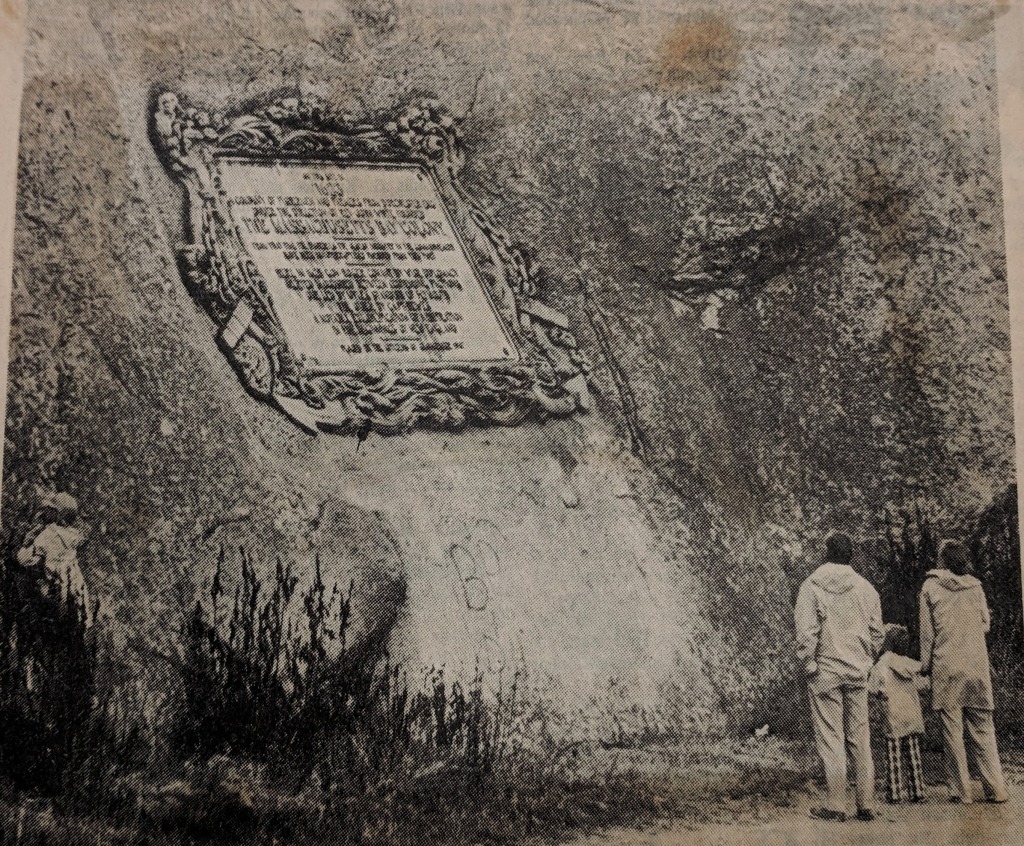

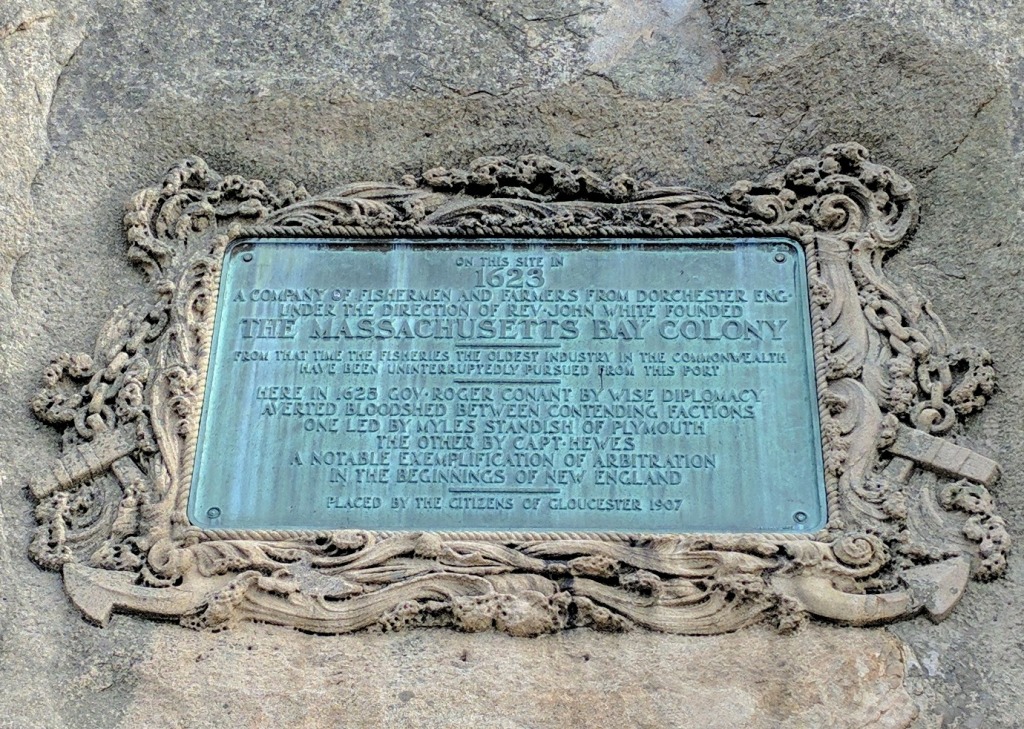
Image block documenting how Tablet Rock looked pre bronze tablet through today: before the plaque, 1901 (branded Battery K still visible); 1907 dedication, Library of Congress (Hammond with his daughter Natalie Hammond); 1970s; 1974 (graffiti beneath); 2016; 2019. Note the rectangular area beneath the plaque was lightened at the time of installation. The border carving degraded. The dark streaks accelerated after 2020 (note the verdigris patina 2016, 2019, etc)
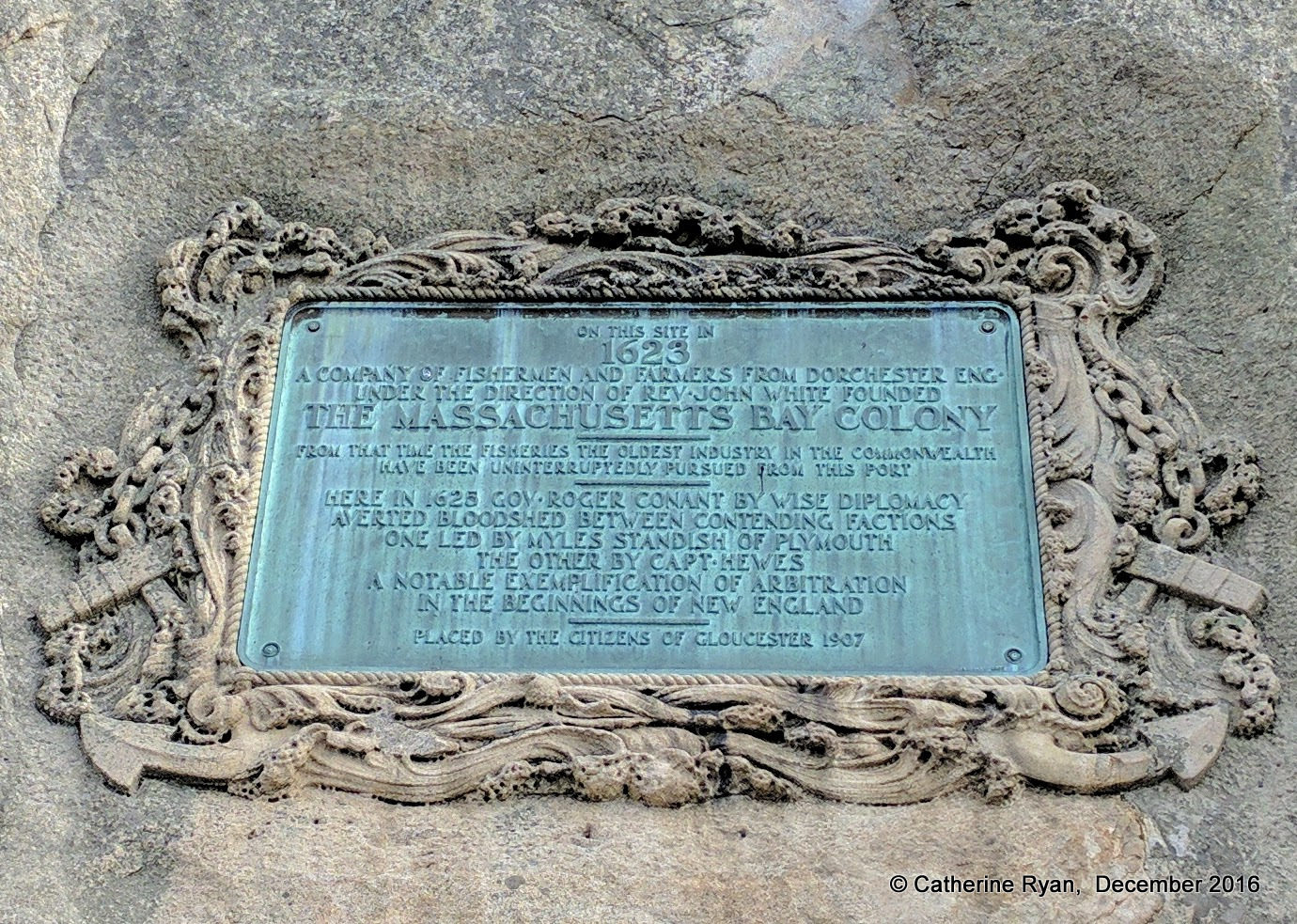

ON THIS SITE IN
1623
A COMPANY OF FISHERMEN AND FARMERS FROM DORCHESTER ENG.
UNDER THE DIRECTION OF REV. JOHN WHITE FOUNDED
THE MASSACHUSETTS BAY COLONY
____
FROM THAT TIME THE FISHERIES THE OLDEST INDUSTRY IN THE COMMONWEALTH
HAVE BEEN UNINTERRUPTEDLY PURSUED FROM THIS PORT
____
HERE IN 1625 GOV. ROGER CONANT BY WISE DIPLOMACY
AVERTED BLOODSHED BETWEEN CONTENDING FACTIONS
ONE LED BY MYLES STANDISH OF PLYMOUTH
THE OTHER BY CAPT HEWES
A NOTABLE EXEMPLIFICATION OF ARBITRATION
IN THE BEGINNINGS OF NEW ENGLAND
____
PLACED BY THE CITIZENS OF GLOUCESTER 1907
-transcription Founders Plaque. Tablet Rock. Stage Fort Park. Gloucester MA


New construction downtown.
I don’t know if this is the original applicant. Construction underway at Whistlestop Way near Doyon’s, between Dollar General and Auto Parts, where Google maps is labeled, ‘Family Dollar’. The new sign is ‘Ocean Breeze Craft Cannabis’


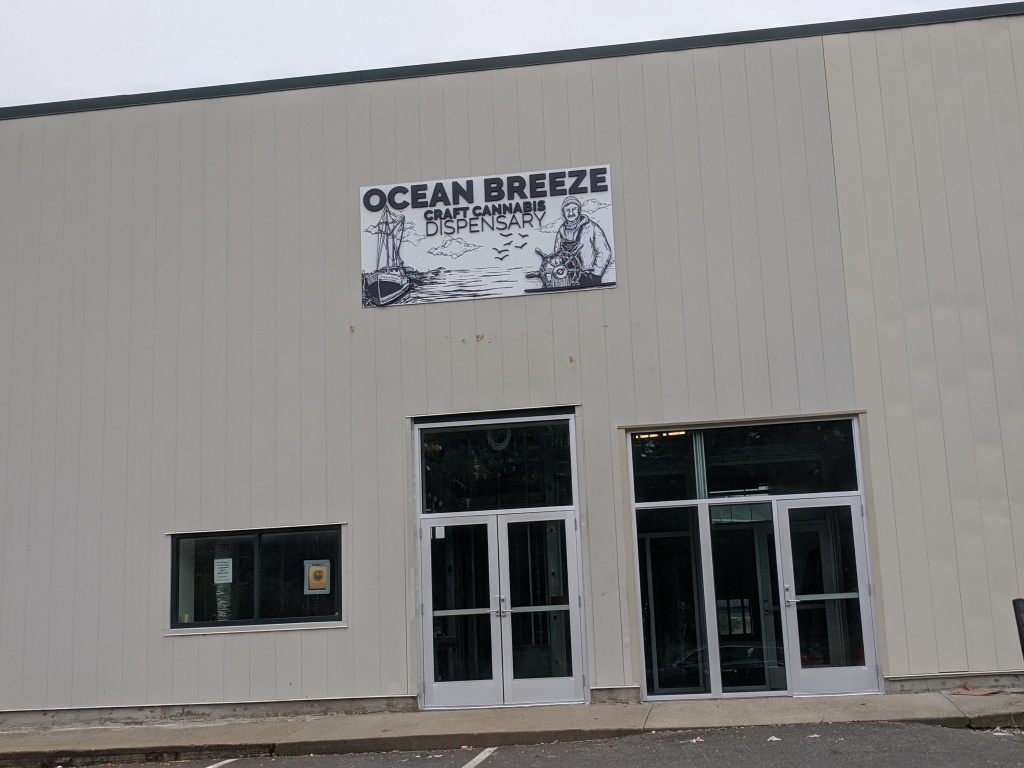

Answers


Construction news.
Chase is opening hundreds of branches in local communities including in Gloucester in one of the anchor buildings comprising Walgreens Plaza downtown. The firm renovating the structure for a flagship bank, in a space originally built out for a now shuttered Papa Gino’s restaurant, has built many for Chase already. The branch is located next to Dunkin’ Donuts and across from the Santander branch that opened in the yogurt store. It’s expected to open by January 2024.
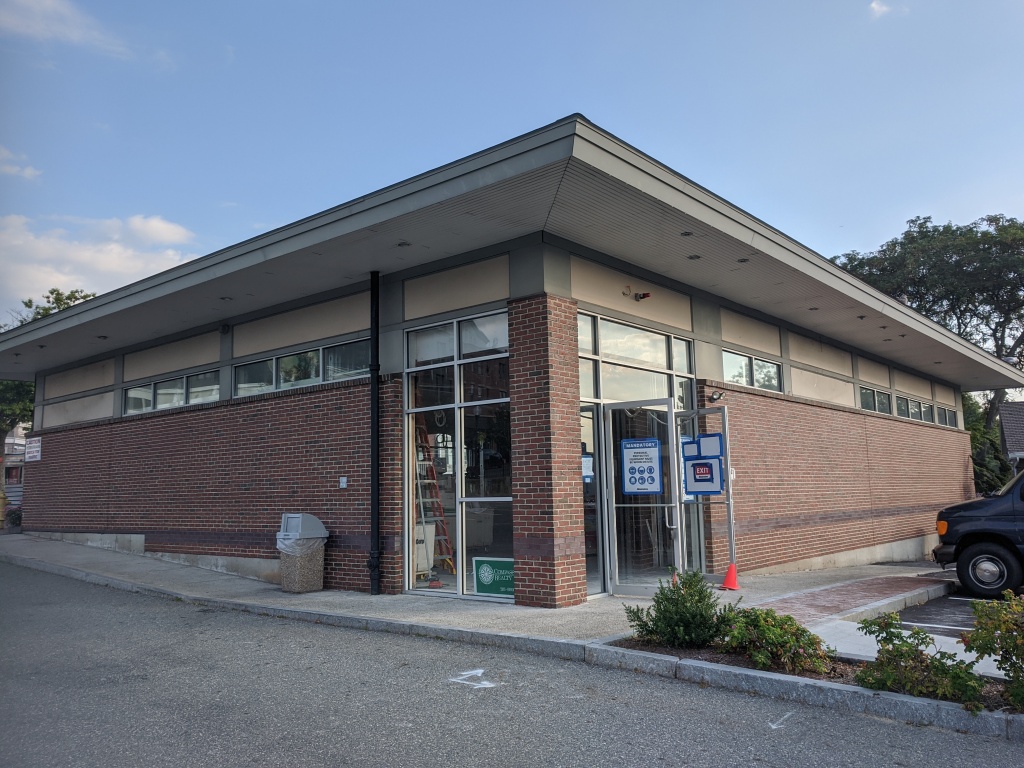


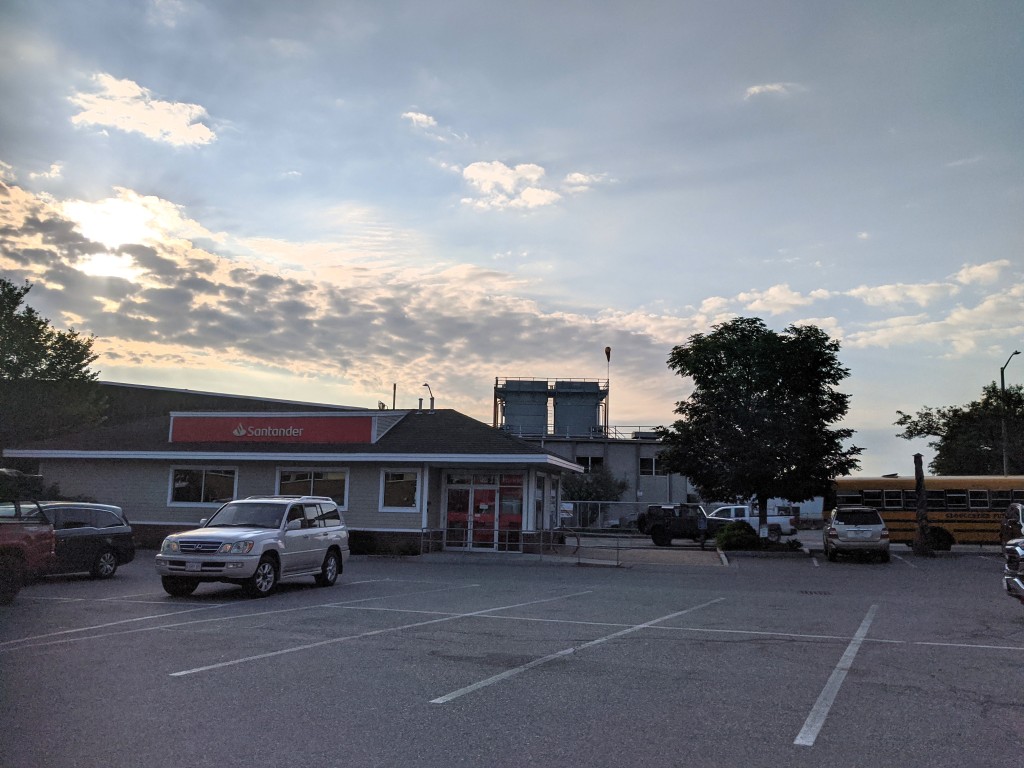
Responses to questions I’ve received about more construction:
The crane above and behind Walgreens is for renovation happening at police headquarters.

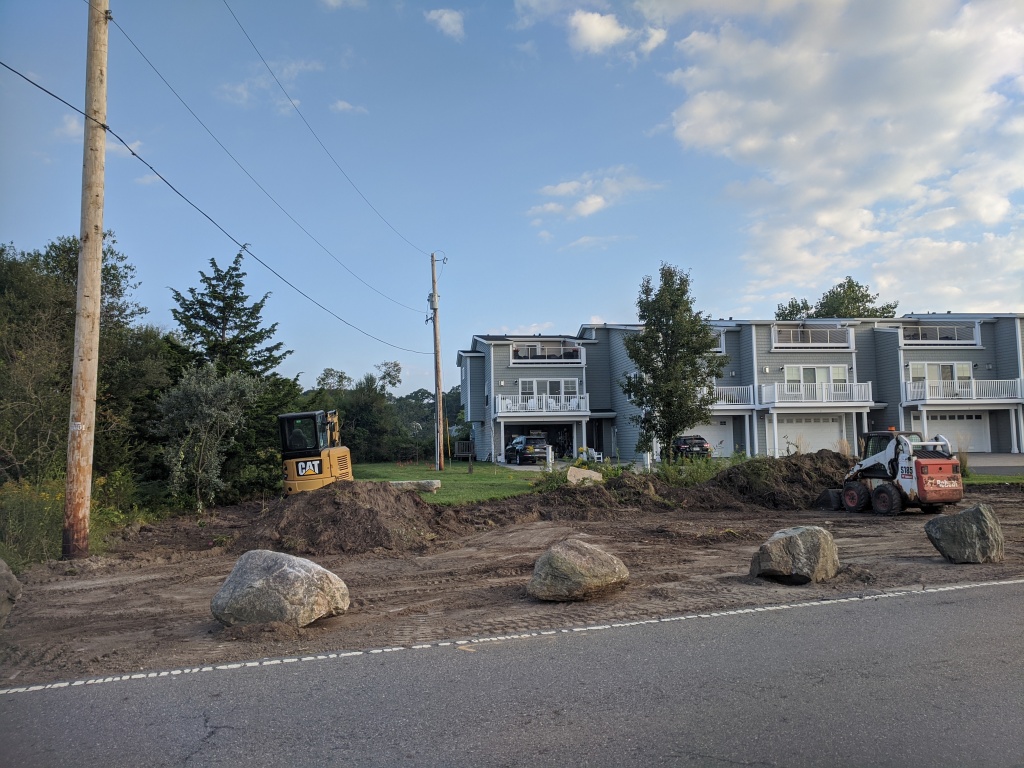
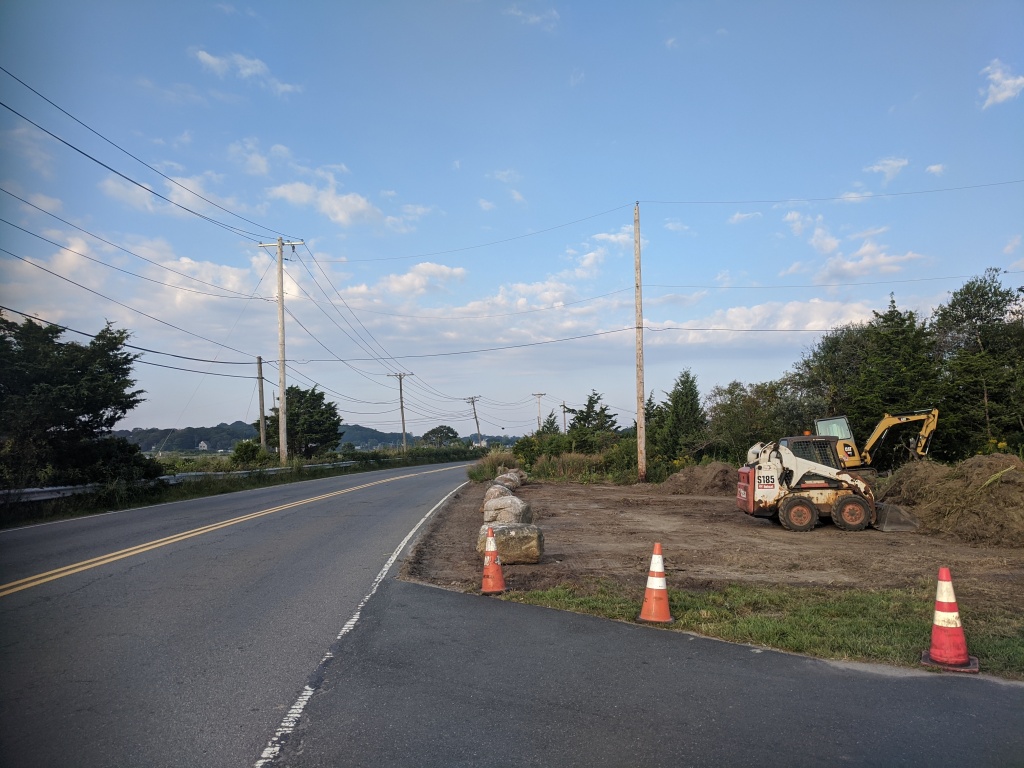
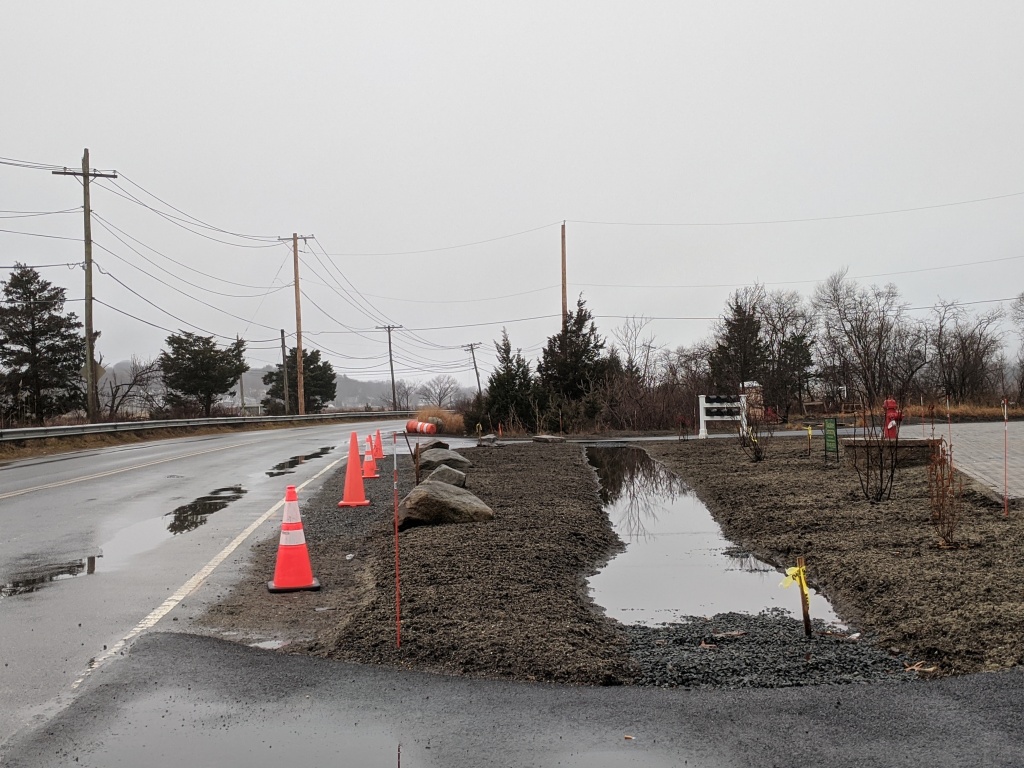
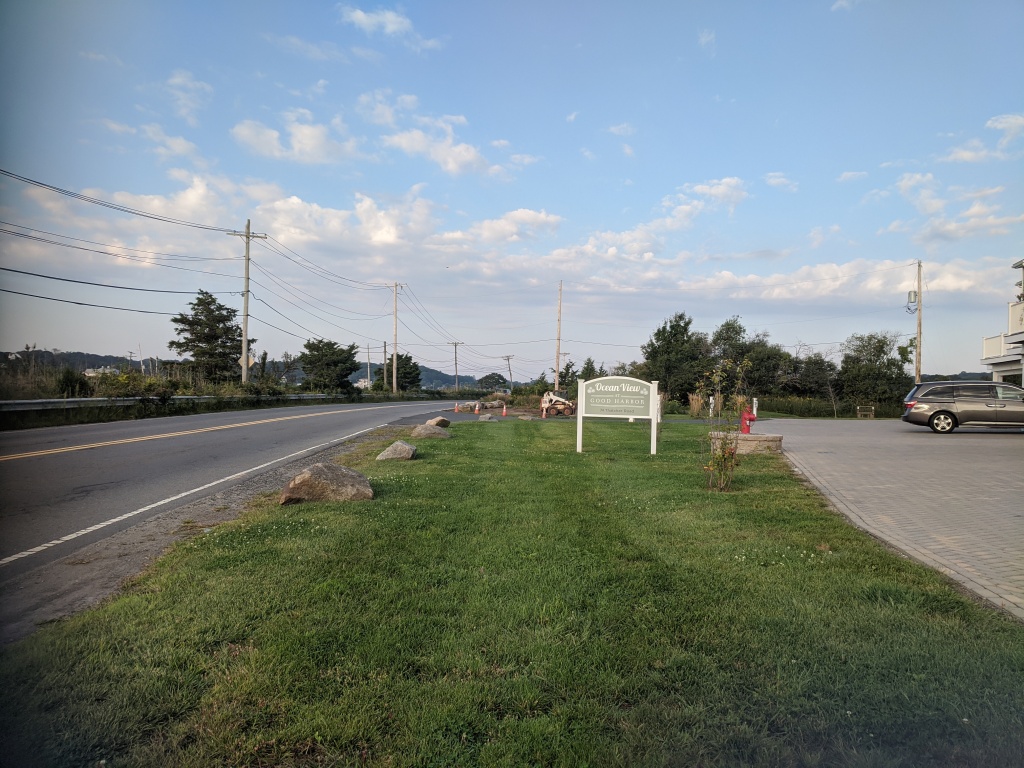
Further afield: not sure, but assuming the dig out by Thatcher Road condos is landscaping and it looks like a path (out back?). The sidewalk/path below grade that flooded and iced over was removed and a new sign added.

American sculptor Walker Hancock volunteered in many civic capacities while a Gloucester resident. While serving as the Chair of the city’s Art Committee in the 1950s, Hancock prepared a Master Plan that managed to forecast an array of evergreen topics: land use, zoning, preservation, open space, Main Street & downtown, public monuments, an arts commission, city improvements (like signage), beautification (trees and blooms), health & safety, tributes, and history– and all through a practical cultural and economic vision.
Robert F. Brown, Harold C. Dexter, Myron U. Lamb, Frederick H. Norton served on this committee with Walker Hancock.

As a World War Two Monuments Men leader, Hancock had overseen the prioritization, protection, and eventual inventorying of tens of thousands of cultural works of significance looted by Nazis. A decade later, cataloguing Gloucester’s plentiful assets was a rather small job for this talented committee–especially with Hancock serving as Chairperson! A brief few sentences from this amazing document allude to his expertise:
“During the Second World War the Allied Expeditionary Force acted under a directive signed by General Eisenhower which required them “To take all measures consistent with military necessity to avoid damage to all structures of cultural, artistic, or historical value, and to assist wherever practicable in securing them from deterioration consequent upon the processes of war”.
To implement the directive of the Supreme Commander, lists of “Protected Monuments” were prepared, designating buildings of sufficient importance to justify the efforts to preserve them even during military operations. Many private houses were included in these lists.
We owe it to ourselves and to the Nation to be at least as solicitous in regard to our own heritage of such structures and to secure them wherever possible from deterioration consequent upon lack of appreciation or neglect.
Attached is a list of structures in Gloucester considered of sufficient architectural value to warrant special effort to preserve them. It is not a complete list and does not include many of the charming houses the destruction or mutilation of which would be a loss to the city as a whole…”
Committee’s Master Plan report (Chairman, Walker Hancock, for Gloucester, Mass., 1958)
Flash forward decades, from 2000-2023, multiple arts ordinances, inventories, and drafts of master arts plan were crafted and/or attempted. (Prior to 2000–and prior to Hancock– there were wonderful asset inventories. Gloucester has amazing archives!) I served on multiple arts related groups and commissions (roughly 2010-2018), the downtown Cultural District, Tourism, and various downtown working groups. Numerous ideas and topics now were covered in this 1958 report, and would have been extremely helpful to reference.
With the upcoming 2023 Comprehensive plan underway and the first public meeting coming September 9th, I thought the writing from 1958 would be of great interest. Read through to see what suggestions have been realized or incorporated and which might be worthy of attention again.
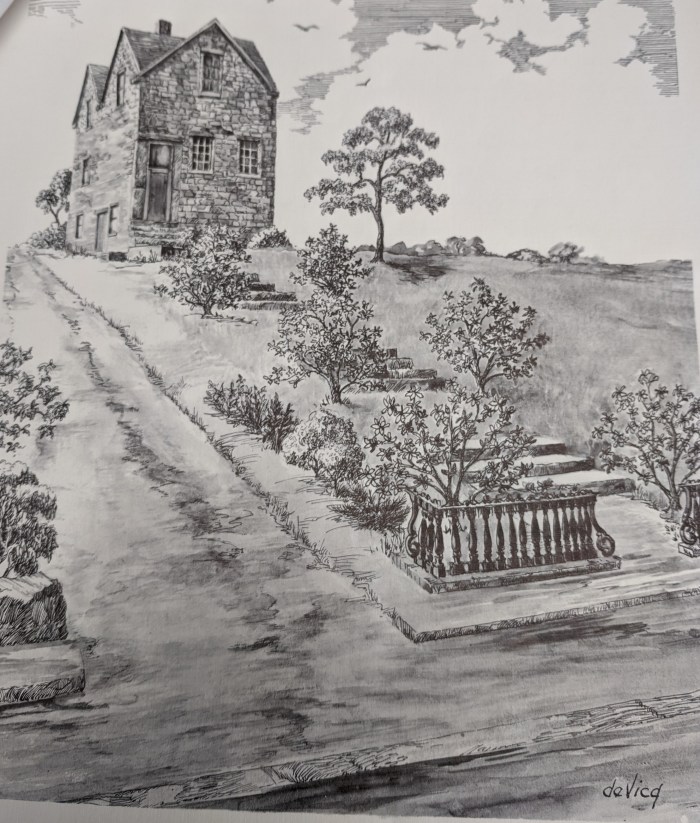
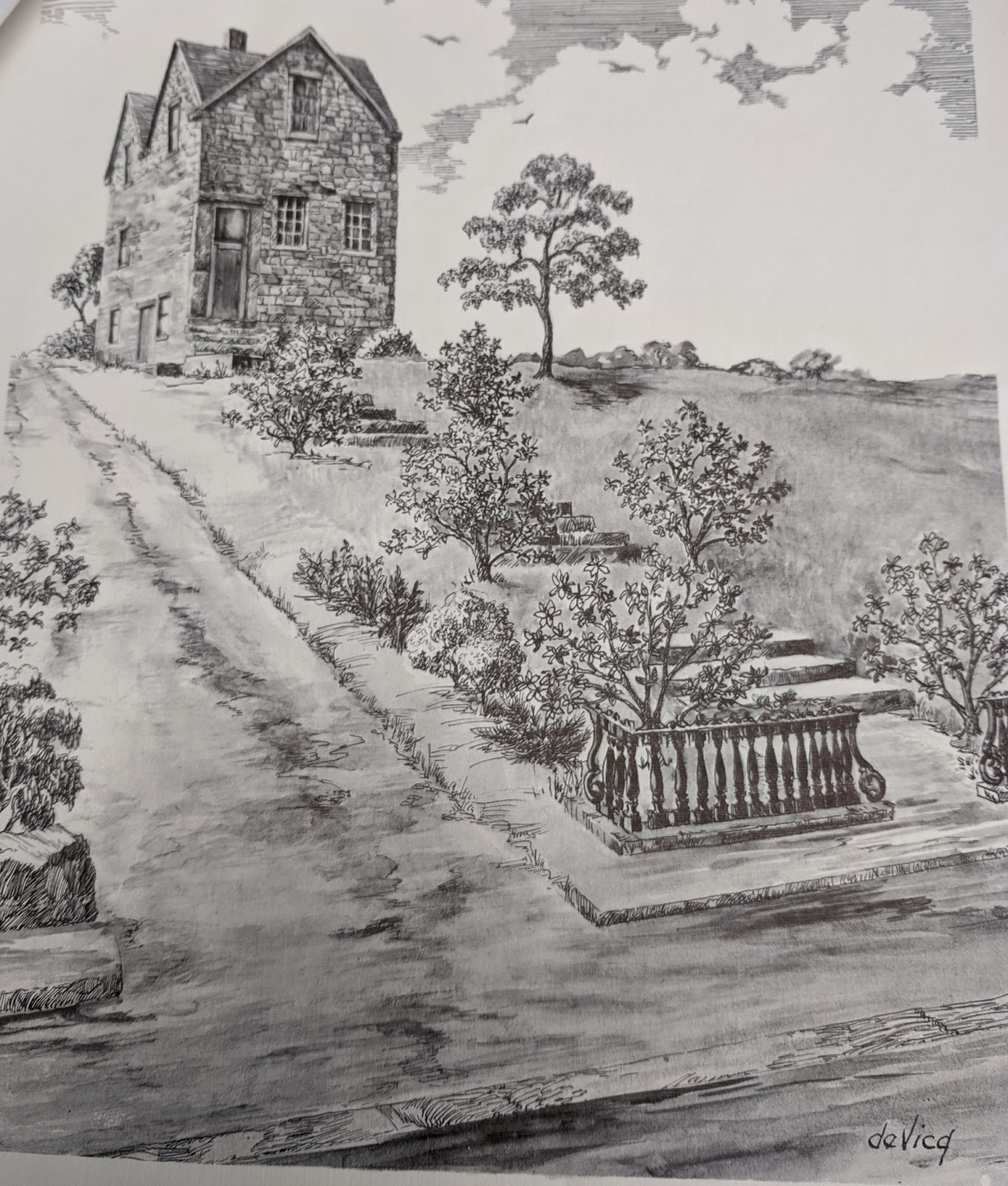
Image: For the 1958 report, artist Betty deVicq provided a rendering for a potential beautication of the Fitz Henry Lane House.
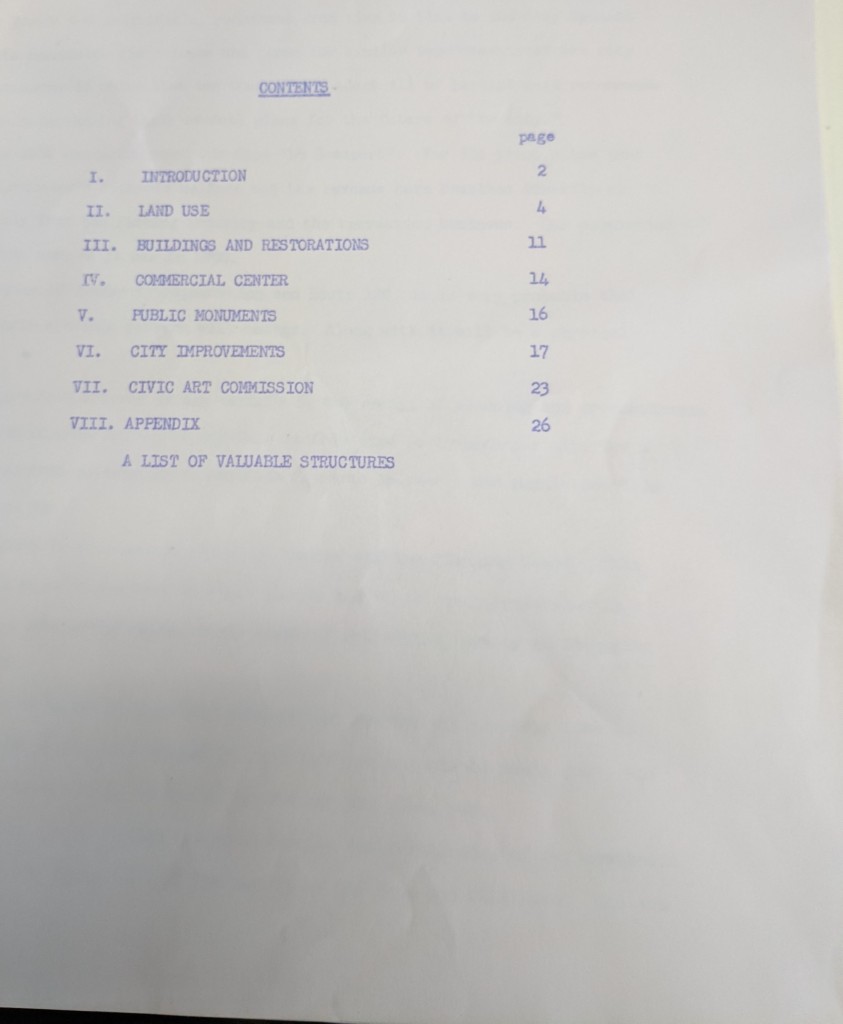
Contents
The following resolution was adopted on unanimous rising vote by the Municipal Council at its meeting in the White-Ellery House on August 1, 1957,
“Be it resolved that the Cape Ann Historical Association, together with other groups and individuals, recommend from time to time to the city Council and its successors their ideas and plans for similar improvements of the city of Gloucester in order that the Council may adopt all or part of said recommendations in furthering their overall plans for the future of the city.”
In 1606 Champlain named our Cape “Le Beauport”. For 334 years since that time Gloucester’s economic welfare and tax revenue have resulted directly or indirectly from the fishing industry and the recreation business. Our population now is the same as it was in 1890.
Because of modern transportation and Route 128, it is very probably that our historic economic pattern will change. Along with it will be a physical change.
The greatest success in any venture is the result of planning and preparedness. The most intelligent action we can take at this time is to plan our city for a changing economic pattern and a possible increase in year round population from 26,000 to 40,000.
Such plans revolve around the City Planner and the Planning Board. This report is to support the work of these people and to go one step further in a ld that is ordinarily beyond their scope of activities, but is an important adjunct to it.
Its purpose is to preserve and enhance the reasons why tourists come to Gloucester, why people will choose to live here and commute to their jobs, and many an industrialist would choose to locate his new plant here.
The subject can be called the preservation and furtherance of our aesthetic advantages, or the protection of the beauty we now have and will have. Its aim
is making the most of our natural beauties in contrast to the stereotyped and ugly procedures in other American communities.
The proposals contained in this report are based on two fundamentals: beauty and cost. Many can be adopted in the normal course of planning with no cost beyond that which would ordinarily be created, such as road signs. Others, such as a Recreation and Art Center, can be provided for as to location and adopted when cost permits. Some proposals can be adopted by the Council, some by private citizens.
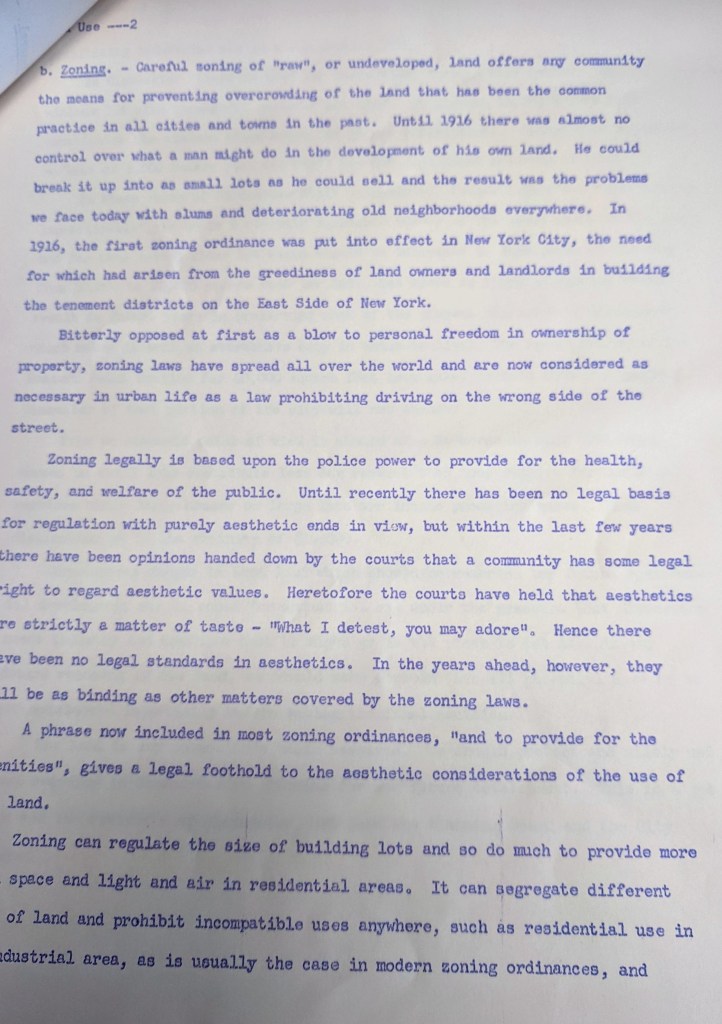
B. Zoning – Careful zoning of “raw”, or undeveloped, land offers any community the means for preventing overcrowding of the land that has been the common practice in all cities and towns in the past. Until 1916 there was almost no control over what a man might do in the development of his own land. He could break it up into as small lots as he could sell and the result was the problems we face today with slums and deteriorating old neighborhoods everywhere. In 1916, the first zoning ordinance was put into effect in New York City, the need for which had arisen from the greediness of land owners and landlords in building the tenement districts on the East Side of New York.
Bitterly opposed at first as a blow to personal freedom in ownership of property, zoning laws have spread all over the world and are now considered as necessary in urban life as a law prohibiting driving on the wrong side of the street.
Zoning legally is based upon the police power to provide for the health, safety, and welfare of the public. Until recently there has been no legal basis for regulation with purely aesthetic ends in view, but within the last few years there have been opinions handed down by the courts that a community has some legal right to regard aesthetic values. Heretofore the courts have held that aesthetics are strictly a matter of taste – “What I detest, you may adore”. Hence there have been no legal standards in aesthetics. In the years ahead, however, they will be as binding as other matters covered by zoning laws.
A phrase now included in most zoning ordinances, “and to provide for the communities”, gives a legal foothold to the aesthetic considerations of the use of land.
Zoning can regulate the size of building lots and so do much to provide more space and light and air in residential areas. It can segregate different use of land and prohibit incompatible uses anywhere, such as residential use in an industrial area, as is usually the case in modern zoning ordinances, and
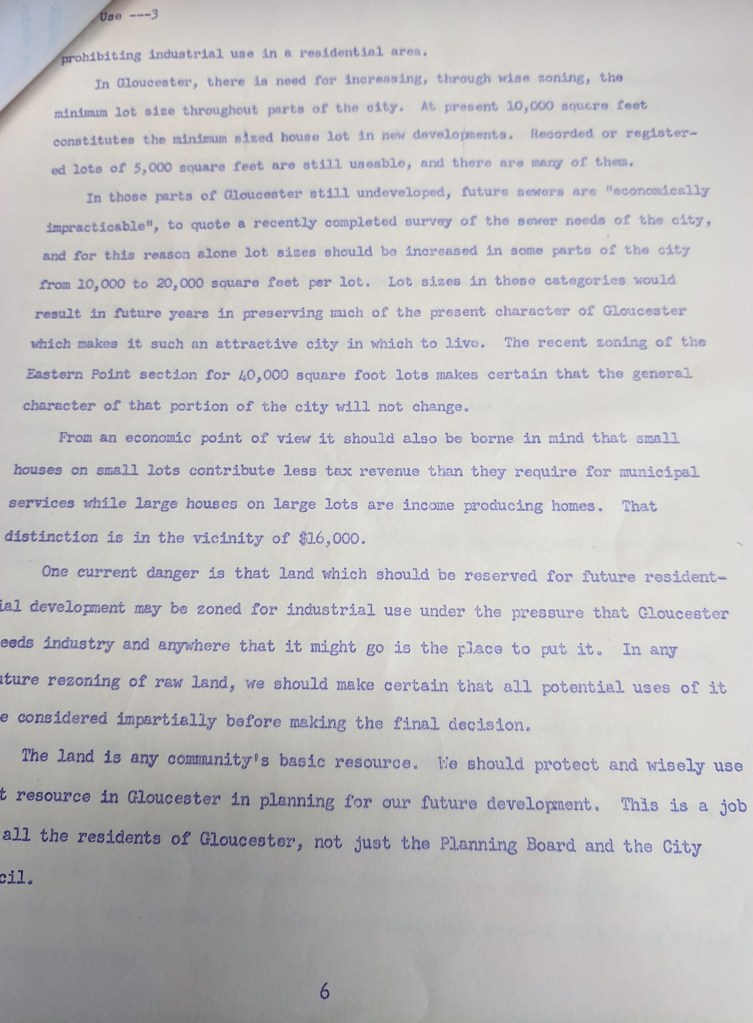
Land Use – 3
Prohibiting industrial use in a residential area.
In Gloucester, there is need for increasing, through wise zoning, the minimum lot size throughout parts of the city. At present 10,000 square feet constitute the minimum sized house lot in new developments. Recorded or registered lots of 5,000 square feet are still usable, and there are many of them.
In those parts of Gloucester still undeveloped, future sewers are “economically impracticable”, to quote a recently completed survey of the sewer needs of the city, and for this reason alone lot sizes should be increased in some parts of the city from 10,000 to 20,000 square feet per lot. Lot sizes in these categories would result in future years in preserving much of the present character of Gloucester which make it such an attractive city in which to live. The recent zoning of the Eastern Point section for 40,000 square foot lots makes certain that the general character of that portion of the city will not change.
From an economic point of view it should also be borne in mind that small houses on small lots contribute less tax revenue than they require for municipal services while large houses on large lots are income producing homes. That distinction is in the vicinity of $16,000.
One current danger is that land which should be reserved for future residential development may be zoned for industrial use under the pressure that Gloucester needs industry and anywhere that it might go is the place to put it. In any future rezoning of raw land,
“we should make certain that all potential uses of it are considered impartially before making the final decision. The land is any community’s basic resource. We should protect and wisely use that resource in Gloucester in planning our future development. This is a job for all the residents of Gloucester, not just the planning board and the city council.”
1958 Committee Report for Gloucester, MA, Chairman Walker Hancock
Land Use – 4
A Citizen’s Council for city planning should be organized to work in consultation with the planning board to insure that the city’s comprehensive plan is in keeping with the best interests of the community, and to support the Planning Board in carrying it out. This council should be composed of a cross section of the various interests represented among the tax-payers of Gloucester, such as merchants, industrialists, real estate agents, home owners, educators, etc. Such a group, which should be as small as possible, consistent with balanced representation, would provide a democratic safeguard against infringements upon the best public interest.
C. Reservations.– The attractions that have made Gloucester famous a summer resort are not merely places for swimming and boating and other amusements. The appeal to the summer vacationist, as well as to people seeking an all year-round residence, of large areas of unspoiled woods, moorland, and shore without artificial “tourist conveniences” can hardly be overestimated. The existence on Cape Ann of such features has brought to our city great numbers of people who prefer them to the kind of tourist amusements offered, for example, by Salisbury and Revere beach. Our good fortune in having an established community of this character should be recognized in time to preserve it.
Fortunately, Ravenswood Park, Stage Fort Park, the Magnolia Shore Reservation, and Mount Ann have been saved for the future. Mr. Roger Babson’s recent gift to the Cape Ann Historical Association promises possibilities of making the main entrance to the city impressive, handsome, and of unusual interest to the tourist. Start has been made at Plum Cove by the action of the Municipal Council in setting the area aside for future use as a school site and recreational area. But these reservations would be far from adequate even for a city the present size of Gloucester were it not for the other open areas that will soon be lost to us unless some action is taken.
Land Use – 5
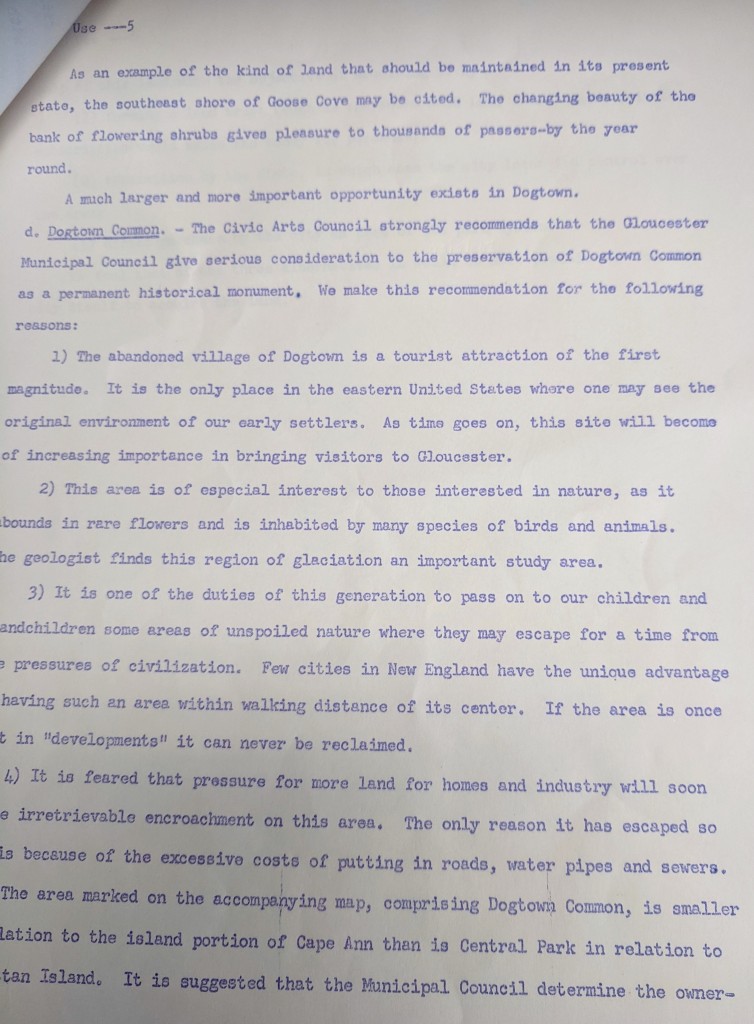
As an example of the kind of land that should be maintained in its present state, the southeast shore of Goose Cove may be cited. The changing beauty of the bank of flowering shrubs gives pleasure to thousands of passers-by the year round.
A much larger and more important opportunity exists in Dogtown.
D. Dogtown Common. – The Civic Arts Council strongly recommends that the Gloucester Municipal Council give serious consideration to the preservation of Dogtown Common as a permanent historical monument. We make this recommendation for the following reasons:
1)The abandoned village of Dogtown is a tourist attraction of the first magnitude. It is the only place in the eastern United States where one may see the original environment of our early settlers. As time goes on, this site will become of increasing importance in bringing visitors to Gloucester.
2)This area is of especial interest to those interested in nature, as it abounds in rare flowers and is inhabited by many species of birds and animals. The geologist finds this region of glaciation an important study area.
3)It is one of the duties of this generation to pass on to our children and grandchildren some areas of unspoiled nature where they may escape for a time from the pressures of civilization. Few cities in New England have the unique advantage of having such an areas within walking distance of its center. If the area is once in “developments” it can never be reclaimed.
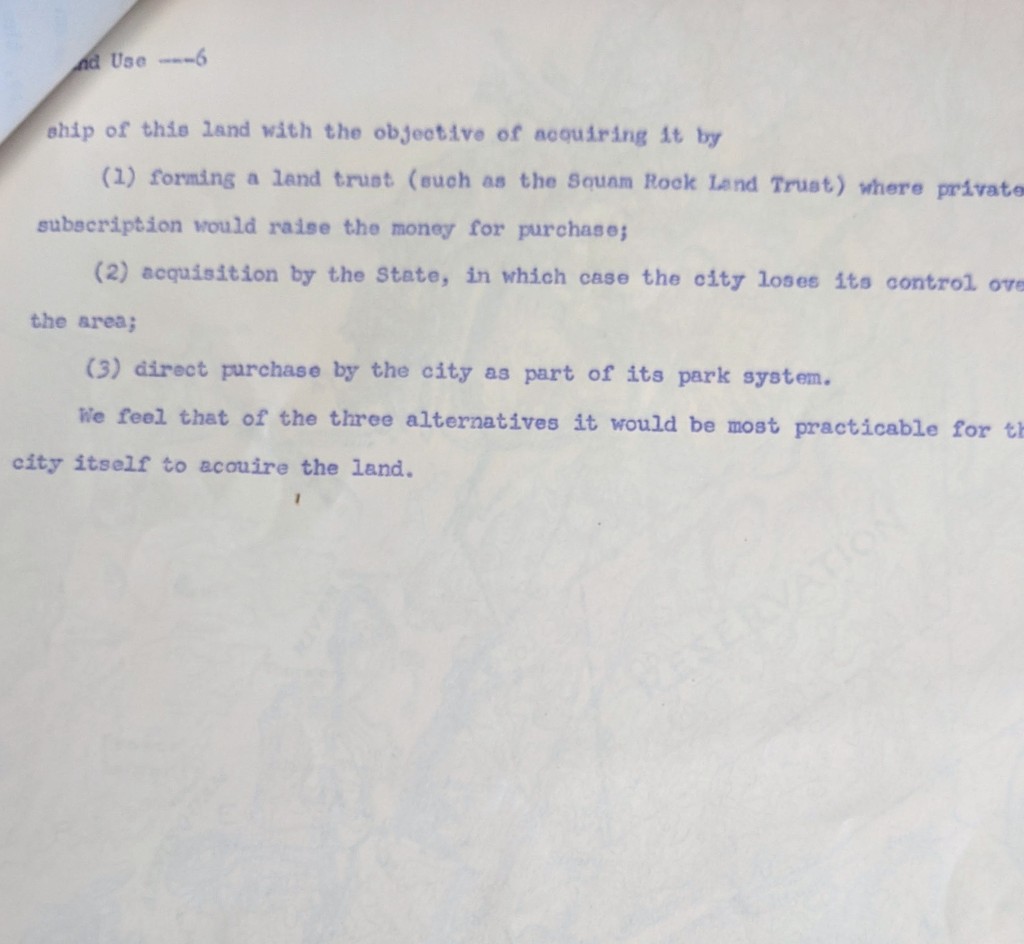
4)It is feared that pressure for more land for homes and industry will soon irretrievable encroachment on this area. The only reason it has escaped so far is because of the excessive costs of putting in roads, water pipes and sewers. The area marked on the accompanying map, comprising Dogtown Common, is smaller in relation to the island portion of Cape Ann than is Central Park in relation to Staten Island. It is suggested that Municipal Council determine the owner-
Land Use – 6
ship of this land with the objective of acquiring it by
(1)forming a land trust (such as the Squam Rock Land Trust) where private subscription would raise the money for purchase;
(2) acquisition by the State, in which case the city loses its control over the area;
(3) direct purchase by the city as part of its park system
We feel that of the three alternatives it would be most practicable for the city itself to acquire the land.
During the Second World War the Allied Expeditionary Force acted under a directive signed by General Eisenhower which required them “To take all measures consistent with military necessity to avoid damage to all structures of cultural, artistic, or historical value, and to assist wherever practicable in securing them from deterioration consequent upon the processes of war”.
To implement the directive of the Supreme Commander, lists of “Protected Monuments” were prepared, designating buildings of sufficient importance to justify the efforts to preserve them even during military operations. Many private houses were included in these lists.
We owe it to ourselves and to the Nation to be at least as solicitous in regard to our own heritage of such structures and to secure them wherever possible from deterioration consequent upon lack of appreciation or neglect.
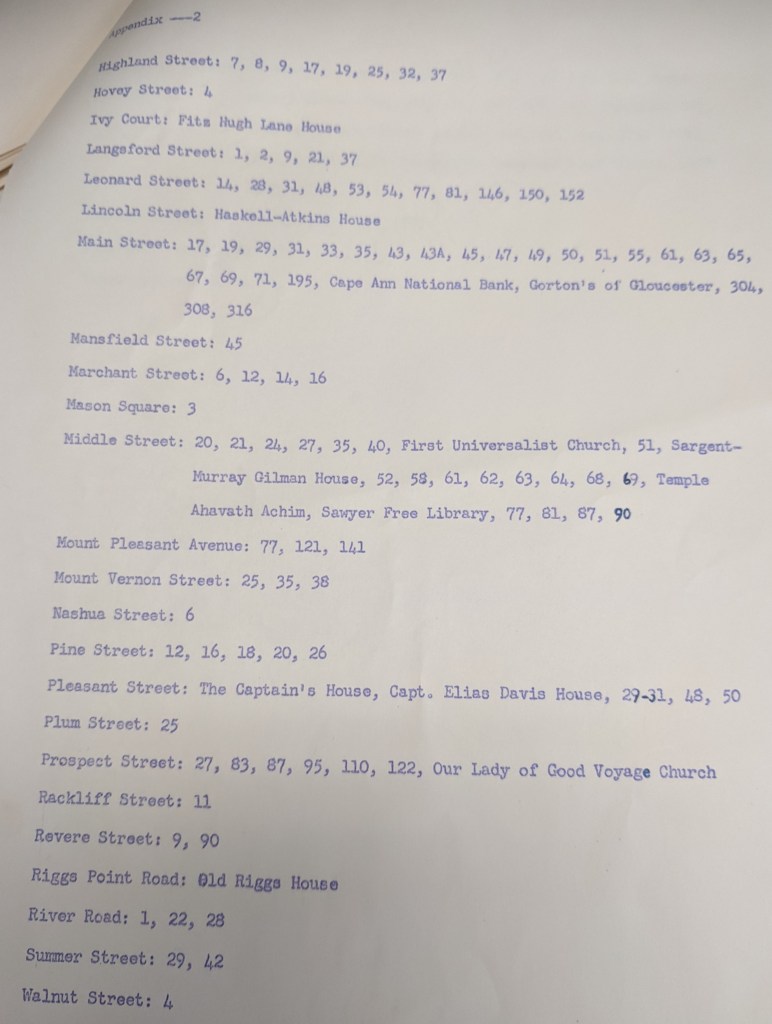
Attached is a list of structures in Gloucester considered of sufficient architectural value to warrant special effort to preserve them. It is not a complete list and does not include many of the charming houses the destruction or mutilation of which would be a loss to the city as a whole.
In the eyes of posterity the Universalist Church, the birthplace of Universalism, will undoubtedly be the most important monumental building that the city possesses. Its exceptionally fine proportions and detail and the great beauty of its tower make it one of the precious examples of American architecture of its period. The City Hall and the Church of Our Lady of the Good Voyage are both Gloucester landmarks of special significance–the former because of the impressiveness of its mass and dominant position which it occupies in the city, the latter because of its carillon, its twin towers, and celebrated statue. The towers of all three of these buildings have been made famous by countless paintings which are shown all over the country.
Gloucester has few residences of the architectural pretentious of many in Salem and Newburyport. Nevertheless, it contains many old houses that have a distinctive quality that contribute more than is generally realized to the
Buildings and restorations – 2
Character of the city . Many such houses have already been superficially spoiled. It would be possible to restore most of the houses that have been unwisely covered with substitute materials by the use of appropriate siding and painting. The Civic Art Committee holds itself ready to advise on the proposed alteration or restoration of any such building. The aid of this Committee is proffered in cases where community effort is needed to restore churches designated in the list by brining to the attention of citizens the importance of the project.
The west end of Main Street offers a remarkable opportunity for restoration that would give real distinction to the neighborhood near the Legion Hall and the Town Landing. The brick houses on the water side from Town Landing to the STrand Theater were built in 1832, the result of a friendly agreement between the families concerned to create an entire street front that should be harmonious. It would require only a similar public spirited move on the part of the present owners and a surprisingly small investment of money to put back street floor entrances and windows as they were originally and make the west end of Main Street an inviting section of the commercial district. If private initiative and means are lacking, some of the uses suggested for certain of these buildings are: a community art center, another club or meeting place, a fisheries museum – or the whole area might be revitalized as a shopping section. This is an opportunity that should not be wasted.
Enclosed is a sketch of the Fitz Hugh (sic) Lane House dominating a parking lot in the Locust Street area to show how the restoration of a historic site can be effectively combined with modern commerce.
Among the new buildings needed in Gloucester, a Recreation Center and an art Center are of prime importance. It is hoped that the sites, at least, for these projects can be determined in the near future with a view to arousing the necessary public interest to insure their eventual realization. Again, this committee stands ready to advise on the location or design of such buildings.
Illustration: Betty deVicq drawing circa 1958 [rendering of potential restoration of “Stone jug” on Ivy Court, overlooking Duncan street, the former home and studio of Fitz Henry Lane.]
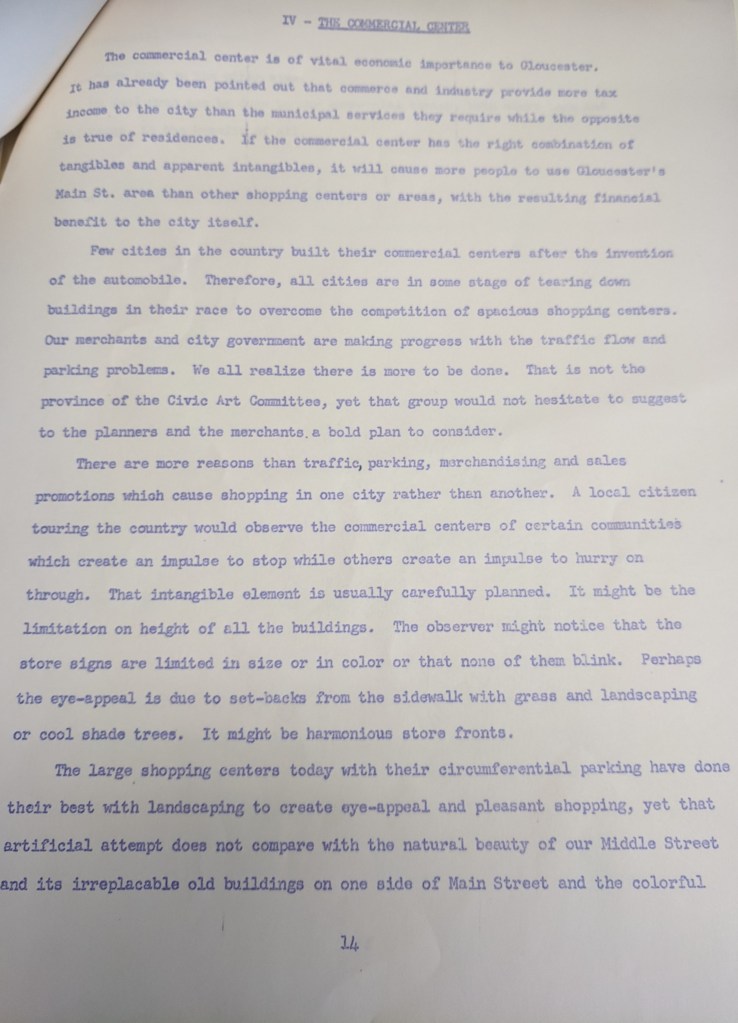
The commercial center is of vital economic importance to Gloucester. It has already been pointed out that commerce and industry provide more tax income to the city than the municipal services they require while the opposite is true of residences. If the commercial center has the right combination of tangibles and apparent intangibles, it will cause more people to use Gloucester’s Main St. area than other shopping centers or areas, with the resulting financial benefit to the city itself.
Few cities in the country built their commercial centers after the invention of the automobile. Therefore, all cities are in some stage of tearing down buildings in their race to overcome the competition of spacious shopping centers. Our merchants and city government are making progress with the traffic flow and parking problems. We all realize there is more to be done. That is not the province of the Civic Art Committee, yet that group would not hesitate to suggest to the planners and the merchants a bold plan to consider.
There are more reasons than traffic, parking, merchandising and sales promotions which cause shopping in one city rather than another. A local citizen touring the country would observe the commercial centers of certain communities which create an impulse to stop while others created an impulse to hurry on through. That intangible element is usually carefully planned. It might be the limitation on height of all the buildings. The observer might notice that the store signs are limited in size or in color or that none of them blink. Perhaps the eye-appeal is due to set-backs from the sidewalk with grass and landscaping or cool shade trees. It might be harmonious store fronts.
The large shopping centers today with their circumferential parking have done their best with landscaping to create eye-appeal and pleasant shopping, yet that artificial attempt does not compare with natural beauty of our Middle Street, and its irreplaceable old buildings on one side of Main Street and the colorful
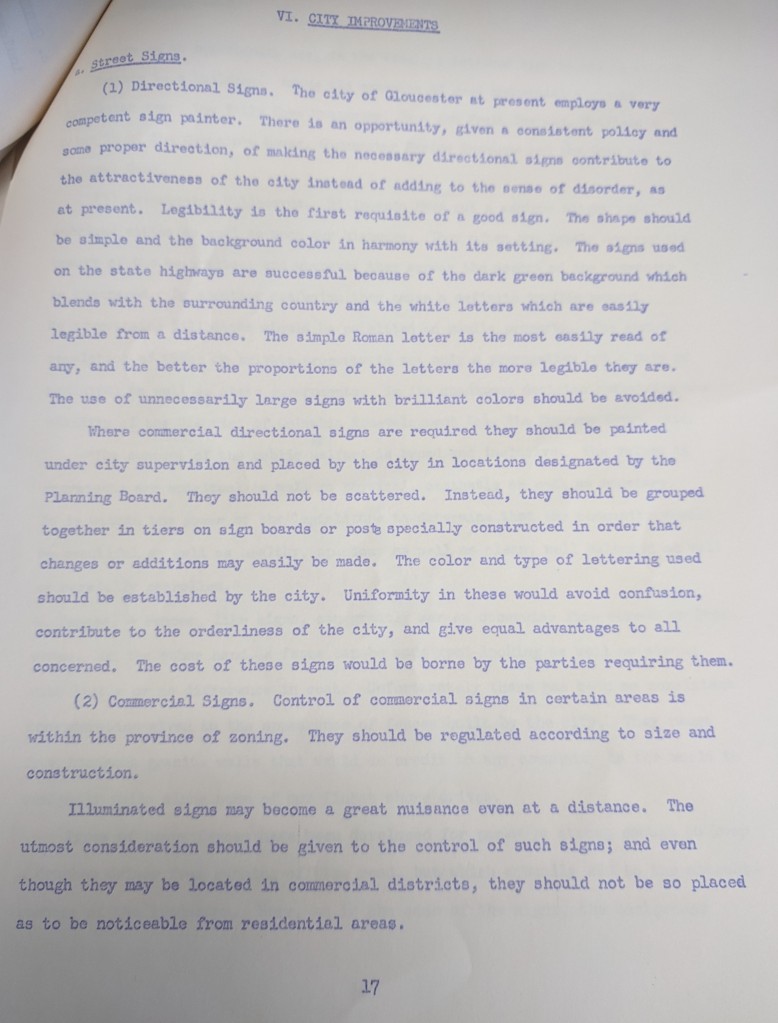
a. Street Signs
Where commercial directional signs are required they should be painted under city supervision and placed by the city in locations designated by the Planning Board. They should not be scattered. Instead, they should be grouped together in tiers on sign boards or post specially constructed in order that changes or additions may easily be made. The color and type of lettering used should be established by the city. Uniformity in these would avoid confusion, contribute to the orderliness of the city, and give equal advantages to all concerned. The cost of these signs would be borne by the parties requiring them.
Illuminated signs may become a great nuisance even at a distance. The utmost consideration should be given to the control of such signs; and even though they be located in commercial districts, they should not be placed as to be noticeable from residential areas.
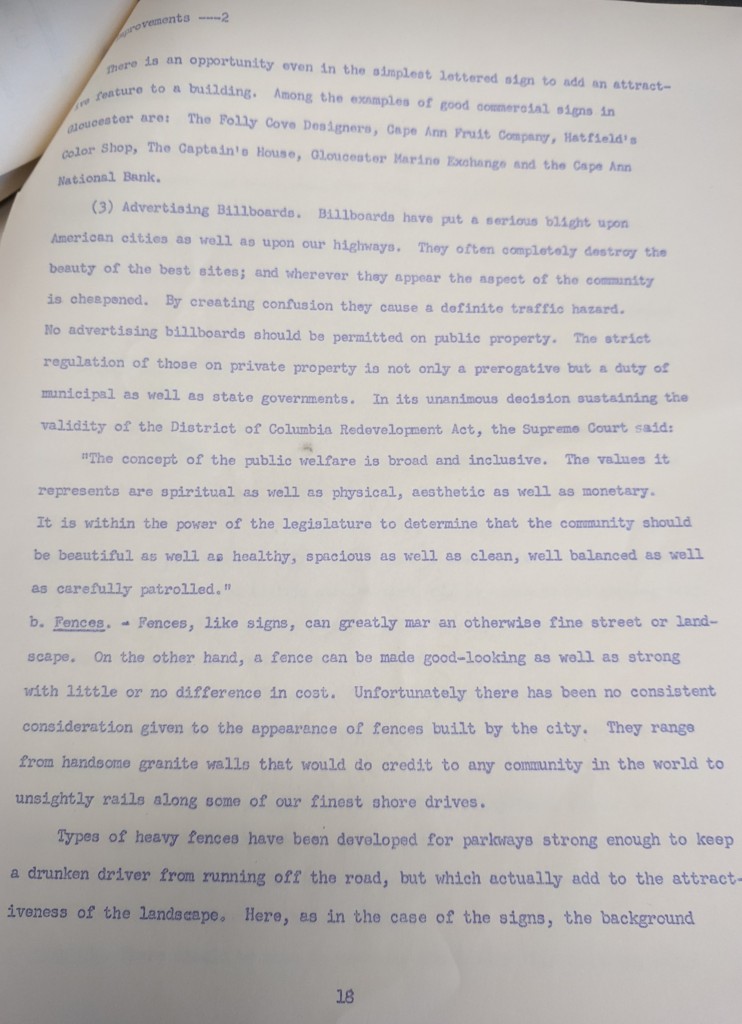
Improvements–2
There is an opportunity even in the simplest lettered sign to add an attractive feature to a building. Among the examples of good commercial signs in Gloucester are: The Folly Cove Designers, Cape Ann Fruit Company, Hatfields Color Shop, the Captain’s House, Gloucester Marine Exchange, and the Cape Ann National Bank.
“The concept of the public welfare is broad and inclusive. The values it
represents are spiritual as well as physical, aesthetic as well as monetary.
It is within the power of the legislature to determine that the community
should be beautiful as well as healthy, spacious as well as clean, well
balanced as well as carefully patrolled.”
b. Fences. – Fences, like signs, can greatly mar an otherwise fine street or landscape. On the other hand, a fence can be made good-looking as well as strong with little or no difference in cost. Unfortunately there has been no consistent consideration given to the appearance of fence built by the city. They range from handsome granite walls that would do credit to any community in the world to unsightly rails along some of our finest shore drives.
Types of heavy fences have been developed for parkways strong enough to keep a drunken driver from running off the road, but which actually add to the attractiveness of the landscape. Here, as in the case of signs, the background
Improvements –3
should be taken into consideration in selecting the appropriate type of construction.
c. Trash containers. It is hoped that an awakened city pride will result in some degree of care about the disposal of rubbish. Trash containers, strategically placed, will help as reminders as well as to provide the means of easy rubbish disposal. However, the trash containers themselves should not be unsightly. Sufficient attention can be directed to them without the use of garish colors. White lettering on dark backgrounds will generally be found preferable.
d. Cleaning and Policing of Roads. – Miles of gloucester’s scenic shore roads are constantly littered with rubbish. Strict enforcement of existing ordinances with some exemplary prosecutions, should go far toward correcting this situation.
e. Place Names and Markers. – It is an important duty of the community to keep alive in the minds of its younger people the achievements of citizens who have brought honor to it in the past. Place names and monuments are a perpetual reminder of the example of courage and moral strength set by our forbears. As the names of Washington and Lincoln give inspiration to the nation, so should the names of Gloucester’s courageous sea faring men inspire this and future generations of our citizens. These men should be memorialized in the names of new streets, squares, and traffic circles that will be added to the growing city. In addition to the name, markers should recount briefly the heroic act for which each man is remembered. Among those who should be honored in this manner are Howard Blackburn, Marty Welch, Alfred Johnson, Clayton Morissey, Sol Jacobs, and Alden Geale; and there are other men still living who should be given the same recognition.
“The sites of the old shipyards, about a dozen altogether, should be appropriately marked, to include the names of the more famous schooners built at that location. Site marking should be carried to other locations of interest, such as the Steamboat Wharf at Duncan’s Point.”
This would have been great incorporated into the HarborWalk markers–and a wonderful Schooner Festival trail brochure.
f. Planting. There should be more to the city physically than building walls
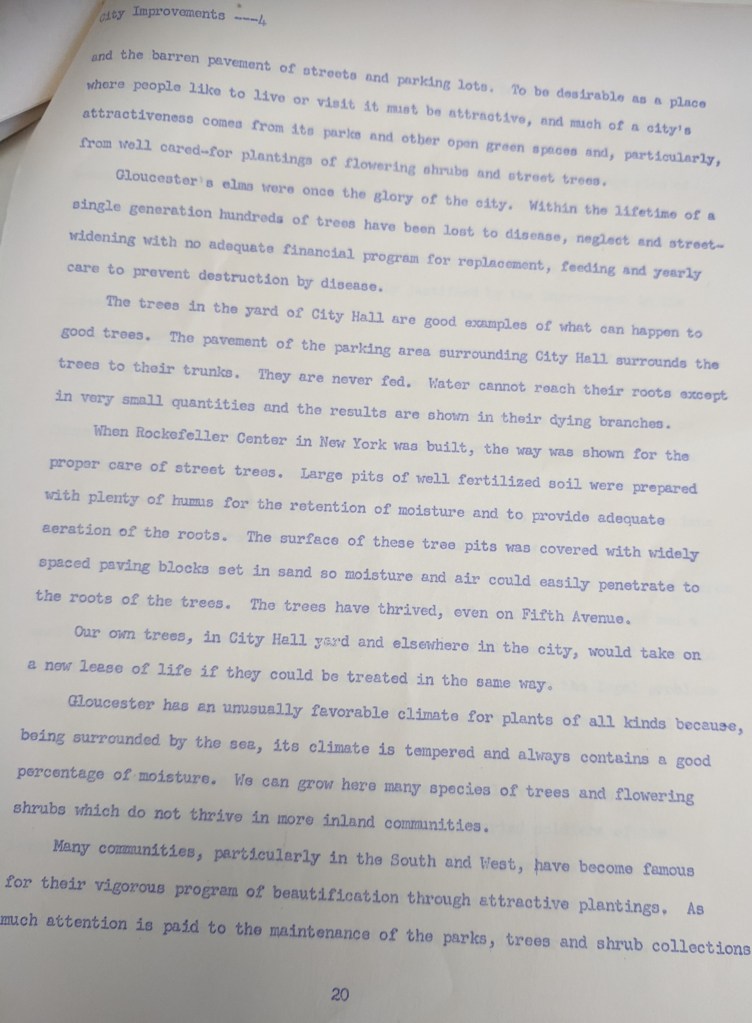
City Improvements —4
and the barren pavement of streets and parking lots. To be desirable as a place where people like to live or visit it must be attractive, and much of a city’s attractiveness comes from its parks and other open green spaces and, particularly, from well-cared for plantings of flowering shrubs and street trees.
Gloucester’s elms were once the glory of the city. Within the lifetime of single generation of hundreds of trees have been lost to disease, neglect and street-widening with no adequate financial program for replacement, feeding and yearly care to prevent destruction by disease.
The trees in the yard of City Hall are good examples of what can happen to good trees. The pavement of the parking area surrounding City Hall surrounds the trees to their trunks. They are never fed. Water cannot reach their roots except in very small quantities and the results are shown in their drying branches.
When Rockefeller Center in New York was built, the way was shown for the proper care of street trees. Large pits of well fertilized soil were prepared with plenty of humus for the retention of moisture and to provide adequate aeration of the roots. The surface of these tree pits was covered with widely spaced paving blocks set in sand so moisture and air could easily penetrate to the roots of the trees. The trees have thrived, even on Fifth Avenue.
Our own trees, in City Hall yard and elsewhere in the city, would take on a new lease of life if they could be treated in the same way.
Gloucester has an unusually favorable climate for plants of all kinds because, being surrounded by the sea, its climate is tempered and always contains a good percentage of moisture. We can grow here many species of trees and flowering shrubs which do not thrive in more inland communities.
Many communities, particularly in the South and West , have become famous for their vigorous program of beautification through attractive plantings. As much attention is paid to the maintenance of the parks, trees and shrub collections
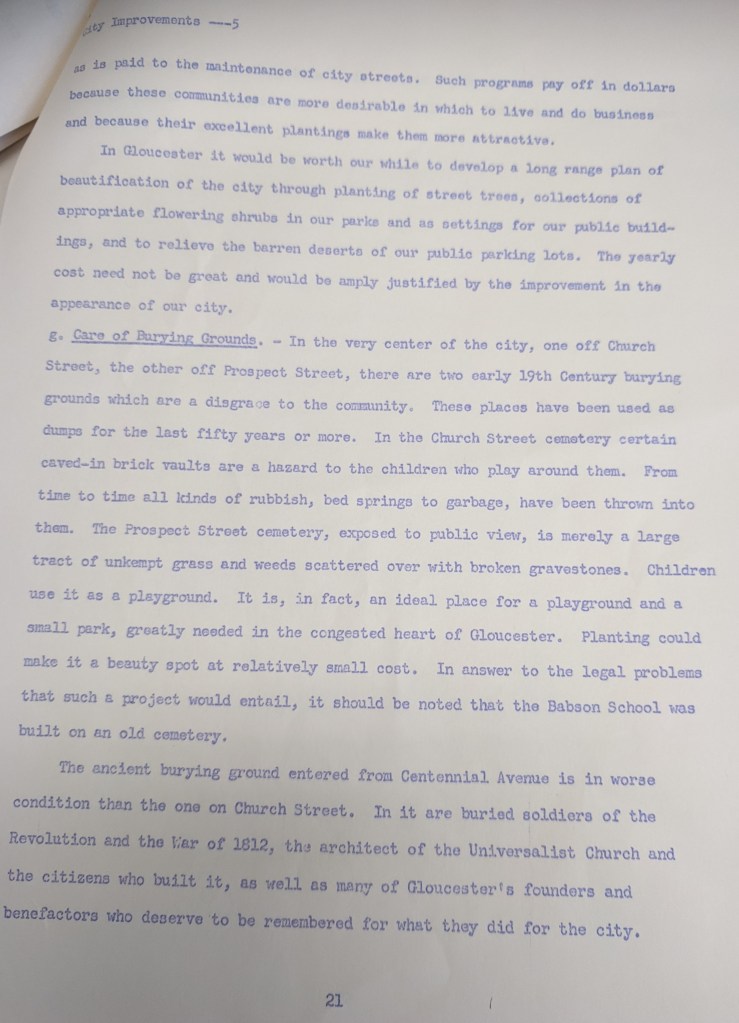
City Improvements —5
as is paid to the maintenance of city streets. Such programs pay off in dollars because these communities are more desirable in which to live and do business and because their excellent plantings make them more attractive.
In Gloucester it would be worth our while to develop a long range plan of beautification of the city through planting of street trees, collections of appropriate flowering shrubs in our parks and as settings for our public buildings, and to relieve the barren deserts of our public parking lots. The yearly cost need not be great and would be amply justified by the improvement in the appearance of our city.
e. Care of Burying Grounds – In the very center of the city, one off Church Street, the other off Prospect Street, there are two early 19th century burying grounds which are a disgrace to the community. These places have been used as dumps for the last fifty years or more. In the Church Street cemetery certain caved-in brick vaults are a hazard to the children who play around them. From time to time all kinds of rubbish, bed springs to garbage, have been thrown into them. The Prospect Street cemetery, exposed to public view, is merely a large tract of unkempt grass and weeds scattered over with broken gravestones. Children use it as a playground. It is, in fact, an ideal place for a playground and a small park, greatly needed in the congested heart of Gloucester. Planting could make it a beauty spot at relatively small cost. In answer to the legal problems that such a project would entail, it should be noted that the Babson School was built on an old cemetery.
The ancient burying ground entered from Centennial Avenue is in worse condition then the one on Church Street. In it are buried soldiers of the Revolution and the War of 1812, the architect of the Universalist Church, and the citizens who built it, as well as many of Gloucester’s founders and benefactors who deserve to be remembered for what they did for the city.
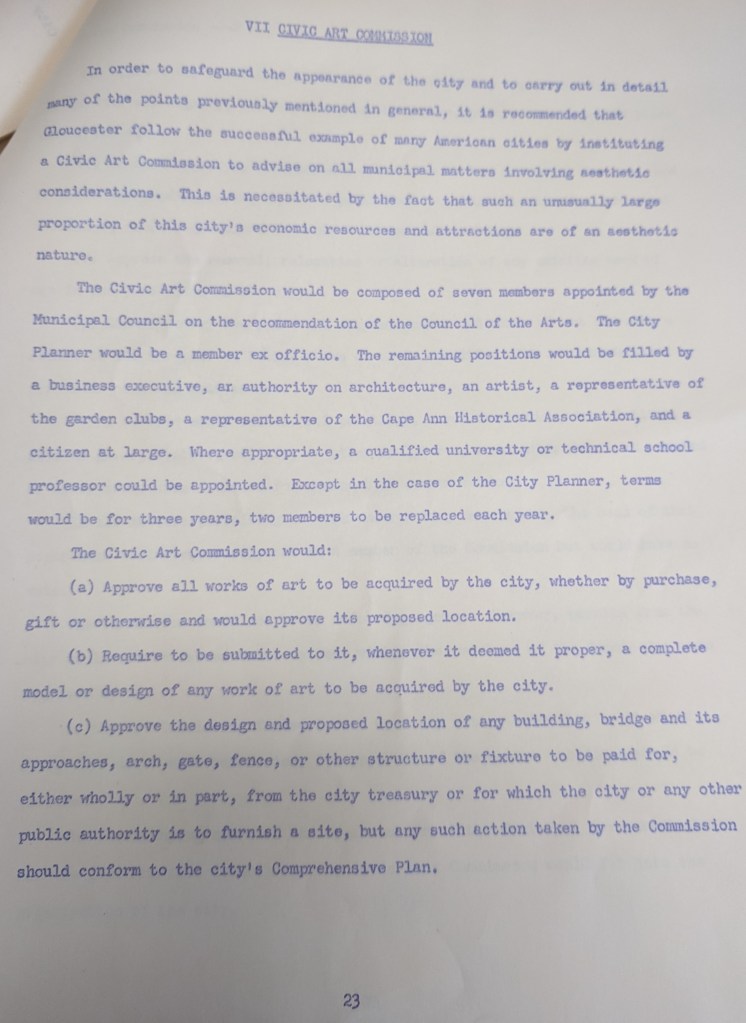
In order to safeguard the appearance of the city and to carry out in detail many of the points previously mentioned in general, it is recommended that Gloucester follow the successful example of many American cities by instituting a Civic Art Commission to advise on all municipal matters involving aesthetic considerations. This is necessitated by the fact that such an unusually large proportion of this city’s economic resources and attractions are of an aesthetic nature.
The Civic Art Commission would be composed of seven members appointed by the Municipal Council on the recommendation of the Council of the Arts. The City Planner would be a member ex officio. The remaining positions would be filled by a business executive, an authority on architecture, an artist, a representative of the garden clubs, a representative of the Cape Ann Historical Association, and a citizen at large. Where appropriate, a qualified university or technical school professor could be appointed. Except in the case of the City Planner, terms would be for three years, two members to be replaced each year.
The Civic Commission would:
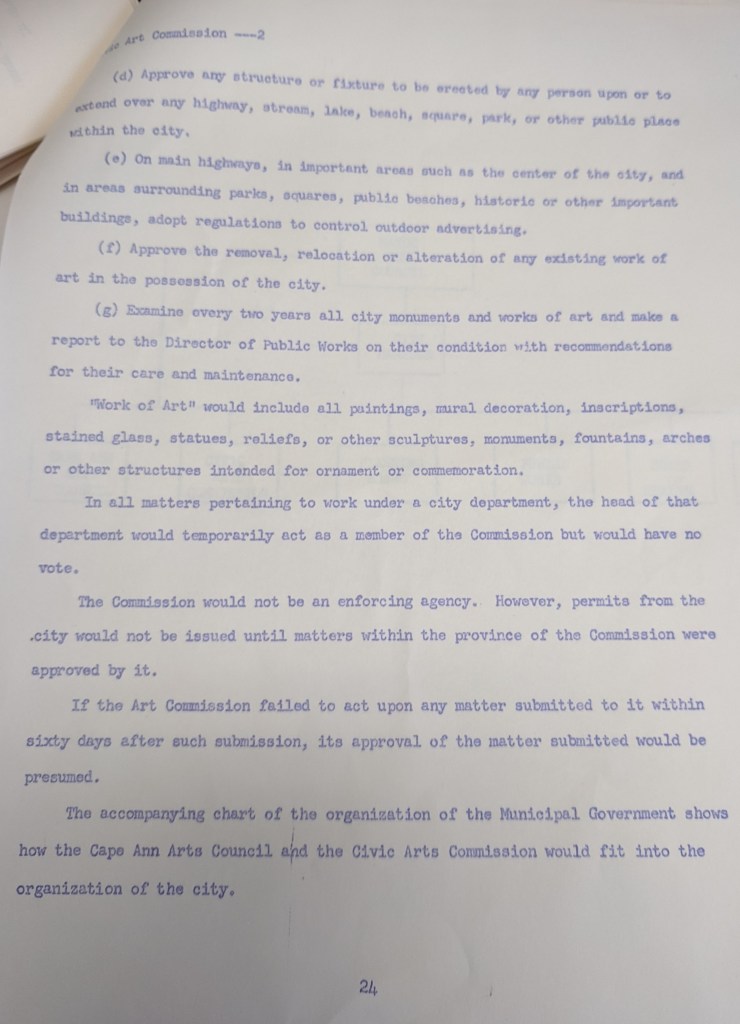
Public Art Commission —2
“Work of Art” would include all paintings, mural decoration, inscriptions, stained glass, statues, reliefs, or other sculptures, monuments, fountains, arches or other structures intended for ornament or commemoration.
In all matters pertaining to work under a city department, the head of that department would temporarily act as a member of the commission but would have not vote.
The Commission would not be an enforcing agency. However, permits from the city would not be issued until matters within the province of the Commission were approved by all.
“If the Art Commission failed to act upon any matter submitted to it within sixty days after such submission, its approval of the matter submitted would be presumed.“
Walker Hancock & Committee, 1958 (simple and easy sentence!)
The accompanying chart of the organization of the Municipal Government shows how the Cape Ann Arts Council and the Civic Arts Commission would fit into the organization of the city.

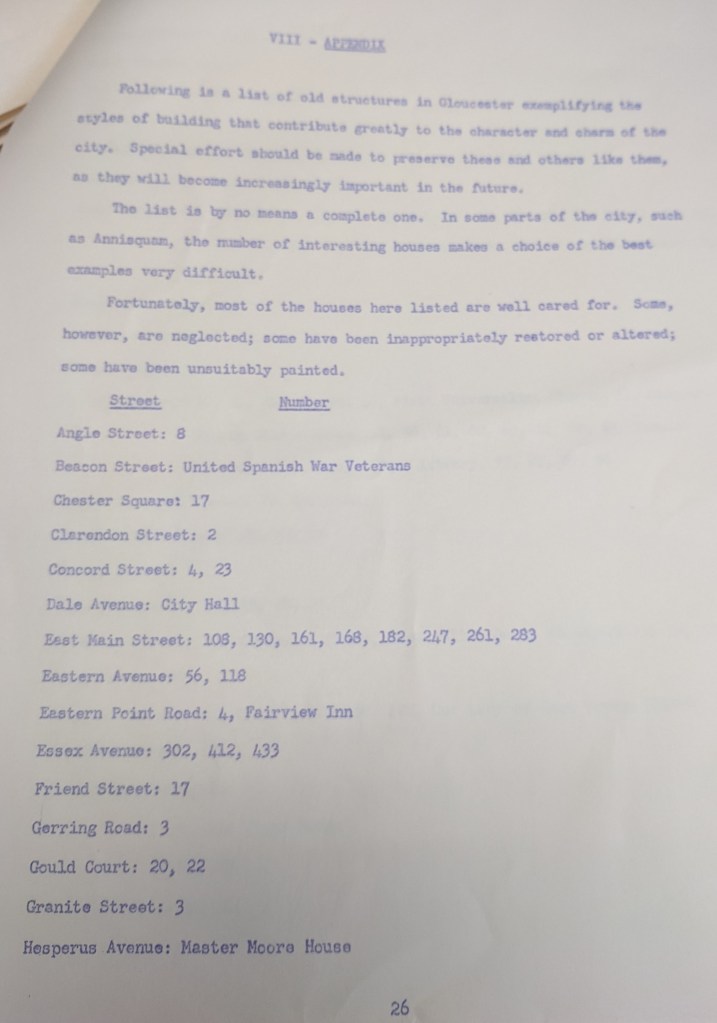
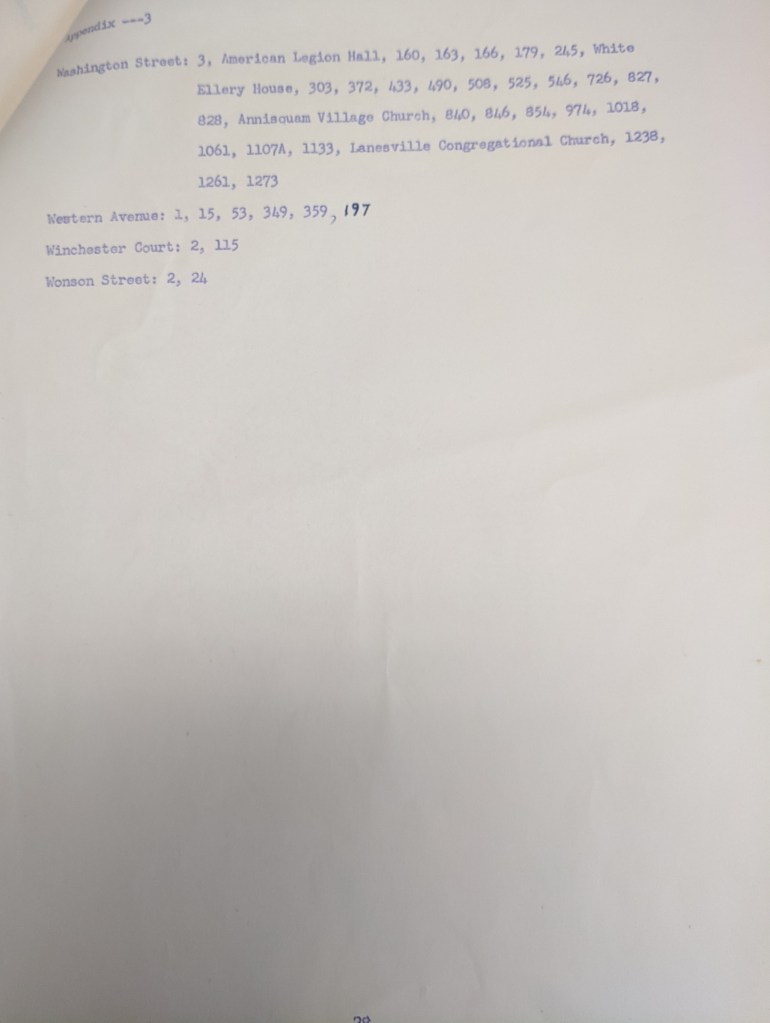
Following is a list of old structures in Gloucester exemplifying the styles of building that contribute greatly to the character and charm of the city. Special effort should be made to preserve these and others like them, as they will become increasingly important in the future.
The list is by no means a complete one. In some parts of the city, such as Annisquam, the number of interesting houses makes a choice of the best examples very difficult.
Fortunately, most of the houses here listed are well cared for. Some, however, are neglected; some have been inappropriately restored or altered; some have been unsuitably painted.








Heidi Dallin reminds us to mark down these upcoming dates and special performances announced for Cape Ann Symphony’s beautiful 72nd Season, “A Season of Exploration”:
Performance: Sunday, October 1, 2023: 2:00 PM: Manchester-Essex High School, Manchester-by-the-Sea, MA
Cape Ann Symphony kicks off the 72nd season with a musical trip to France featuring CAS premieres of Lili Boulanger’s D’un matin printemps; Debussy’s Nocturnes with a special appearance from the New World Chorale; and Ravel’s Mother Goose Suite. The concert finale is Ravel’s popular and thrilling Bolero.
Performances:
The Holiday Pops Concert, Cape Ann Symphony’s joyful holiday tradition, features a program of holiday favorites and welcomes back guest artist gospel sensation Renese King. King last appeared with CAS in 2012.
Ms. King’s array of musical talents have taken her from spiritual and gospel singing at the church podium to timpani playing on the Carnegie Hall stage. She has toured internationally as a percussionist, pianist, and vocalist with a number of Massachusetts based choral and orchestral ensembles. But it is her soulful and unforgettably moving voice that has piqued her national reputation.
Performance: Sunday, March 17, 2024: 2:00 PM Manchester-Essex High School, Manchester-by-the-Sea, MA
Cape Ann Symphony welcomes back world renown pianist Janice Weber to play Beethoven’s show stopping Emperor Piano Concerto . The concert program also includes the CAS premieres of esteemed composers: Louise Farrenc and William Grant Still. The orchestra will play Farrenc’s Overture No .1 and Still’s Woodnotes.
Performance: Sunday, May 19, 2024: 2:00 PM Manchester-Essex High School, Manchester-by-the-Sea, MA
BSO violinist and a favorite CAS guest artist Lucia Lin returns for The Three B’s: Beethoven, Bizet and Brahms to play Brahms’ monumental Violin Concerto. The orchestra plays Beethoven’s Egmont Overture and Bizet’s Symphony in C.



Read more about Cape Ann Symphony’s 72nd season: A SEASON OF EXPLORATION
Cape Ann Symphony proudly announces the launch of the orchestra’s 72nd concert season on Sunday, October 1 at 2:00 PM at Manchester-Essex High School Auditorium. “After a terrific summer Pops Concert playing for thousands in Stage Fort Park , we are so thrilled to be back on stage for our 72nd season!” says Cape Ann Symphony Board President Fran White. “This season of exploration is especially exciting for our audiences and our orchestra. We will be playing pieces that CAS has never played over the orchestra’s 71 seasons and we celebrate three amazingly talented and world-renowned guest artists: pianist Janice Weber, gospel vocal sensation Renese King and BSO violinist Lucia Lin. You will want to hear every note this season! I highly recommend getting your season subscription NOW so you will not miss a concert !”
Cape Ann Symphony Music Director and Conductor Yoichi Udagawa is eager to open the CAS 72nd Season, “The musicians of the Cape Ann Symphony and I are very excited about the upcoming season. We are starting off with a French Spectacular featuring the works of Lili Boulanger, Claude Debussy and Maurice Ravel. The New World Chorale will be joining us in the Debussy Nocturnes, and the concert will close with Ravel’s ever popular and exciting Bolero. Holiday Pops will feature all the favorites of the season, and this year we have a special guest – Gospel Sensation Renese King. In March, pianist Janice Weber will be playing Beethoven’s Emperor Concerto and in May, audience favorite violinist Lucia Lin will return to play the Brahms Violin Concerto. ”This Season of Exploration features a season of firsts for Maestro Udagawa and the orchestra. “Our season opening French Spectacular Concert includes three pieces that we have never performed: Lili Boulanger’s D’un matin printemps; Debussy’s Nocturnes and Ravel’s Mother Goose Suite.Our March concert: Known (and Unknown) Greats includes two composers making their CAS debut Louise Farrenc and William Grant Still. We have played Still’s music in Musicians Unleashed, our popular chamber series, but never with a full orchestra! On a personal note, this season is especially exciting, I will be conducting Boulanger’s D’un matin printemps, Debussy’s Nocturnes; Ravel’s Mother Goose and William Grant Still’s Woodnotes for the first time in my career. The musicians and I can’t wait to begin this journey of exploration with our audiences!”
Cape Ann Symphony preview announcement for the 2023/2024 season
Adult/$45.00
Senior Citizens/$40.00
Students (of any age)/$20.00
Youth (Age 12 and Under)/$5.00
Season Subscriptions are Available.
For Information call 978-281-0543 or Visit www.capeannsymphony.org
Images:
Photo 1: Guest Artist for Known and (Unknown) Greats, the March 2024 Concert: Janice Weber, world renowned pianist and best selling novelist Photo Credit: Liz Linder
Photo 2: Guest Artist for The Three B’s: Beethoven, Bizet and Brahms, the May 2024 Concert: Lucia Lin, acclaimed BSO violinist
Photo 3: Cape Ann Symphony Conductor and Music Director Yoichi Udagawa
Photo 4: Guest Artist for 2023 Holiday Pops Concert: Renese King, gospel vocal sensation


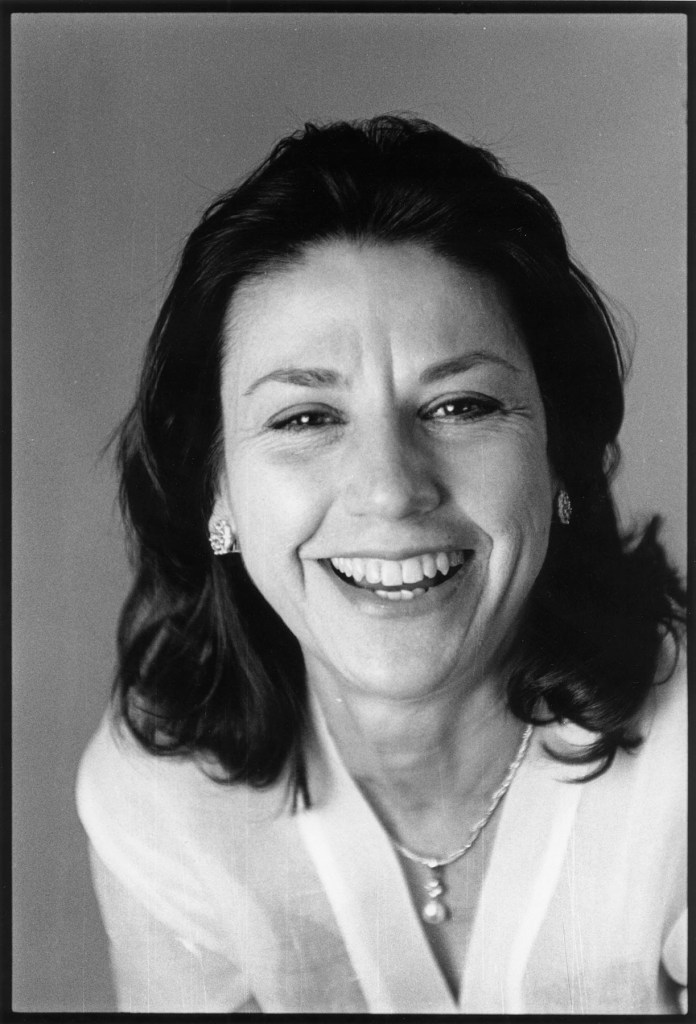
Heidi Dallin has a fall update about this amazing opportunity for professional acting and singing classes in Gloucester at the Cape Ann YMCA.
Sign up now!
Acting 101 with Heidi Dallin and Singing 101 with Heidi Dallin and Marina Gallo
Printable PDF here:
For more information, please contact Heidi Dallin at dallinh@northshoreymca.org, 978.283.0499

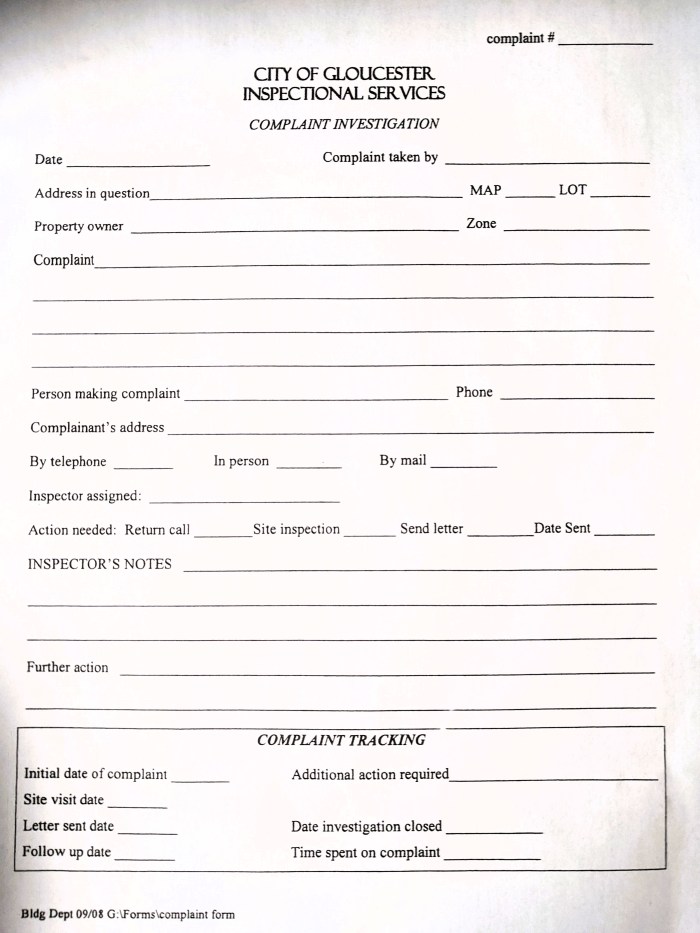
Helpful tip! Did you know if you have a question or concern about a property in Gloucester (construction, zoning, demo, abutter, safety, compliance, etc.) and you call the building department, there is no record until you fill out a form? Any concern is noted when this form is filled out, dropped off, and emailed.

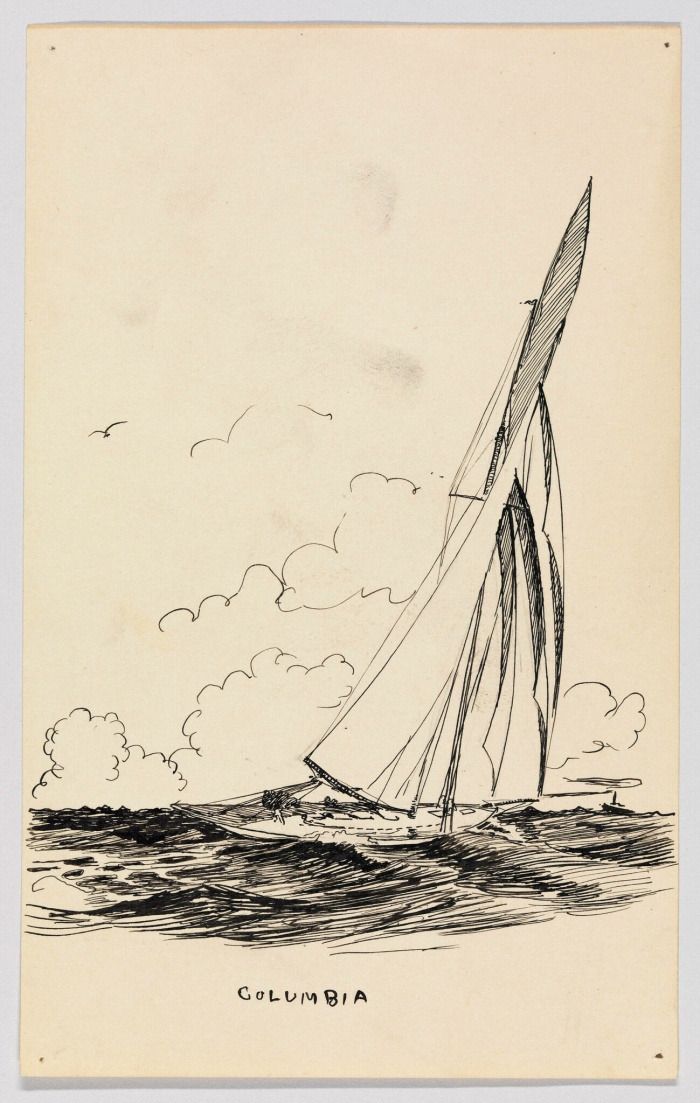
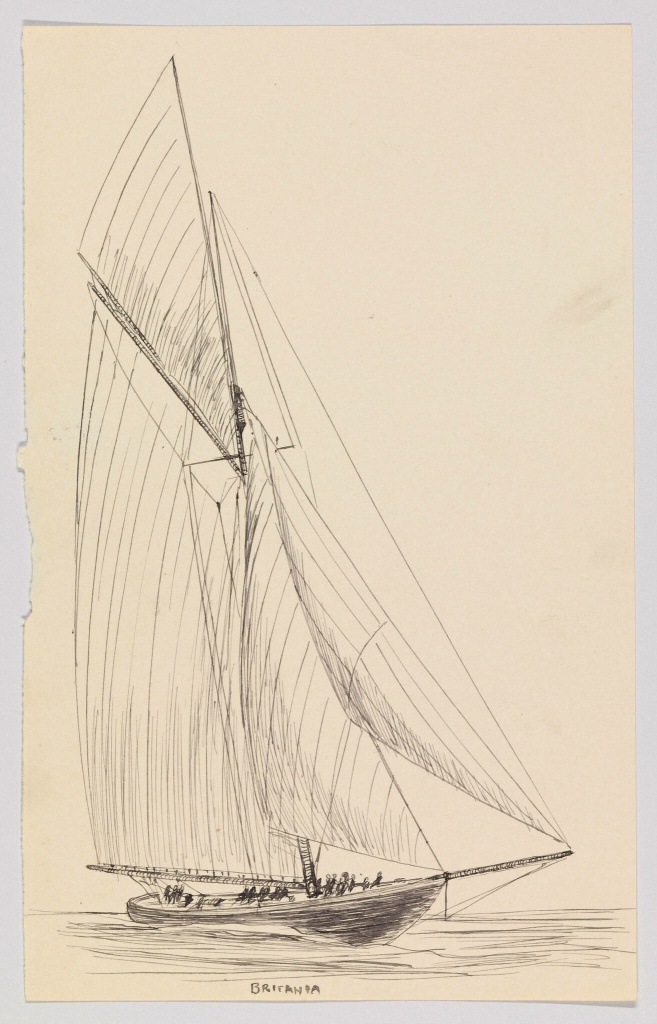

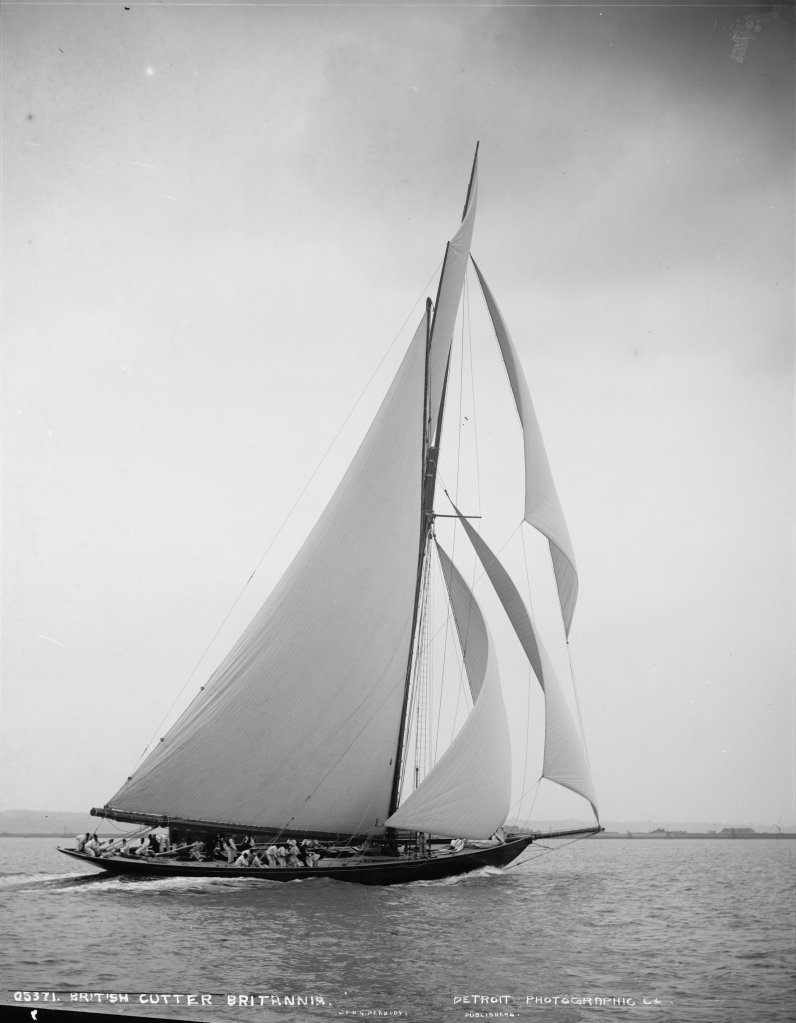
Edward Hopper’s sketch of the fast schooner Columbia was completed in Gloucester in 1923 or later: Columbia was built in Essex and launched in 1923. The Hopper drawing annotated ‘Britania’ is a misspelling. The Prince of Wales (future King Edward) commissioned the racing yacht (a cutter) Britannia in 1892. The racer was retooled several times.
Hopper traveled in the UK and Gloucester. It’s likely he saw Columbia in person in 1923 or on later Gloucester visits. If not he saw both boats reproduced in print and in the news. Gorgeous yacht and race photography was popular and circulated widely especially as marine photography advanced.
For Britannia, see British photographers, Alfred Beken and his son, Frank, who settled and worked in Cowes on the Isle of Wight from 1888 on.
For the fishing schooner Columbia see Boston photojournalist, Leslie Jones, collection Boston Public Library.
After 1923, news in the the 1920s: Britannia was racing regularly and Columbia and her crew disappeared in 1927.
Continue here for more Hopper boats in Gloucester.

Incomparable American photographer and boat fanatic–as much as Hopper–Boston based photojournalist, Leslie Jones


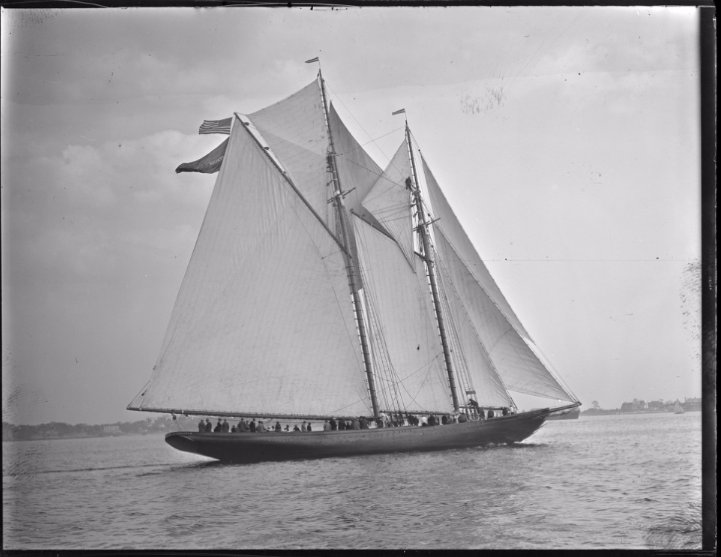
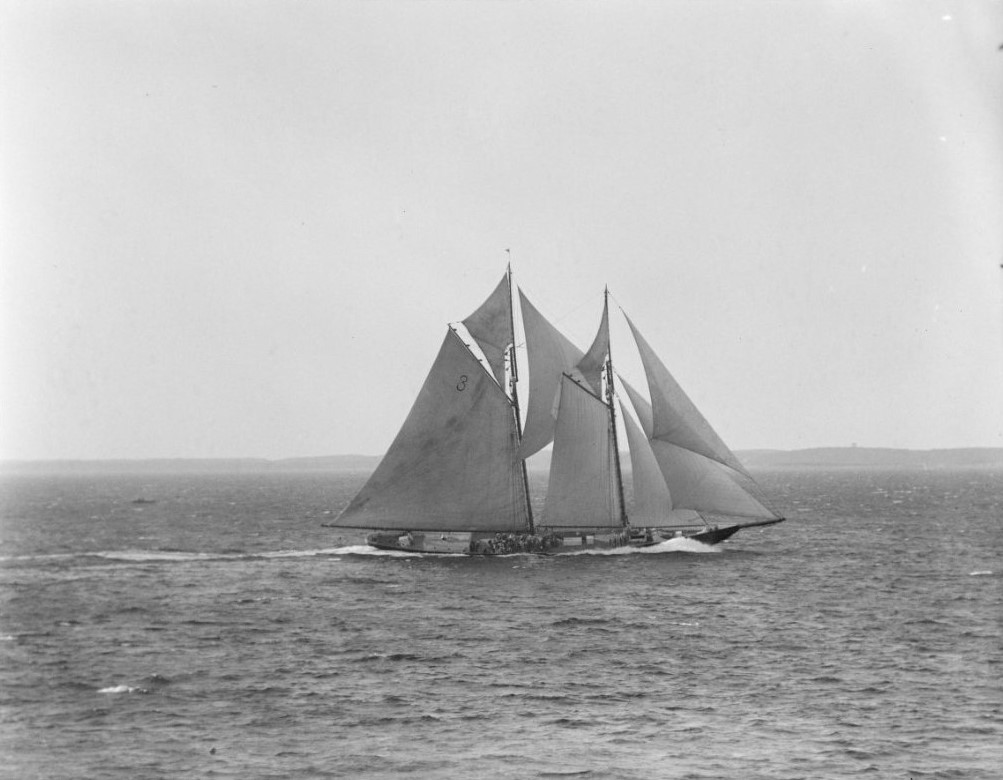




Images: Edward Hopper, Columbia, 1923. Whitney Museum. (Choppy and clouds- possibly sketched while here in Gloucester); Edward Hopper, Britania (sic), date unknown conjectured juvenalia, however he sketched yachts and boats from his youth on. Whoever annotated the sketch misspelled the boat. [Collection Whitney Museum of American Art]

Image: 2023. Columbia in Gloucester Harbor: (will add in soon)
A replica of Columbia launched in 2014 is a showstopper at the Schooner Festival in Gloucester, MA. see easternshipbuilding.com

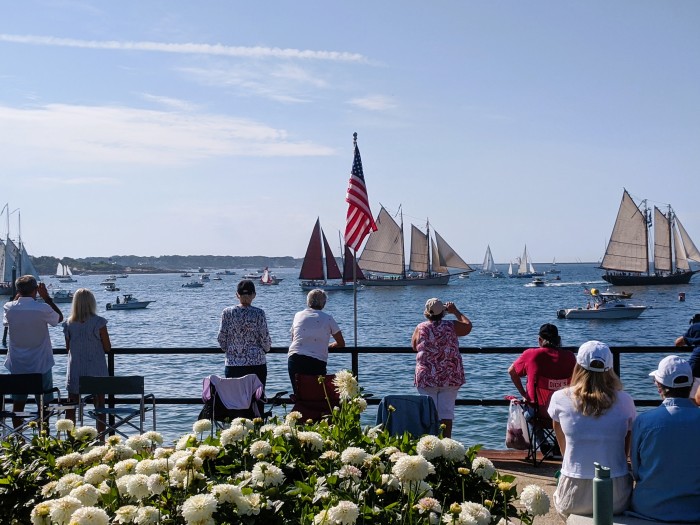
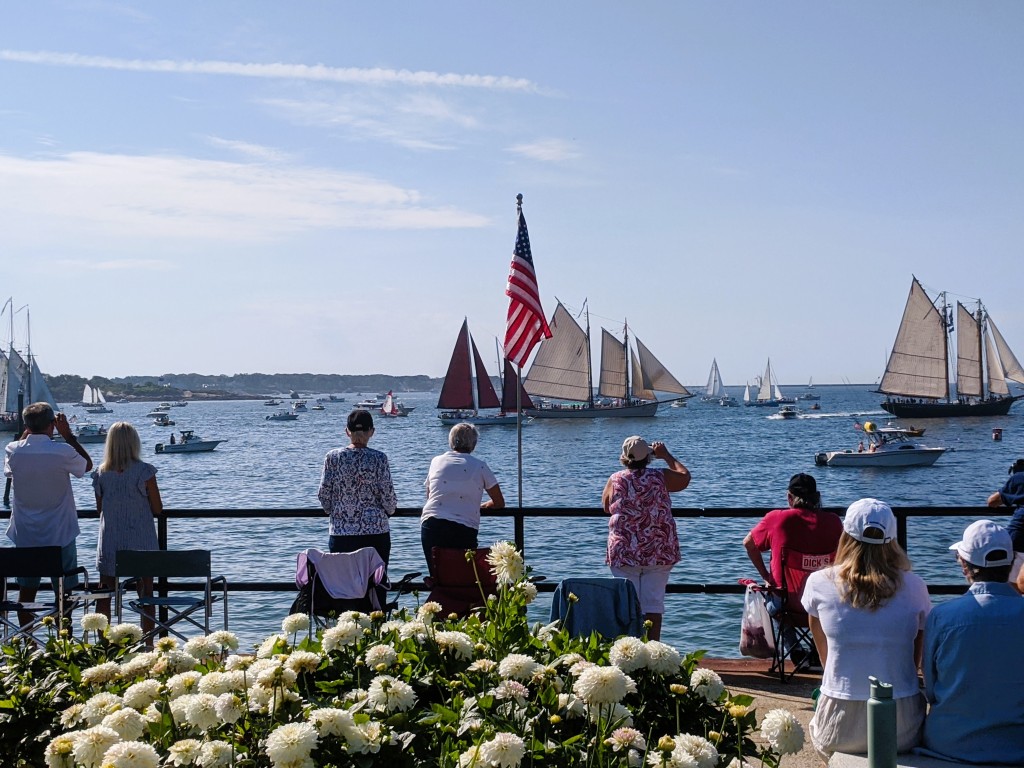
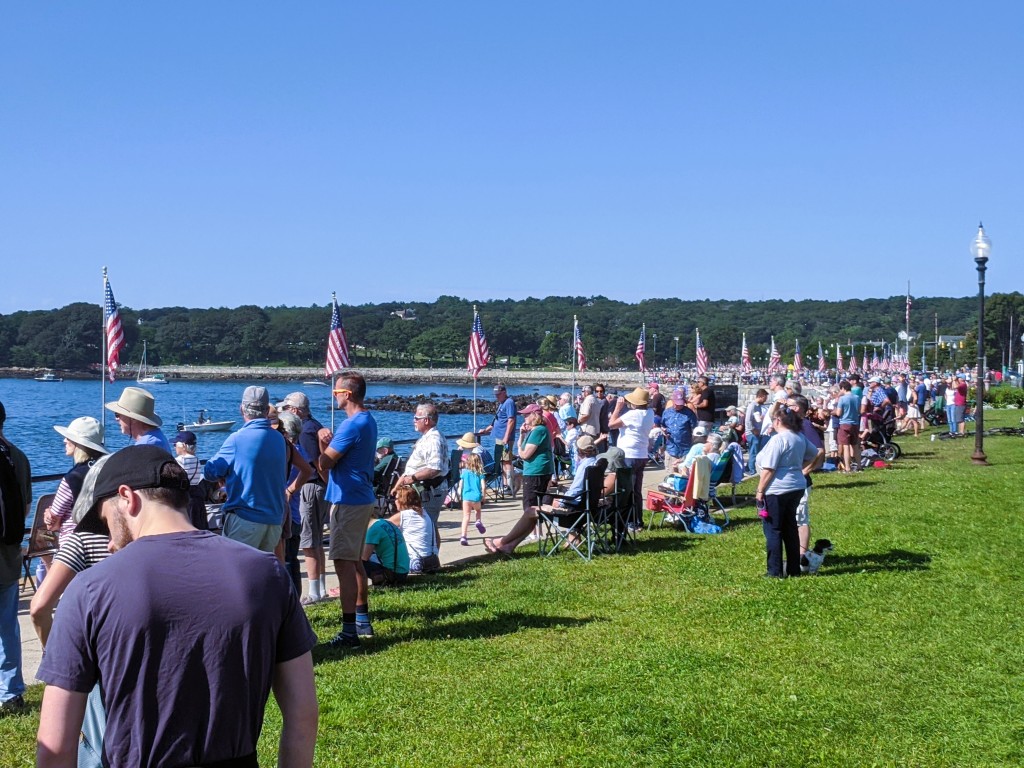
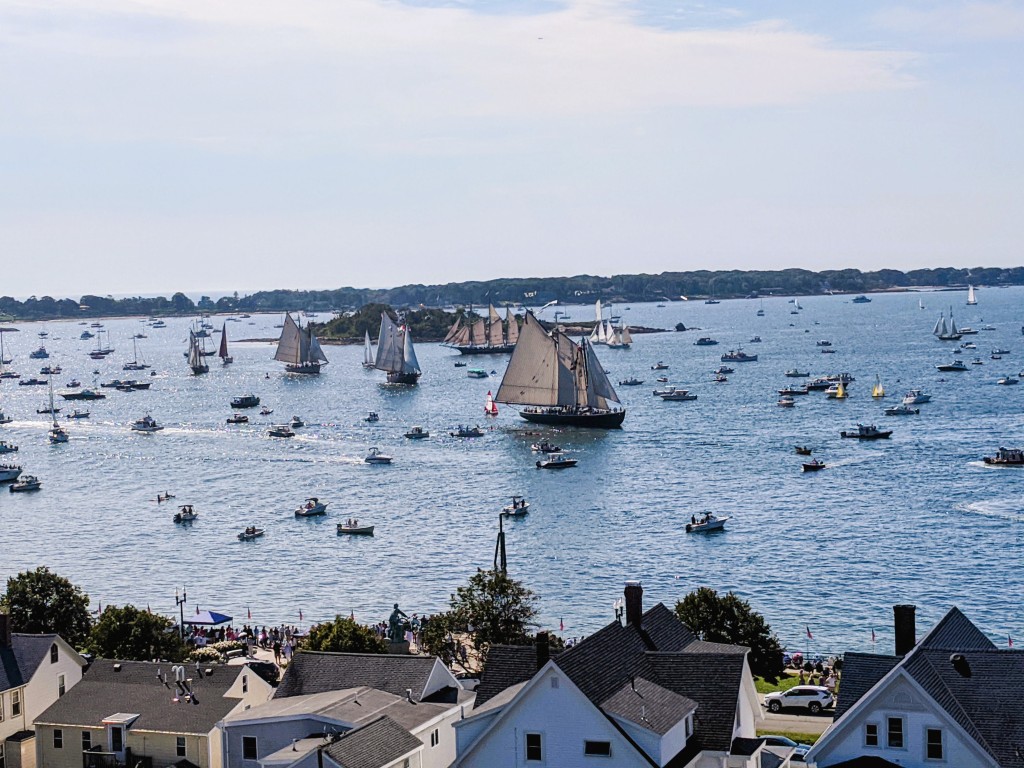
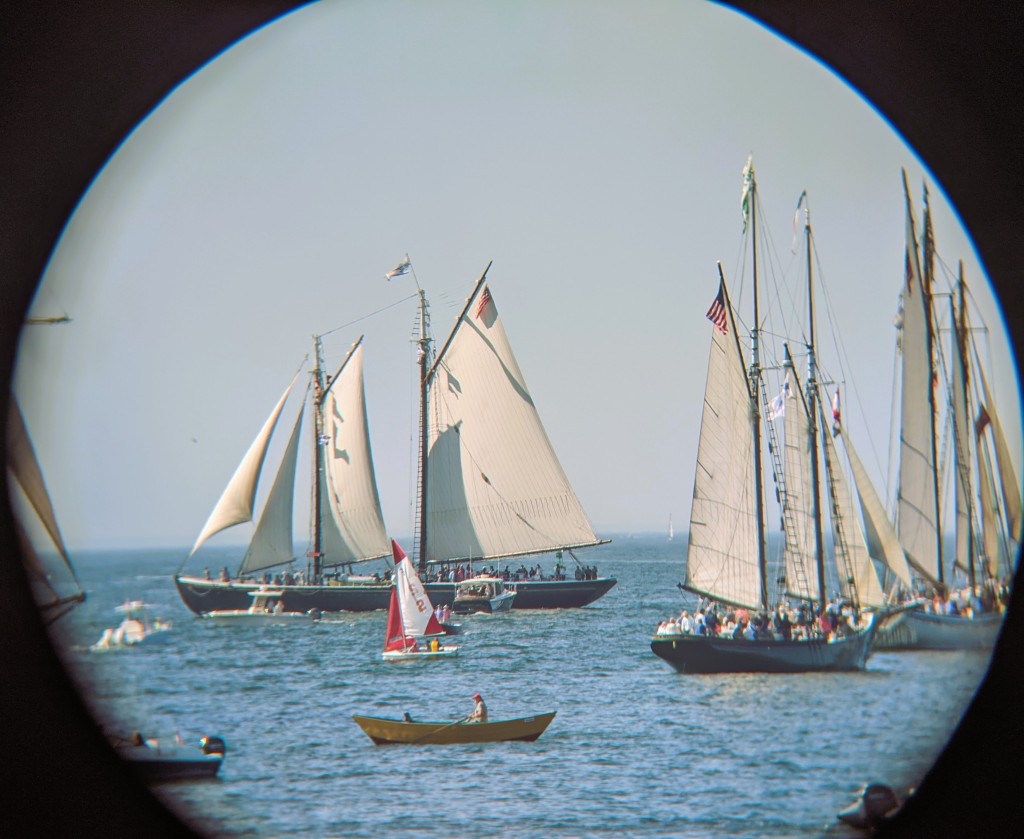
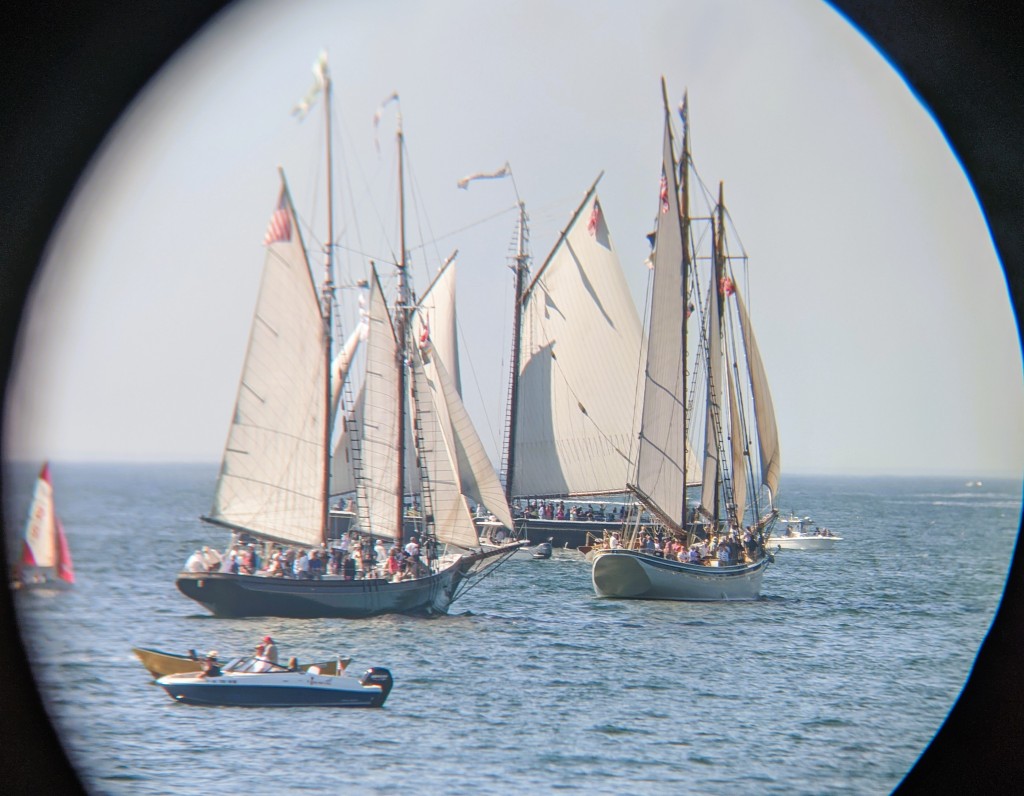
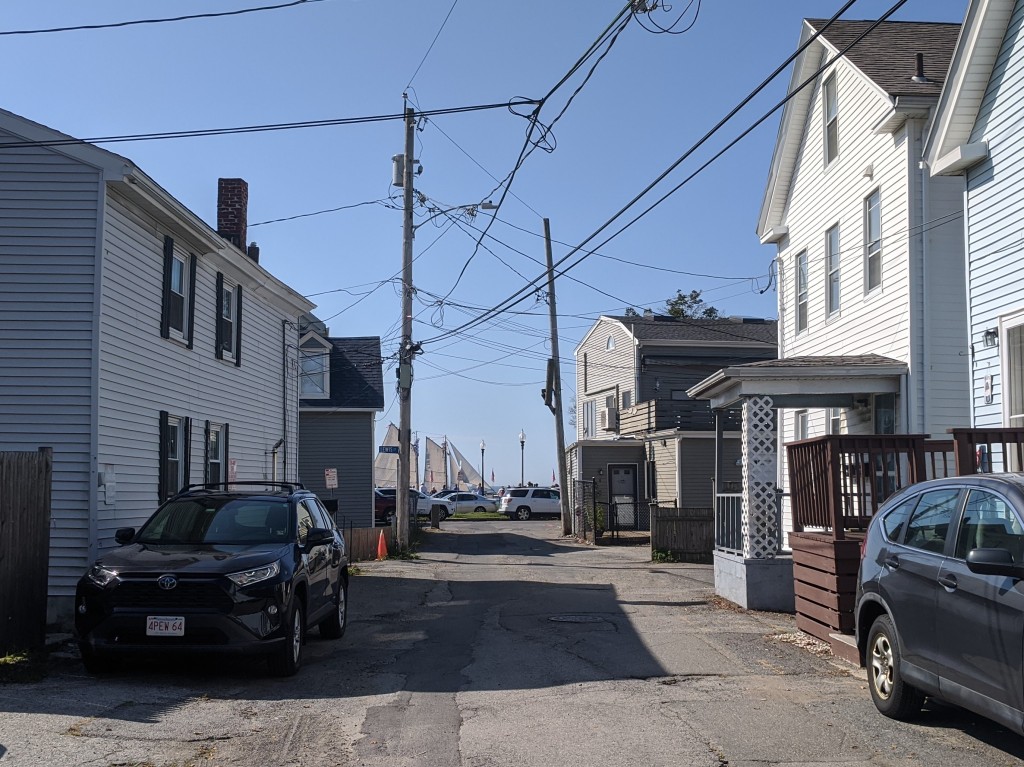
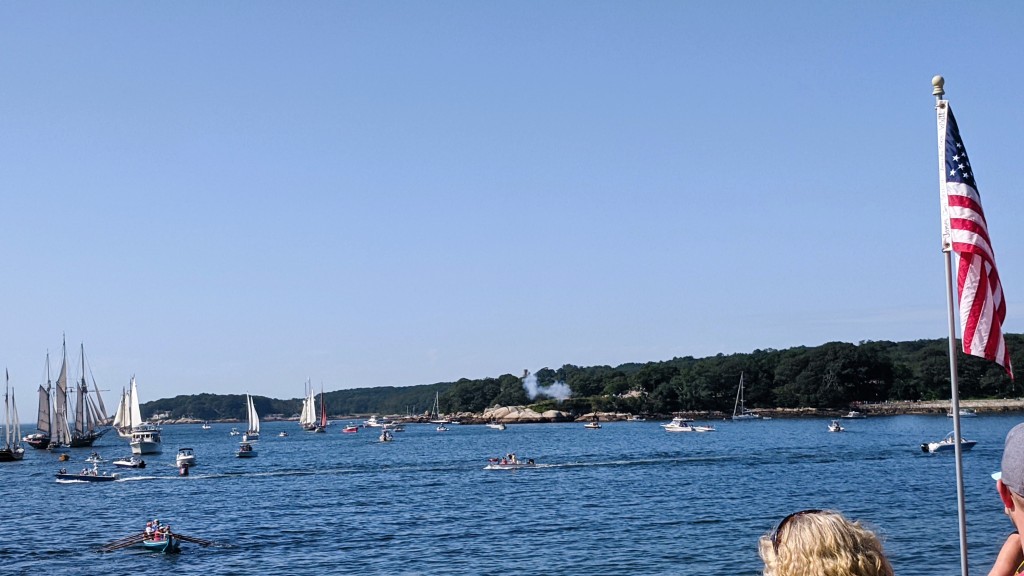
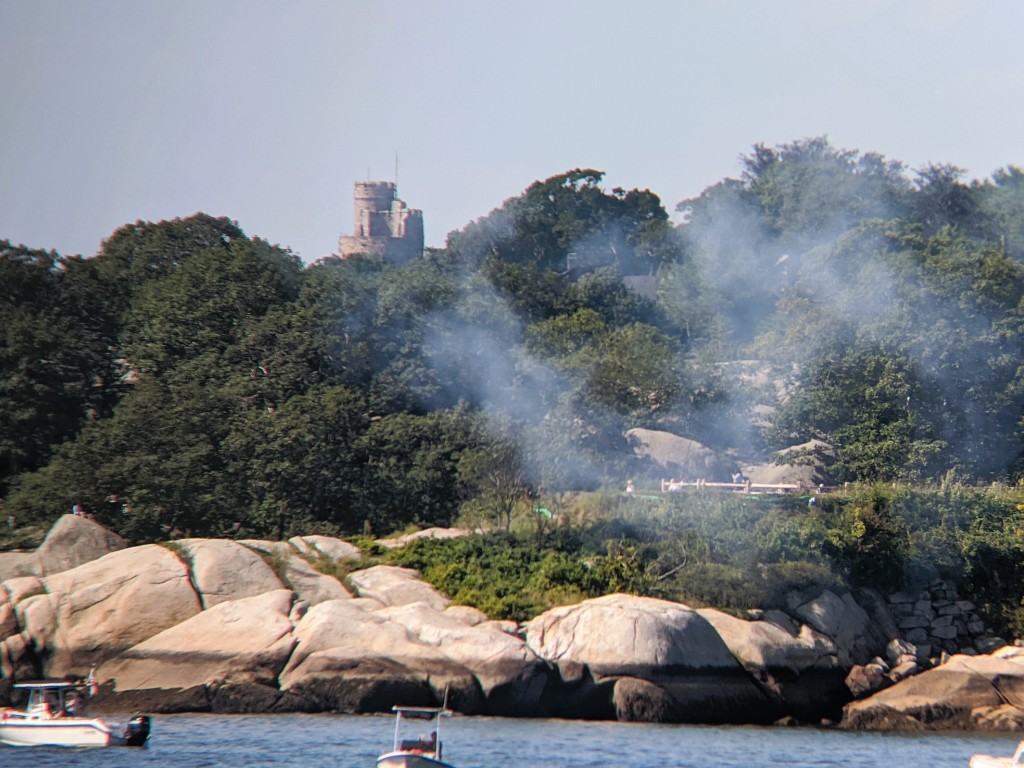
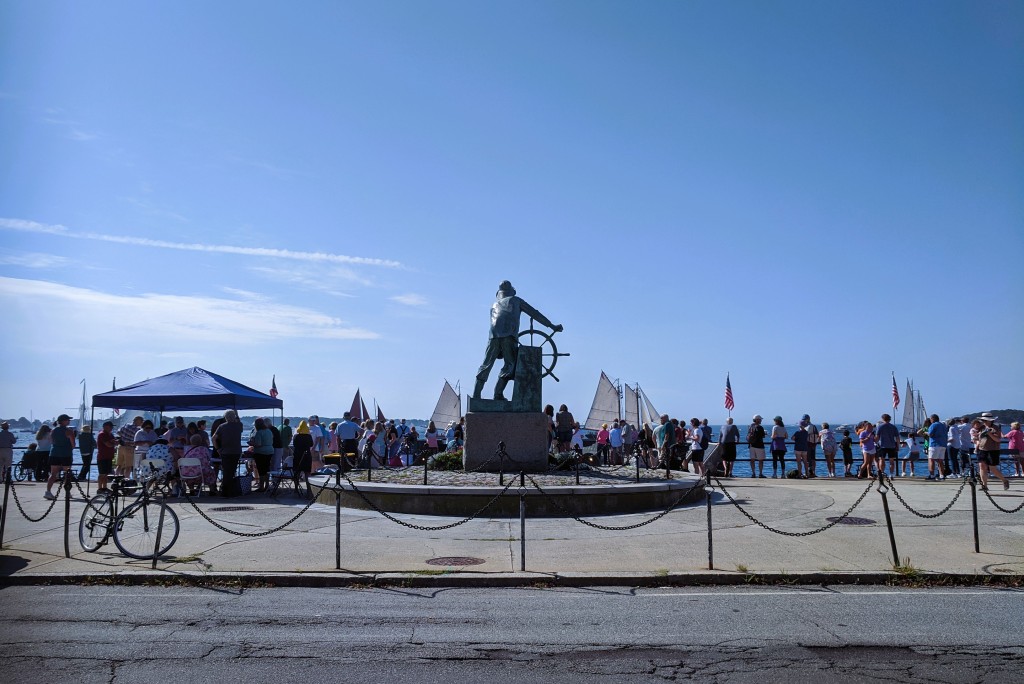
Aug.* September 3, 2023 Blooms, crowds, sails. Views from Stacy Boulevard and vicinity. Sky at times hazy smoky from wildfires as has been common during this summer.
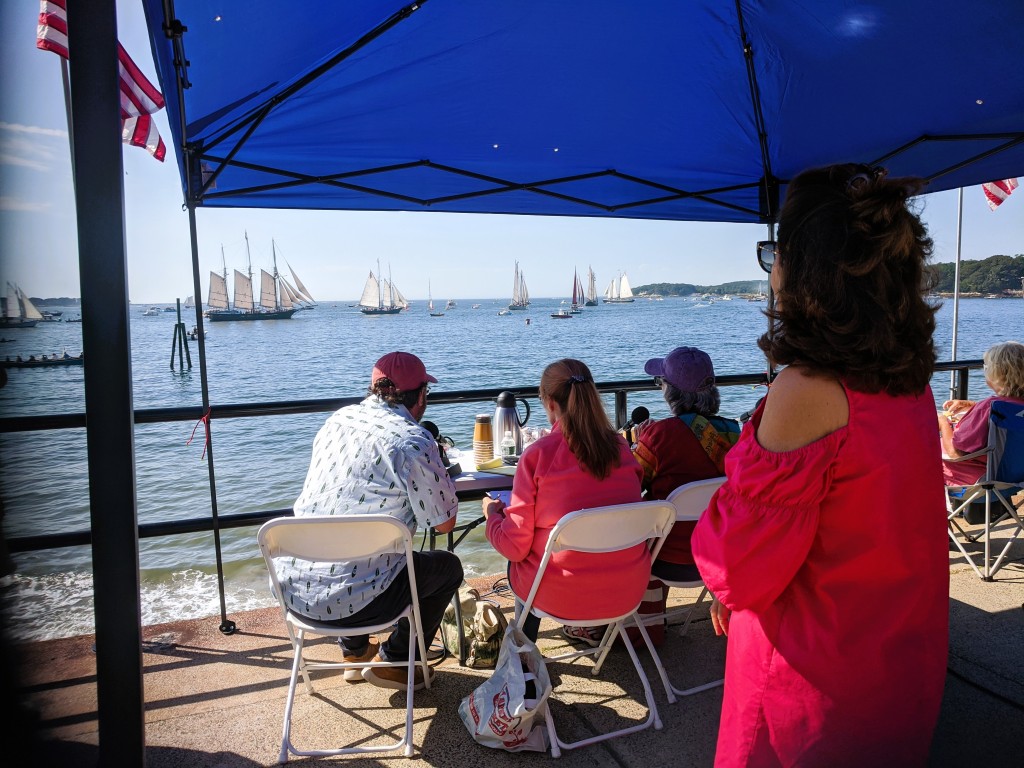



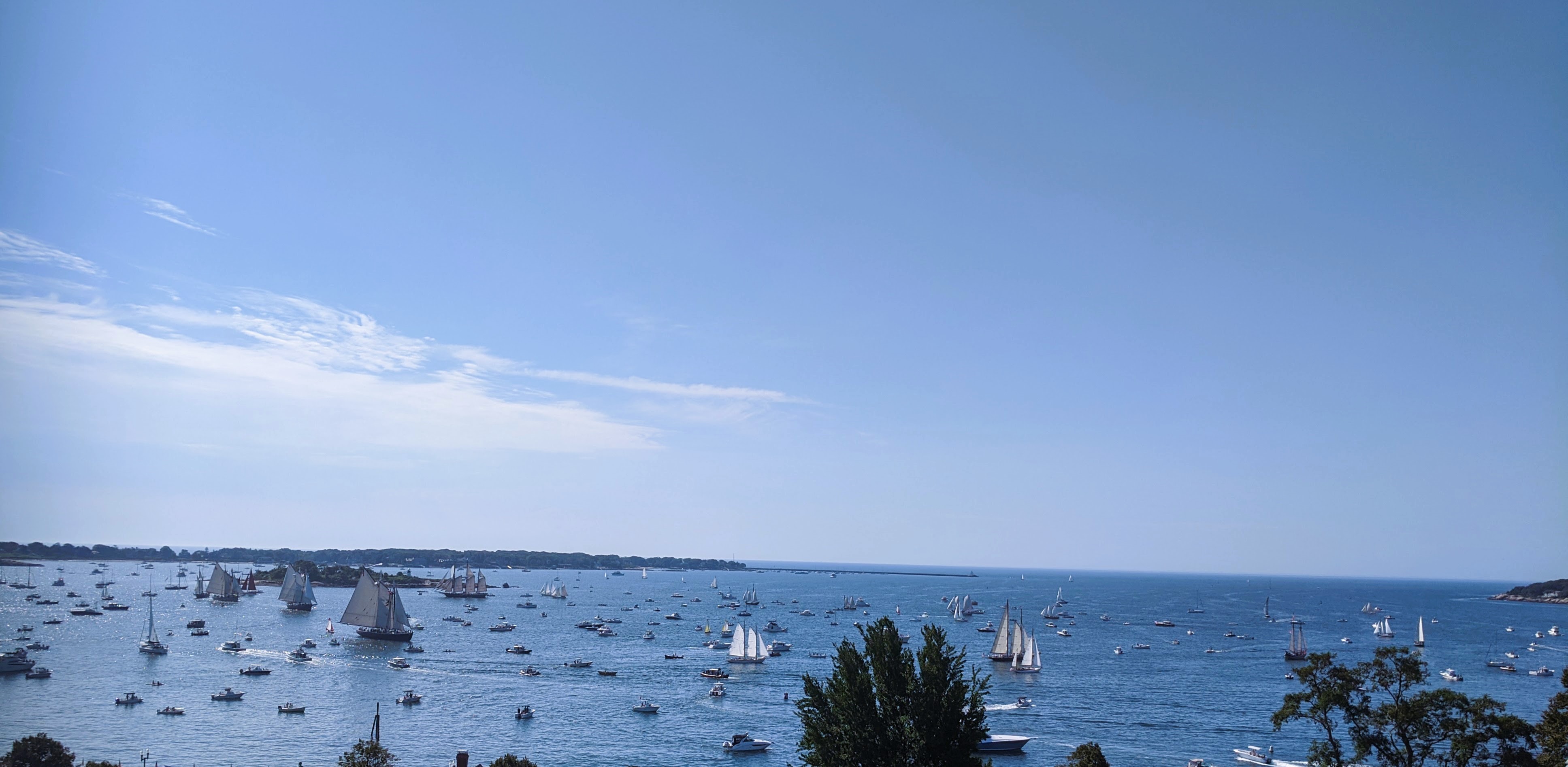
*typo update–or clearly wishing for more summer 🙂

Here they come! Good number of boats!


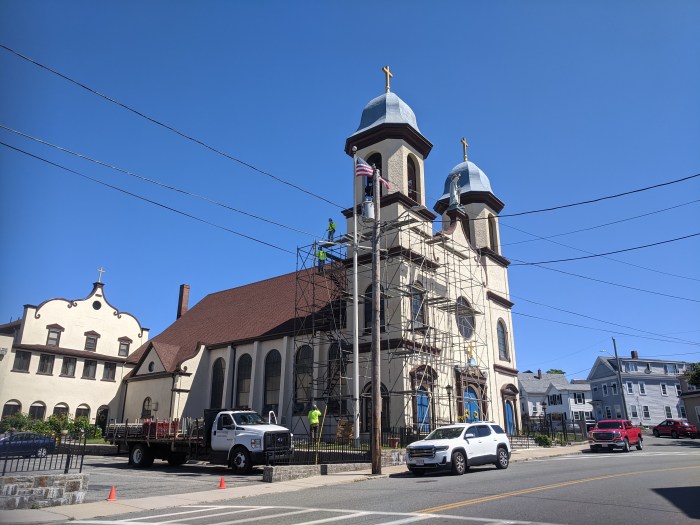
Great to see!

Photo: C. Ryan. Lofty repairs lifting spirit, Our Lady of Good Voyage, 143 Prospect St., Aug. 31, 2023. Gloucester, Mass.



upcoming special event September 16, 2023

Mark your calendars: Jane Deering shares the announcement for an upcoming debut at Annisquam Village Church.
Lobster Cove String Quartet debuts at historic Annisquam venue
Gloucester, MA – The Lobster Cove String Quartet makes its debut
Saturday evening, September 16, 2023 at 7:30pm.
The white walls of the historic Annisquam Village Church will become
the canvas for a soundscape of swirling tone-colors, as the Gloucester-based
group presents To Paint the Night: a diverse bill of fare showcasing the richness
and versatility of the string quartet format.
The program opens with Astor Piazzolla’s fiery Four for Tango, before
probing the dark night of the soul which is Dmitri Shostakovich’s String
Quartet No. 8—dedicated by the composer “to the victims of fascism and
war.” Thelonious Monk’s ‘Round Midnight, newly arranged for quartet by
violinist and composer Scott Moore, is all blues and purples and grays:
lush, playful, and mysterious. The concert closes with the sensual
Impressionism of Claude Debussy’s radiant String Quartet in G minor.
The Lobster Cove String Quartet is the latest creation of Scott Moore, Artist-in-
Residence at the Annisquam Village Church. Moore is joined by members
Erica Pisaturo (violin), Brandon White (viola), and Alex Fowler (cello).
Admission is by donation ($35 suggested), and a reception with the artists
will follow the performance.
news from Annisquam Village Church
Annisquam Village Church. 820 Washington Street. Gloucester MA

September 1, 2023
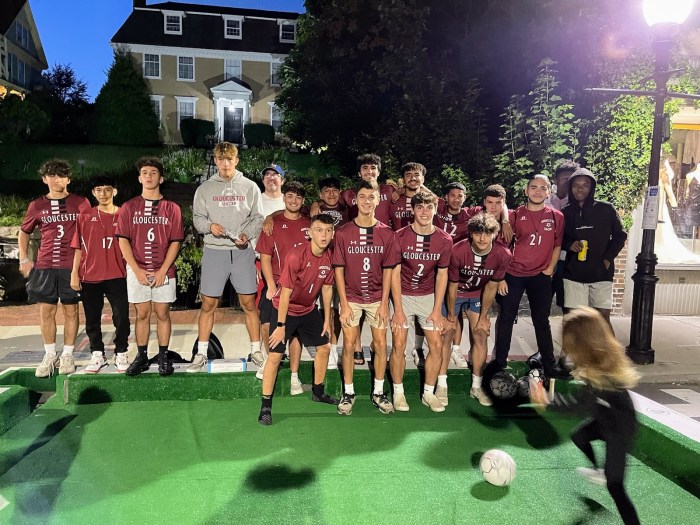
Gloucester’s Main St. Block Party traditions: Soccer boosters had a table and the mini turf for future soccer players to kick and play.

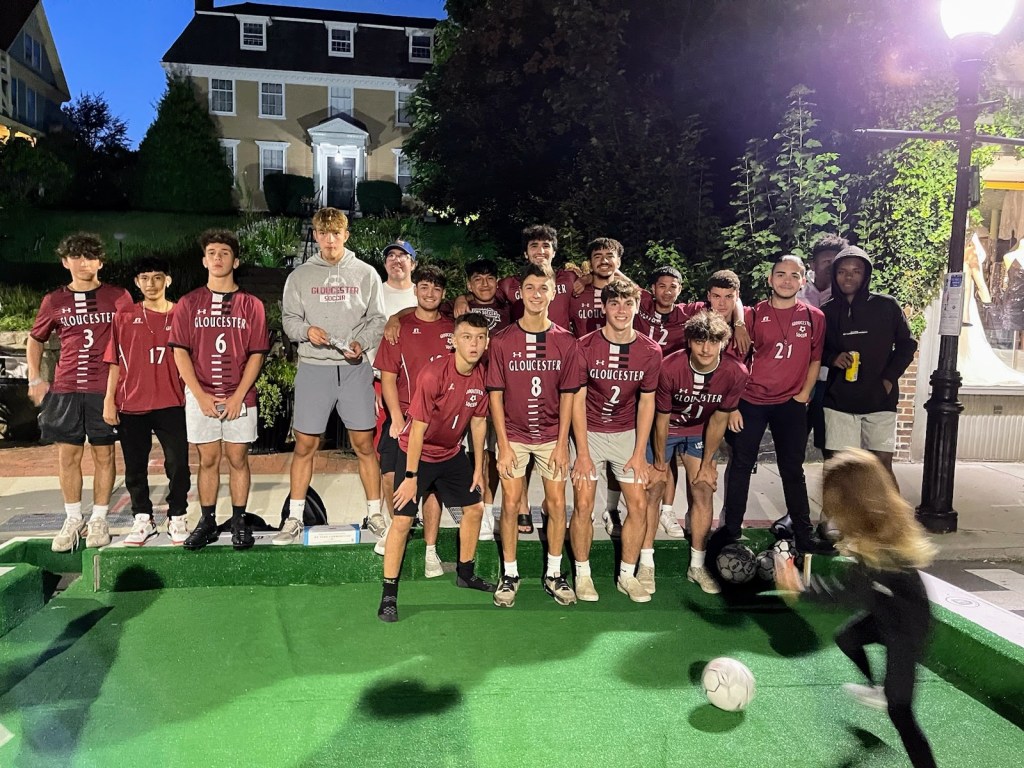
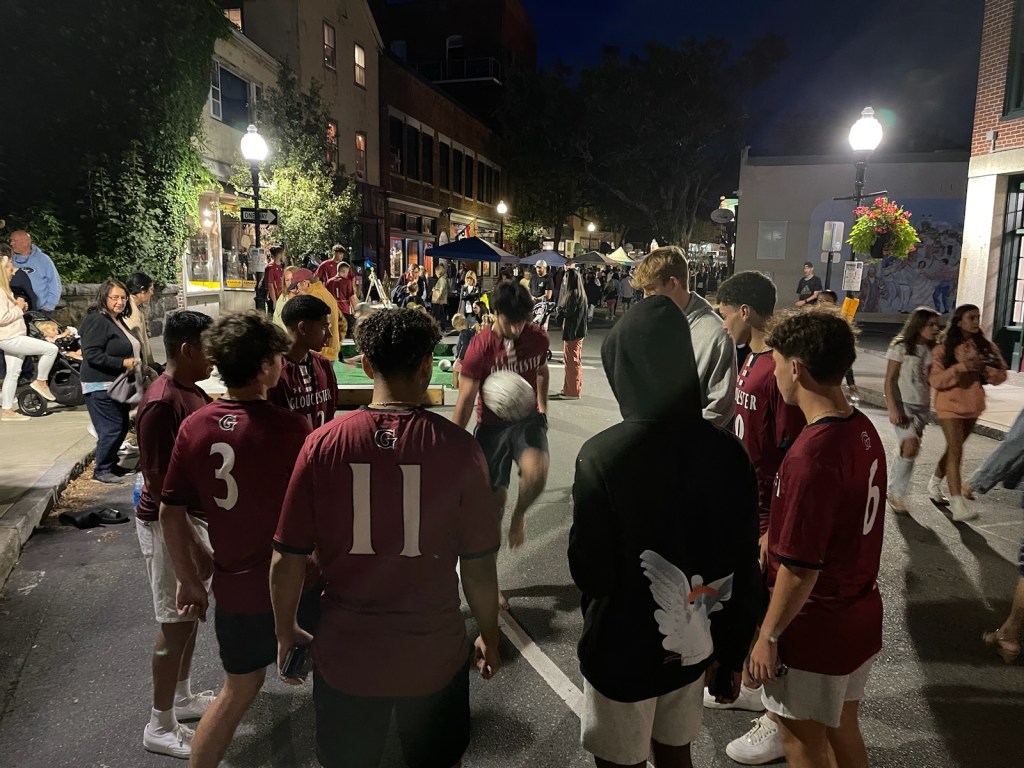
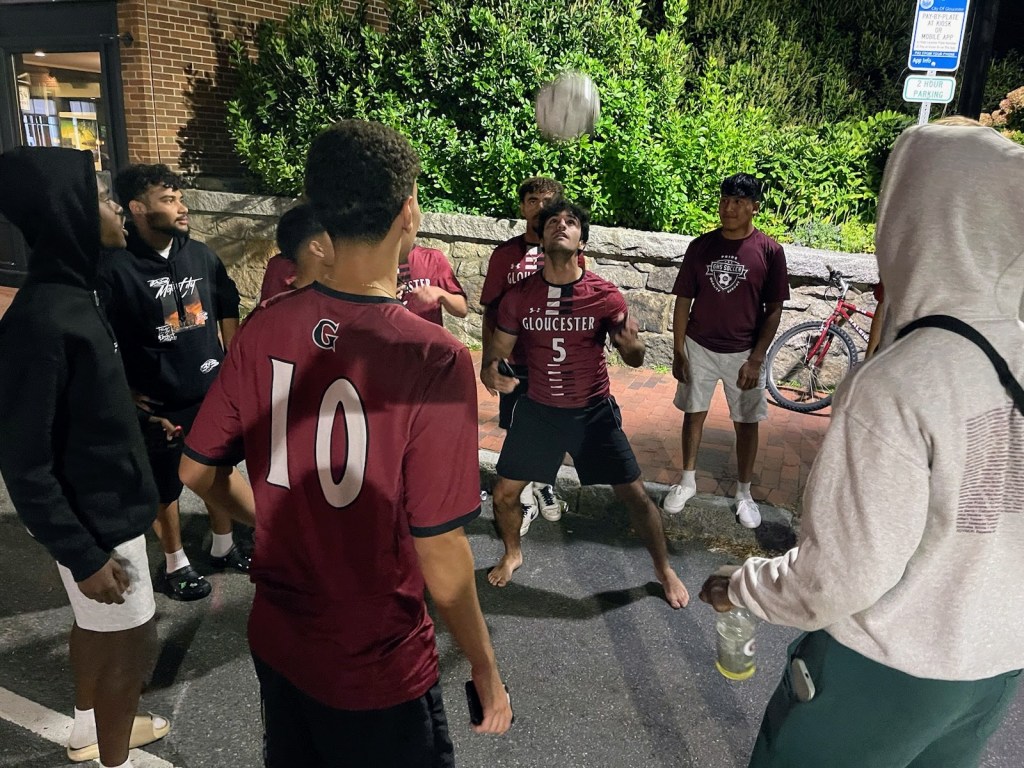
GHS Fishermen Athletics varsity soccer opening games 2023 vs. Salem September 6, 2023 (Boys at Home Newell New Balance/ Girls Away )

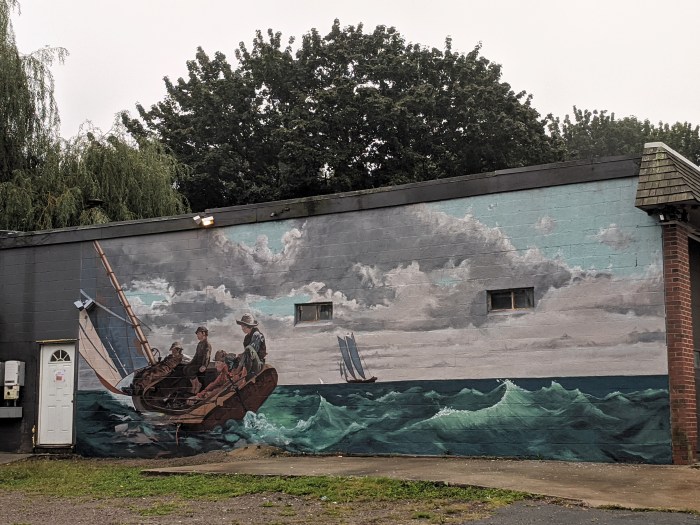
There’s a new Winslow Homer mural at the bend of Maplewood and Poplar on the former Linsky’s service station property, Cape Ann Auction headquarters since November 2022.
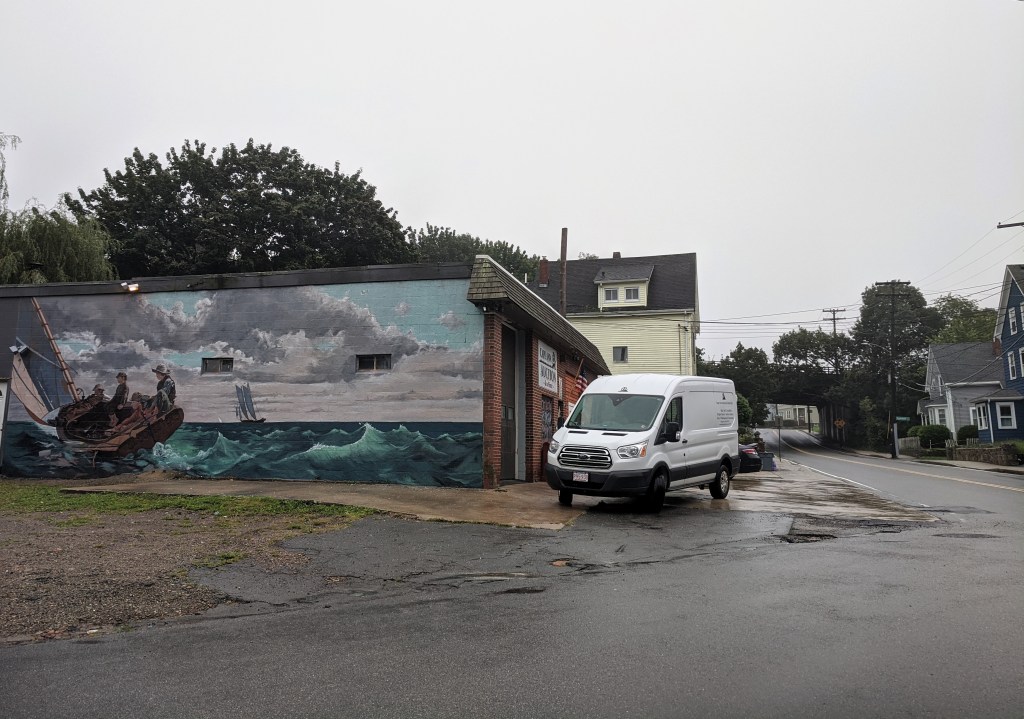
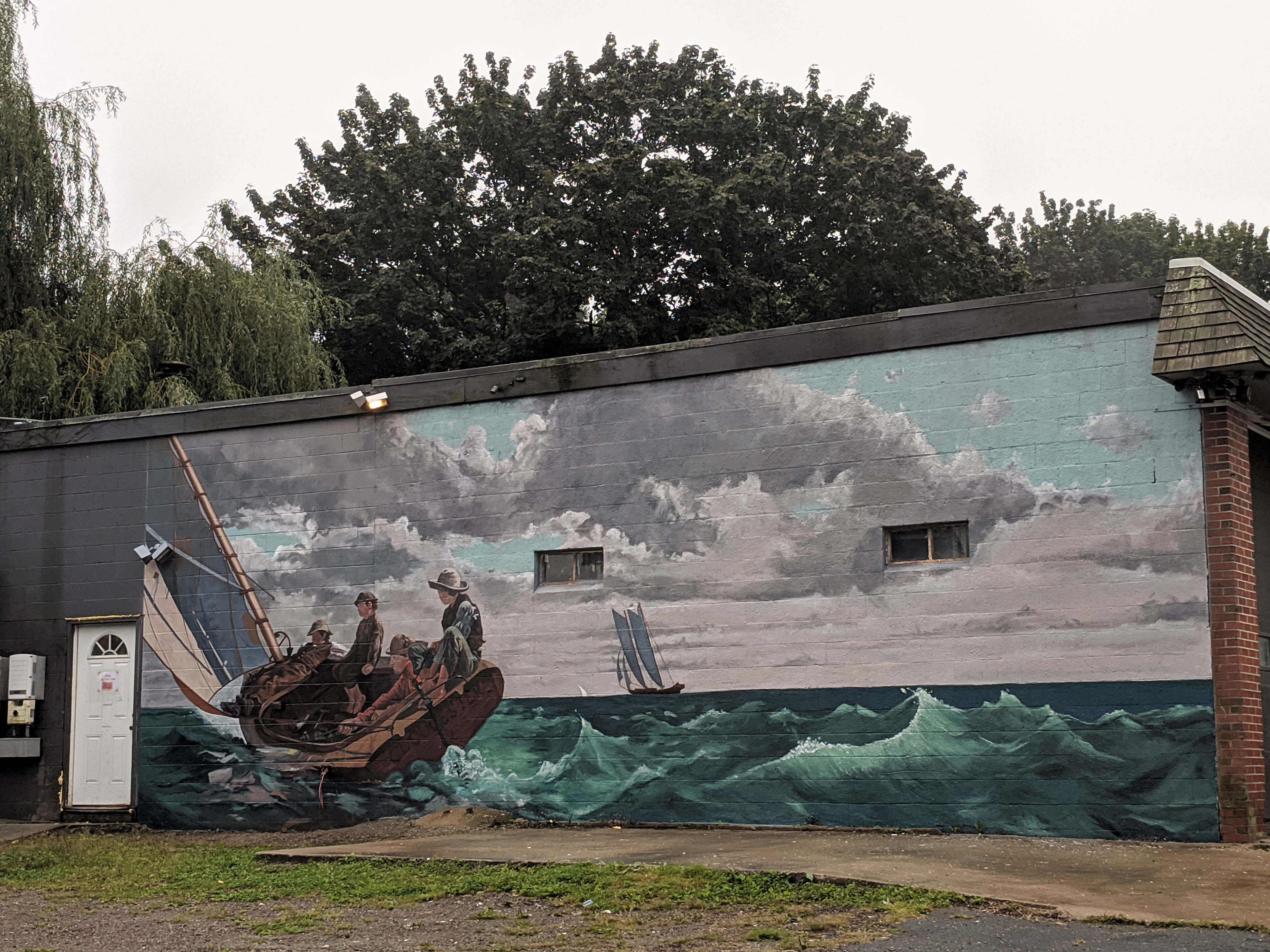
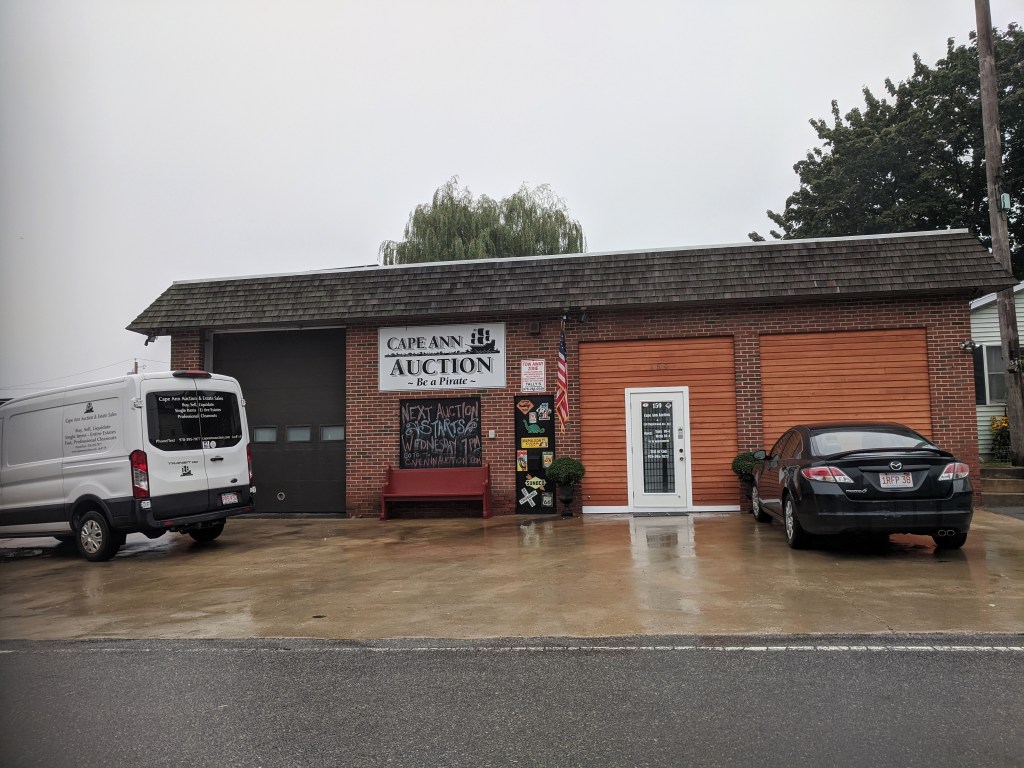
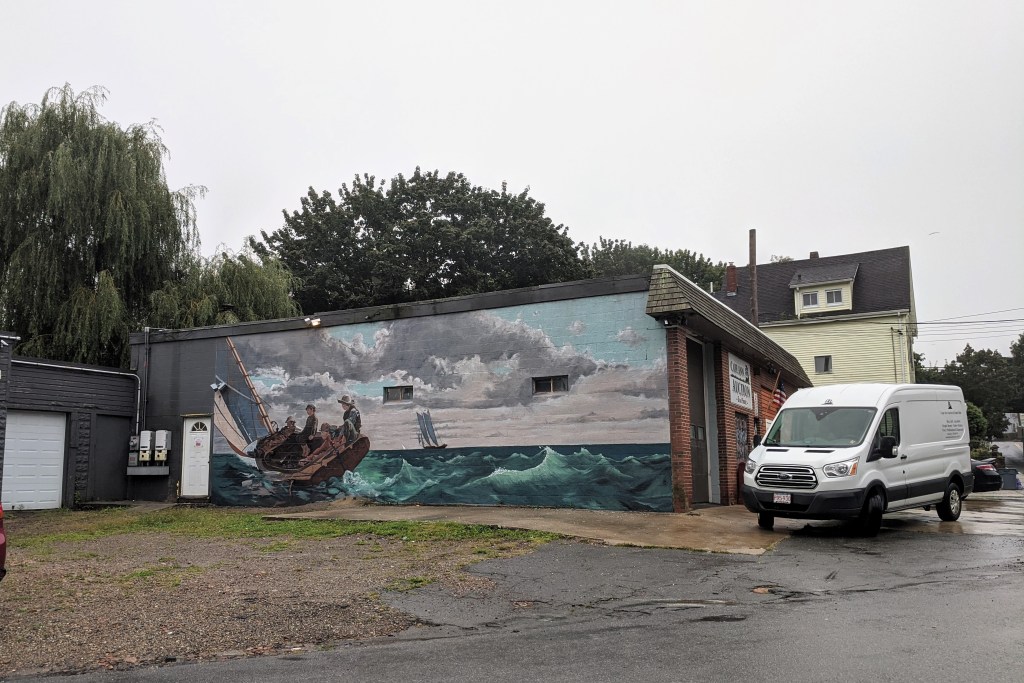
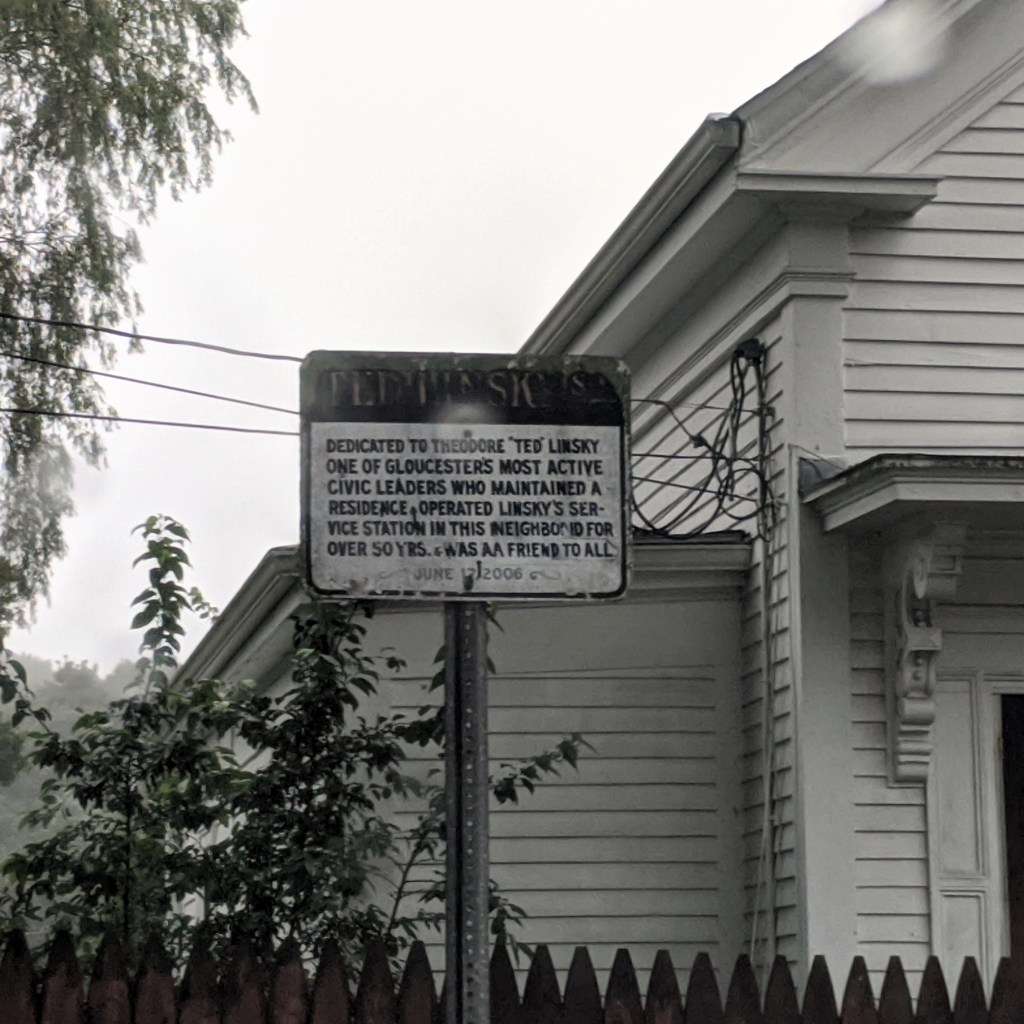
159 Maplewood Avenue, Gloucester, Mass. Read more about this Studio fresh mural project inspired by Homer’s works here (Awesome Gloucester).
Both Breezing Up (A Fair Wind) and The Flirt depict figures in a cat boat in Gloucester harbor.
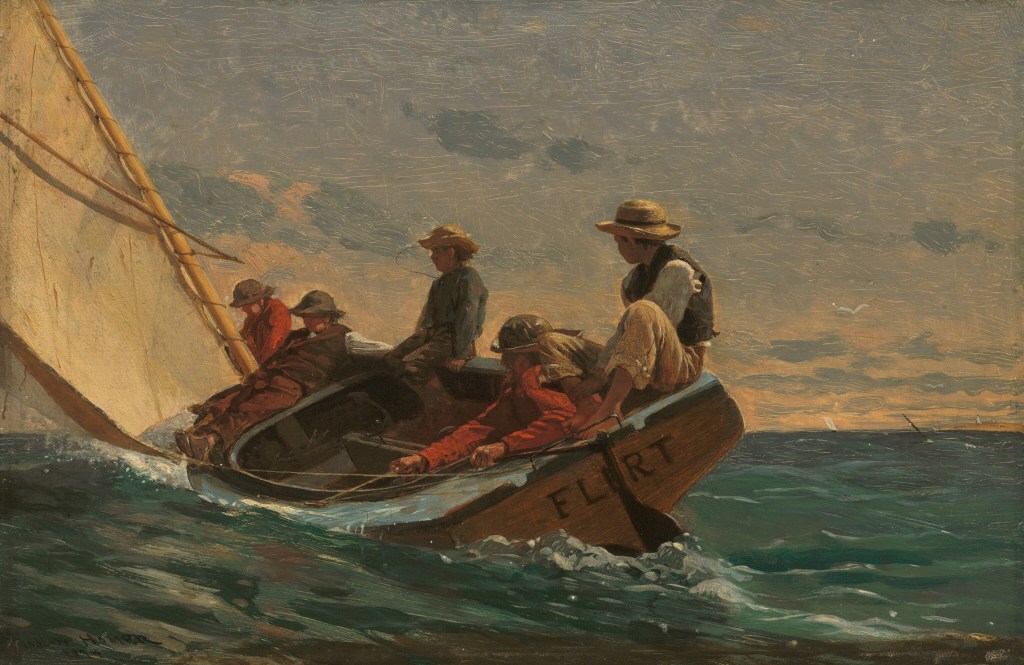
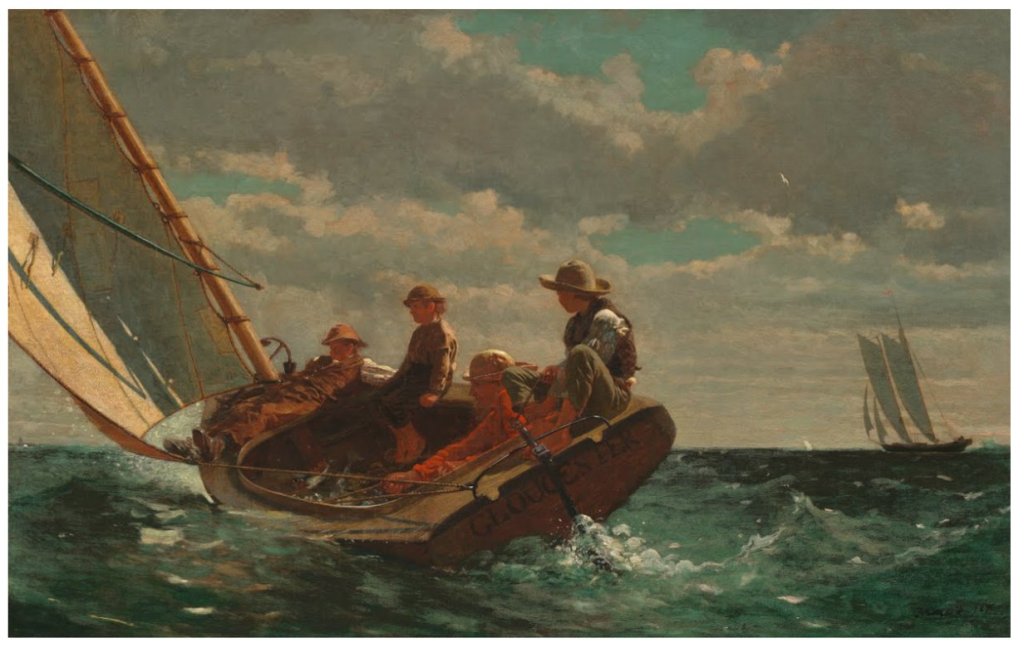
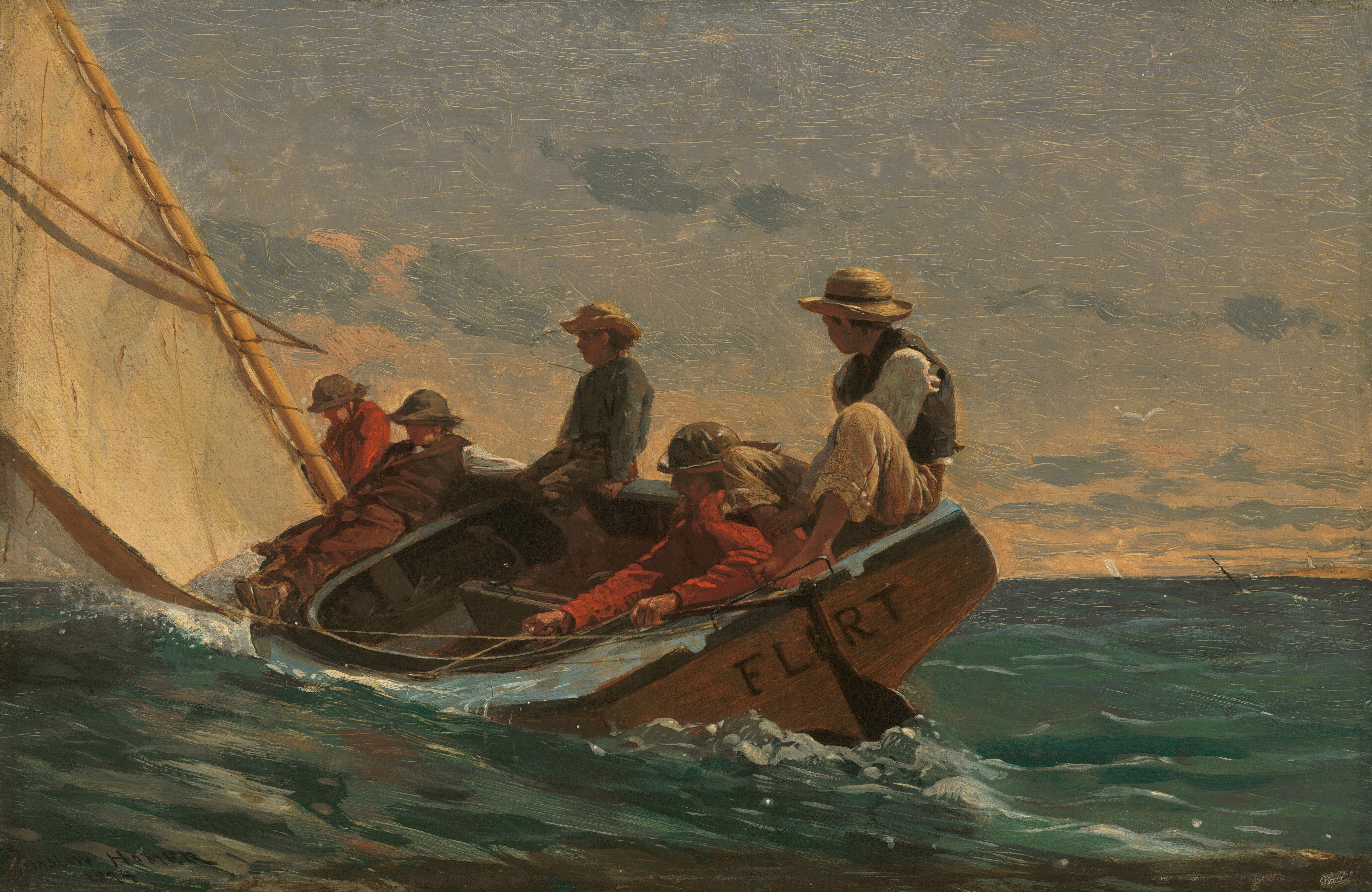
Image: Winslow Homer (1836-1910), The Flirt, 1874, oil on panel, National Gallery of Art acquisition, 2014 (Mellon collection)
Image: Winslow Homer, Breezing Up (A Fair Wind), 1873-1876, oil on canvas. National Gallery of Art acquisition (Wildenstein Gallery), 1943. Gift of the W. L. and May T. Mellon Foundation.
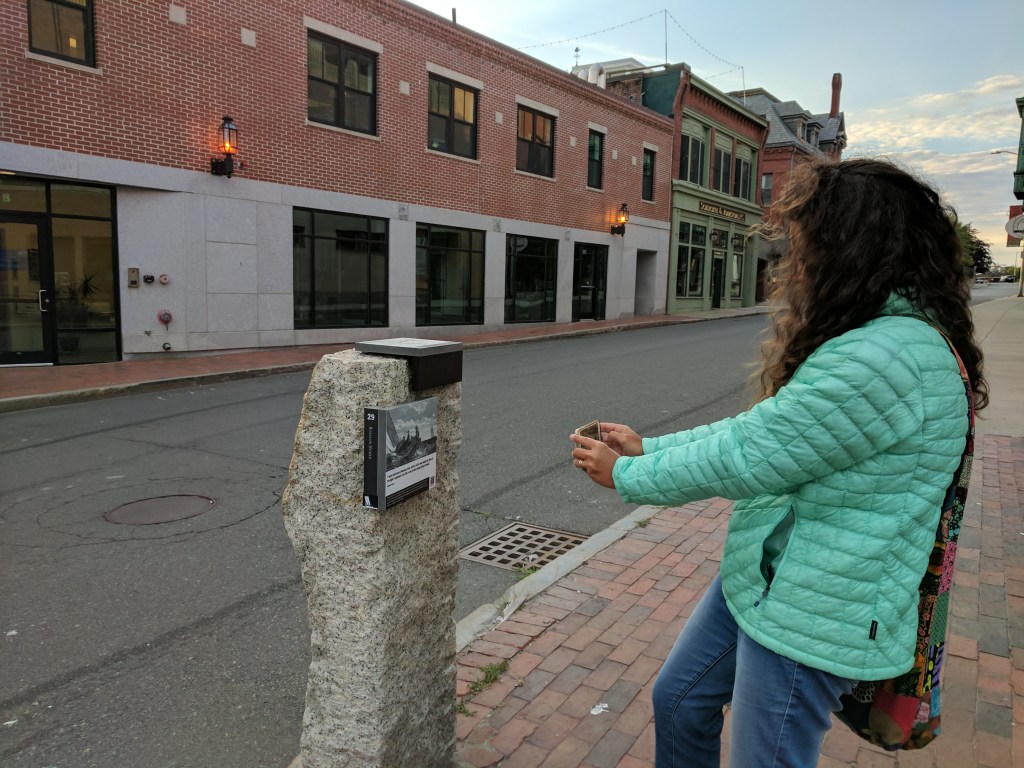
The Winslow Homer marker on the corner of Dale Ave & Main for Gloucester’s HarborWalk features Breezing Up (A Fair Wind) thanks to permission from the National Gallery of Art.


Author’s Note: From the National Archives collection, this contemporaneous 20 minute highlights newsreel covers the sights and sounds from the historic March On Washington for Jobs and Freedom, distributed in 1964. In 2021, I timestamped the music splits, and identified the speakers and performers included in this particular POV reel. (Still missing a few. Can you help?) Re-sharing on this 60th milestone anniversary Aug. 28, 2023.
video title: The March on Washington, 1964 film by the US Information Agency compilation for overseas from the National Archives and Records Administration collection (20 min)
Among the speakers and performers on the program (* appear in film clip):
Marian Anderson, Josephine Baker, Joan Baez* (audio early, then w/video 9:38-10:26), Harry Belafonte, Dr. Eugene Carson Blake* (16:59-17:28), Bobby Darin, Ossie Davis* (but only when he introduces Burt Lancaster 10:27), Ruby Dee (co-emcee with Ossie Davis), Bob Dylan, Freedom Singers* with choir (We shall not be moved 7:14 – 9:06), Dick Gregory, Martin Luther King Jr.* (18:18 – 18:59 press conference), Lena Horne, Mahalia Jackson, Eva Jessye Choir* (12:41 Freedom is the thing we’re talking about – Yolanda Clarke on organ), Burt Lancaster* (traveled from Paris to speak, 10:35-12:02), John Lewis* (video only – standing behind Reuther 17:29), Dr. Benjamin Mays* ( 14:34-15:36 benediction), Odetta, Peter Paul & Mary* (clips & audio of Blowin in the wind and If I had a hammer 3:18-4:33 first set), Asa Philip Randolph* (16:16-16:57 and again intro MLK 18:18), Bayard Rustin* (12:11 video only); Rev. Fred Shuttlesworth* (9:08- 9:27), Walter Reuther* (17:29-18:16), Camilla Williams (stepped up for the National Anthem; with the big crowds, Marian Anderson was too late, and would sing later in program. Williams famous, too, and worked with Jessye on Porgy & Bess.), Roy Wilkins* (13:41-14:28) and Josh White.
Opens with crowd walking and singing “we stay home and you’ll be gone…jail for more than a week, all I had was beans to eat…because my home is Danville” **Can you identify this song?**
Parade and marching band 4:34-5:40.
Eva Jessye Choir at 7:14-9:06 with Freedom singers “We shall not be moved” and later “Freedom is the thing we’re talking about” where Eva Jessye herself can be seen directing from back. Can you help identify the soloists- the gorgeous baritone, Robeson-esque at 12:36, and at 18:69 a stunning soprano soaring “We shall overcome” choir version, with crowd? The Eva Jessye Choir was the official choir for the March on Washington. Her long and storied career took off as chorus director for the Virgil Thomson and Gertrude Stein opera, “Four Saints in Three Acts” in 1934 and Gershwin’s “Porgy and Bess” the following year. She worked with Marian Anderson, Paul Robeson and more.
Among the notables marching with the crowd and/or mingling with dignitaries and speakers already mentioned above: Faye Anderson, Josephine Baker, James Baldwin, Leon Bibb, Marlon Brando, Diahann Carroll, Tony Curtis, Bobby Darin, Sammy Davis Jr., Tony Franciosa, James Garner, Charlton Heston, Kiyoshi Kuromiya, Joseph Mankiewicz, Rita Moreno, Gordon Parks, Paul Newman, Rosa Parks, Gregory Peck, Sam Peckinpah, Sidney Poitier, Jackie Robinson, Bill Russell, Robert Ryan, and Joanne Woodward. Senators present: Phillip Hart (D-Mich), Wayne Morse (D-OR), William Proxmire (D-WI), and Mayor Wagner (NYC).
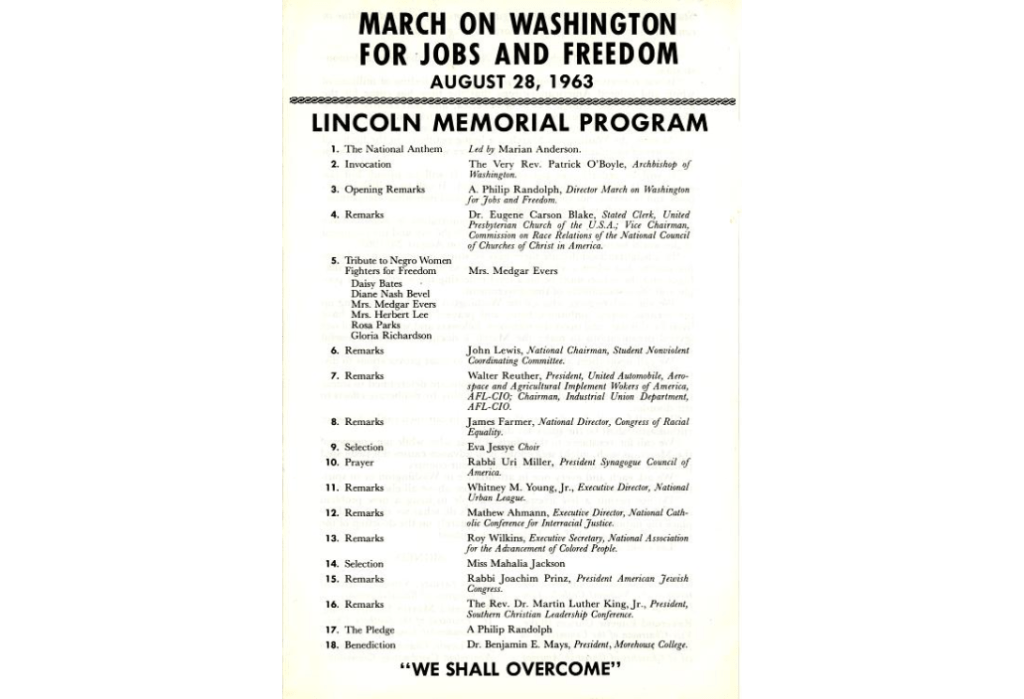
King delivered an earlier iteration of the sermon in Detroit, orchestrated by Rev. C.L. Franklin, Aretha Franklin’s father. During the march, news spread that W. E. B. DuBois died the previous night in Ghana. So much hope and progress, and mere weeks later, retaliation. The Birmingham Baptist church bombing was on September 15, 1963. Within five years of the March on Washington, Malcolm X and King were killed.
“We’re going to march. We’re going to walk together. We’re going to stand together. We’re going to sing together. We’re going to stay together. We’re going to moan together. We’re going to groan together and after a while, we will have freedom, freedom, and freedom now. And we all shall be free.”
Rev. Fred Shuttlesworth not formally asked for the program but asked to speak that day, one of many adjustments on the fly, rose to the occasion, primed the crowd
National Archives description of the film (added 2009 and still as of 2021):
“ARC Identifier 49737 / Local Identifier 306.3394. Scenes from Civil Rights March in Washington, D.C., August 1963. People walking up sidewalk; gathering on Mall, standing, singing. Lincoln Memorial, Washington Monument, crowd gathered on the Mall. People marching with signs, many men wearing UAW hats. People at speakers podium, men with guitars. Crowds outside of the White House, sign: The Catholic University of America. Band, people marching down street. Many signs, including All D.C. wants to vote! Home Rule for DC; Alpha Phi Alpha; and Woodstock Catholic Seminary for Equal Rights. Lincoln Memorial with crowds gathered around reflecting pool. People singing and clapping at speakers platform. Signs, people clapping. Man speaking, woman playing guitar and singing at podium. More speakers and shots of the crowd. A chorus, NAACP men in crowd. Close-ups of people in crowd with bowed heads. Shots taken from above of White House. More speakers, including Rev. Martin Luther King, Jr. Women at podium singing We Shall Overcome. Crowd swaying, singing, holding hands.”
1963 GORDON PARKS COLOR PHOTOGRAPH

photo: installation view at The Cooper Gallery Harvard, Gordon Parks exhibition 2019 by C. Ryan — Parks’ photo journalist and cinematic chops in this sea of us momentous moment, March on Washington, 1963, view from Lincoln Memorial to Washington Monument. [*Lincoln designed by Daniel Chester French unveiled 1922; Washington Monument designed by Robert Mills; completed by Thomas Casey and the U.S. Army Corps of Engineers, dedicated 1884.] For more about Gordon Parks work in Gloucester, Mass. see 2012-14 here
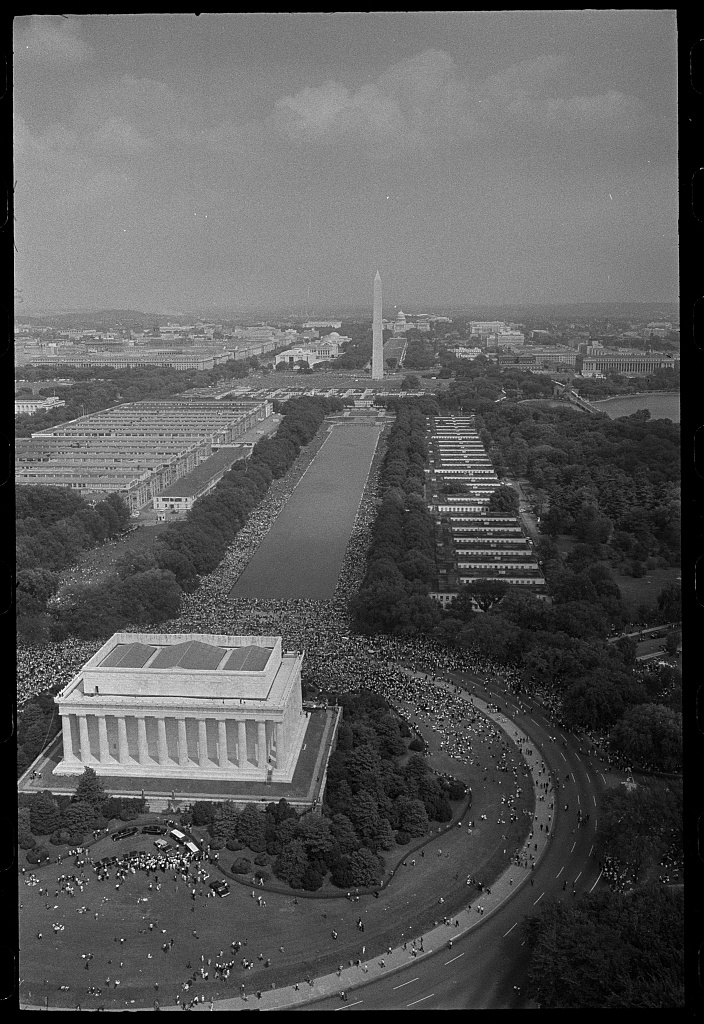
[photographer Thomas J. O’Halloran, aerial view of marchers, from the Lincoln Memorial to the Washington Monument, at the March on Washington, 1963, Library of Congress.]


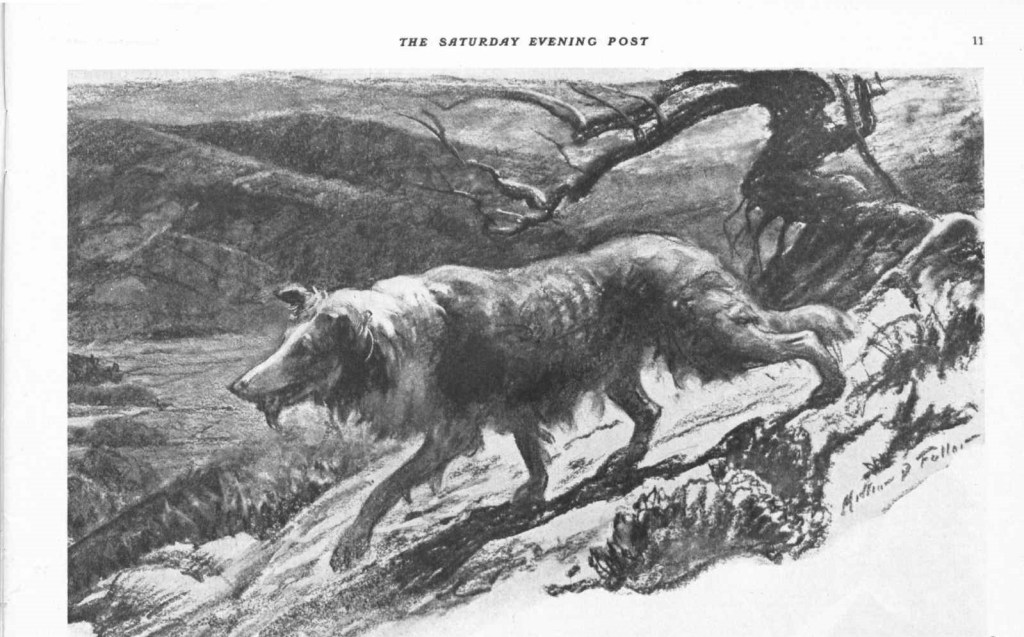
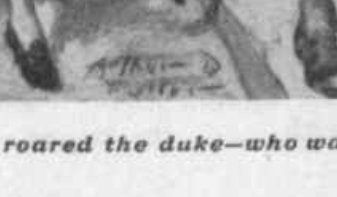
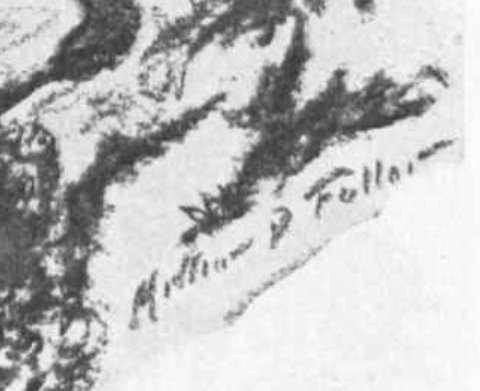
Illustrations: The short story, Lassie Come-Home by Edward Knight with illustrations by Arthur D. Fuller*, was an instant must-read-and-share when it was first published in the popular magazine, The Saturday Evening Post on December 17, 1938. Edward Hopper painted Cape Cod, Evening in 1939. *The illustrator’s signature is tough to read without the credit beneath the byline. (Scroll down to see and read the story pages or to print a PDF. It’s a great read!)
You may know the memorable and unbreakable bond of the boy and his dog which Lassie Come-Home describes, and the small and epic journeys.
The short story, Lassie Come-Home by Edward Knight with illustrations by Arthur D. Fuller, was an instant must-read-and-share when it was first published in the popular magazine, The Saturday Evening Post on December 17, 1938.
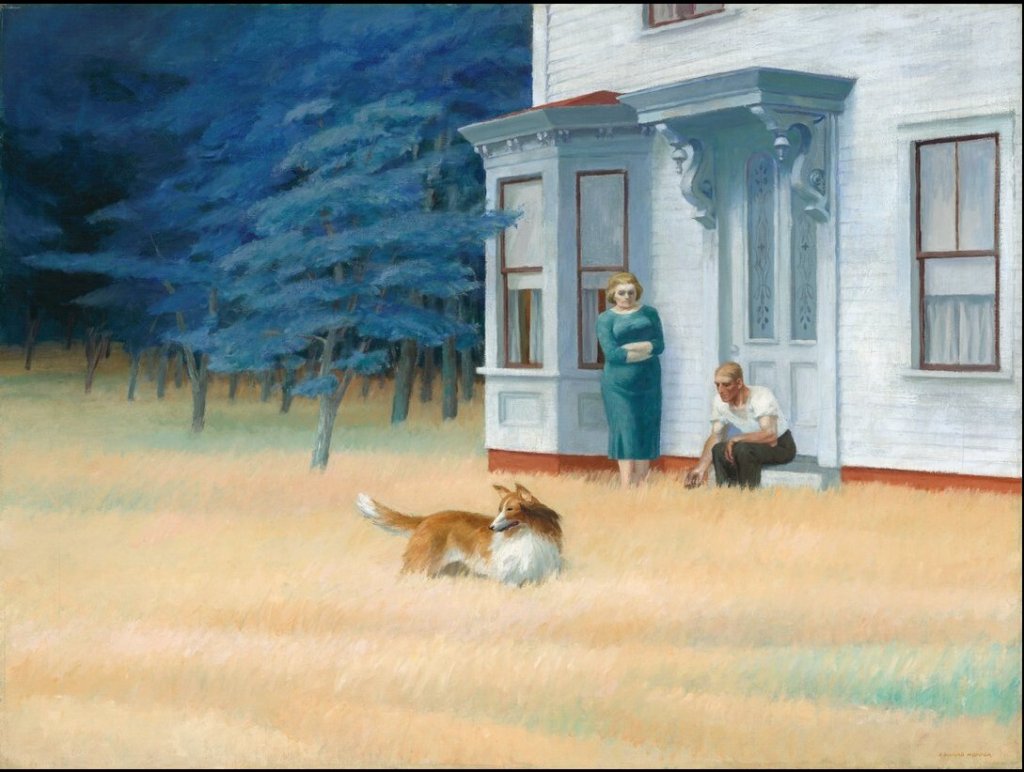
Edward Hopper painted Cape Cod, Evening in 1939.
The short story is set in England and opens with a small family of three in recurring and searing pain: Two parents who have fallen on hard times and are under great emotional strain struggle to comfort their only child because they sold the family dog. Their beautiful collie, “Lassie”, is so devoted to their son, the dog runs away from the new owner straight back to the boy over and over again. Under the circumstances, any and every solution is untenable. His parents’ misplaced anger, adult exchanges, and silence confuse the boy. Their anguish and love is palpable.
Out of desperation, Lassie is removed to Scotland which they believe will be an insurmountable distance to cover.
It’s not. And no wonder a legend is born!
The first Lassie novel was published in 1940. Swift adaptations followed. It’s easy to see how the story resonated with American audiences during the Great Depression, even perhaps the great American artist, Edward Hopper.
If not Lassie herself, it’s tempting to consider the intergenerational communication and couple dynamics explored in Knight’s story as themes Hopper noticed, too.
“…Then they heard his opening of the door and the voice stopped and the cottage was silent. That’s how it was now, the boy thought. They stopped talking in front of you. And this, somehow, was too much for him to bear. He closed the door, ran out into the night, and onto the moor, that great flat expanse of land where all the people of that village walked in lonesomeness when life and its troubles seemed past bearing…”
Lassie Come-Home, Edward Knight, The Saturday Evening Post, 1938 Dec. 17
Both used punctuation in titles. Knight offset the story’s title with a vital hyphen, Lassie Come-Home (command-comfort) that might have caught Hopper’s attention. Hopper used commas often for emphasis–as in Cape Cod, Evening.
Beyond the Great Depression, 1938 may have appeared especially distant, simpler, on first pass. Yet, with international tensions rising year by year and the horrors of WWI just a generation past, neither 1938 nor 1939 were simple. Jan Struther, another UK author, broached topics of peacetime, lengthy stasis, and looming loss in the popular Mrs. Miniver pieces, published in The Times London newspaper (1937-39 ), at the same times as Lassie. Reader’s Digest distribution was international beginning in 1938.
In Cape Cod, Evening 1939, Hopper’s dog reacts, hears something, like a whippoorwill, or so the story goes. (Lloyd Goodrich’s Hopper bio, 1971; also Gail Levin, 1995) Levin’s book takes time to introduce the reader to Hoppers’ friends, and so we understand the grief from the loss of their friend Harriet Jenness who died “in early July of 1939. It was she who had firmed up the Hoppers’ courage to build in the first place and provided a roof till theirs was done.” (Levin, 1995.)
Cape Cod, Evening is constantly changing because it’s laden with enigmatic motifs. It’s late summer and fall. Unsettling and calm. Are the man and woman taking a momentary break together (as with the son and father walking in the Lassie story) or engaged in a forced desist (as with the parents going silent in the Lassie story)? Active fight or passive summer ennui? And what about that evergreen Hopper forest at the edge? Is it a cool and reachable retreat? Are the trees leaning, falling? Is the sea of dry grass sunlit and waving or scorched and still? And why no path? The man and woman are lost in thought. Worried? Families will have to have difficult conversations. Some won’t return. And what about the significance of that star dog with the striking fur?
Hopper was 35 at the onset of WWI, registered, but not called for duty. He was 57 in 1939.
Edward Hopper paintings dated 1939: Bridle Path (Bruce Museum of Art, CT), Ground Swell ( NGA collection), Cape Cod, Evening (NGA collection), and New York Movie (MoMa). As a group, they make a strong case that Hopper was thinking about 1939 in 1939.
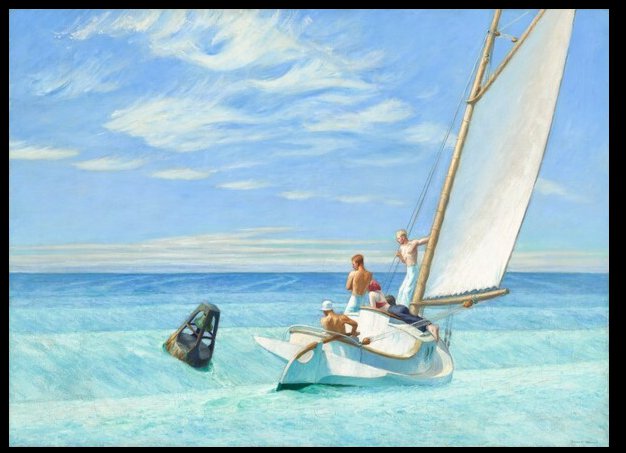

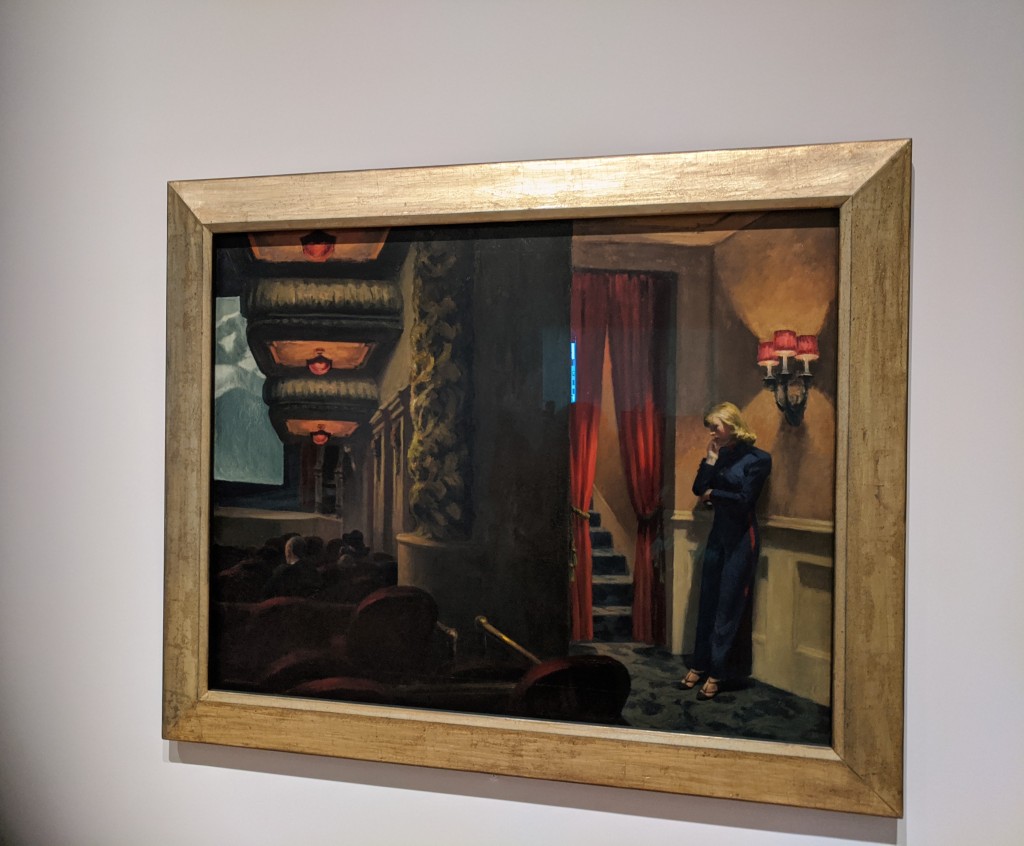
Edward Hopper and Jo Hopper were on the Cape when war broke out.
On August 29, 1939, friends dropped by their summer home in Truro and Jo Hopper noted in her diary how the woman said, “…She’d been to England last week. Said they all prepared for war—everyone has his funkhole ready for an air raid.” On August 30 she added “E.” went to town on errands and picked up a magazine:
“Augu. 30. Still raining. After lunch E. went to P.O. & bought back kerosene, Readers Dig, postcard from Ginny at fair + the note from D R.—to see us Sept. 18 at 11. Onion soup & banana salad for lunch & tummy ache over dishes. E. so tired. Standing up at canvas. Canvas seems standing still. But I’ve seen that happen before…”
Josephine N. Hopper, Aug. 30, 1929 diary page. Provincetown Art Museum Collection, 2016. “Donation by Laurence C. and J. Anton Schiffenhaus in honor of their mother Mary Schiffenhaus (a close and personal friend of Josephine and Edward Hopper)”
On September 1, 1939 Germany invaded Poland, and England and France declared war on Germany just two days later.
On September 3, Jo mentions art and war :
“…E’s 2 canvases*. Sailboat without sky as yet. Tonight Bertha Frank & Edgar Cobb came up to say good bye for the season. Everyone else in Truro had their supper dishes washed—but we hadn’t begun yet. E. was still working when they arrived. He’s been plenty interrupted today. We didn’t swim—it looked so cold. Ginny said not cold but very dirty + water full of pink jelly fish.
So war is declared today & yesterday we saw that over into Poland. E. had a Times yesterday & we saw that. How Nat. news dwarfs everything. Why Pittsburgh festivities. Why anything. E. said he could drive an ambulance. I hope not. We most of everything need to get well…”
Josephine N. Hopper, Sept. 3, 1939. *Ground Swell and Cape Cod, Evening
Examples of dogs in famous visual arts and letters abound before Lassie. During WWI, the soon to be famous german shepherd puppy Rin Tin Tin was rescued from the battlefield by Lee Duncan, and brought back to the United States. He was trained exceptionally well then on a hunch for the Silent Movie era. The original Rin Tin Tin’s first Hollywood movie was a bit part in 1922. He starred in so many box office hits, when he died in 1932 his death ‘stopped the presses’. Generations of Rin Tin Tin descendents followed, representing his public legacy if not his agility and acting chops. Other shepherds were used in later vehicles. For more about Rin Tin Tin’s global fame and impact and Duncan’s life–he did not trademark the name– see Susan Orleans biography, Rin Tin Tin: The Life and the Legend. (Also her short piece The Dog Star, New Yorker, Aug. 2011 and a preview excerpt NY Times Oct. 2011.) I doubt Hopper would add a German Shepherd in a 1939 painting.
And before Rin Tin Tin? There would be no Dorothy without Toto. Frank Baum wrote the The Wizard of Oz in 1900. The production of the movie adaptation made news ahead of its release August 29th, 1939. (It failed to earn a profit until re-releases decades later.)
Jack London’s Buck in The Call of the Wild debuted in 1903.
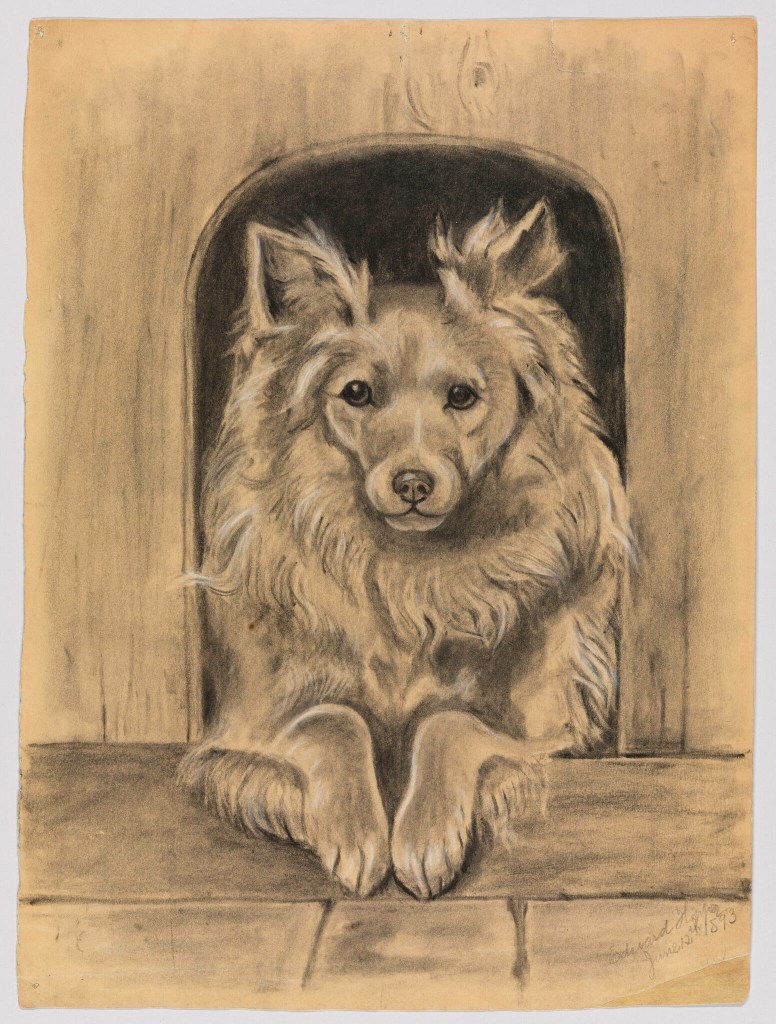
The Whitney Museum holds an early portrait drawing by Edward Hopper (1882-1967) of a contented dog–framed in a doghouse door naturally–dated 1893.
Edward Hopper Cape Cod, Evening 1939 was acquired by the National Gallery of Art in 1982.
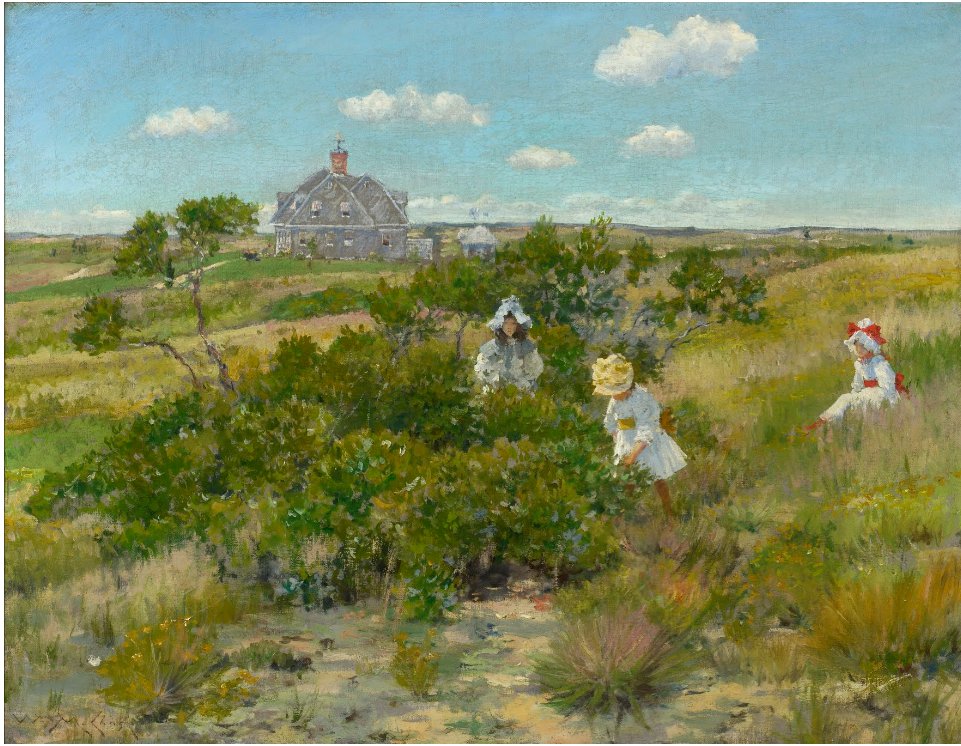
I think about Wyeth and Chase a lot when I look at Hopper’s Cape Cod, Evening. Same when I encounter any one of the three.
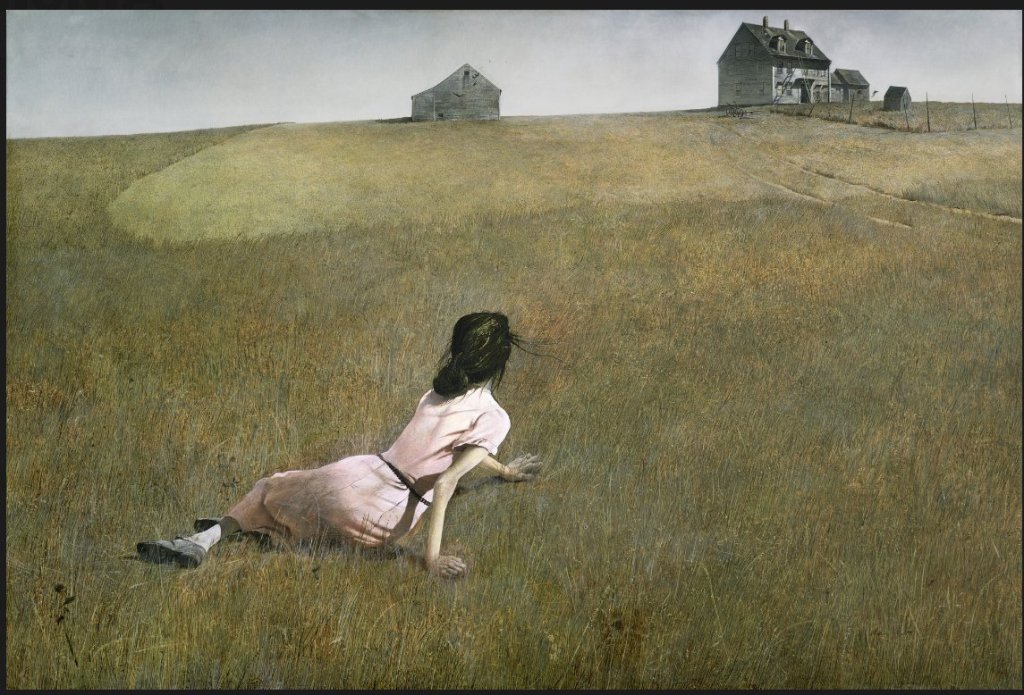
A decade after Cape Cod, Evening, American artist and fan of Hopper, Andrew Wyeth, completed Christina’s World, 1948 (Museum of Modern Art, New York).
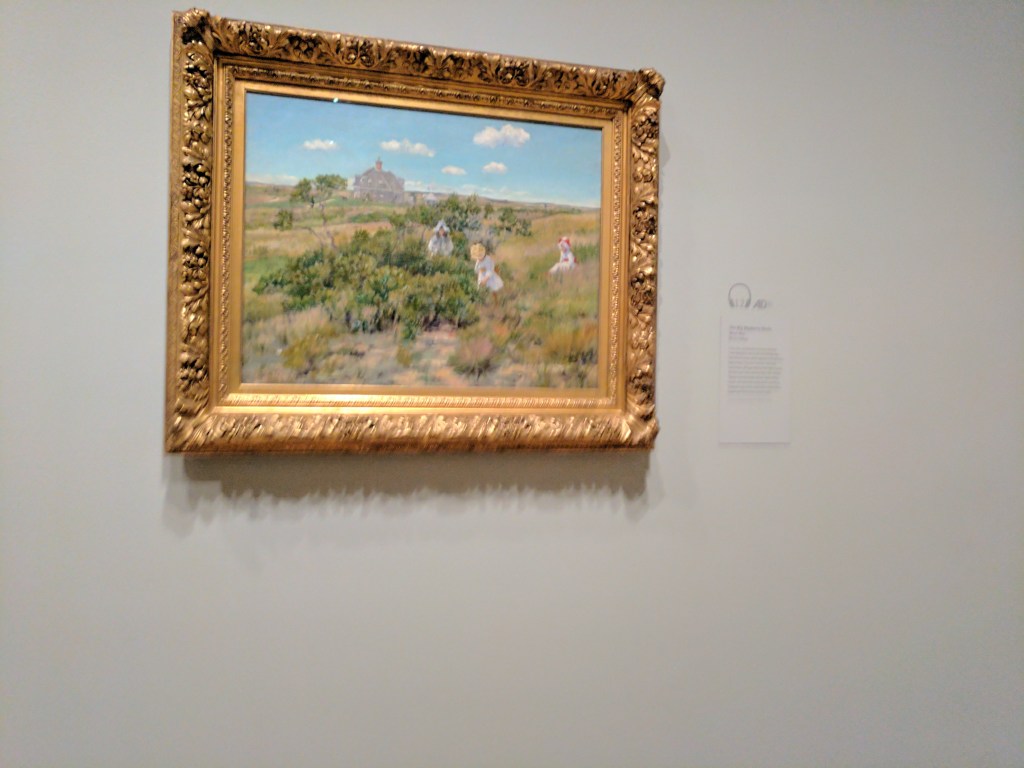
Dry grass dunes and vegetation in the Hamptons on Long Island by American artist William Merritt Chase, art world famous in his day, and one of Hopper’s esteemed fine art professors. Photos: C. Ryan. Installation views from the William Merritt Chase exhibition at the MFA in 2017. Shinnecock Hills of Southampton seen in two works: Bayberry Bush 1895 (Parrish Art Museum) and Seaside Flowers (Crystal Bridges) The photo with the supercharged green is how it’s often depicted, but not how I experience this Chase series in person. (Chase painted a bevy of great dogs in other works.)

The Saturday Evening Post’s tag line “Founded 1728 by Benj. Franklin”
Select to enlarge pages and pinch or zoom. PDF below. Lassie Come-Home by Edward Knight with illustrations by Arthur D. Fuller. The Saturday Evening Post. December 17, 1938
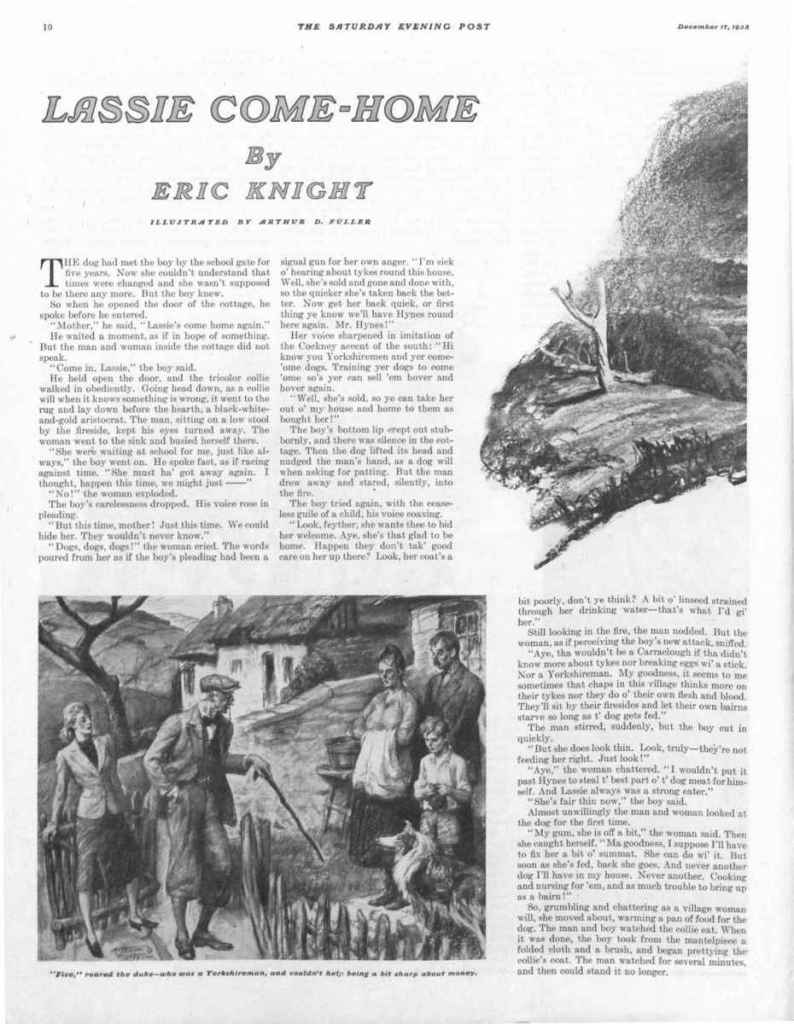
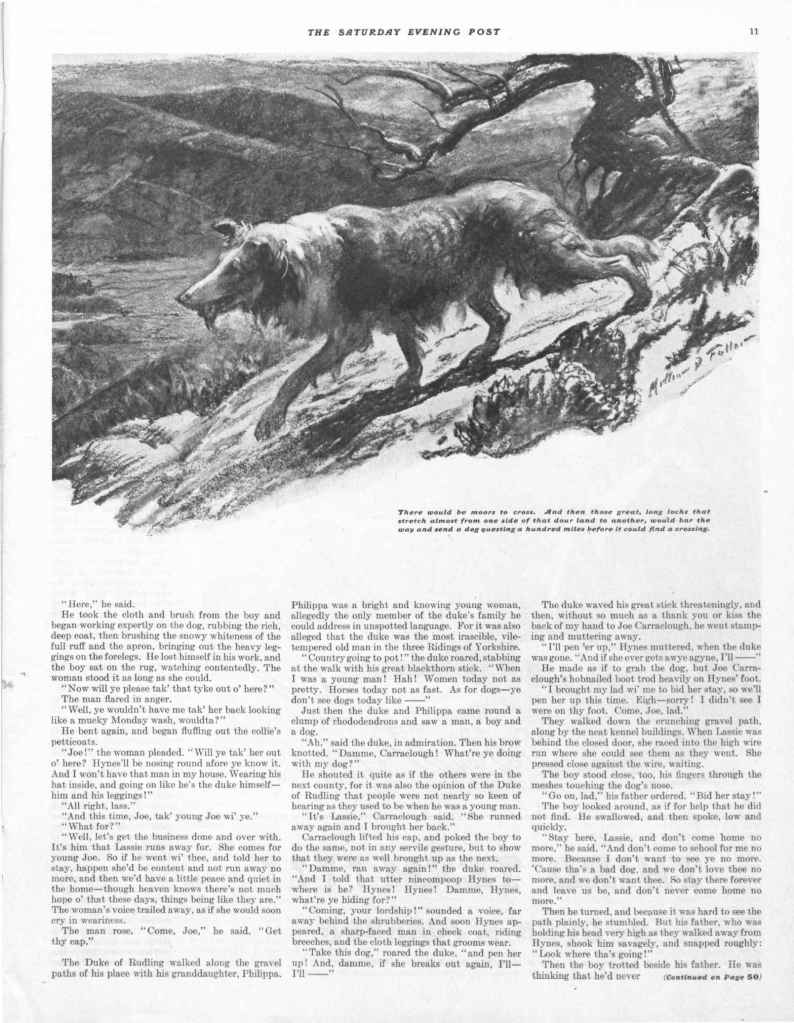
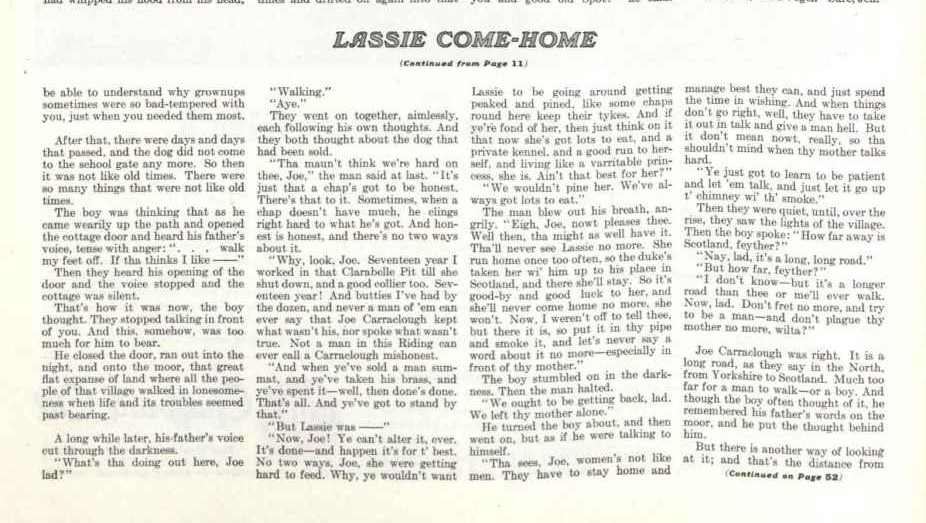


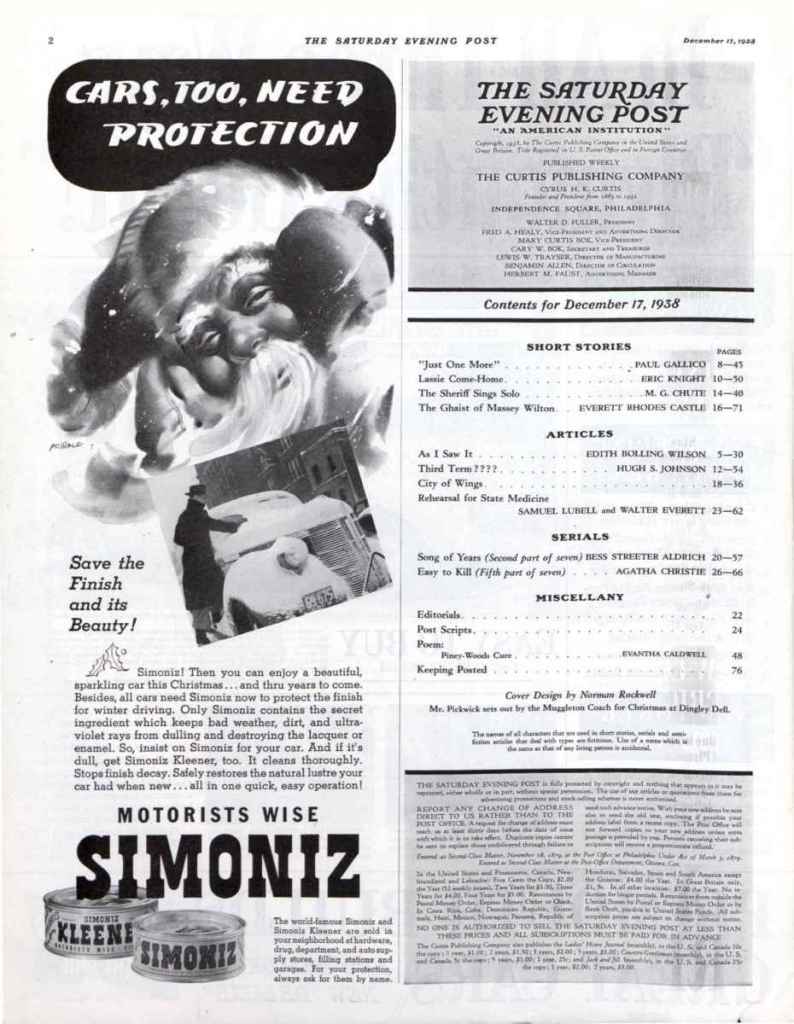

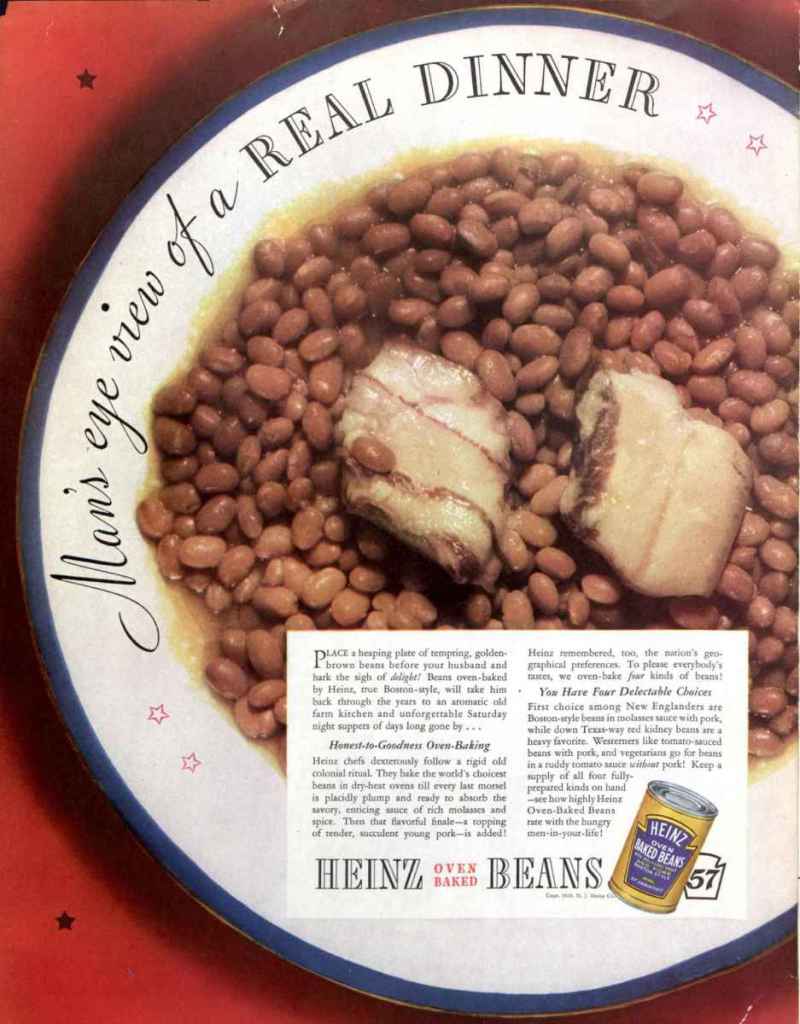

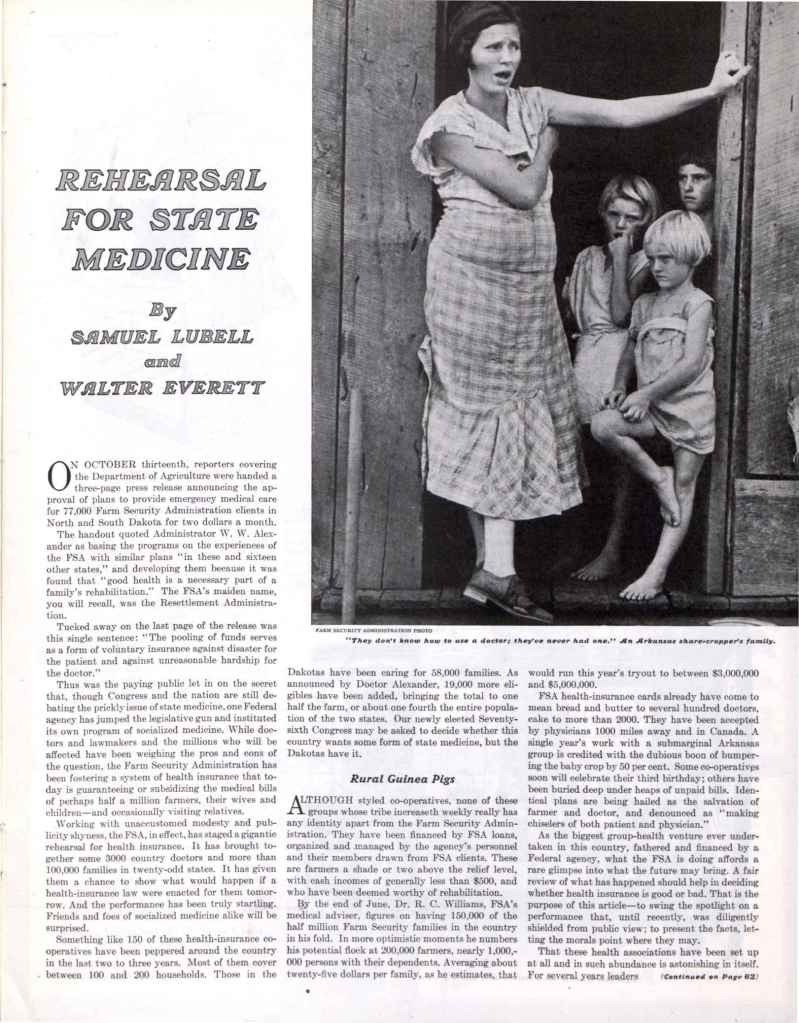
The issue also featured a Norman Rockwell on the cover, a serialized Agatha Christie installment, an investigative long read about universal healthcare– illustrated with a Farm Security Administration (FSA) photograph by Arthur Rothstein in Arkansas, circa 1935–and several classic ads. New Yorkers Jo and Ed Hopper did not eat at home much, and when they did…beans were a big draw. The prominent full page color Heinz ad was on the inside cover of this issue. I do not know the illustrator of the Gulfpride Oil ad, but it’s great. For more information about the FSA and Arthur Rothstein with a timeline continue reading here ; for more about Roy Stryker & the origins of the FSA and Gordon Parks continue reading here; and for more about the FSA and Howard Liberman continue reading here.
-by Catherine Ryan
cryanaid.com Edward Hopper All Around Gloucester
**First published 8/26/2023 on the occasion of National Dog Day. August 26 is International Dog Day. **

**August 26 is International Dog Day**
Illustrations: The short story, Lassie Come-Home by Edward Knight with illustrations by Arthur D. Fuller*, was an instant must-read-and-share when it was first published in the popular magazine, The Saturday Evening Post on December 17, 1938. Edward Hopper painted Cape Cod, Evening in 1939. *The illustrator’s signature is tough to read without the credit beneath the byline. (Scroll down to see and read the story pages or to print a PDF. It’s a great read!)
You may know the memorable and unbreakable bond of the boy and his dog which Lassie Come-Home describes, and the small and epic journeys.
The short story, Lassie Come-Home by Edward Knight with illustrations by Arthur D. Fuller, was an instant must-read-and-share when it was first published in the popular magazine, The Saturday Evening Post on December 17, 1938.
Edward Hopper painted Cape Cod, Evening in 1939.
The short story is set in England and opens with a small family of three in recurring and searing pain: Two parents who have fallen on hard times and are under great emotional strain struggle to comfort their only child because they sold the family dog. Their beautiful collie, “Lassie”, is so devoted to their son, the dog runs away from the new owner straight back to the boy over and over again. Under the circumstances, any and every solution is untenable. His parents’ misplaced anger, adult exchanges, and silence confuse the boy. Their anguish and love is palpable.
Out of desperation, Lassie is removed to Scotland which they believe will be an insurmountable distance to cover.
It’s not. And no wonder a legend is born!
The first Lassie novel was published in 1940. Swift adaptations followed. It’s easy to see how the story resonated with American audiences during the Great Depression, even perhaps the great American artist, Edward Hopper.
If not Lassie herself, it’s tempting to consider the intergenerational communication and couple dynamics explored in Knight’s story as themes Hopper noticed, too.
“…Then they heard his opening of the door and the voice stopped and the cottage was silent. That’s how it was now, the boy thought. They stopped talking in front of you. And this, somehow, was too much for him to bear. He closed the door, ran out into the night, and onto the moor, that great flat expanse of land where all the people of that village walked in lonesomeness when life and its troubles seemed past bearing…”
Lassie Come-Home, Edward Knight, The Saturday Evening Post, 1938 Dec. 17
Both used punctuation in titles. Knight offset the story’s title with a vital hyphen, Lassie Come-Home (command-comfort) that might have caught Hopper’s attention. Hopper used commas often for emphasis–as in Cape Cod, Evening.
Beyond the Great Depression, 1938 may have appeared especially distant, simpler, on first pass. Yet, with international tensions rising year by year and the horrors of WWI just a generation past, neither 1938 nor 1939 were simple. Jan Struther, another UK author, broached topics of peacetime, lengthy stasis, and looming loss in the popular Mrs. Miniver pieces, published in The Times London newspaper (1937-39 ), at the same times as Lassie. Reader’s Digest distribution was international beginning in 1938.
In Cape Cod, Evening 1939, Hopper’s dog reacts, hears something, like a whippoorwill, or so the story goes. (Lloyd Goodrich’s Hopper bio, 1971; also Gail Levin, 1995) Levin’s book takes time to introduce the reader to Hoppers’ friends, and so we understand the grief from the loss of their friend Harriet Jenness who died “in early July of 1939. It was she who had firmed up the Hoppers’ courage to build in the first place and provided a roof till theirs was done.” (Levin, 1995.)
Cape Cod, Evening is constantly changing because it’s laden with enigmatic motifs. It’s late summer and fall. Unsettling and calm. Are the man and woman taking a momentary break together (as with the son and father walking in the Lassie story) or engaged in a forced desist (as with the parents going silent in the Lassie story)? Active fight or passive summer ennui? And what about that evergreen Hopper forest at the edge? Is it a cool and reachable retreat? Are the trees leaning, falling? Is the sea of dry grass sunlit and waving or scorched and still? And why no path? The man and woman are lost in thought. Worried? Families will have to have difficult conversations. Some won’t return. And what about the significance of that star dog with the striking fur?
Hopper was 35 at the onset of WWI, registered, but not called for duty. He was 57 in 1939.
Edward Hopper paintings dated 1939: Bridle Path (Bruce Museum of Art, CT), Ground Swell ( NGA collection), Cape Cod, Evening (NGA collection), and New York Movie (MoMa)
As a group, they make a strong case that Hopper was thinking about 1939 in 1939.
Edward Hopper and Jo Hopper were on the Cape when war broke out.
On August 29, 1939, friends dropped by their summer home in Truro and Jo Hopper noted in her diary how the woman said, “…She’d been to England last week. Said they all prepared for way—everyone has his funkhole ready for an air raid.” On August 30 she added “E.” went to town on errands and picked up a magazine:
“Augu. 30. Still raining. After lunch E. went to P.O. & bought back kerosene, Readers Dig, postcard from Ginny at fair + the note from D R.—to see us Sept. 18 at 11. Onion soup & banana salad for lunch & tummy ache over dishes. E. so tired. Standing up at canvas. Canvas seems standing still. But I’ve seen that happen before…”
Josephine N. Hopper, Aug. 30, 1929 diary page. Provincetown Art Museum Collection, 2016. “Donation by Laurence C. and J. Anton Schiffenhaus in honor of their mother Mary Schiffenhaus (a close and personal friend of Josephine and Edward Hopper)”
On September 1, 1939 Germany invaded Poland, and England and France declared war on Germany just two days later.
On September 3, Jo mentions art and war :
“…E’s 2 canvases*. Sailboat without sky as yet. Tonight Bertha Frank & Edgar Cobb came up to say good bye for the season. Everyone else in Truro had their supper dishes washed—but we hadn’t begun yet. E. was still working when they arrived. He’s been plenty interrupted today. We didn’t swim—it looked so cold. Ginny said not cold but very dirty + water full of pink jelly fish.
So war is declared today & yesterday we saw that over into Poland. E. had a Times yesterday & we saw that. How Nat. news dwarfs everything. Why Pittsburgh festivities. Why anything. E. said he could drive an ambulance. I hope not. We most of everything need to get well…”
Josephine N. Hopper, Sept. 3, 1939. *Ground Swell and Cape Cod, Evening
Examples of dogs in famous visual arts and letters abound before Lassie. During WWI, the soon to be famous german shepherd puppy Rin Tin Tin was rescued from the battlefield by Lee Duncan, and brought back to the United States. He was trained exceptionally well then on a hunch for the Silent Movie era. The original Rin Tin Tin’s first Hollywood movie was a bit part in 1922. He starred in so many box office hits, when he died in 1932 his death ‘stopped the presses’. Generations of Rin Tin Tin descendents followed, representing his public legacy if not his agility and acting chops. Other shepherds were used in later vehicles. For more about Rin Tin Tin’s global fame and impact and Duncan’s life–he did not trademark the name– see Susan Orleans biography, Rin Tin Tin: The Life and the Legend. (Also her short piece The Dog Star, New Yorker, Aug. 2011 and a preview excerpt NY Times Oct. 2011.)
And before Rin Tin Tin? There would be no Dorothy without Toto. Frank Baum wrote the The Wizard of Oz in 1900. The production of the movie adaptation made news and was released August 29th, 1939. It failed to earn a profit until re-releases decades later.
Jack London’s Buck in The Call of the Wild debuted in 1903.
The Whitney Museum holds an early portrait drawing by Hopper of a contented dog–framed in a doghouse door naturally–dated 1893.
Edward Hopper Cape Cod, Evening 1939 was acquired by the National Gallery of Art in 1982.
I think about Wyeth and Chase a lot when I look at Hopper’s Cape Cod, Evening. Same when I encounter any one of the three.
A decade after Cape Cod, Evening, American artist and fan of Hopper, Andrew Wyeth, completed Christina’s World, 1948 (Museum of Modern Art, New York).
Dry grass dunes and vegetation in the Hamptons on Long Island by American artist William Merritt Chase, art world famous in his day, and one of Hopper’s esteemed fine art professors. Photos: C. Ryan. Installation views from the William Merritt Chase exhibition at the MFA in 2017. Shinnecock Hills of Southampton seen in two works: Bayberry Bush 1895 (Parrish Art Museum) and Seaside Flowers (Crystal Bridges) The photo with the supercharged green is how it’s often depicted, but not how I experience this Chase series in person. (Chase painted a bevy of great dogs in other works.)
The Saturday Evening Post’s tag line “Founded 1728 by Benj. Franklin”
Select to enlarge pages and pinch or zoom. PDF below. Lassie Come-Home by Edward Knight with illustrations by Arthur D. Fuller. The Saturday Evening Post. December 17, 1938
The issue also featured a Norman Rockwell on the cover, a serialized Agatha Christie installment, an investigative long read about universal healthcare– illustrated with a Farm Security Administration (FSA) photograph by Arthur Rothstein in Arkansas, circa 1935–and several classic ads. New Yorkers Jo and Ed Hopper did not eat at home much, and when they did…beans were a big draw. The prominent full page color Heinz ad was on the inside cover of this issue. I do not know the illustrator of the Gulfpride Oil ad, but it’s great. For more information about the FSA and Arthur Rothstein with a timeline continue reading here ; for more about Roy Stryker & the origins of the FSA and Gordon Parks continue reading here; and for more about the FSA and Howard Liberman continue reading here.
-by Catherine Ryan
cryanaid.com Edward Hopper All Around Gloucester
**First published 8/26/2023 on the occasion of National Dog Day. August 26 is International Dog Day. **

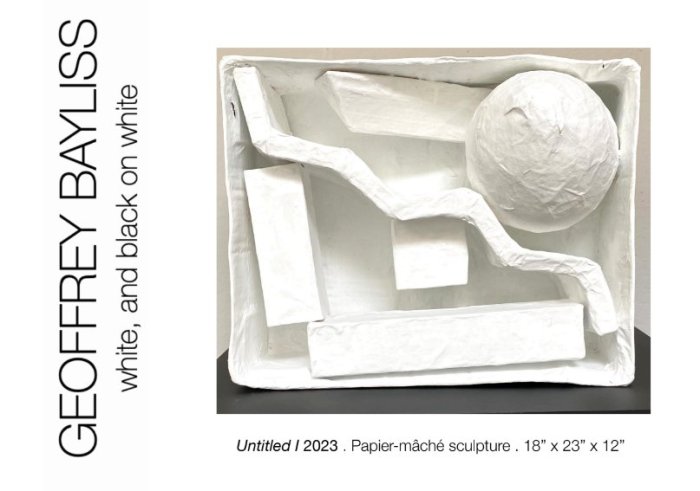
Save the date announcement from Jane Deering-
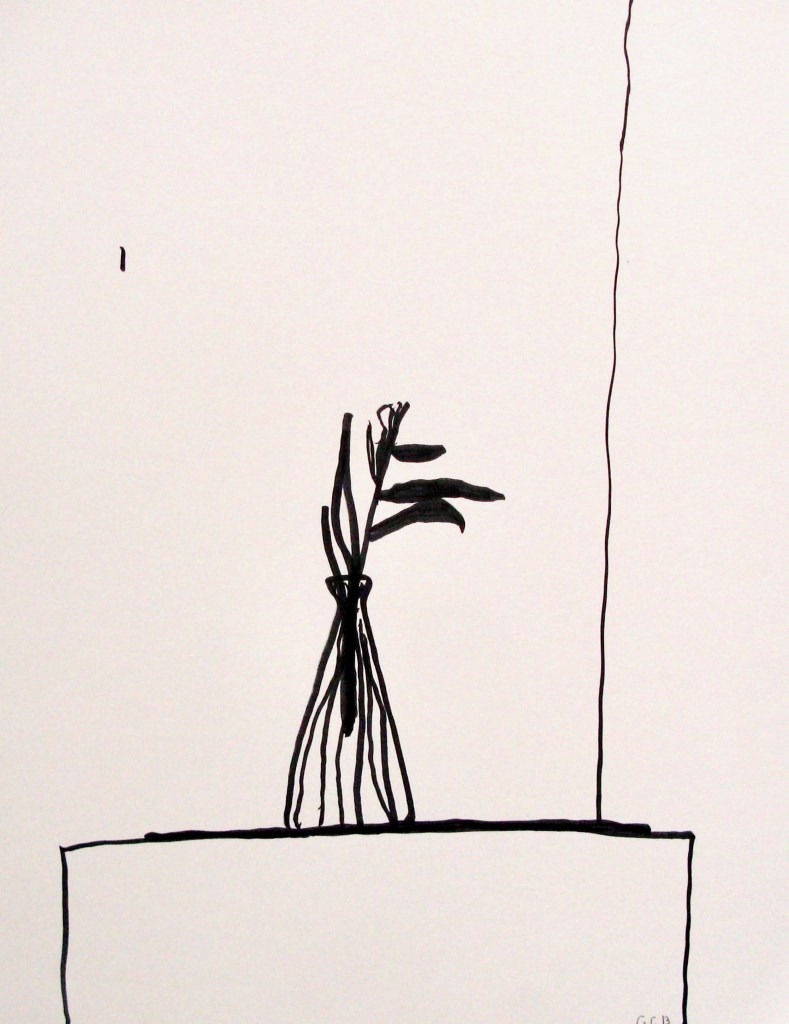
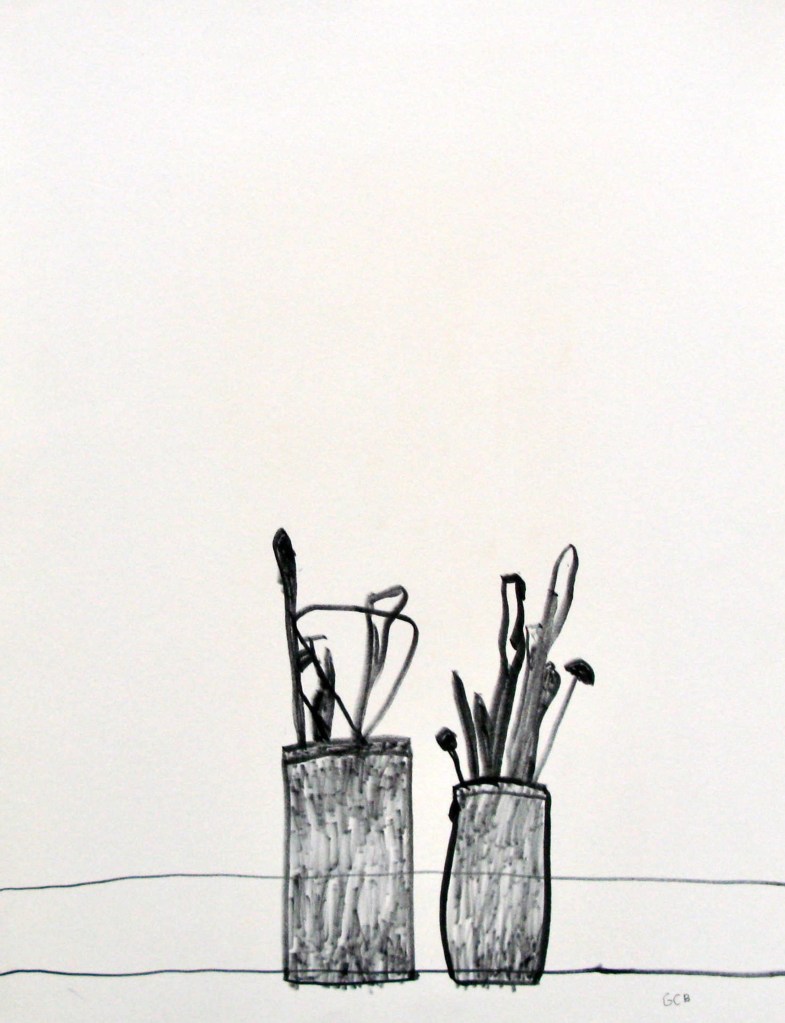
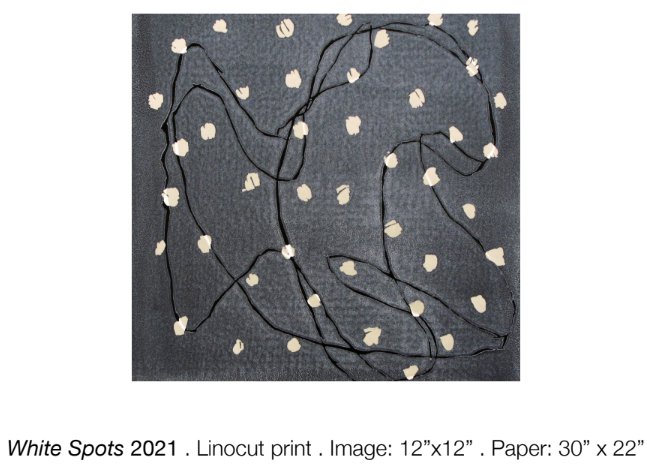
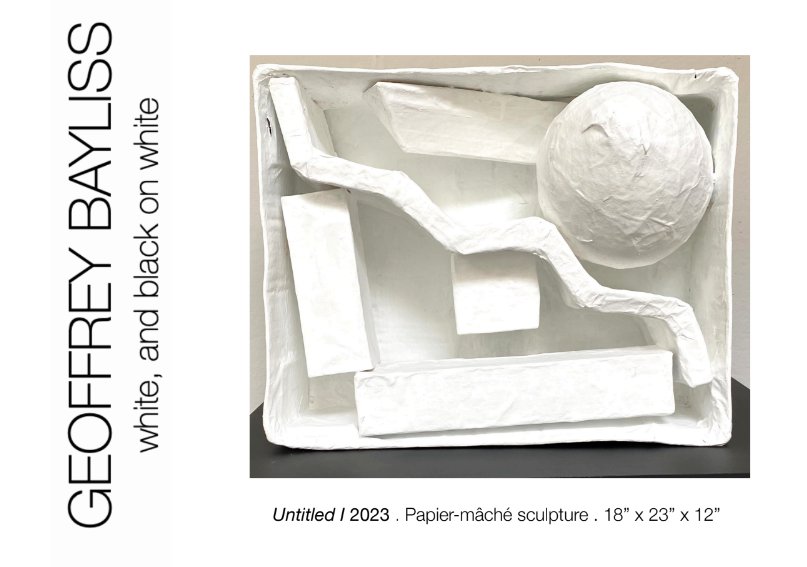
Jane Deering Gallery is pleased to present GEOFFREY BAYLISS | white, and black on white
opening with a public Reception on Thursday August 24th, 2023 from 5-7pm. This is Bayliss’s fifth solo show with the gallery and celebrates his Ink drawings, monotypes and recent experimental sculpture — all media in the sophistication of white and black.
Geoffrey Bayliss, a native of Gloucester, holds a BA in architecture from Columbia University. He has studied with artist Celia Eldridge, sculptor John Bozarth, printmaker Coco Berkman, and artist Charlotte Roberts. His work is held in numerous private collections in the US. Bayliss’s work was recently featured at OMG Art Faire, Kingston NY — the first contemporary art fair in New York’s Hudson Valley.
Continue reading:

 Good Morning Gloucester