Published by Joey Ciaramitaro
The creator of goodmorninggloucester.org Lover of all things Gloucester and Cape Ann. GMG where we bring you the very best our town has to offer because we love to share all the great news and believe that by promoting others in our community everyone wins.
View all posts by Joey Ciaramitaro


 Good Morning Gloucester
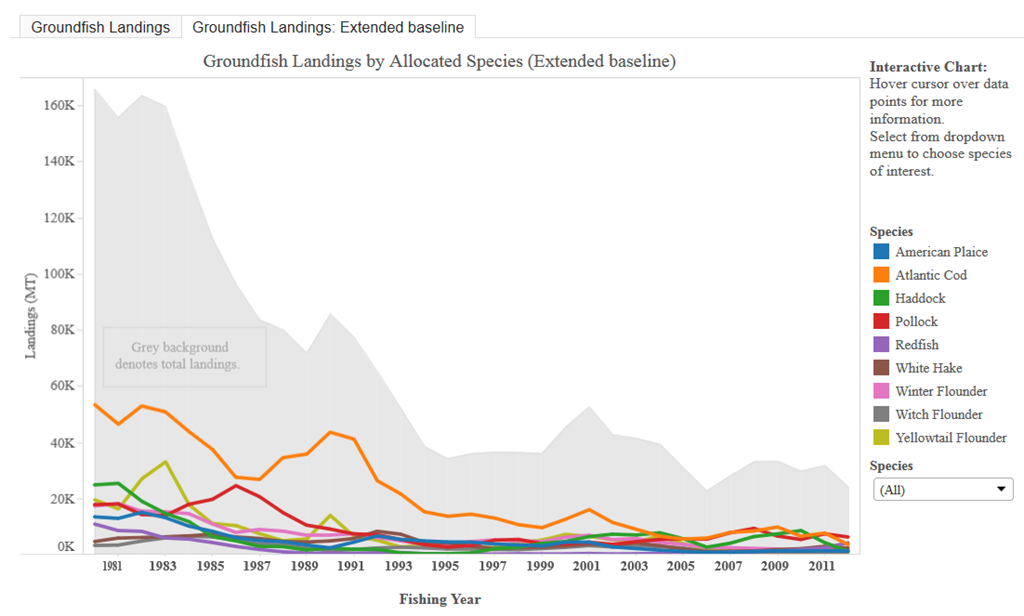
I want to share this chart with my students. Can you tell me if these are numbers from Gloucester or regional?
Diane Strever
LikeLike
Hi Joey,
Not really fair to post this with out telling the whole story. The perception from the public will be that there aren’t any fish left when in fact the problem may be that there are no boats left to catch the fish.
how many boat were landing fish in 1981?
In 1981 there were far less government regulations on mesh size and there were no days at sea restrictions or quotas.
There were no fish size regulations.
In 1986 I believe, the world court gave the most productive part of Georges bank to Canada. when you look historically at the big trips that boats like the Joseph and Lucia’s, the Tremont, Old Colony, and all the New Bedford boats, I could name more, were landing, those trips and the huge landings came from the parts of browns bank and east Georges that we can no longer fish.
Closed areas very few, now the most historically productive areas off our coast have been closed for over 15 years. We could come up with the same type of statistics if we restrict Bear hunting to main st Gloucester. I don’t think the hunters would shoot many bears on main street.
Did you know that the Bigalow, NMFS state of the art survey vessel makes 75 tows, 20 minutes each which equates to 75 miles of area to estimate the abundance of fish in Gulf of Maine which is 65,000 square miles.
lets take a look at CPUE (catch per unit of effort) in other words if I towed for 10 hours in 1981 and 10 hours in 2016 (in the same area) how much fish would I catch in 10 hours. now your comparing apples to apples, I think the results would show a different picture.
The majority of the fishing boats that are still active today put about 20% of the effort per year as compared to the active boats in the 80,s. especially the inshore vessels that average about 2 days per week. they do not have enough quota to fish any more than that.
just my 2 cents.
LikeLike
Absolutely I see your point. To me it’s even more sad that there are that many fewer fishing families because of the hyper-consolidation of the fleet when it seemed that days at sea and the 800 lb limit there were still a large dayboat fleet catching quality product and getting good money for them but there had to be a rush to quota and being able to buy and sell permits and catch shares. With the 800lb limits stocks seemed to be rebounding nicely, boats were being maintained and far more fishermen were being employed. It seemed to be a sustainable model but for whatever reason it was abandoned for catch shares and you see the devastating results they have left. Less fish and far fewer fishermen comparatively. Our fishing industry is a shadow of it’s former self and to paint it any other way would be disingenuous.
LikeLike
Glad to see that David Leveille put that chart in perspective. Back in the early 70’s I fished on the Lady of Fatima, an offshore boat. We fished the northern edge of George’s around the 90 fathom line, mainly for grey sole, part of the year.
Plenty of haddock, cod, dabs and catfish (now called wolf fish) too. It was like the United Nations out there with East German, West German, Polish, Dutch, Lithuanian, English, Nova Scotian and of course plenty of Russians. All big stern trawlers. That continued until 1976 when we finally declared the 200 mile limit. We lost most of the good part of Georges to Canada when the World Court split it up (fairly though). It would be interesting to see how much fish could be caught there now if fishing was opened up there again.
You say “for whatever reason it was abandoned and catch shares were introduced”. I’ll tell you the reason: catch shares were introduced when Jane Lubchenco was appointed Director of National Marine Fisheries, it’s sole purpose to destroy the commercial fishery. It has just about accomplished it’s goal. (Can you spell OIL, can you spell OCEAN MINING?
LikeLike
So what does that mean in regards to a “working waterfront”? Fewer landings = fewer boats fishing = less revenue at the docks for businesses that depend on the fishing industry. Will Gloucester’s Waterfront become a string of “Beauport Hotels”? With the ongoing demise of the fishing industry what other commercial applications can be brought to this incredible south facing, storm protected harbor?
We can lament the demise of the fishery and blame anyone and everyone for it’s demise but the truth of the matter is that the once great Gloucester Fishing Industry is no longer great. I hope that there are some focused folks living in Gloucester who will see the value of this great harbor and waterfront and figure out how to keep it a working water front. It may not be a working waterfront for the fishing industry but hopefully it won’t be for the tourist industry either.
Gloucester Harbor as well as all of Gloucester is changing rapidly. I don’t live in Gloucester (can’t afford it) but come back on a regular basis. I see the changes every time I come over the bridge. Being away for a period of time helps capture the magnitude of change that others living here may not see. Change is steady and profound. Some changes are for the better and some for the worse depending on who’s shoes you’re standing in. Regardless, change is ongoing, continuous, and to a great extent unstoppable. So… what does that men in regards to a “working waterfront”?
“It is not the strongest of species that survives, nor the most intelligent that survives. It is the one that is the most adaptable to change.” Charles Darwin
LikeLike