Listen I don’t care if you’re one of these Coyote sympathizers who would rather see a human eaten than a coyote put down or if you are a Coyote hater who thinks that we can eradicate and remove them one by one and relocate them. -I consider both factions equally crazy on the crazy meter.
But the fact of the matter is that there’s bananaland amounts of money being spent on counting fish. I’m pretty sure we have more people counting how many fish that are being landed than we actually have fishermen fishing for fish.
So how about we carve out just a smidgen of money to track the explosion in the past 8 years of coyotes living among us. We had the coyote that had to be shot down at East Gloucester Elementary School and now this attack on Eastern Point. Every single year there are more and more of them around us.
I’m not saying that we gotta round em up and kill em or relocate them, but I wouldn’t mind some benchmarks or some studying.
Oh, here it is, The National Marine Fisheries Service 2016 Proposed budget- A Mere $990,121,000.00
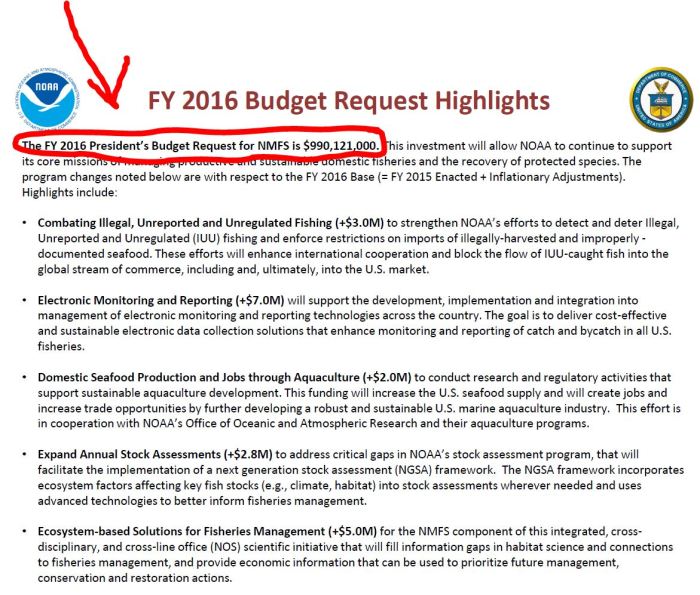
Isn’t it about time we get some money together to study the coyotes and figure out what the heck is going on?


 Good Morning Gloucester
YAAAAASSSS!! GO JOEY GO!! BRILLIANT!! 😃😃😃👍👐👏
LikeLike
The coyote wolf mix is one of the more heavily studied wildlife phenomena going on right now. If you do a Google Scholar search on “wolf coyote New England” there are 13,700 papers. If you do a more recent PubMed there are 141 papers on the same subject.
Some of the more interesting to me are the genomic studies because that is my day job. Until recently they only used mitochondrial DNA because those tags were worked out and the testing was inexpensive compared to full genomic sequencing but that is changing rapidly. Mitochondrial DNA can give spurious results because of the male female behavior and interactions of packs which can lower the percentage of wolf mitochondrial DNA. Full genomic sequencing or at least a dense SNP map can be done for a few hundred dollars. So we are finding out that the wolf DNA is a bit higher than previously thought.
There are also tons of behavioral papers describing what to do and what not to do when trying to control populations. One thing that has become evident is that you do not trap or shoot them because this causes the packs to actually increase in size rapidly because all female members of the pack go into estrous and all male members are allowed to mate. In a stable pack only the alpha male and female mate.
If you find a paper in PubMed that you want the full pdf just email me and I can send you a copy. One of the perks of my day job, I can download all papers. (I just can’t post it to a group larger than a biology class.)
LikeLiked by 2 people
Wow! So, what are some of the options to control coyote population that DO work?
LikeLike
The best bet seems to be to leave them alone. Their population will stabilize. What might really help is that we modify human fear and human behavior just a little bit.
The big modification is fear. Our fear of the coywolf. While in one year in the United States there are 4.7 million bites inflicted by domestic dogs sending more than half a million US citizens to the hospital the number of wolf and coyote attacks on man are pretty rare. But of course there is no call for leg traps or shooting domestic dogs. We need to acknowledge that the fear is a bit overblown.
The second big modification of our behavior is to not do things to allow the coywolf to become comfortable around humans. Don’t feed them, don’t leave things out in the yard that attract them like a poodle staked out in the backyard. Don’t run away, stand tall, make noise if you see one. Also learning a few ways to avoid them. If you see coywolf puppies that might not be the best place to put your lawn chair and read a book since there is likely a den or satellite den nearby. Just give them a little space. If you saw a beehive you would not take a nap under the hive. If you see evidence of a coywolf, move on. They really do not want to mess with you. Give them the chance to go the other way.
LikeLike
Joey, you should take Paul’s replies to this post and create its own post titled, “What to Do About Coyotes.” Well played, Paul. Good, basic info that more people need to hear.
LikeLiked by 1 person
Paul,
Very informative and you are on to something here too! 🙂 Dave
LikeLike
Listen, Joey, they are part of where we live…no study needed- just a good head on your shoulders on how to behave when they are in the vicinity and careful protection of our animals/pets.
LikeLiked by 1 person
Just information only!!!! From a little south of your location road Island shoreline! I can say and ask my mother who lived in MA since early 30’s and some native friends of mine human kindness may be behind some even as inverting when the circle of life get’s out of whack
Click to access CoyoteManagementNWRRI.pdf
Some of their studies may help and found this on another post she was from your way (Rockport) a wildlife web site today also – 10 years ago starting appearing that way?
Linda Horn says:
November 29, 2012 at 7:21 am
Humans are killing too many top-tier predators, throwing “the balance of nature” out of whack. No matter how much we put into research, Ma Nature still does it best. My solution for areas where coyotes (and even wolves) are a PROVEN problem (not just an inconvenience!) or at-risk of losing their lives due to human ignorance is “trap, treat, and release”. TT&R has helped reduce the number of feral cats in the community where I live. I wish I could say the same about feral dogs,
BTW, I live in far Northwest New Mexico, but have lived in Houston, other cities in Texas, and Albuquerque. One thing these cities have in common is a growing coyote population. I’m originally from Rockport, Massachusetts, where people began to spot coyotes about 10 years ago.
They may be hybrids, because they’re absolutely gorgeous. Big and healthy, with grey coats that blend with Cape Ann’s granite. One frequently makes its way across my parents’ backyard. I first spotted it well before dawn when a boulder “moved” and came trotting out of the fog. Unfortunately, small pets have gone missing all over the area. Fewer domestic and feral cats have meant more small rodents, and even Norway Rats – wharf cats are tough!
Unless the coyotes can book passage across the Atlantic, the coast is as far as they can go. I talked with several people about the growing population and various options for control. Most residents of Eastern Massachusetts are very pro animals and animal welfare, so they were predictably in a quandary over what to do. I recommended they find solutions NOW. If they don’t, they won’t like what they and the coyotes will face down the road
Dave
LikeLike