Richard J. King is senior lecturer in literature of the sea with the Maritime Studies Program of Williams College and Mystic Seaport. In 2004 he published an article in the Log of Mystic Seaport (Vol 55), “The Most Valuable Bird in the World.” (Domestic birds excluded.) I was quite astounded when I read it at the time, and have just now enjoyed his new book, published by the University of New Hampshire Press, “The Devil’s Cormorant.”
With all due respect to the beautiful GMG icon, one has to admit its eating habits don’t set a great example for a blog that so often features fine food. But the cormorant ___ ahh ___ only the freshest fish will do.
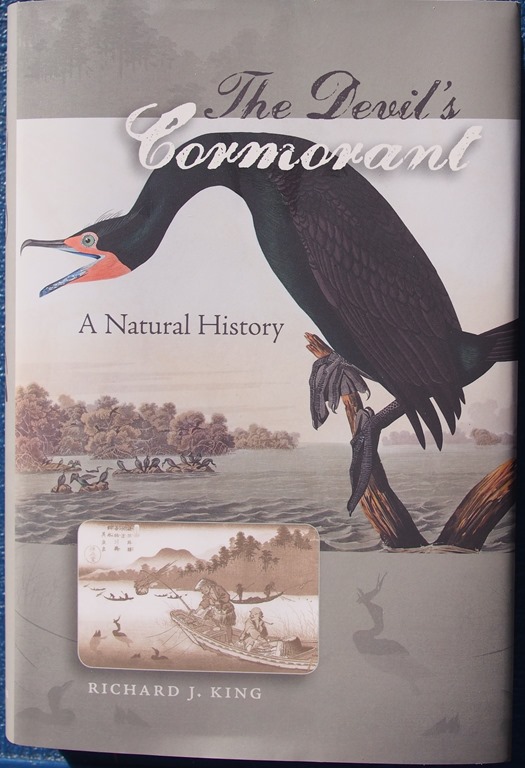
Overview from the publisher of The Devil’s Cormorant
Behold the cormorant: silent, still, cruciform, and brooding; flashing, soaring, quick as a snake. Evolution has crafted the only creature on Earth that can migrate the length of a continent, dive and hunt deep underwater, perch comfortably on a branch or a wire, walk on land, climb up cliff faces, feed on thousands of different species, and live beside both fresh and salt water in a vast global range of temperatures and altitudes, often in close proximity to man. Long a symbol of gluttony, greed, bad luck, and evil, the cormorant has led a troubled existence in human history, myth, and literature. The birds have been prized as a source of mineral wealth in Peru, hunted to extinction in the Arctic, trained by the Japanese to catch fish, demonized by Milton in Paradise Lost, and reviled, despised, and exterminated by sport and commercial fishermen from Israel to Indianapolis, Toronto to Tierra del Fuego. In The Devil’s Cormorant, Richard King takes us back in time and around the world to show us the history, nature, ecology, and economy of the world’s most misunderstood waterfowl.


 Good Morning Gloucester
Looks like a very interesting book Al–as you know , they are ubiquitous here, and everywhere, but always super interesting to observe. I think a flock spends the night at Salt island because I often see a group head over from that direction to feed at the Good Harbor tide pools.
LikeLike
Very interesting indeed, I might have to add that book to my lengthy list. I do see cormorants a lot in The Fort, but definitely see and hear seagulls more, so I still think it was the right pick for the logo, but wonder if they could do a limited edition cormorant stickah like the one EJ mocked up?? use them for special prizes at GMG events or for sale? 🙂
LikeLike
Kim, ubiquitous they are, and becoming more so, from what I’ve seen. They likely don’t have many admirers around here, but their athletic prowess deserves respect. They sometimes work together in pursuit of fish. Scientists taped depth gauges to the backs of blue-eyed shags (cormorants) in Antarctic waters and recorded dives to 475 feet and 6 minutes duration. There are about forty species of cormorants worldwide, in this area, two, Double-Crested (most numerous) and the larger Great Cormorant. The author cites studies that concluded cormorants consume perhaps about a pound of fish per day, with huge variations by individuals, species, time of year, and within an individual’s life cycle.
The residents of the Good Harbor tide ponds are unfortunate if there is a roost on Salt Island, for that makes a convenient stopover if they are headed for Gloucester’s inner harbor. Put food in their path and they will take advantage, as the Mississippi catfish industry has learned. Their ponds, now a magnet, are smack on the flyway of the migrating inland cormorants.
The author traveled extensively to gather information for this book … there are chapters on Gifu City, Japan, Henderson Harbor, NY, Aran Islands, Ireland, the Antarctic, Columbia River, Tring, England, Galapagos, Belzoni, MS, Isla Chincha Centro, Peru, and Cape Town South Africa.
It’s pretty clear we’ll be living with cormorants for quite some time. There is still much to learn about these birds.
LikeLike
Hi Al,
Great to see you at mug-up this morning and thank you for sharing what looks to be a very interesting and beautifully written book about cormorants. I look forward to reading it and appreciate the information you have provided here.
P.S. I can’ do anything from this end about the repeat comments; to readers of these comments, this is an admin error.
LikeLike
Kim, ubiquitous they are, and becoming more so, from what I’ve seen. They likely don’t have many admirers around here, but their athletic prowess deserves respect. They sometimes work together in pursuit of fish. Scientists taped depth gauges to the backs of blue-eyed shags (cormorants) in Antarctic waters and recorded dives to 475 feet and 6 minutes duration. There are about forty species of cormorants worldwide, in this area, two, Double-Crested (most numerous) and the larger Great Cormorant. The author cites studies that concluded cormorants consume perhaps about a pound of fish per day, with huge variations by individuals, species, time of year, and within an individual’s life cycle.
The residents of the Good Harbor tide ponds are unfortunate if there is a roost on Salt Island, for that makes a convenient stopover if they are headed for Gloucester’s inner harbor. Put food in their path and they will take advantage, as the Mississippi catfish industry has learned. Their ponds, now a magnet, are smack on the flyway of the migrating inland cormorants.
The author traveled extensively to gather information for this book … there are chapters on Gifu City, Japan, Henderson Harbor, NY, Aran Islands, Ireland, the Antarctic, Columbia River, Tring, England, Galapagos, Belzoni, MS, Isla Chincha Centro, Peru, and Cape Town South Africa.
It’s pretty clear we’ll be living with cormorants for quite some time. There is still much to learn about these birds.
LikeLike
Kim, ubiquitous they are, and becoming more so, from what I’ve seen. They likely don’t have many admirers around here, but their athletic prowess deserves respect. They sometimes work together in pursuit of fish. Scientists taped depth gauges to the backs of blue-eyed shags (cormorants) in Antarctic waters and recorded dives to 475 feet and 6 minutes duration. There are about forty species of cormorants worldwide, in this area – two, Double-Crested (most numerous) and the larger Great Cormorant. The author cites studies that concluded cormorants consume perhaps about a pound of fish per day, with huge variations by individuals, species, time of year, and within an individual’s life cycle.
The residents of the Good Harbor tide ponds are unfortunate if there is a roost on Salt Island, for that makes a convenient stopover if they are headed for Gloucester’s inner harbor. Put food in their path and they will take advantage, as the Mississippi catfish industry has learned. Their ponds, now a magnet, are smack on the flyway of the migrating inland cormorants.
The author traveled extensively to gather information for this book … there are chapters on Gifu City, Japan, Henderson Harbor, NY, Aran Islands, Ireland, the Antarctic, Columbia River, Tring, England, The Galapagos, Belzoni, MS, Isla Chincha Centro, Peru, and Cape Town South Africa.
It’s pretty clear we’ll be living with cormorants for quite some time. There is still much to learn about these birds.
LikeLike