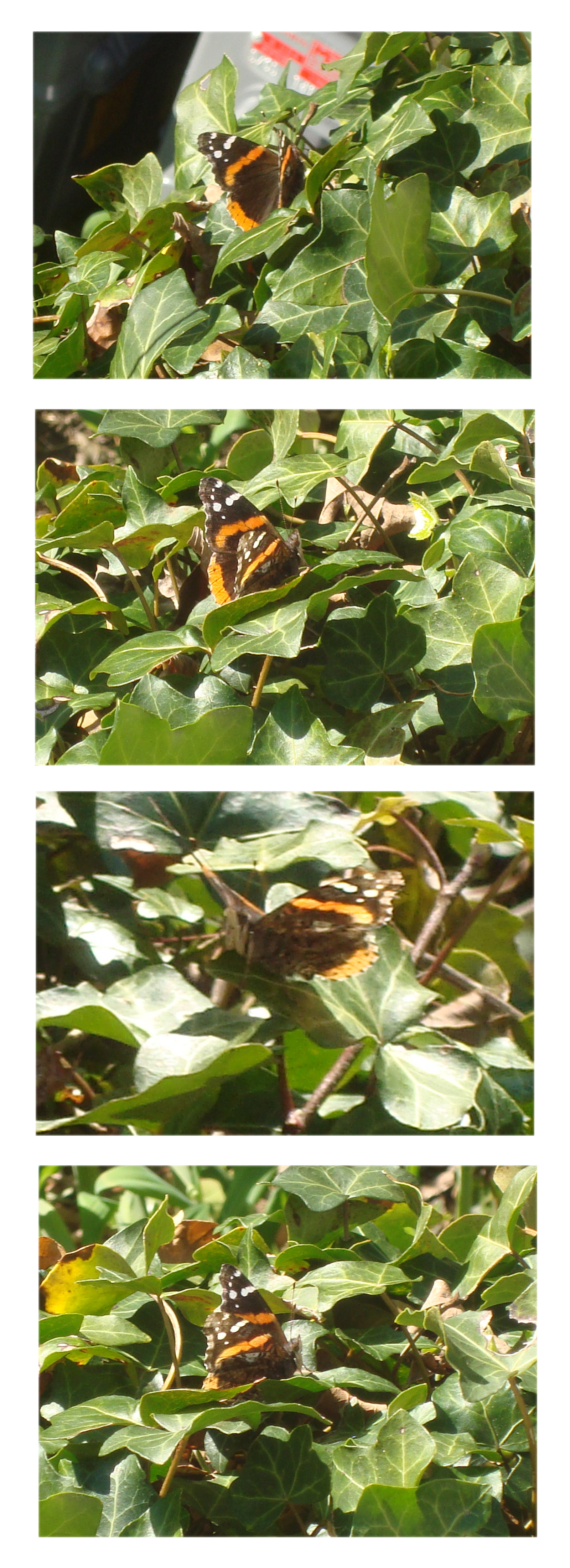
I’ve never seen one of these before – it looks like a butterfly, but also looks like a moth. Do you or does anyone know what it is?
My View of Life on the Dock
I’ve never seen one of these before – it looks like a butterfly, but also looks like a moth. Do you or does anyone know what it is?


 Good Morning Gloucester
Dear E.J.
This is your friendly Red Admiral butterfly–I actually tried to make a little video of one today and it was not at all behaving in a friendly manner!
Red Admirals are everywhere this spring and have come out of hibernation much, much earlier than usual. They are in the Vanessa genus (Vanessa atalanta) and are related to the Painted Lady and American Lady. Males perch looking for females and are very territorial–even chasing after people, too. Red Admirals drink sap from trees at this time of year, as well as nectar.They are considered “friendly” because they often alight on people’s skin; attracted by the minerals in perspiration.
I think identifying this butterfly is sometimes confusing to people because the color of the Red Admiral’s wings fade very dramatically–vivid red-orange when newly emerged, then fading to a very dull pale orange over time.
P.S. The caterpillar’s food plant is nettles.
P.P.S. Joey mentioned your butterfly book and it sounds FABULOUS and I can’t wait to see it!!!!!
LikeLike
Thanks Kim. I knew you’d know and give us the whole lowdown on him/her.
My book isn’t actually about butterflies, but about Bong Tree Island. The section Joey was referring to is about a special butterfly that lives there.
“An interesting Bong Tree Island insect is the Fluorescent Blue Yellow Spotted and Fluorescent Green and Red Cat Paw Butterdragonfly, which is a cross between a butterfly and a dragonfly. It flutters around like a butterfly sipping nectar, but also has a set of dragonfly wings, which it can use instead to zip around when it wants to get somewhere fast. It feeds on both nectar and small insects. The tail is actually a sewing needle, and in an emergency when an inhabitant of Bong Tree Island has been injured, the butterdragonfly arrives on the scene and sews up the wound with a thread that it secretes from its head, much the same way a silkworm creates silk.
The Fluorescent Blue and Green Butterdragonfly has been known to make overseas migrations of great distances, and was first discovered outside of the Bermuda Triangle in Gloucester, Massachusetts on Cape Ann, by a Lepidopterist there named Blythe Davis.” (aka Kim Smith) 🙂
LikeLike
E.J. that sound WONDERFULLY DELIGHTFUL and I am looking forward to seeing your illustrations!!
LikeLike
Hi E.J. I think this may be the one.

Red Admiral (Vanessa atalanta): a 2″ Brushfoot. Migratory. Location: Overall Run, SNP, VA and McCray Tr, MNF, WV.
http://midatlantichikes.com/floraandfauna/butterflies.htm
LikeLike
I was going to post the same question to Kim but I couldn’t get a photo. If they are looking to the right, a big orange C with white spots on the tips of the wing but otherwise brown.
I must have had fifty of these going nutty on the Andromeda. Those and the super big bumble bees are swarming.
LikeLike
To Paul M.–me too on my andromeda–both the Red Admirals and Carpenter Bees. I imagine Carpenter Bees are probably what you are seeing. Yesterday I posted a photo of a Carpenter Bee nectaring at the florets of the flowering dogwood, second photo.
The males are territorial and curious and will fly right at you, but are stingless–so no worries there. They bore dime-sized holes, primarily in untreated, unpainted wood, but other than cosmetic, the damage caused is not serious (compared to termites, for example). Despite this, people like to keep them around because they are good native pollinators for open-faced flowers, and besides they can easily be persuaded to bore and build their nests in an alternatively supplied piece of wood.
LikeLike
So those massive bumblebees we’re seeing all over the place aren’t bumblebees, but carpenter bees? I thought they were bumblebees had gotten into MiracleGro.
LikeLike
it’s Red Admiral butterfly. I’ve been seeing them everywhere, also record numbers in Canada:
http://www.ottawacitizen.com/Life/All/6493323/story.html
LikeLike
I think this is a Red Admiral butterfly. I only know because the zoo I work at has a butterfly house. 🙂
LikeLike
i say butterfly. moths keep their wings flat when at rest. butterflies are lifted together, similar to hands at prayer.
LikeLike
I love that. What a great way to recognize a butterfly – praying.
LikeLike
Seems like GMG readers know their butterflies. Thanks everyone. I’d never heard of a Red Admiral.
LikeLike
I live in Holland, Michigan; and we’re having record numbers here, too. They’re all over my lilacs.
LikeLike