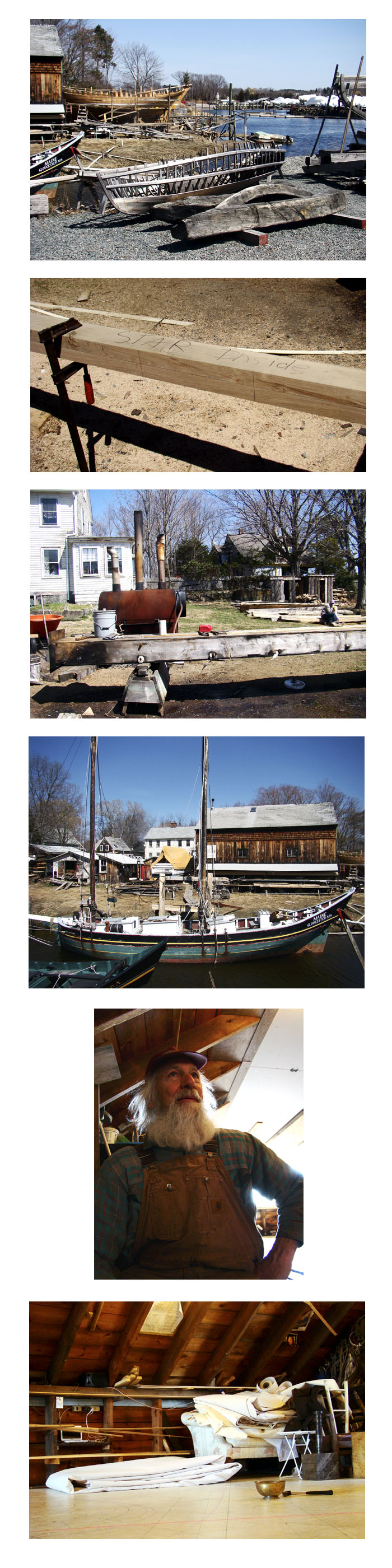
That the last plank to be affixed to a boat is called the rum (or whiskey) plank because of the spirits traditionally imbided after its completion? In the old days, this was the time the crew would finally get their first pay and a celebration would often ensue. These are some shots of the ARDELLE and rum plank being prepared. The first shot is of the ARDELLE awaiting shuttering (the final planking). The second photo is of the inside starboard section of the whiskey plank. The third photo is of the Steam Jenny where planks go to be steamed and made pliable enough to be bent and twisted into place before being affixed to the boat. The fourth photo is of the schooner MAINE, whose masts and other useable parts will be recommissioned for use on the ARDELLE. Next we see Steve Willard, volunteer helper on the ARDELLE, who is also working on the Schooner ADVENTURE in Gloucester, and is a member of the Three Sheets to the Wind sea chantey group that do a chantey night at Brew Pub on Tuesday nights (got to do that, I love sea chanties – Marit, you want to go with?). Finally the sails being made by apprentice sailmaker, Chuck Redman (not pictured), for the ARDELLE, as well as replacement sails for schooner FAME.
Harold Burnham, not pictured, is the 11th generation Burnham to operate a shipyard in Essex since 1819. I’d say shipbuilding is hardwired into his DNA. The Pinky ARDELLE, scheduled to be launched this summer, (something I definitely want to experience) will be the sixth full-scale historic representation and the third Coast Guard-inspected passenger vessel he has built including the pinky schooner FAME of Salem, owned and chartered by Michael Rutstien. Pinky Schooners were a common type of fishing vessel that sailed out of Cape Ann harbors from the early eighteenth century through the early twentieth century. In 1839, there were 64 registered out of the Gloucester district. Pinkies were generally smaller vessels but were known for their seaworthiness.
The ARDELLE will operate out of the Gloucester Maritime Heritage Center, where she will serve as the centers’ research and educational vessel as well as taking passengers out during the season. The ARDELLE will be certified by the Coast Guard to carry 49 passengers and it is anticipated that she will run several two-hour public trips a day and be available for charter for weddings, birthdays, family events or other special occasions.
The ARDELLE is named after Harold’s grandmother Ardelle and his daughter, Perry Ardelle. As far as her design goes, the ARDELLE is a typical clipper pinky schooner and her lines are based largely on the original Pinky MAINE built by Ebeniser Burnham in Essex in 1845.
To keep up with the progress of Schooner ARDELLE, visit http://boatbuildingwithburnham.blogspot.com/.
E.J. Lefavour
www.khanstudiointernational.com


 Good Morning Gloucester
Fascinating report, E.J.! Gloucester, MA was largest client base for Essex-built vessels. The second largest state to purchase Essex-built schooners was Texas. Harold is essentially building Ardelle in the traditional plank-on-frame, trunnel-fastened method typical of Essex schooners built since the late 1600’s. Stand at the edge of the Essex River basin watching the Ardelle being built and it could be just as easily be 1930, or 1890, or 1780.
LikeLike