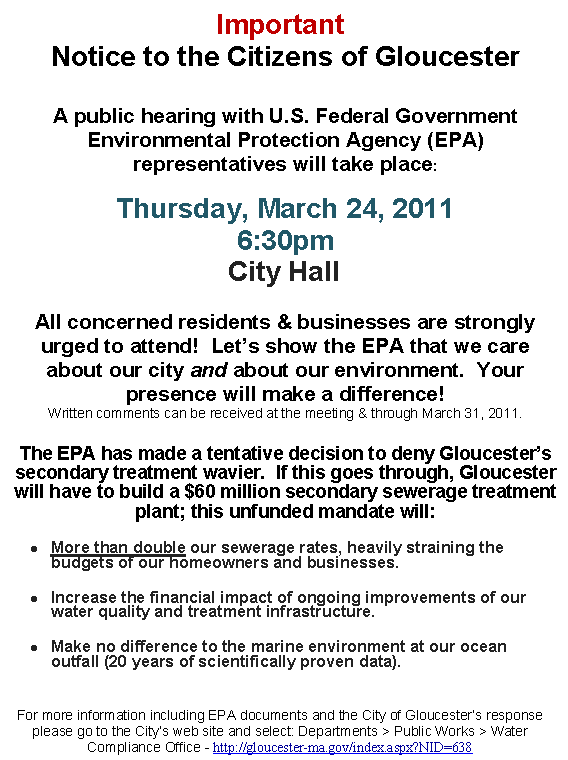
Notice to the Citizens of Gloucester
A public hearing with U.S. Federal Government Environmental Protection Agency (EPA) representatives will take place:
Thursday, March 24, 2011 6:30pm City Hall
Written comments can be received at the meeting.
The EPA has made a tentative decision to deny Gloucester’s secondary treatment wavier. If this goes through, Gloucester will have to build a $60 million secondary sewerage treatment plant; this unfunded mandate will:
· More than double our sewerage rates, heavily straining the budgets of our homeowners and businesses.
· Increase the financial impact of ongoing improvements of our water quality and treatment infrastructure.
· Make no difference to the marine environment at our ocean outfall (20 years of scientifically proven data).
For more information including EPA documents and the City of Gloucester’s response please go to the City’s web site and select: Departments > Public Works > Water Compliance Office – http://gloucester-ma.gov/index.aspx?NID=638
Background
Gloucester is one of 16 Cities and Towns in New England with an EPA 301(h) secondary treatment waiver. Gloucester has been operating under this wavier since 1985. The EPA has recently tentatively denied Gloucester’s renewal request of this wavier. This decision has major economic implications for the City.
An explanation of each point follows:
· More than double our sewerage rate, heavily straining the budgets of our homeowners and businesses.
Estimates of the capital and operating expenses of a new secondary waste water treatment plant indicate that the facility will cost at least $60 million, not including land and other additional costs. Annual operations and maintenance will cost an additional $1 million per year. There are currently no federal grants available for secondary treatment plant construction (as there were for all of the secondary plants built between 1972 and 1990). The cost burden will, therefore, fall on Gloucester citizens and businesses.
This investment will more than double Gloucester’s sewerage rate (see table). An increase of this magnitude will impact significantly citizens living on low or fixed incomes, especially those who are still paying betterment fees from previous sewer system upgrades. The average annualized rate will be about 5.4% of the Median Household Income in the City, almost three times the percentage that EPA itself considers a “very high” burden on residential customers in its guidance on affordability of sewer infrastructure improvements.
The current and projected sewerage rates and cost impact to the average homeowner, restaurant, and major water user are as follows:
Such increases could create a Domino effect by incentivizing large businesses (such as our hospital, nursing centers, and fish processors) to close or move away. This, in turn, could raise our unemployment rate and further increase homeowner rates if the city’s operating and debt service burden is forced to shift from the current balance of commercial-industrial and residential taxpayers towards a higher percentage of the latter.
· Increase the financial impact of ongoing improvements of our water quality and treatment infrastructure.
The city of Gloucester has recently made several large investments to improve the city’s water infrastructure. These include a total of $35 million on the combined sewerage overflow project (CSO) to separate storm water overflow from the sewer system, $15 million on our drinking water purification and distribution system, and $7 million on Phase I improvements to our waste water treatment plant. An additional $13 million is already committed for Phase II waste water treatment plant improvements, slated to begin this year. The city is in the process of developing an over-arching Water System Master Plan to prioritize ongoing and planned improvements.
Without ongoing maintenance and investment, our water purification and long-neglected distribution infrastructure will inevitably suffer from continued problems and failures. Urgently needed improvements include: water pipe, pump and valve replacements; critical repairs to the Plum Cove tower and the Lanesville/Annisquam water distribution systems; generator repairs and failsafe mechanisms; dam repairs; reservoir aeration to reduce chemical usage; water conservation by recycling at the purification plants, and green energy investments. These projects will improve the quality of our drinking water and the reliability of our distribution system, but they will also result in higher water rates for our citizens.
Combined water and sewer rates, therefore, will be significantly higher than the basic sewerage rates mentioned above. While some of these projects could be deferred, most will be unavoidable – and indeed, all are highly desirable. Additional investments may be necessary if the EPA increases the stringency of regulations on storm water runoff for Massachusetts communities, as currently predicted.
· Make no difference to the marine environment at the ocean outfall.
The city of Gloucester is committed to preserving and protecting the ocean resources that have played a major role in its history, and which are a vital part of Gloucester’s identity. This can be achieved, however, without the installation of a new secondary sewerage treatment plant. The EPA’s tentative decision to deny the city’s 301(h) wavier is based on sporadic failure to meet permit limits in three areas: oil and grease, fecal coliform bacteria, and effluent toxicity. The facts are as follows:
For oil and grease, the few times when permit limits were exceeded were tightly correlated with street runoff during major storms. Since major CSO improvements were completed in 2009, approximately 90% of storm water overflow to the sewers has been eliminated and there have been no further violations in this area.
The few isolated fecal coliform violations that occurred over the past two years were either due to equipment failure or operator errors at the treatment plant. However, the city has recently made dramatic improvements to operations at the plant (now under operation and management contract with Veolia Water). In any case, the daily maximum was only exceeded 6 times in the past 3 years and the monthly average limits were never exceeded. As the ongoing improvements to our waste water treatment system are brought online, the probability of future violations in this area will be reduced significantly.
Gloucester’s primary treatment plant effluent sometimes fails a toxicity test in which juvenile fish and shrimp are exposed to treated water dilutions for a period of 48 hrs. This test has proven to be very unreliable and is considered by many scientists to be of little value since the test conditions bear no resemblance to conditions in the real world. Furthermore, the results are highly inconsistent between different testing laboratories.
A systematic evaluation of the effluent has shown that ammonia is the primary cause of the toxicity, but secondary treatment does not remove ammonia. What then, is the purpose in building a $60 million secondary treatment plant?
The present ocean outfall for Gloucester’s treated water is located in a high energy marine environment with significant mixing and oxygenation levels. The outfall is designed to provide instantaneous dilution and rapid diffusion of the treated water. An extensive 20 year monitoring program (as required by the EPA) has been conducted in the waters and sediments around the outfall, and paid for by Gloucester citizens at $3.5 million. This study showed no change in the natural marine community in terms of species diversity or of accumulations of organics or other pollutants in the sediments. The EPA is implying the existence of damaging effects based on the results of an unreliable and artificial laboratory test. However, this conclusion ignores 20 years of scientific monitoring involving thousands of individual tests, which show no impact on the marine community around the outfall (see Figures 1-3 below). In fact, all federal and state water quality standards are met in the marine environment around the outfall.
The Water Advisory Team of Citizens; WATCH2O is a committee of five Gloucester Citizen Volunteers appointed by Mayor Kirk, who meet regularly with the City of Gloucester’s Environmental Engineer/Manager of the Water Compliance Office. The committee became active in November 2010, and currently has Ad Hoc status.
The Mission of WATCH2O is to help manage, protect, improve and conserve the City of Gloucester’s water, watersheds, storm water, and waste water infrastructure. WATCH2O works collaboratively with the city and Gloucester citizens to promote responsible stewardship of our water systems through communication, education, development and implementation of best management practices.
Disclaimer: The information presented here is derived from documents available on the city’s web site or available elsewhere in the public record and do not represent the official position of the City of Gloucester.
Graphs and Pictures are in the Attachment
Fig 1. Effect of primary treatment on sensitive marine communities in terms of species abundance: A. Improvement at the original Harbor outfall 5 years after initiation of primary treatment in 1985; B. No change at the current Ocean outfall after 20 years of primary treatment discharge.
Fig 2. Outfall diffuser prior to installation.
Fig 3. Location of ocean outfall (~1 mile beyond Dog Bar Breakwater).
PUBLIC HEARING HOSTED BY THE EPA ON THEIR DENIAL OF A WAIVER FOR A SECONDARY TREATMENT FACILITY MARCH 24th


 Good Morning Gloucester