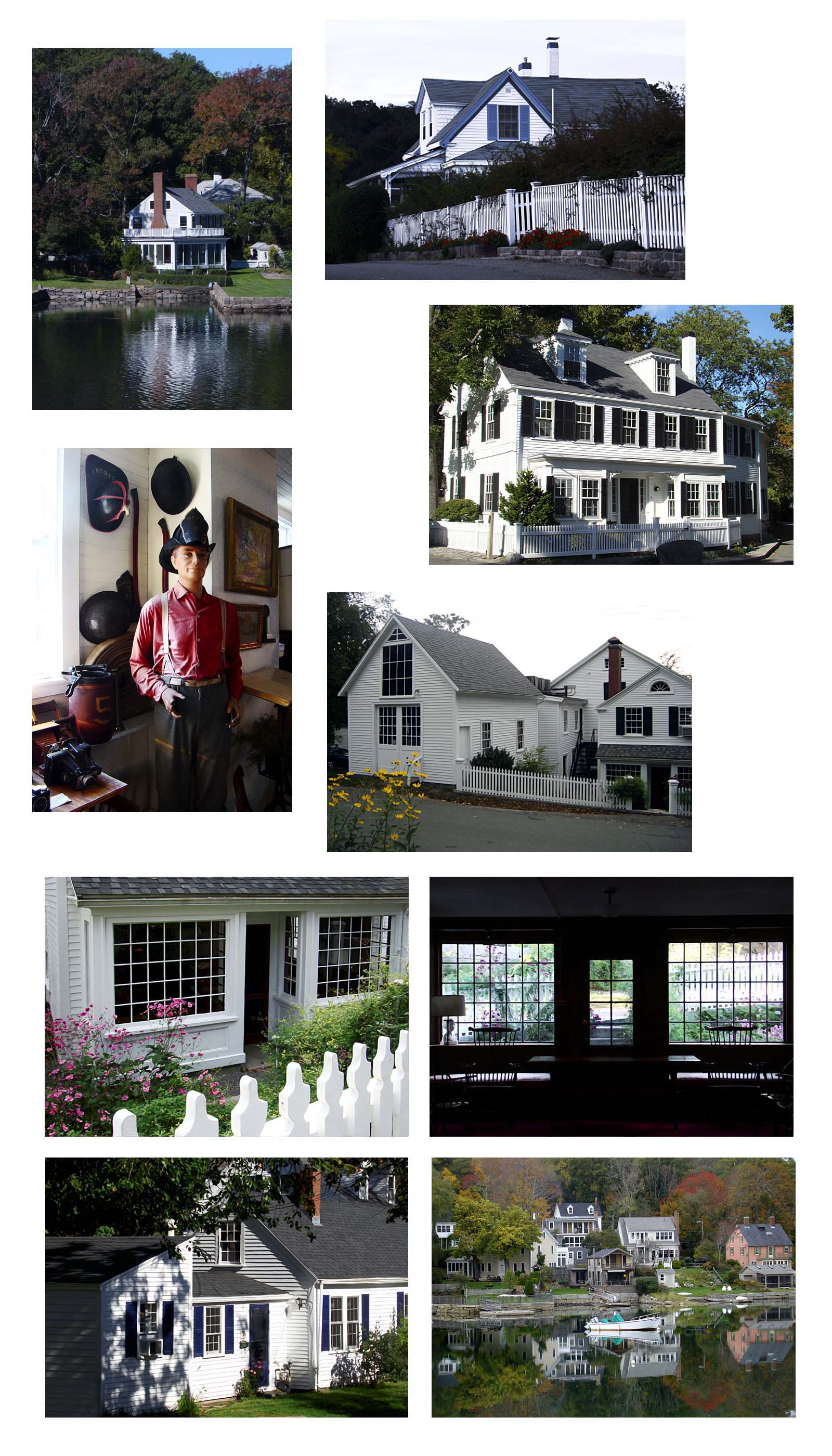
That cozy Annisquam village grew up on the east side of the river’s northern end beginning in 1631? The village grew into a fishing and shipbuilding center that rivaled Gloucester Harbor in its early days. The Annisquam River was considered an important harbor of refuge for vessels traveling along the coast. Charles Boardman Hawes, in his book Gloucester by Land and Sea, illustrates this with the story of a sermon delivered by a fire-and-brimstone minister at the Isles of Shoals:
Suppose, my brethren, any of you should be taken short in the bay, in a northeast storm, your hearts trembling with fear, and nothing but death before you. Whither would your thoughts turn? What would you do?” he asked his congregation. One fisherman replied matter-of-factly, “Why, I should hoist the foresail and scud away for ’Squam.”
The name is said to derive from Ann (as in Cape Ann) and squam, meaning harbor. In the late 19th-century, it was home to both granite quarrying and an artist colony, which attracted painters including George Loftus Noyes and Margaret Fitzhugh Browne.
Although I love every part of Cape Ann that I have discovered since moving here, I do feel especially blessed to be able to spend some time living in Annisquam and getting to know this tucked away quaint little seaside village, which staunchly resists change and cherishes its history. Being here and talking with some of the longtime inhabitants is what motivated me to delve into the history behind the things I see, photograph and paint, and to do my “Did You Know” posts. I want to thank Martha and Geoffrey Bentley, whose house I am renting for the winter, for making this experience possible.
E.J. Lefavour
www.khanstudiointernational.com


 Good Morning Gloucester
Fascinating as usual! Was the fireman part of the deal?
LikeLike
Hope you’re feeling better Mike. The fireman is in the Historical Society Museum which used to be the firehouse. There are a bunch of interesting old things there including old firehouse artifacts, hatchets, helmets, etc., and the fireman with the missing hand.
LikeLike
I really like the photo with the pink flowers, the one to the right of it with the windows, and the one directly below that. Very nice!
LikeLike
Hello again! In reference to Annisquam being a cozy village which grew up around 1631, I am reading John J. Babson’s “History of the Town of Gloucester” from 1860 and he states that “in 1656 Edward Haraden came into possession of land at what is now known as Annisquam and who, from the best information now attainable, (in 1860) settled upon it, and became the first permanent settler in Annisquam.”
This differs from what you stated regarding a village in 1631. I wonder which one is correct???
LikeLike
Thanks Karen. The windows with the pink flowers is an outside garden shot of the Annisquam Village Library, and the shot beside it is of the garden from inside the Library looking out. The one below is the house next to the Leonard Club and Annisquam Village Realty.
LikeLike
Hi Susan,
How are things in Granville? That is the first I have heard that late date for the settling of Annisquam. In James R. Pringle’s “History of Gloucester, Mass.” 1623-1890, in his discussion of Indians, says “… Wingaersheek and Annisquam, the designation of the harbor on the northerly side of the Cape. The earliest mention of the latter name in is Wood’s map, in 1634, where it is spelled Anasquam, and in Josselyn’s “Account of Two Voyages in New England, in 1638, the orthography is Wondoquam.” In a future post, I’ll talk about Planter’s Neck, the peninsula portion of Annisquam, which is where the first settlers are said to have established fishing stages in 1631. It is also where Edward Harraden of Chebacco (Essex/Ipswich) purchased land from Robert Dutch in 1656 and built his house. One thing I have learned about history is that it is “his” story, and the facts depend largely on whose story you read and accept. For example, I’m quite certain the story passed down by Indians would be quite different from the story passed down by the early settlers who encountered them. Donald K. Usher, past curator of the Annisquam Historical Society, believed based on his research, that the name Annisquam came from Charles Annis who built a home on the Annisquam Harbor in the 1660’s; however, if it was already referrred to as Anasquam in Wood’s 1634 map, that couldn’t be so. If all you ever read was Donald Usher’s writings, you would believe (rightly so with the information you had) that Annisquam was named after Charles Annis, and therefore didn’t exist until the 1660’s.
LikeLike
NICE – Keep up the great work, hope you get to stay longer than the winter. I won’t get north until September but we will meet then
LikeLike
I’ve thoroughly enjoyed your little history lessons about my home town; you do an excellent job presenting them in an interesting way. Yes, Annisquam is lovely and quaint, and many tourists miss it as they tool along to Rockport’s more well known points of interest. You’ve opened some eyes to our hidden treasures. Well done!
LikeLike
Thanks Debra and Leslie. I’m glad to know two relocated Squam girls are enjoying the reconnect to their home. Debra, I certainly hope to be somewhere on Cape Ann in September; however, the Universe loves surprising me, and never tips its hand to let me know what is coming up next, what I’ll be doing or where I’ll be. We’ll definitely meet up when you come home though.
LikeLike
I love your posts about Annisquam. I am the 3rd generation fortunate enough to have spent my childhoods secluded away in this little village. I thought being a ‘Squamie’ I knew just about every story ….but your posts are teaching me even more. Thank you!
LikeLike
I lived on Squam Rock Road in the off-season in 2000 and it remains my favorite place of beautiful sunsets, fog horns, serene winter snowfalls, and a true New England village.
LikeLike