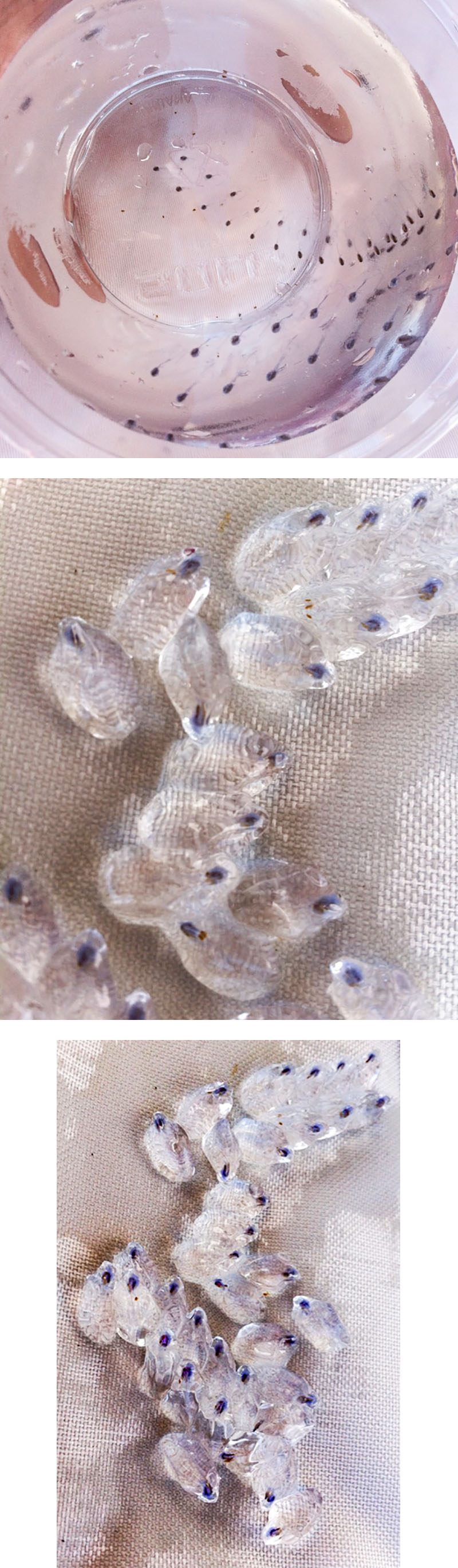
These Salps or Salpae were at Good Harbor Beach, where there were multitudes of strands of them riding on the incoming tide in the river. They are very cool gelatinous little creatures, which I had never heard of or seen before. The first photo is a couple of strands floating in a plastic cup. The other two are out of the water (although I put them right back after photographing them) on land. When you remove them from water, the strand immediately breaks up into individual animals, but when you return them to the water, they find each other and rejoin again. Very fascinating creatures.
A salp (plural salps) or salpa (plural salpae or salpas[1]) is a barrel-shaped, planktonic tunicate. It moves by contracting, thus pumping water through its gelatinous body. Salp jet propulsion is one of the most efficient in the animal kingdom.[2] The salp strains the pumped water through its internal feeding filters, feeding on phytoplankton.
Salps are common in equatorial, temperate, and cold seas, where they can be seen at the surface, singly or in long, stringy colonies. The most abundant concentrations of salps are in the Southern Ocean[3] (near Antarctica), where they sometimes form enormous swarms, often in deep water, and are sometimes even more abundant than krill.[4] Since 1910, while krill populations in the Southern Ocean have declined, salp populations appear to be increasing. Salps have been seen in increasing numbers along the coast of Washington.[5]
Salps have a complex lifecycle, with an obligatory alternation of generations. Both portions of the lifecycle exist together in the seas—they look quite different, but both are mostly transparent, tubular, gelatinous animals that are typically between 1 and 10 cm (0.39 and 3.94 in) tall. The solitary life history phase, also known as an oozoid, is a single, barrel-shaped animal that reproduces asexually by producing a chain of tens to hundreds of individuals, which are released from the parent at a small size. The chain of salps is the ‘aggregate’ portion of the lifecycle. The aggregate individuals are also known as blastozooids; they remain attached together while swimming and feeding, and each individual grows in size. Each blastozooid in the chain reproduces sexually (the blastozooids are sequential hermaphrodites, first maturing as females, and are fertilized by male gametes produced by older chains), with a growing embryo oozoid attached to the body wall of the parent. The growing oozoids are eventually released from the parent blastozooids, and then continue to feed and grow as the solitary asexual phase, thus closing the lifecycle of salps.
The alternation of generations allows for a fast generation time, with both solitary individuals and aggregate chains living and feeding together in the sea. When phytoplankton is abundant, this rapid reproduction leads to fairly short-lived blooms of salps, which eventually filter out most of the phytoplankton. The bloom ends when enough food is no longer available to sustain the enormous population of salps. Occasionally, mushroom corals and those of the genera Heteropsammia are known to feed on salps during blooms[6]
The incursion of a large number of salps (Salpa fusiformis) into the North Sea in 1920 led to a failure of the herring fishing.[7]
One reason for the success of salps is how they respond to phytoplankton blooms. When food is plentiful, salps can quickly bud off clones, which graze the phytoplankton and can grow at a rate which is probably faster than that of any other multicellular animal, quickly stripping the phytoplankton from the sea. But if the phytoplankton is too dense, the salps can clog and sink to the bottom. During these blooms, beaches can become slimy with mats of salp bodies, and other planktonic species can experience fluctuations in their numbers due to competition with the salps.
Sinking fecal pellets and bodies of salps carry carbon to the sea floor, and salps are abundant enough to have an effect on the ocean’s biological pump. Consequently, large changes in their abundance or distribution may alter the ocean’s carbon cycle, and potentially play a role in climate change.
Salps are related to the pelagic tunicate groups Doliolida and Pyrosoma, as well as to other bottom-living (benthic) tunicates.
Although salps appear similar to jellyfish because of their simple body form and planktonic behavior, they are chordates: animals with dorsal nerve cords. Such evolutionary development leads in turn to vertebrates, animals with backbones.
Salps appear to have a form preliminary to vertebrates, and are used as a starting point in models of how vertebrates evolved. Scientists speculate that the tiny groups of nerves in salps are one of the first instances of a primitive nervous system, which eventually evolved into the more complex central nervous systems of vertebrates.[8]
From Wikipedia


 Good Morning Gloucester
Very interesting, never heard of them or saw them, thanks for sharing!!
LikeLike
I had never seen or heard of them before either. I showed them to a number of people at the beach, and no one else had ever seen them before either. I wonder if they are here because of the warmer water we are experiencing. It certainly was luscious to swim in today, and interesting to be surrounded by those unusual little creatures.
LikeLike
Great Post EJ and learned much! Thank you. They come most every year right, around this time, and were at Brace’s this morning. A little weird to swim through because they sometimes get stuck in your swimsuit.
LikeLike
You are the first person who has seen them before. I thought they were some strange alien invasion, but if they have come before, that makes then not so strange. I found them very strange but not unpleasant to swim through because I could feel them bouncing off my arms, and it felt weird.
LikeLike
I so wish I were there to see in real life–but am grateful for the virtual chance you give!
LikeLike
Wonderful! I saw them yesterday and could not figure out wha they were. Tracy Bowen at Maritime Gloucester suggested that they were Salp. Really fascinating.
LikeLike
Karen and Wayne from Sailor Stan’s were out clamming this afternoon and encountered them in thick blooms, but didn’t know what they were.
LikeLike
We saw them the first year we moved here (2006), but not since. Going to have to go check ’em out again! Great post!
LikeLike
Great post EJ. I thought I knew what a tunicate was but these things are just so weird. So when they fell apart then you put them back in the water they realigned into a string? Just got back in town and I am going for a swim with the tunicates in the morning if I can find them. They have been seen over on Cape Hedge also.
LikeLike
There were a bunch of them at Good Harbor, but Karen and Wayne (Sailor Stan’s) were out clamming on the river and saw them thick in full bloom. I don’t know if they are in Rockport, but I would assume they are all over. Yes, when I fished a string out of the water they separated immediately in my hand, but when I put the separated ones back into the water together, they found their way back to each other and were reconnecting. They are very cool little creatures. The little dark part inside the jelly pod looks just like a sperm, with a little tail and head, or a tiny tadpole. When floating in the water, all you can really see is the little sperm things all lined up together, because the jelly pods are invisible. Really fascinating.
LikeLiked by 1 person
Long Beach too
LikeLike
Great post, I think we had something like these on Magnolia Beach earlier in the season.
LikeLike
I just collected a few Salps from Singing Beach in manchester. I have them in a jar of seawater, and it’s interesting to see just how quickly they move about. Those that I collected as individuals judging by the single dark colored part inside the clear body have not recombined into a string. Those collected as a string have remained in a string.
LikeLike
We saw them for the first time today in the water at Front Beach in Rockport. Weird little chains of 6 – 10 inches, which as you say fell apart on handling. I did not see them reforming. Thank you so much for the information.
LikeLike
I saw lots of them on the edge of the beach, by the creek part of Good Hahbah, as the tide was going out,.
You learn something new every day. Very alien looking life form. Infinite diversity on Earth.
LikeLike
Very well done here RJ – your learn something new each time here on GMG. As children these type items are all around you it’s not until later that all of it comes together to complete the circle! Thank you the new wisdom and background! 🙂 Dave & Kim 🙂
LikeLike
I wonder if they’re related to Thetys vagina. https://goodmorninggloucester.wordpress.com/2014/12/01/straight-outta-aliens/
LikeLike
They look very similar and may be two different variations of salps. I know it made your day to be able to introduce Thetys vagina again!
LikeLike
Haha yup ~ wonder how many hits Joey got on that ~ I admit I had to go there! Otherwise ~ interesting post. Nice that you did research for us and contributors posted experiencing the same sightings.
LikeLike
Thanks for posting this, EJ. I’ve been coming across them these past two weeks in the water between Niles Beach and Black Bess at Eastern Point. They are multitudinous there! I thought they were free-floating fish eggs. They are harmless in the water, it seems. After swimming through thickets of them I haven’t felt any ill effects.
LikeLike
I was swimming through them as well, and picked a bunch up with my hands. They are benign, harmless creatures, at least to us anyway. Amazing little creatures.
LikeLike