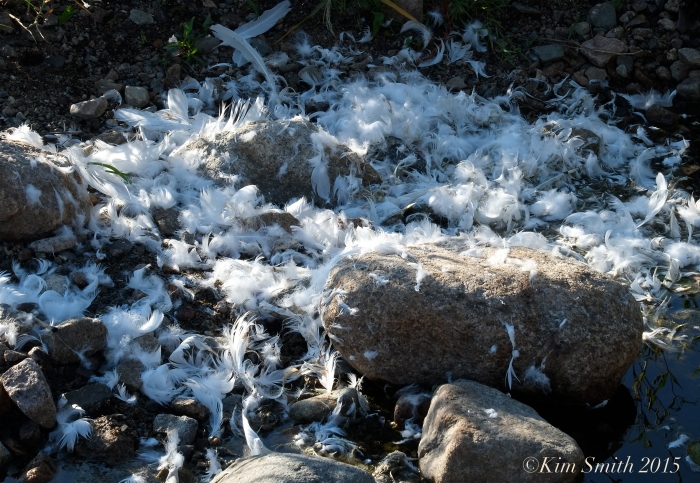
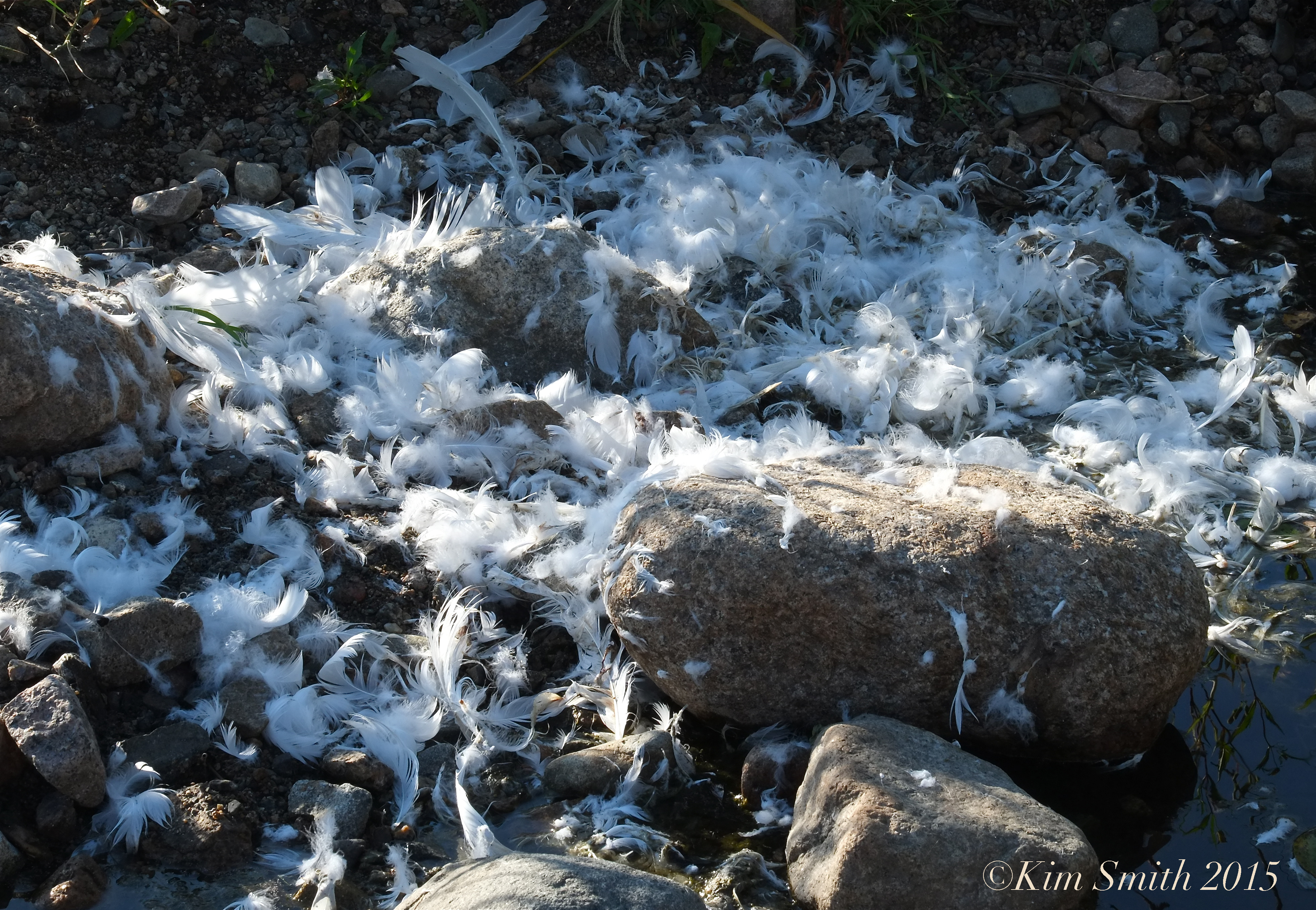
Thank you to my friend Lyn for sharing this story. Lyn lives on Niles Pond and, as do several family’s around the pond, she keeps a watchful eye on the swans, ducks, and all the birds that make Nile Pond their home. Lyn thinks the last time the swans were seen together was Monday, Labor Day. Mr. Swan has taken to sitting in the middle of the pond, crying and wailing, lamenting the loss of his beautiful mate. Wednesday Lyn took me around the causeway to the spot where it looks as though the kill took place, with only her feathers remaining.
If anyone has additional information, please share. Thank you so much.
Spread The GMG Love By Sharing With These Buttons:
Related
Published by Kimsmithdesigns
Documentary filmmaker, photographer, landscape designer, author, and illustrator. "Beauty on the Wing: Life Story of the Monarch Butterfly" currently airing on PBS. Current film projects include Piping Plovers, Gloucester's Feast of St. Joseph, and Saint Peter's Fiesta. Visit my websites for more information about film and design projects at kimsmithdesigns.com, monarchbutterflyfilm.com, and pipingploverproject.org. Author/illustrator "Oh Garden of Fresh Possibilities! Notes from a Gloucester Garden."
View all posts by Kimsmithdesigns


 Good Morning Gloucester
Oh that is just heartbreaking. Poor Mrs. Swan. Poor Mr. Swan. 😦
LikeLiked by 1 person
So sad. I say we get rid of the coyotes!
LikeLike
How about we don’t. It’s the circle of life. Coyotes need to eat too!
LikeLiked by 1 person
This is heartbreaking news, what can we do???
LikeLiked by 1 person
Oh no! My goodness, that is sad news.
LikeLiked by 1 person
The Mute Swan is not native to this area. It is an introduced species and deters many other native waterfowl. Swans are pretty,but the local ecosystem is better off without Mute Swans. Sorry for your loss. I have often watched nests where fledglings get picked off by predators, and it is alway disturbing.
LikeLiked by 1 person
Neither coyotes nor Mute Swans are native to this area.
In our region of the country, Mute Swans do not pose a threat to other waterfowl, as may be the case in some areas where they flock by the hundreds. As a matter of fact, many times I have filmed Mute Swans sharing food with dabbling ducks in the dead of winter when there is no other vegetation available except what the swans pull up from the floor of the pond.
LikeLike
Nor are humans.
LikeLike
So sad. I hope she didn’t suffer. Hope the mister finds another mate.
LikeLiked by 1 person
This is so Heartbreaking. She was so sweet & very dear to many. Sure hope grieving Mr Swan is strong enough to go on & not meet the same fate. Coyotes are smart, they watch & wait for a mistake & then seize their meal. Prayers & Positive energy for a brighter future for Mr. swan.
LikeLiked by 1 person
We used to see entire swan families at this time of year on Niles Pond. I just had an idea while writing this. Perhaps a small anchored platform could be constructed where they could get away from the coyotes. And then in the early spring the reeds that the swans use to build their nests could be placed on the platform to give them the idea they could even build their nest upon the platform.
I am interested to learn about how other communities are dealing with the plethora of coyotes.
LikeLike
How horrible , poor Mr. Swan .
LikeLiked by 1 person
I heard her yesterday in the middle of the pond crying. It was the first time I had heard one made a noise and didn’t know what the problem was. Now I know. How sad.
LikeLiked by 1 person
The only other time I have heard a swan make that cry was several years ago at dawn when a cygnet got separated from its family. It was a very lonely and plaintive cry. Earlier I had seen the rest of the family do its thing where they fly off for five, ten, sometimes fifteen minutes or so, stretching their wings, circling around the Pond and over to Brace Cove and back again. Somehow the cygnet hadn’t joined the flock. It swam back and forth crying. A short time later ma, pa, and siblings returned and the family was reunited!
LikeLike
Are you sure it was the female? The male was heartbroken BUT survived the loss of his his life-long mate about 6 years ago. “Little Girl Swan” came and joined him on Henry’s Pond. AT first, he was not at all interested; but then they came to know each other and bonded as a wonderful pair. So sad.
LikeLiked by 1 person
Will go and have another look today however, the male’s blackberry is not swollen during the breeding season and it may be hard to tell from a distance and without a side-by-side. I think Lyn would know for sure because they come right up to her.
I do not think the Niles Pond couple is the same couple that had a single cygnet this year at Henry’s. I think the Niles Pond pair has been together for several years, since the loss of his first wife. The female of the pair at Henry’s this year was very young; she was very small and she still had some brownish cygnet feathers when they first began nesting this spring. I have been filming and photographing both pairs and perhaps we can enlarge the photos and look at the beaks for clues.
LikeLike
I was not sure either, Kim. I know they were not the long-time Niles pair…but I had not seen the Niles pair at all this year. Then, after the Henry’s Pond swans lost their Cygnet and took off a few days later, a pair “re-appeared” at Niles. I know them VERY WELL close up, but have only been able to see them from a distance while at Niles. No, the female at Henry’s Pond has been with Cobb for at least five years; I do not recall over the last few years seeing any cygnet brown feathers on her, she WAS quite young when they first got together. Can you check with Lyn and see whether the Niles Pond pair were there since late winter/early Spring. THANKS!!!
LikeLiked by 1 person
As a child, some 55+ years ago my mother would bring us (me and my brothers) down to Niles pond to picnic along the pond’ s edge. The road was passable back then. I remember swans in the pond and ice boats sitting beached on the shore waiting for winter. I don’t know if they are the same swans (probably not) or from the same family. I understand the circle of life and all that, but learning of this gives me a bit of sadness, a moment to pause and think of my own mortality, some time to remember back to my own childhood growing up in “Glousta” and all the wonderful memories the old seaport has to offer. I hope another swan comes along to become a mate as much as I futilely hope that things never change. Unfortunately or perhaps fortunately, we are all part of the “Circle of Life” and these moments are time for reflection on our own short lives. Fortunately there are places like Niles Pond with the swans, scenic views, and memories as well as many other “places” in “Glousta” that provide that perfect venue for reflection, peace, and tranquility. Mourn the loss but cherish the moments that you have to be able to soak in the beauty of this wonderful and dynamic community!
RIP Mrs. Swan
LikeLiked by 1 person
Thank you Rick, so appreciative of your thoughtful post. Late for work now and running, but thankful for everyone’s kind comments.
LikeLike
Sad ending indeed.. Sorry Kim, I know you enjoyed going down there to film and photo. Nature is a bitch some times.
LikeLiked by 1 person
How sad! I hope Mr. Swan recovers and finds a new mate. RIP Mrs. Swan
LikeLiked by 1 person
Dear Coyotes,
You dont hunt fair…
….neither do we.
Sincerely yours,
The human
top of the food chain.com
LikeLiked by 1 person
Sorry Kim! Think Rick said it well. Wonder why all the coyotes are so present? 1957-1968 I don’t recall seeing many not that they were not there but very scared of humans (feeding them will bring them in also)…Now foxes we used to see quite a bit…You become one with them it’s very painful to see loss (death is part of the natural circle of life but still impacts those touched by the life). I had a squirrel that I used to feed on Peterson AFB live in the tree close to out dorm and after a long day would sit out back under the tree and be waiting for me eat out of my hand and actually follow me around up the sidewalks. I still have a picture of her a the Apartment.
Then one day went to put some nuts out for her in the fall she was gathering them up but could not find her walked around and found her dead by the far side of tree some one shot her with a high-power slingshot BB ball bearing crushed her skull! I buried her by the tree with nuts for her journey…I am glad I did not find the offender as that would get ugly! In the native culture you kill it you eat it and prays before hunt, during hunt, when taken and eaten, and prayers when bury what is not used which is not much as everything in used in one way or another.
Sorry for your loss like Rick said above remember the moments together and pleasure that can never be taken!
Dave 🙂
LikeLiked by 1 person
Coyotes are not indigenous to this region and as they migrated eastward they bred with the gray wolf, which has made them heartier. DNA evidence show coyotes in the east are 80 percent coyote, 10 percent dog and 10 percent wolf.
Coyotes compete with the red fox for habitat and that is why we have so many fewer fox. Fox are more interested in eating young rabbits, chipmunks, white-footed deer mice, and other small rodents, coyotes less so, and that is why we have seen population explosions of all three species, and why too Lyme disease is out of control. It was formerly thought that deer were the greatest carriers of ticks that carry Lyme disease but it is now known that white-tailed mice and chipmunks are the greatest vectors of the disease. Deer quickly flush Lyme-causing bacteria from their system, unlike hosts such as white-footed mice, which can’t clear it. In fact, a 2008 study found 80 to 90 percent of Lyme-infected ticks picked up the bacteria from shrews, the Eastern chipmunk and white-footed deer mice.
LikeLike