
As long as supplies last if any GMG folks want a bumper sticker but can't drop down the dock, just send a self addressed and stamped envelope longer then 7 and a half inches and I'll drop one in the mail for you.
Send the self addressed and stamped envelope to the dock at 95 East Main St Gloucester Ma 01930 care of Joey (put my name in big letters to make sure it gets to me)
As long as supplies last if any GMG folks want a bumper sticker but can't drop down the dock, just send a self addressed and stamped envelope longer then 7 and a half inches and I'll drop one in the mail for you.
Send the self addressed and stamped envelope to the dock at 95 East Main St Gloucester Ma 01930 care of Joey (put my name in big letters to make sure it gets to me)


 Good Morning Gloucester
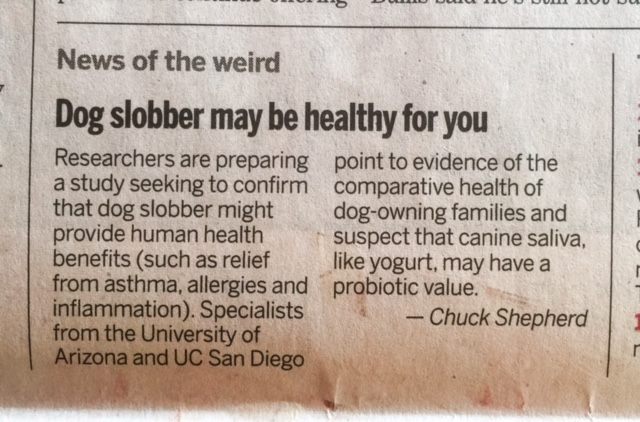
Validation! I KNEW it was OK to French my puppy!
LikeLiked by 1 person
You may be on to something here! 🙂 Dave
Paul – you will have to break this one down beyond my knowledge:
1. Physiol Behav. 1990 Sep;48(3):383-6.
Antibacterial properties of saliva: role in maternal periparturient grooming and
in licking wounds.
Hart BL(1), Powell KL.
Author information:
(1)Department of Physiological Sciences, School of Veterinary Medicine,
University of California, Davis 95616.
Canine saliva was tested for its bactericidal effects against pathogens relevant
to the presumed hygienic functions of maternal grooming of the mammary and
anogenital areas and licking of wounds. Both female and male saliva were
bactericidal against Escherichia coli and Streptococcus canis but only slightly,
and nonsignificantly, bactericidal against coagulase positive staphylococcus and
Pseudomonas aeruginosa. E. coli is the cause of highly fatal coliform enteritis
of neonatal mammals and E. coli and S. canis are the main pathogens implicated in
neonatal septicemia of dogs. The bactericidal effects of saliva would facilitate
the hygienic function of maternal licking of the mammary and anogenital areas in
protecting newborns from these diseases. E. coli and S. canis along with
coagulase positive staphylococcus and P. aeruginosa are among the common wound
contaminants of dogs. Wound licking, and the application of saliva, would thus
reduce wound contamination by E. coli and S. canis. The resistance of
staphylococcus to bactericidal effects of saliva may be a factor in the high
frequency (46 percent) with which coagulase positive staphylococcus was isolated
from wounds compared with much lower frequency (9-17 percent) with which E. coli
and S. canis were isolated.
PMID: 2125128 [PubMed – indexed for MEDLINE]
LikeLike
Perfect. My granddaughter wants a puppy, but her father resists. She has terrible allergies, so I forwarded her the clipping to show to her dad.
LikeLiked by 1 person