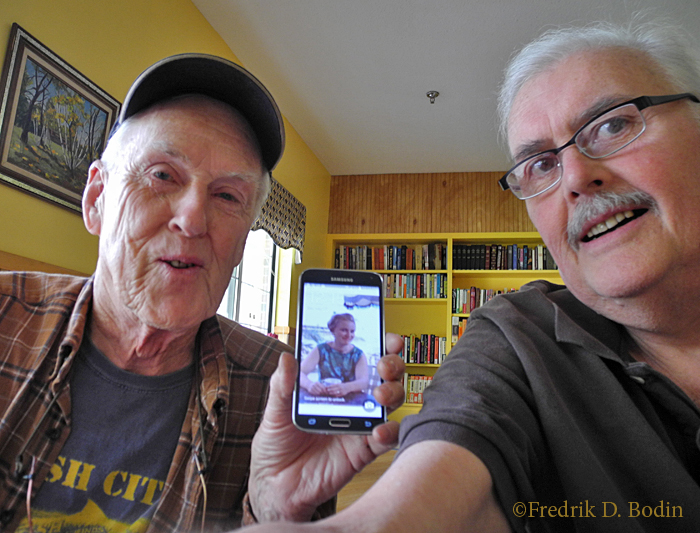
A Selfie of Friendship and of Hope
My View of Life on the Dock

Cat Ryan submits-
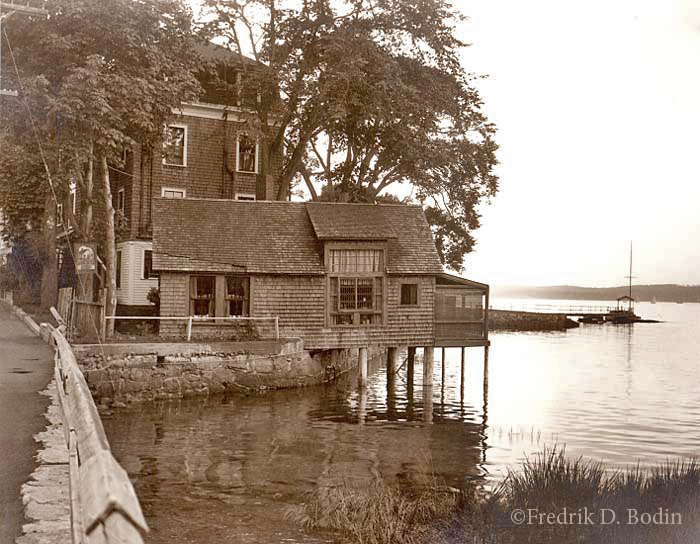
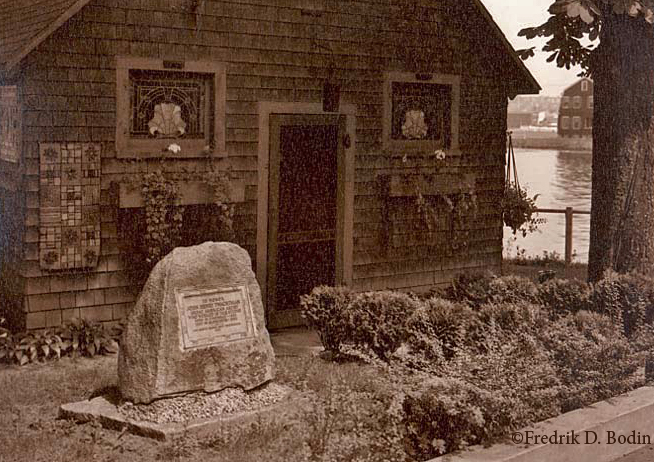
FSA/OWI photograph in the Library of Congress
Gordon Parks Gloucester photos Memorial Day 1943-
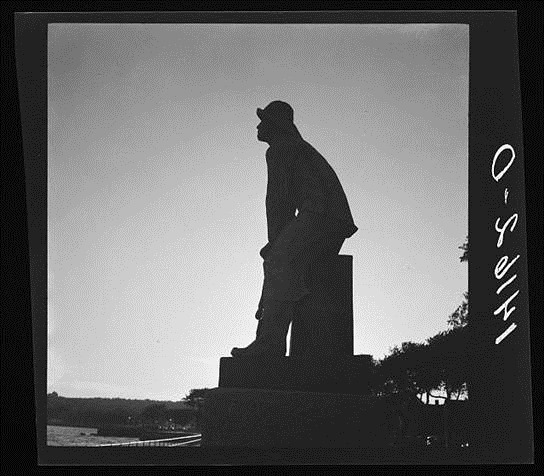
Gordon Parks, Gloucester Massachusetts. Memorial services for fishermen lost at sea.
Citizens gathered on the banks near the sea, May 1943.


More Gordon Parks 1943 Memorial Day pictures click here

http://www.manatthewheel.blogspot.com/
Check out the interview with the ever upbeat Heidi Wakeman

Here’s the blog-
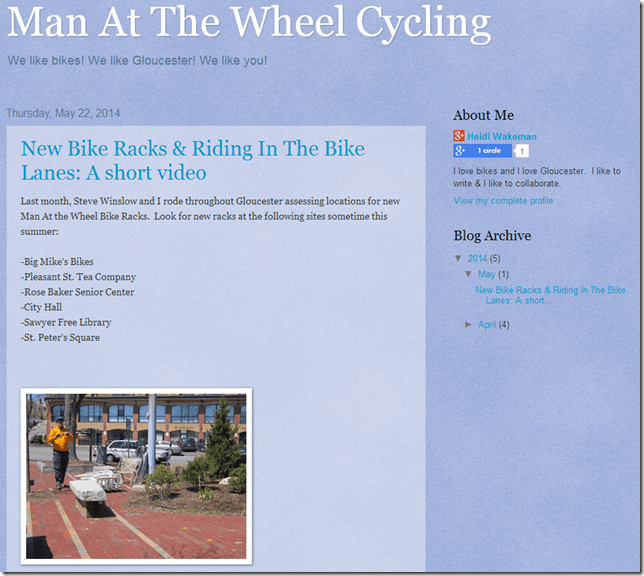
Send in pics of your bike, start up the conversation about local biking, all that good stuff. Heidi is about the sweetest woman you’d ever wanna meet.
Here’s our interview from August 2008 when the GMG was only a few months old-




Check it out!
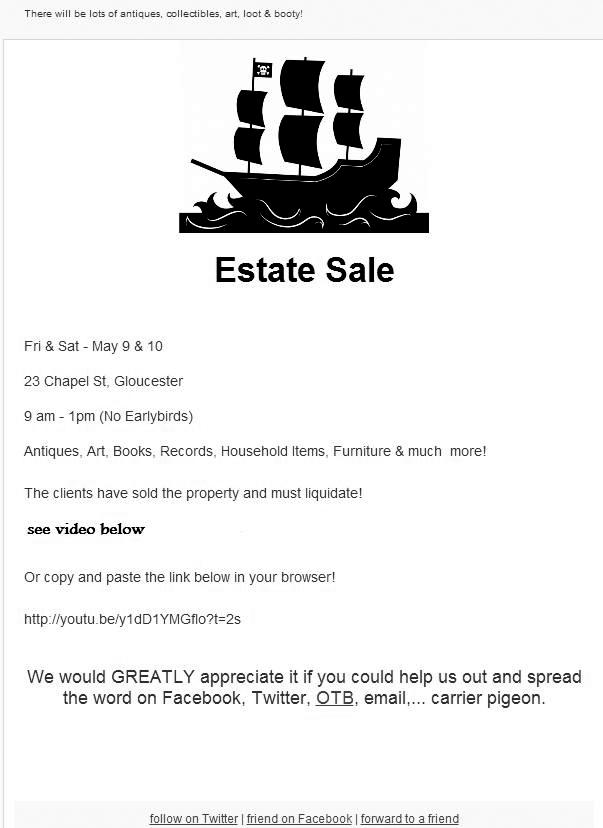
May 9th & 10th 9:00am No early birds, please
23 Chapel Street
East Gloucester, MA

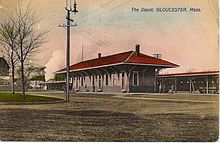
I ran across this link to a MAPC study, browsing news for work. TOD or Transportation Oriented Developments are getting a lot of talk today and places like Melrose are already trying to capitalize on the idea. I thought to post the following link to the study on GMG as the concept could be looked into for Gloucester and perhaps Beverly. The effort usually takes a zoning overlay district that allows mixed use developments and areas with strong connections to rail and bus systems. Not sure if anyone’s thinking along these lines already.
Follow this link to the MAPC (Metropolitan Area Planning Council) study of stations within the Metro area showing potential for development and capacity. Melrose has now proposed zoning changes in it’s Tremont/Essex Street Commuter Rail Corridor. Some of these include relaxed height restrictions allowing 4 stories, up from 2 stories, greater density, and broadened scope of allowed uses. Great ideas for growth going forward with incorporation of public transportation as a foundation. http://bit.ly/1pWsmKY . IMHO!

Cat Ryan submits-
Hi Joey,
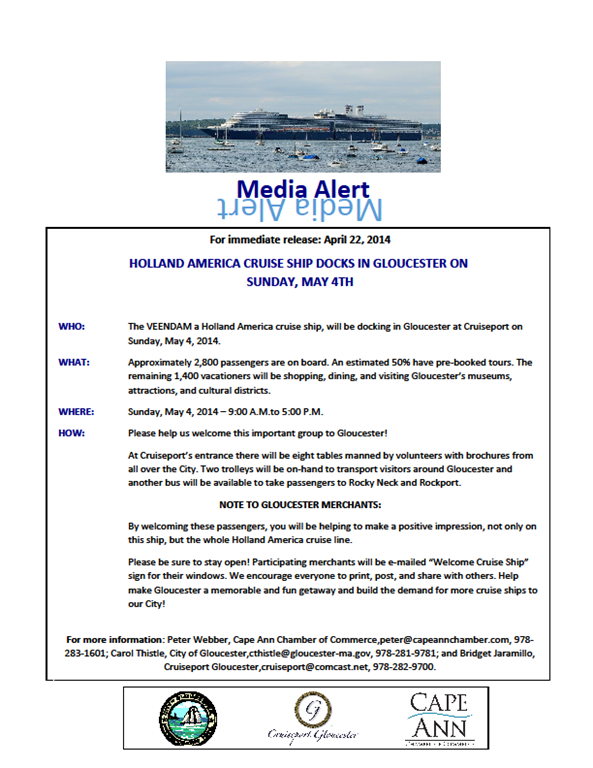
A cruiseship is coming! A cruiseship is coming! Sunday, May 4, 2014, Holland America will be arriving at Cruiseport
Calling all Main Street, downtown, shops, restaurants, cultural districts, Rocky Neck:
v Open up if you can on Sunday May 4, and maybe at an earlier time (see flyer)
v Print out and hang up a welcome sign that’s being created for this day (coming soon!)
v By April 30th, email Carol Thistle if you will be open, cthistle@gloucester-ma.gov
v By April 30th, email Carol Thistle if you can offer a special discount or have a creative theme you would like to share.
o Gloucester doesn’t need too much help in that department but if you’re needing last minute oomph ideas, search GMG and see what Toodeloos and Pop Gallery and so many others come up with for holidays and block parties!
v Some of downtown is open Sundays anyhow (Island Art & Hobby); it would be good for all of us to know who is open on Sundays
v Passengers won’t be able to visit everywhere, of course. Residents: this might be a fun day to come together to support downtown, your favorite store, restaurant, gallery– and some great people watching!
Gloucester is one port of call. Hundreds of passengers have pre-booked, arranged itineraries– day or ½ day trips that will depart directly from Cruiseport. Some passengers remain on board. Many passengers specifically selected disembarking and exploring Gloucester.
Stage Fort Visitor Center will be open. Maritime Gloucester will be open. Cape Ann Museum is closed for renovation. How about you?


Cat Ryan submits-
Hey Joey,
Whether you fall on the side of these commercials are a prime example of greenwashing, this is SUCH a landmark PSA, let’s make another parody, or hey wait a minute Iron Eyes Cody was Sicilian?—people of a certain age remember seeing the Ad Council’s Keep America Beautiful ads. Lassie and Lady Bird Johnson were helping the campaign, too. Wildflowers and THE dog.
I was a kid. This tv spot was memorable and effective.
And this one. William Conrad voice over.
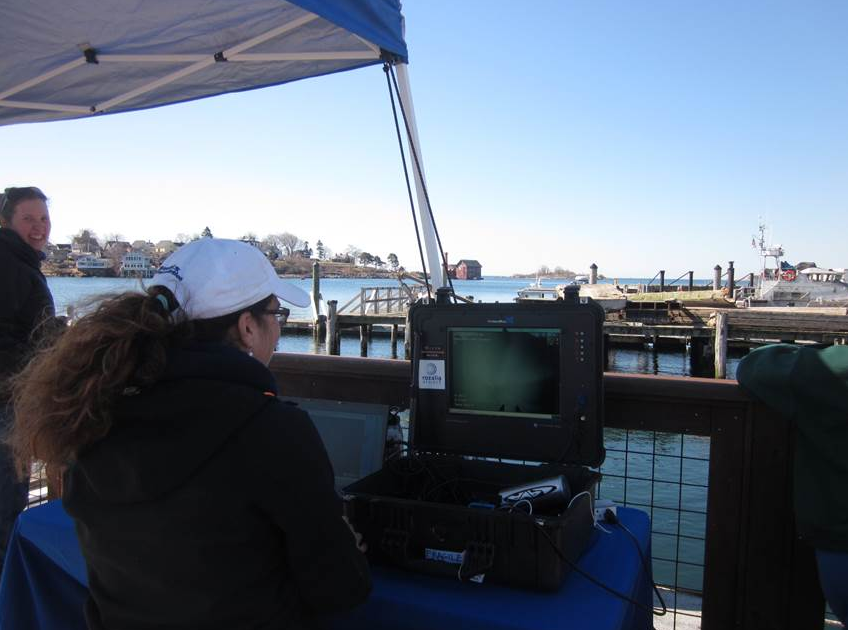
The Rozalia Project lecture at Maritime Gloucester for the kick-off event of the first Harbor community clean up reminded me of these ads. In a positive way! Highways look better. Now on to our shoreline and ocean floors. There was a photo of a crab trying to maneuver past sunglasses and various beverage cans in Newport that specifically brought those commercials back to me. Oh, and check your toothpaste and skin polishers – no poly anything ingredient. Trust me.
The next day following that lecture, clean up happened all around the harbor, right at the water’s edge, different neighborhoods, and even by boat. Kudos to Maritime Gloucester for organizing and Harbortown and Rocky Neck Cultural Districts and other partners and volunteers.
At Maritime Gloucester, the Rozalia Project robot, Hector the Collector, went to work while Audie Tarr and others set out in boats for some surface retrieval. Gig Rowers in action, too.

Cat Ryan submits-
Thursday, April 24, 2014 is National Poem in Your Pocket Day. Gloucester’s Poet Laureate Rufus Collinson will have a poem for sure. How about you? It’s easy to join in the excitement. On April 24th Copy, Carry, Share and Care
1)Write your own poem or jot down one of your favorites
2)Remember to carry a poem in your pocket
3)share the fun of poetry and national poetry month with your friends, family, coworkers, classmates, wherever you go
4)ask them to share their poem with you
Visit the American Academy of Poets site www.poets.org for more info or New York City’s (started there 12 years back)
Gloucester Committee for the Arts
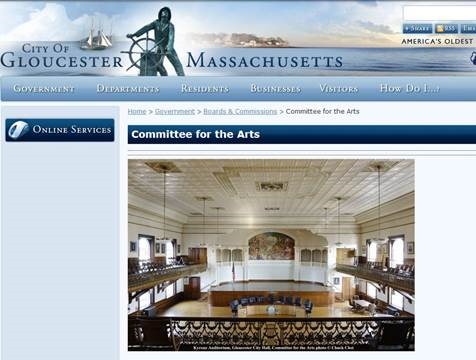


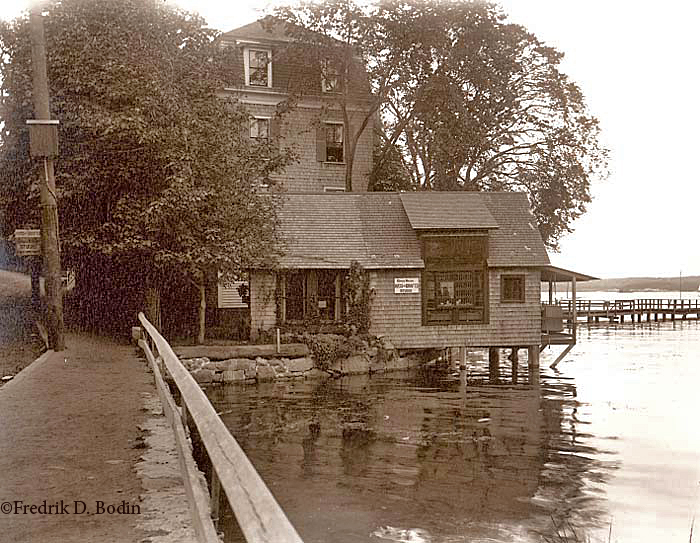

So, I’m doing some exploring this morning looking for fun things to do with kids, and I landed on good ol’ GLOUCESTERMA.COM. Then I see an ol’ favorite, the Gloucester Maritime Museum, harmless right? It’s a haven for kids, family, education and fun. Fair enough I feel. Then I click on this link
http://www.gloucestermaritimecenter.org
and BOOOOOM!
So, click and tell me what you find!

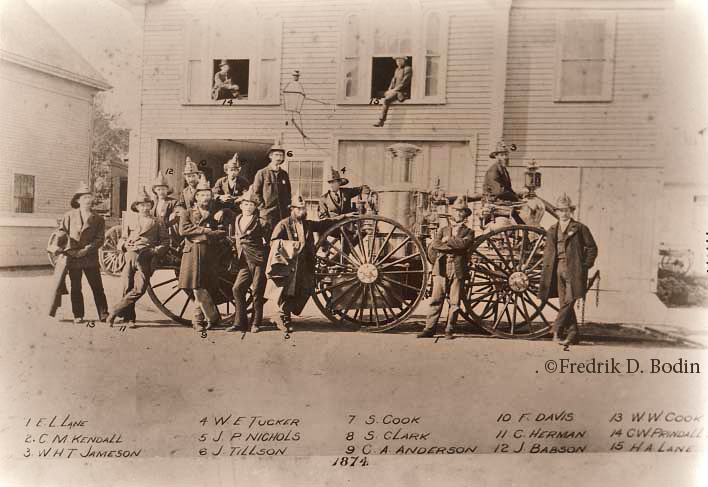

Cat Ryan Submits-
Hi Joey
Turner, Monet, Whistler, Dow…Lane?
Check out John Wilmerding’s review of Fitz Henry Lane’s half-dozen foggy views such as Ship Starlight in the Fog (c.1860) which is in the collection of the Butler Institute of American Art in Youngstown, OH.

For more hazy light and atmosphere, rivers and tides, and artists born in MA: the WSJ has covered the James Abbott McNeill Whistler biography by Sutherland
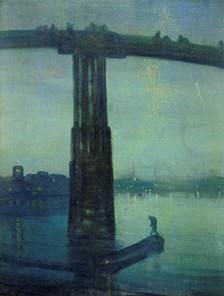
and current Whistler exhibitions which you can check out if you hustle. An American in London: Whistler and the Thames at Addison Gallery of American Art is closing April 13, 2014. Go!
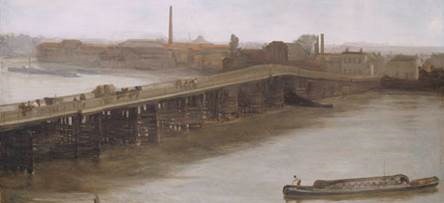
No deadlines:
Make time to visit Ipswich and seek out work by Arthur Wesley Dow.


And when it re-opens, Cape Ann Museum for all things Lane.

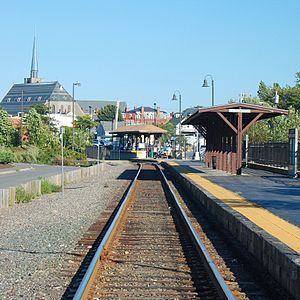
Reimagining Railroad and Maplewood and …
Gloucester Community Development / Metropolitan Planning Area Council
Catt Ryan submits-
Hey Joey,
Last night, Community Development partnered with the Metropolitan Planning Area Council (MAPC) to host the first in a series of discussions about Gloucester’s railroad station and the surrounding area. Along with all the other robust planning that is ever constant, this interactive meeting was an extra special focus on what transit oriented attention and development might mean for Gloucester. Gloucester Planning Director, Gregg Cademartori, gave a great introduction.
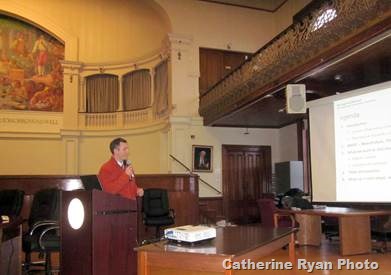
Eric Halvorsen introduced the team from MAPC, which helps town generally within the wide swath of I-95. I met Eric last fall at a MA Smart Growth event he was part of. It featured Fred Kent of Project for Public Space and one of our site walks that day considered spaces and transit areas at Harvard. Halvorsen explained that there are 280 or so transit stops in Massachusetts. He enthusiastically gushed, “They are precious and finite”– and therefore merit our attention. These transit hubs account for 5% of the geography of the state, and cover 37% of the jobs. The state considers Gloucester’s railroad station as an ‘urban gateway’, one of 10 types of transit stop categories they’ve identified in MA. Salem, Beverly and Haverhill are other examples of this urban gateway category.
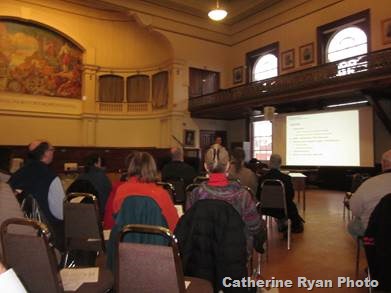
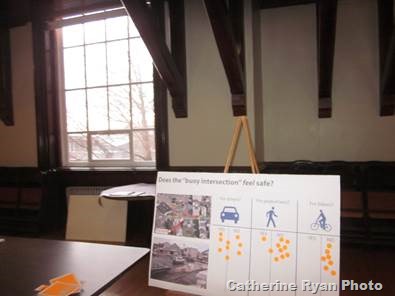
The evening ended with three tables of break out discussions. Topics swirled, and questions prompted responses and exchanges. Connections to other areas downtown were mentioned, Gloucester’s past, and the railroad station area as a gateway. We wondered together what people thought it might be like soon and many, many years from now. Creative ideas and similar words and phrases oscillated throughout Kyrouz like air-popped kernels: emphasis on sidewalks, signage, streets (Washington Street, Maplewood, Prospect, Railroad Avenue, Dale and Pleasant), seniors, bike rentals, safety, young families, terms such as “soft and hardscaping”, public space, shade, paving one side (like the HarborWalk), green energy, beach buggies, maker spaces, lighting, artists and other professionals, trees, wayfinding, future businesses, pedicabs, mixed use, residences, single stories, design, the stores folks value now, the Jeff Weaver mural, the supermarket, Dunkin Donuts, the restaurants.
Community Development and MAPC will share results from these conversations and offer their take, research and observation. Our input will inform the process, and there’s funding queued up.
There will be two more public meetings and they’re sure to be interesting … make sure you come if you can for the next ones, and for any that Community Development organizes.
For the Railroad discussions, send in ideas and comments and/or sign up for updates on any future meetings with:
Eric Halvorsen ehalvorsen@mapc.org
Gregg Cademartori gcademartori@gloucester-ma.gov


Catherine Ryan Submits-
CROSS-COUNTRY CHRONICLE
Gloucester, MA in landmark FSA/OWI documentary photographs
Part 3
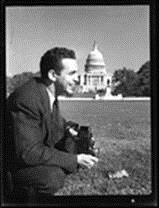
American Photographer HOWARD LIBERMAN
150 FSA/OWI photos in Gloucester, MA, September 1942

Hey, Joey,
Here is Part 3 in a series about Gloucester photographs in the legendary Farm Security Administration / Office of War Information (FSA/OWI) collection within the Library of Congress.
You can go back to Part 1 about artist Gordon Parks, and for some background about the program (1935-42).
Part 2 is about photographer Arthur Rothstein with a timeline and quick facts.
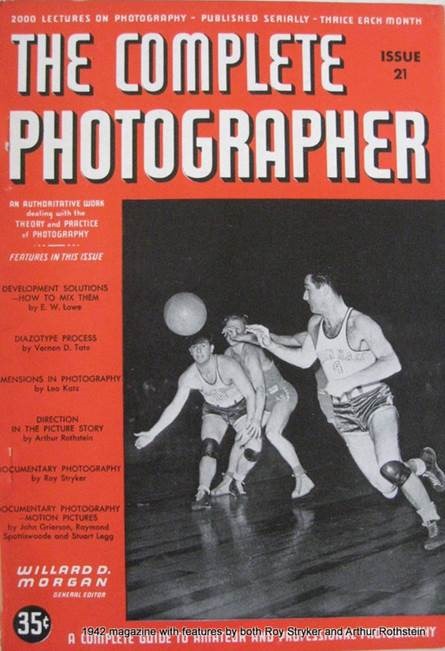
In 1942, the Farm Security Administration Historic Photographic section program was winding down as it transitioned and prioritized for WWII. It was temporarily folded into the Office of War Information before shutting down completely. (Gordon Parks was brought on board during this transition.) Director Roy Stryker was occupied with many directives including securing a safe haven for the FSA archives. He was also maintaining a network of contacts in the publishing world and private sectors, and writing. He contributed a chapter for Caroline Ware’s influential book, The Cultural Approach to History. There was magazine work such as the 1942 issue of The Complete Photographer which published articles by both Arthur Rothstein (“Direction in the Picture Story”) and Roy Stryker (“Documentary Photography”.)
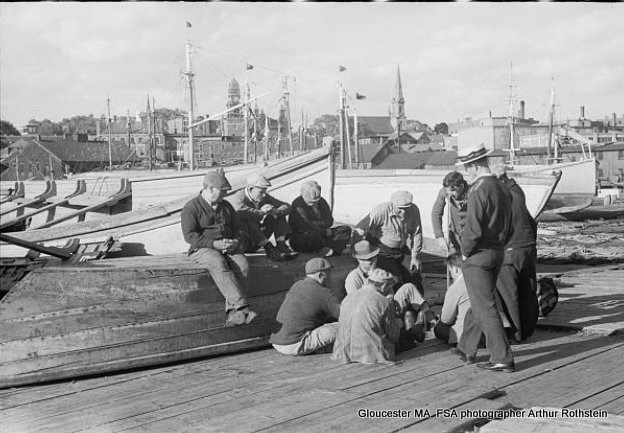
Rothstein had already left the FSA. In 1940, Peter E. Smith Publishers, Gloucester, MA, produced his photo book, Depression Years as Photographed by Arthur Rothstein. This compilation of photographs included the best known Gloucester image from his 1937 visit; was it one of the publisher’s, too.
In 1941, Elmer Davis was appointed as the Director of the newly created Office of War Information (OWI). In 1942, Davis hired Francis Edwin Brennan from FORTUNE magazine to head the Graphics Department of the OWI.
As Art Director of Fortune (1938-1942), Brennan commissioned famous covers by artists such as Otto Hagel and Fernand Leger. He was known in the industry as a serious art and publishing expert and was a favorite of Henry Luce.
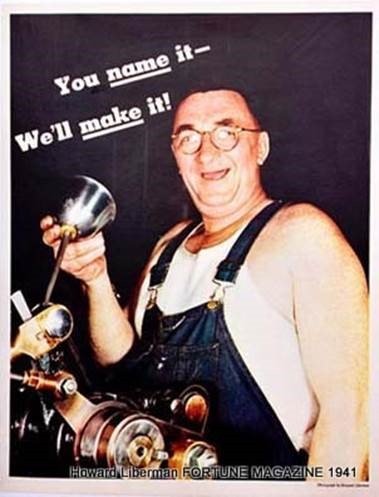
It’s likely that Brennan was one contact for Howard Liberman’s engagement at OWI. In August of 1941 Brennan featured a FORTUNE magazine special portfolio of sample posters to showcase the development and potential of this media. Howard Liberman was one of the artists he commissioned; here’s his contribution for that issue:
And here is a poster Liberman created for the OWI.

Liberman worked with color photography, too, which is a sub-collection at the Library of Congress, less known than the black and white. Color photography was available, but more expensive to process and for media publishers to print.
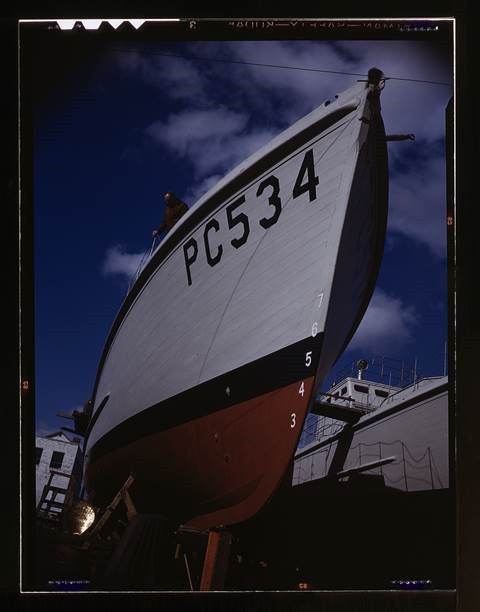
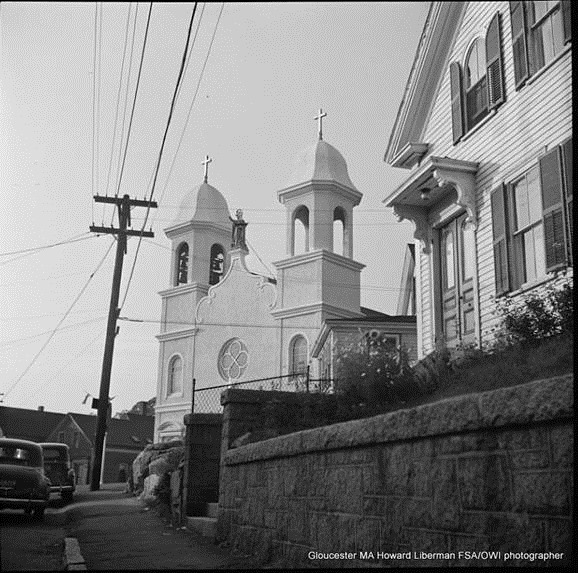
Howard Liberman was dispatched to Gloucester in September of 1942. His photographs show a clear emphasis on WWII dominant coverage, sometimes with an FSA take. The titles on Liberman’s OWI photos often lead with a heading. For Gloucester, many images have caption leads that begin with the patriotic category: VICTORY FOOD FROM AMERICAN WATERS.
In Gloucester, Howard Liberman spent a time on the docks and out with the crew of the OLD GLORY.
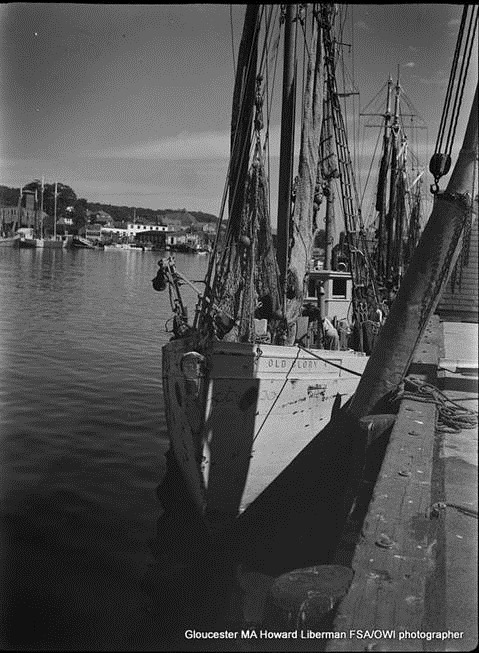
His captions seldom include surnames of the portrait subjects. They do have lengthy– sometimes general, sometimes quite specific– descriptions to support the category heading.
There are action and portrait shots of the crew catching rosefish during an Old Glory voyage.
“Victory food from American waters. At the docks in Gloucester, Massachusetts, crew members prepare their trawler for a week’s voyage. Most of the fishermen in the city come from a line of fishermen that dates back for centuries.”

“Victory food from American waters. Immediately after being caught rosefish are shoveled into the hold for packing the ice. Once called “goldfish” because of their brilliant color, the fish are finding a ready market because of their manifold uses–as food for humans, as fish meal and fish oil.”
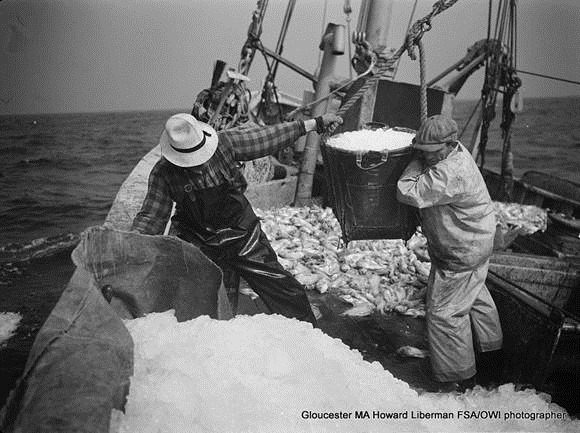
“Crew members throw overboard excess ice from Old Glory’s hold. Fishmen allow a proportion of one ton of ice to three tons of fish. When the catch is unusually large as on this trip, some ice is removed to make room for the fish.”
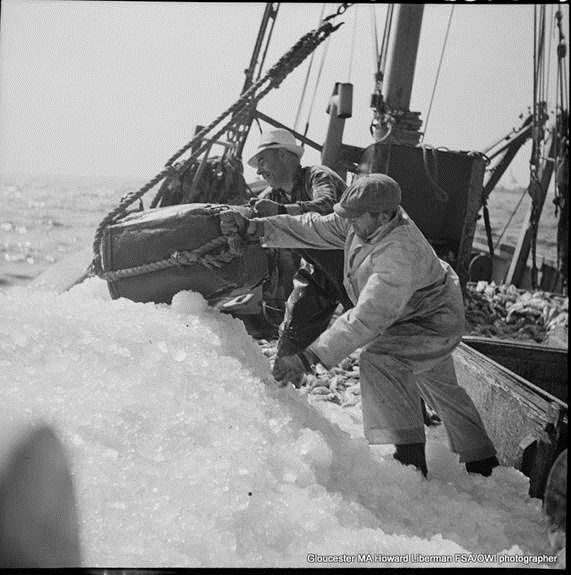
“Victory food from American waters. Decks are covered with tons of rosefish as the Old Glory reaches its capacity load. After two and one half days of fishing, a catch of 85,000 pounds has been hauled in”

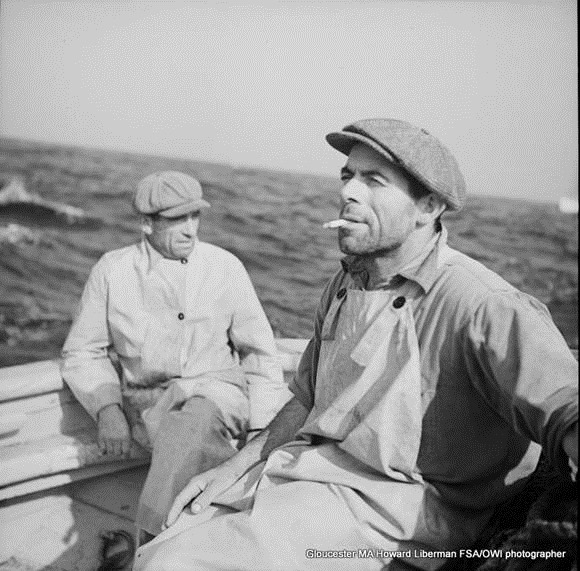
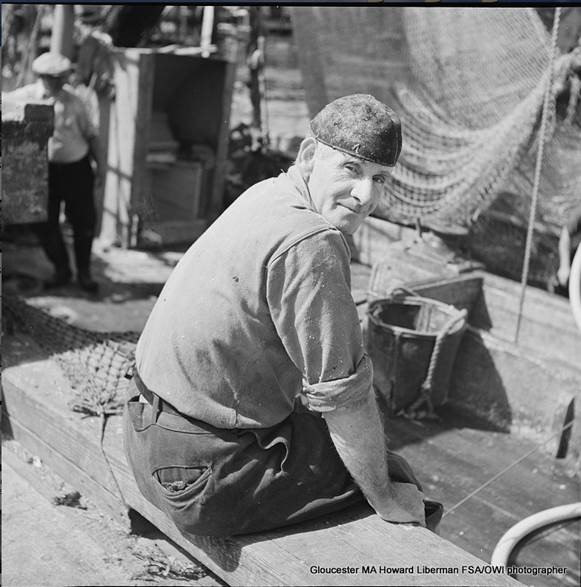
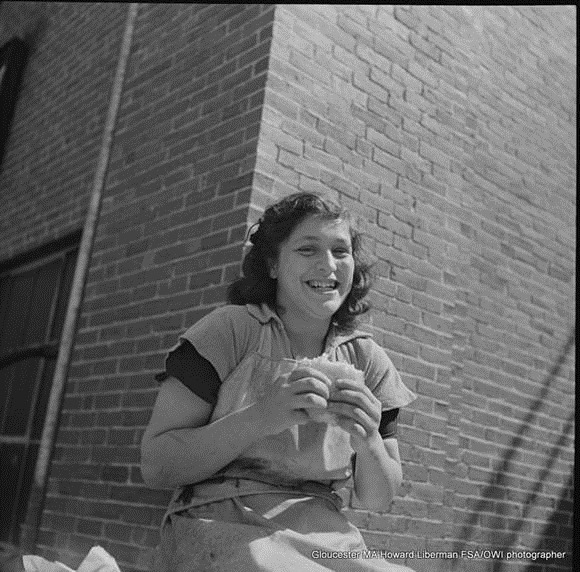
“Tomorrow’s fishermen–young Gloucester boys push wagons of rosefish from the unloading pier to the processing plant where the fish are filleted and frozen…Many of the boys will follow their forefathers and fishermen in New England waters”

Look for ‘scenes’ such as Captain John Ribiera (surname spelled a couple of ways in the archive) at work and with his wife at home. 1942 census indicates “Oscar (Irene) fishermn Riberio” at 18 Perkins Street.

Note the picture of “the Pilot at the Wheel” above the stove


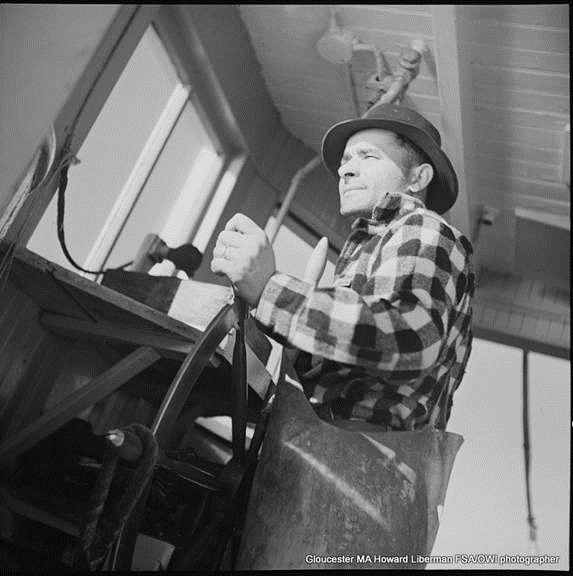
Another reminder to look for exhibits to see vintage prints in person, rather than the low resolution files I’m showing here. Various resolution options are available at the Library of Congress. Besides the formal details, check out the Captain’s eyes!
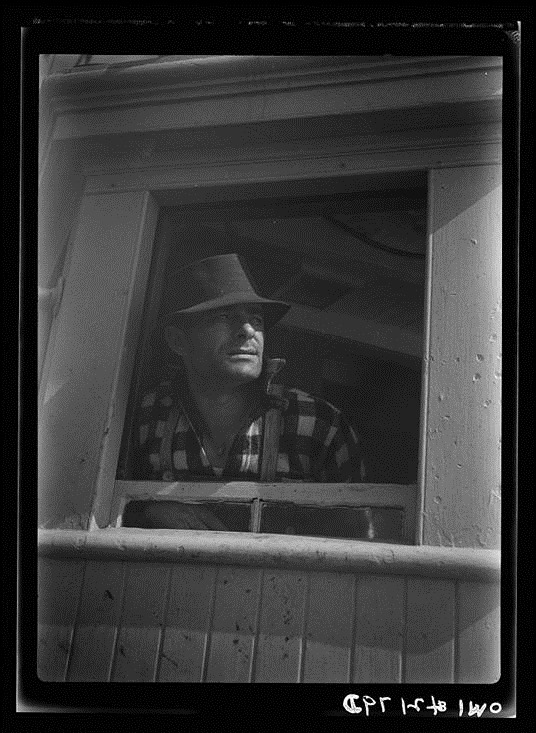
Binnacle blinded.

The “Mother of Good Voyages” statue in Captain John Riberia’s quarters on the fishing trawler “Old Glory”

There are a couple of Gloucester interiors (deteriorated negatives) of the Gloucester Mariners’ Association; they infer “captains welcome only.” One shows a gentleman playing cribbage; another shows Captain Ben Pine, the man who raced the schooner Gertrud Thebud.

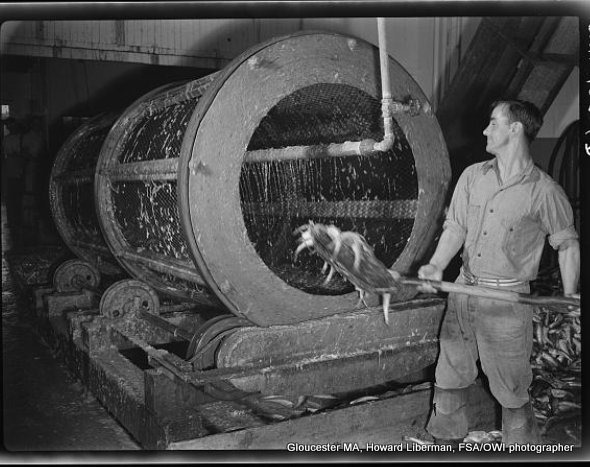
Joey, beautiful dangerous industry: shoveling fish into the rotary scaler at a fish packing plant.
For assignments in other towns, typical headings for Liberman categories include:
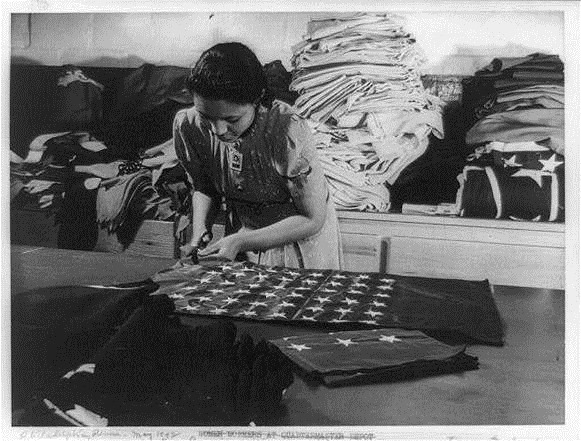
Americans All; Subcontracting; School Boys in Training; Industrial Safety; Office Equipment Used by WPB; Women at War; Fuel Oil Consumption; Women Workers (see below making flags); Airports (ditto other industries); Military (e.g. Fort Belvoir); African American Aircraft Propeller Workers (ditto other jobs); Shipyard Workers; Bomber Plant Workers; Price Control; Production; Submarine Chasers; and Conversions (from this to look here it is now was a useful WWII product)
There are more than 50 additional Gloucester photos in the Library of Congress collection, and one Royden Dixon image from 1940.
We are fortunate that so many talented artists worked on the FSA/OWI project, that a few visited Gloucester, and that so many folks across the county were willing to participate as subjects (easier during the War)
The municipal employees and the curators and staff who have worked on these collections (over decades) are superstars. Beverly Brannan is the curator of 20th C documentary photography at the Library of Congress.
For the FSA/OWI program, Director Roy Stryker proselytized that photography was perhaps the best tool for analyzing living history. He felt that photography as a fine art form and its gains in technical ease and advances coincided ideally with the timing of the FSA/OWI historical photographic section. He forecast rapid and constant increase in photography use and adapters. He was inspired by individual and private pioneering antecedents (Brady/Civil War, Hines/Russell Sage), and public ones such as the documentary photographs by William Jackson for the Department of the Interior.
Sometimes I think of Stryker’s Section work along a continuum of government spending on exploration that produced great contemporaneous historical records. The journals of Lewis & Clark. The work created by artists who participated in the NASA Art Program. These FSA photographs.
Stryker realized that there were collections of photography building up in municipalities big and small; how they were catalogued and assessed were critical to their use. Here in Gloucester, the Cape Ann Museum maintains a Historic Photo Collection containing over 100,000 images from 1840s through now. Photography is included among its permanent and temporary exhibits and what’s not on view can be researched at their archives.
GLOUCESTER PHOTOGRAPHY PRE, DURING AND POST FSA/OWI
There were many independent artists as well as staff photographers (local newspapers, businesses such as Gorton’s, etc.) working in photography here in Gloucester. Every decade has wonderful examples such as Herbert Turner, Alice Curtis (and other photographers that Fred Bodin features), and David Cox’s father, Frank L. Cox.
There were numerous visits from staff photographers of major publications like Life, Vogue, National Geographic, and more. Gordon Parks came back at least two more times; a few other celebrated staff photographers that came through include Luis Marden, Eliot Elisofon, Yale Joel, Co Rentmeester and Arthur Schatz.
No- photographic artists who also worked in photography is another long list, and would include Leonard Craske, Emil Gruppe, Philip Reisman, and many others.
Good Morning Gloucester features photography, that’s for sure.
-Catherine Ryan / all photos Library of Congress, FSA/OWI black and white photography collection

 Good Morning Gloucester