In Case You Missed It
Here’s a video from 2009 showing how The Plan B Herring Boat loads it Seine boat.
Imagine the fun they must have loading that boat in rough Seas.
My View of Life on the Dock
Here’s a video from 2009 showing how The Plan B Herring Boat loads it Seine boat.
Imagine the fun they must have loading that boat in rough Seas.

The Schooner Thomas E Lannon Under Sail 2010 Video
If you have a story about Joe you would like to share send it in and I’ll add it to this post.
Joe “Stoga” Scola remembers Joe Garland in this video interview-
###
BY SANDY TOLAN
He was a bard of the Atlantic: A crusty, delighted, outraged, self-deprecating, sharp-eyed, ever-curious citizen historian of America’s oldest fishing port. But it was an unforgettable trauma on land, nearly halfway around the world, that decades ago brought the legendary Joe Garland back home to Gloucester, and to Black Bess, his weathered old house on Eastern Point.
From there, Joe would gaze through his six-foot-high living room windows to the inner harbor, and consider two mortalities: That of the Gloucester fisherman, and that of himself.
Joe’s connection with the lethal risks to the Gloucestermen came through his own confrontation with death on the winter line at Italy’s Anzio beachhead during World War II. At Anzio, it was trench warfare, as Allied and German soldiers shot and shelled each other over mere feet of land. Joe was deeply scarred by this, and for decades, he worked on Unknown Soldiers, a memoir of his time in war. For years, while that narrative eluded him, he cranked out book after beautiful book about Gloucester and the North Atlantic: Lone Voyager, about fisherman Howard Blackburn, who survived a brutal winter journey, cut off from his mother ship and lost at sea in a tiny dory; Guns Off Gloucester, about redcoats and rebels on the North Shore of Boston during the Revolutionary War; and Down to the Sea, a history of the thousands of men who sailed out of Gloucester harbor and never came back.
"The American Dream has always been that joy and discovery and energy and activism and optimism are what have knit our society together and have brought it power and expansion," Joe told me. "But I reckon in a more profound way, loss is a more enduring kind of a social cement."
Like perhaps all trauma victims, Joe was witness to things he didn’t much want to talk about, but which nevertheless, for decades, he couldn’t shake. And yet he dealt with the loss – and the "shellshock," as people used to call PTSD – creatively: He wrote about it, over and over again, even if indirectly. (And, eventually, directly: Unknown Soldiers was finally published in 2009.) And, in the tradition of the many writers and artists who had came to the North Shore before him, he told great stories.
"Let me tell you about Helen!" Joe exclaimed to me on the day we met, as we sat at dusk in the living room, surrounded by ticking grandfather clocks, watching the blinking lights of the trawlers on the path to the open sea. An army buddy told Joe he needed a pen pal: Helen Bryan, his childhood neighbor from New Jersey. Joe wrote Helen nearly every day from Anzio. They fell in love by U.S. Army Post; in Joe’s mind, with the smoke of battle around him, they would get married nearly the moment he touched American soil. Provided he survived. On Thanksgiving 1945, Helen was waiting for him in pearls and a full length fur coat at Grand Central Station. But she wasn’t ready to marry; on her father’s orders, she would need to finish Sarah Lawrence College first. Joe was furious, dumbfounded, traumatized; he cut off the relationship, burned Helen’s letters, married someone else, raised a family. Decades passed. Helen married too, and had four children. Then, on July 5, 1978, Joe, at work on Unknown Soldiers, contacted Helen to see what she remembered. (After all, he no longer had the letters!) They met again, at the Thayer Hotel at West Point. And fell in love again. "And on my way home I pulled over to the side of the road and I cried my eyes out!" Joe nearly barked at me.
Many years later, when my former wife Lamis and I were living down the street in East Gloucester,, Joe and Helen Garland would hold court beneath the big chandelier in the dining room at Black Bess. There was always something urgent to discuss. Maybe it was the battle over Gloucester’s historicPaint Factory, which a couple of outsiders were trying to turn into condos. Outrageous!, Joe would bellow. What the hell do they think they’re doing? Or maybe it the gas pipeline going in on the Atlantic seabed, and how it might threaten the dwindling fishing stocks. Or it was the endless intrigue of the town’s mayoral politics. Or the battle over the future of Israel and Palestine, what Anaconda Corporation did to the Hudson River Valley, the indigenous politics of New Zealand, the legacy of Margaret Mead in the United Nations, the courage of a Catholic priest in India, or of cousin Billy in Scotland. Often, the conversation was about the decline of a kind of decency and fairness in American society and politics – a theme Joe frequently returned to, with genuine bewilderment and sadness.
Throughout these dinners, there was Joe, chewing his food ever so slowly (he was the world’s slowest eater), ever in his baggy, deeply faded jeans and blue-and-white-striped milkman shirt, his shock of white hair brushed absentmindedly across his brow: joking, inquiring, reminiscing, lamenting – and encouraging his younger visitors in whatever dreams they’d brought with them that evening.
I called Helen the other day to see how she was doing. We shared some Joe stories, and discussed the upcoming celebration of his life, which will take place today [Saturday] on Gloucester Harbor. And then she told me something surprising. Finally, at the end, Joe’s trauma was gone. After his war book – his recurring trauma – went out into the world, the PTSD began to dissolve. Daily, he was reminded of the poem his war buddy Frank Merchant wrote for Joe and Helen:
May this day, a diamond discovered
Glint from the old war and terror
"You saved my life," Joe told Helen, near the end. "You should have seen him," Helen recalled of his final hours. "You’ve never seen such change in a person." He was in the living room, looking out at the passing ships in the harbor. "It was magic. He was totally absorbed in something beautiful."
Sandy Tolan is a former resident of Gloucester and an associate professor at the Annenberg School for Journalism and Communication at USC. He is working on a book about music in the Holy Land.
###
Bruce Bonham-
Sadden to hear of the passing of Joe Garland.
A few years ago during one of our annual Gloucester and Cape Ann visits, I stumpled upon a Garland book up at a Newburyport flea market.
It was the history of Eastern Point. I immediately fell more in love with the area. I purchased a few more of Garland’s Gloucester and North Shore books, then during a September visit a few years ago gathered up courage enough to knock on his Eastern Point front door at Black Bess.
"Come on in!" was the sight unseen call from Joe’s wife, Helen. "You wanna see Joe? He out feeding the dog. He’ll be right in."
She took me to Joe’s perch at the back of his historic house with spectacular views of the harbour and city. I was there, on the premise of getting his books autographed (which he did, making me feel he was honoured to do so), but really wanted to meet the man who wrote the area’s interesting history.
Turns out we had lot’s to talk about. He began, he told me, as a newspaperman. I was a newspaperman too. Perfect!
Joe has touched many lives in his long years.
My experience will be forever cherished.
Bruce Bonham
St. Catharines, Ontario, CANADA
###
Bill Hubbard Writes-
My wife and I moved back to Gloucester in 1959 and into a home on Ledge Lane in E. Gloucester after living in Western Mass for three years. I first met Joe that year at Drift In(now Sailor Stan’s) on Rocky Neck and saw him frequently there.
That winter I bought an unfinished banks dory from Burnham & Thomas and decided to make a sailor of her. I sketched out a sail plan for her along with a centerboard and rudder and took them down to Capt. Bill Sibley’s shop at 15 Rocky Neck Av. – where my cousin Larry Dahlmer has his gallery today. It was a cold day and Sib had the woodstove cranking and quite a gang was on hand to go over my plans. Joe was there along with Capt. Tom Morse and soon-to-be-city councilor, Ed Flynn and Dick Hunt. As I recall, we spent several hours discussing the plans and then Joe invited me to his home at Black Bess and we sat down and drew them up to scale.
Next Spring, Joe and Dick Hunt were on hand when I launched her at Wonsan’s Cove, stepped the mast and bent on the new sails made by Bob Enos and the centerboard cut by Ed Alexander at Beacon Marine. Then Joe hopped in with me for the christening sail.
A few years later, at Joes’ urging, I wrote a short history of the “Michigan Bears”. It was the story of the Michigan men who sailed their small boats and gillnets from the lakes to found the gillnet fishery in Gloucester in 1909. They were led by Capt. Albert Arnold and included Dahlmer’s, Tysvers, Shores, Lasley’s and LaFonds, among others. Joe was my inspiration for that article, contributed many anecdotes about the Bears. He also suggested I submit it to Joe Kakanes, “Gloucester Magazine” where it was published the following year.
I probably saw Joe once or twice every week on Rocky Neck, especially at Sibley’s where many of us passed the time in deep conjecture on many topics important to the world, Gloucester and especially to us. We moved to New Hampshire in 1969 and I only saw Joe occasionally when visiting relatives. He was a wonderful person and with his books and projects contributed much to Gloucester that will be a lasting tribute to him. He was one of the prime movers to restore Howard Blackburn’s and Centennial Johnson’s boats for future generations. I think of him every time I visit Gloucester and drive onto Rocky Neck or Eastern Point.
Bill Hubbard
Visit my artists website at:
http://bill-hubbard.fineartamerica.com
###
Tom Halsted writes-
One day in early October of 1991, I got a call from Joe Garland: “Can you take a day off to drive to the Catskills with me?” he asked. “There are two great rowing canoes we can buy cheap but I need to get there soon. I’m getting one. Do you want to get one too? Can you get away on Saturday”? I did, and could..
By Saturday we had located a lightweight boat trailer I could tow behind our VW Dasher station wagon. I picked up Joe at about 8 AM, hooked up the trailer, and headed west.
Our destination: Mohonk Mountain House in New Paltz, New York, 250 miles away. Joe and Helen had just returned from a memorable weekend stay there. It’s a mountaintop resort, with a large 1890s-era hotel, miles of walking and carriage trails, and a manmade lake on a mountaintop. In the lake were a fleet of newly purchased rowboats for guests to use, and in one of the carriage barns (which had once held 300 carriages and their horses) the older fleet of rowboats, all Old Town rowing canoes, was stored. Joe inquired whether any were for sale, was told that they were, and could be had for $50 apiece. The deal, in Joe’s opinion, was too good to pass up.
We arrived at the hotel around noon, and went in search of the manager Joe had spoken to a few days earlier. He was nowhere to be found, but a sympathetic assistant listened to Joe’s explanation and showed us to the carriage barn. There on racks were a dozen canoes in various states of repair. We poked and picked among them, and eventually found two in fairly good shape, and a couple of pairs of oars.
We loaded them on the trailer and then went in search of someone we could pay for them. The same assistant manager eventually showed up, took our $100, and we were on our way back to Gloucester. We stopped in Vernon, Connecticut, outside of Hartford, for a dish of tapioca pudding Joe knew he could get at Rein’s Deli there, and eventually made it back to Gloucester, arriving at about 6. I stowed my canoe in my family’s barn in Manchester, we unloaded Joe’s at his house, I took the trailer back to its owner, and went home for supper.
Old Town rowing canoes were built in Old Town, ME from the end of the 19th century to the first few decades of the 20th century, and ranged from 15 to 20 feet in length. (Ours were 15-footers). They were built like canoes, thin cedar planks clench-nailed to flat split ash ribs, covered with canvas and painted dark green. They had bronze oarlocks and elegant spoon-bladed oars. They were heavy, but made to slide through the water with ease.
For one reason or another I didn’t get around to working on my canoe at first, but Joe dropped everything to put his in rowing condition as soon as possible. In a few days he patched the hull, repainted the canvas skin, and painted the name “HOMONK” on the bow. Then he built an elaborate wooden railway from the top of the rocks down to the cove so he could launch the canoe by sliding it along the planks down into the water at any tide. He was ready to do some serious rowing, and managed to get out for a couple of brief and satisfying excursions.
A few days later, on October 31, Gloucester was walloped by what came to be known as “The Perfect Storm.” Huge waves crashed over the breakwater, tossing gigantic granite blocks into the sea, before sweeping across the few hundred yards to Black Bess. Railway and canoe were swept away in an instant. After the storm had passed Joe hunted for the canoe in the thicket that lined Eastern Point Boulevard on the landward side of the road. He came upon a few scraps of green canvas and chunks of hull, one with most of the word “HOMONK” on it — all that remained of his once great Lake Mohonk rowing canoe.
As for my canoe, I never did restore it, but sold it a few weeks later to a collector, for $250. If I’d had any decency I would have split my $200 bonanza with Joe, but I have a suspicion I never did. Sorry, Joe.
— Tom Halsted
October 1, 2011
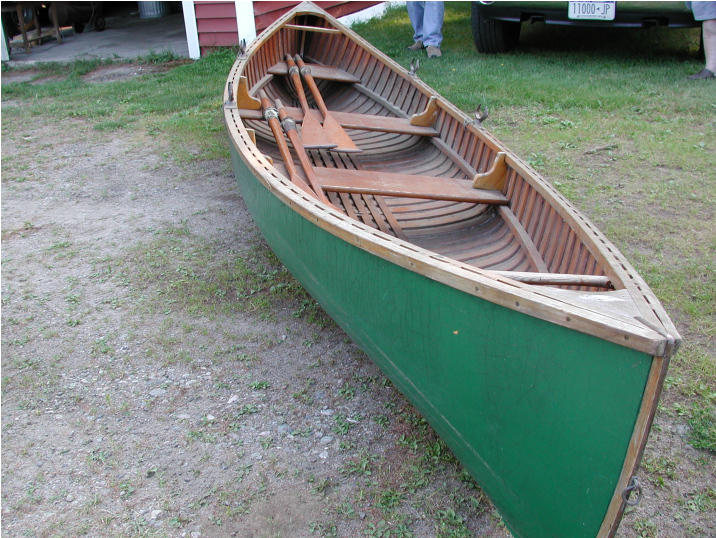 A 15’ Old Town Rowing Canoe
One of Joe’s unfinished books was to have been the narrative of his life in the many boats — cutters, sloops and a schooner — that he had owned and sailed over the years. All but the last were built of wood, and usually well-used when he bought them. He lovingly cared for them and sailed them each season from the first warm days of spring until late into the autumn. They were moored just off Black Bess, where he could admire them from the porch when he wasn’t sailing them, in Gloucester waters and beyond.
Joe’s next-to-last boat, acquired in 1986, was March Hare, a 23-foot wooden cruising sloop, designed jointly by famed yacht designers William Atkin and Starling Burgess. She was built in Long Island and launched in 1932. She had an unusual “turtleback” hull design, the ribs forward of the cockpit completely encircling the hull and the rounded cabin top. The standing rigging was also unusual, a forestay and two single shrouds. No spreaders, no backstay. Below decks there were four narrow bunks with sitting headroom, a sink and a head. A diesel inboard engine provided power.
One hot summer day in 1987, Joe invited me for a sail on “The Hare.” By the time we had rowed out to the boat, set sail and cast off the mooring, the breeze had dropped to about 5 knots. By the time we reached mid-harbor, it was almost undetectable.
But something was odd: March Hare didn’t seem to notice the flat-ass calm at all. Instead she heeled gently over onto the starboard tack, and glided confidently out to sea past the Dog Bar. The sails obligingly bellied out, water gurgled pleasantly along the hull, a frothy wake trailed off astern in a nice straight line.
“Joe”! I exclaimed, “this is incredible! If only there was another boat like this!”
“But there is,” said he. “Another one is advertised in WoodenBoat, for $5,000. It’s out of the water, in Scituate.”
As soon as I was home, I turned to the magazine, and there she was: Jabberwock, almost identical to March Hare except for the foredeck, which held a more traditional boxy trunk cabin, rather than the turtleback. The Alice in Wonderland-named boats were apparently two of a fleet of at least three; Atkins and Burgess’s first boat was named Dormouse. Surely there was also a Mad Hatter somewhere if still afloat, and perhaps more similarly named sister ships. A Walrus? A Carpenter?
I called Jabberwock’s owner, who told me where to find the boat. “She’s in fine shape,” he told me. “Sailed her everywhere, from Long Island Sound to East Quoddy Head. Wonderful, fast cruising boat.” The liar.
My wife Joy and I drove to Scituate and found the boatyard. The yard owner looked at us with a wry smile; it was clear no one else had been looking at Jabberwock in quite a while, and we soon saw why. There was probably a hefty yard bill.
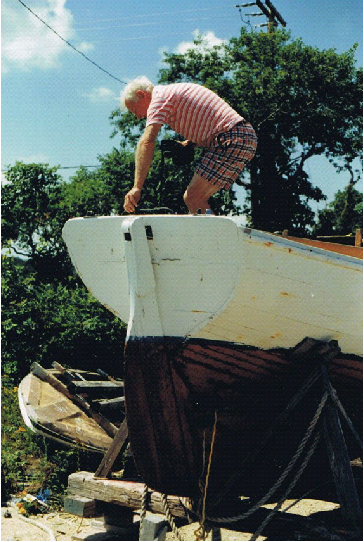
The boat sat forlornly in an old cradle. She had obviously been there for several hard winters. Remains of a blue tarp hung in tatters over the cradle; there were big gaps between several butt joints and a large hole in the stem timber. A knife went into the stern post like butter. The forward hatch cover had blown off; the rudder hung precariously from a single remaining screw. What little varnish was still on the brightwork fluttered from it in long peeling strips. Rust stains dribbled down the topsides from every bunghole. Below decks, the bunk cushions were soaking wet, and the bilges contained a brew of rainwater, paint, empty bottles, an old chart, and a half-empty can of spar varnish; the other half had also spilled into the bilges.
The mast, boom, tiller and engine had been removed and stored under cover. The spars looked somewhat better, but the engine looked tired. “To hell with it,” I told Joy. “Too far to go.” “Well —,” she said. Uncharacteristically, she obviously liked what she saw more than I.
We drove home and I reported the bad news to Joe. “It can’t be that bad,” he said. “Let me have a look at her.” Joy chimed in, “I really liked that boat.”
So it was back to Scituate the next day, with Joe. He climbed up on Jabberwock’s deck, squinted along the sheer and waterline, thumped a plank or two, and said “She’s in great shape. You really ought to get her.”
We drove home. I called the owner. “You have ruined a beautiful boat,” I snarled at him. “You should be ashamed. How can you ask five thousand dollars?” Then, I don’t know what came over me, as I asked, “Will you take two”?
“Sure,” he replied in an instant, and I began to think I should have said “two hundred,” instead of “two thousand.” But it was clear he had enough to cover what must have been a healthy yard bill.
A few days later, I glumly followed behind a boat trailer, watching Jabberwock suffer each jarring bounce as the trailer bumped at high speed over every rut and pothole between the South and North Shore. At dusk we arrived home, and set up the boat on jack stands in our back yard.
For the next fourteen months Joy and I labored over Jabberwock, with much expert help from Larry Dahlmer, Leon Poindexter and Steve Waldron, and sage advice from Joe. We repaired the stern post, replaced planks, butt blocks, and floor timbers, replaced hundreds of screws, bunged and planed off each screw hole, fashioned a new keel bolt out of a bronze propeller shaft and installed it, repaired and installed the engine, replaced dubious turnbuckles and chain plates, replaced all the running rigging, scraped, sanded, varnished, caulked and painted. Joy spent a long day painting below decks and cutting in a neat blue boot stripe.
At last, on October 14, 1988, we hauled Jabberwock to Hank Bornhofft’s yard at the head of the harbor, slung her in the travel lift, and lowered her gently into the ocean. Joe and Helen were on hand for the launching. We stepped the mast, bent on the sails, and watched for the next day and a half, as water poured into the boat through every seam, and gushed back out through a new bilge pump. But eventually the planks swelled, the gush slowed to a trickle and finally stopped, and it was clear Jabberwock would swim.
After a trial sail or two I called Joe to see how the two boats compared. We met on a sparkling November day off Black Bess, beat across the Harbor on a port tack, ran down to the Cut, jibed, reached up the Harbor as far as Smith Cove, reached back to Stage Fort, beat back to the end of Dog Bar on a starboard tack, and ran back downwind to Black Bess.
Jabberwock beat March Hare on every point of sail. Joe graciously said, “It’s clear who’s the better skipper.” “No, no,” said I, “You’re the better skipper, but my boat has a cleaner bottom, and you’ve been in the water all summer.” So in the end we agreed we were both great skippers, and both had great boats. But I never did figure out how March Hare could have sailed so beautifully that windless summer day. Must have been that magic Garland touch.
— Tom Halsted
October 1, 2011
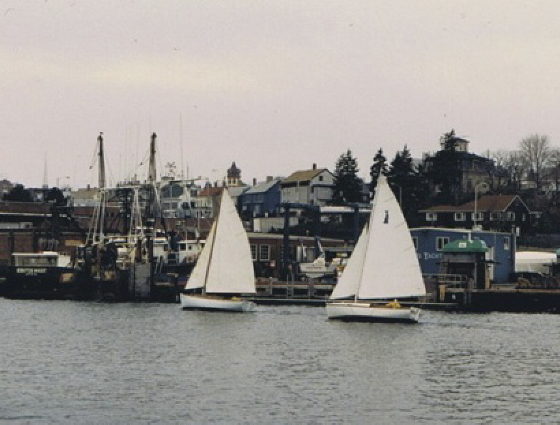
Jabberwock Leads March Hare, November 18, 1988
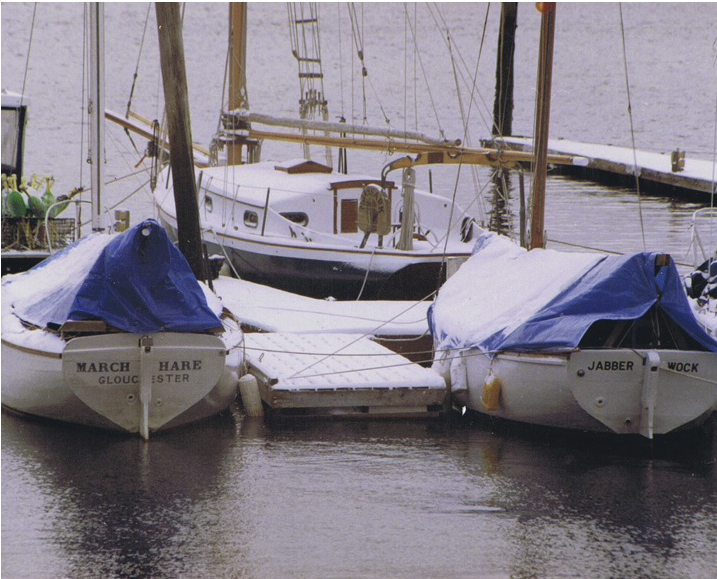
March Hare and Jabberwock, Winter 1989

You know what the sign in the office of The Schooner Lannon says?-
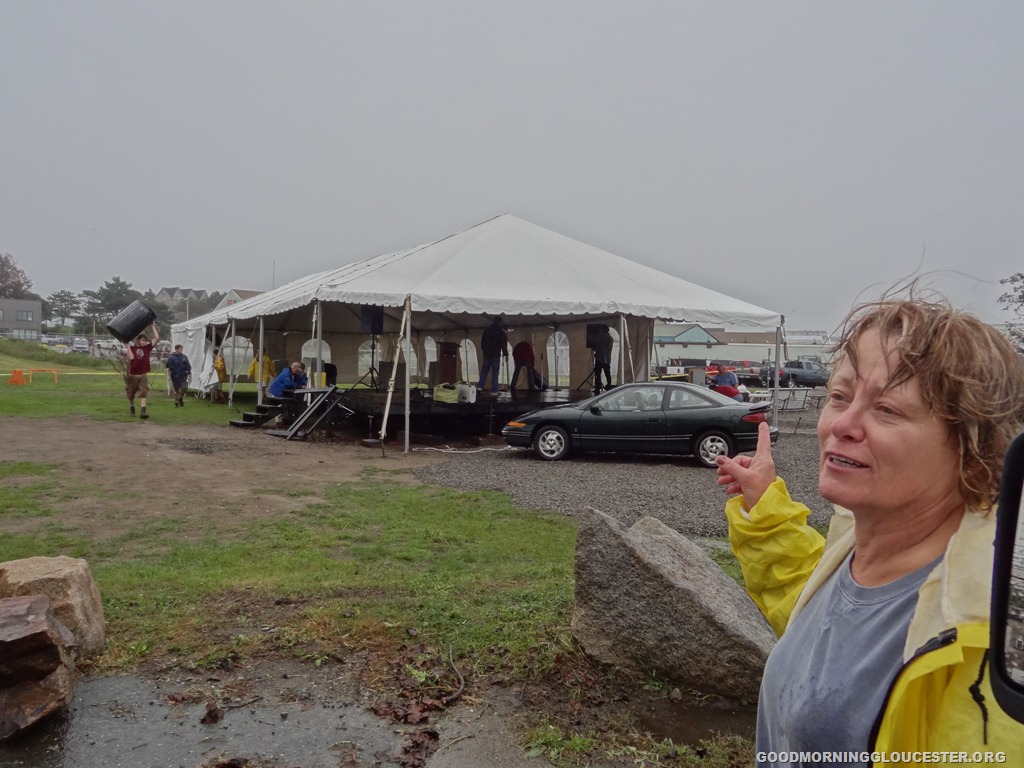
“There’s no such thing as bad weather. Only inappropriate clothing”

Video Below- Manny Simoes
and Click Here For the Updates Throughout The Day

Video Greasy Pole Being Towed Through Gloucester Harbor from Paulie Walnuts-
From DiscoverGloucester
we will be updating all day
I reached out to Mayor Kirk this morning for a statement about the greasy pole.
Here is her response.
The Greasy Pole will be rebuilt. I have already met with members of the Fiesta Committee this morning and assured them the city will be their partner. It will take a community effort though. We need the Fiesta Committee, the Waterways Board and the city to all step up to the financial challenge. The Greasy Pole represents a tradition and culture that we cherish in Gloucester, and we won’t let it vanish.
Regards, Carolyn Kirk Mayor
Donna Ardizzoni Photos-

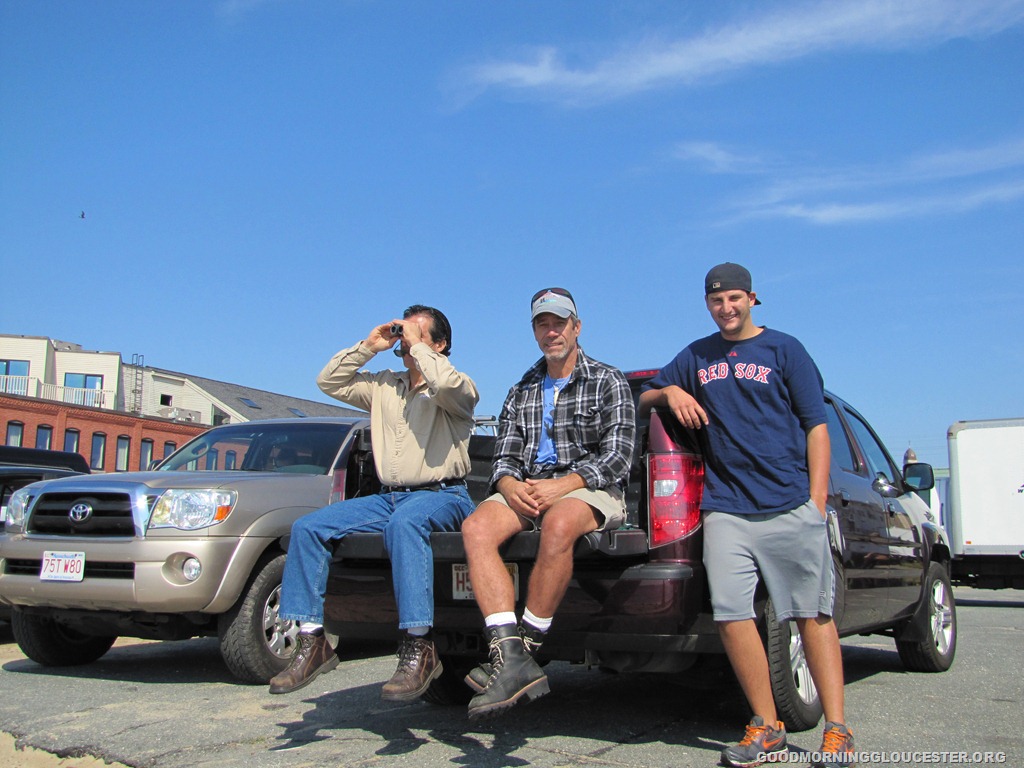
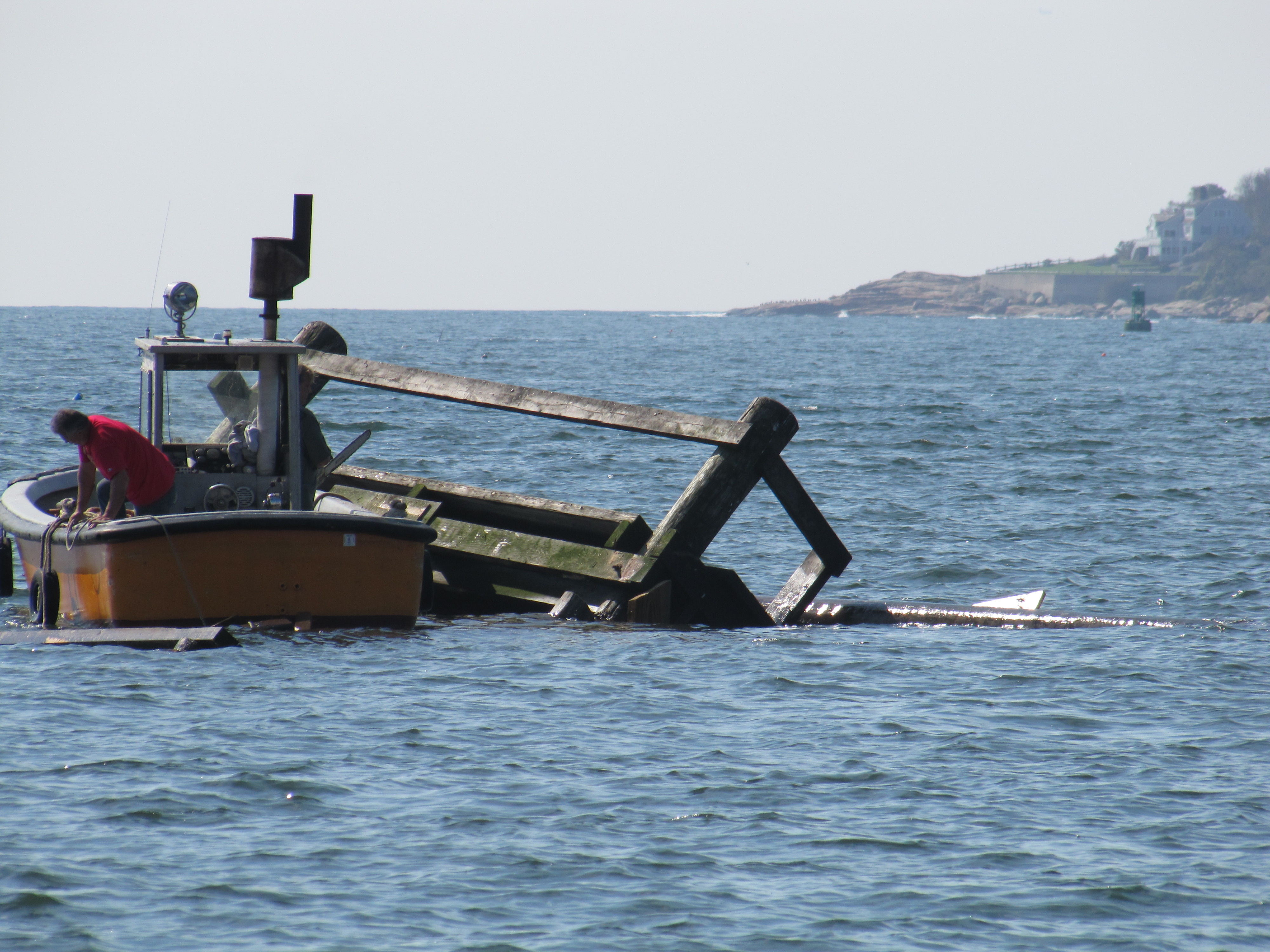
Greasy Pole Being Hauled Out Of The Water At Rose’s Marine From Paulie Walnuts
Another angle from Rob Foley
So proud of our team!
You guys are the best. I wouldn’t trade any one of you for anyone else. Great work on bringing this critical story to our readership and the world.
GMG Takin’ No prisoners!!!!
#boomthatjusthappened

September 28th, 2011
Eloise and Madeline Send Monarch to Mexico
Brianmoc writes-
Fishing Off Gloucester MA for blue fin tuna is becoming fun. This is the second Fish out of three trips but its not easy. The captain of this boat has been a quick study and thanks to that we got this 275 pound Blue fin that only took 50 min to get in. This shows the how to fish for blue fin tuna are way so in enjoy.
The Kindle Fire Color Tablet is going to sell like hotcakes.
The Amazon Fire Tablet is going to be this year’s Zhu Zhu Pet and Past year’s Cabbage Patch Doll. The thing where everyone will be killing themselves to get and there won’t be enough to go around creating a frenzy to get them. you heard it here. Sepember 28th, 2011. Write it down.
It’s brilliantly priced for people who don’t have to do everything an iPad can do or as seamlessly. Also there are more pixels than the already fantastic iPad screen?
This will sell well, really well for all those folks who can’t justify an iPad at the same price of a decently spec’d laptop.
You can and should pre-order one for Christmas presents if you don’t want to spring ALL the money for an iPad.

Display
7″ multi-touch display with IPS (in-plane switching) technology and anti-reflective treatment, 1024 x 600 pixel resolution at 169 ppi, 16 million colors.
Size (in inches)
7.5″ x 4.7″ x 0.45″ (190 mm x 120 mm x 11.4 mm).
Weight
14.6 ounces (413 grams).
System Requirements
None, because it’s wireless and doesn’t require a computer.
On-device Storage
8GB internal. That’s enough for 80 apps, plus either 10 movies or 800 songs or 6,000 books.
Cloud Storage
Free cloud storage for all Amazon content
Battery Life
Up to 8 hours of continuous reading or 7.5 hours of video playback, with wireless off. Battery life will vary based on wireless usage, such as web browsing and downloading content.
Charge Time
Fully charges in approximately 4 hours via included U.S. power adapter. Also supports charging from your computer via USB.
Wi-Fi Connectivity
Supports public and private Wi-Fi networks or hotspots that use the 802.11b, 802.11g, 802.11n, or 802.1X standard with support for WEP, WPA and WPA2 security using password authentication; does not support connecting to ad-hoc (or peer-to-peer) Wi-Fi networks.
USB Port
USB 2.0 (micro-B connector)
Audio
3.5 mm stereo audio jack, top-mounted stereo speakers.
Content Formats Supported
Kindle (AZW), TXT, PDF, unprotected MOBI, PRC natively, Audible (Audible Enhanced (AA, AAX)), DOC, DOCX, JPEG, GIF, PNG, BMP, non-DRM AAC, MP3, MIDI, OGG, WAV, MP4, VP8.
Documentation
Quick Start Guide(included in box); Kindle User’s Guide (pre-installed on device)
Warranty and Service
1-year limited warranty and service included. Optional 2-year Extended Warranty available for U.S. customers sold separately. Use of Kindle is subject to the Kindle License Agreement and Terms of Use.
Included in the Box
Kindle Fire tablet, U.S. power adapter (supports 100-240V), and Quick Start Guide.
$199.00 Free Super Saver Shipping
Pre-order now to reserve your place in line
Our all-new Kindle Fire will be released on November 15, 2011. Orders are prioritized on a first come, first served basis.
Ships from and sold by Amazon Digital Services. U.S. only.
Movies, apps, games, music, reading and more, plus Amazon’s revolutionary, cloud-accelerated web browser
This thing has more pixels than the iPad at less than half the price? If anyone has seen the iPads gorgeous screen you know that’s a big deal. The thing will play windows videos as well as mac videos and best of all it supports Flash, so all those flash based sites you can’t access on an iPad, you can on the kindle Fire.
If they were both the same price I’d buy the iPad all day long but when you take that $200 price into account it’s tough to beat for value.
My prediction, when you want to buy one, for Christmas present’s they will be so backordered you probably won’t be able to get one.
Best move is to put in a pre-order for one ASAP and even if you change your mind you can cancel the order before November but best case scenario is you sell it for double on eBay to someone who desperately needs one to give as a Christmas present.
There’s no way they produce enough for the demand at that price point.
A laptop and/or pc replacement for $200 and will do everything that 90% of people need it to do.
Is it a replacement for a power user? Obviously not, but power users only make up 10% or less of the marketplace IMO and the Kindle Fire will capture the other 90% of the marketplace’s needs. This would be PERFECT for my mom, my wife, my nephew or niece, my sister, just about anyone whose computing use is 90% Facebook and 10% web browsing.
No-Brainer as my boy Patrick Ryan said to me earlier.

For More Info Chickity Check- RockportArtFestivals

Posted on September 22, 2011 by nubar
The 45 foot Schooner Ardelle was built at Harold Burnham’s Boat Yard in Essex, Massachusetts. It was launched in Essex on July 9th at high tide almost one year after Harold and friends began building her. (More about the Ardelle below).
What you see here are stills and HD footage all shot with the iPhone4. This is not an edited piece. Instead, I’ve inserted a panorama of the boat to open the piece which was shot in December, 2010. A couple of HD clips from the launch come next, followed by a few clips of her maiden voyage from Essex to Gloucester. It ends with a still image of her in Ipswich Bay (My godson and I were out fishing early that morning. Didn’t find the fish, but we saw this image of the Ardelle making her way to safety before Hurricane Irene arrived).
Large school of Atlantic white-sided dolphin off coast of Gloucester MA. Dolphin are as curious about people as some people are about them. They like to eat, play (riding bow and stern waves), and get bored quickly. Sound familiar?”
– Courtesy Eric Swanson Gloucester resident




 Good Morning Gloucester