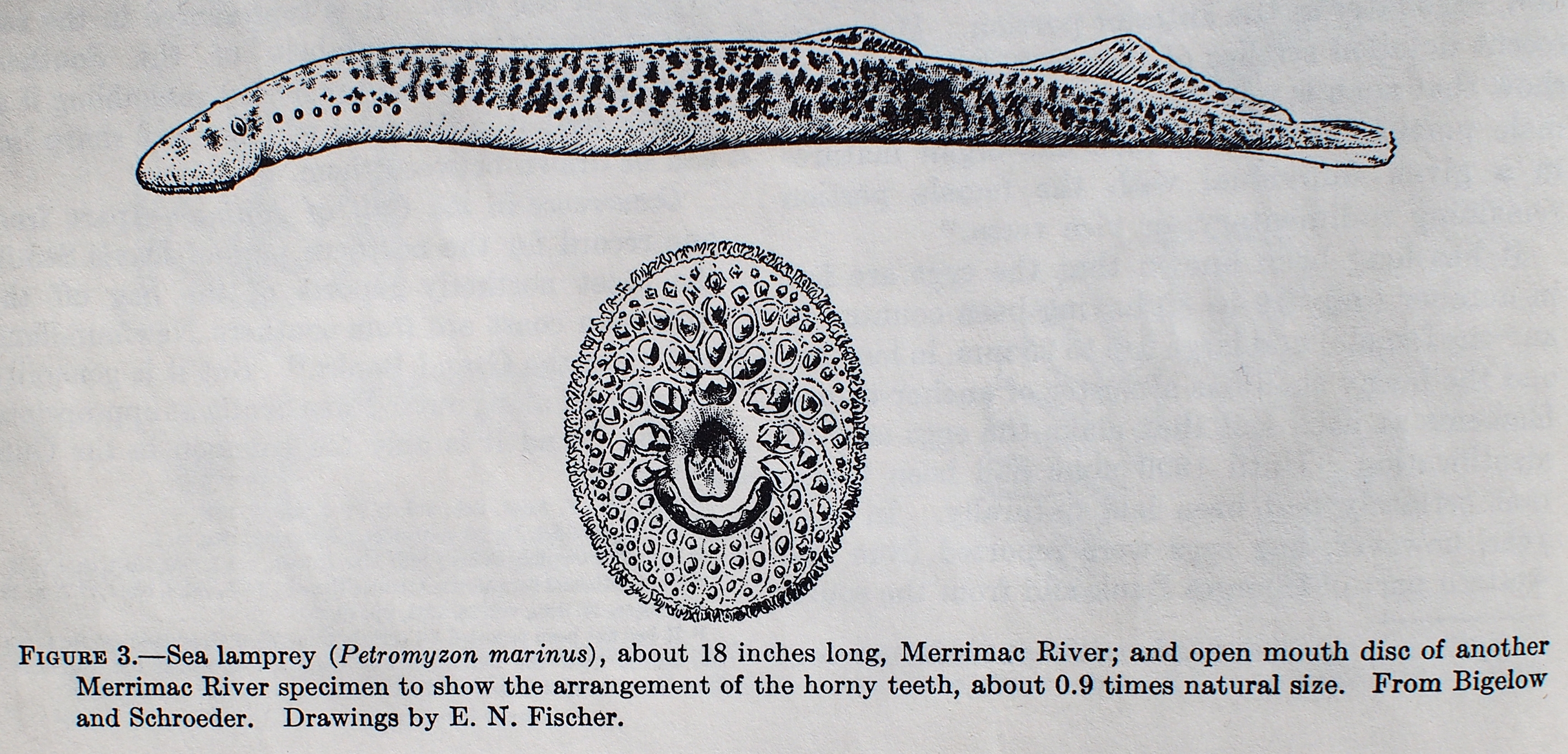
LAMPREY; SPOTTED LAMPREY; LAMPER; EELSUCKER
Lampreys were esteemed a great delicacy in Europe during the middle ages (historians tell us Henry I of England died of a surfeit of them)
Little is known of the habits of the lampreys while they live in the sea further than that their mode of life centers around a fiercely predaceous nature. Judging from their land-locked relatives and from the occasions on which they have been found fastened to sea fish, they must be extremely destructive to the latter, which they attack by “sucking on” with their wonderfully effective mouths. The lamprey usually fastens to the side of its victim, where it rasps away until it tears through the skin or scales and is able to suck the blood. Its prey sucked dry, it abandons it for another. Probably lampreys are parasites and bloodsuckers pure and simple, for we cannot learn that anything but blood has been found in their stomachs, except fish eggs, of which lampreys are occasionally full.
From Fishes of the Gulf of Maine by Bigelow and Schroeder (1953) online courtesy of MBL/WHOI http://www.gma.org/fogm/Petromyzon_marinus.htm


 Good Morning Gloucester
In the late 1800s and early 1900s, improvements to the Welland Canal, which bypasses Niagara Falls and provides a shipping connection between Lakes Ontario and Erie, allowed sea lampreys access to all the Great Lakes beyond previously infested Lake Ontario.
Sea lampreys have had an enormous, negative impact on the Great Lakes fishery, inflicting considerable damage. Before the sea lamprey invasion, Canada and the United States harvested about 15 million pounds of lake trout in the upper Great Lakes each year. By the late 1940s, sea lamprey populations had exploded. They fed on large numbers of lake trout, lake whitefish, and ciscoes—fish that were the mainstays of a thriving Great Lakes fishery. By the early 1960s, the catch had dropped dramatically, to approximately 300,000 pounds, about 2% of the previous average. During the time of highest sea lamprey abundance, up to 85% of fish that were not killed by sea lampreys were marked with sea lamprey attack wounds. The once thriving fisheries were devastated, and along with them, the hundreds of thousands of jobs related to the region’s economy.
http://www.glfc.org/sea-lamprey.php
LikeLike
Some success in controlling Great Lakes sea lampreys …
http://ijc.org/greatlakesconnection/en/2017/06/sea-lamprey-greatest-invasive-control-success-story/
LikeLike