Since I’ve started contributing to GMG there’s been a particular hot topic that seems to come up every so often…so today, I took that topic to the streets.
Actually, not so much to the streets, as to the classroom.
Joey has referred to it as “The Pussification of Sports”….I chose to not use that term in the classroom today. But, I was very interested in what my students would have to say.
The hot topic in question has centered around the belief that some parents have that all kids should be praised, rewarded, celebrated, and applauded equally no matter how they play or contribute (or don’t contribute) to the team’s success. Don’t go all nutty here about the word “success” and how it should be measured. I realize that a team’s success could just as easily be measured by the number of laughs the kids had or the great team morale…or even because of an injury free season. But, for the sake of playing devil’s advocate, let’s say that just for a second, we’re measuring the success of a season by the “Win vs. Loss” column. Is it OK to single out players who excelled? Is it OK to acknowledge those who gave 110% all season long? Is it OK to determine that one kid’s talents and abilities are clearly above the rest? Is it OK to give awards for things like MVP? Or Most Improved? Or by naming one kid the Captain?
Some parents will say that hurts feelings. Some parents will say, “There’s no I in Team” and each player is equally important. Singling out the “better” players is wrong…and not fair. Other parents will say that in the college or professional sports we have things like captains, MVPs, Golden Glove Award winners, Heisman Trophy awards, Cy Young Awards, the coveted Master’s Green Jacket, or the Tour de France yellow jersey. And what about Gold Medals? Parents from the other side would clearly retort, “But our kids aren’t playing professional sports….these are just little kids.” Fair enough.
FYI…the same conversation has been happening in academics. Who remembers this story from last year? It isn’t fair to give Awards of Academic Excellence to just some students! It will hurt other kids’ feelings. Oooh, Oooh, Oooh……OooooR, I have an idea….it just might motivate them to work harder. Or to put energy into something that they excel at or have a passion for. Maybe they’ll never be top of their class, but maybe they become motivated to paint more, or write more poetry, or practice more piano, or donate time to a worthy cause, or think outside the box. Because, really, being top of the class isn’t everything, but those kids do deserve their academic merit awards…and hopefully other children will find their own way to shine…or at least feel good about themselves! Just Saying. (Darn..I wasn’t going to offer my own opinion…but it got away from me for a minute).
The sports question came up mid October in the Boston Globe when Globe Columnist Thomas Farragher wrote, “Put Our Kids In, Coach”. And then Sports Columnist, Bill Speros (Obnoxious Boston Fan), countered with “There’s a Reason Why Your Kids Aren’t Playing – They’re Not Good Enough” on Boston.com.
So, when, if your child has decided to become part of a sports team, should you expect that the Direct Goal is a winning season and the Indirect Goals (added bonus) would be that all the kids have fun, learn about team work, get some exercise, learn a bit of stick-to-it-ness, and maybe gain some discipline. I ask that seriously. What is the “correct” age for the transition. I mean clearly Professional Sports are concerned about THE WIN. Safe to say College Sports are too. I’d even dare say, High School sports would rather win than lose…even if that means some players didn’t get a chance to touch the ball. So, when should a child be prepared for less playing time or smaller (or no!) trophies unless they’re the high scorer, most valuable, etc.?
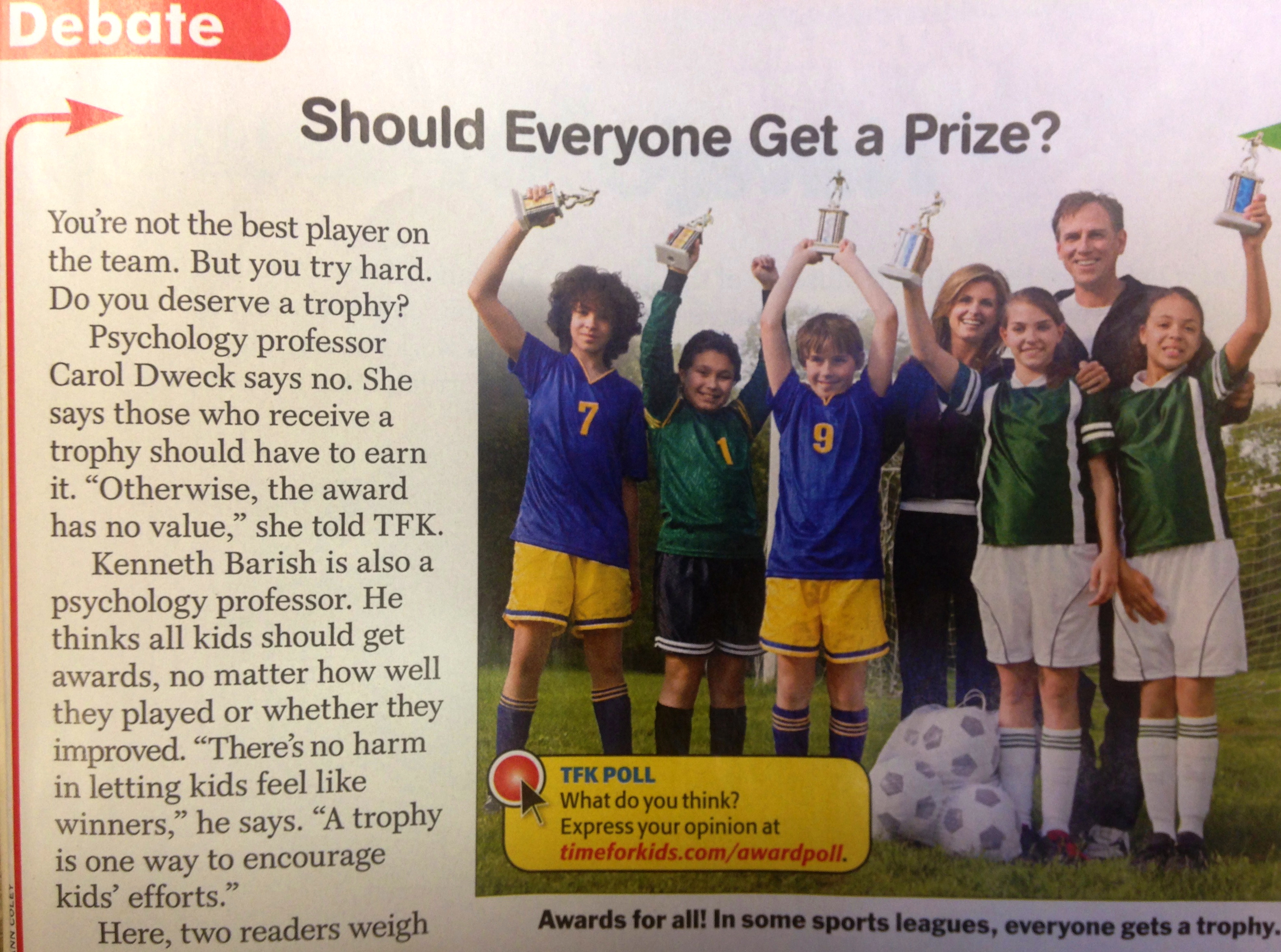
Well, those questions may have been too abstract for my 3rd grade students today. So, with the help of Time For Kids Magazine, we explored this question instead.
“Should everyone get a prize or is it OK to acknowledge just the “best” players?”
My students had some pretty interesting and wise things to say. At first the majority quickly thought, “Yes, everyone should get a trophy for being part of the team” but then we started discussing it a bit. Some interesting “what ifs” came up. I won’t try to wax poetically about our whole debate, but some of the key points became:
What if one player plays well, but has really poor sportsmanship?
What if one player plays well, but never shows up to practice, doesn’t try much until its a game situation, and doesn’t act like a part of the team?
What if a player isn’t so great, but supports all of his/her teammates, tries really hard, takes advice, works on skills, never gives up?
After some back and forth, my students decided that all members of a team (up until High School) should receive acknowledgement and, ideally, a really cute little trophy…or at least a ribbon and a certificate 🙂 BUT…then, in addition, the “best” or “hardest working” or “most helpful teammate” players could all get bigger and more special awards. Their words, not mine. Aren’t they cute!?
So, I’ll ask you too.


In the real world in most industries these days, things are collaborative. For instance, at Apple it would be insane to reward the people who wrote the code but not the one’s who designed the user interface. But what about the bug fixer? What about the materials sourcer? Bench testers? In much of the real world, effort is increasingly teams not individuals. The Nobel science prizes are not given to individuals anymore, but to teams (two guys won for their graphene work a year or two ago, but that’s a rarity. When the LHC wins, it could be more than a hundred people). So I think the question that seems to imply a choice between rewarding “everyone who shows up” and “the outstanding performers” is flawed. Yeah, Steve Jobs gets a different kind of reward than the code compiler, but if Apple is smart it will learn how to reward both appropriately. That’s what we’re struggling with as a culture, I feel.
LikeLike
I like the idea of younger kids (up to middle school) getting little trophies because we want to encourage them to play sports and maybe with them we should emphasis teamwork and good sportsmanship and give out an award to the player who exemplified those attributes the most so it’s not about physical ability. Starting in middle school there are captains and mvps and awards and in high school better players should also be recognized – and most kids still get their letters even of they don’t get mvp so it is ok to acknowledge participation as well but when a kid goes the extra mile they deserve to be recognized for it. But if they all get awards and accolades for every little thing they do they will have a tough time in college and the real world. Too many kids in college feel like the deserve an A just for showing up and the kids who actually work really hard are the ones who deserve A’s and they deserve not to have them cheapened.
LikeLike
I guess I am the odd ball out my feeling after all the years of sports is the trophies championships-playoff’s etc always stay with the entire team like your old high school or Jr High-College in a display case. Certificates were given for MVP or Most valuable player, and other trophies to aim for, but the trophy and letter sweater’s had the devices for the year.
My first year at Ward 7 I always felt part of the team we had great coaches and support that support and looking at folks yelling and watching made it so great family and friends…in both good and bad seasons they were their!
Everyone holds the team together and like a band of brother’s or sister’s we travel the path together to reach our goals!
Enjoy the song says it all!!!
Peter, Paul and Mary – Right Field (25th Anniversary Concert)
Dave 🙂 Kim:-)
LikeLike