April 2024.
Turning back around


My View of Life on the Dock
April 2024.

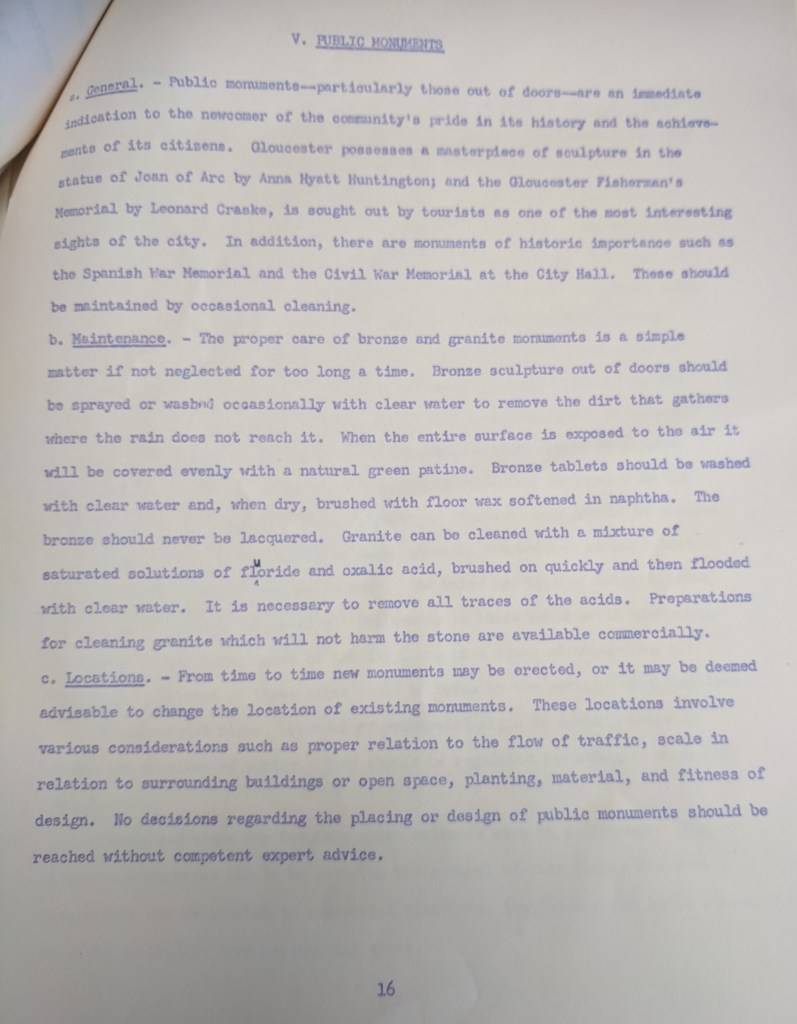
American sculptor Walker Hancock volunteered in many civic capacities while a Gloucester resident. While serving as the Chair of the city’s Art Committee in the 1950s, Hancock prepared a Master Plan that managed to forecast an array of evergreen topics: land use, zoning, preservation, open space, Main Street & downtown, public monuments, an arts commission, city improvements (like signage), beautification (trees and blooms), health & safety, tributes, and history– and all through a practical cultural and economic vision.
Robert F. Brown, Harold C. Dexter, Myron U. Lamb, Frederick H. Norton served on this committee with Walker Hancock.

As a World War Two Monuments Men leader, Hancock had overseen the prioritization, protection, and eventual inventorying of tens of thousands of cultural works of significance looted by Nazis. A decade later, cataloguing Gloucester’s plentiful assets was a rather small job for this talented committee–especially with Hancock serving as Chairperson! A brief few sentences from this amazing document allude to his expertise:
“During the Second World War the Allied Expeditionary Force acted under a directive signed by General Eisenhower which required them “To take all measures consistent with military necessity to avoid damage to all structures of cultural, artistic, or historical value, and to assist wherever practicable in securing them from deterioration consequent upon the processes of war”.
To implement the directive of the Supreme Commander, lists of “Protected Monuments” were prepared, designating buildings of sufficient importance to justify the efforts to preserve them even during military operations. Many private houses were included in these lists.
We owe it to ourselves and to the Nation to be at least as solicitous in regard to our own heritage of such structures and to secure them wherever possible from deterioration consequent upon lack of appreciation or neglect.
Attached is a list of structures in Gloucester considered of sufficient architectural value to warrant special effort to preserve them. It is not a complete list and does not include many of the charming houses the destruction or mutilation of which would be a loss to the city as a whole…”
Committee’s Master Plan report (Chairman, Walker Hancock, for Gloucester, Mass., 1958)
Flash forward decades, from 2000-2023, multiple arts ordinances, inventories, and drafts of master arts plan were crafted and/or attempted. (Prior to 2000–and prior to Hancock– there were wonderful asset inventories. Gloucester has amazing archives!) I served on multiple arts related groups and commissions (roughly 2010-2018), the downtown Cultural District, Tourism, and various downtown working groups. Numerous ideas and topics now were covered in this 1958 report, and would have been extremely helpful to reference.
With the upcoming 2023 Comprehensive plan underway and the first public meeting coming September 9th, I thought the writing from 1958 would be of great interest. Read through to see what suggestions have been realized or incorporated and which might be worthy of attention again.
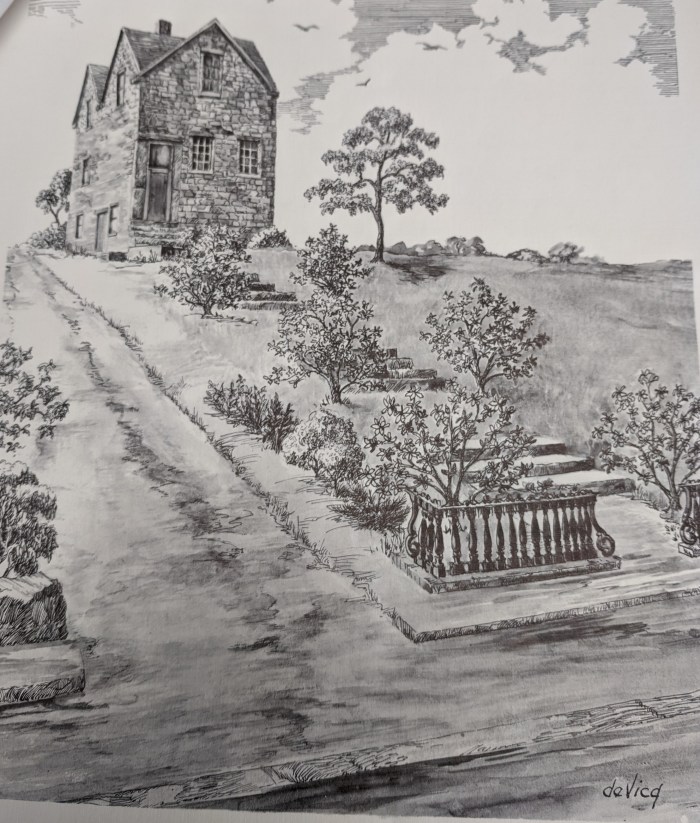
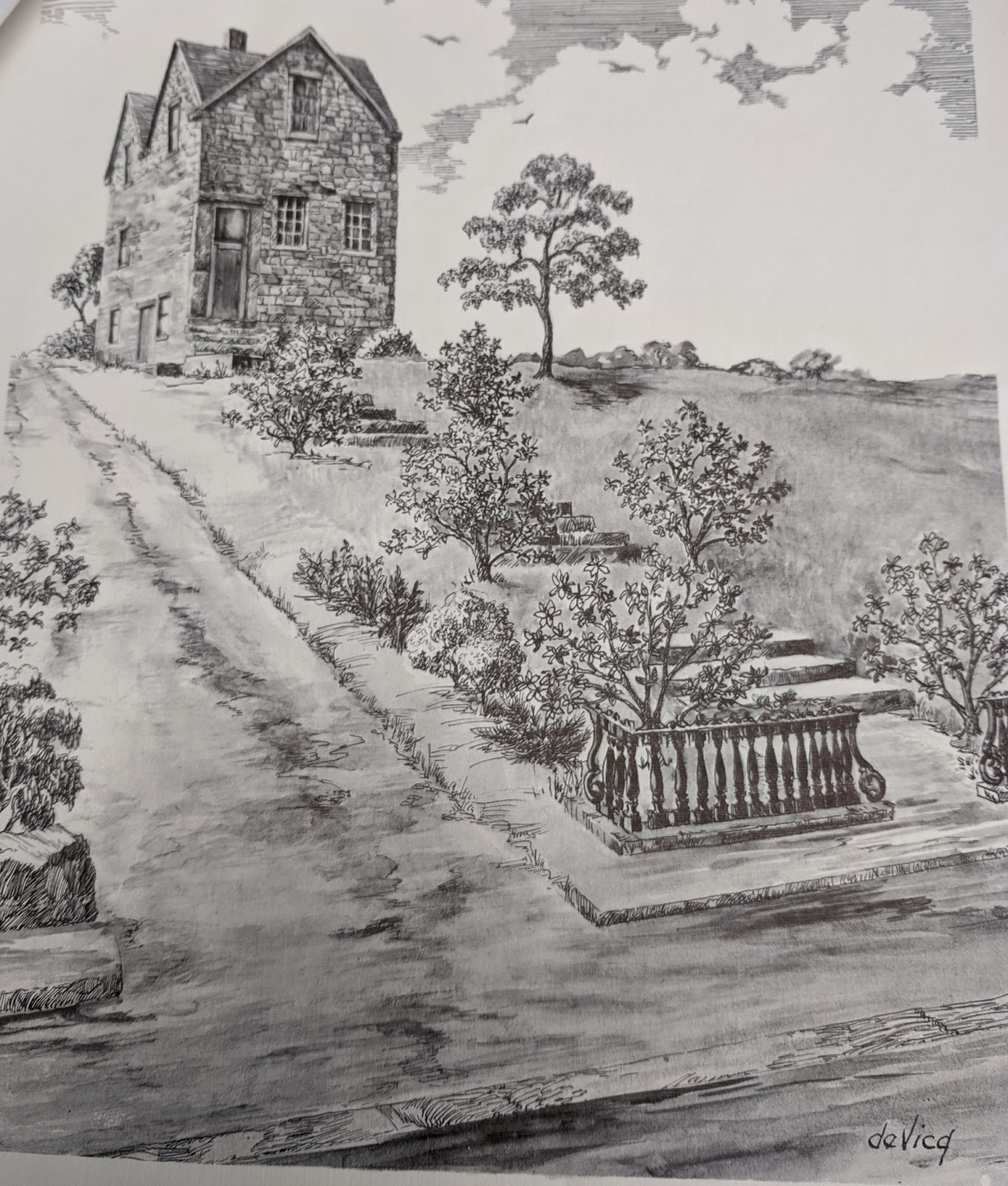
Image: For the 1958 report, artist Betty deVicq provided a rendering for a potential beautication of the Fitz Henry Lane House.
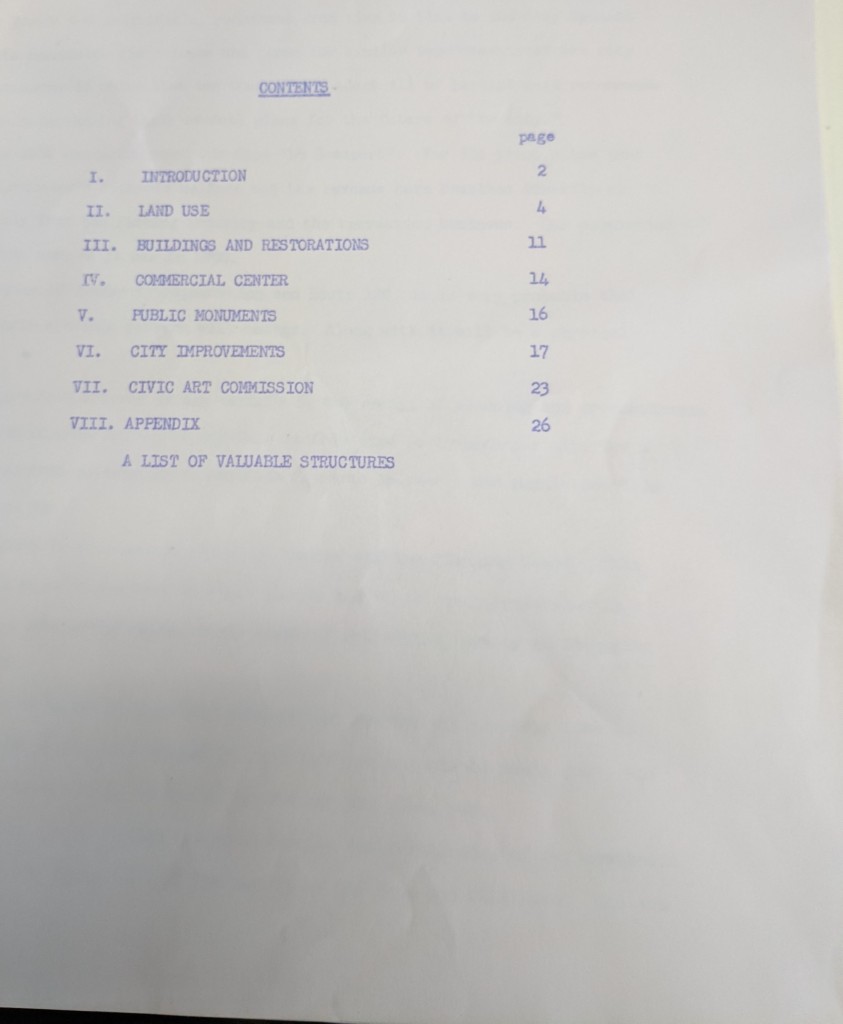
Contents
The following resolution was adopted on unanimous rising vote by the Municipal Council at its meeting in the White-Ellery House on August 1, 1957,
“Be it resolved that the Cape Ann Historical Association, together with other groups and individuals, recommend from time to time to the city Council and its successors their ideas and plans for similar improvements of the city of Gloucester in order that the Council may adopt all or part of said recommendations in furthering their overall plans for the future of the city.”
In 1606 Champlain named our Cape “Le Beauport”. For 334 years since that time Gloucester’s economic welfare and tax revenue have resulted directly or indirectly from the fishing industry and the recreation business. Our population now is the same as it was in 1890.
Because of modern transportation and Route 128, it is very probably that our historic economic pattern will change. Along with it will be a physical change.
The greatest success in any venture is the result of planning and preparedness. The most intelligent action we can take at this time is to plan our city for a changing economic pattern and a possible increase in year round population from 26,000 to 40,000.
Such plans revolve around the City Planner and the Planning Board. This report is to support the work of these people and to go one step further in a ld that is ordinarily beyond their scope of activities, but is an important adjunct to it.
Its purpose is to preserve and enhance the reasons why tourists come to Gloucester, why people will choose to live here and commute to their jobs, and many an industrialist would choose to locate his new plant here.
The subject can be called the preservation and furtherance of our aesthetic advantages, or the protection of the beauty we now have and will have. Its aim
is making the most of our natural beauties in contrast to the stereotyped and ugly procedures in other American communities.
The proposals contained in this report are based on two fundamentals: beauty and cost. Many can be adopted in the normal course of planning with no cost beyond that which would ordinarily be created, such as road signs. Others, such as a Recreation and Art Center, can be provided for as to location and adopted when cost permits. Some proposals can be adopted by the Council, some by private citizens.
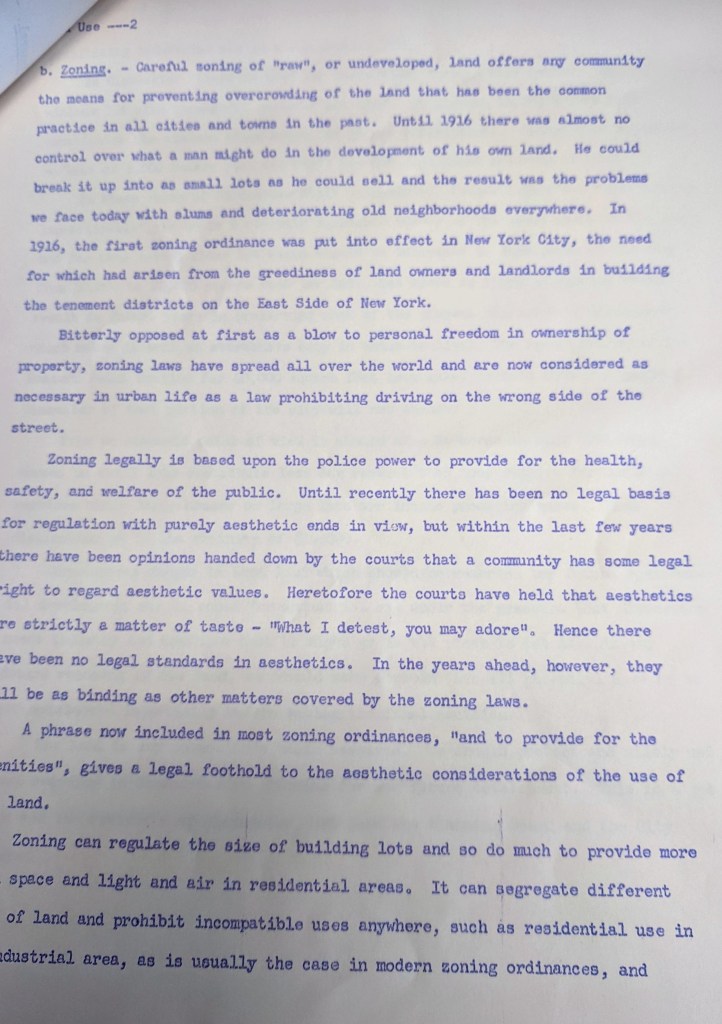
B. Zoning – Careful zoning of “raw”, or undeveloped, land offers any community the means for preventing overcrowding of the land that has been the common practice in all cities and towns in the past. Until 1916 there was almost no control over what a man might do in the development of his own land. He could break it up into as small lots as he could sell and the result was the problems we face today with slums and deteriorating old neighborhoods everywhere. In 1916, the first zoning ordinance was put into effect in New York City, the need for which had arisen from the greediness of land owners and landlords in building the tenement districts on the East Side of New York.
Bitterly opposed at first as a blow to personal freedom in ownership of property, zoning laws have spread all over the world and are now considered as necessary in urban life as a law prohibiting driving on the wrong side of the street.
Zoning legally is based upon the police power to provide for the health, safety, and welfare of the public. Until recently there has been no legal basis for regulation with purely aesthetic ends in view, but within the last few years there have been opinions handed down by the courts that a community has some legal right to regard aesthetic values. Heretofore the courts have held that aesthetics are strictly a matter of taste – “What I detest, you may adore”. Hence there have been no legal standards in aesthetics. In the years ahead, however, they will be as binding as other matters covered by zoning laws.
A phrase now included in most zoning ordinances, “and to provide for the communities”, gives a legal foothold to the aesthetic considerations of the use of land.
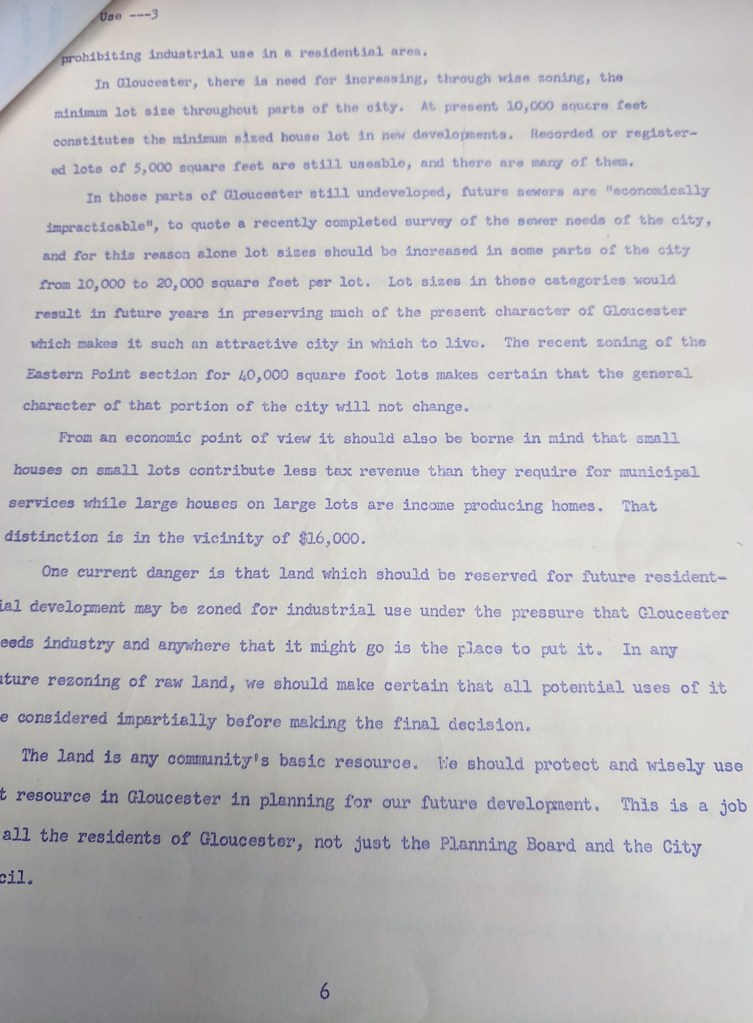
Zoning can regulate the size of building lots and so do much to provide more space and light and air in residential areas. It can segregate different use of land and prohibit incompatible uses anywhere, such as residential use in an industrial area, as is usually the case in modern zoning ordinances, and
Land Use – 3
Prohibiting industrial use in a residential area.
In Gloucester, there is need for increasing, through wise zoning, the minimum lot size throughout parts of the city. At present 10,000 square feet constitute the minimum sized house lot in new developments. Recorded or registered lots of 5,000 square feet are still usable, and there are many of them.
In those parts of Gloucester still undeveloped, future sewers are “economically impracticable”, to quote a recently completed survey of the sewer needs of the city, and for this reason alone lot sizes should be increased in some parts of the city from 10,000 to 20,000 square feet per lot. Lot sizes in these categories would result in future years in preserving much of the present character of Gloucester which make it such an attractive city in which to live. The recent zoning of the Eastern Point section for 40,000 square foot lots makes certain that the general character of that portion of the city will not change.
From an economic point of view it should also be borne in mind that small houses on small lots contribute less tax revenue than they require for municipal services while large houses on large lots are income producing homes. That distinction is in the vicinity of $16,000.
One current danger is that land which should be reserved for future residential development may be zoned for industrial use under the pressure that Gloucester needs industry and anywhere that it might go is the place to put it. In any future rezoning of raw land,
“we should make certain that all potential uses of it are considered impartially before making the final decision. The land is any community’s basic resource. We should protect and wisely use that resource in Gloucester in planning our future development. This is a job for all the residents of Gloucester, not just the planning board and the city council.”
1958 Committee Report for Gloucester, MA, Chairman Walker Hancock
Land Use – 4
A Citizen’s Council for city planning should be organized to work in consultation with the planning board to insure that the city’s comprehensive plan is in keeping with the best interests of the community, and to support the Planning Board in carrying it out. This council should be composed of a cross section of the various interests represented among the tax-payers of Gloucester, such as merchants, industrialists, real estate agents, home owners, educators, etc. Such a group, which should be as small as possible, consistent with balanced representation, would provide a democratic safeguard against infringements upon the best public interest.
C. Reservations.– The attractions that have made Gloucester famous a summer resort are not merely places for swimming and boating and other amusements. The appeal to the summer vacationist, as well as to people seeking an all year-round residence, of large areas of unspoiled woods, moorland, and shore without artificial “tourist conveniences” can hardly be overestimated. The existence on Cape Ann of such features has brought to our city great numbers of people who prefer them to the kind of tourist amusements offered, for example, by Salisbury and Revere beach. Our good fortune in having an established community of this character should be recognized in time to preserve it.
Fortunately, Ravenswood Park, Stage Fort Park, the Magnolia Shore Reservation, and Mount Ann have been saved for the future. Mr. Roger Babson’s recent gift to the Cape Ann Historical Association promises possibilities of making the main entrance to the city impressive, handsome, and of unusual interest to the tourist. Start has been made at Plum Cove by the action of the Municipal Council in setting the area aside for future use as a school site and recreational area. But these reservations would be far from adequate even for a city the present size of Gloucester were it not for the other open areas that will soon be lost to us unless some action is taken.
Land Use – 5
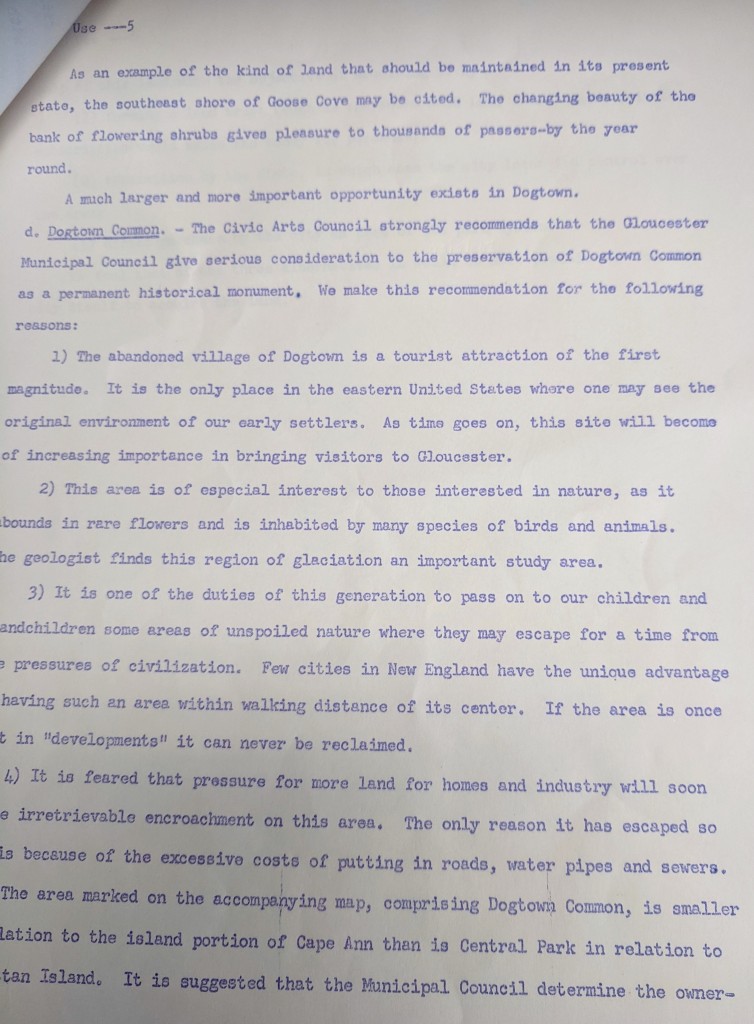
As an example of the kind of land that should be maintained in its present state, the southeast shore of Goose Cove may be cited. The changing beauty of the bank of flowering shrubs gives pleasure to thousands of passers-by the year round.
A much larger and more important opportunity exists in Dogtown.
D. Dogtown Common. – The Civic Arts Council strongly recommends that the Gloucester Municipal Council give serious consideration to the preservation of Dogtown Common as a permanent historical monument. We make this recommendation for the following reasons:
1)The abandoned village of Dogtown is a tourist attraction of the first magnitude. It is the only place in the eastern United States where one may see the original environment of our early settlers. As time goes on, this site will become of increasing importance in bringing visitors to Gloucester.
2)This area is of especial interest to those interested in nature, as it abounds in rare flowers and is inhabited by many species of birds and animals. The geologist finds this region of glaciation an important study area.
3)It is one of the duties of this generation to pass on to our children and grandchildren some areas of unspoiled nature where they may escape for a time from the pressures of civilization. Few cities in New England have the unique advantage of having such an areas within walking distance of its center. If the area is once in “developments” it can never be reclaimed.
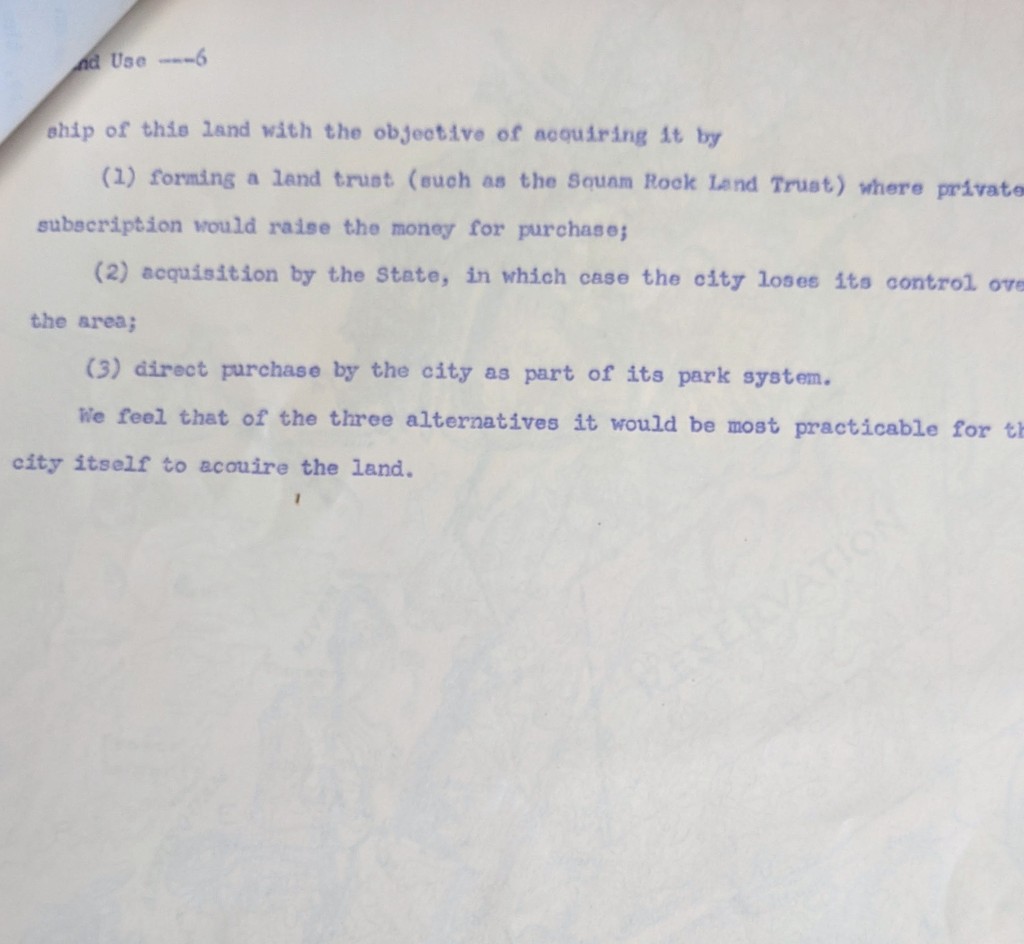
4)It is feared that pressure for more land for homes and industry will soon irretrievable encroachment on this area. The only reason it has escaped so far is because of the excessive costs of putting in roads, water pipes and sewers. The area marked on the accompanying map, comprising Dogtown Common, is smaller in relation to the island portion of Cape Ann than is Central Park in relation to Staten Island. It is suggested that Municipal Council determine the owner-
Land Use – 6
ship of this land with the objective of acquiring it by
(1)forming a land trust (such as the Squam Rock Land Trust) where private subscription would raise the money for purchase;
(2) acquisition by the State, in which case the city loses its control over the area;
(3) direct purchase by the city as part of its park system
We feel that of the three alternatives it would be most practicable for the city itself to acquire the land.
During the Second World War the Allied Expeditionary Force acted under a directive signed by General Eisenhower which required them “To take all measures consistent with military necessity to avoid damage to all structures of cultural, artistic, or historical value, and to assist wherever practicable in securing them from deterioration consequent upon the processes of war”.
To implement the directive of the Supreme Commander, lists of “Protected Monuments” were prepared, designating buildings of sufficient importance to justify the efforts to preserve them even during military operations. Many private houses were included in these lists.
We owe it to ourselves and to the Nation to be at least as solicitous in regard to our own heritage of such structures and to secure them wherever possible from deterioration consequent upon lack of appreciation or neglect.
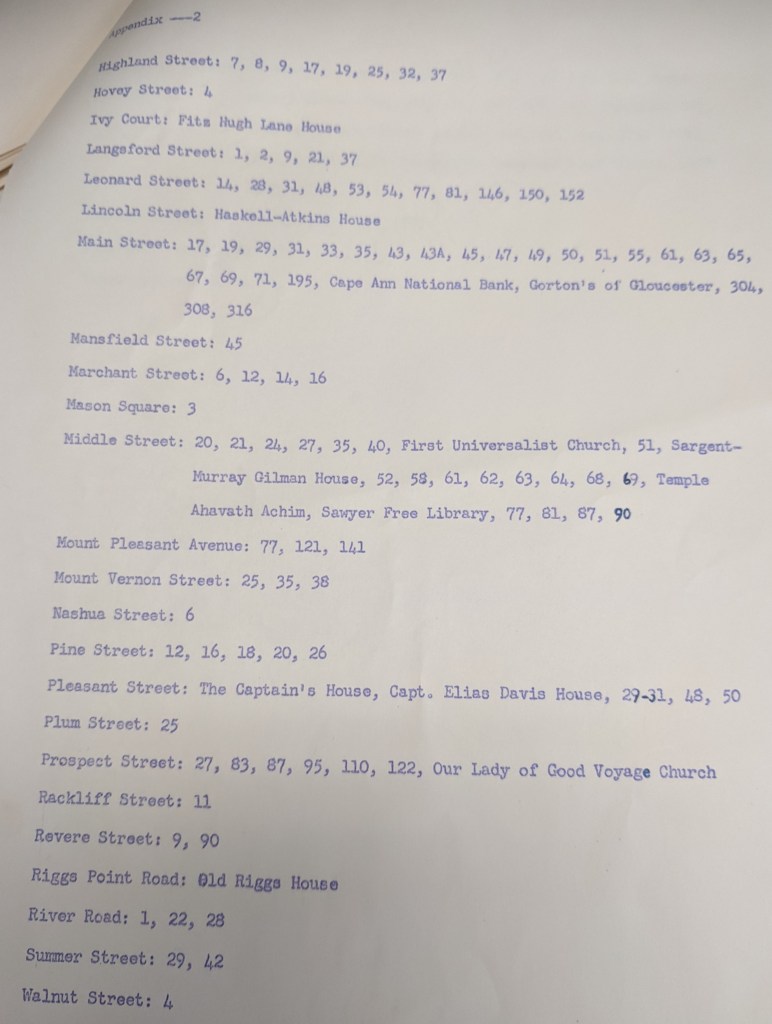
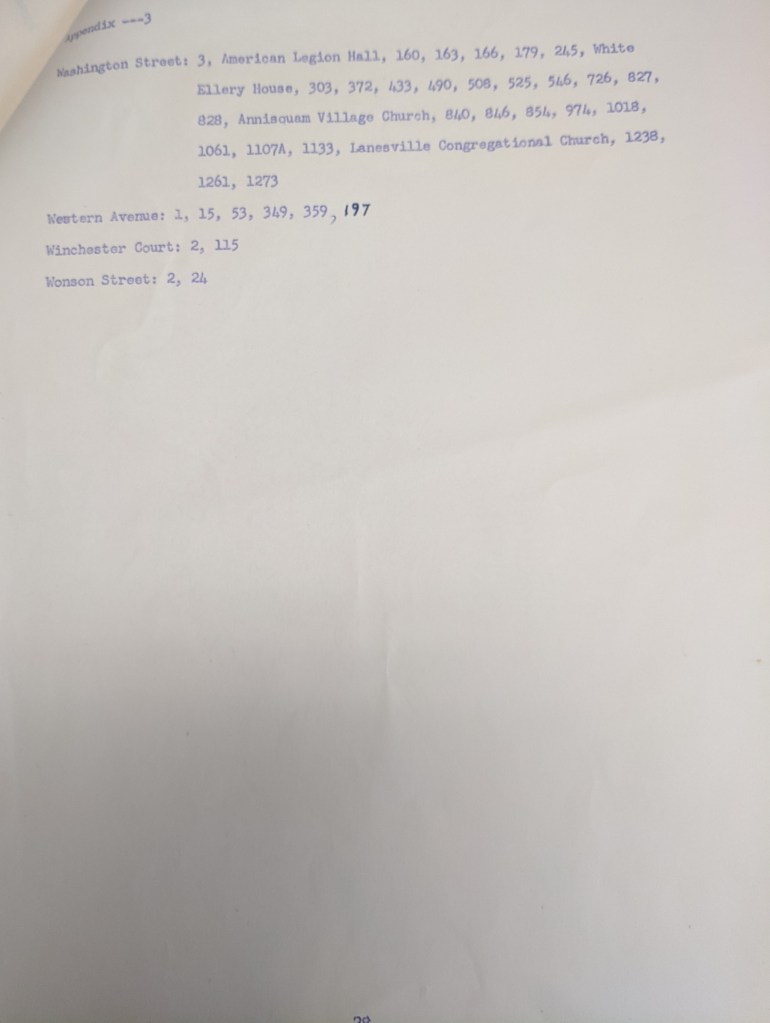
Attached is a list of structures in Gloucester considered of sufficient architectural value to warrant special effort to preserve them. It is not a complete list and does not include many of the charming houses the destruction or mutilation of which would be a loss to the city as a whole.
In the eyes of posterity the Universalist Church, the birthplace of Universalism, will undoubtedly be the most important monumental building that the city possesses. Its exceptionally fine proportions and detail and the great beauty of its tower make it one of the precious examples of American architecture of its period. The City Hall and the Church of Our Lady of the Good Voyage are both Gloucester landmarks of special significance–the former because of the impressiveness of its mass and dominant position which it occupies in the city, the latter because of its carillon, its twin towers, and celebrated statue. The towers of all three of these buildings have been made famous by countless paintings which are shown all over the country.
Gloucester has few residences of the architectural pretentious of many in Salem and Newburyport. Nevertheless, it contains many old houses that have a distinctive quality that contribute more than is generally realized to the
Buildings and restorations – 2
Character of the city . Many such houses have already been superficially spoiled. It would be possible to restore most of the houses that have been unwisely covered with substitute materials by the use of appropriate siding and painting. The Civic Art Committee holds itself ready to advise on the proposed alteration or restoration of any such building. The aid of this Committee is proffered in cases where community effort is needed to restore churches designated in the list by brining to the attention of citizens the importance of the project.
The west end of Main Street offers a remarkable opportunity for restoration that would give real distinction to the neighborhood near the Legion Hall and the Town Landing. The brick houses on the water side from Town Landing to the STrand Theater were built in 1832, the result of a friendly agreement between the families concerned to create an entire street front that should be harmonious. It would require only a similar public spirited move on the part of the present owners and a surprisingly small investment of money to put back street floor entrances and windows as they were originally and make the west end of Main Street an inviting section of the commercial district. If private initiative and means are lacking, some of the uses suggested for certain of these buildings are: a community art center, another club or meeting place, a fisheries museum – or the whole area might be revitalized as a shopping section. This is an opportunity that should not be wasted.
Enclosed is a sketch of the Fitz Hugh (sic) Lane House dominating a parking lot in the Locust Street area to show how the restoration of a historic site can be effectively combined with modern commerce.
Among the new buildings needed in Gloucester, a Recreation Center and an art Center are of prime importance. It is hoped that the sites, at least, for these projects can be determined in the near future with a view to arousing the necessary public interest to insure their eventual realization. Again, this committee stands ready to advise on the location or design of such buildings.
Illustration: Betty deVicq drawing circa 1958 [rendering of potential restoration of “Stone jug” on Ivy Court, overlooking Duncan street, the former home and studio of Fitz Henry Lane.]
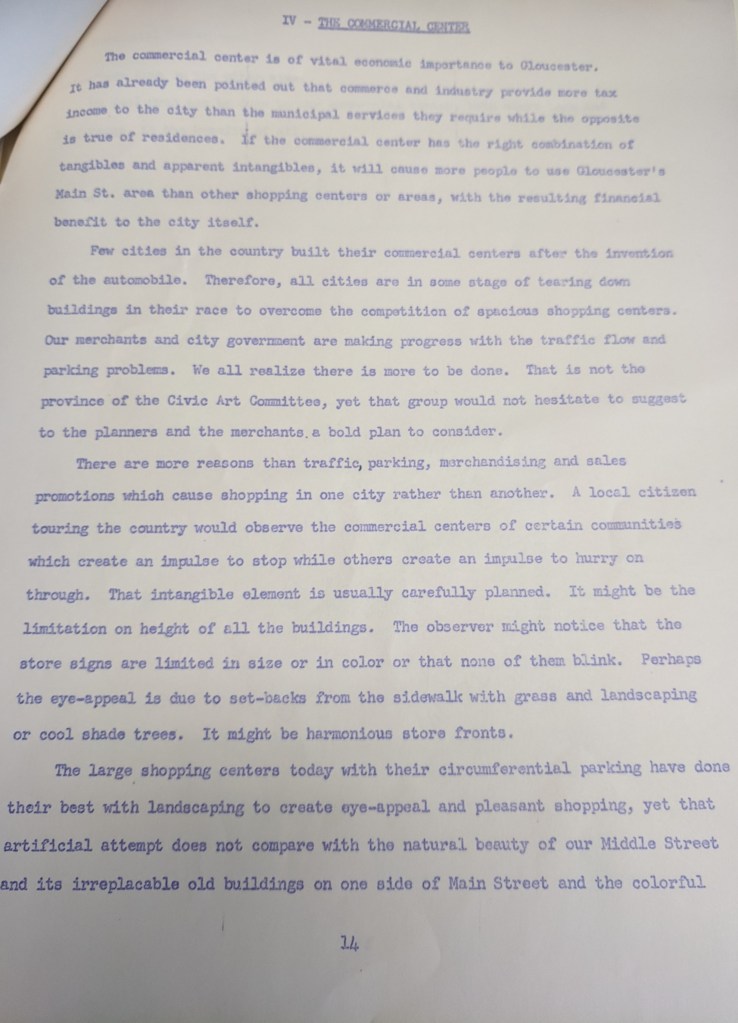
The commercial center is of vital economic importance to Gloucester. It has already been pointed out that commerce and industry provide more tax income to the city than the municipal services they require while the opposite is true of residences. If the commercial center has the right combination of tangibles and apparent intangibles, it will cause more people to use Gloucester’s Main St. area than other shopping centers or areas, with the resulting financial benefit to the city itself.
Few cities in the country built their commercial centers after the invention of the automobile. Therefore, all cities are in some stage of tearing down buildings in their race to overcome the competition of spacious shopping centers. Our merchants and city government are making progress with the traffic flow and parking problems. We all realize there is more to be done. That is not the province of the Civic Art Committee, yet that group would not hesitate to suggest to the planners and the merchants a bold plan to consider.
There are more reasons than traffic, parking, merchandising and sales promotions which cause shopping in one city rather than another. A local citizen touring the country would observe the commercial centers of certain communities which create an impulse to stop while others created an impulse to hurry on through. That intangible element is usually carefully planned. It might be the limitation on height of all the buildings. The observer might notice that the store signs are limited in size or in color or that none of them blink. Perhaps the eye-appeal is due to set-backs from the sidewalk with grass and landscaping or cool shade trees. It might be harmonious store fronts.
The large shopping centers today with their circumferential parking have done their best with landscaping to create eye-appeal and pleasant shopping, yet that artificial attempt does not compare with natural beauty of our Middle Street, and its irreplaceable old buildings on one side of Main Street and the colorful
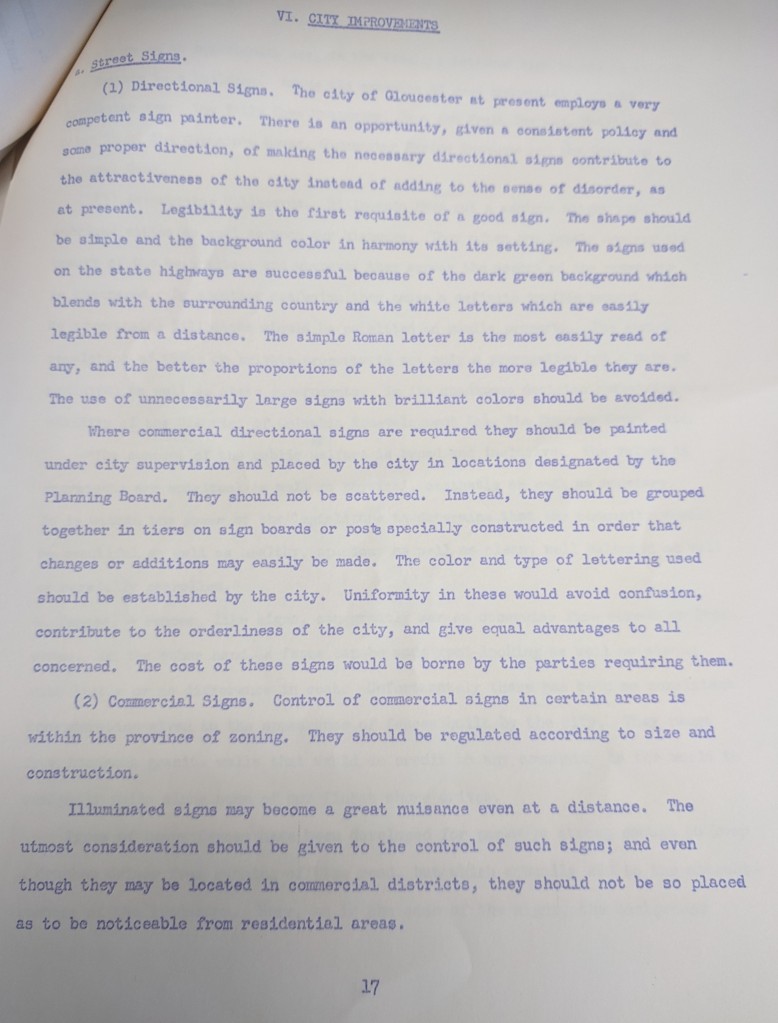
a. Street Signs
Where commercial directional signs are required they should be painted under city supervision and placed by the city in locations designated by the Planning Board. They should not be scattered. Instead, they should be grouped together in tiers on sign boards or post specially constructed in order that changes or additions may easily be made. The color and type of lettering used should be established by the city. Uniformity in these would avoid confusion, contribute to the orderliness of the city, and give equal advantages to all concerned. The cost of these signs would be borne by the parties requiring them.
Illuminated signs may become a great nuisance even at a distance. The utmost consideration should be given to the control of such signs; and even though they be located in commercial districts, they should not be placed as to be noticeable from residential areas.
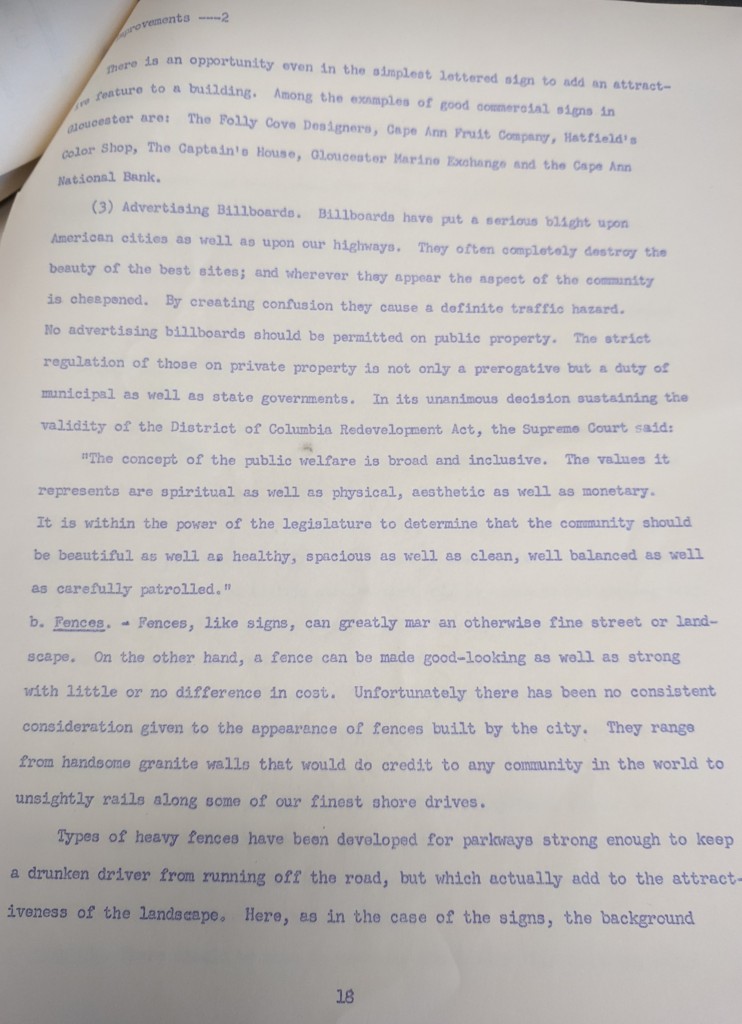
Improvements–2
There is an opportunity even in the simplest lettered sign to add an attractive feature to a building. Among the examples of good commercial signs in Gloucester are: The Folly Cove Designers, Cape Ann Fruit Company, Hatfields Color Shop, the Captain’s House, Gloucester Marine Exchange, and the Cape Ann National Bank.
“The concept of the public welfare is broad and inclusive. The values it
represents are spiritual as well as physical, aesthetic as well as monetary.
It is within the power of the legislature to determine that the community
should be beautiful as well as healthy, spacious as well as clean, well
balanced as well as carefully patrolled.”
b. Fences. – Fences, like signs, can greatly mar an otherwise fine street or landscape. On the other hand, a fence can be made good-looking as well as strong with little or no difference in cost. Unfortunately there has been no consistent consideration given to the appearance of fence built by the city. They range from handsome granite walls that would do credit to any community in the world to unsightly rails along some of our finest shore drives.
Types of heavy fences have been developed for parkways strong enough to keep a drunken driver from running off the road, but which actually add to the attractiveness of the landscape. Here, as in the case of signs, the background
Improvements –3
should be taken into consideration in selecting the appropriate type of construction.
c. Trash containers. It is hoped that an awakened city pride will result in some degree of care about the disposal of rubbish. Trash containers, strategically placed, will help as reminders as well as to provide the means of easy rubbish disposal. However, the trash containers themselves should not be unsightly. Sufficient attention can be directed to them without the use of garish colors. White lettering on dark backgrounds will generally be found preferable.
d. Cleaning and Policing of Roads. – Miles of gloucester’s scenic shore roads are constantly littered with rubbish. Strict enforcement of existing ordinances with some exemplary prosecutions, should go far toward correcting this situation.
e. Place Names and Markers. – It is an important duty of the community to keep alive in the minds of its younger people the achievements of citizens who have brought honor to it in the past. Place names and monuments are a perpetual reminder of the example of courage and moral strength set by our forbears. As the names of Washington and Lincoln give inspiration to the nation, so should the names of Gloucester’s courageous sea faring men inspire this and future generations of our citizens. These men should be memorialized in the names of new streets, squares, and traffic circles that will be added to the growing city. In addition to the name, markers should recount briefly the heroic act for which each man is remembered. Among those who should be honored in this manner are Howard Blackburn, Marty Welch, Alfred Johnson, Clayton Morissey, Sol Jacobs, and Alden Geale; and there are other men still living who should be given the same recognition.
“The sites of the old shipyards, about a dozen altogether, should be appropriately marked, to include the names of the more famous schooners built at that location. Site marking should be carried to other locations of interest, such as the Steamboat Wharf at Duncan’s Point.”
This would have been great incorporated into the HarborWalk markers–and a wonderful Schooner Festival trail brochure.
f. Planting. There should be more to the city physically than building walls
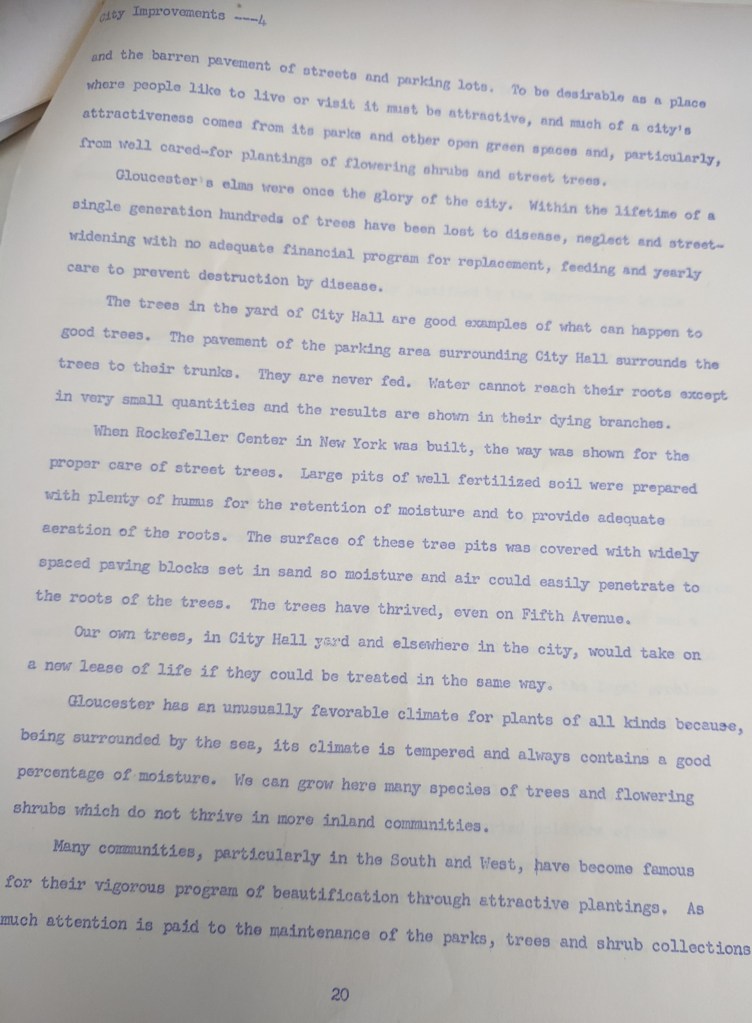
City Improvements —4
and the barren pavement of streets and parking lots. To be desirable as a place where people like to live or visit it must be attractive, and much of a city’s attractiveness comes from its parks and other open green spaces and, particularly, from well-cared for plantings of flowering shrubs and street trees.
Gloucester’s elms were once the glory of the city. Within the lifetime of single generation of hundreds of trees have been lost to disease, neglect and street-widening with no adequate financial program for replacement, feeding and yearly care to prevent destruction by disease.
The trees in the yard of City Hall are good examples of what can happen to good trees. The pavement of the parking area surrounding City Hall surrounds the trees to their trunks. They are never fed. Water cannot reach their roots except in very small quantities and the results are shown in their drying branches.
When Rockefeller Center in New York was built, the way was shown for the proper care of street trees. Large pits of well fertilized soil were prepared with plenty of humus for the retention of moisture and to provide adequate aeration of the roots. The surface of these tree pits was covered with widely spaced paving blocks set in sand so moisture and air could easily penetrate to the roots of the trees. The trees have thrived, even on Fifth Avenue.
Our own trees, in City Hall yard and elsewhere in the city, would take on a new lease of life if they could be treated in the same way.
Gloucester has an unusually favorable climate for plants of all kinds because, being surrounded by the sea, its climate is tempered and always contains a good percentage of moisture. We can grow here many species of trees and flowering shrubs which do not thrive in more inland communities.
Many communities, particularly in the South and West , have become famous for their vigorous program of beautification through attractive plantings. As much attention is paid to the maintenance of the parks, trees and shrub collections
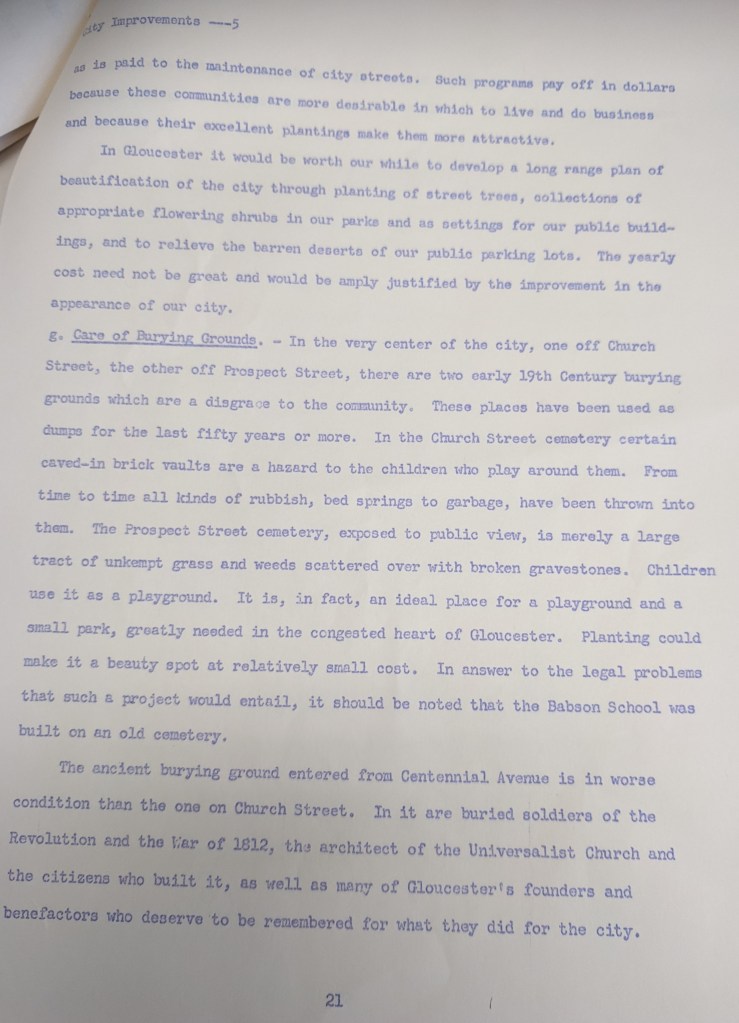
City Improvements —5
as is paid to the maintenance of city streets. Such programs pay off in dollars because these communities are more desirable in which to live and do business and because their excellent plantings make them more attractive.
In Gloucester it would be worth our while to develop a long range plan of beautification of the city through planting of street trees, collections of appropriate flowering shrubs in our parks and as settings for our public buildings, and to relieve the barren deserts of our public parking lots. The yearly cost need not be great and would be amply justified by the improvement in the appearance of our city.
e. Care of Burying Grounds – In the very center of the city, one off Church Street, the other off Prospect Street, there are two early 19th century burying grounds which are a disgrace to the community. These places have been used as dumps for the last fifty years or more. In the Church Street cemetery certain caved-in brick vaults are a hazard to the children who play around them. From time to time all kinds of rubbish, bed springs to garbage, have been thrown into them. The Prospect Street cemetery, exposed to public view, is merely a large tract of unkempt grass and weeds scattered over with broken gravestones. Children use it as a playground. It is, in fact, an ideal place for a playground and a small park, greatly needed in the congested heart of Gloucester. Planting could make it a beauty spot at relatively small cost. In answer to the legal problems that such a project would entail, it should be noted that the Babson School was built on an old cemetery.
The ancient burying ground entered from Centennial Avenue is in worse condition then the one on Church Street. In it are buried soldiers of the Revolution and the War of 1812, the architect of the Universalist Church, and the citizens who built it, as well as many of Gloucester’s founders and benefactors who deserve to be remembered for what they did for the city.
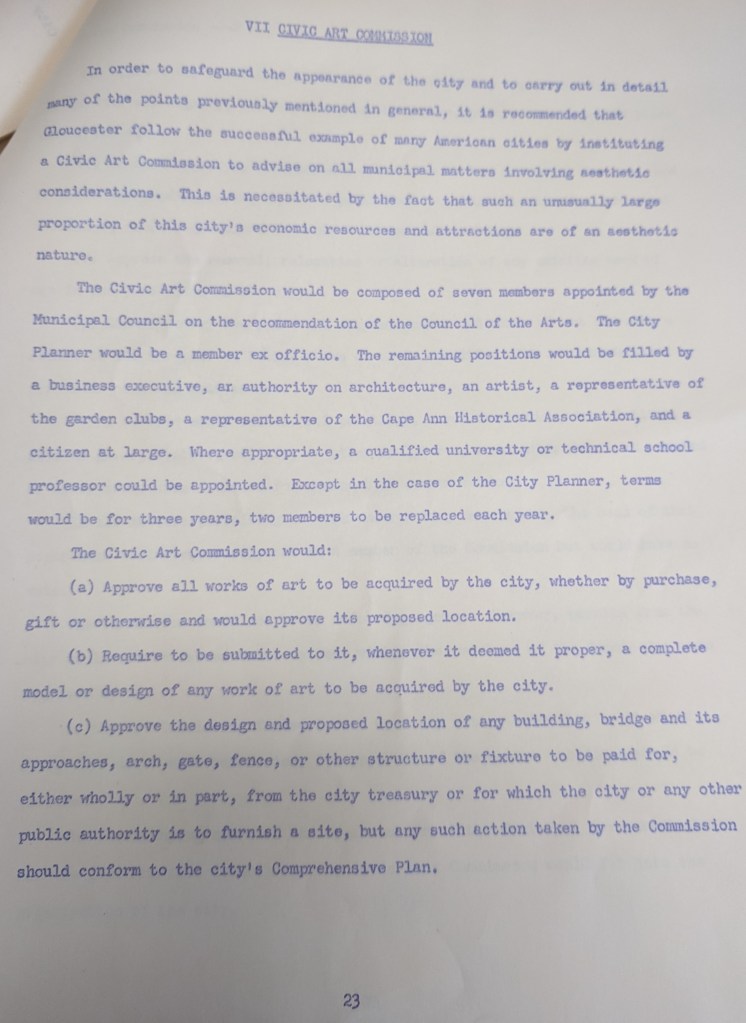
In order to safeguard the appearance of the city and to carry out in detail many of the points previously mentioned in general, it is recommended that Gloucester follow the successful example of many American cities by instituting a Civic Art Commission to advise on all municipal matters involving aesthetic considerations. This is necessitated by the fact that such an unusually large proportion of this city’s economic resources and attractions are of an aesthetic nature.
The Civic Art Commission would be composed of seven members appointed by the Municipal Council on the recommendation of the Council of the Arts. The City Planner would be a member ex officio. The remaining positions would be filled by a business executive, an authority on architecture, an artist, a representative of the garden clubs, a representative of the Cape Ann Historical Association, and a citizen at large. Where appropriate, a qualified university or technical school professor could be appointed. Except in the case of the City Planner, terms would be for three years, two members to be replaced each year.
The Civic Commission would:
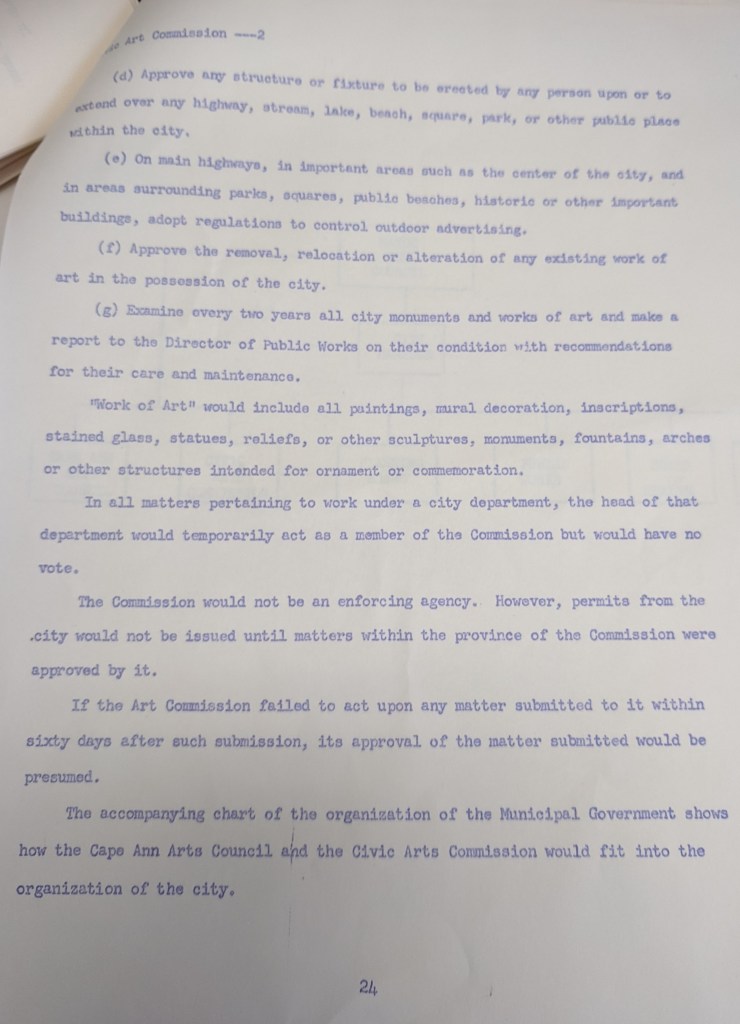
Public Art Commission —2
“Work of Art” would include all paintings, mural decoration, inscriptions, stained glass, statues, reliefs, or other sculptures, monuments, fountains, arches or other structures intended for ornament or commemoration.
In all matters pertaining to work under a city department, the head of that department would temporarily act as a member of the commission but would have not vote.
The Commission would not be an enforcing agency. However, permits from the city would not be issued until matters within the province of the Commission were approved by all.
“If the Art Commission failed to act upon any matter submitted to it within sixty days after such submission, its approval of the matter submitted would be presumed.“
Walker Hancock & Committee, 1958 (simple and easy sentence!)
The accompanying chart of the organization of the Municipal Government shows how the Cape Ann Arts Council and the Civic Arts Commission would fit into the organization of the city.

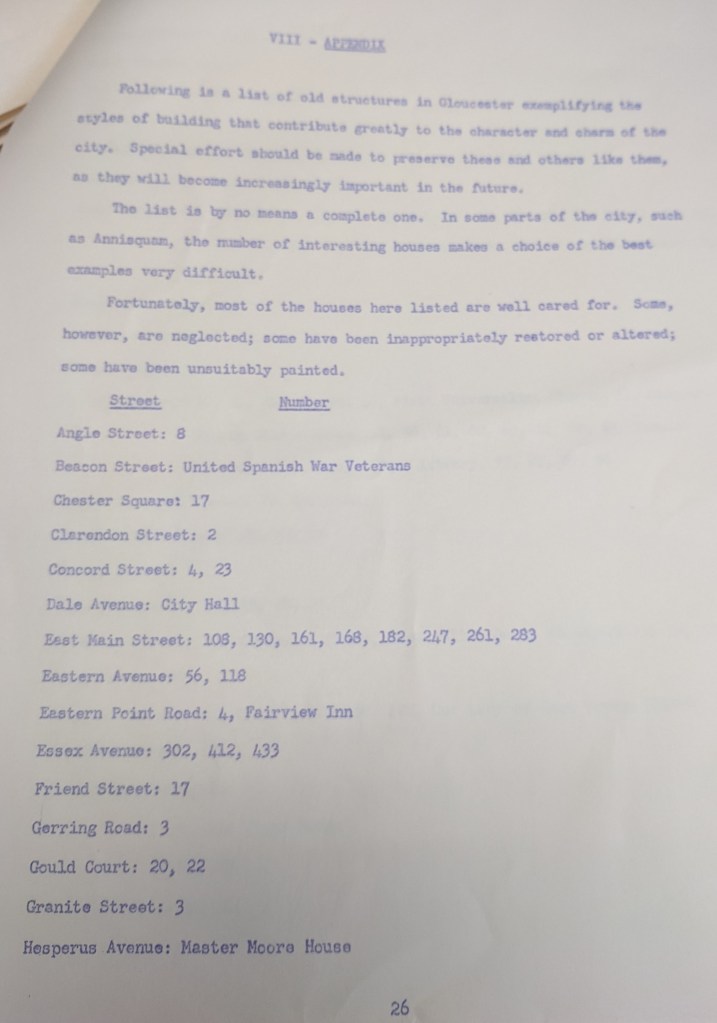
Following is a list of old structures in Gloucester exemplifying the styles of building that contribute greatly to the character and charm of the city. Special effort should be made to preserve these and others like them, as they will become increasingly important in the future.
The list is by no means a complete one. In some parts of the city, such as Annisquam, the number of interesting houses makes a choice of the best examples very difficult.
Fortunately, most of the houses here listed are well cared for. Some, however, are neglected; some have been inappropriately restored or altered; some have been unsuitably painted.







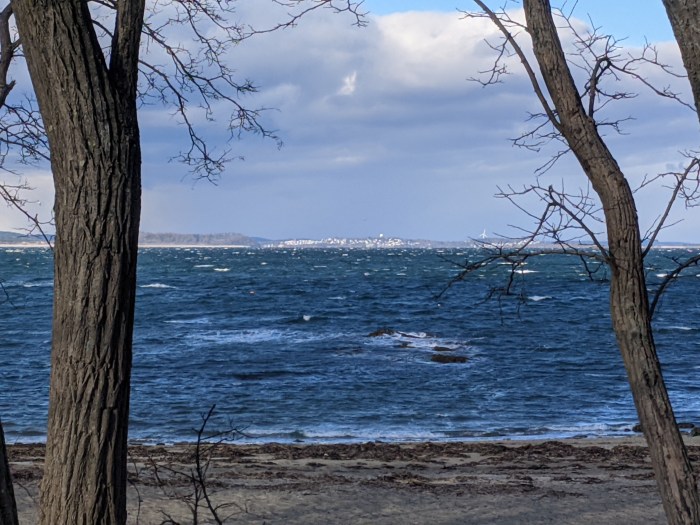
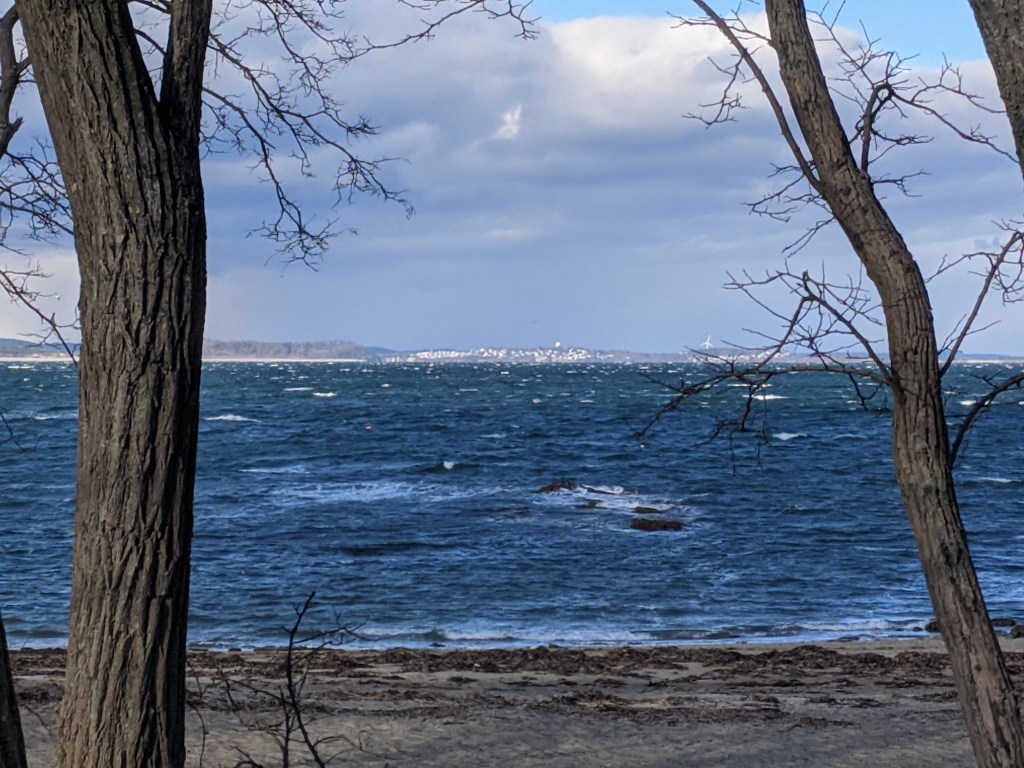
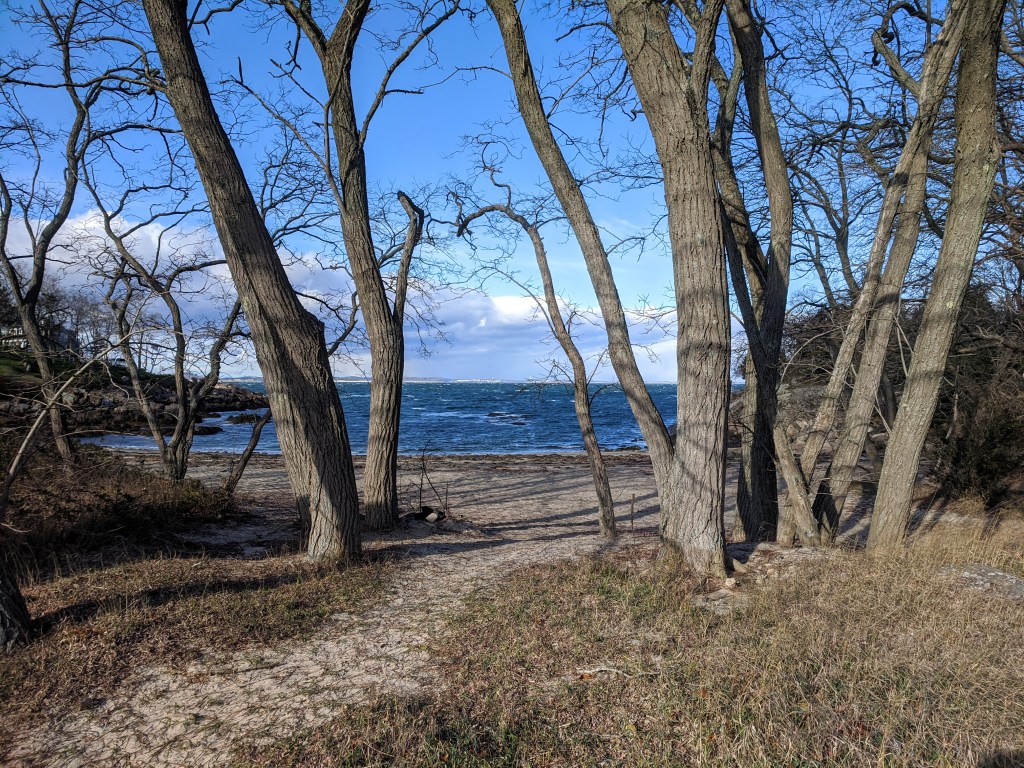
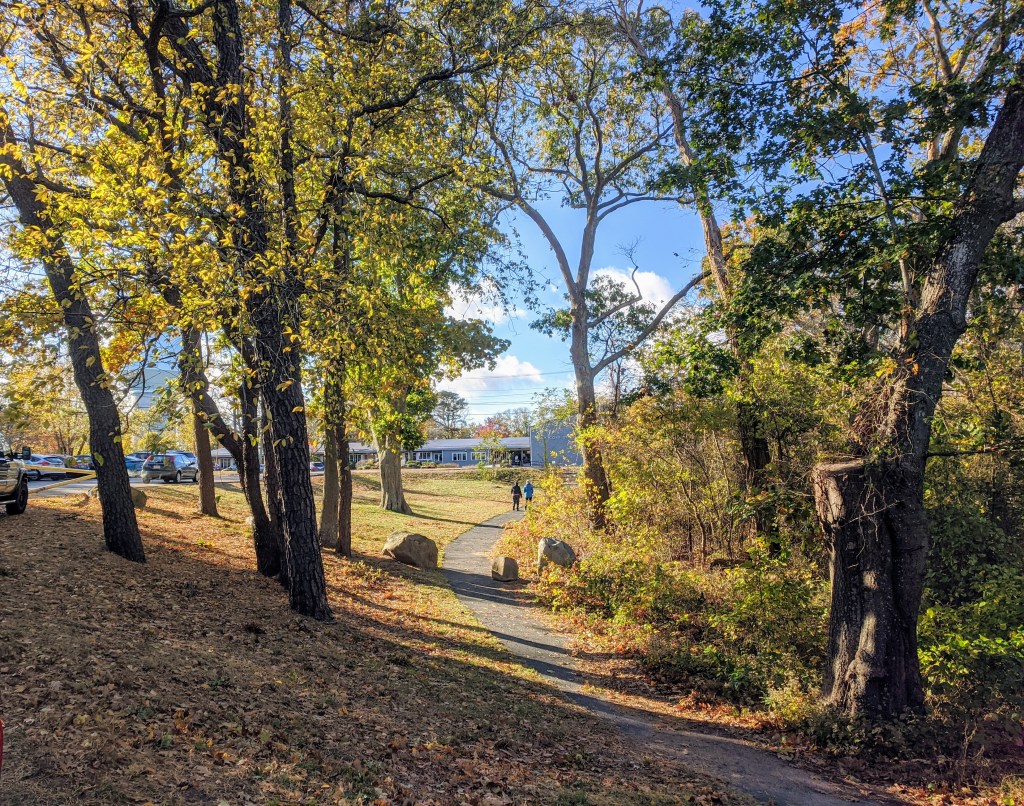
Wherever the political paths may lead, the natural vistas were crystal clear this morning!
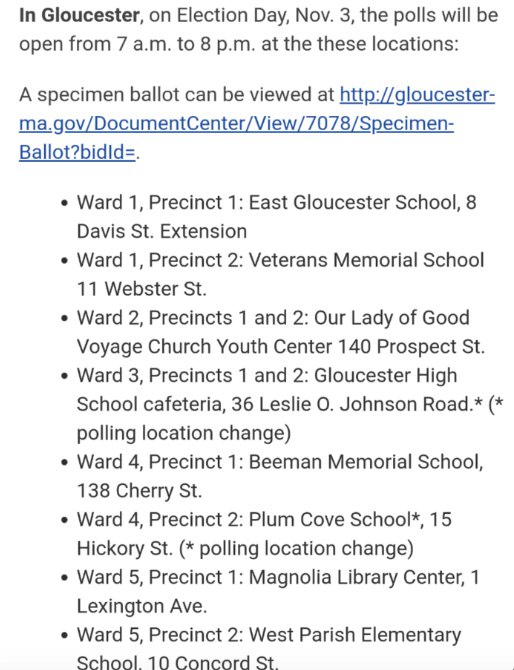
Polls are open until 8pm in Gloucester – from the GDT


On July 18, 2019 the architectural firm, Dore & Whittier, was slated to reveal associated rough costs on new school(s) buildings– such as construction costs, swing space costs, and eligible reimbursables– with the School Building Committee. (See summary of City Council requests July 9, 2019 here.) The meetings are public. Associated costs were not transparent for the public. Instead a dollar sign rating system was illlustrated pictorially, like so:
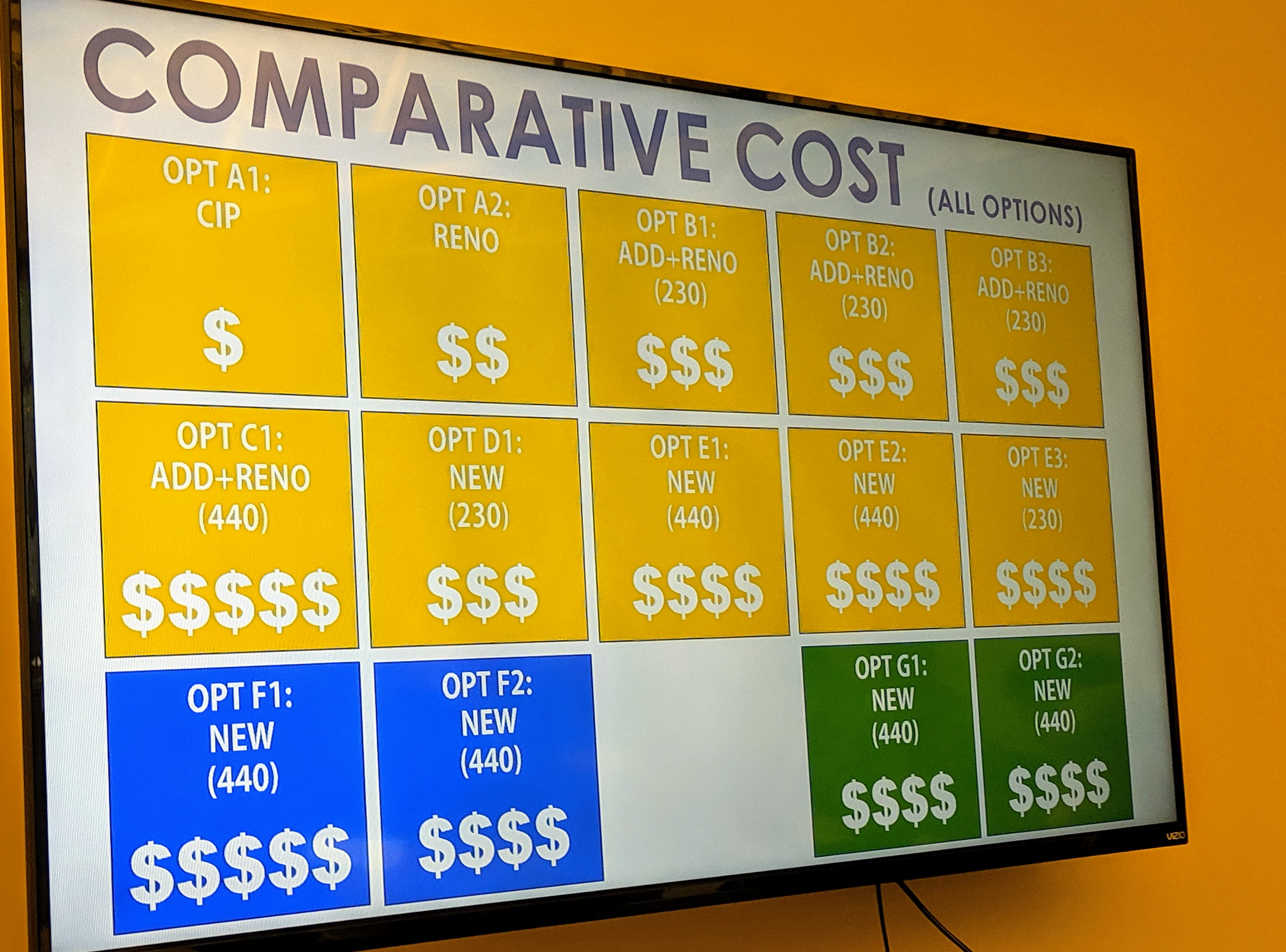
Why were rough estimate details cut from the presentation? A few reasons were provided, namely “MSBA does not look kindly” on public disclosure because
Other districts post all associated costs, why not Gloucester? Why are the design/build firms awarded these contracts charged with bidding out the cost evaluations on projects, especially ones greater than 5 million? Why assume this process is the only way to go about it?
Michele Rogers with Dore & Whittier announced that there were “no surprises” following review of the cost estimate comparisons. “Eliminations were easy; the most expensive were eliminated.” She concluded that this presentation was the second and final per their contract for services related to this Feasibility Study Phase. [This one feasibility study phase contract total cost is: $569,075 ($284,296 for the feasibility study and $275,704 for the future schematic design. One environmental study add on is $9075). Requests for a breakdown of all studies and plans related to new schools–at least since 2012– have gone unanswered by the school committee and architectural firm.]
The next step is to compile and deliver submission to the MSBA, the state agency tasked with reviewing Gloucester’s application for new schools.
Q. Next steps? “Submittal allows us to do geotechnical site evaluation and other necessary investigations (like traffic and environmental studies), and more design. Submittal helps us narrow down and leave behind areas we won’t bother with as we know…We’ll need to tighten the building design and handle specialized pieces. We’ll proceed from 9 options to 6 very quickly. ”
Q. What is the submission? “It’s a thick binder, maybe 10- inches thick, with all our reports to date, the educational program narrative, the space summaries approved earlier, etc.” Will the MSBA require a presentation? “No. The MSBA will review the binders within a two week turn around; then we have a two week turn around to respond.” Dunn commented to make sure the City see that. The MSBA will decide on November 13th or November 20th whether to make a recommendation to allow this proposal to proceed to the next phase: schematic design. “Or they’ll push back and request more information.” The MSBA “will not require more work on many options as the scoring was so low. They’ll be concentrating on the top 3 or 4 options.”
Tom Ellis was present related to a staff change; Roger who managed the design phase is moving out of state so the team for Gloucester will need to be reorganized. They met with MSBA July 17, 2019 to discuss this change. (Was someone from the city at the meeting?) Chris Tremblay will be assisting. “MSBA doesn’t like surprises,” Ellis remarked.
Who does?
The costs and application should be public before it’s forwarded to the state. Chairman Jonathan Pope said he’d forward the pricing.
Double click on pictures to enlarge the slides for the “East Gloucester Elementary School Building Committee 7.18.19″. Color coding continues as in yellow = East Gloucester; Blue = Vets; and Green = Green Street area.


one location at Vets and both at Green

“By October we’ll be back on schedule. Yes, MSBA has seen the schedule and is pleased.”

Fraternity Club Gloucester, Ma

Catch up posts, documents, links related to Gloucester’s school committee new school buildings/consolidation process: Continue reading “Dore & Whittier School consolidation plans & costs heading to MSBA August 1, 2019”

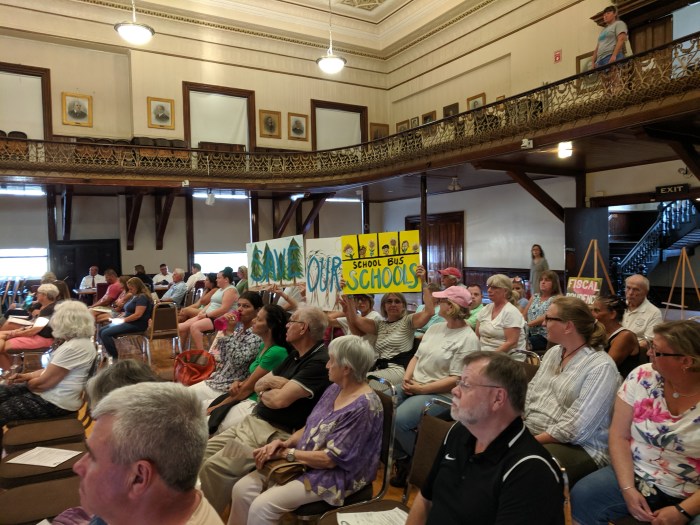 SAVE THE DATE
And when! “Light Up Mattos has rented the Fraternity Club, 27 Webster Street, Gloucester, MA, for a Listening Post on July 25th, 2019 at 6:30 to talk about the possibilities of a 440 student population in Mattos field area, Green Street and East Gloucester school. Together we can ask questions of each other and really see what we all think of having such a large population of students, and perhaps find new ideas, too. Please come and be heard and listen. Together we can make a difference. We will be looking for volunteers to put information flyers in neighbors doors in Mattos field area, Green Street area, West Parish area and East Gloucester area to get the word out. Proposed schools affects us all!” – Light Up Mattos
Gloucester schools | Elementary: East Gloucester, Veterans Memorial, West Parish, Beeman, and Plum Cove; Middle: O’Maley and fields; High School: GHS and fieldhouse
The next new school meeting is TONIGHT- July 18, 2019. Associated costs for limited options slated to be revealed. Goal for submission to the state agency, MSBA, is August 1, 2019. Meeting held in the School admin offices at Blackburn. 5pm.
Catch up on new school building process in these prior posts:
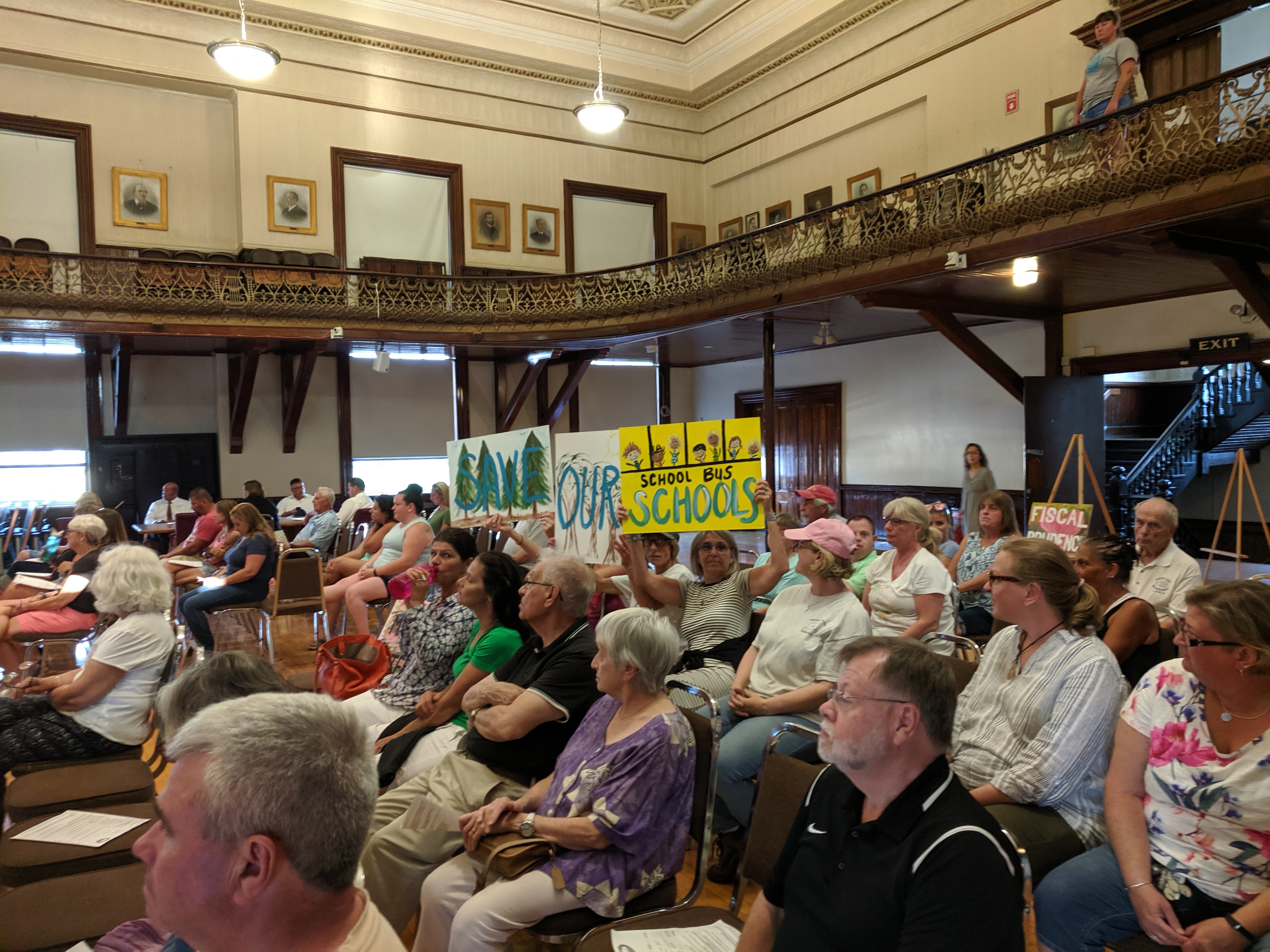


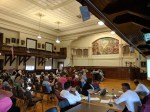

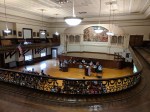

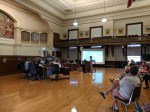


Oral Communications july 9, 2019:
“Joseph S. Mattos Jr. grew up right up the street from Mattos field at 9 Linnett Place. He came from a patriotic family and chose the Army for his love of animals. Mattos field was dedicated to Joseph in 1935 and was rededicated last October 5th. the 100th. anniversary of his death. Lt. Maxwell Parsons grew up at 65 Mt. Pleasant Ave. Lt. Maxwell served in the U.S. Army. Lt. Maxwell Parsons Playground was erected by the Gloucester Playground Commission in 1935 Ganine Nancy Doucette grew up at 19 Mt. Vernon St. The Park was dedicated in 1986 in her memory. Mr. John Gus Foote was instrumental in the dedication. Private First Class Doucette wanted to serve her country and almost could not. She died serving her country as she wished. I am their voice as they have none. I am here today to speak for them all. Please don’t take their dedicated open space. Thank you. Patti Amaral”
“A round up of Pros and Cons related to the recent West Parish construction and its use and operating costs since being built might be helpful. Some West Parish feedback that made the news ranged from small inconveniences (no dishwasher) to larger concerns about design (despite ample site the gymnasium was not designed with enough space for spectators, the design of the parking lot did not take into account ease in snowplowing and numerous vehicular/traffic snafus). There was no discussion about these proposals within a broader context of all the school properties, all the elementary schools, merging with Rockport, what happens with development of the older sites if Schoolhouse Road option is undertaken, etc.” Big built out schools haven’t demonstrated a reduction in operating costs. The state is considering policy for livable, innovative, green and walkable communities. You can’t alter special places, build mega schools that everybody needs to drive to, and have walkable, quintessential New England neighborhoods and green communities. Can we request a modified incentive to best match our geography and green goals?
folds into the Trustees meeting 7/23/19 and specifically capital projects Wed 7/24/19 8:30AM.

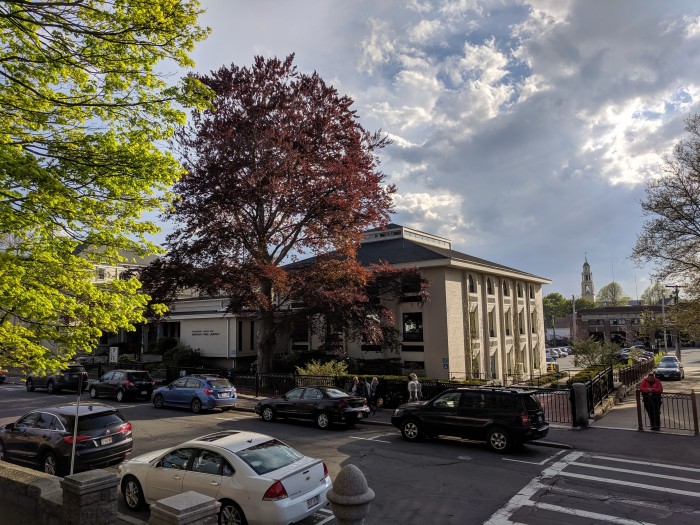
This photo chronicle begins with scenes from the Gloucester Lyceum & Sawyer Free Public Library 2019 Annual meeting, including views of the concept proposal for renovation and addition intended for the library as they appeared in the feature presentation that evening with some brief analysis. (This update is part of an ongoing series published on GMG.)
The second part of the piece provides background about the American architect, Donald F. Monell, and visual context regarding his designs for the library expansion built in 1973 and largely ignored through this current new build consideration. Links to several reference documents relevant to this process are collected and provided at the end.
Part 1 Annual meeting – Arriving/settling in
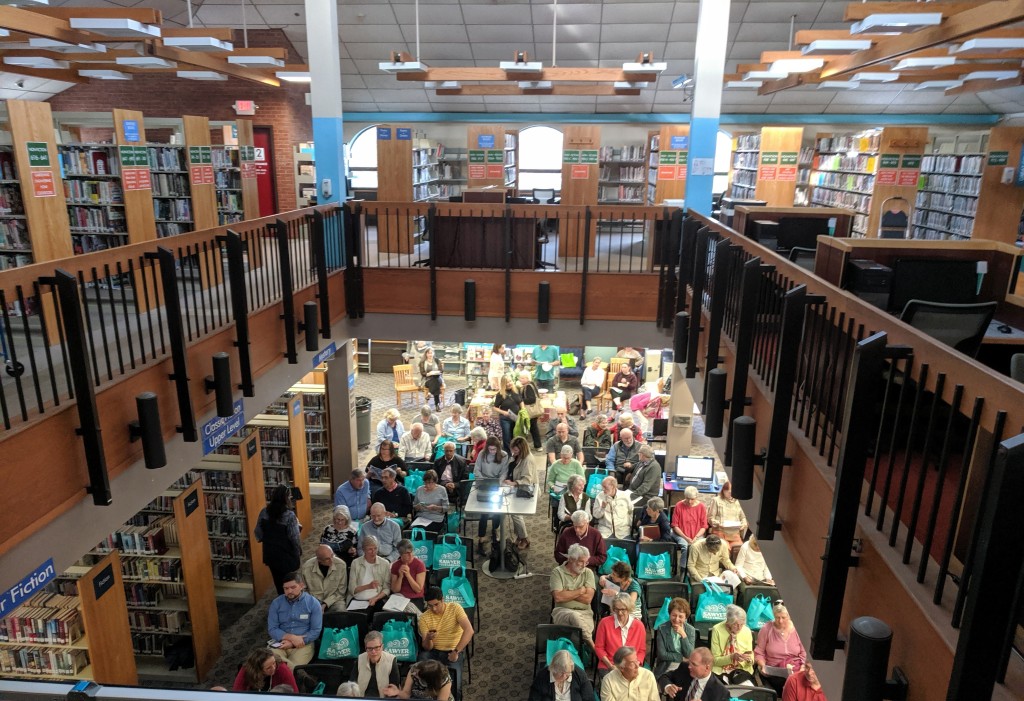
About 85 people including Trustees with guests, library personnel, and marketing and architectural representatives were present for the Gloucester Lyceum & Sawyer Free Public Library’s Annual Meeting on May 20, 2019. (click individual photos to see full size)

Introductions
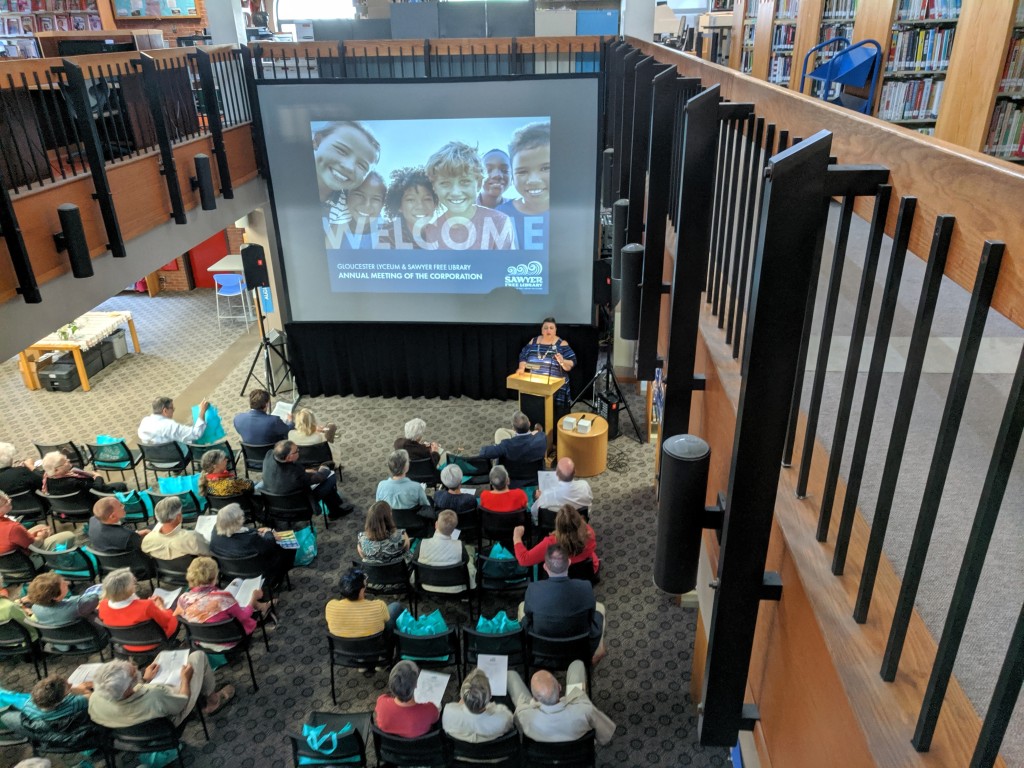
Mayor Romeo Theken, Library Dir. Deborah Kelsey, and Trustee Chair John Brennan welcomed the public. Brennan thanked several Trustees for long service and welcomed new ones.

Award
Deborah Kelsey presented the Mary Weissblum Smith Volunteer Award to Susan Oleksiw and Christy Park in recognition of their curation and management of the Matz Gallery rotating exhibitions over the past five years and their notable careers. Ironically, in the new concept plans, there is no Matz Gallery and limited art space. Read more about Matz’s philanthropy and work in Gloucester here. The major works from the art collection continue to be off view and similarly unaccounted for in future plans.

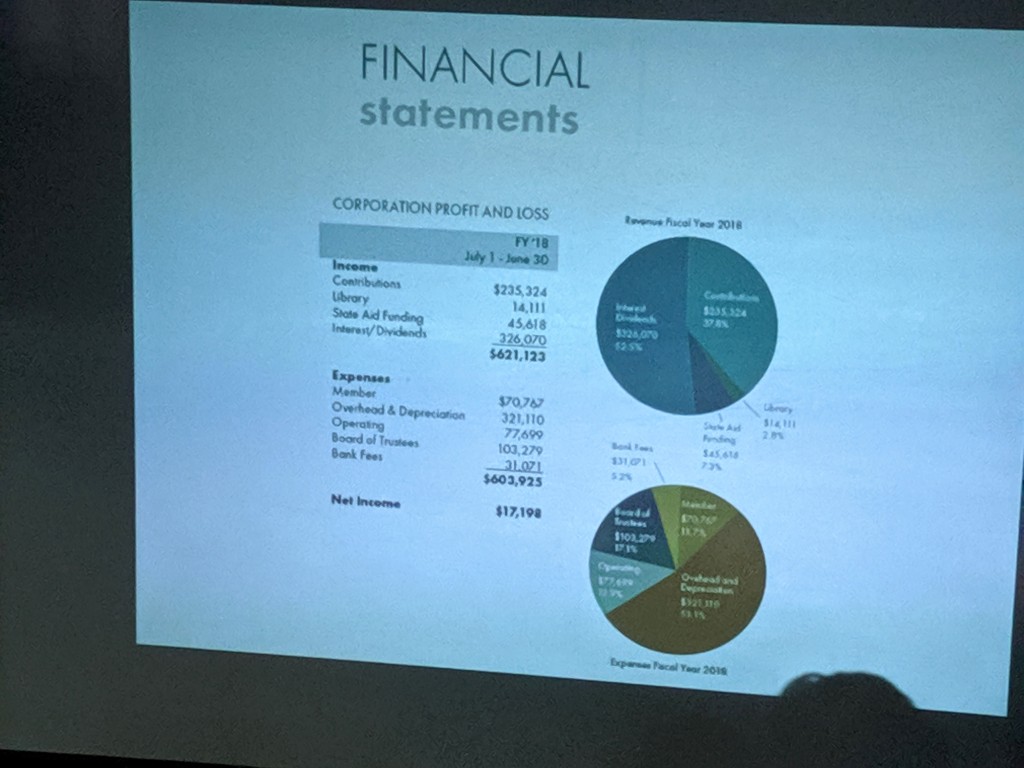
Financial Statement YR 2017-18
The library’s treasurer explained that the Annual Meeting financial reports always illustrate the prior year rather than the one just completed. So for this 2019 annual meeting, the report reflects May 2017- May 2018. He explained next year’s will represent the year 2018-19 and will show red and depletion of the 6 million endowment. Former board members asked about expenses to date, related to the new build, and itemization of the Trustee expenses line item, which was not in use when they served. A trustee explained that a title more accurately reflecting those expenses would be helpful. Reports will be shared.


Architect’s renderings / Oudens-Ello (with Dore & Whittier for library and MBLC)
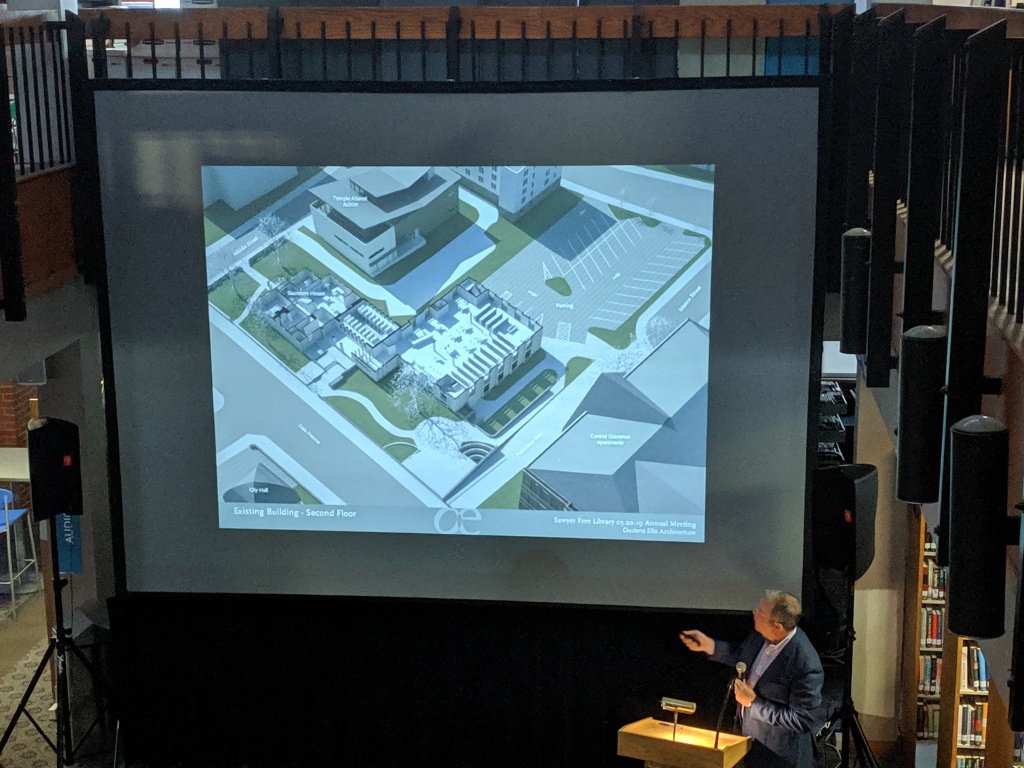
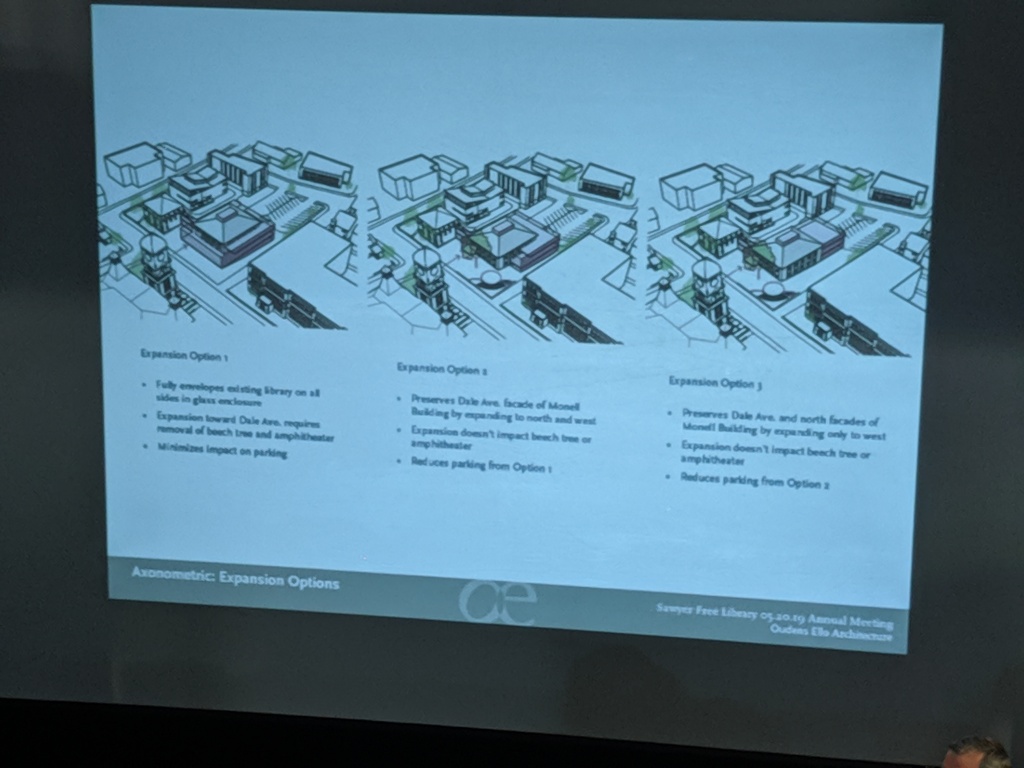
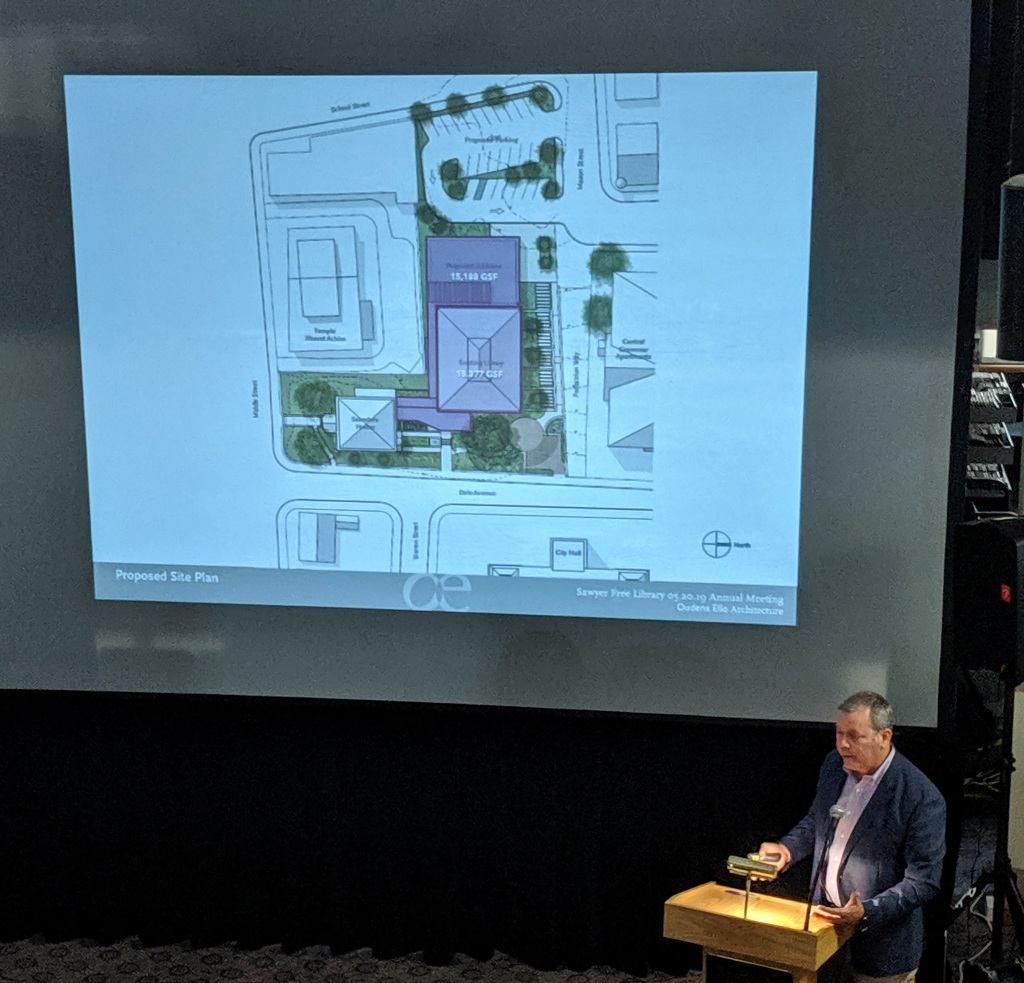
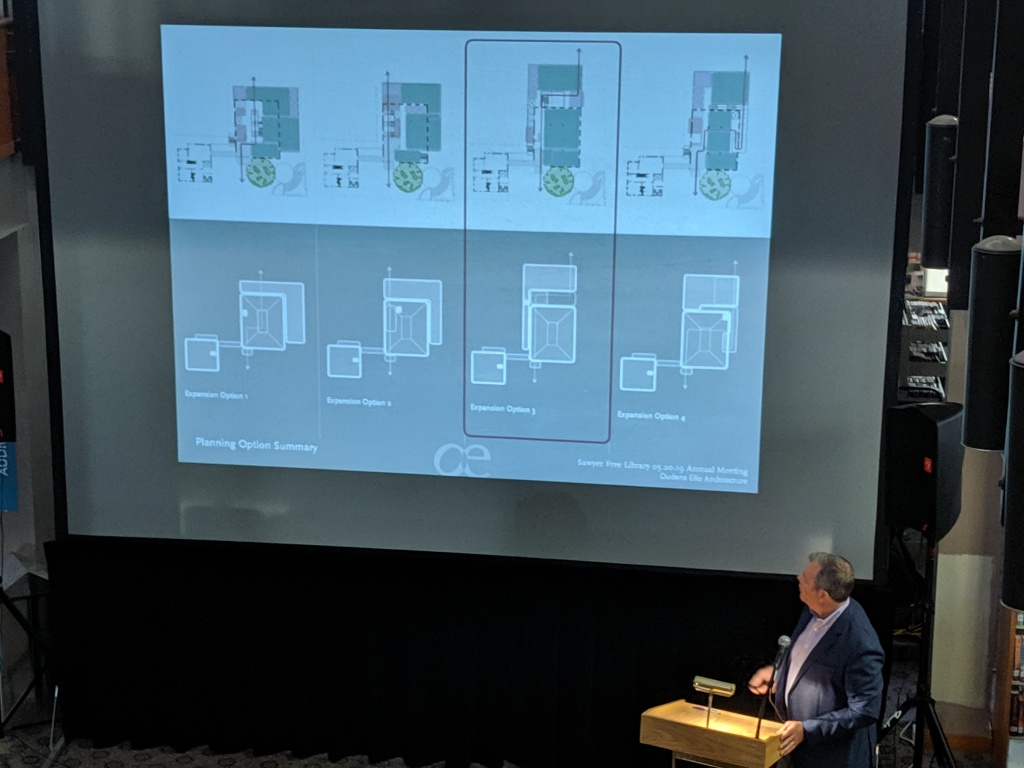

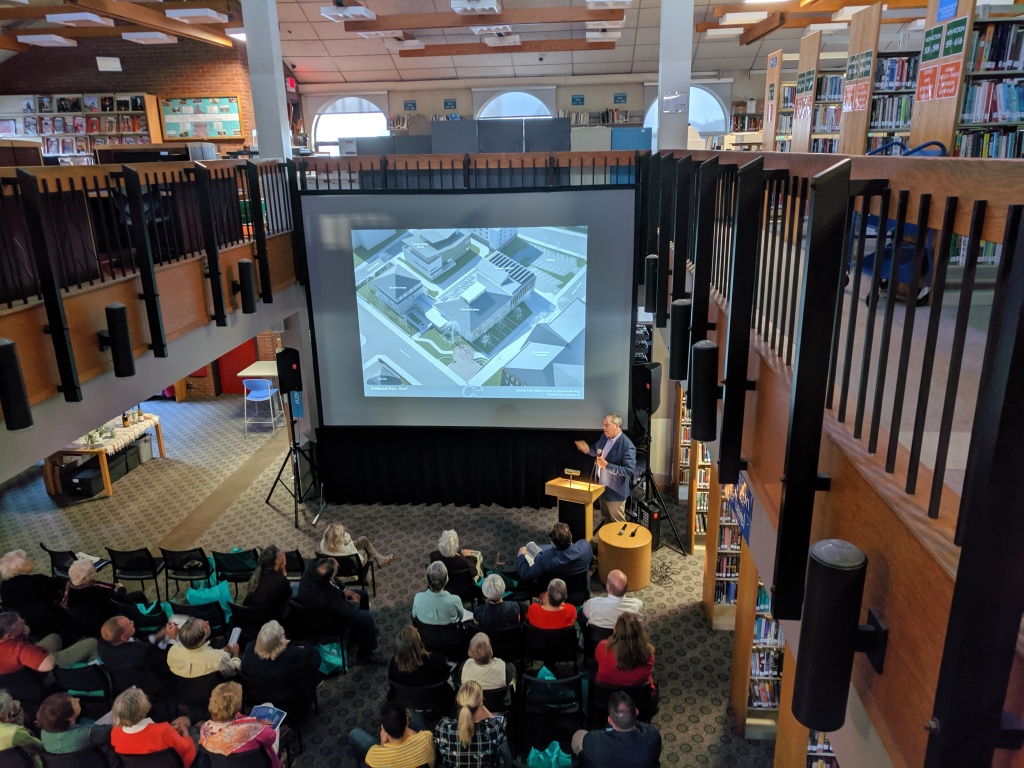


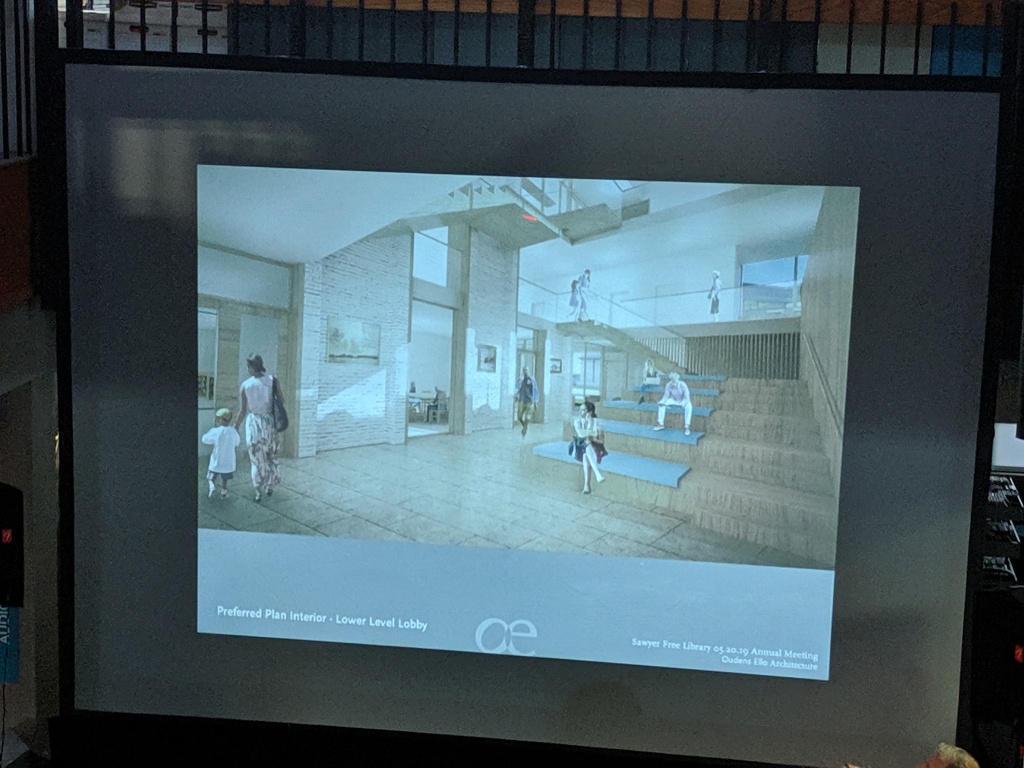
The 25 million+ quoted for the concept plan does not include preservation of the original heart and soul of the library, the Saunders building, or any mention of the library’s fine art. A recent estimate for potential Saunders preservation begins at 3 million– which would be in addition to any work done elsewhere with the library.
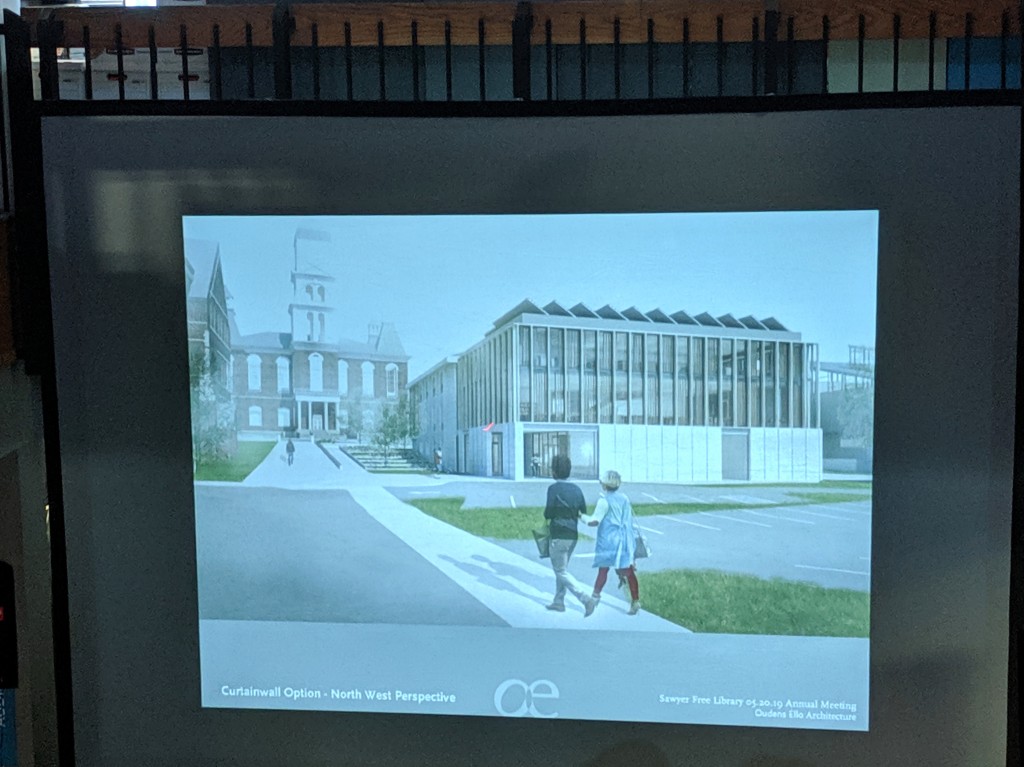
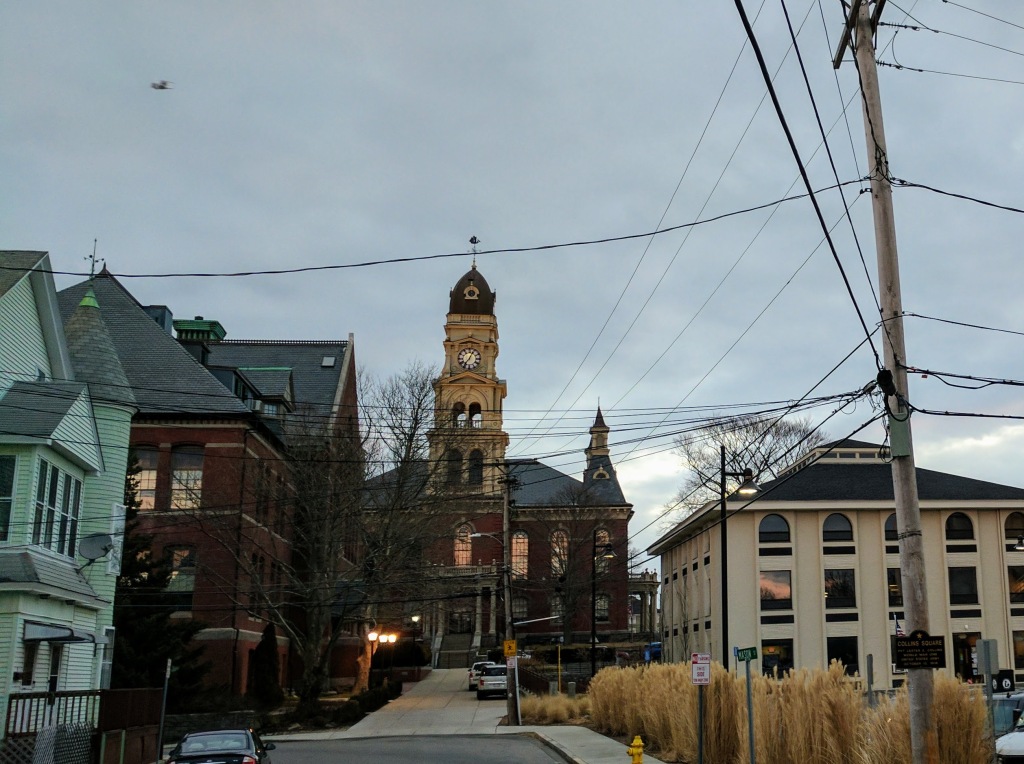
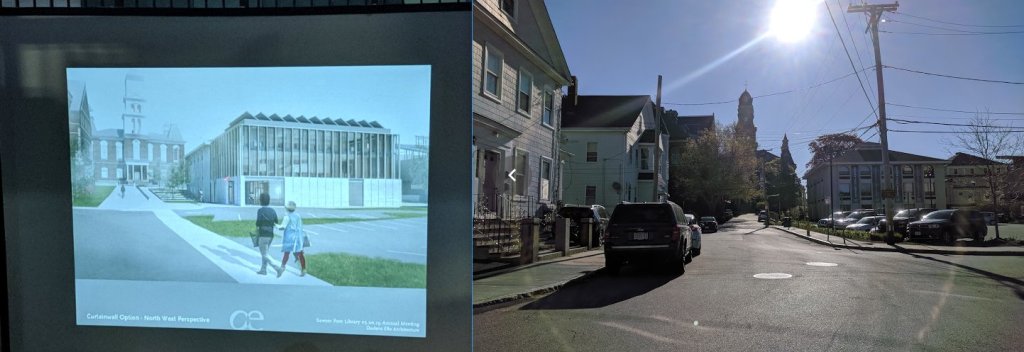
Stairs and more stairs

Design inspiration did not come from Saunders or Monell. (I asked.) One of the stated goals was striving to continue to make the library accessible for all, although in my opinion since the first presentation years ago, this design undercuts that aim.
Because of gentle switchback steps, currently there is technically no “accessible for all” direct entry from Dale to the Main Floor, or from Middle Street. The accessibility option from Dale curves around to a side* and back entrance. If that level is not the destination, patrons continue to the elevator.
Increasing all of the buildings’ gateway capacities is a fantastic goal. I do not understand how a concept with such tremendous staircase emphasis will remedy that expression of accessibility for all, or ease patron flow. The monumental scale of the three-story glass central stairwell takes up the transition volume between the original Monell and concept addition, and looms larger than the current Monell atrium. In this concept, children’s and teen spaces will be on the top floor. Crowd flow of all ages will need to access the elevator from the ground floor near the back entrance. Once upon a time the children’s wing was on the top floor of the Saunders building and intentionally moved to a space on the ground level. Currently, children’s services is on the ground floor. Friends and librarians using Reading and Salem libraries are not fans of children’s spaces on the top floor.
*The side entrance was sealed off this year due to safety concerns which can be helped by architecture and staff. The new security officers received the biggest applause of the night.
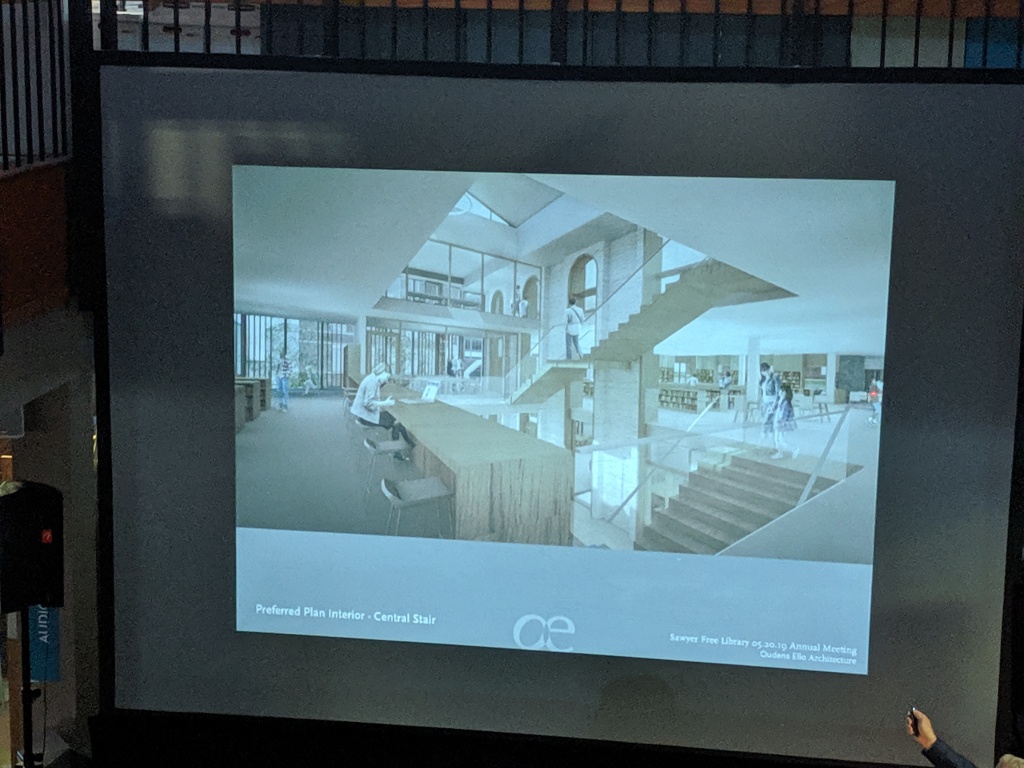
Glass staircase design statements — stacked cantilevered and floating– are common features in malls, retail, and transportation (airports!) hubs, often with escalator options, and ample budgets for cleaning staff. They’re not super kid friendly or easy to clean. For this concept, the staircase massing can be greatly reduced and favorably impact the footprint, cost and siting. I’ve written about the odd flow of moving the library’s busy children’s services up to the top level in this proposal. Just one of Christy Russo’s daily programs may bring in 20 to 80 kids and their grown-ups!
Moving to elevator and stairs with or without strollers will increase flow inefficiency dramatically, and be a disservice to an evergreen and engaged population. Children’s could be flipped back to the ground floor, with or without a separate teen space on this level. Research and multi use rooms requested for “21st century programming needs” could be dispersed throughout the expanded upper levels. Safety issues and bathrooms can be addressed on any floor. The librarians have been patiently awaiting remodeling and interior update and upgrades on the ground floor since 2012. The build out goal of 2026 or later is too long! They need more space, a functioning and better test kitchen, and major bathroom renovations (yesterday!).
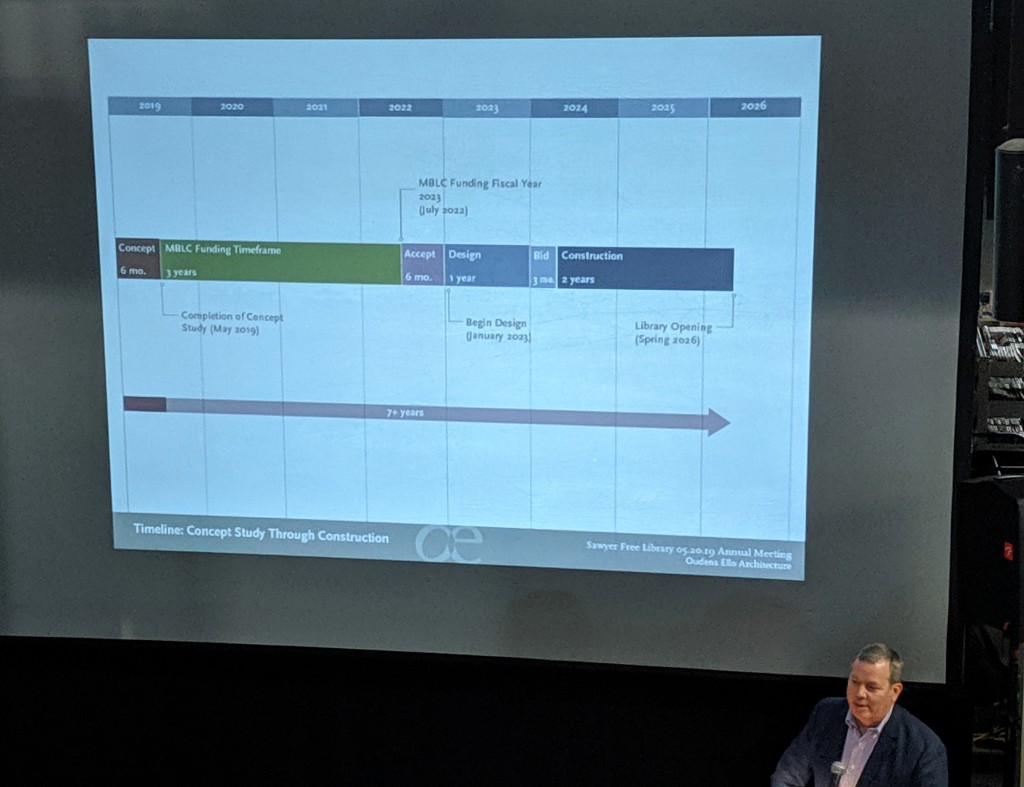
Oudens Concept plan Timeline
ETA library tentative opening 2026
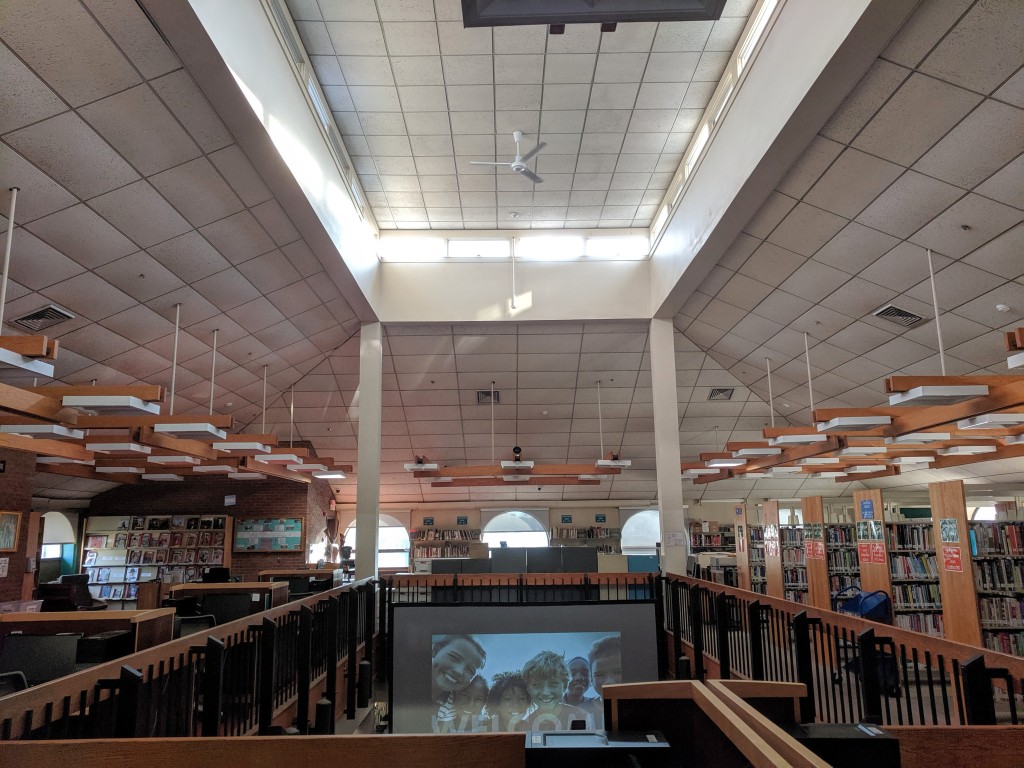
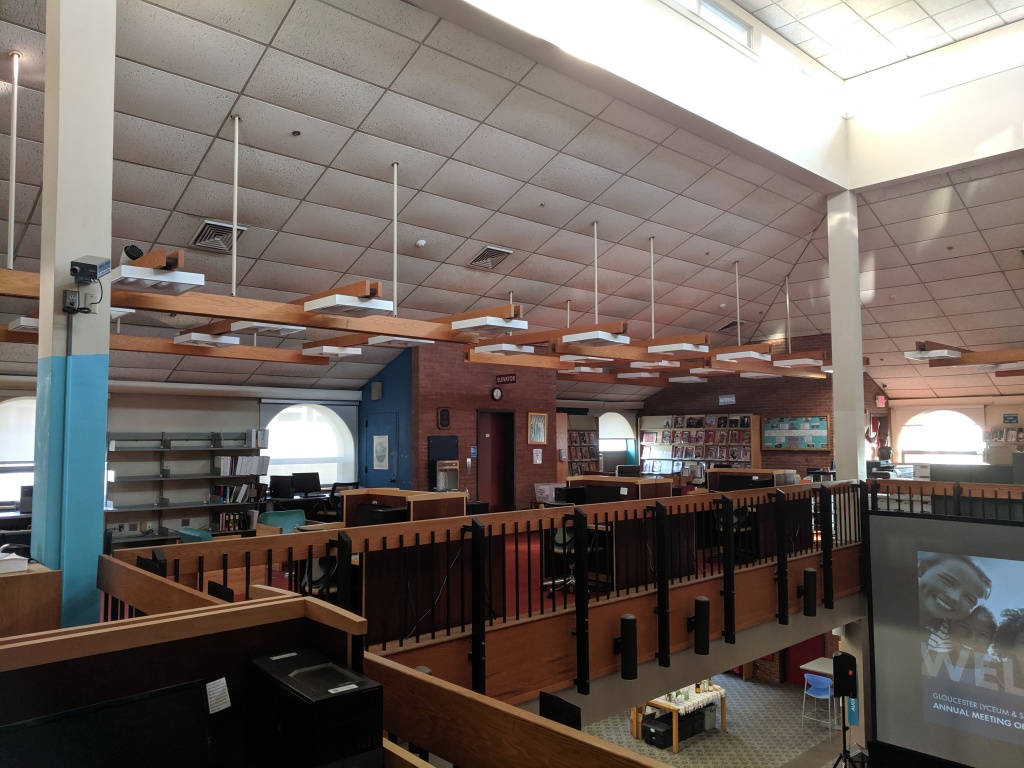
SFL Library atrium, architect Donald F. Monell
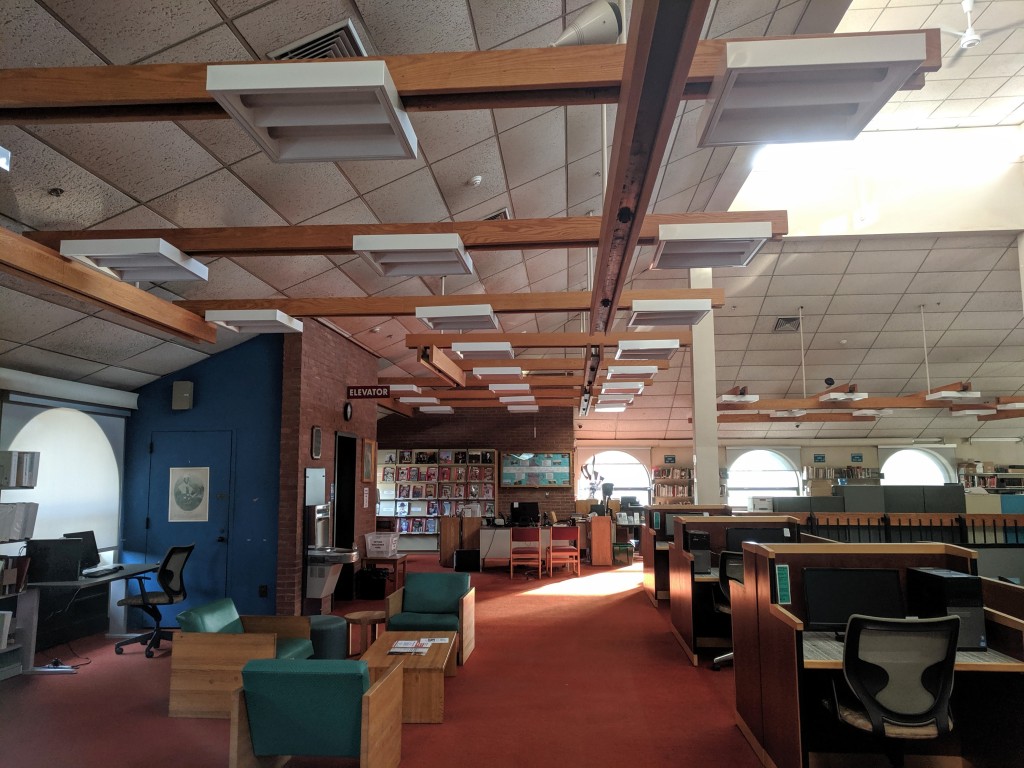
Monell building, top floor, no artificial light, no filter: looking across atrium with presentation underway on Main Floor as this space was being described again as an uninviting dark hole.

Part 2
For nearly 190 years, the Gloucester Lyceum & Sawyer Free Public Library has played a key role in the cultural life of the city of Gloucester and the Commonwealth. Gloucester Lyceum & Sawyer Free Public Library features not one but three iconic buildings. Investment in building projects with such inspiring history, pedigree, assets, materials and form are indeed a rare and enviable opportunity. Any library build should feature both Saunders and Monell. We are so lucky to have them!
There was worry about the Saunders and Monell buildings, the Stacks, and the Rando Memorial garden when the proposed new building first dropped and as this process continued. Thankfully, a Saunders stewardship committee has been reestablished and the Rando Garden will remain. (There was pushback that the “21st century building” left the community with less green space, not more.) It’s only since last week that razing Monell was taken off the table. And it’s only since February 2019 that the architects began to emphasize green design as they had not realized how valued such criteria was in Gloucester. A workshop was held at the library.
Still, no one involved in the new process was discussing Monell, his inspiration, or influence. Regarding the library 2019 green visionaries—Monell may be more important to them than they realize. After all, he was ahead of his time incorporating wind and solar design into public buildings and homes. I’ve been thinking more and more about Monell, his studies and business ventures, his devotion to Gloucester.
Donald F. Monell earned multiple degrees at Bowdoin (BS, 1937) , Royal College of Edinburgh (1938), Tekniska Hogskolan in Stockholm (KTH Royal Institute of Technology), and M.I.T. (MS in city planning,1941 and MS in architecture, 1950). He was a research assistant in City Planning at M.I.T. (1940-41), and a Research Associate in solar energy at M.I.T. from 1949 to 1951. During World War II he served as a Captain with the 333 Engrs. S.S. Regiment in the US Army Corp of Engineers from 1942-46. Prior to setting up his own firm in 1952, he worked as a community planner in Tennessee and for various architectural establishments. His son Alex Monell said that his father declined positions with larger international firms. “He preferred working on a smaller one to one relationship with clients.” Monell’s tenure at M.I.T. coincided with I.M. Pei and Buckminster Fuller; Monell set up his eponymous business two years prior to I.M. Pei. I asked Alex if his father worked with architect Eleanor Raymond. She built her home in Gloucester and had similar interest in sustainable design. She is credited with designing one of the first solar heated houses in 1948 “I know he worked with Maria Telkes (who invented a means to store heat in melted crystals that stored more than water could) on one of their solar homes and now that I looked her up I see the home was designed by Eleanor Raymond! So they knew each other.”
Monell was licensed to practice in Massachusetts, New Hampshire and New York and was NCARB certified. He was a member of AiA and Boston Society of Architects. He served on Gloucester’s Civic Art Committee beginning in the 1960s. He was a trustee of the Cape Ann Symphony Orchestra, an incorporator of AGH and Cape Ann Savings Bank, and a Vice President of the Cape Ann Museum (then Cape Ann Historical Assoc.). Monell’s office was located in the Brown Building, 11 Pleasant Street. His son remembers visiting his dad on jobs and admiring the hand made scale models. Local residents may recognize the names of Monell hires: Kirk Noyes who preserved Central Grammar and other award winning developments, was a draftsman, and Craig Toftey helped Monell with the Sawyer Free library.
The new building planners describe the need for a 21st century library. What does that mean today? Back in 2012, technology was the big discussion point and the library a possible tandem option for schools. (Elementary school libraries were shuttered and/or volunteer run, and school librarian positions cut.) Since then, libraries in schools became “Learning Commons” with a tech focus. By 2019 Gloucester Public Schools have a 1 to 1 student computer initiative. There was a desire for grounds improvement, since completed and well received with the Rando Memorial. I was asked about helping with a public art comission and how it might work as a play structure, too. Mayor Romeo Theken reminded us of the homes and neighborhood playground where the Monell addition and parking lot were built. Community input suggested opportunities for more outdoor spaces would be welcome, not less. Library design trends recommend co-work and makerspace options so the library is a community center. (Sawyer Free has been a community center since its founding.)
One thought regarding “21st Century” library tech goals: partnerships with M.I.T., Harvard, and Bowdoin could be fruitful and shored up by honoring Monell. Perhaps they’d help facilitate subscriptions to specialized libraries. Coordinating public access to resources like MatLab as one example would enhance “accessibility for all” in a 21st century sort of way.
Monell’s son, Alex, shared a section from M.I.T. President’s Report, 1951, with a reference to his father: “Mr. R. Buckminster Fuller, visiting lecturer, who contributed significantly to this conference, worked this year with the third-year students in architectural design and presented his concept of the “comprehensive designer” in a program emphasizing the relation of structure to design. In August, I950, occurred the five-day symposium on “Solar Energy for Space Heating,” under the auspices of the Godfrey L. Cabot Fund, attended by about 900 persons who were mostly visitors to the Institute. Mr. Donald F. Monell, research associate, was responsible for organization. Speakers included staff members and outside authorities in this field. Professor Lawrence B. Anderson was one of the contributors.”
1951
Don and Lila Monell could be the ‘Charles and Ray Eames of Gloucester‘.
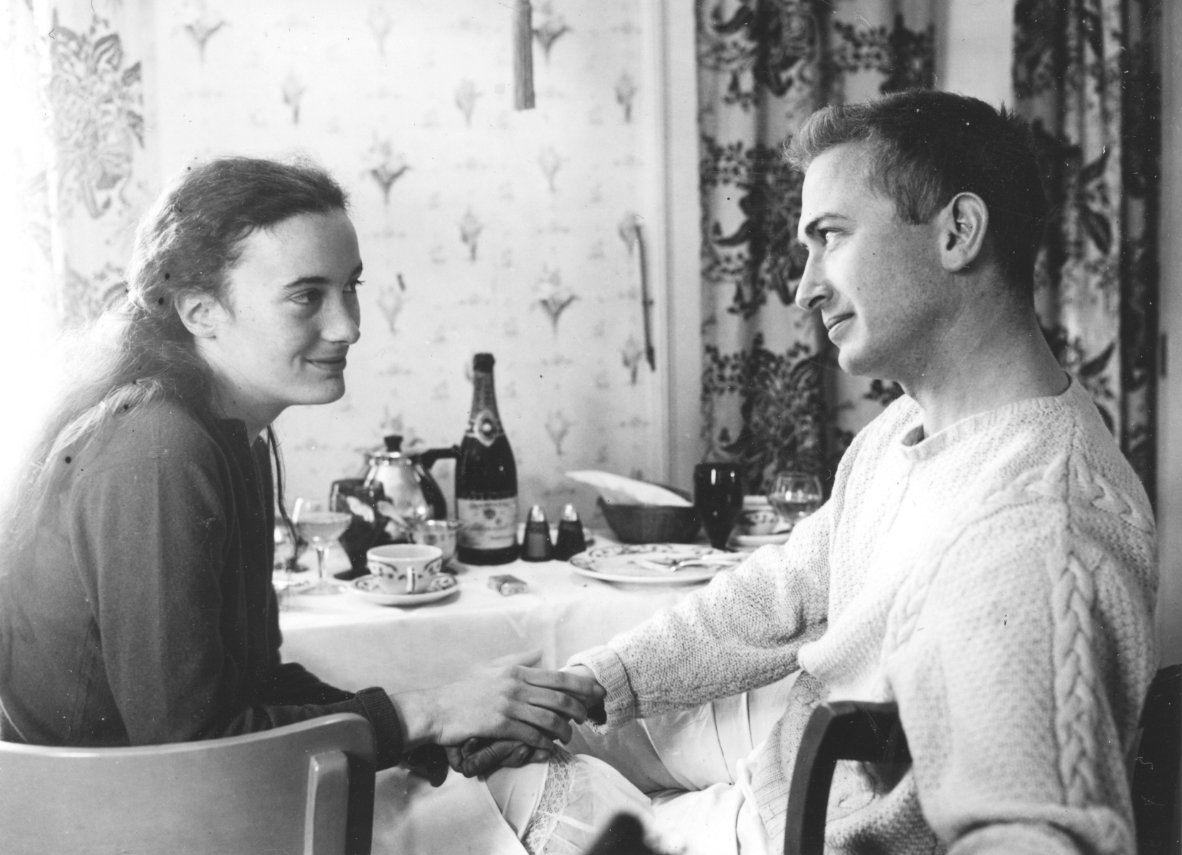
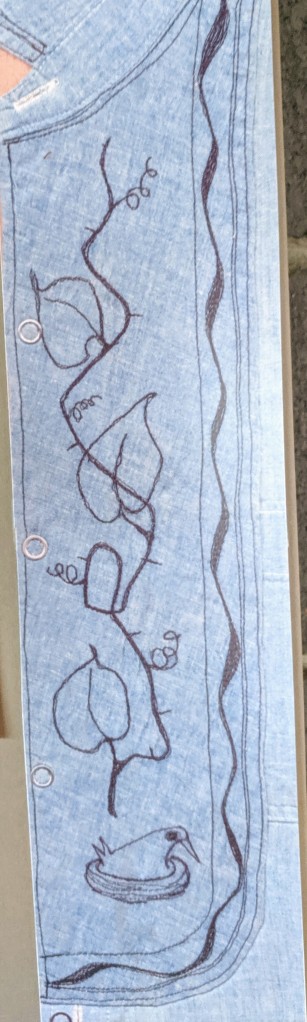
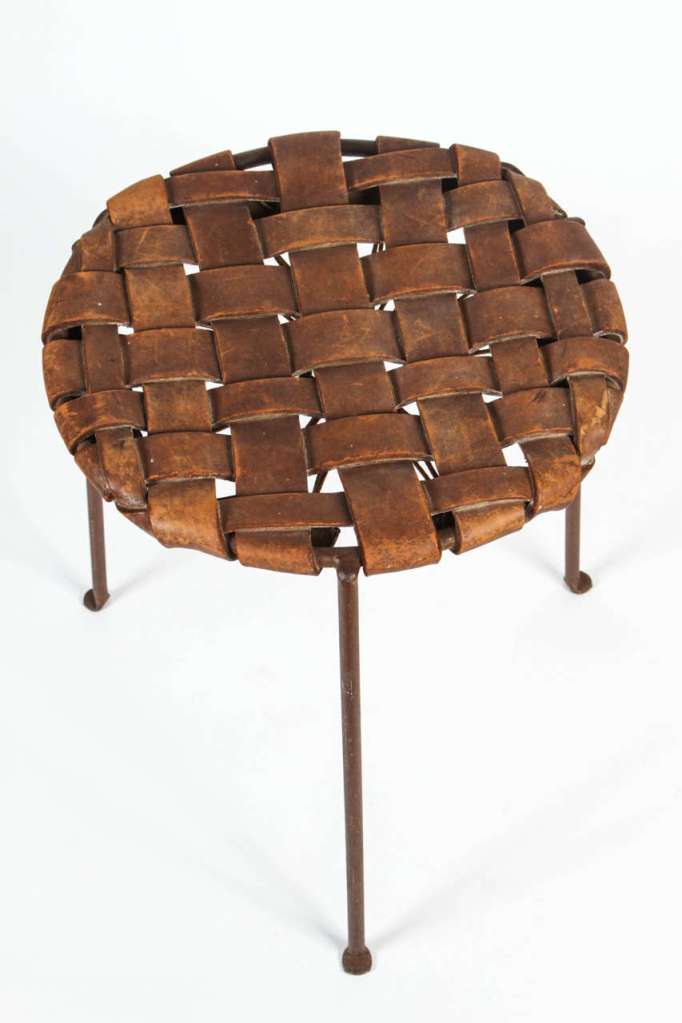
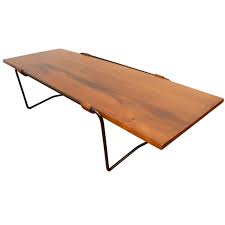
Don Monell and Lila Swift should rightly be included on any Massachusetts #MassModernism trail. Monell and Swift, co-founders and collaborators of their own wrought steel furniture design firm in 1950, Swift & Monell, husband and wife, architect and artist, were the Charles and Ray Eames* of Gloucester. Original examples of their woven leather, metal and enamel stools, tables, and bins are rare and placed in collections. The furniture was exhibited at Current Design (now ICA) and Furniture Forum. They operated the business in upstate New York when Monell worked for Sargent Webster Crenshaw & Folley. They built a studio for their business in their home when they moved back to Gloucester in 1952. Initial prototypes and editions were inspired by touring Lawrence Mills with Monell’s brother in law, who worked in the textile industry. Alex clarifies: “I do not know what mill my father’s brother in law was involved in or to what capacity, I just remember my parents toured it and found the source of leather. A Cambridge firm sold them for awhile. And later my parents gifted them as wedding presents to close friends and relatives. Ray Parsons a blacksmith from Rockport often made the frames and later I made some at Modern Heat.”
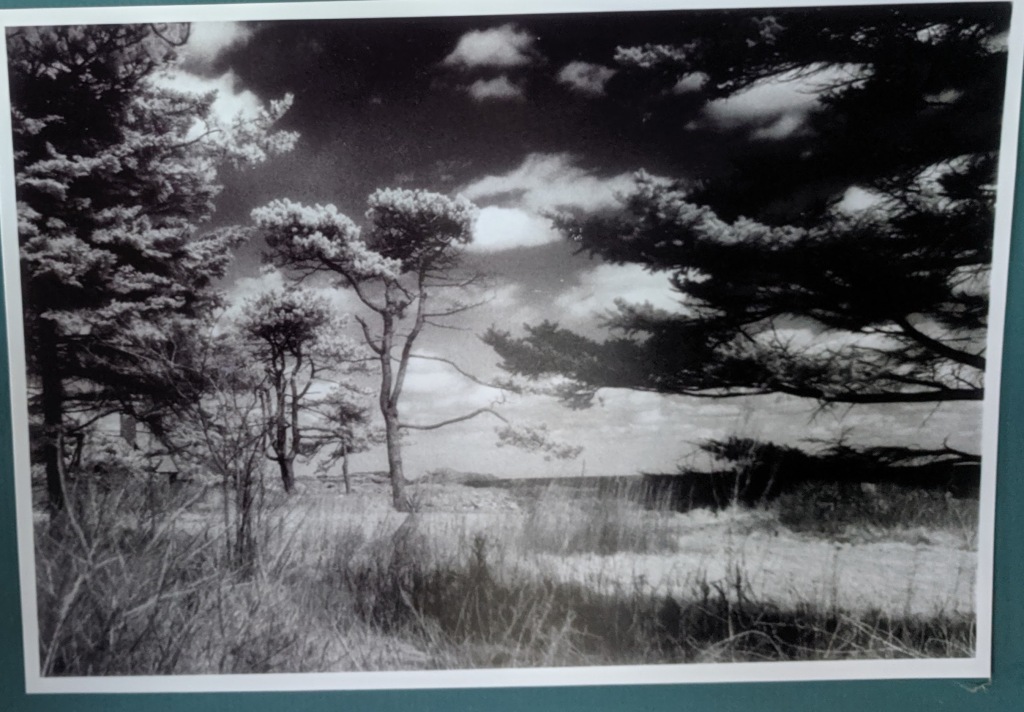
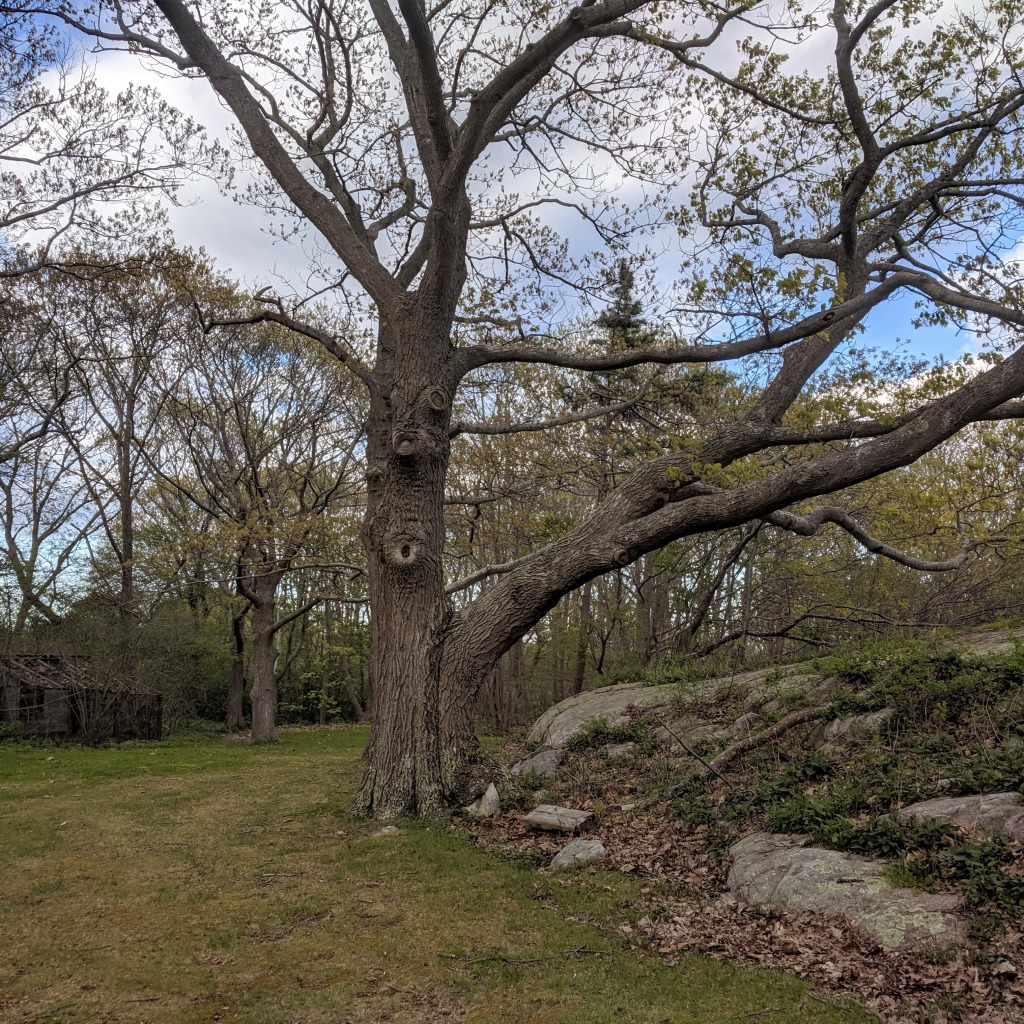


Note: Ray Eames was in Gloucester.
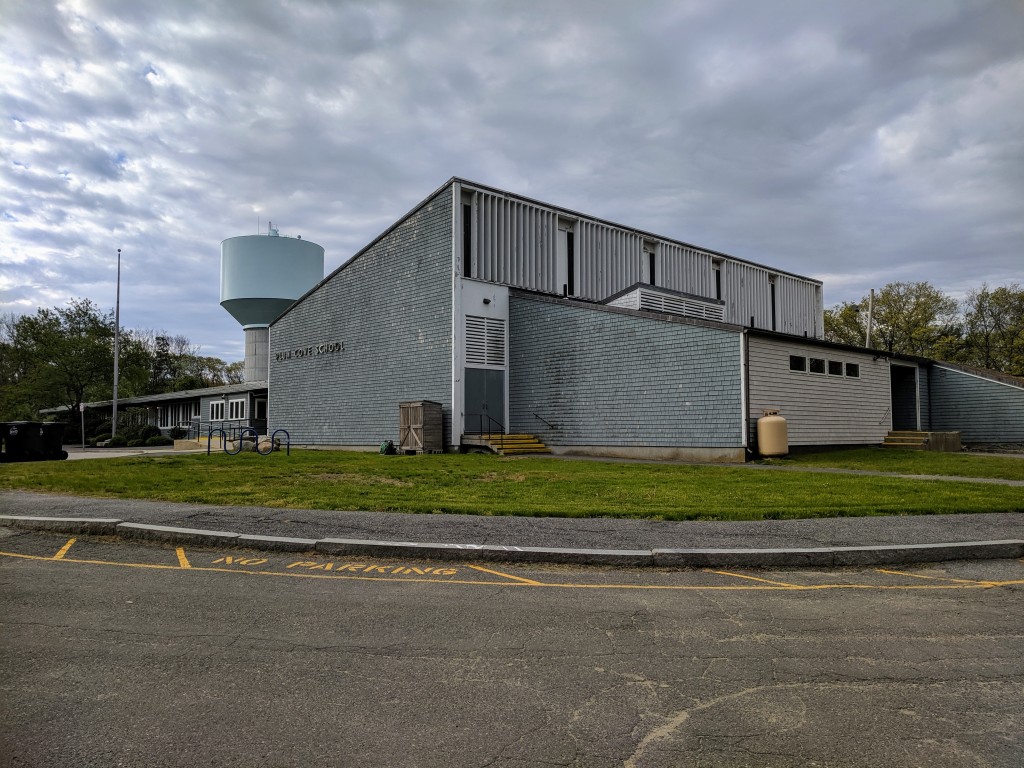
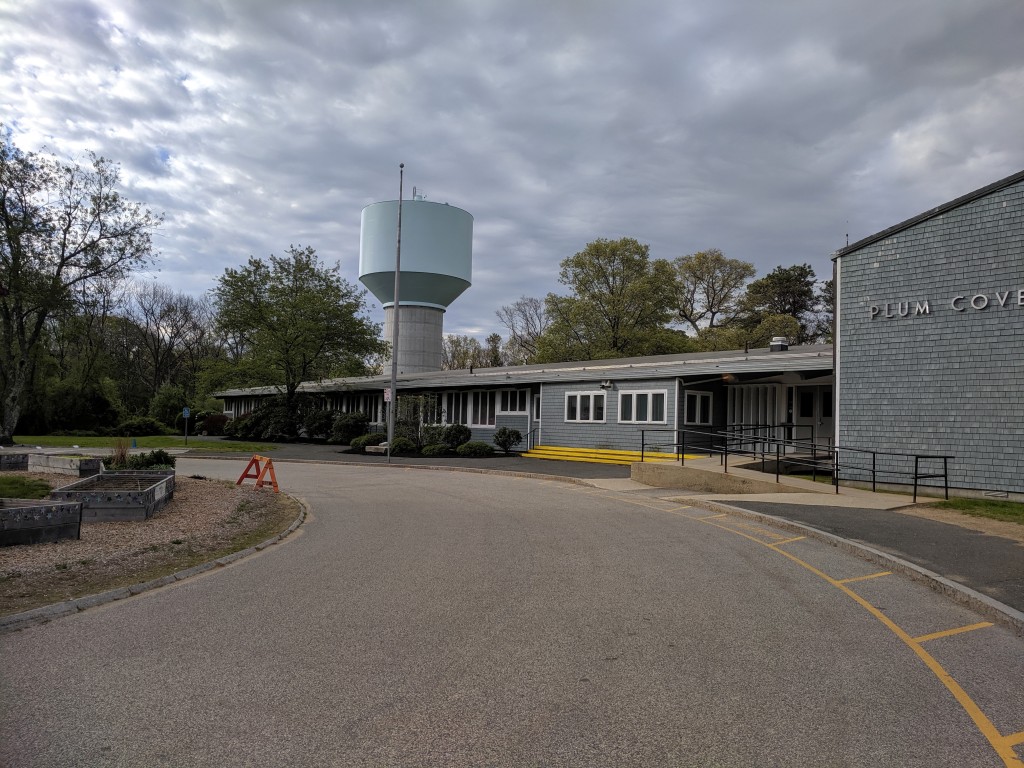
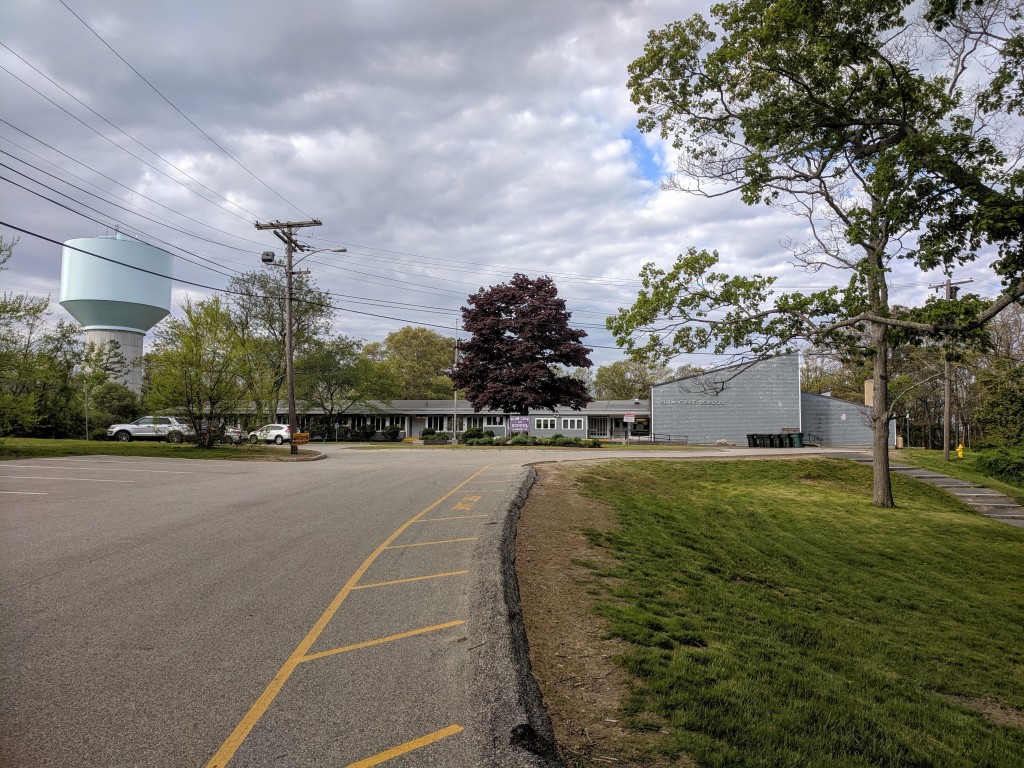
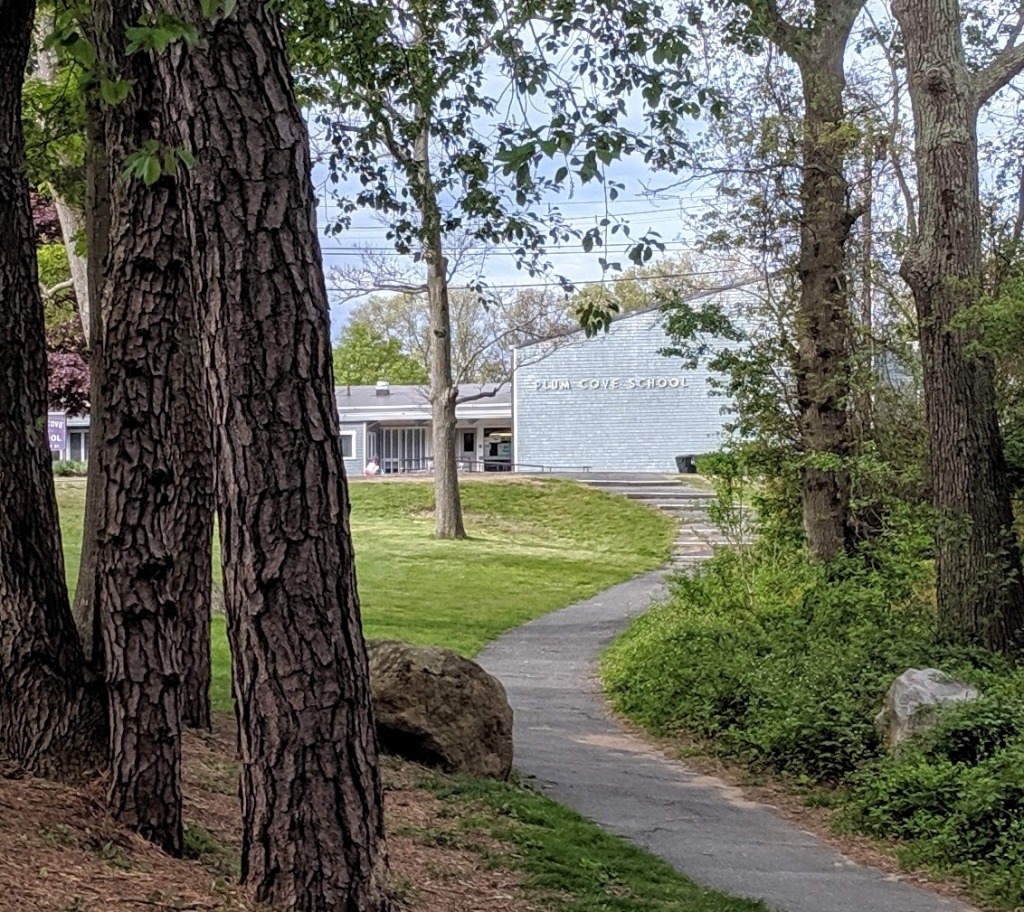
Before Hans Hofmann settled into teaching in Provincetown, he was invited to teach summer classes at the Thurn School of Art in Gloucester, Massachusetts, in 1933 and 1934. Thurn was a former Hofmann student. Ray Eames studied painting with Hofmann in Gloucester and was a student of his for years. Decades later (during an interview with Ruth Bowman, who was wonderful, and owned a fabulous Gloucester Hopper), Eames mentioned 1940, a later date, for when she first learned about Hofmann. On an architecture timeline” Charles and Ray Eames were born in 1907 and 1912 respectively, and Monell in 1917. They were married about a decade before Monell & Swift and west coast rather than east. Yet they were contemporaries. Art & Architecture case study homes began in 1945 (Eames house, 1949) Eames lounge chairs were manufactured in 1956 (after years of prototypes). Gropius House in Lincoln , Mass., landmark Bauhaus residence now museum was built in 1938, same year as MoMa Bauhaus exhibition. The Graduate school at Harvard designed by Gropius was a TAC (The Architects Collaborative) build in 1950. TAC was founded in 1945 with the clout addition of Gropius who continued with the firm until his death in 1969. Original 7 founders were Norman Fletcher, Louis McMillen, Robert McMillan, Ben Thompson, Jean Fletcher, Sarah Harkness and John Harkness. Twenty years later, Monell’s Plum Cove elementary school design in 1967 (see below) was leveraged by partnering with The Architects Collaborative. Gloucester’s Plum Cove school is a TAC build. Wikipedia lists several commissions. The school could be added.
Catherine Ryan

The Monells were friends with many artists and Gloucester residents. They were best friends with Sarah Fraser Robbins which is another rich “green” connection. The Monells were married at her house and living there when their first son came home! Eventually they built their dream home in Gloucester designed to maximize its stunning natural setting, all granite and ocean views. Their family and business grew. Lila’s art and home are inspired by wild nature, especially birds and insects, often the subject of her prints and photographs, and even wardrobe embellishments. (More than one person recalled a striking faux brooch or embroidery like adornment that was actually a coiled live centipede.) Domestic animals and wild birds were part of the family. There were always pet crows and birds. “Our mother raised geese and guinea fowl,” Alex continued, “Mainly the birds we had were ones she brought to rescue from oil slicks and other calamities. She was well known as someone to bring an injured bird to.” Lila wrote an article in the Mass Audubon newsletter about two cormorants which she had a permit to raise. “Sarah (Fraser Robbins) had an old lobster boat, never used as one.” Alex recalled. “They used it for fishing. Our families were quite close. We’d head to Norman’s Woe and bring back seagulls. You know, rescue babies, and help teach them to fly.” He said he got them comfortable being tossed like a glider. “They’d come back again and again ready to launch!” It was easy to imagine some glimpse of his childhood in this idyllic setting. His delight brought to mind My Side of the Mountain by Jean Craighead George and Driftwood Captain by Paul Kenyon. Sea and stone. What a playground!
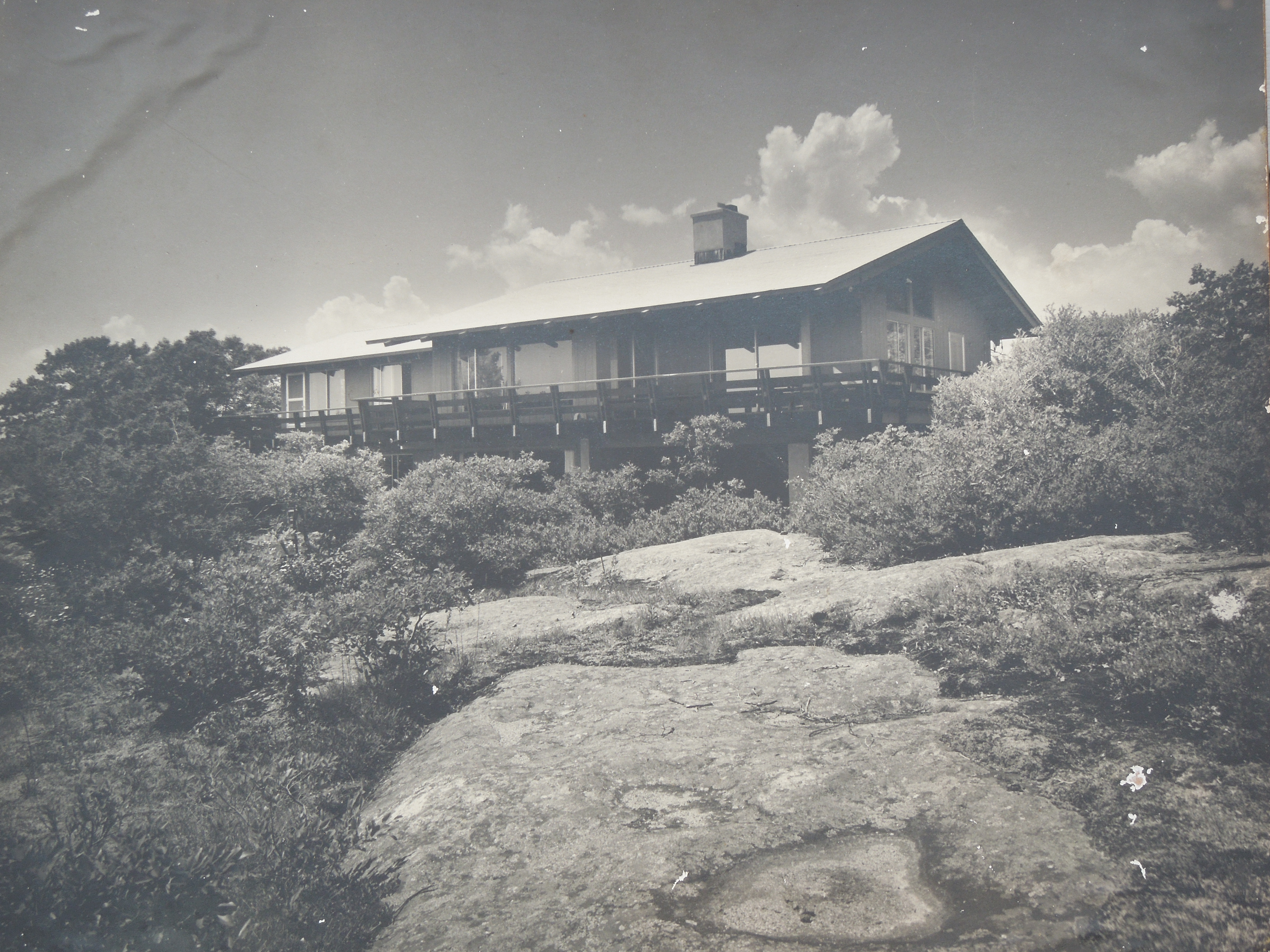
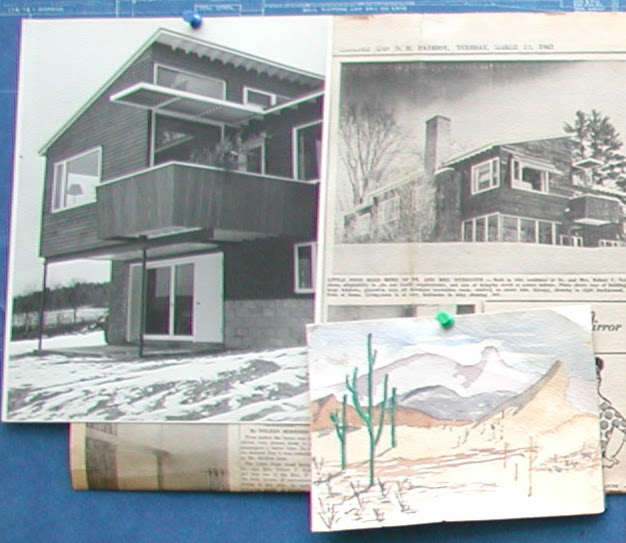
Monell completed many commissions in Gloucester and elsewhere on the North Shore, New Hampshire and New York. Any renovation and remodel at Sawyer Free is an incredible chance to celebrate his work and honor his legacy. After considering examples of Monell’s architecture it is easy to find his personal design in the work he did at Sawyer Free Library. He was trained as a landscape architect as well which helps to imbue his projects with great sensitivity and gentle passages. Many of his commissions are heavenly sites where buildings serve the surroundings, whether built or natural. His designs are better because of this reverence for context.
(Note on images- double click to enlarge)
Monell designed numerous private residences and additions [e.g. Dotty & Lawrence Brown (1957), Laight (1958), Despard (1959), Boyce (1961), Foster, Nydegger, Marietta Lynch, Judy Winslow, Bob and Libby French (1967), Featherstones, John Hays Hammond Jr, and Phil Weld (many)] in Massachusetts, New Hampshire and New York. Several clients were repeat customers. The Brown home is one example. Alex writes that “the residence was altered by my father in the late 70s to accommodate a library when they moved there year round.” Much of the big collection of books were cookbooks. “Dotty was a great cook and good friends with Julia Child.”
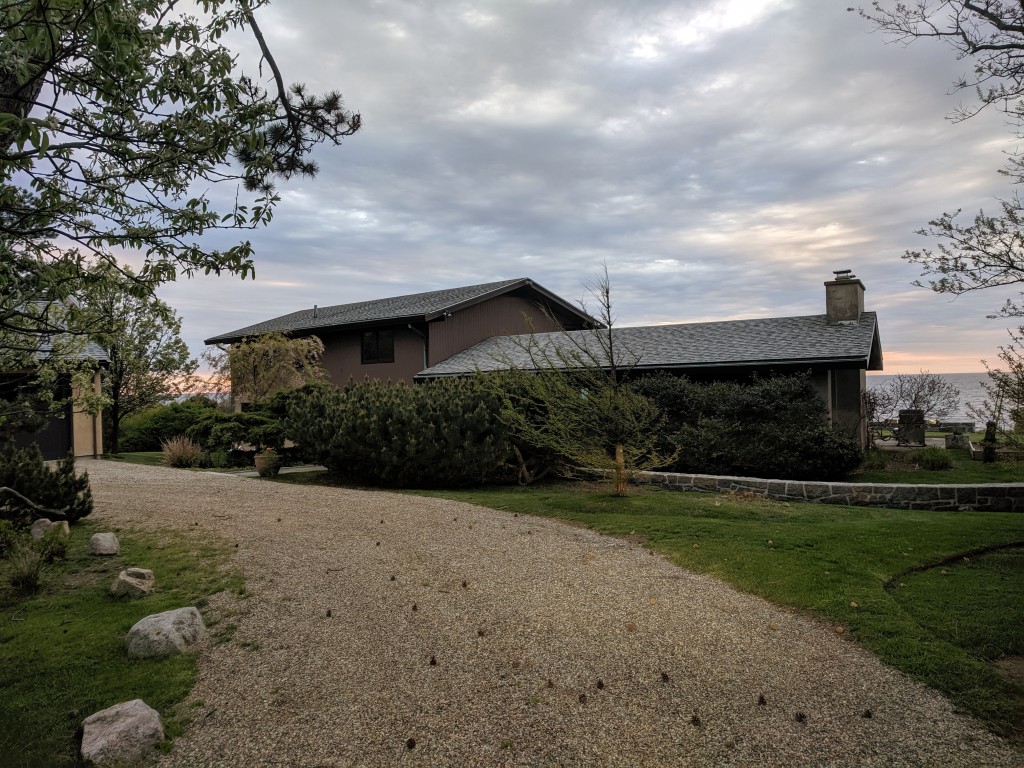

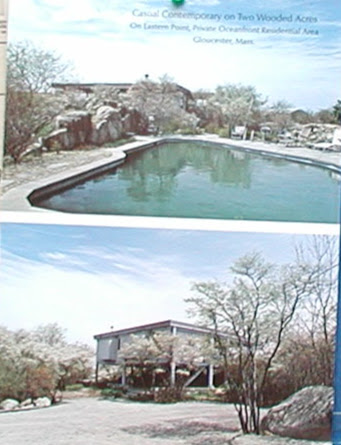

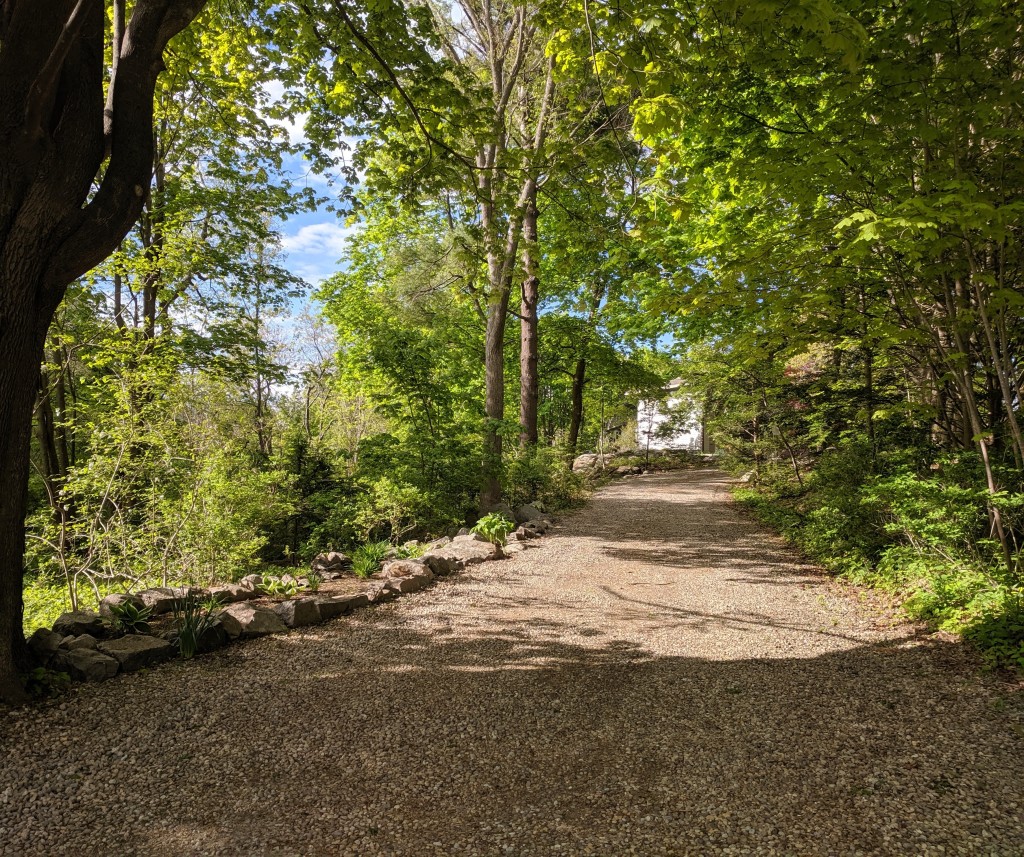


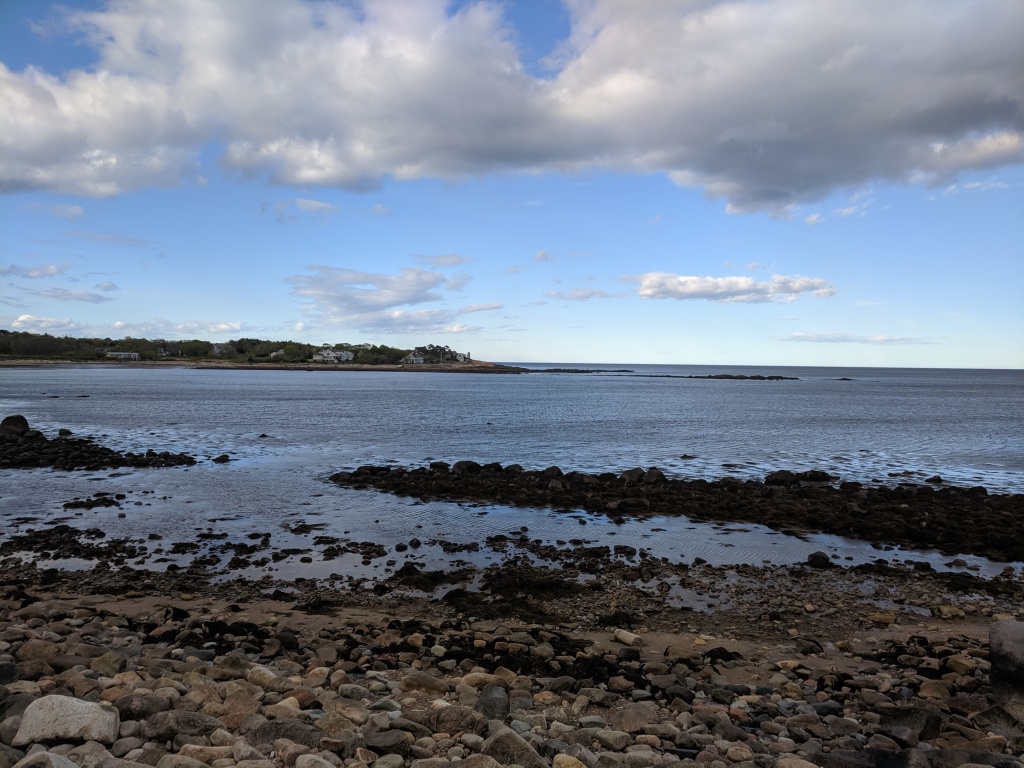
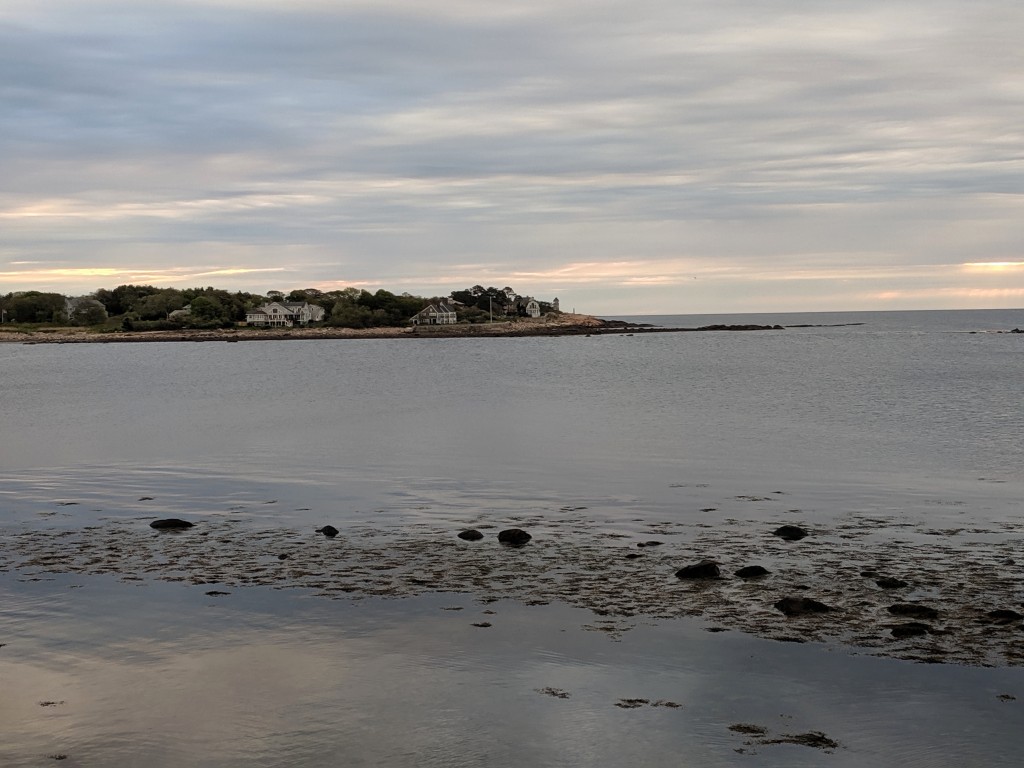

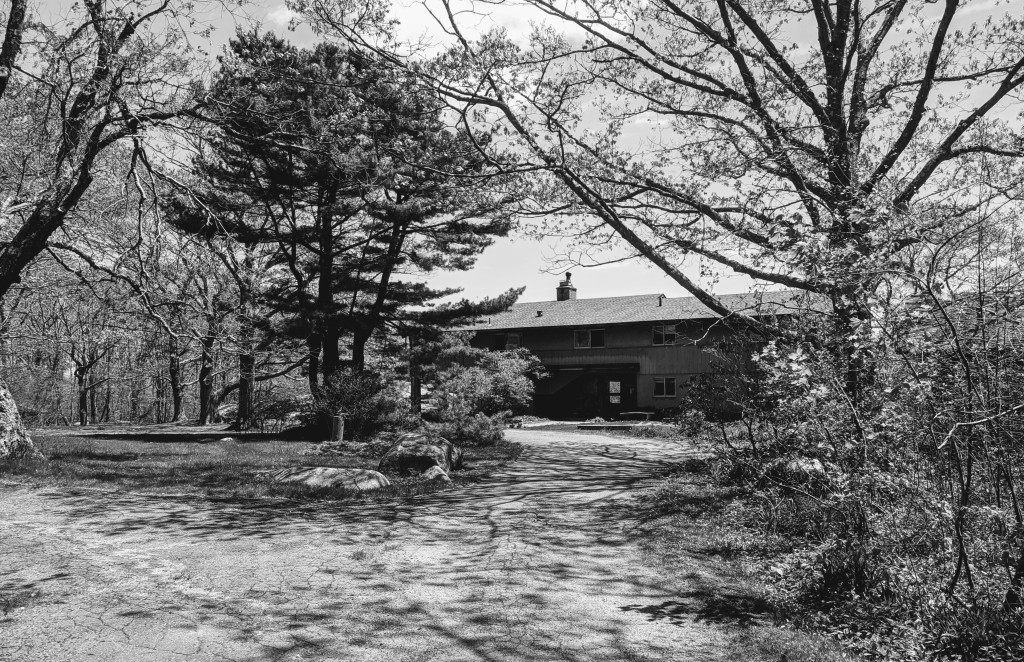


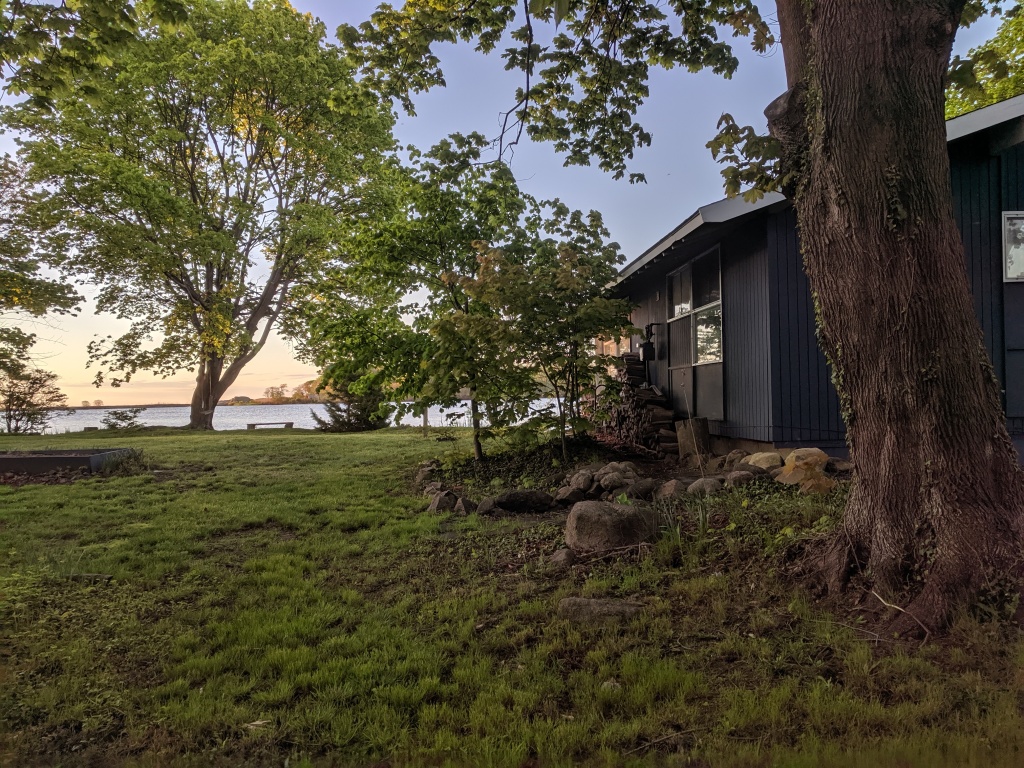
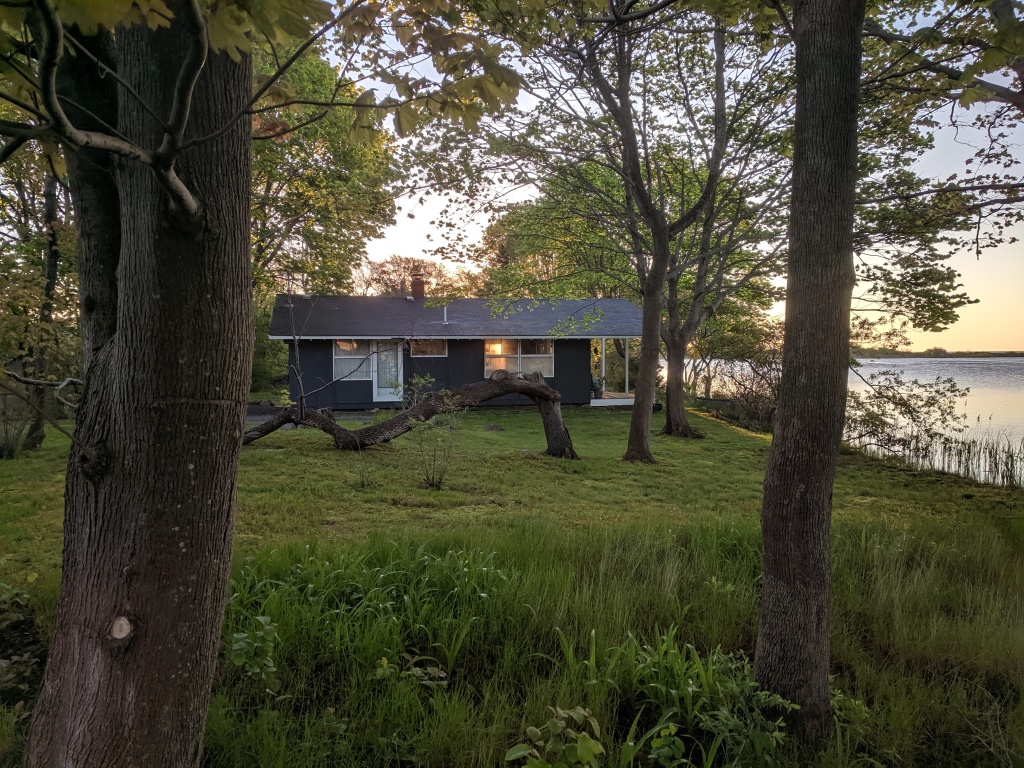
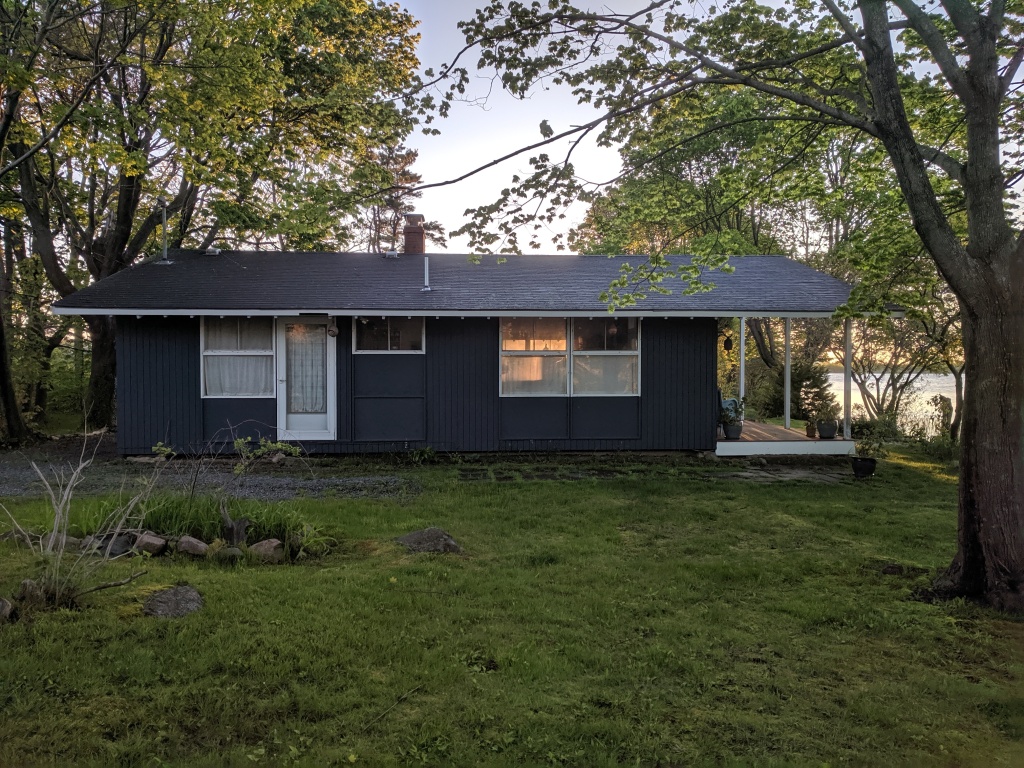
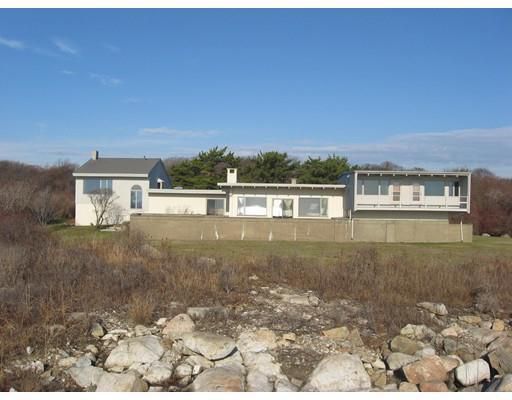
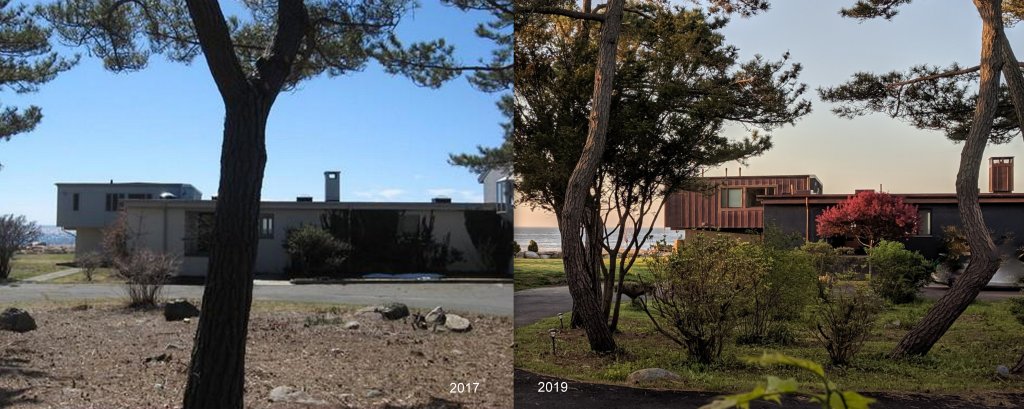
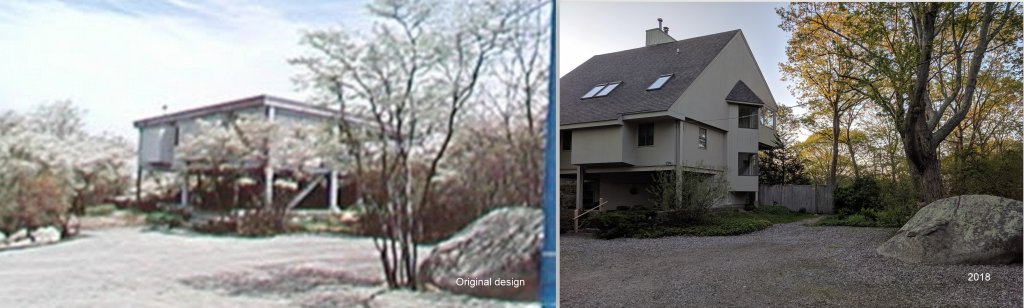
Within a few short years of moving to Gloucester, Robert and Elizabeth ‘Libby’ French expanded their art collection, he was elected Mayor, and they commissioned Monell to design their home and property in 1967. caption: video shows interior/exterior and was published in 2016. I don’t know when it was filmed. Small lovely moments – note the interior staircase railing, and exterior deck and bridge to glacial boulders. Clearly some modifications since it was designed in 1967 and perhaps since this video.
Besides the Gloucester Lyceum & Sawyer Free Public Library commission, Monell government and public buildings include the Beverly Newspaper factory and offices, Eastern Point Retreat, Plum Cove School, and the Cape Ann Historical Society. Elements of his signature architecture resonate strongly with the work he did at the library.
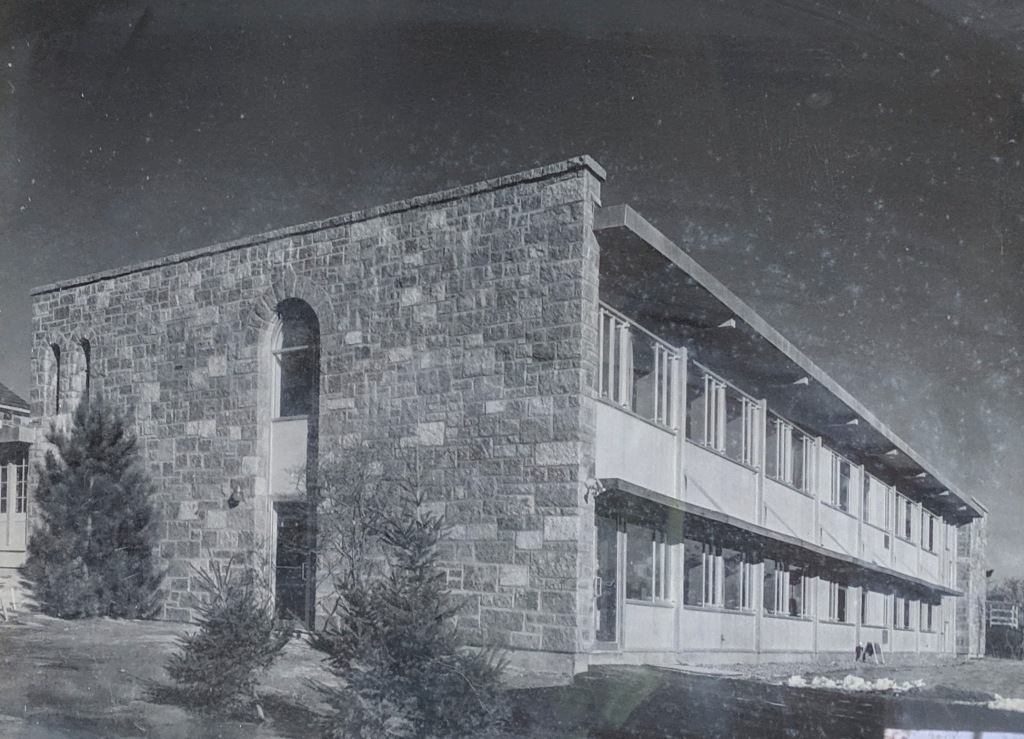
Eastern Point Retreat House, Dorm & Dining Halls 1960
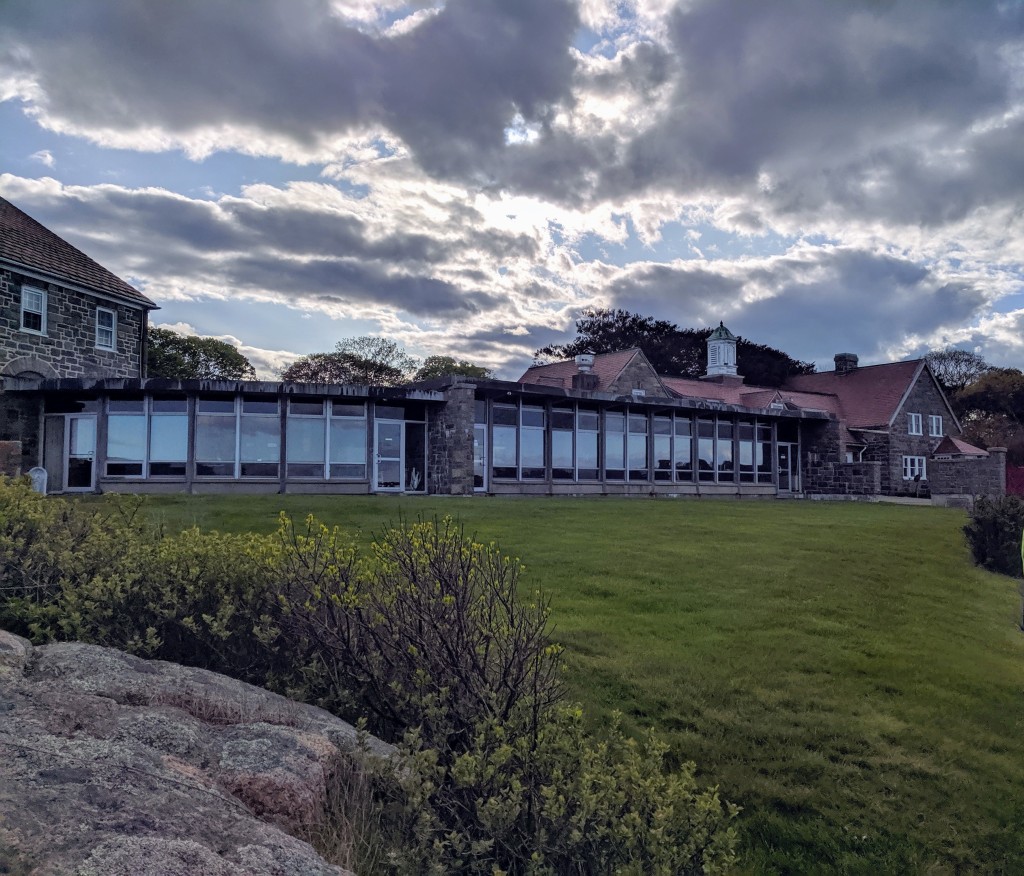
For the Gonzaga project, Monell joined two buildings and built a cafeteria and dormitories. Recently his original work at the entrance, connector and dormitories was razed. The historic photos BEFORE illustrate his artistry and display a strong connection with the design Monell established at the front of the library on the stacks building between Saunders and the expansion.
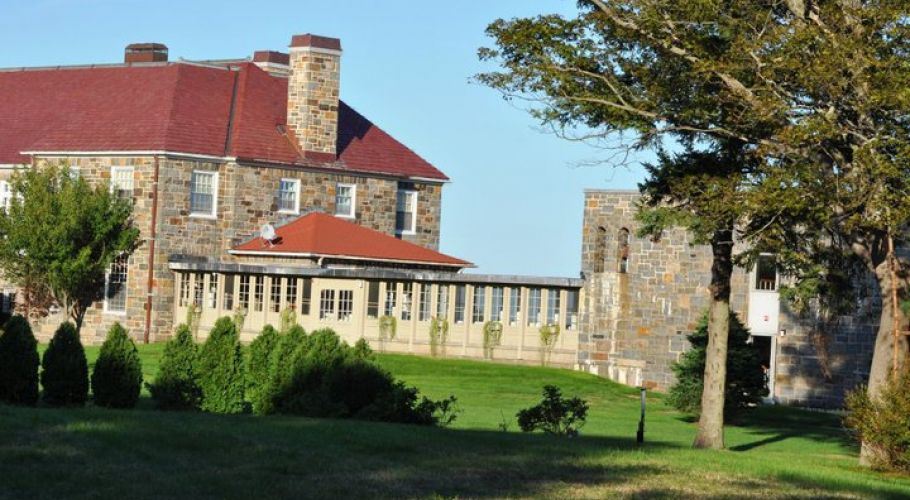
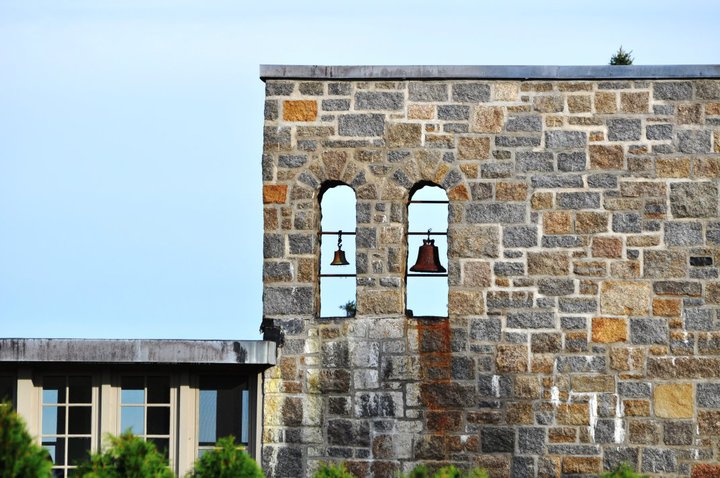
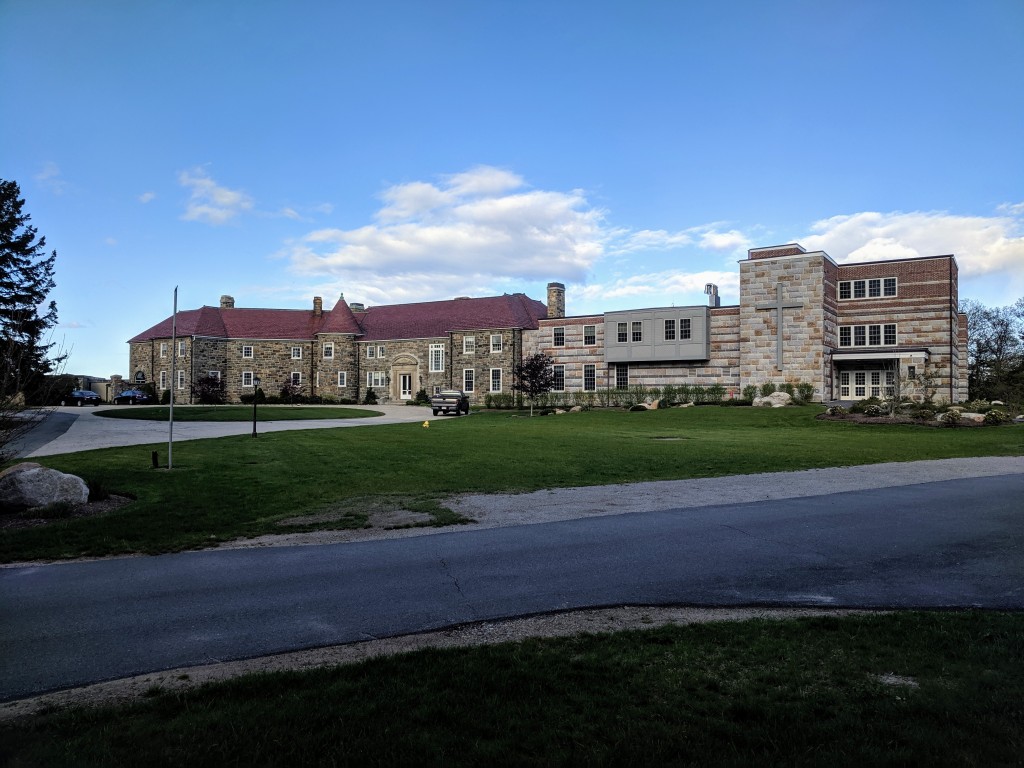


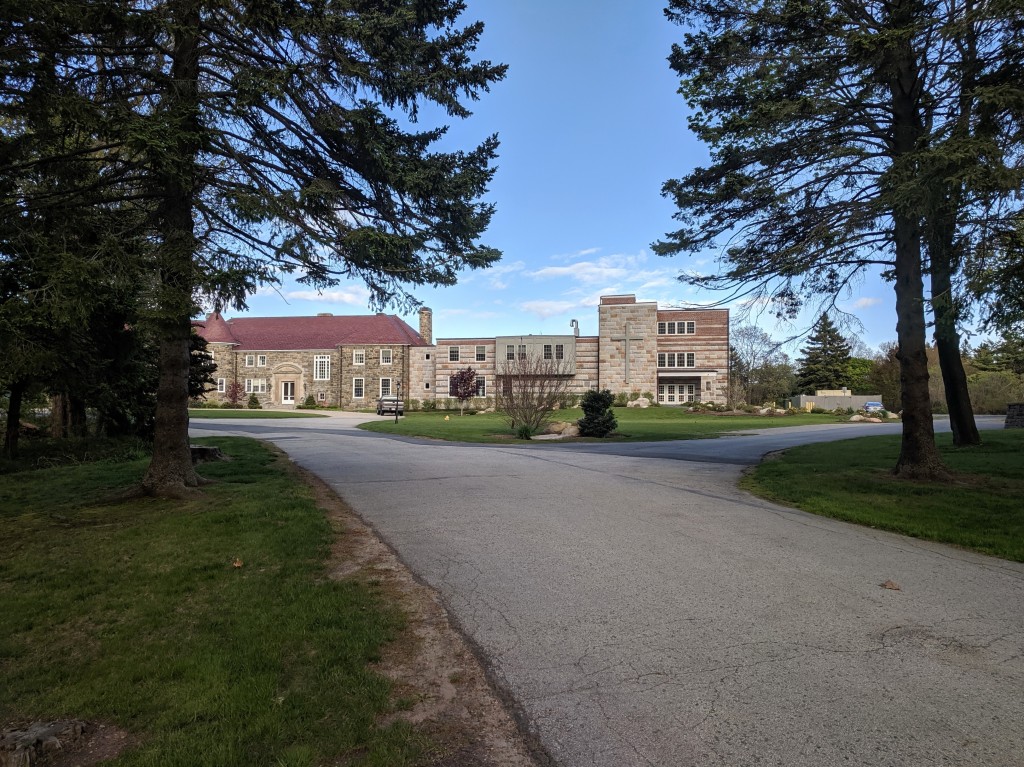
BEFORE / AFTER – dorm, far left (ocean side)
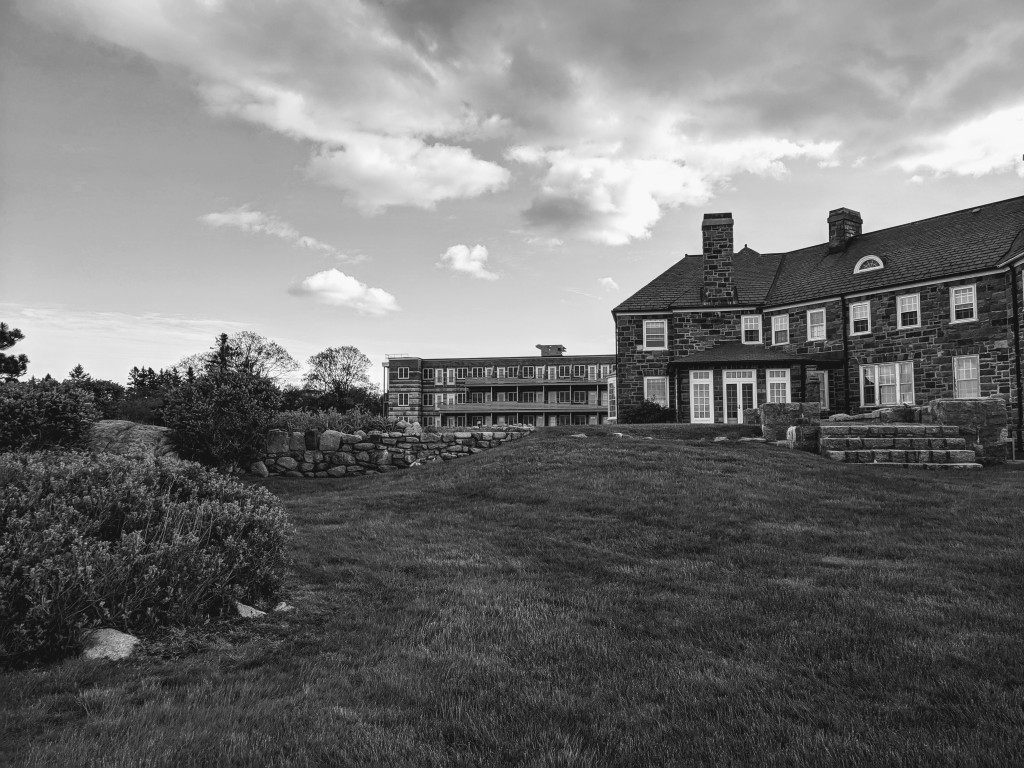
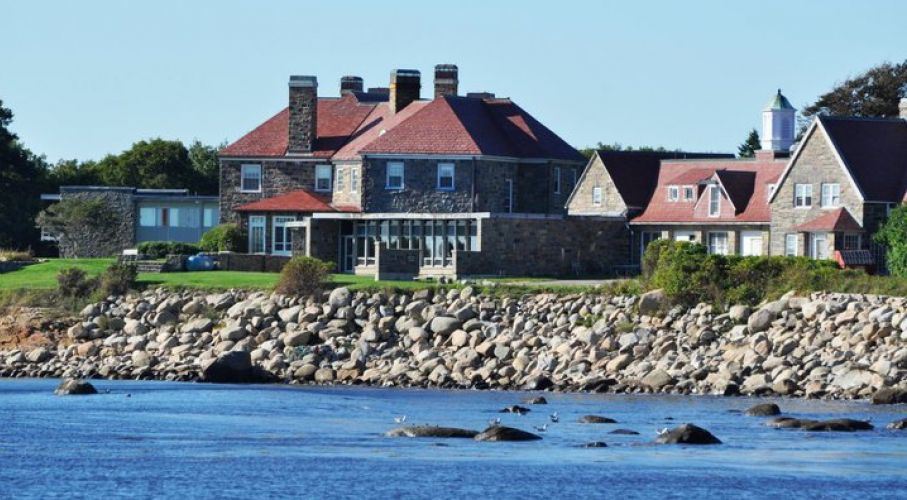

BEFORE / AFTER – dorm (parking side)
Microphone were set up to amplify sounds of the ocean (white noise) within the dormitory

BEFORE /AFTER – cafeteria low glass ceiling (ocean side) remains


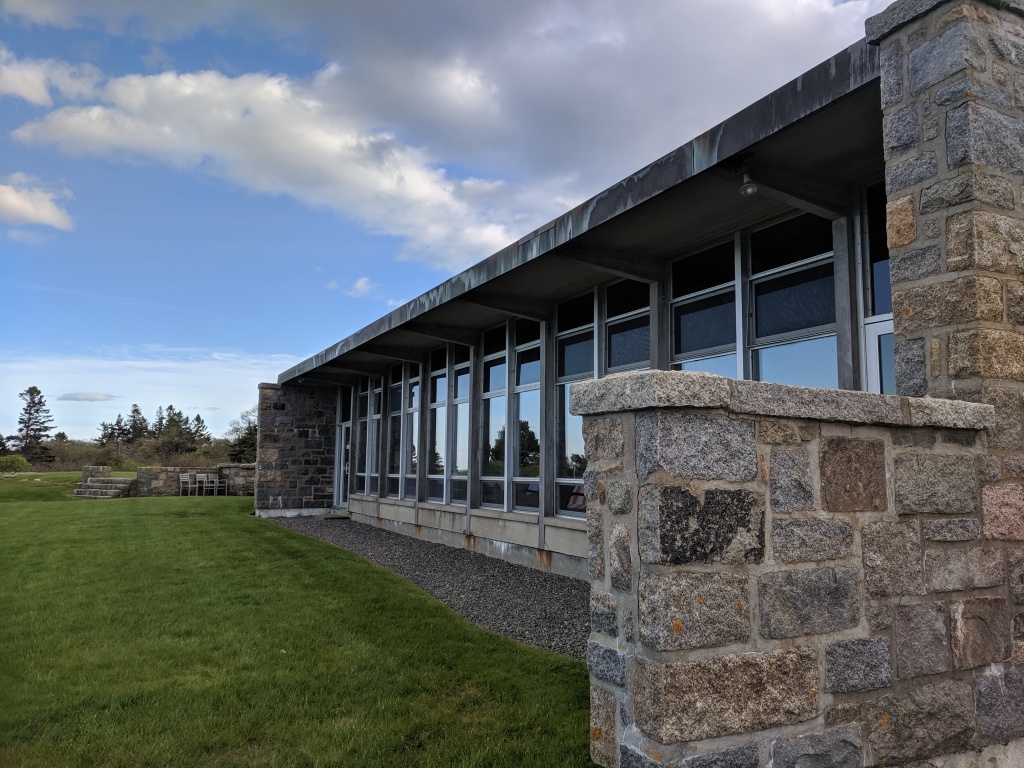
Monell subcontracted/collaborated with TAC for build
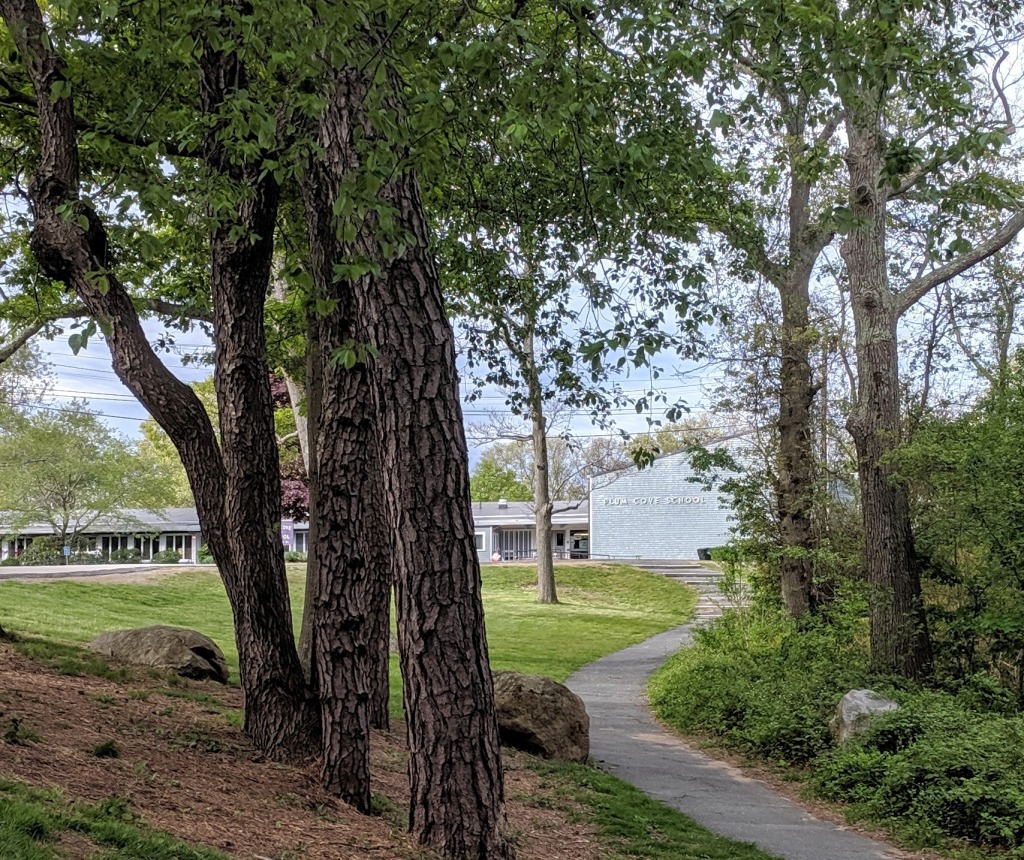


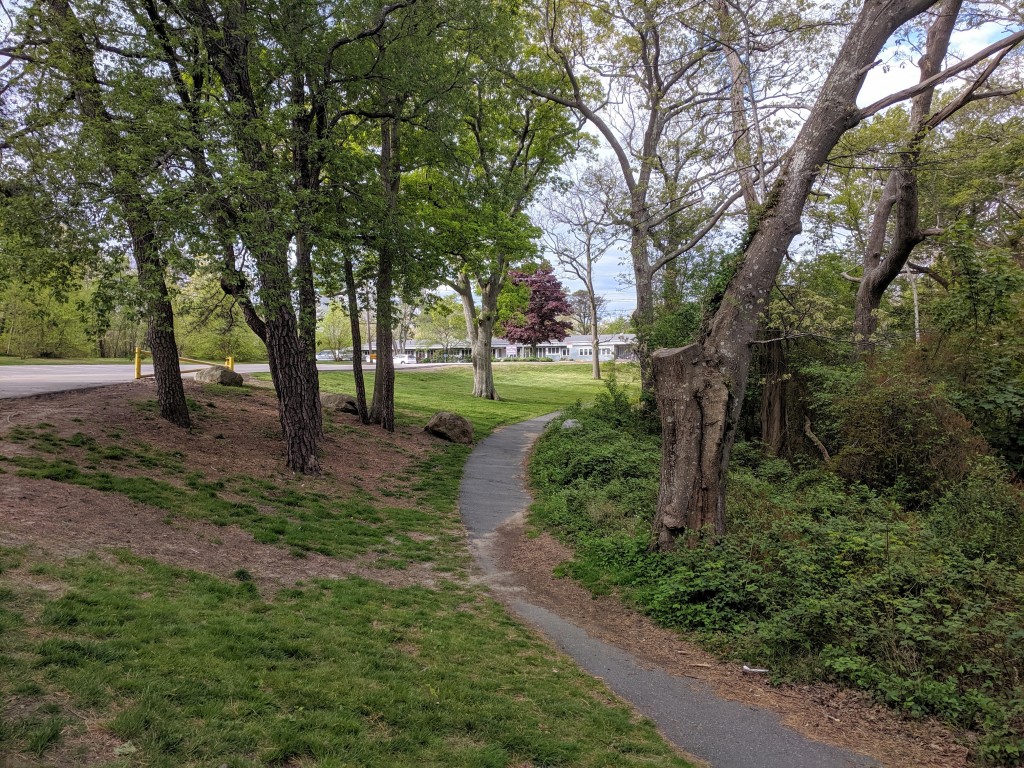
Beverly Newspaper Offices and Factory (now Salem News)
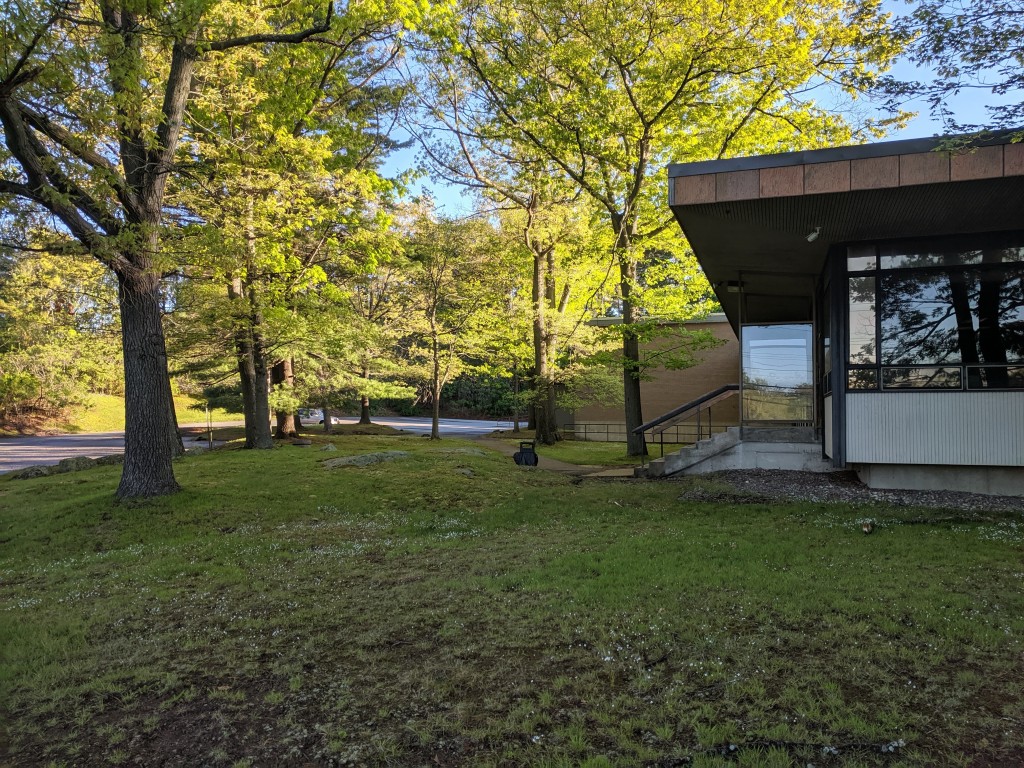
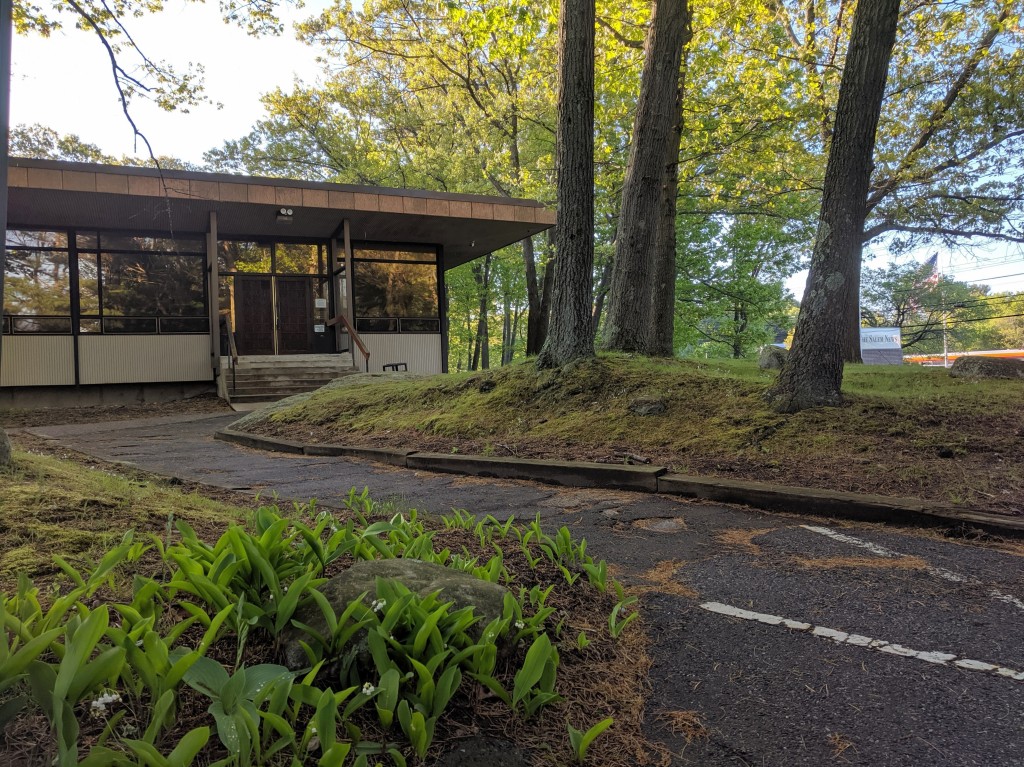
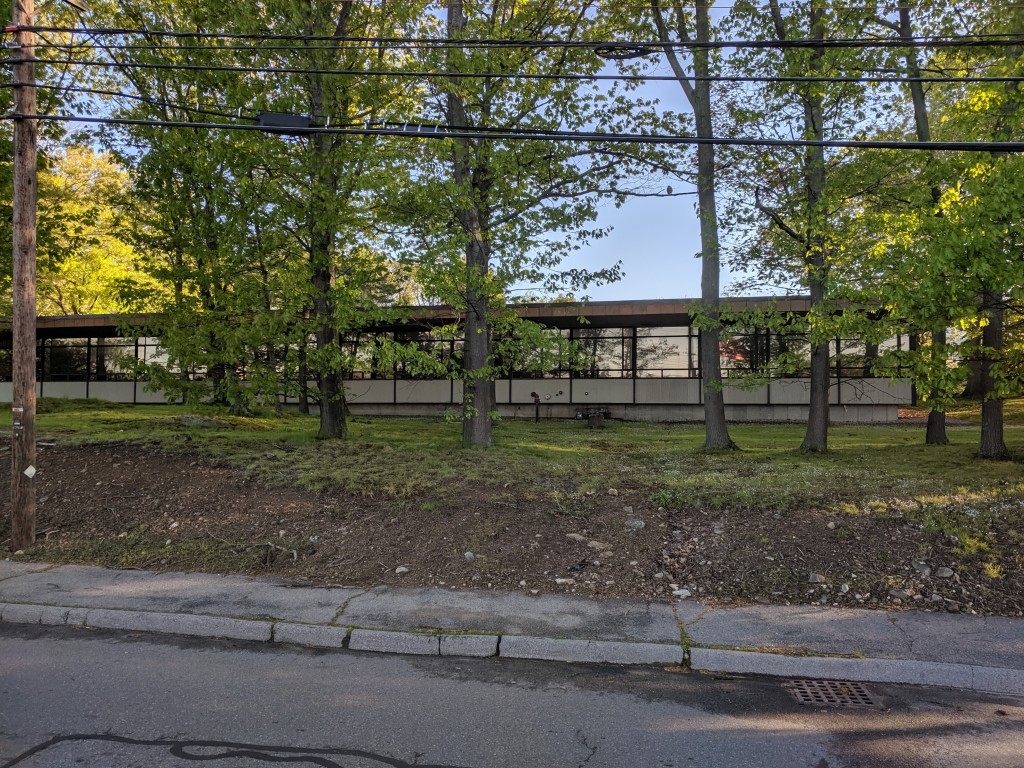

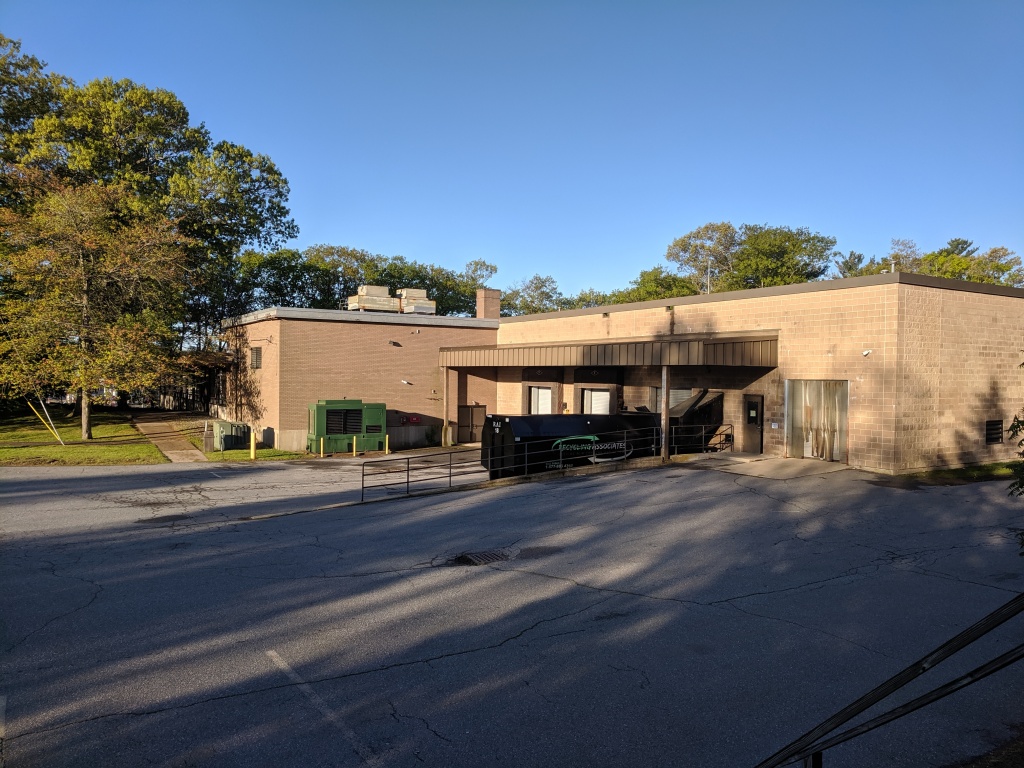


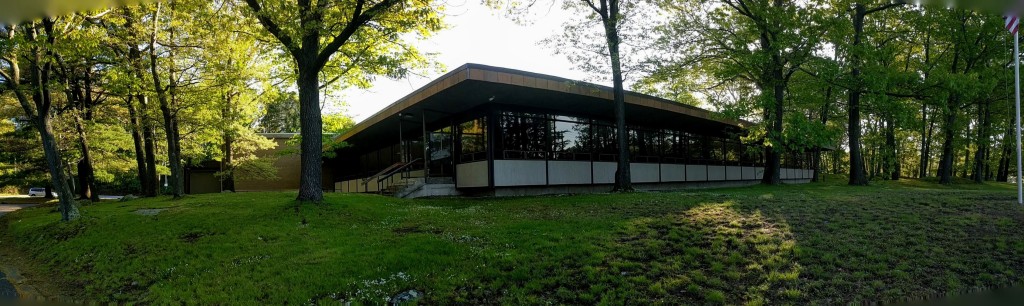
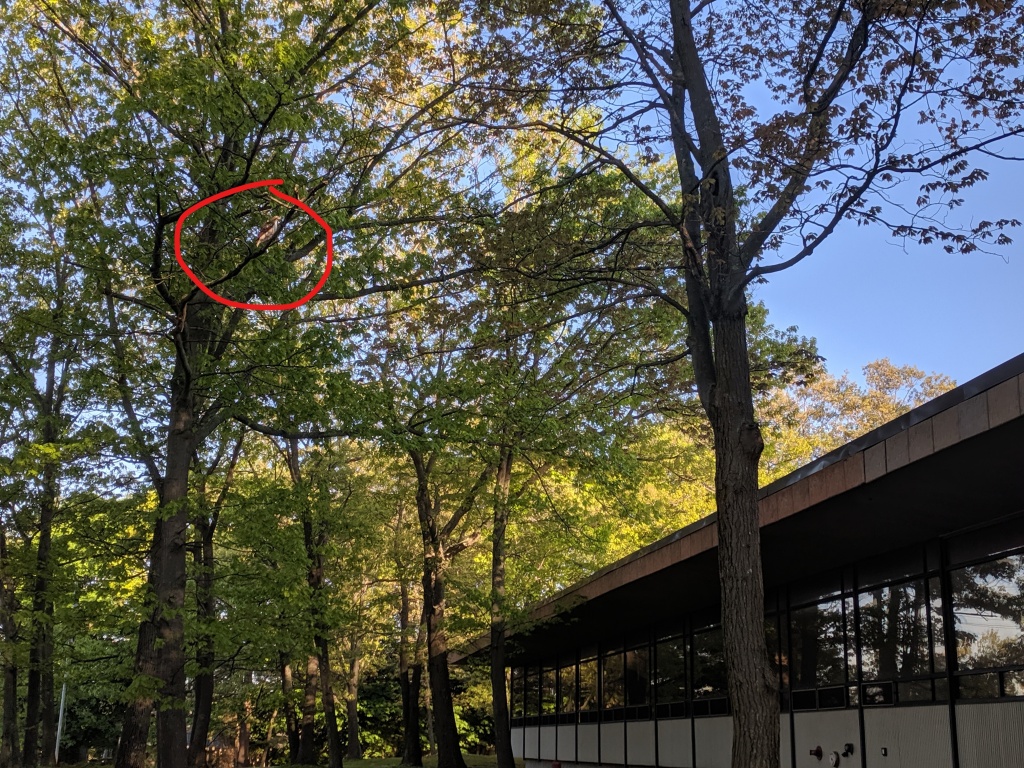

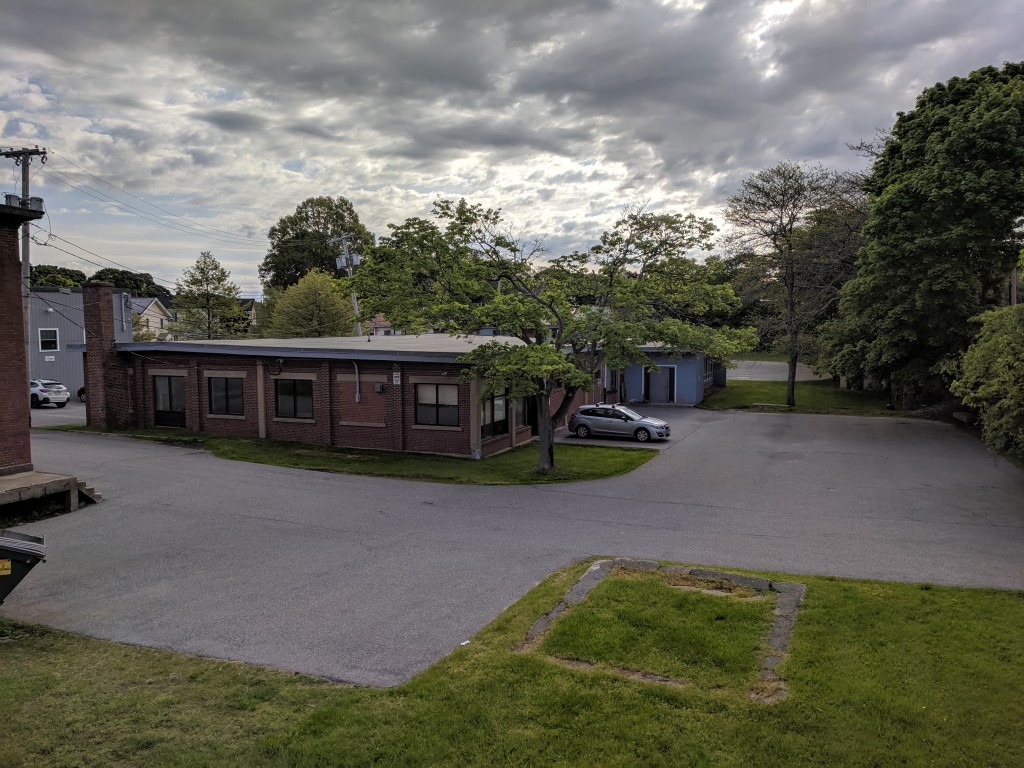
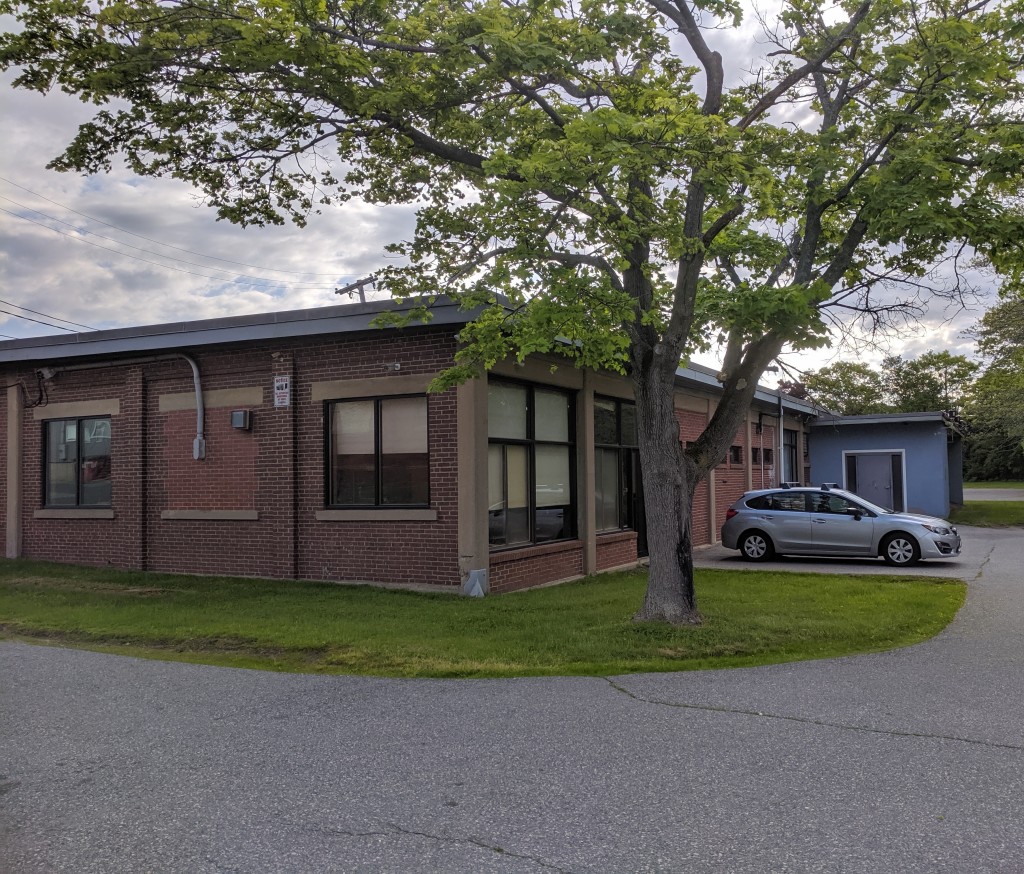


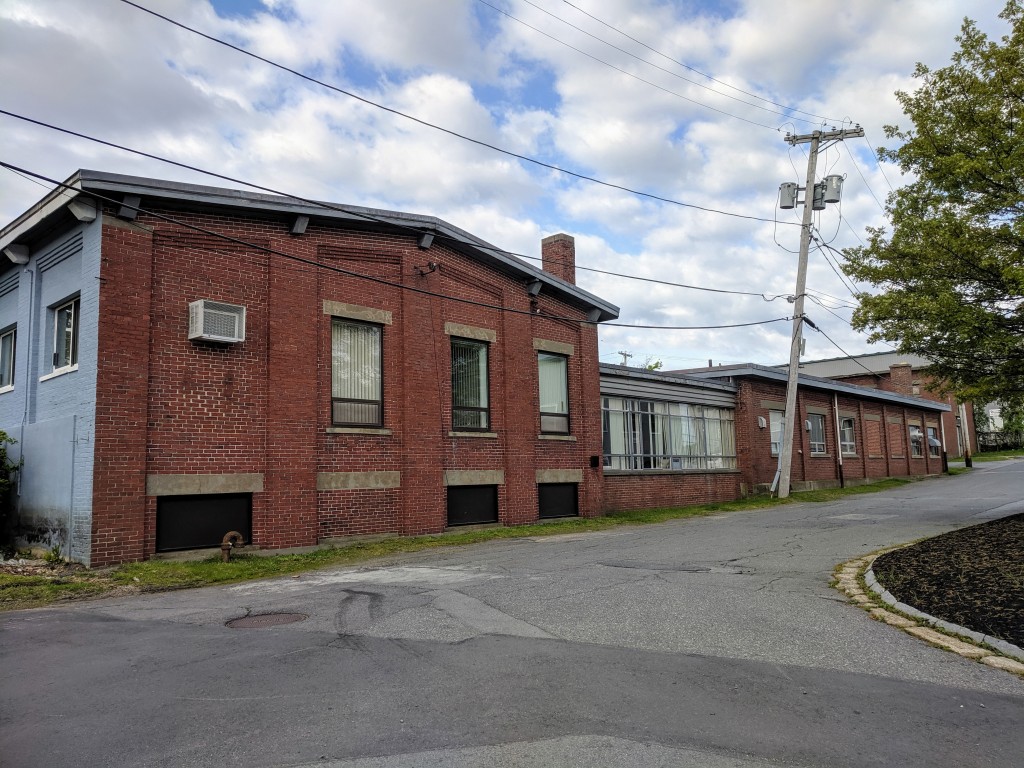

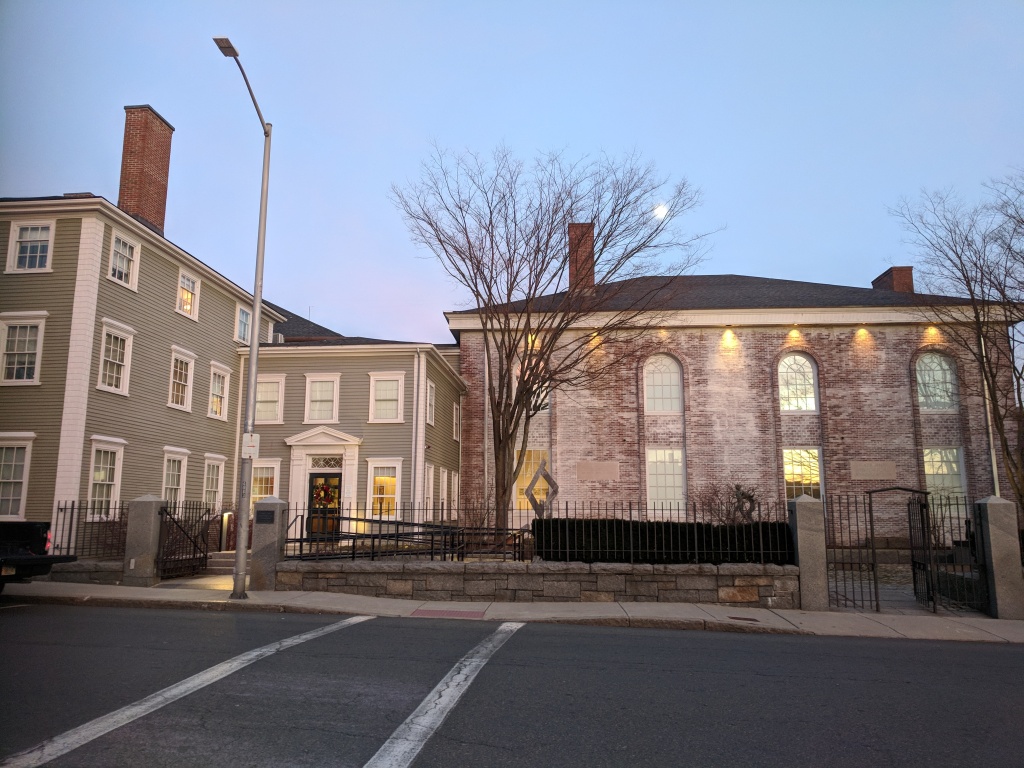
Circa 1967 plans for property by Grant Circle
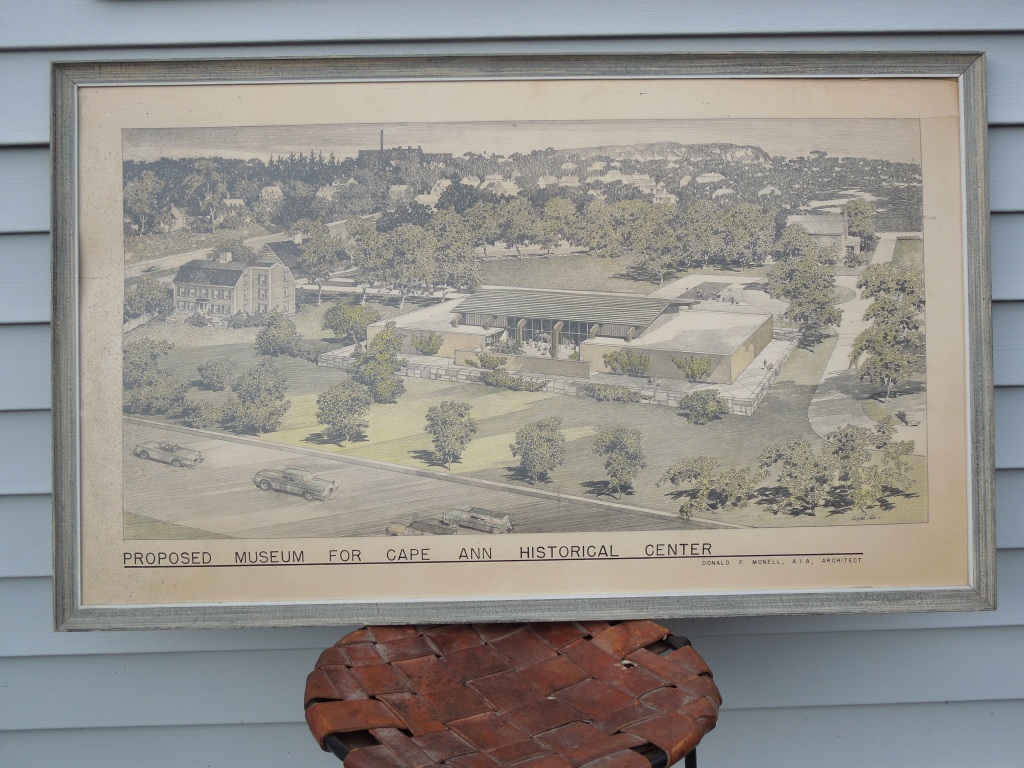
Monell’s work at Cape Ann Savings Bank has been altered at least 2x since his commission. Here are a couple of placeholder “before” snapshots until I obtain better examples. Before (courtesy photos)/After example – Note changes like the Monell staircase design vs replacement and office additions vs open floor plan. The arch window motif remains.
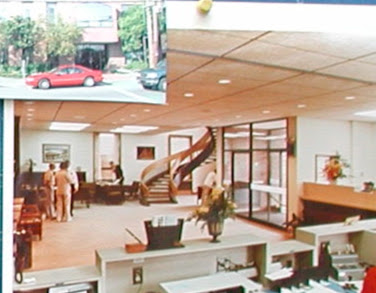

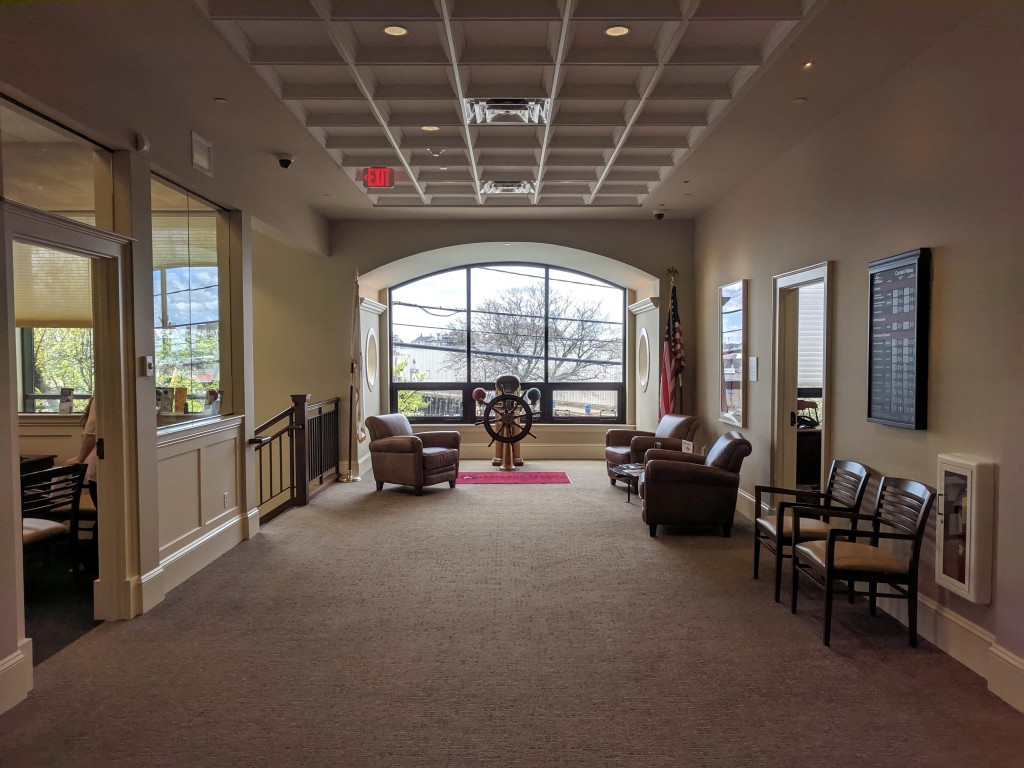
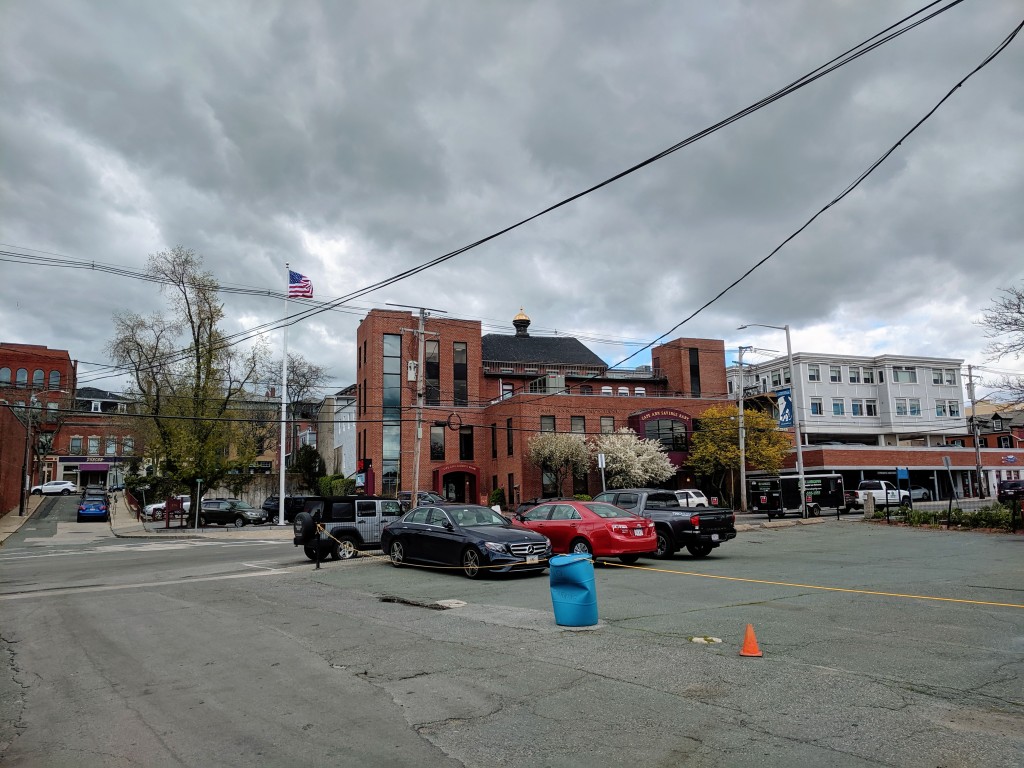
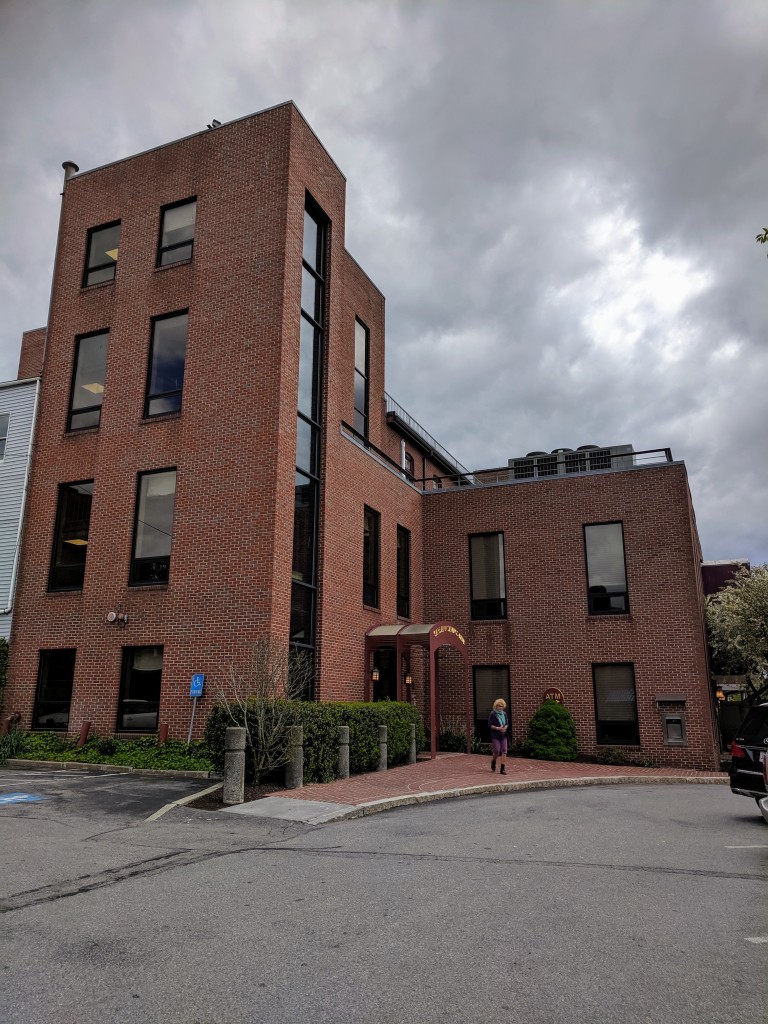

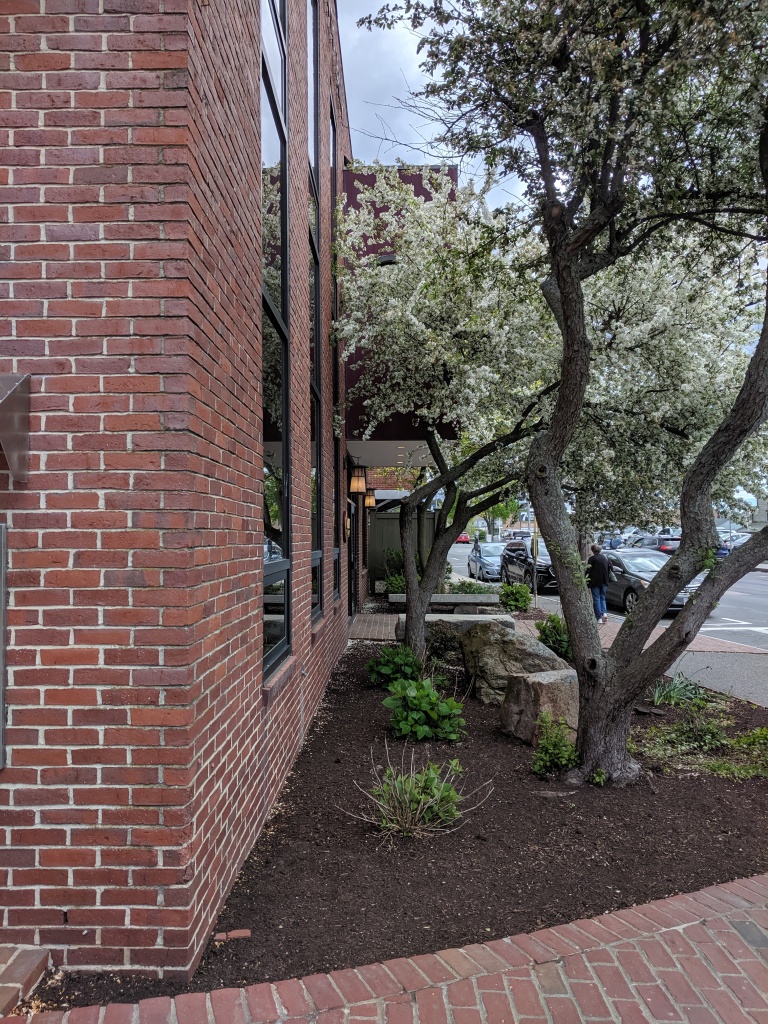
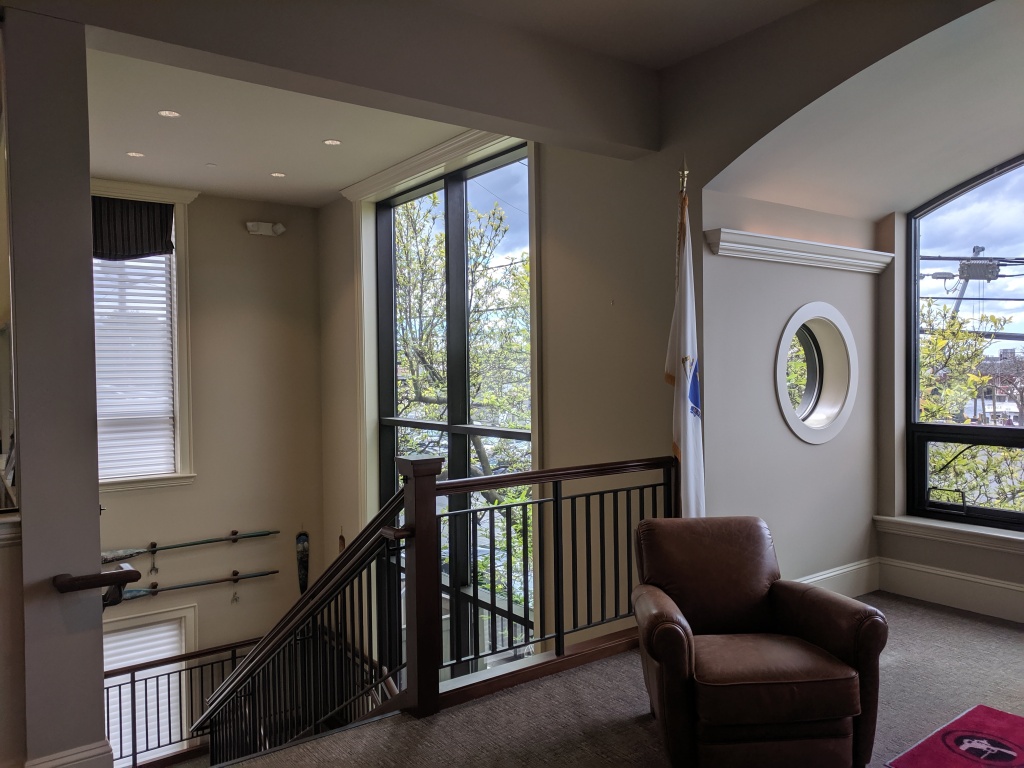
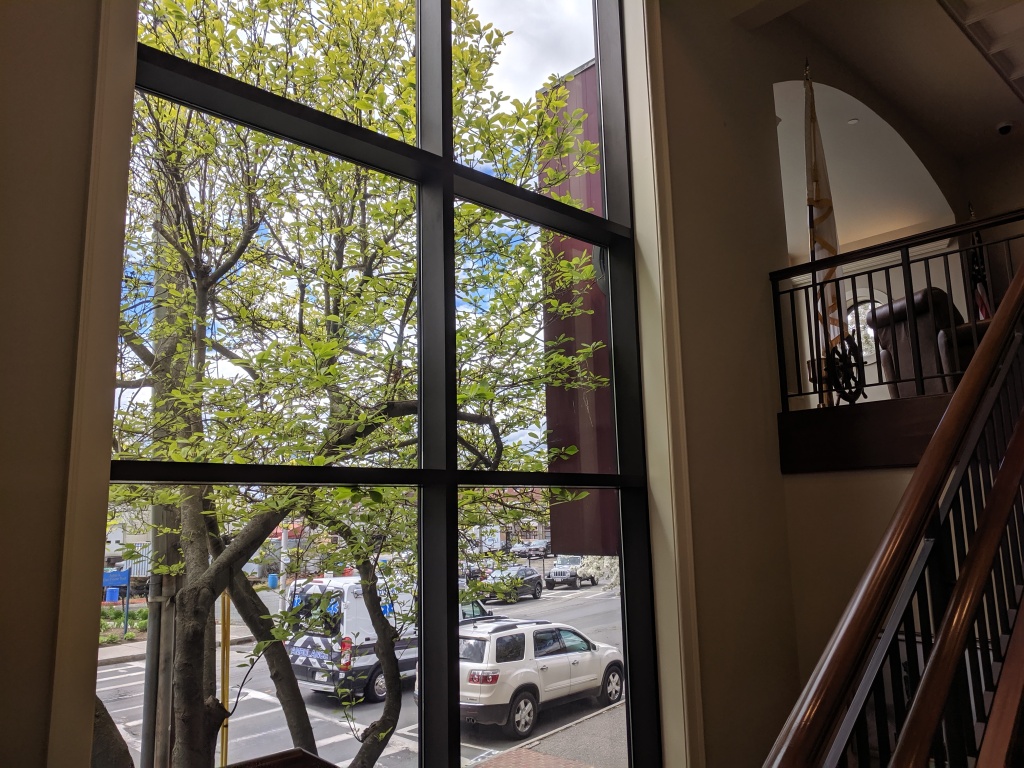
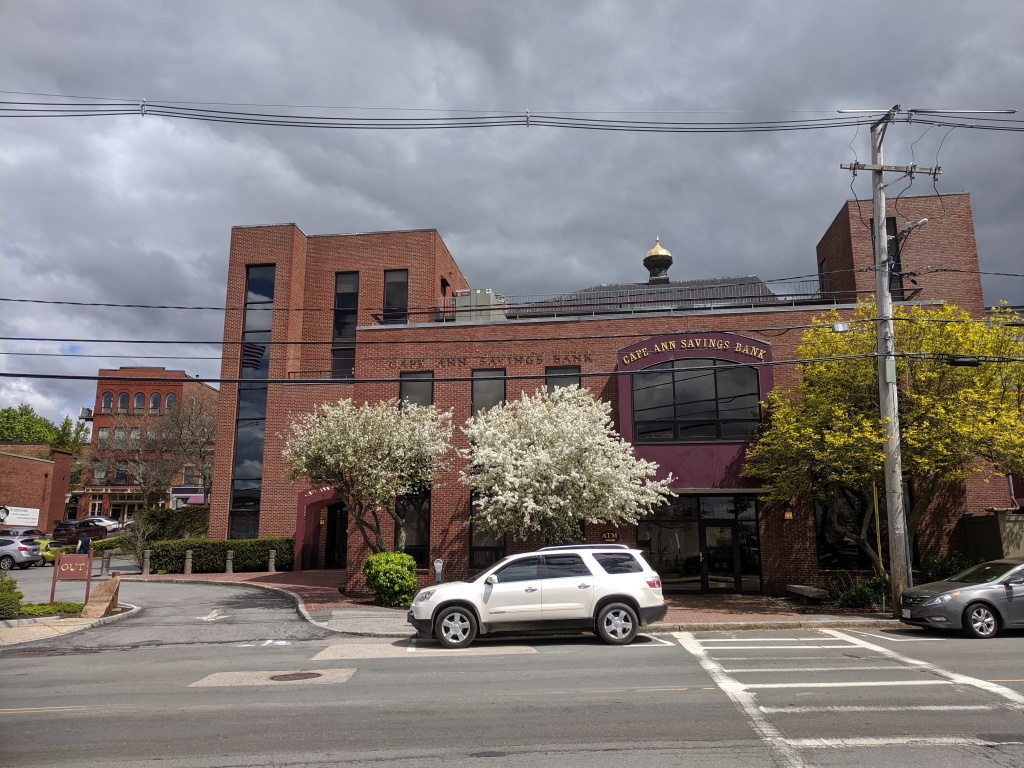

Monell was concerned with getting it right. You don’t have to know about Monell, his body of work or the history of architecture to be moved or respond. His slow designs are considerate of their surroundings, integrating connections with the natural and built environment. Thanks to his gentle, contemplative approach, it feels as though there’s more than enough space even when there isn’t much space to be had.
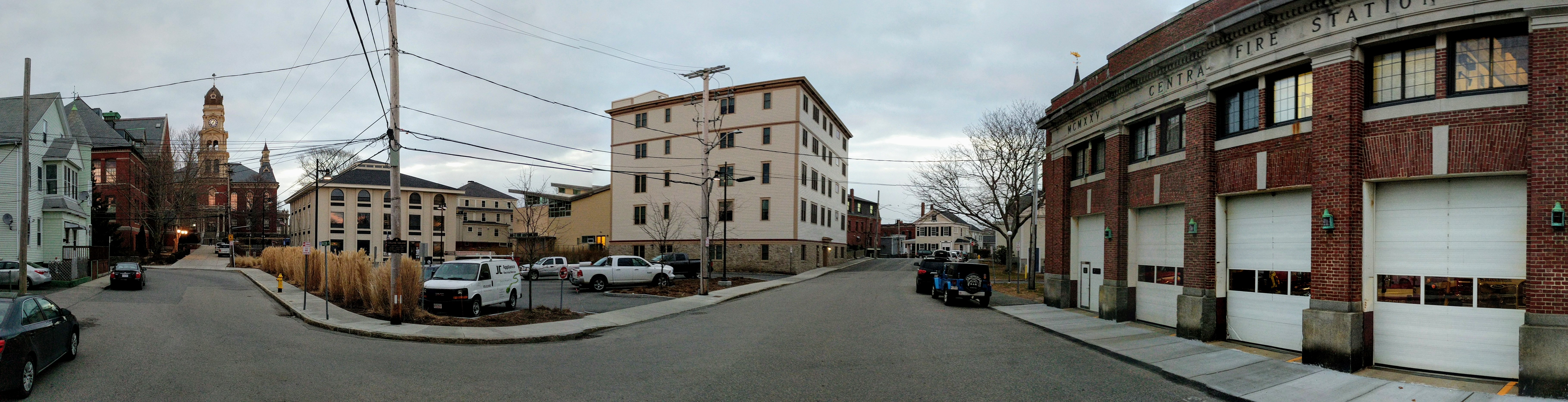
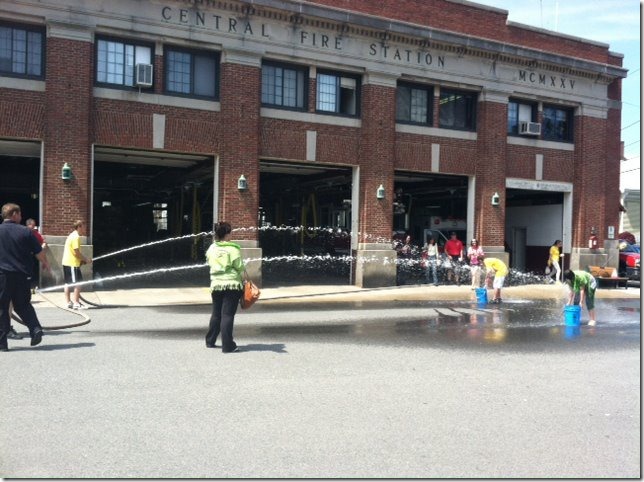
When reviewing Monell’s body of work, it’s clear to see that Gloucester’s landscape, history, art and architecture inform his designs. The library’s connector and entrance are signature Monell motifs and beautiful. It’s no accident that the symmetry of the windows at the back of the building echo the five bays of the fire station,
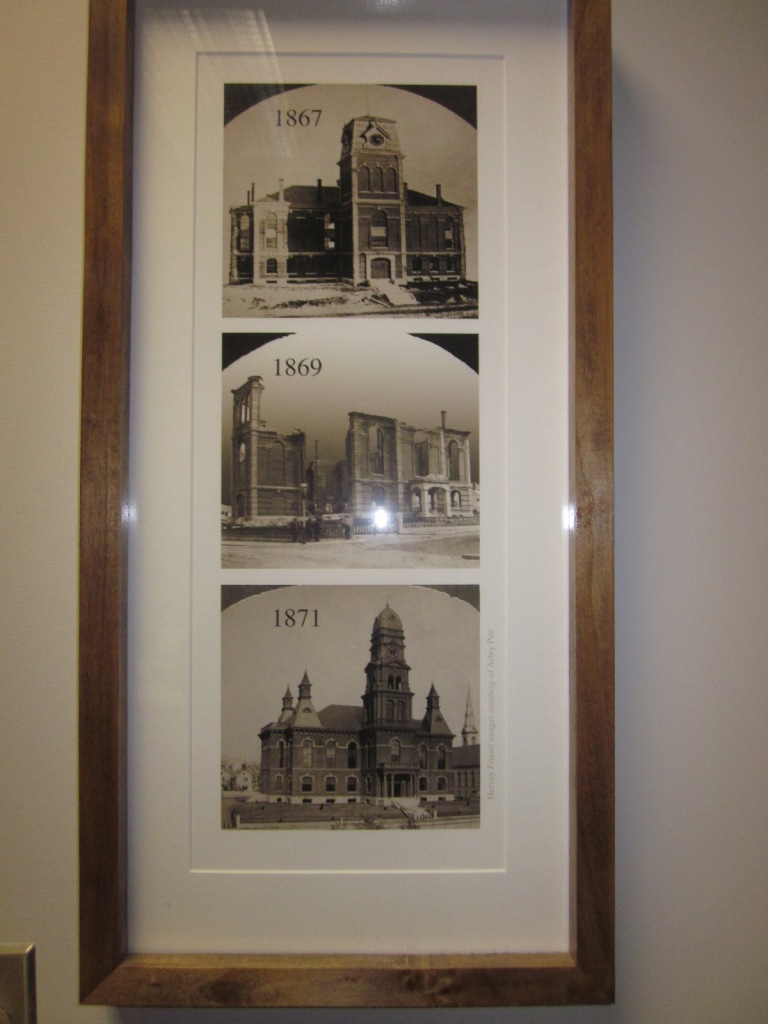
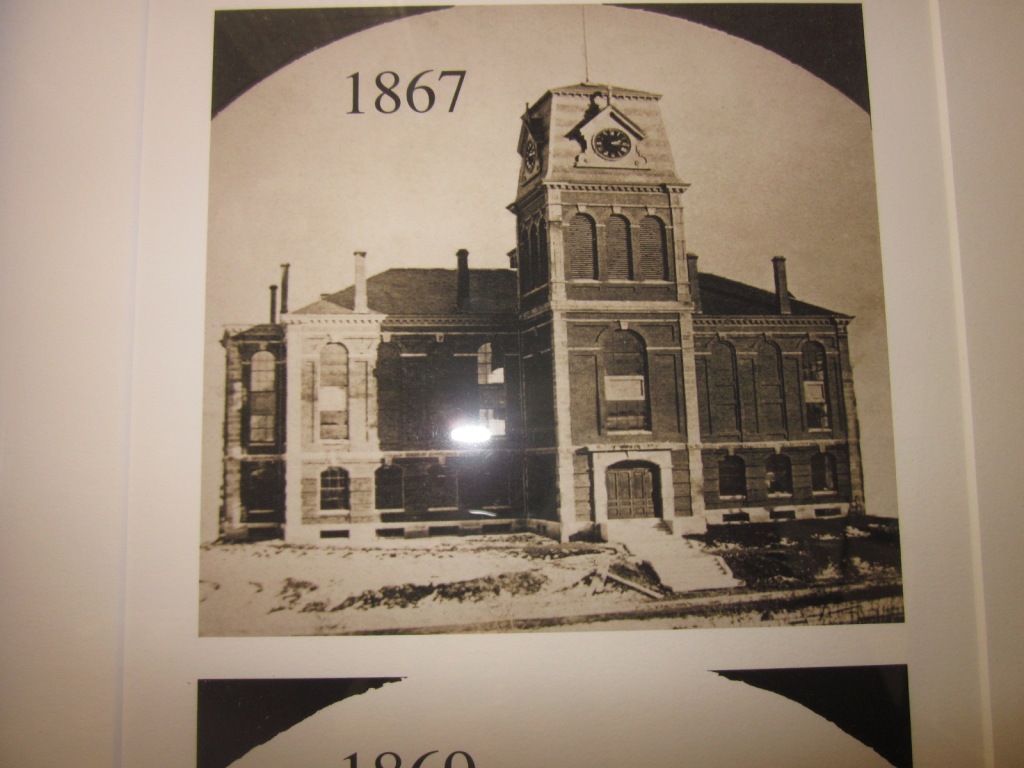
or that they were inspired and reference City Hall, 1867.

No matter which approach one takes to the library, Monell’s consideration of the building and its surroundings is intentional and graceful.
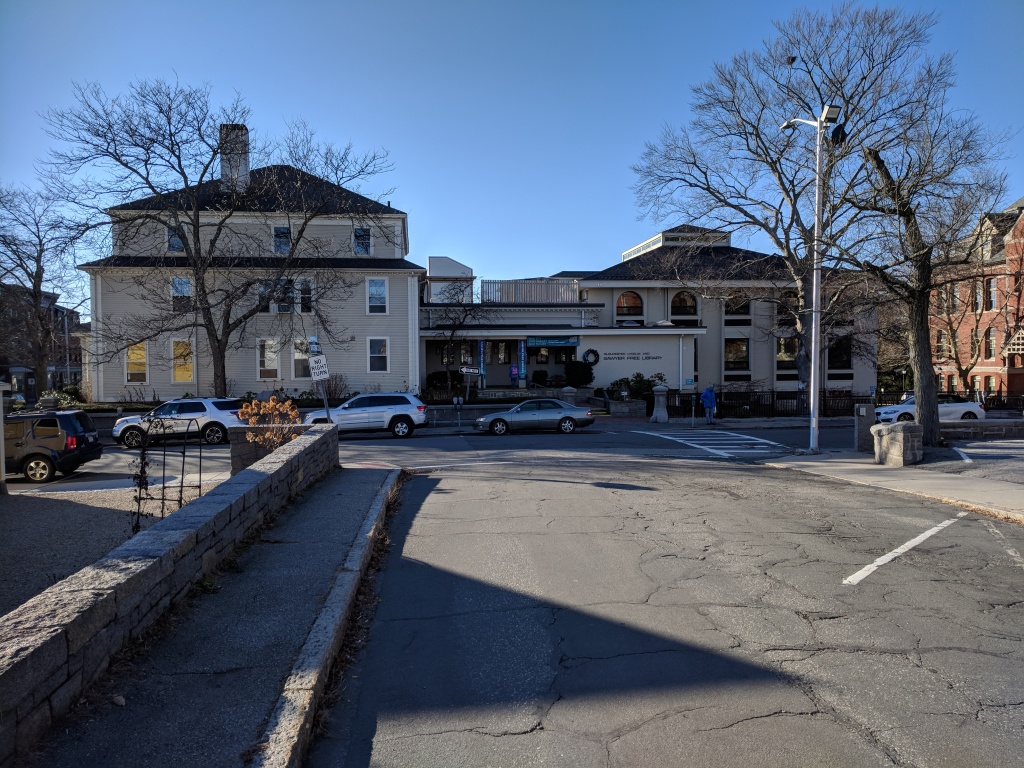
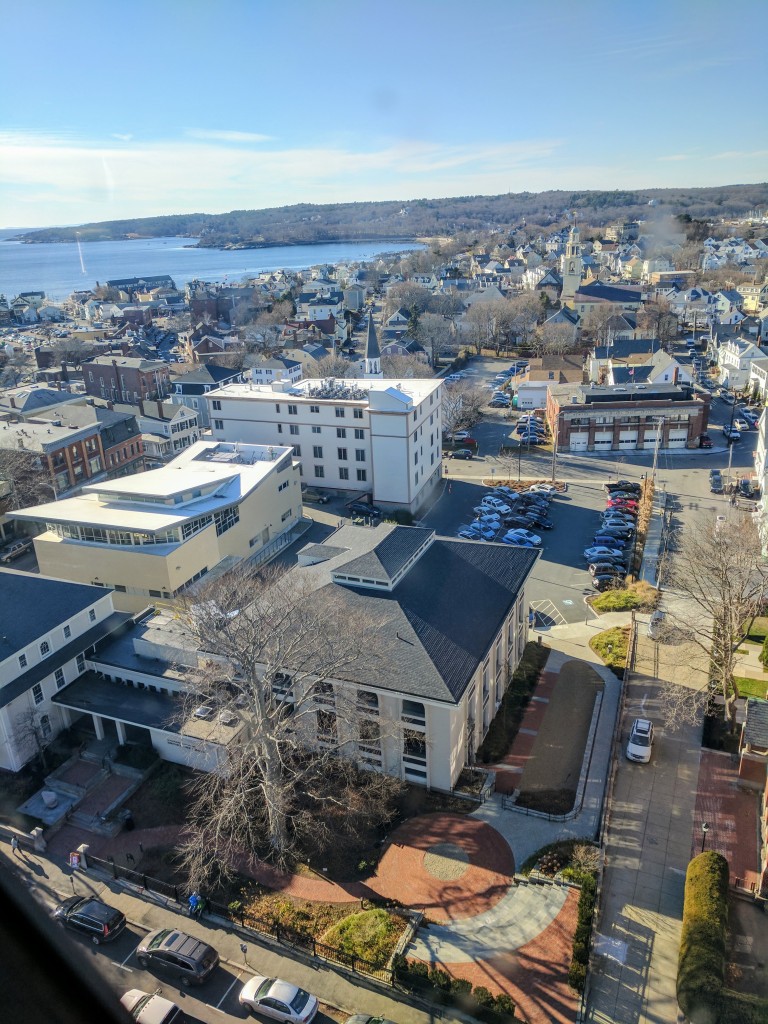

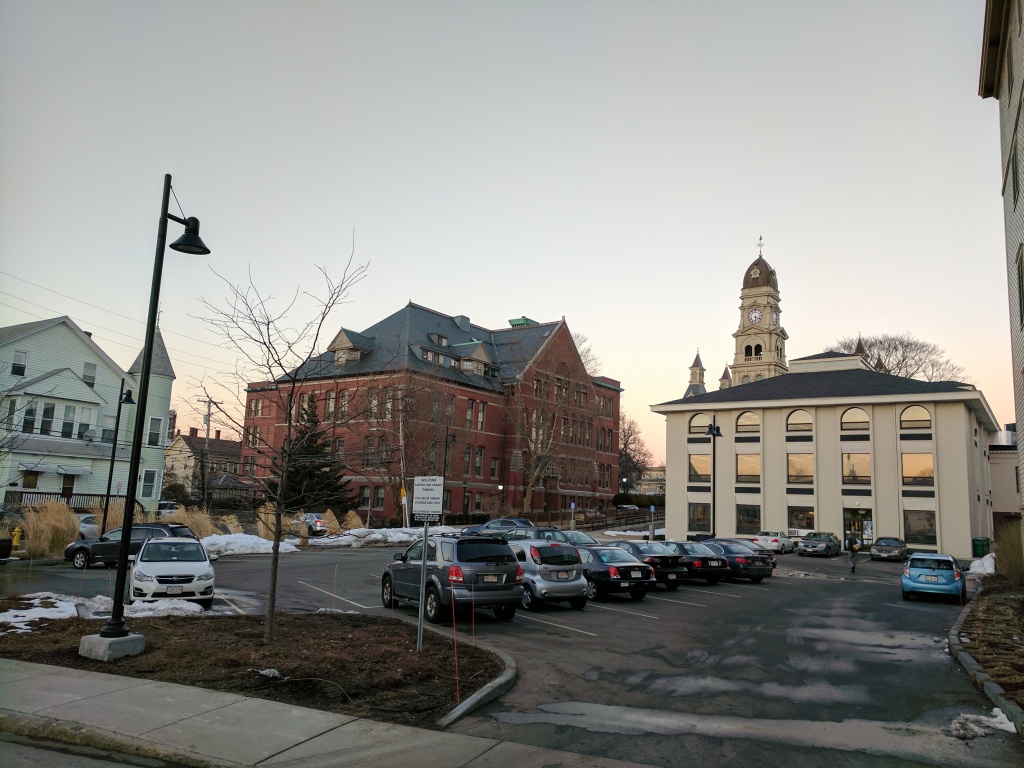


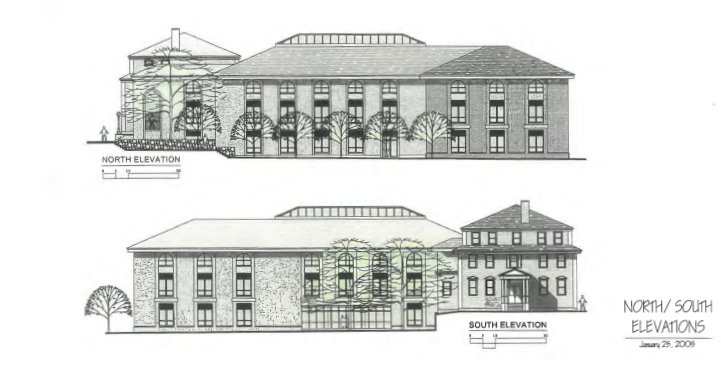
Special thanks to Alexander Monell for sharing his time, knowledge and inspiring family history. Photos are mine unless noted “courtesy”. Those are extra special as they were culled by Alexander Monell in loving tribute to his father and family that he kindly shared and even granted permission to publish here. More to come!
-Catherine Ryan, May 2019
Further reading



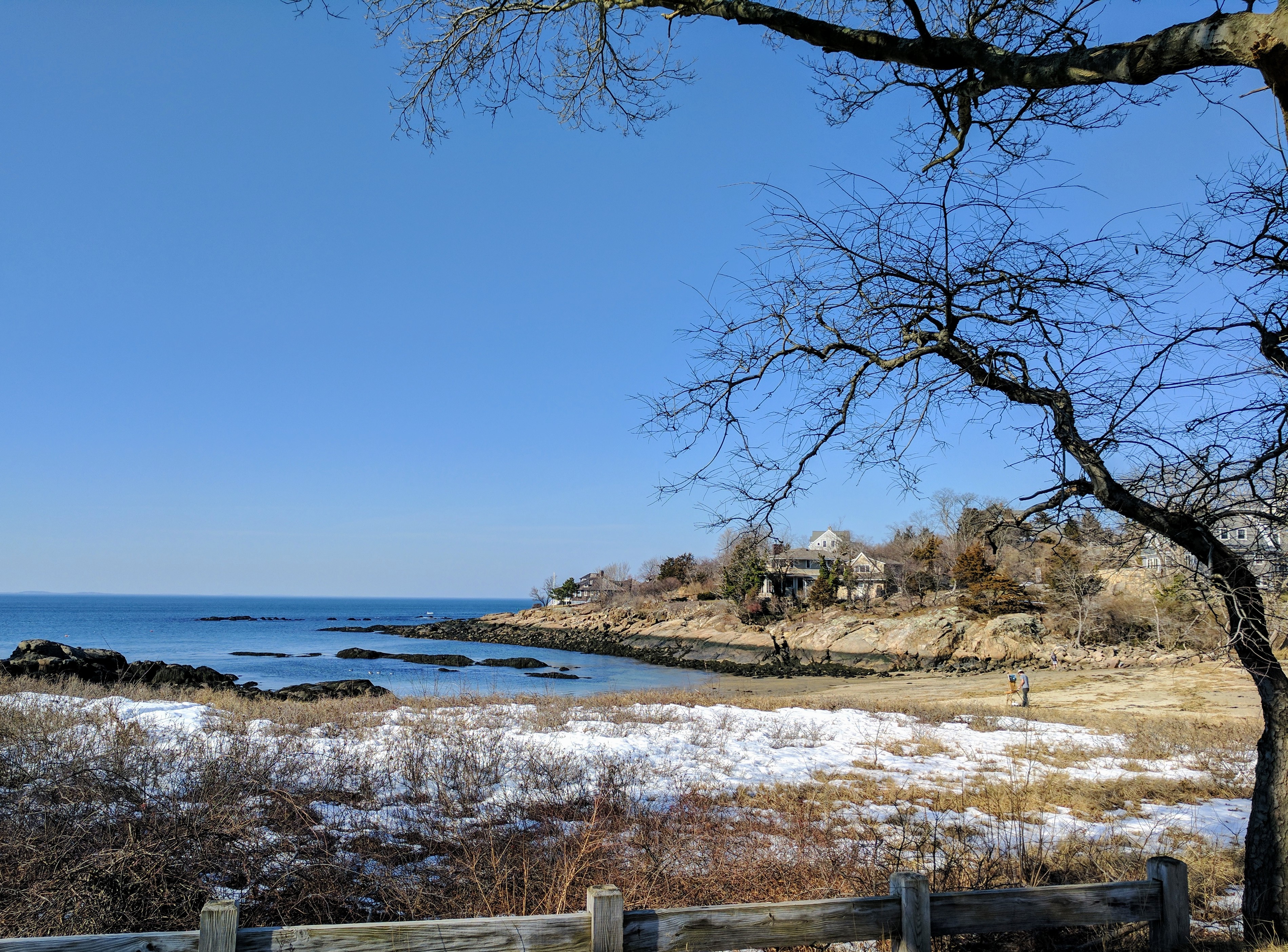
Gorgeous Feb 23, 2017. Foreground capped with light layer of snow, artist adorned with snappy white fedora, and white caps on the water.
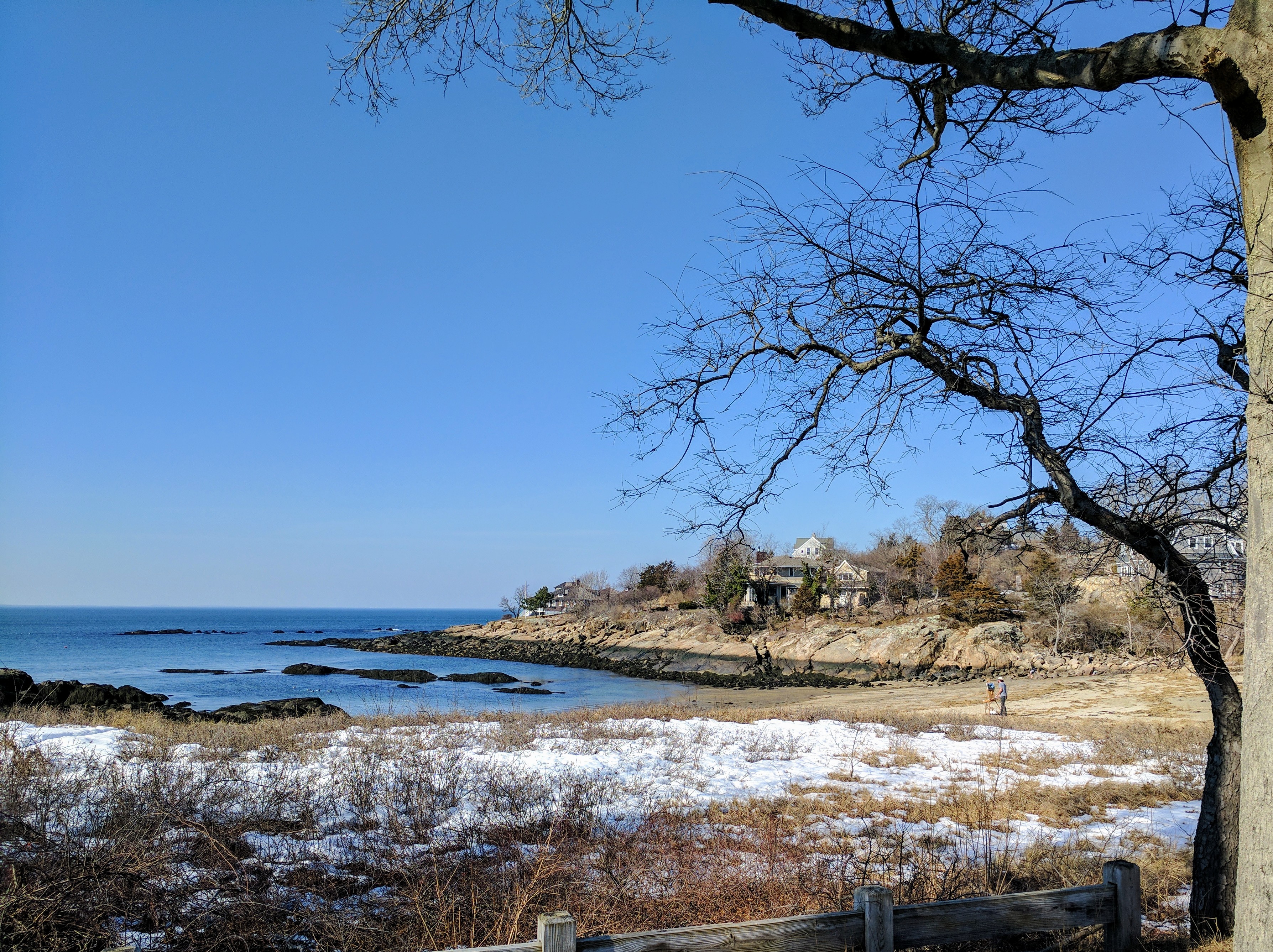
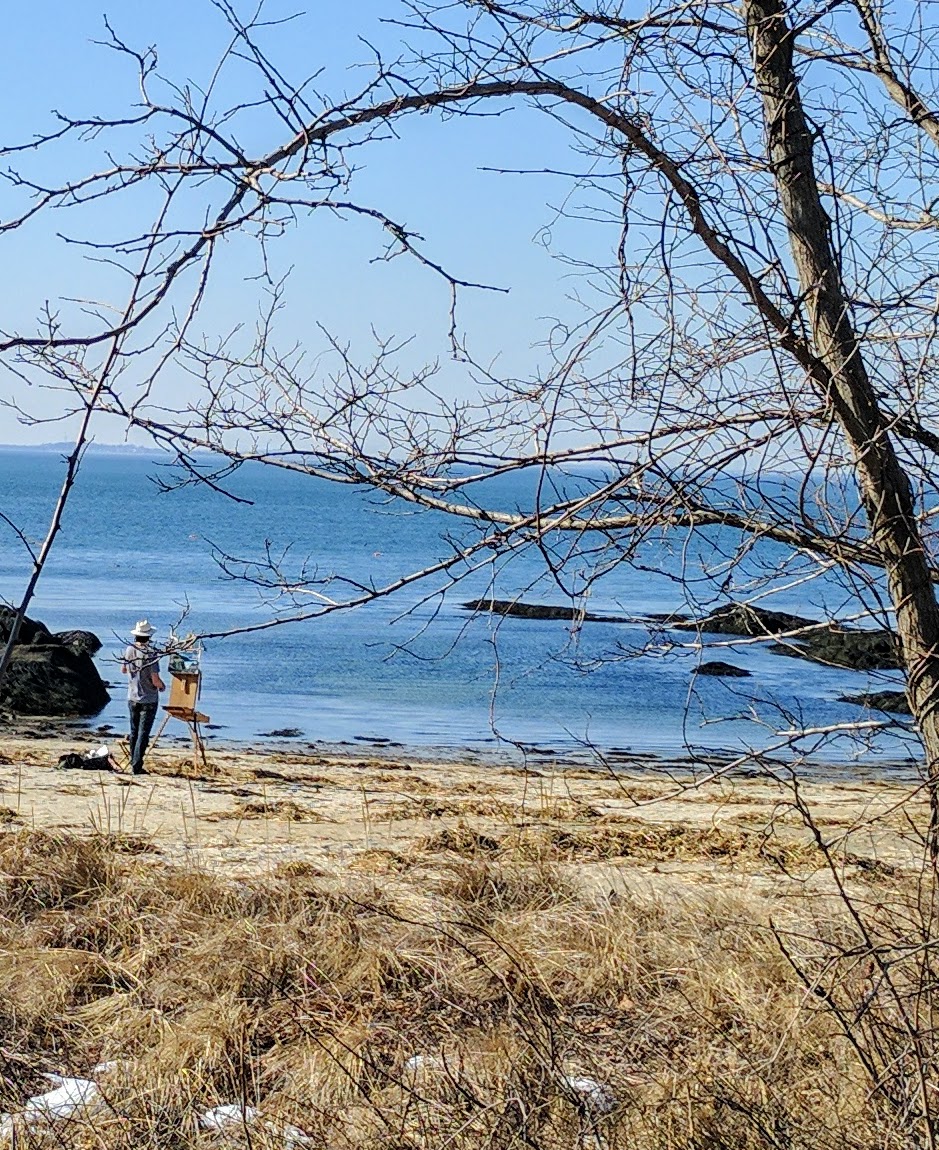

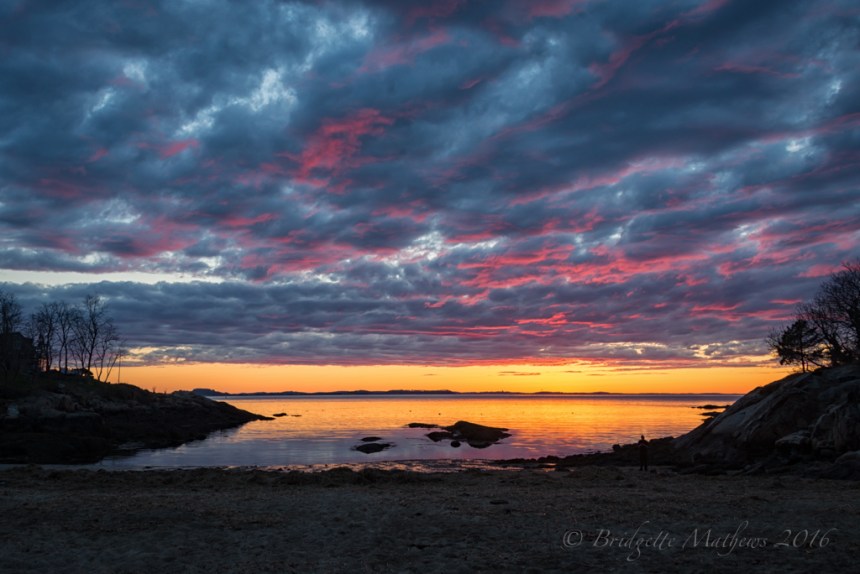
Ran down and caught the tail end of a fluorescent sunset last night at Plum Cove. I’m not sure when taps started again but it was a sure sign of summer when the horn started to play! Have a great Sunday!

It was a double header



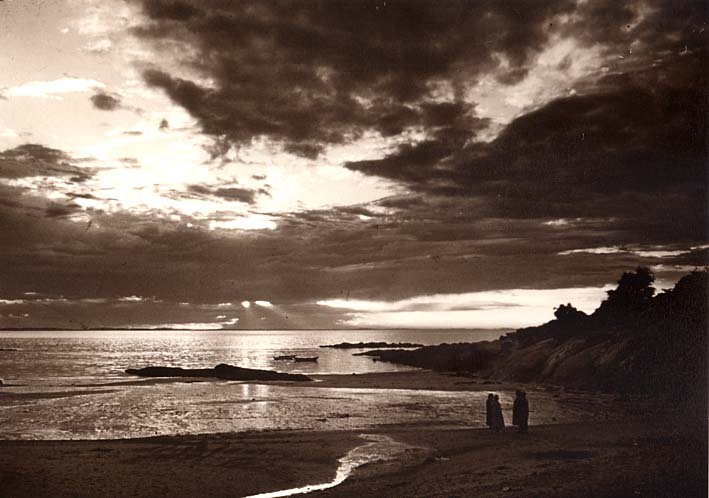 Plum Cove Sunset, circa 1930 Alice M. Curtis/©Fredrik D. Bodin

Took advantage of this hot weather and did a little snorkeling at Plum Cove. Here are a couple videos, but I did learn two lessons:
1. Put charged batteries in the camera
2. Stay still longer
It feels like you’re not moving, but looking at the video it’s pretty fast. I also didn’t get much shot as the low battery kept shutting off the camera. I hope to get some better videos to share later this week.
We saw a winter skate, baby flounder, hermit crabs, and cunner fish.


2 WEEKS ONLY! Monday, March 14 8:00 am – Monday, March 28 10:00 pm
Plum Cove Elementary School
http://www.biddingforgood.com/plumcove
15 Hickory St., Gloucester, MA
The Plum Cove PTC will be hosting its 3rd annual online fundraising auction for The Plum Cove Elementary School in Gloucester, MA from March 14th through March 28th.
Gloucester, MA Feb 1st, 2011 – Expect to find great deals on one-of-a-kind, unique items and experiences at Plum Cove’s largest annual fundraising event. Cape Ann’s favorite local businesses, artists, authors and services have donated items to benefit this, our 3rd consecutive online auction.
100% of the proceeds will benefit the arts and education of the students at Plum Cove Elementary School. The success of our past auctions has allowed us to re-build our playground and make improvements to our library; including the purchase of books and the implementation of an electronic library cataloging system.
About the Plum Cove Parent-Teacher Co-op:
Voted PTO Today’s “Outstanding New Group” of the year in 2009, the Plum Cove Parent-Teacher Co-op was established in 2007 following a major citywide redistricting that left the school without a parent/teacher group of their own. The group leaders and parent volunteers, through an enormous amount of local support, raised funds to upgrade the existing playground equipment, relocate a playground from an old school, update the library and upgrade the school grounds, making them better suited to the new student body.
Contact:
Ann Andrew, PTC Auction Chair
Plum Cove Parent-Teacher Co-op
978 325 0220
http://www.biddingforgood.com/plumcove
Time Bandit Jacket
Online OpenMar 14, 2011 8:00 AM EDT
Online CloseMar 28, 2011 10:00 PM EDT
Number of Bids0
Opening Bid$100.00
Item Information
Estimated Value Priceless
Item Number 154
Item Description
Time Bandit Crew Jacket signed by Captain Andy Hillstrand – featured on Discovery Channel’s hit show – The Deadliest Catch Black Jacket size XL.


Ann Andrews writes-
You are invited to participate in our 3rd-annual on-line auction to benefit the arts and education of our students at Plum Cove Elementary School. The success of our past auctions has allowed us to re-build our playground and make improvements to our library; including the purchase of books and the implementation of an electronic library cataloging system. Save the date to place your bids on great items! You can sign in and make donations effective immediately. Thanks for your support…

 Good Morning Gloucester
