GREAT DININNG EXPERIENCE AT THE BROWN DOG IN IPSWICH!

Cape Ann has a wealth of restaurants from which to choose, and we love our favorites passionately. Occasionally though we enjoy trying new places off Cape. One of my husbands’s oldest and nicest friends, Bob Vallis, has opened a fabulous pub in downtown Ipswich. Located at the former Zabaglione address, The Brown Dog serves the best of wonderfully fresh and hearty American cuisine/comfort food within a casually inviting and cozy atmosphere.

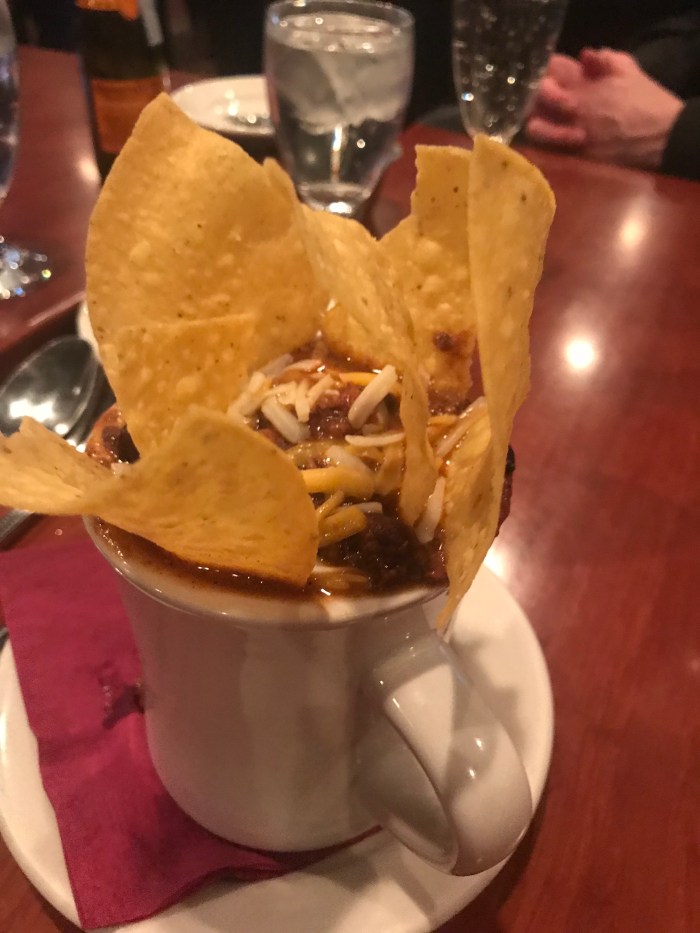
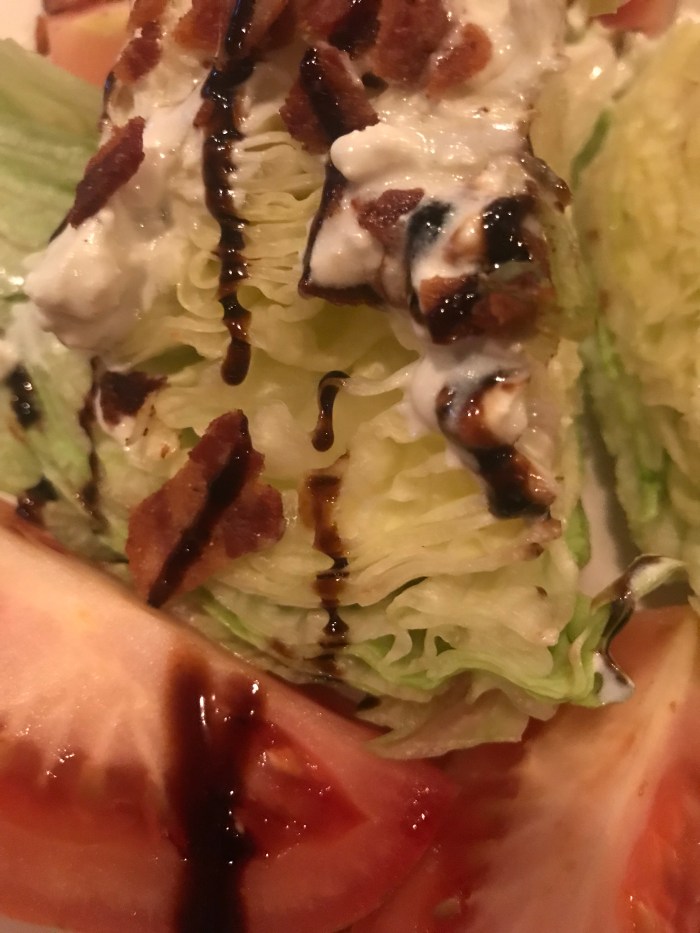
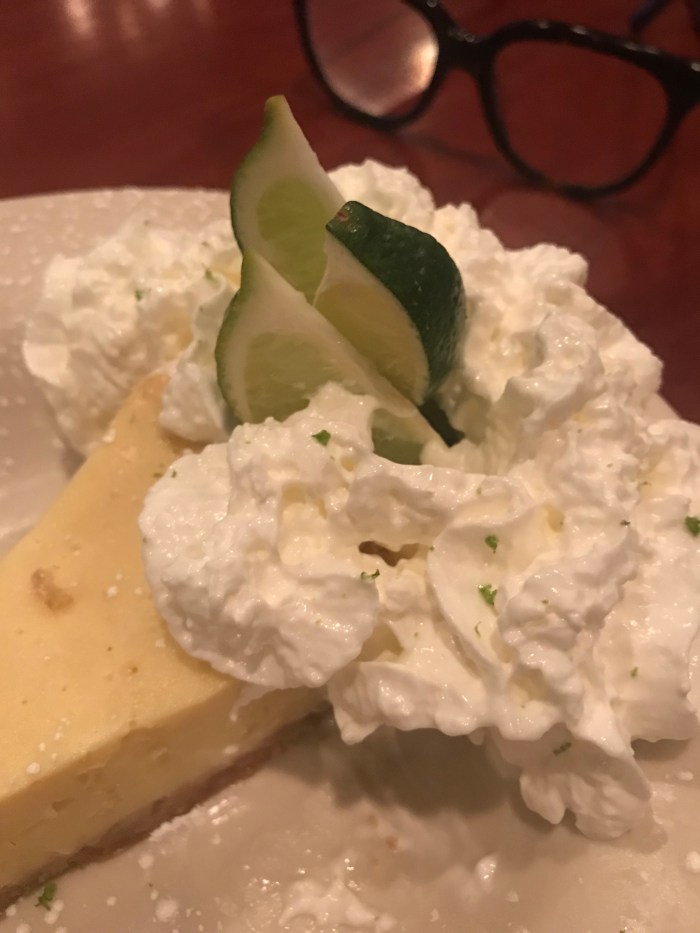
Gloucester residents may recall that Bob formerly owned the Blackburn Tavern. Chef Doug Papaws, also from Gloucester, is working his magic in the kitchen. I had without a doubt the best fried oysters I have ever had in my life. They tasted on the inside as sweetly plump and succulent as freshly shucked oysters, but with a light touch of deeply golden fried crusty deliciousness on the outside. Tom tried the chili and baked chicken, also both stellar, and the key lime pie was the perfect touch of creamy citrusy fresh sweetness. We loved our waitress–I think her name is Eleanor, and her mom, also known as the local librarian, helps out on weekends with hostessing.

Thanks to Bob and Doug and our lovely waitress for a great night out!

Cell phone photos don’t do the fabulous fare justice–so just go and check it out for your self!

The Brown Dog is located at 14 Central Street in Ipswich. Phone 978-312-6362 and visit The Brown Dog website here.

https://www.instagram.com/p/BhULBcRFNh6/

here.

Beautiful Fish: Striped Bass -By Al Bezanson
Striped Bass, Striper, Rockfish, Rock, Linesides

The bass grows to a great size, the heaviest of which we have found definite record being several of about 125 pounds that were taken at Edenton, N. C., in April 1891.  Stripers are powerful fish; so strong in fact, that they appear to have no difficulty in handling themselves in the surf, where one is sometimes seen actually in the translucent crest of a comber just before the latter breaks.  The bass is very voracious, feeding on smaller fishes of whatever kind may be available, and on a wide variety of invertebrates. Lists of its stomach contents for one locality or another include alewife, anchovy, croakers, channel bass, eels, flounders, herring, menhaden, mummichogs, mullet, rock eels (Pholis gunnellus), launce, sculpins, shad, silver hake, silversides, smelt, tomcod, weakfish, white perch, lobsters, crabs of various kinds, shrimps, isopods, gammarid crustaceans, various worms, squid, soft clams (Myra) and small mussels. In our Gulf the larger bass prey chiefly on herring, smelt, sand launce, eels, and silver hake, on squid (on which they gorge when they have the opportunity), on crabs large and small, on lobsters, and on sea worms.  When bass are gorging on any one particular prey it is common knowledge among fishermen that they are likely to ignore food of other sorts for the time being. It seems also that when prey is plentiful, bass are likely to gorge, then cease feeding to digest, then to gorge again; also that all the members of a given school are likely to do this in unison, with consequent annoyance to the angler.


From Fishes of the Gulf of Maine by Bigelow and Schroeder (1953) online courtesy of MBL/WHOI http://www.gma.org/fogm/Roccus_saxatilis.htm


Al Bezanson


NOT THREE BUT FOUR PIPING PLOVERS ON GOOD HARBOR BEACH! (AND ONE DUNLIN)

April 7th

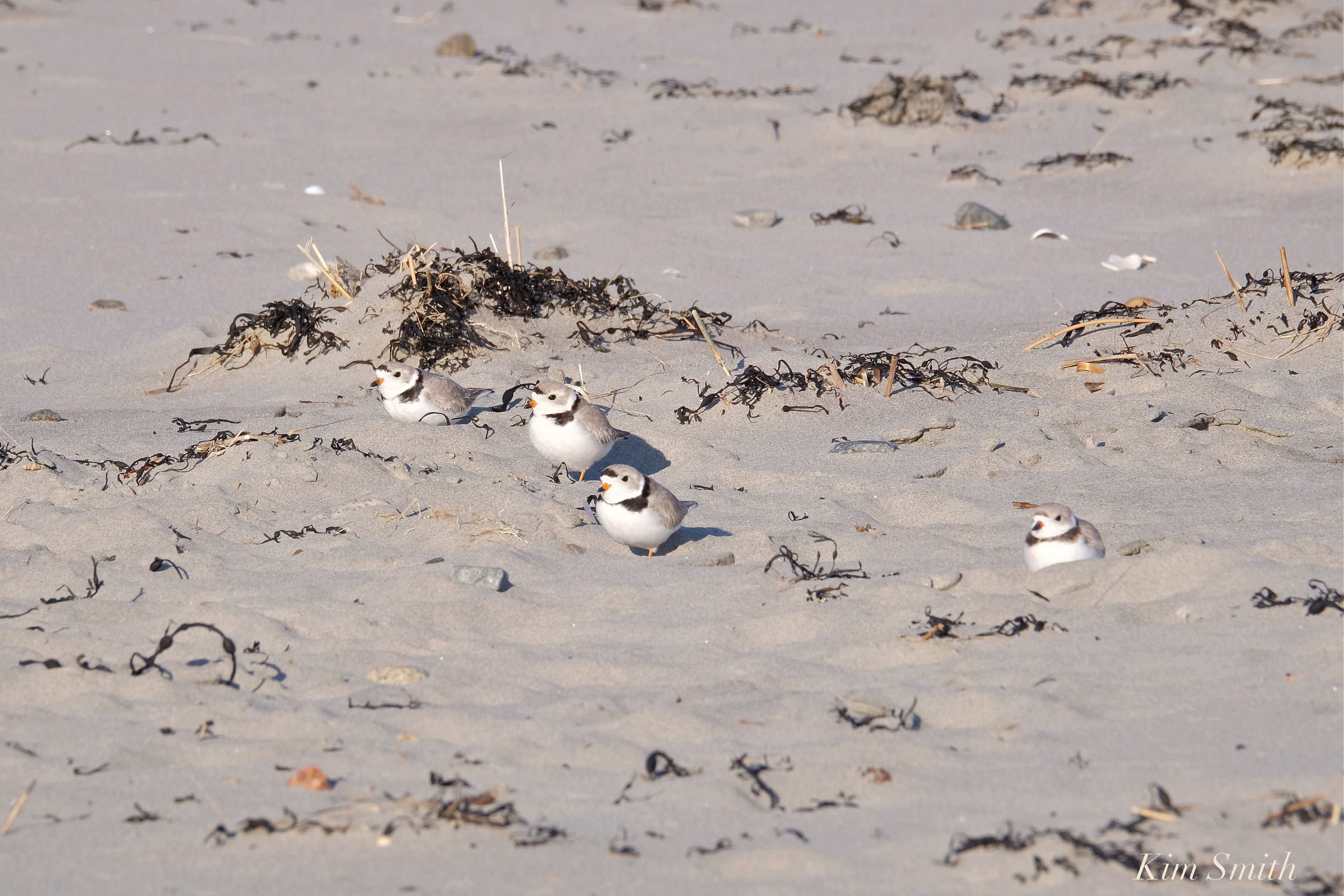
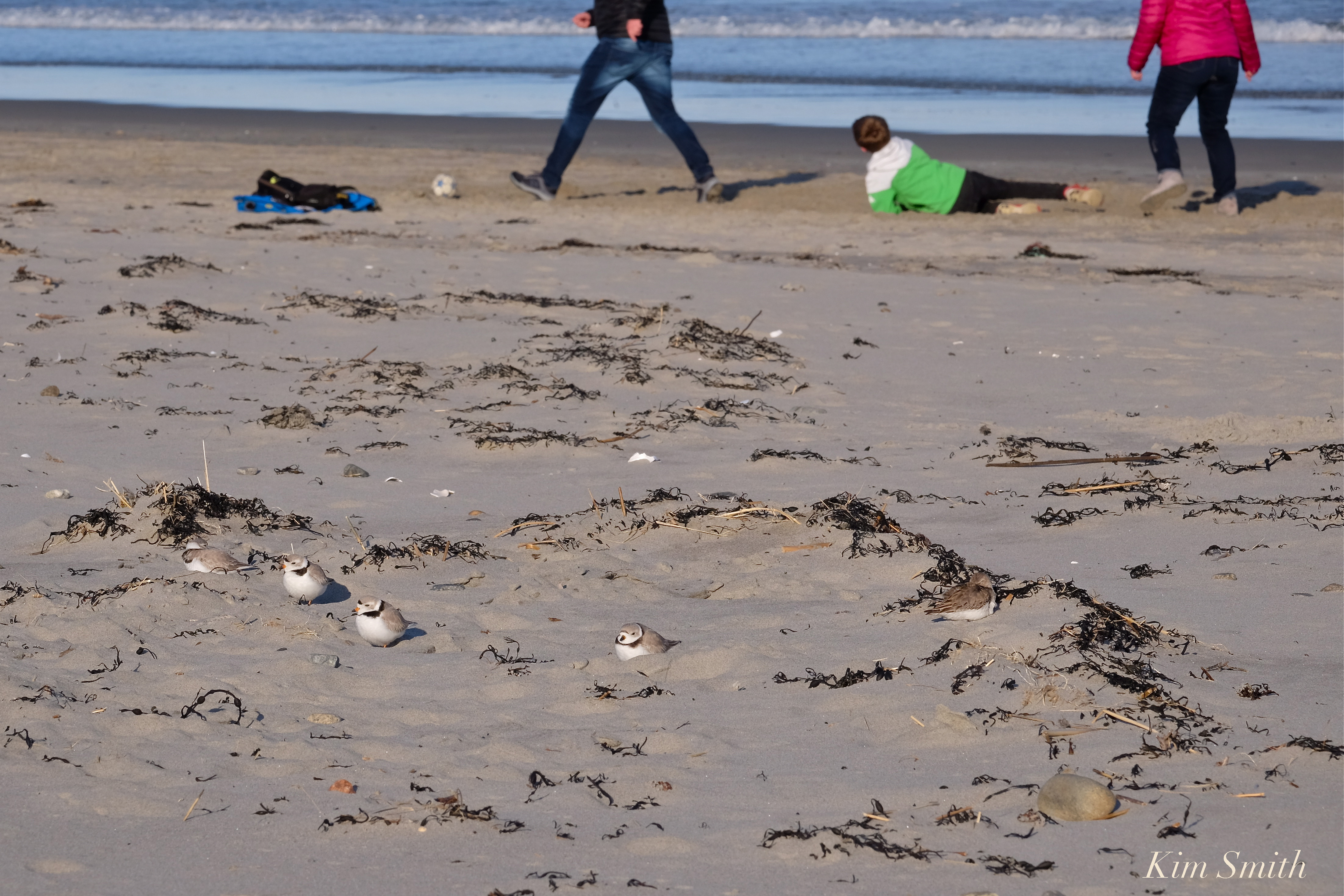
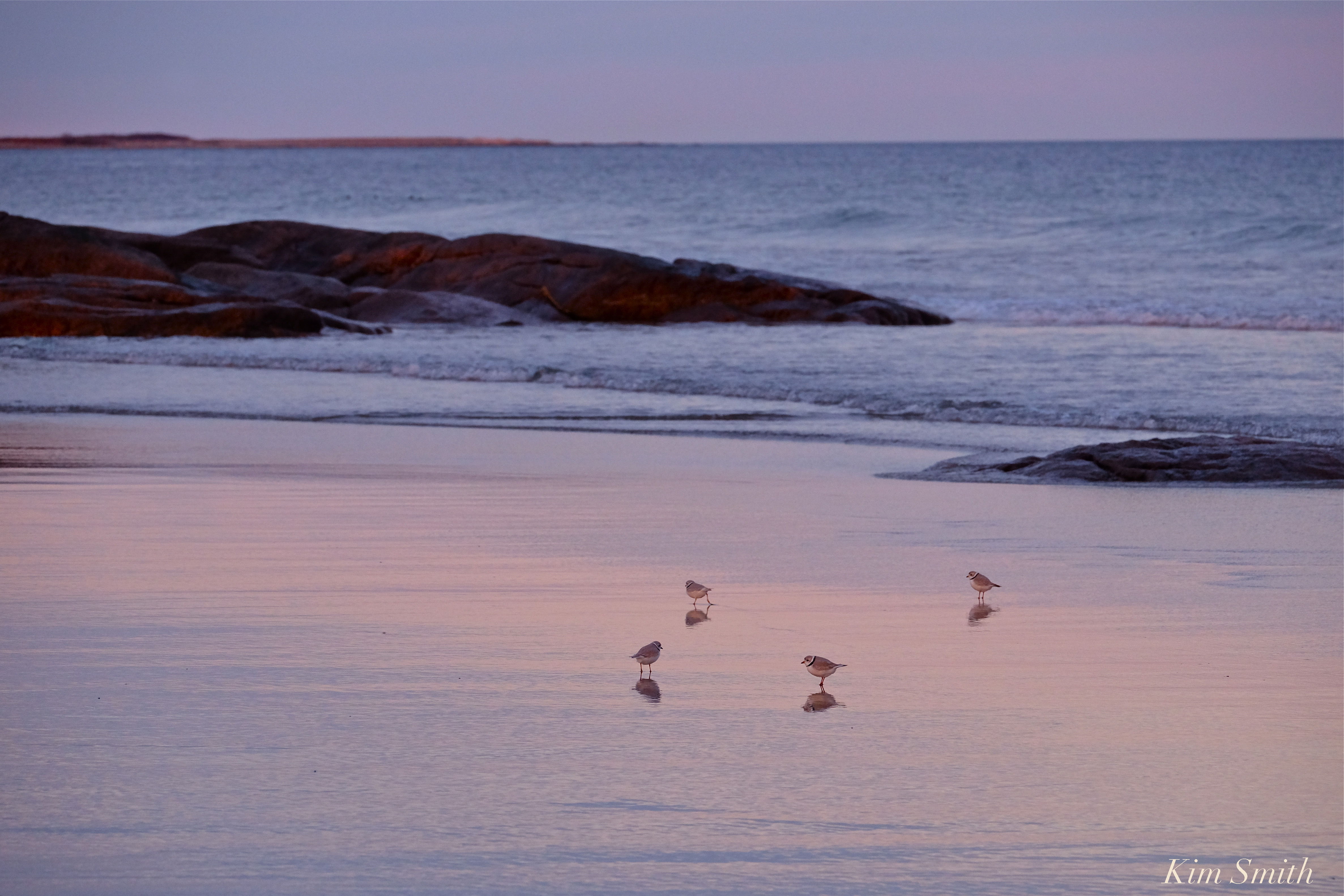
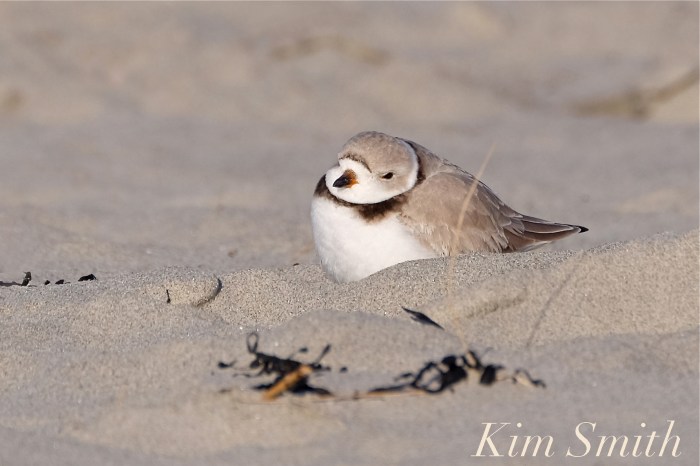
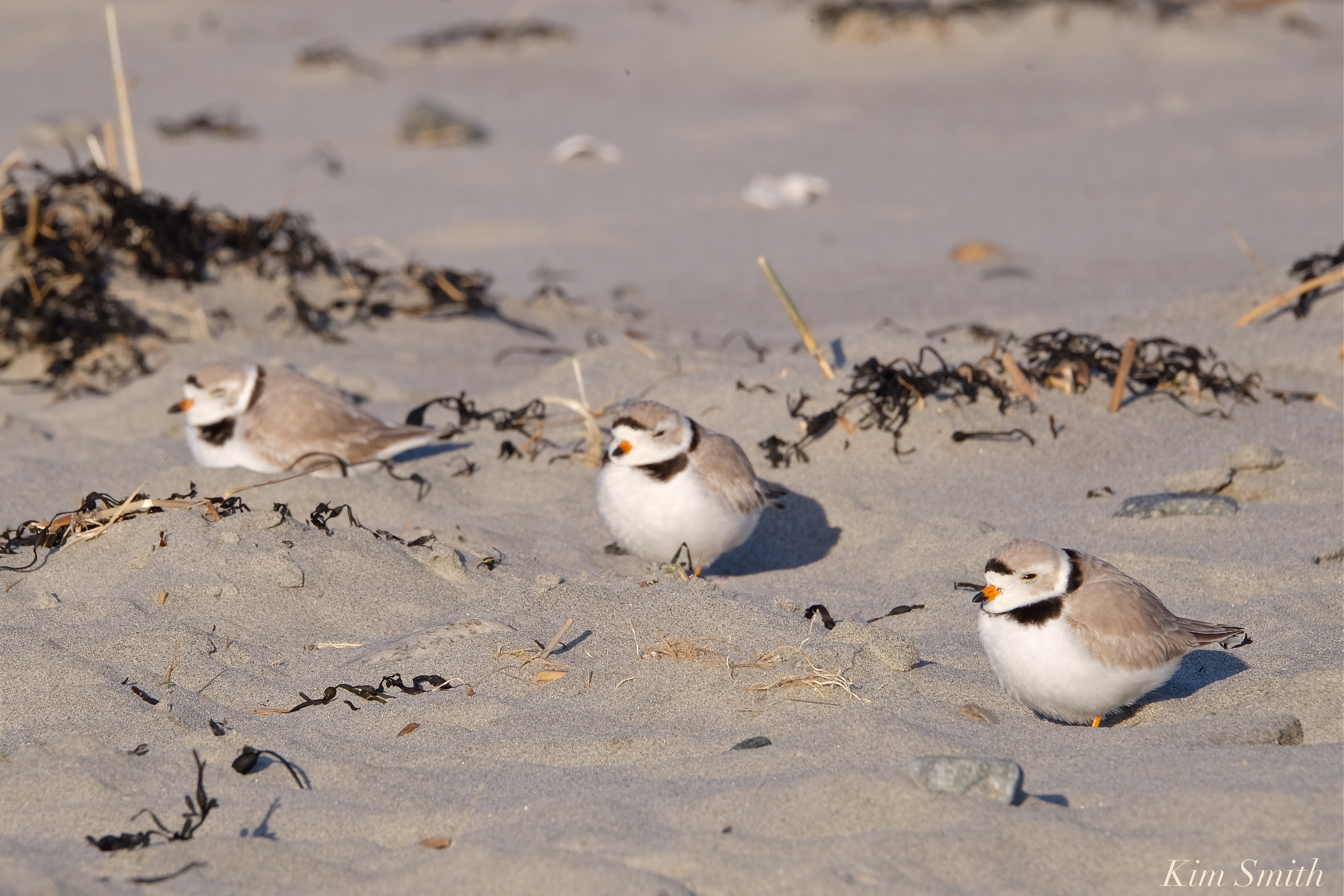
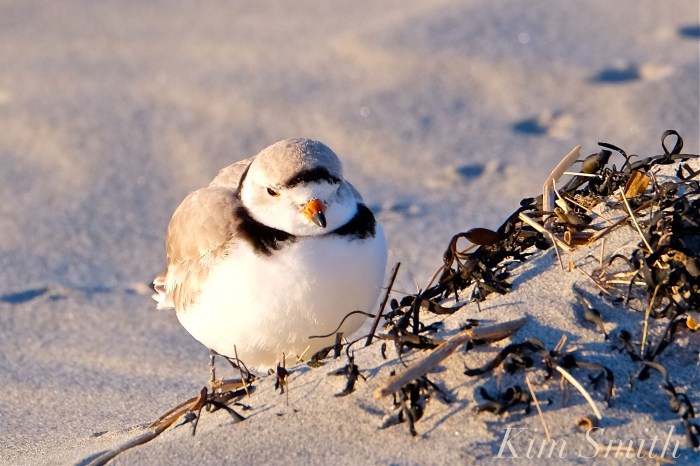
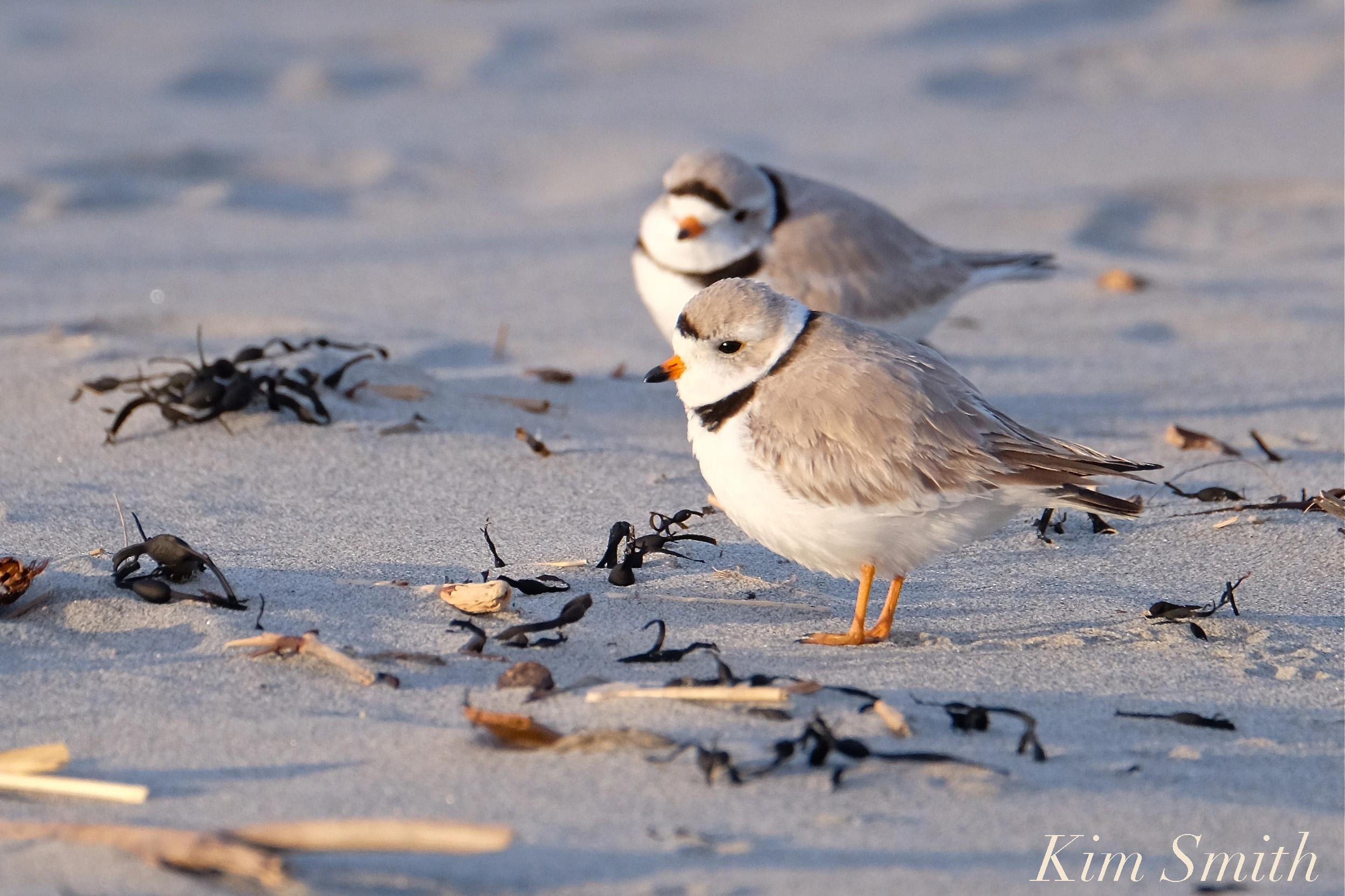
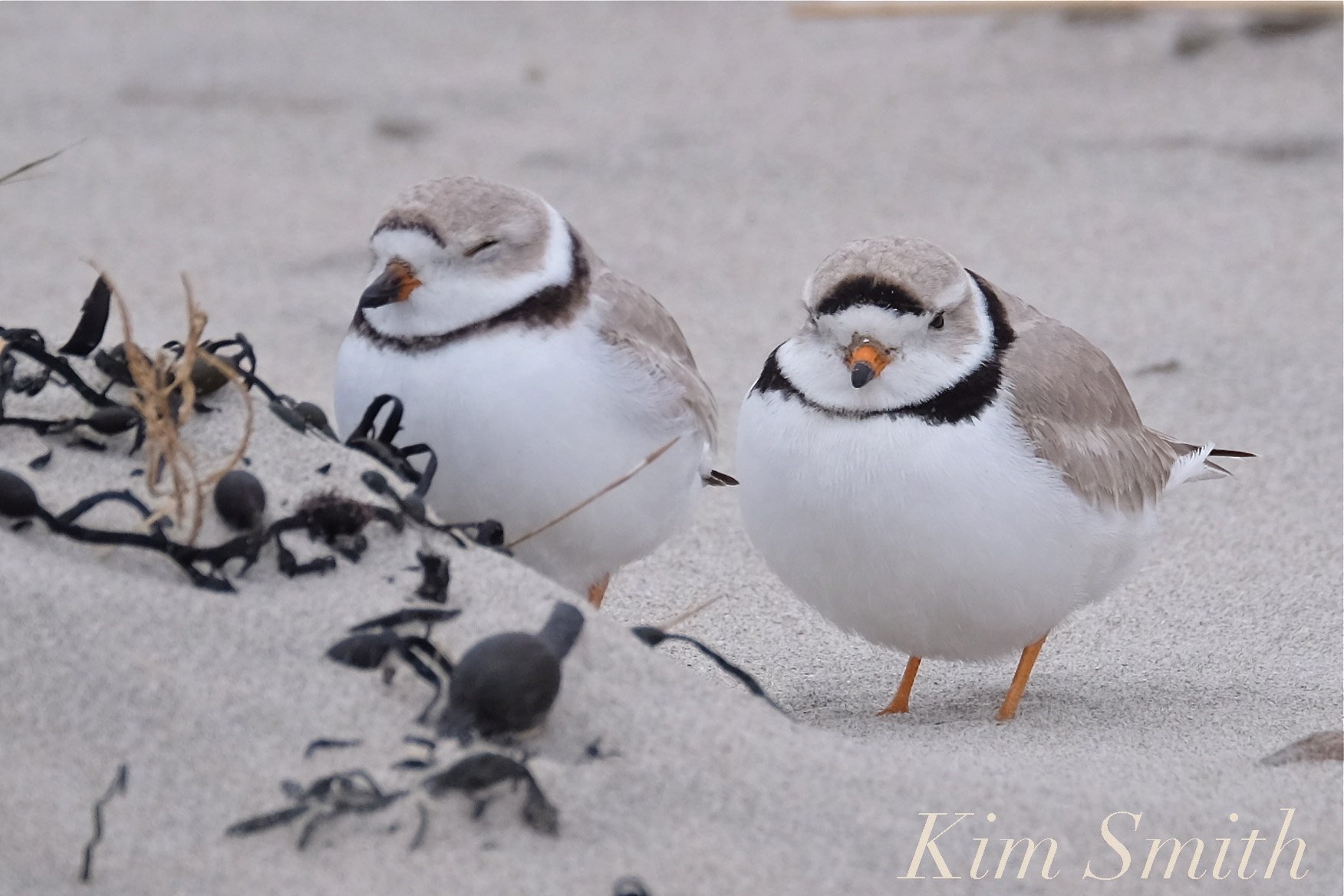
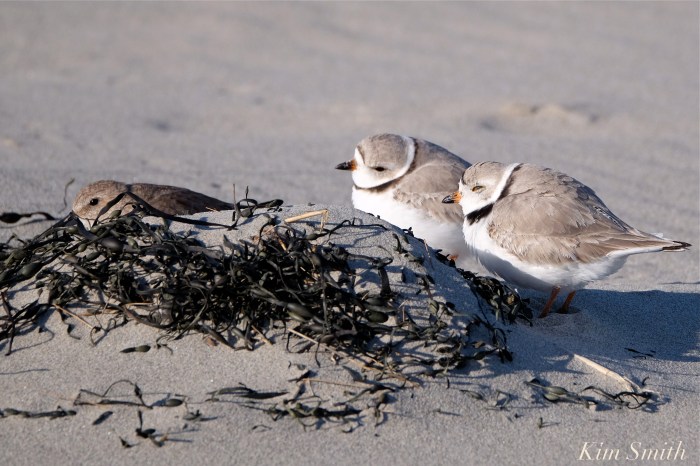
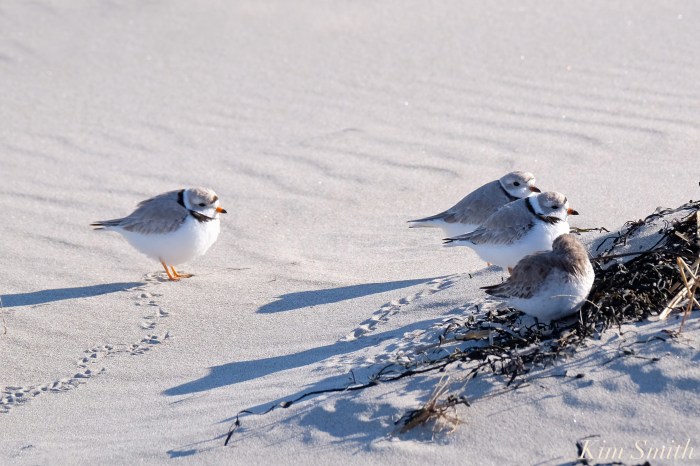
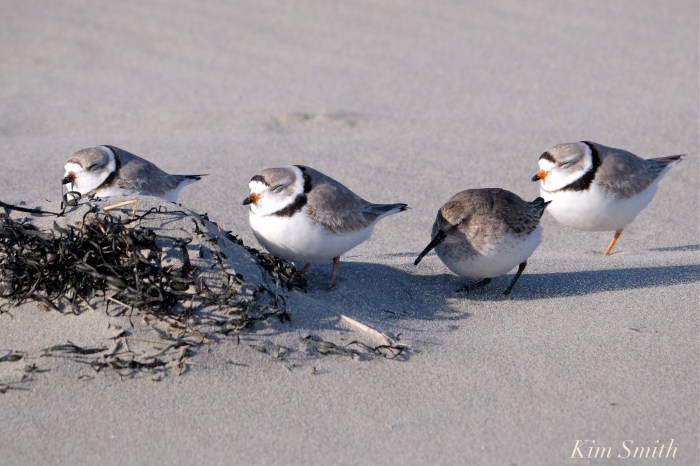
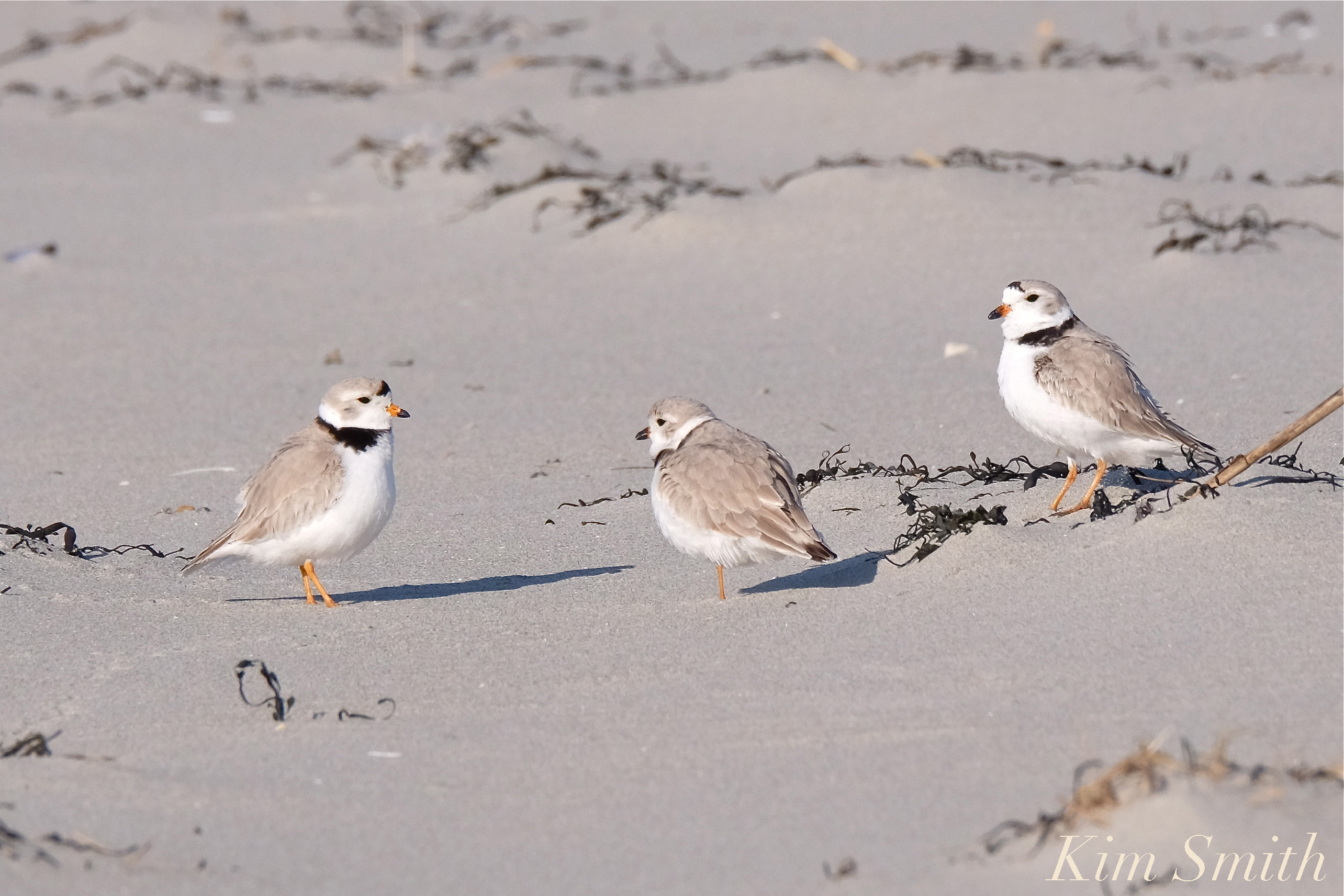
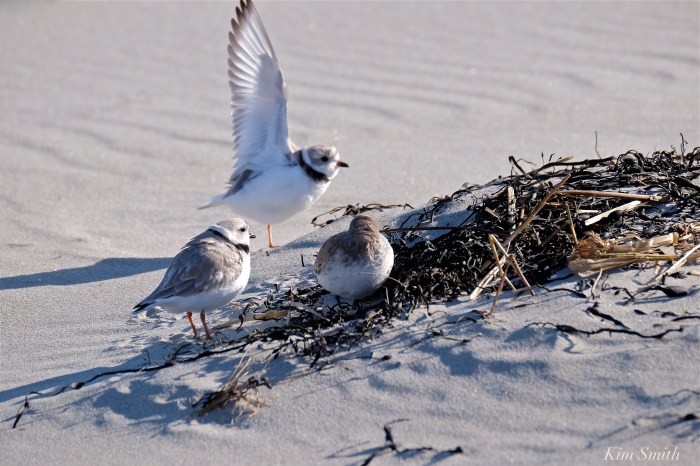
Saturday at 5:30pm and there are not three, but four PiPl!! The Dunlin is still here and doing everything Plover, it is so funny to see. I think we have three males and one female.

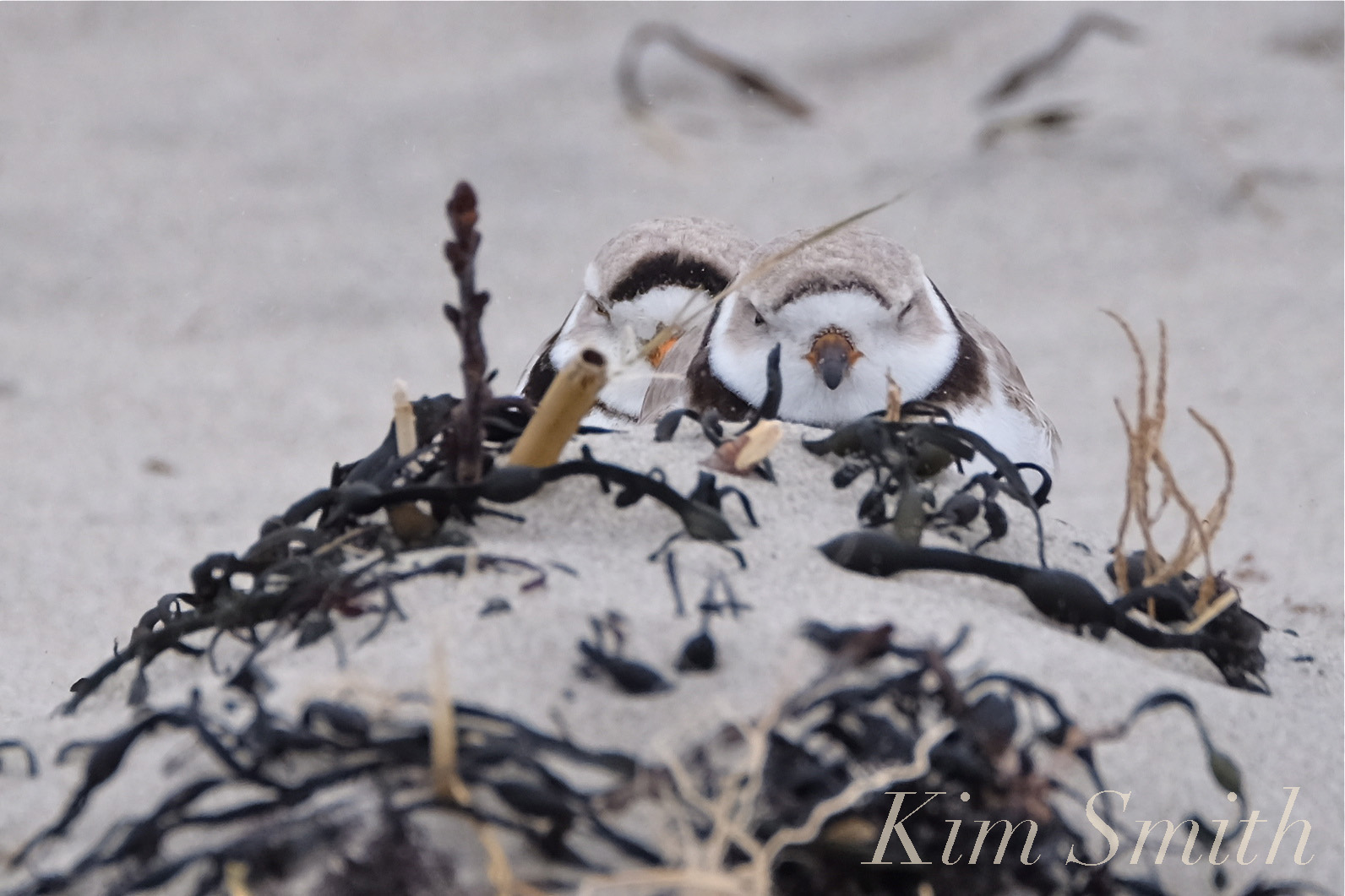
They were sleeping at the wrack line but as the sun was setting, more and more dogs. They don’t seem to mind people playing in close proximity, but then a bunch of dogs ran through where they were resting and so down to the water’s edge they flew.

Sixteen off leash between 5:30 – 7pm, and it’s an on leash day. I avoid GHB during the off season because of dog owners that allow their dogs to jump on you, but it is so disheartening to see them running wild through the dunes. So much habitat destruction taking place. How will the dog owners respond when they learn the Piping Plovers have returned and are nesting again at GHB I wonder.

April 8th

Total mayhem on the beach. Dogs are everywhere, on the shoreline, the wrack zone, and running completely wild through the dunes. One knocked me over. I love dogs but this is crazy. The PiPl don’t have a chance and it’s too distressing to watch them try and rest and forage and nest and constantly be chased off.

Precisely where they were sleeping at the wrack line, a couple threw their dog’s tennis ball right smack at the PiPl. So startled, I and the PiPl both jumped up half a foot, before they flew off. Of course the couple didn’t know the PIPl were sleeping but it’s just really, really frustrating.

I wish so much we could do what they do at Crane’s Beach, where during the off season, dogs are allowed on a section of the beach. And at Cranes dog owners do not allow their dogs to run rampant through the dunes.

Tom came back from a walk at noon and couldn’t find the PiPl anywhere, and he is really good at spotting. I’ll check back at sunset to see if the PiPl can be found. Praying and hoping they have found a safe place.

Heartbroken. No plovers at sunset, anywhere, walked from the creek to the hotel twice. Still chaotic with dogs. Will try tomorrow at dawn.

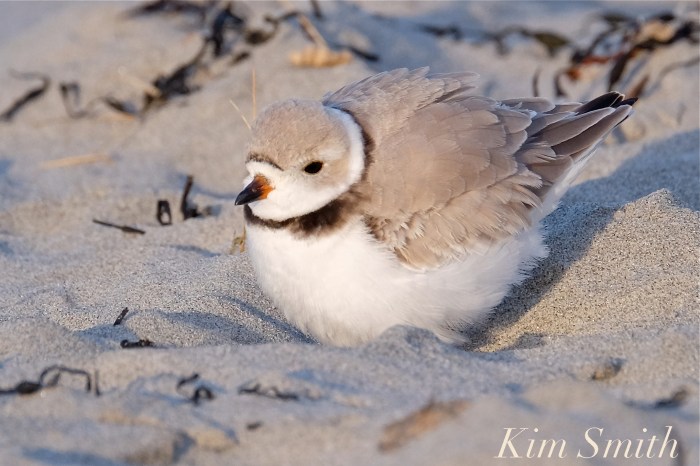
Pretty Mama Plover

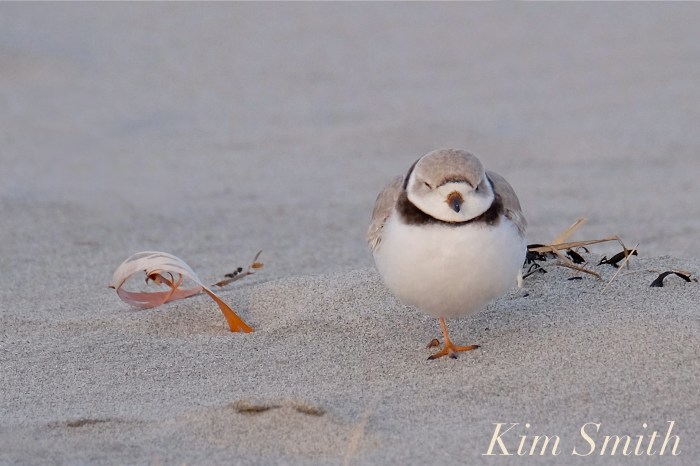
The boys of spring.

April 9th

Hooray!! Daybreak and I found them, three Plovers sleeping all in a row! Hopefully will find the other PiPl and Dunlin later today. Emailed Ken Whittaker, Gloucester’s awesome conservation agent, and we are meeting this afternoon. The goal is to get a cordoned off area in place before the next weekend when dogs are off leash. Reminder to let people know to contact Ken if they would like to help this summer by being a Plover ambassador.

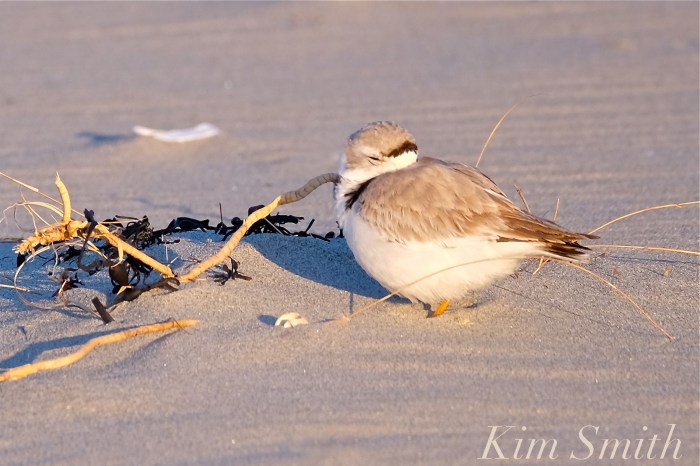
Three in a row sleeping this morning, with Mama in the middle

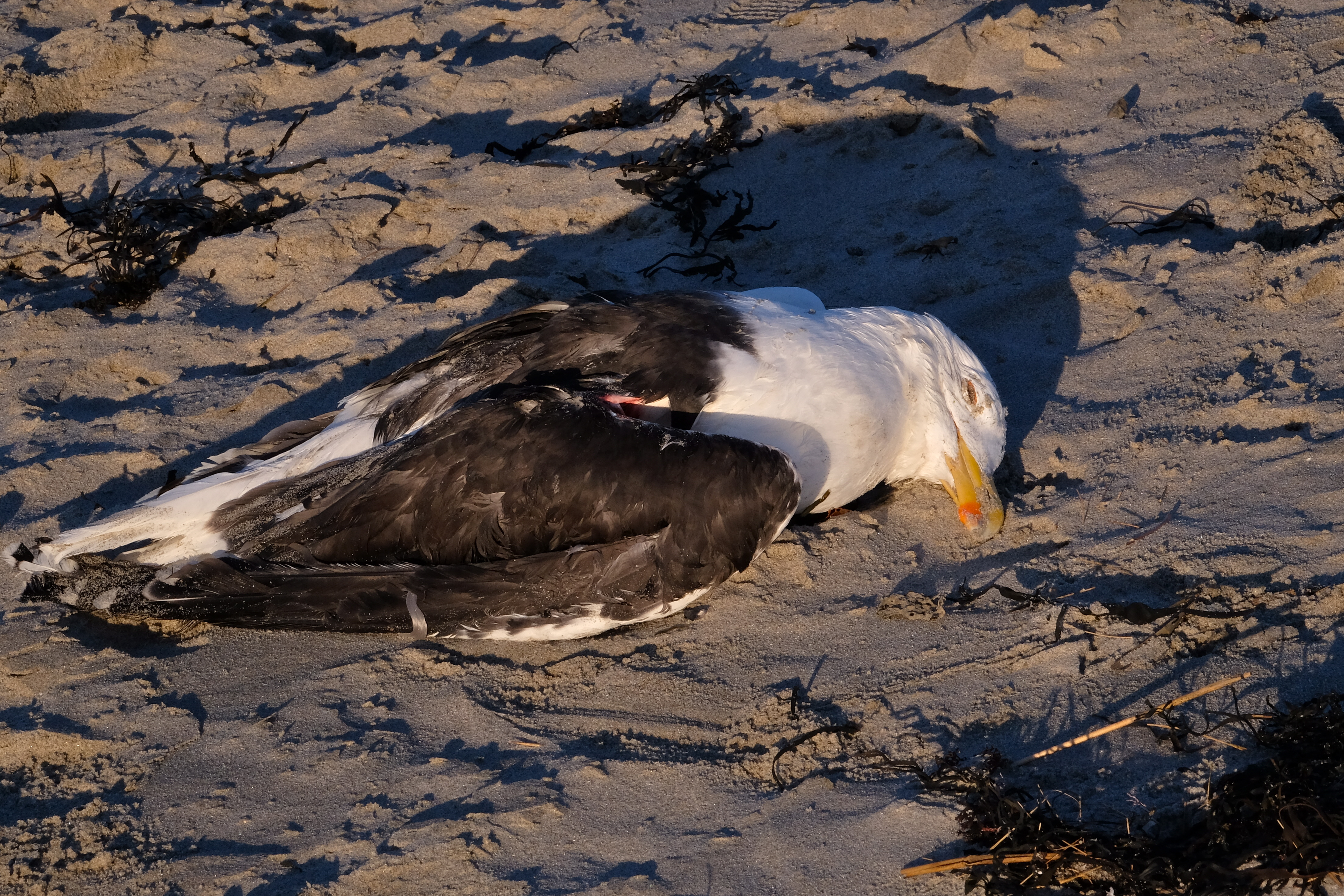
Large dead Black-backed Gull on the beach near the big rock and will move that this afternoon after I speak with Ken. We don’t want to attract varmints to the Plovers’ nesting area!

PIPING PLOVER AMBASSADORS NEEDED!

If you would like to become a Piping Plover ambassador and cover Plover monitoring shifts this season at Good Harbor Beach please contact Gloucester’s conservation agent Ken Whittaker to volunteer.

Thank you so much, and the PiPl thank you, too!!

Ken Whittaker contact information: kwhittaker@gloucester-ma.gov
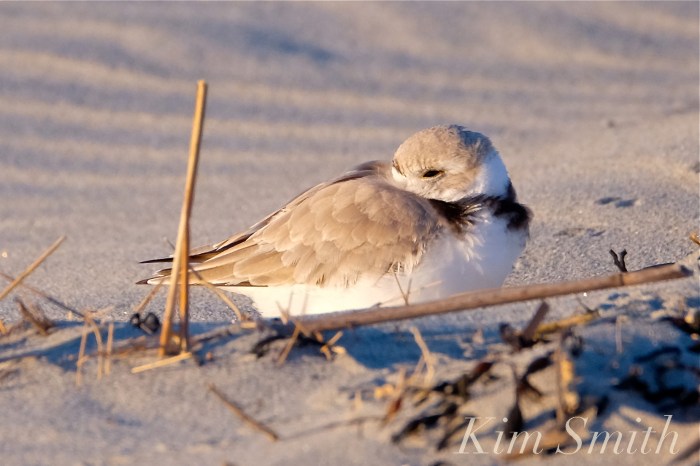
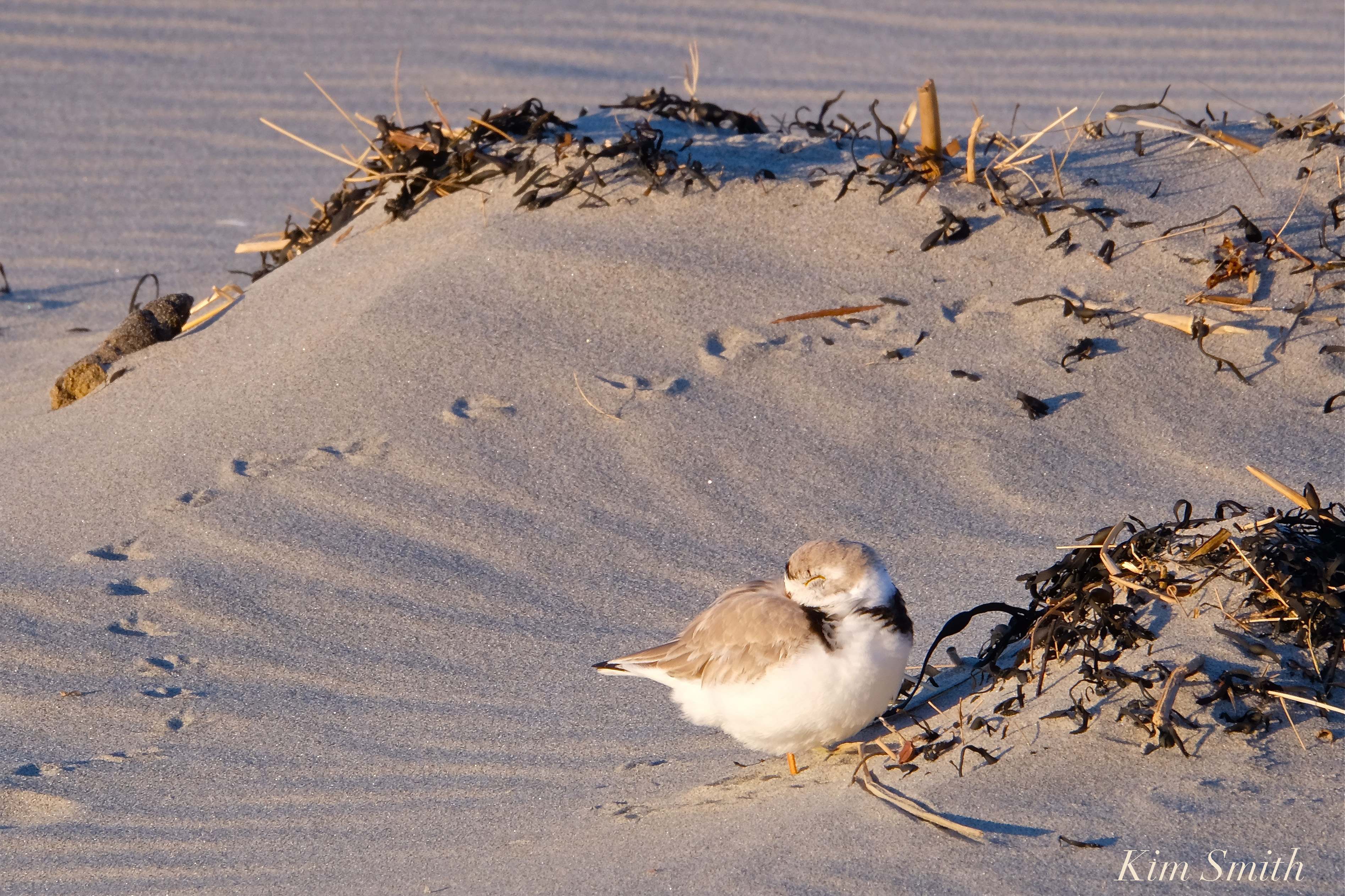
Male Piping Plover sleeping and PiPl tracks in the sand.

House Fire in West Gloucester Still Smoldering Monday Morning

The once beautiful home owned by restaurateur Steve DiFillippo, of Davio’s fame, that burned overnight Saturday to Sunday morning is still smoldering as of early this morning. The wind is blowing fiercely out on the neck.

To read the full story, see today’s Gloucester Times.

BREAKING: PIPING PLOVERS LITTLE CHICK AND FRIENDS RETURN!!! -By Kim Smith

Tuesday April 3, 2018

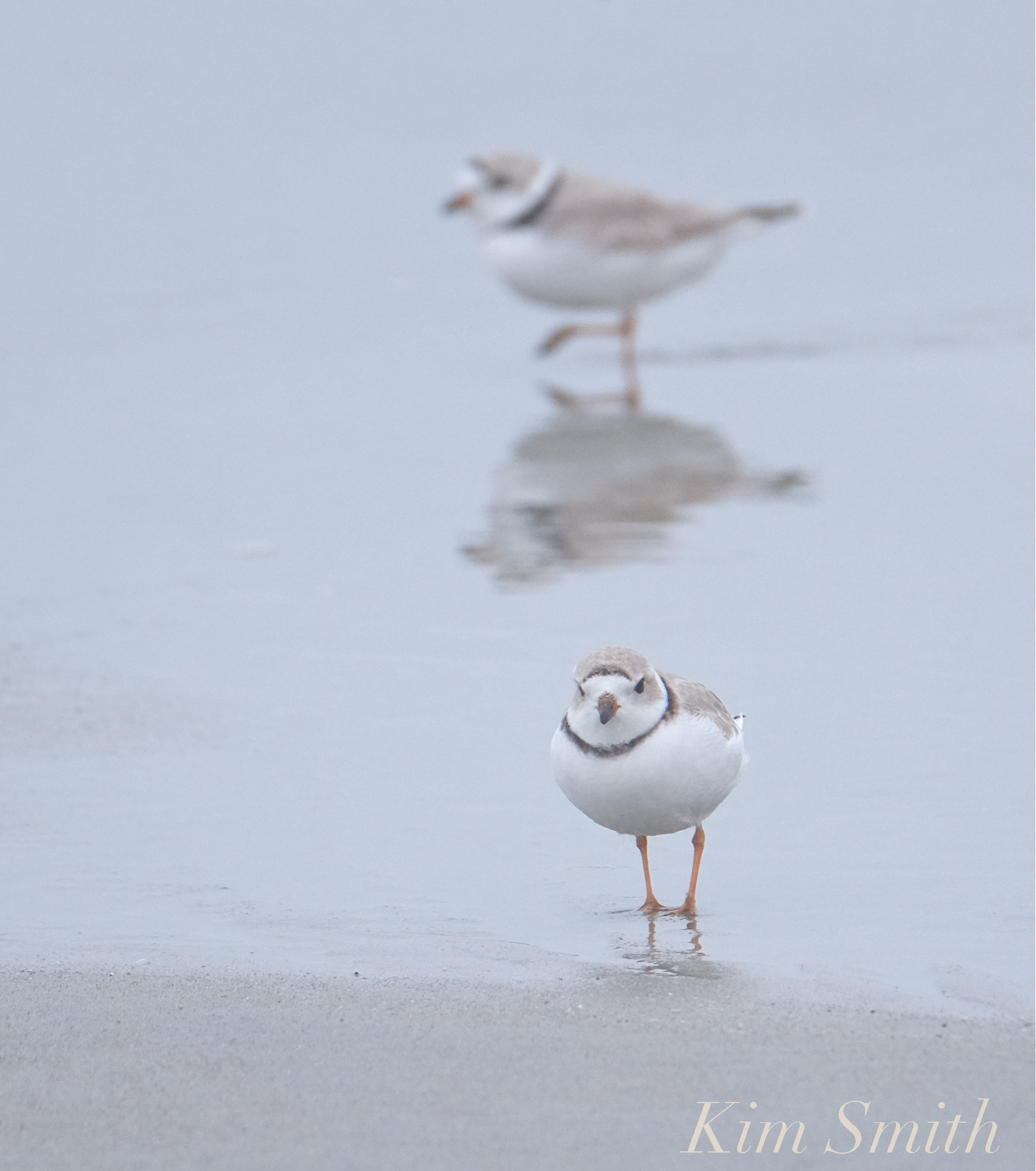
Oh Happy Day! Overjoyed to see the return of Little Chick and Friends!!!! Daily for the past several weeks I have been checking to catch sight of Piping Plovers. I looked this morning and nothing, but as Tom was leaving for a noon walk on GHB I asked him to keep his eyes peeled. My heart skipped a beat when he called only fifteen minutes later and said he thought there were three. I raced over, and sure enough, YES, three little plovers!!! They are so weary I don’t know what to think. Did they fly straight from the Carolinas or even further, from the Turks and Caicos, or possibly some remote island in the Bahamas? They are so sleepy-eyed and only want to rest.

Will they stay or are they on their way further north? Is this a passing passel of plovers? Could this be Little Chick or Papa and Mama Plover returning? It’s so cold and damp, rain is predicted and later this week, snow. What do Plovers do in the snow?

Wednesday April 4thDunlin in the drizzle

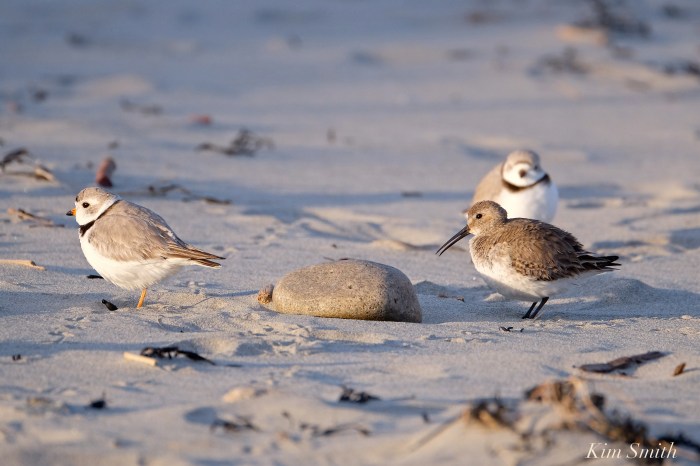
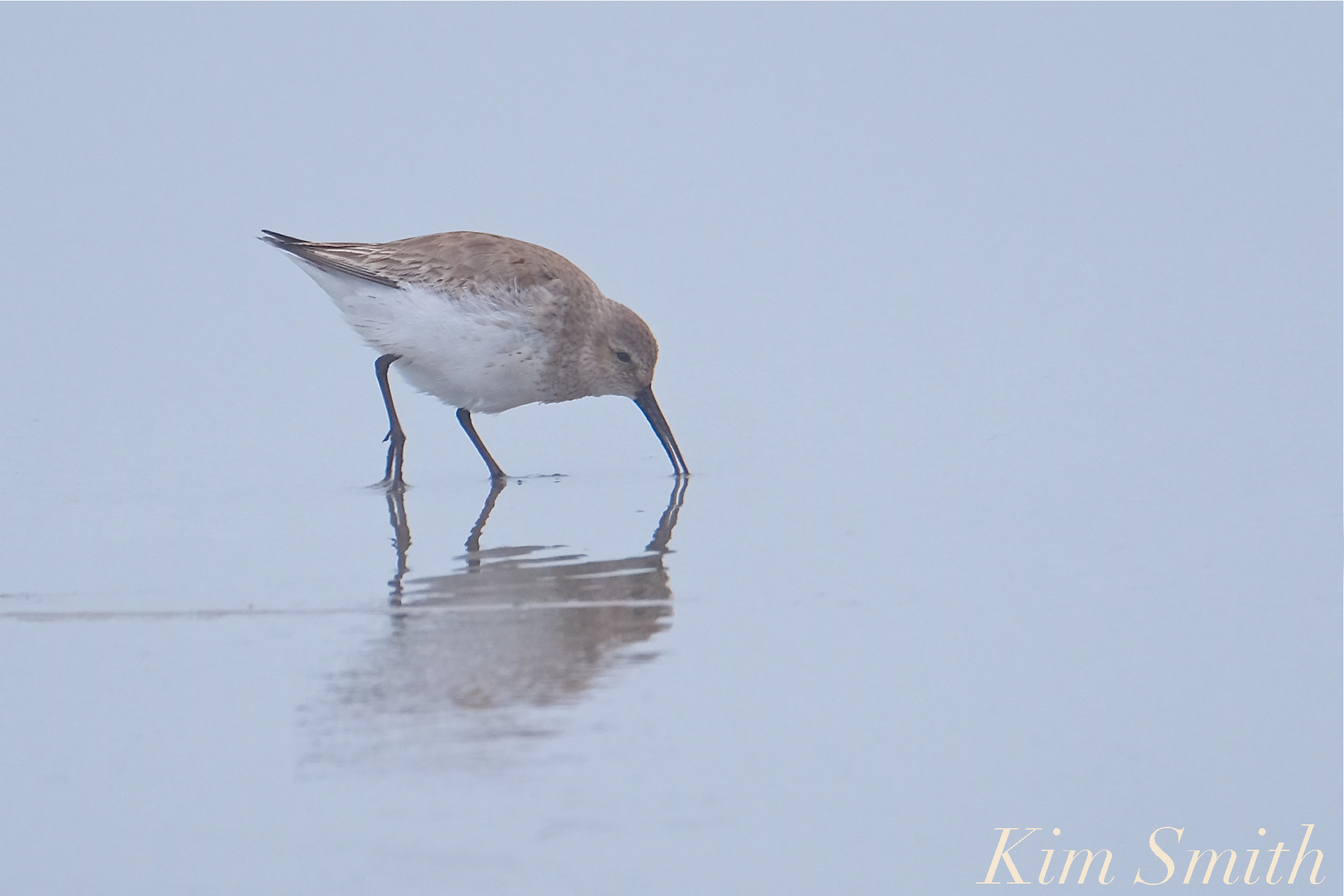
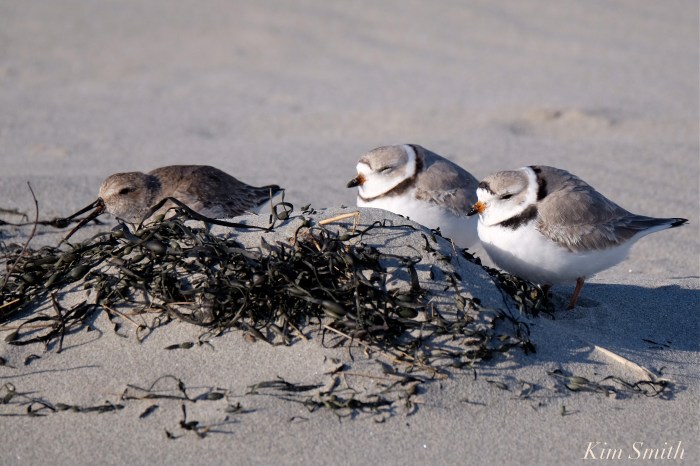
The Piping Plovers stayed the night, all three! They have been joined by a nearly as tiny little shorebird, a Dunlin I think. The PiPl appear to accept the Dunlin as part of the troupe. The Plovers seem a bit more perky today, foraging in the tidal flats.

Why oh why do folks encourage their dogs to chase shorebirds? Will have to post about the Plovers if they decide to stay. Too foggy and drizzly for my cameras on the beach today.

Thursday April 5th


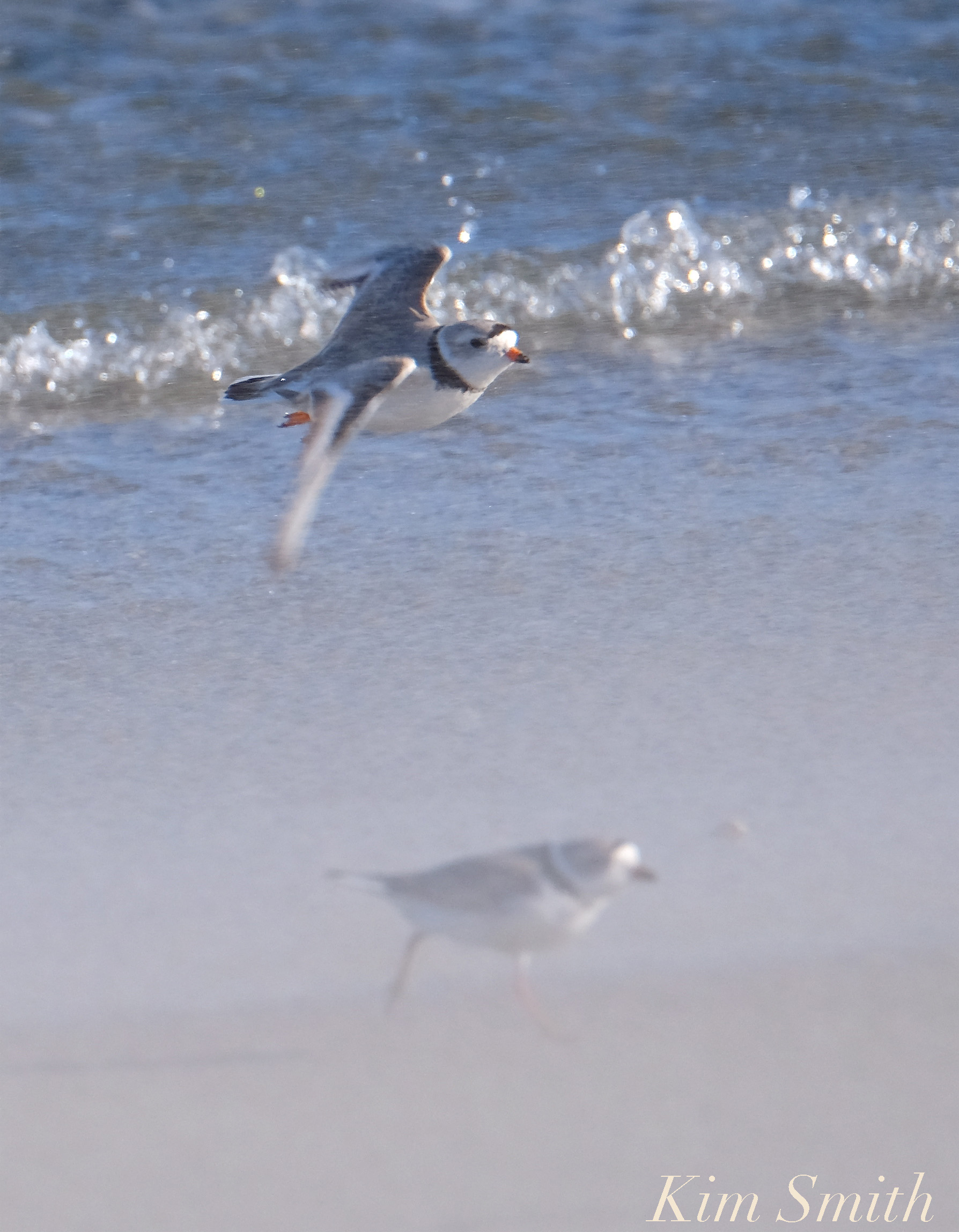
Plover flying through a sand storm.

Joy! They are still here.

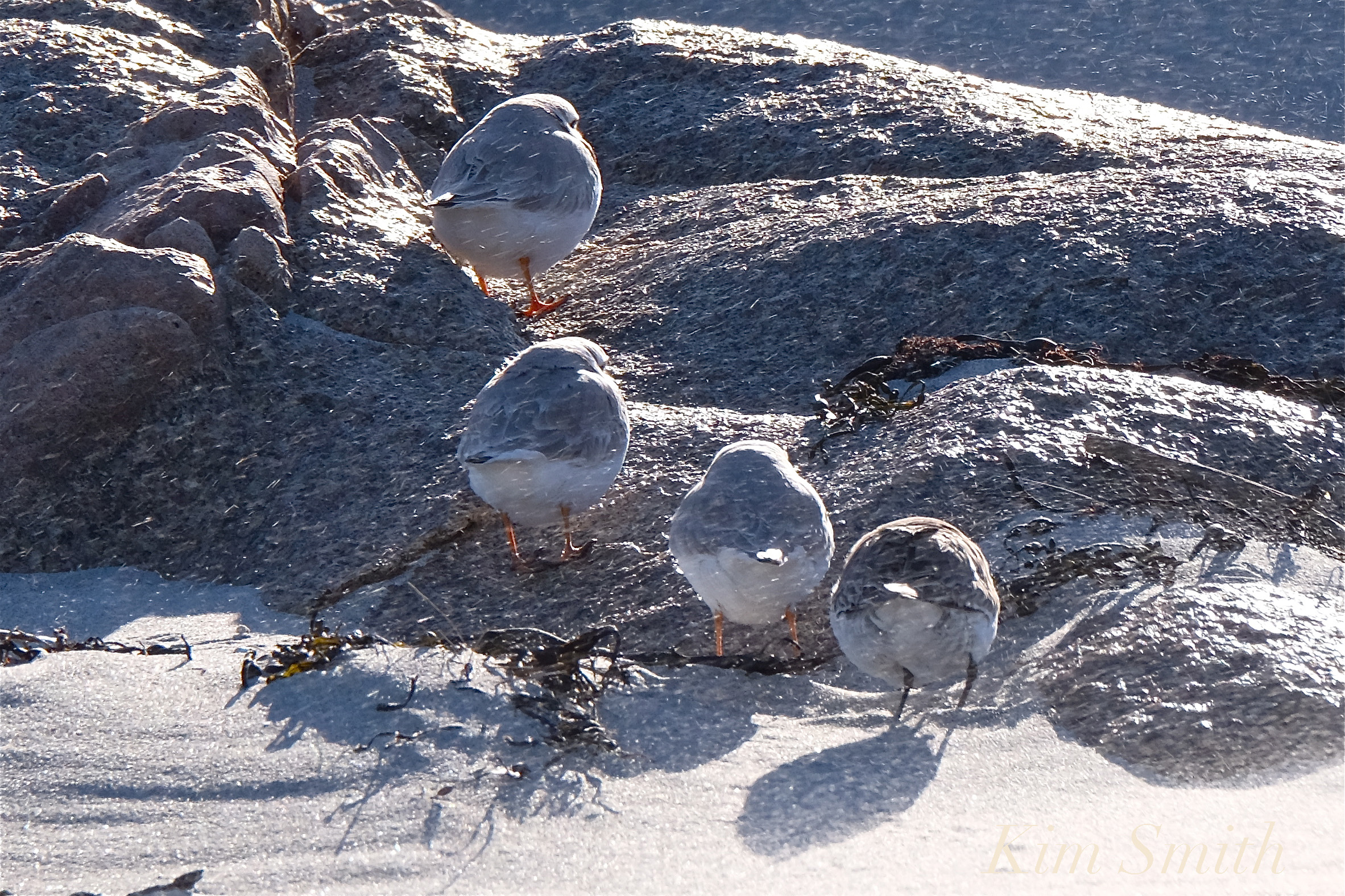
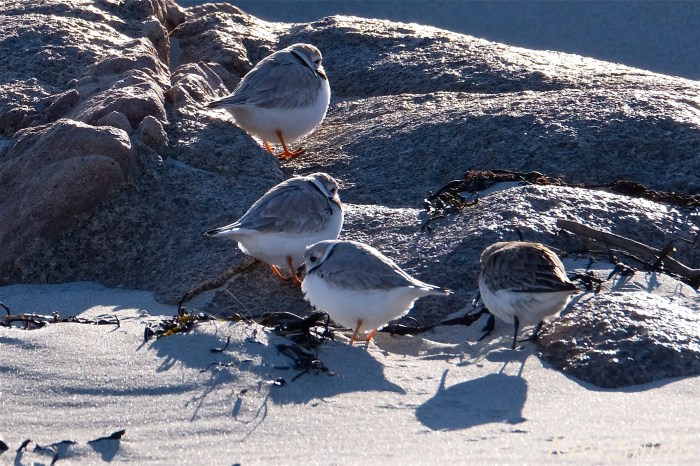
Terribly, terribly windy. The Plovers are trying to forage but are being blown sideways. So smart–they are seeking and finding shelter behind the big rock, and are huddling with the Dunlin. Too much sand blowing on my cameras.

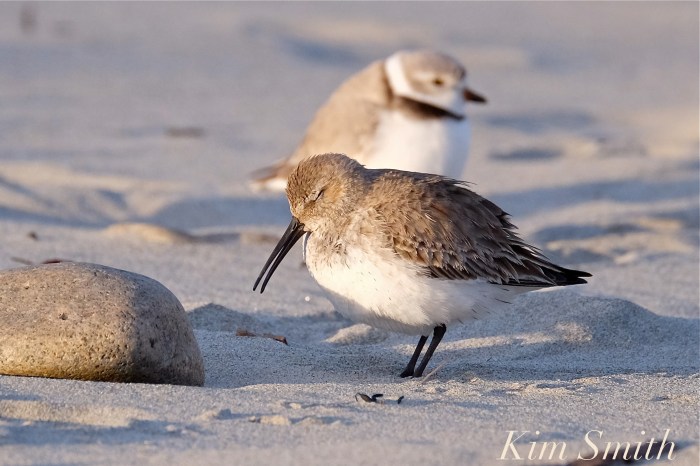
The Dunlin-that-thinks-he-is-a-Plover

Friday April 6th

The PiPl are courting!!! Does this mean they have made GHB home for the summer? If they lay eggs now, won’t that be tremendous because chicks will hatch well before July 4th. I think there are two males, one female, and the Dunlin is still here.

 Object of desire.

The male with the brightest orange bill made several nest scrapes, inviting the female to come sniff his cloaca and to inspect the site. Courtship was interrupted numerous times by curious and exuberant pooches. The dogs are off leash on even numbered days. Perhaps the Dog Friendly people will help and keep dogs on leash when near this potential nesting area. I hope so much we can make this happen. If the PiPl are able to nest early, the chicks will have a much, much better chance of survival. Millions and millions of dogs, but only about three thousand nesting pair of Piping Plovers remaining. Will the numbers again drop this year after multiple hurricanes and late season nor’easters?

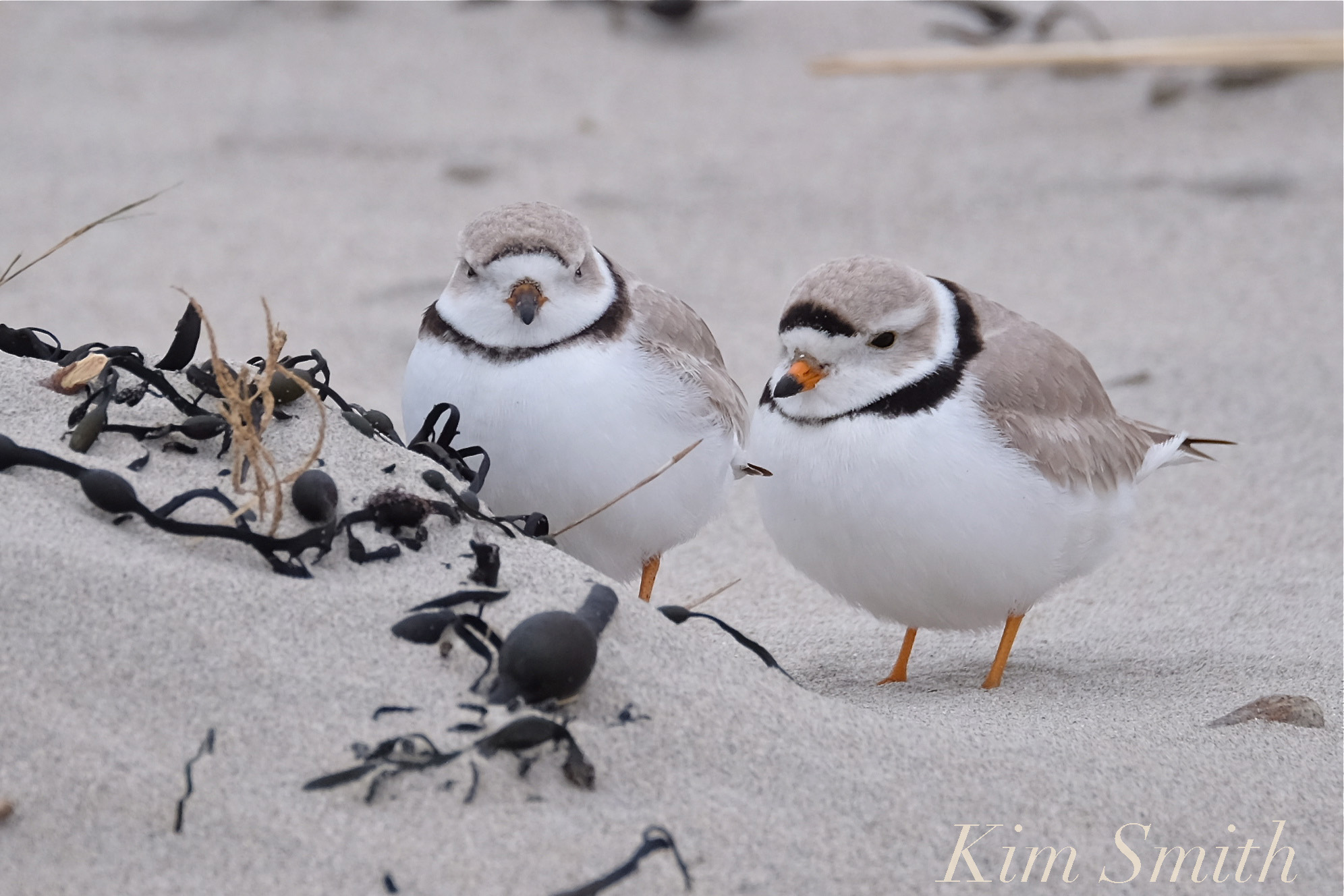
Female left, male right – notice the female Plover’s paler crescent band across her forehead, just a beautiful example of the difference between a male and female PiPl.

It’s time to let folks know about the Plovers, and we need a roped off area as soon as possible.

Sunny and cold and beautiful, with snow later today.

Late afternoon–what do Piping Plovers do in a snow squall? They forage! No photos, but a tiny bit of film footage. What were nice puffy wet flakes at home in my garden became icy, stinging cold driving rain/snow mix on the beach and too much for cameras to stay long.

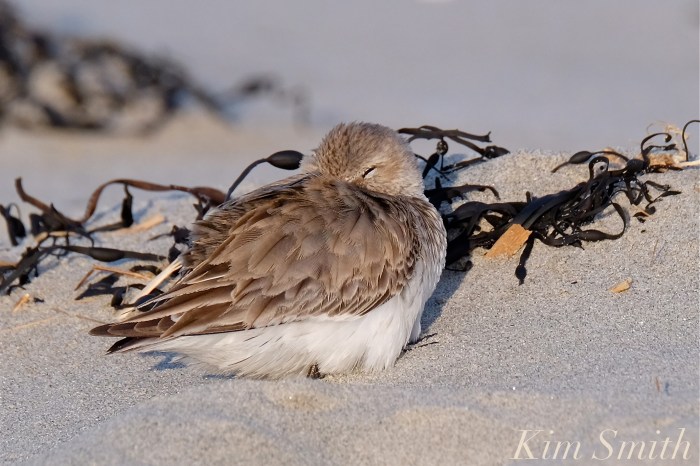
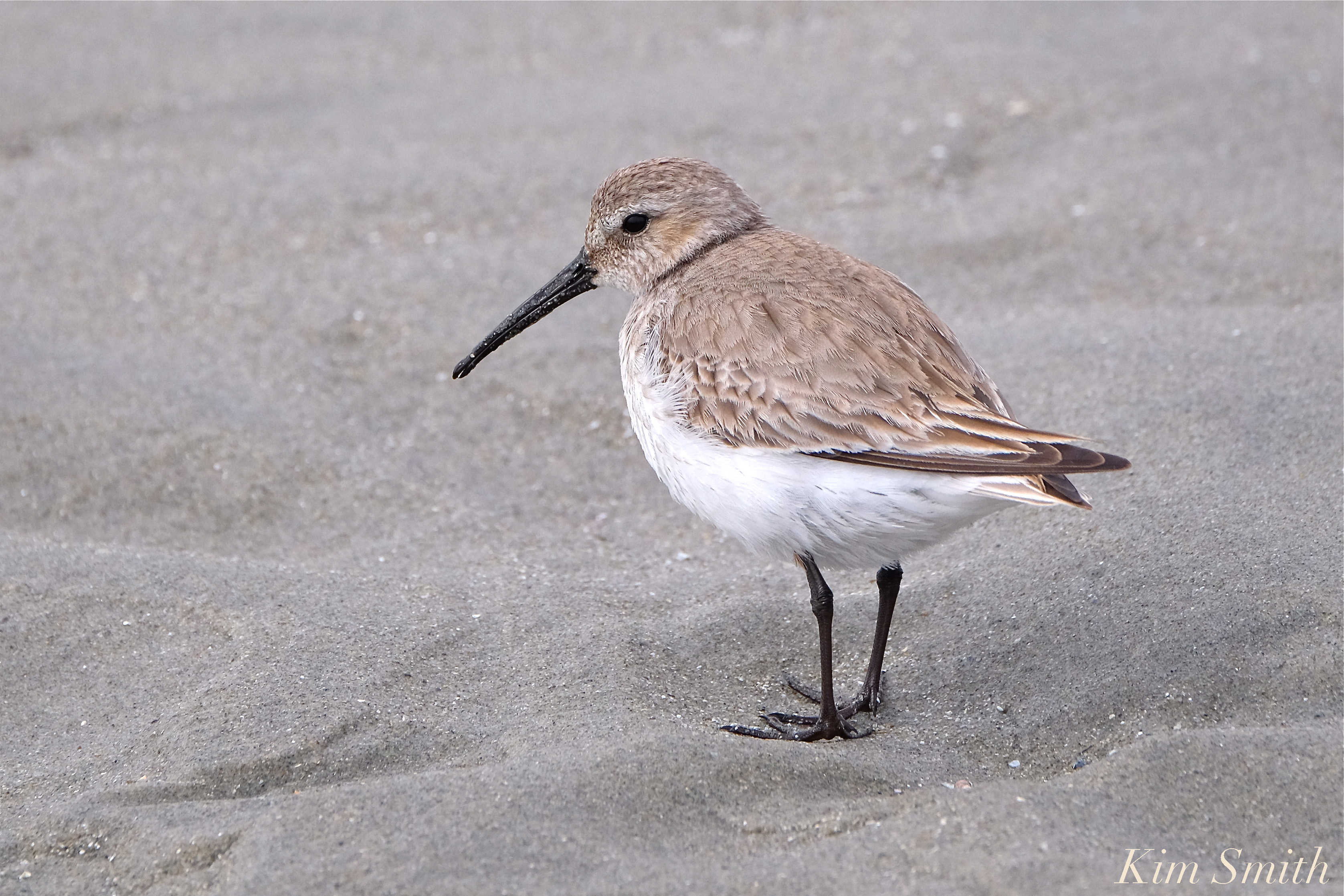
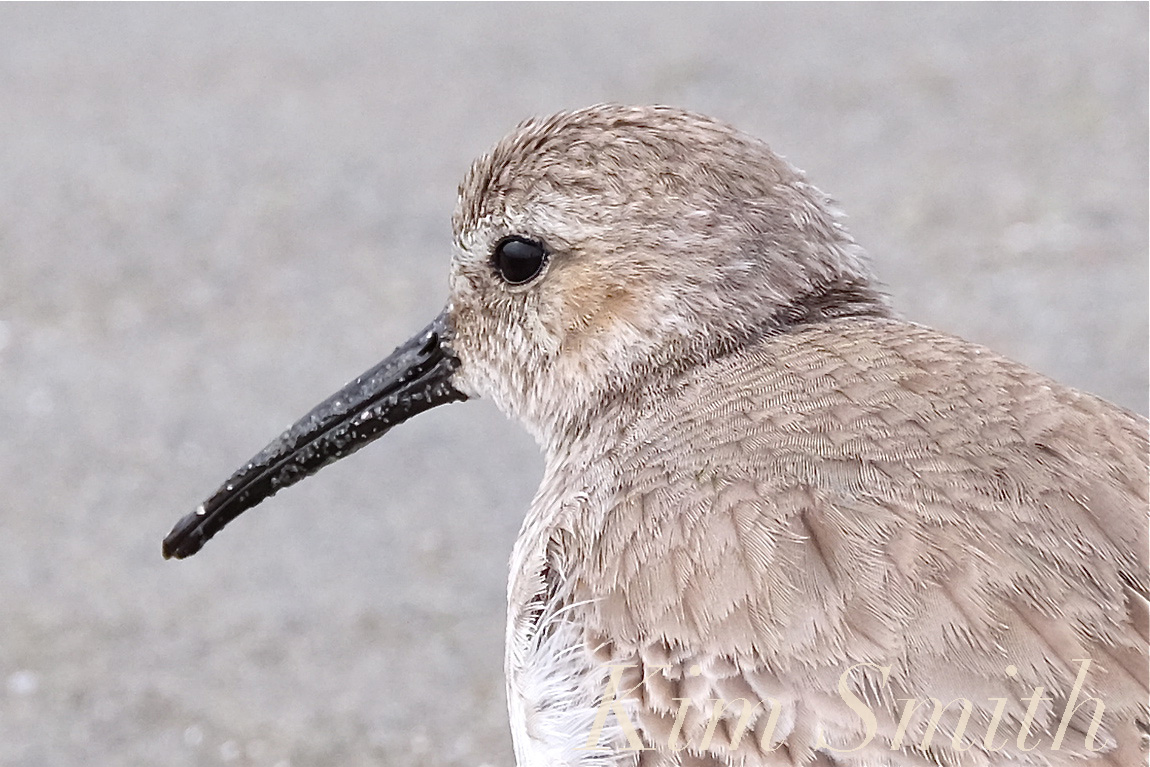
Dunlin  (Calidris alpina) close-up

Posting Saturday and Sunday tomorrow when I have a chance to go through photos.

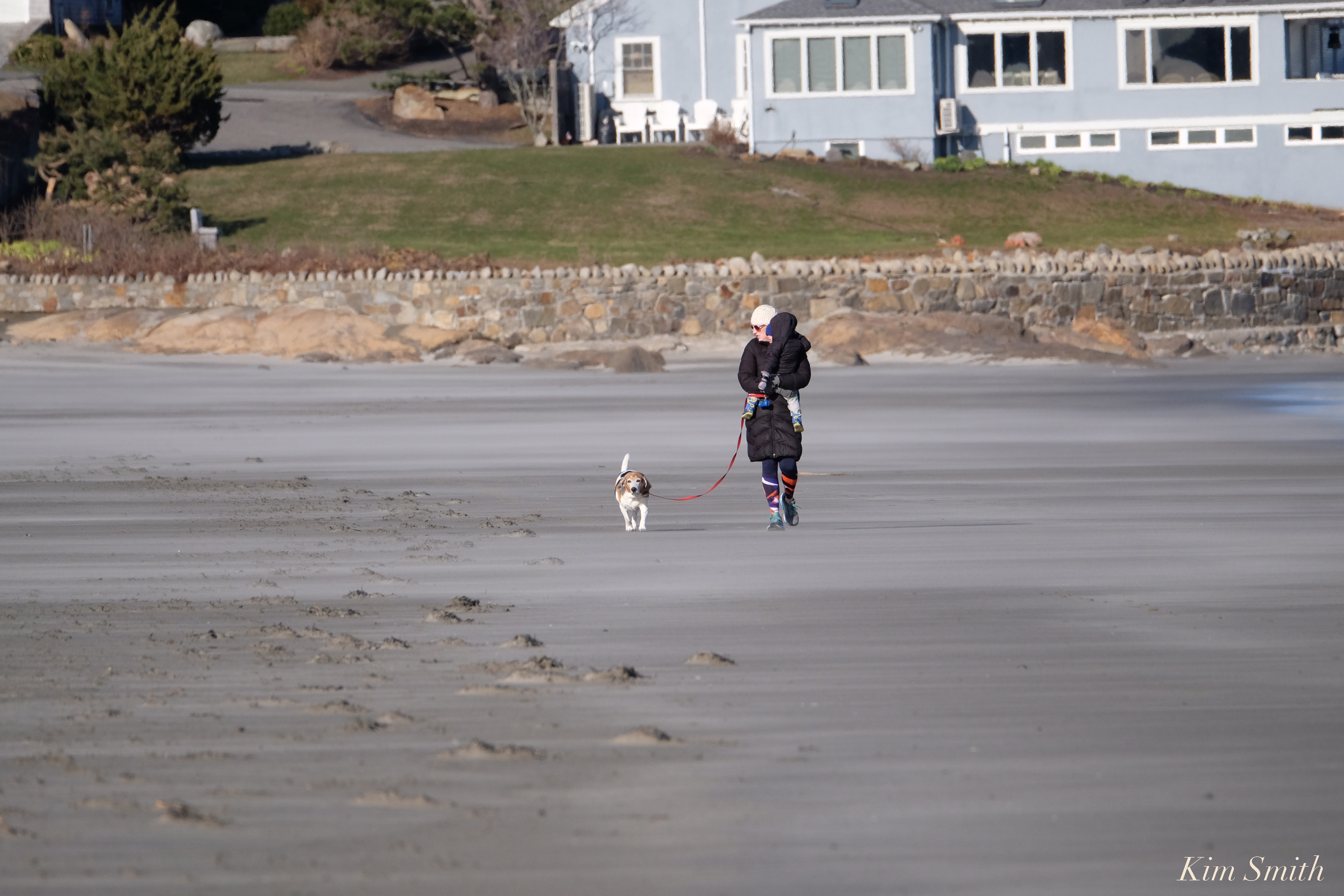
Great Gloucester citizen and friend to wildlife–kudos to this Mom for walking her dog on a leash, while carrying a child!

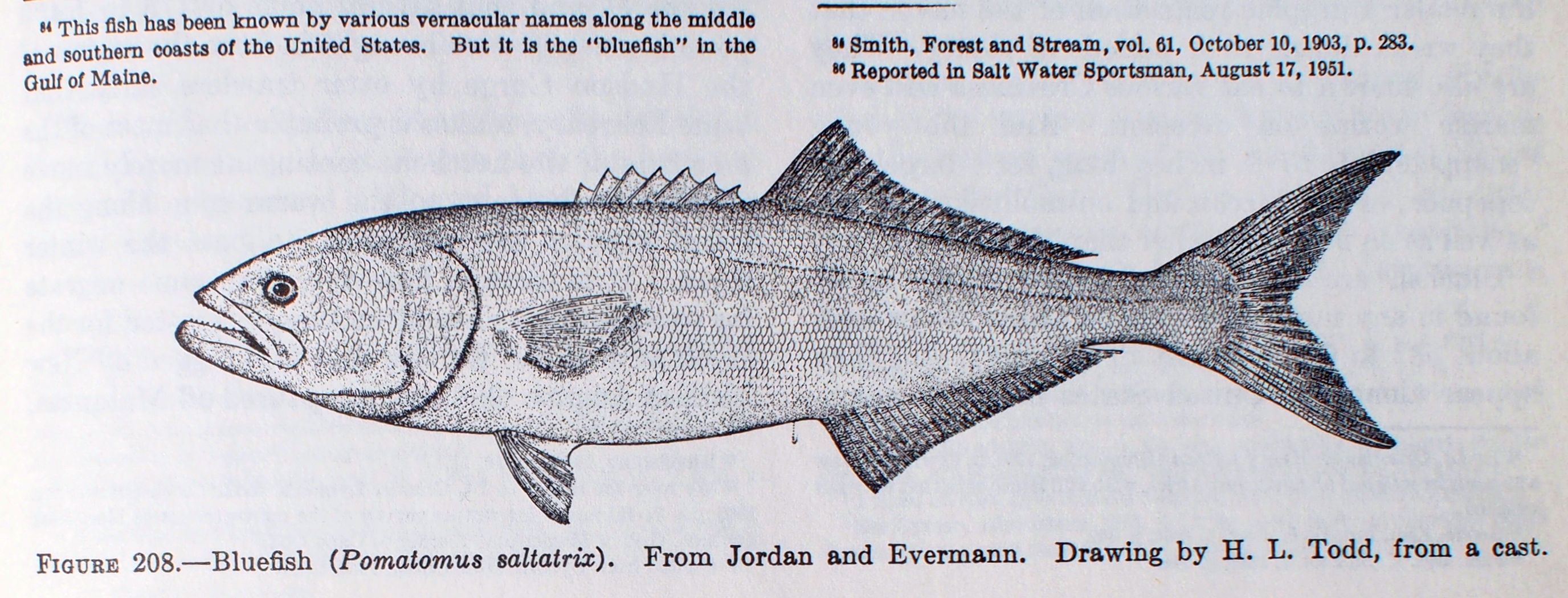
Beautiful Fish: Bluefish -By Al Bezanson

Bluefish; Snapper (young)
It is perhaps the most ferocious and bloodthirsty fish in the sea, leaving in its wake a trail of dead and mangled mackerel, menhaden, herring, alewives, and other species on which it preys. Goode[89] wrote long ago, the bluefish, “not content with what they eat, which is itself of enormous quantity, rush ravenously through the closely crowded schools, cutting and tearing the living fish as they go, and leaving in their wake the mangled fragments.” It is not only the schooling fish that fall prey to them, but scup, squeteague, hake, butterfish, cunners, and small fish of all kinds, besides squid. Baird, writing in the 1870’s, when bluefish were at the height of their abundance, estimated that they annually destroyed at least twelve hundred million millions of fish during the four summer months off southern New England; and while this calculation surely was wildly exaggerated it will help give the reader a graphic realization of the havoc that they wreak during their periods of plenty.

From Fishes of the Gulf of Maine by Bigelow and Schroeder (1953) online courtesy of MBL/WHOI http://www.gma.org/fogm/Pomatomus_saltatrix.htm

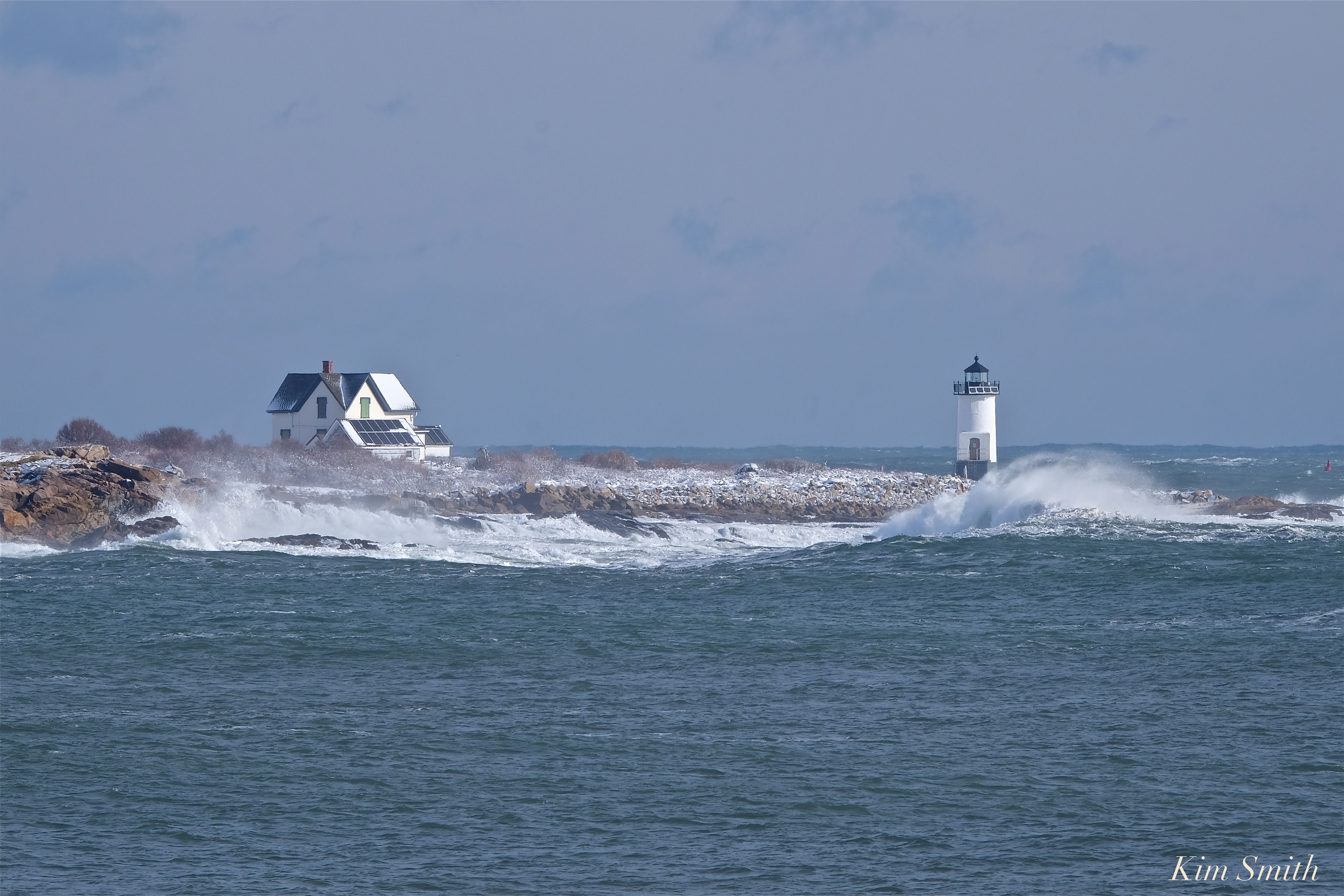
GREAT NEWS FOR STRAITSMOUTH ISLAND AND CONGRATULATIONS TO PAUL ST. GERMAIN AND THACHER ISLAND ASSOCIATION!!

A huge shout out to Thacher Island Association and president Paul St. Germain for winning an Essex National Heritage Area partnership grant to restore the elevated pedestrian lighthouse walkway on Straitsmouth Island.

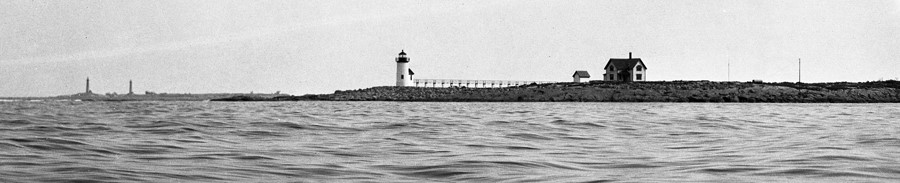
Paul St. Germain writes, “We will restore the original C 1850, 220-foot granite and wooden timber walkway to provide safe and easy access for the public to visit the lighthouse from the keeper house. This walkway has been there since 1854 and was destroyed sometime in the 1930’s. Besides its usefulness it has also been an iconic signature of the island’s profile for over 80 years.”

This unique 1906 photo shows the 315-foot walkway, the oil house, and keeper house, as well as Thacher Island’s Twin Lights in the distance.

Facts about Straitsmouth Island Light Station

  
  • First lighthouse was established in 1835 to mark the entrance to Rockport Harbor.
  • The lighthouse was rebuilt in 1851 and again in 1896.
  • A 6th order Fresnel lens was installed in the lantern in 1857.
  • The current Victorian styled keeper house was built in 1878 similar to the one on Thacher Island.
  • In 1932 the light was converted from white to green.
  • Coast Guard moved the station to shore at Gap Head and sold the island to private parties in 1934.
  • Coast Guard continues to maintain the light as an official aid to navigation today. In 1967 the island (except for the lighthouse) was donated to Massachusetts Audubon Society who maintains it as a wildlife sanctuary.
  • Straitsmouth Island was listed on the National Register of Historic Places in 1987.
  • In 2010 the lighthouse and 1.8 acres of land was given to the Town of Rockport by the coast guard.
  • In 2014 the Town of Rockport signed a long term 30 year lease with Mass Audubon for the use of the keeper and oil houses.

TO LEARN MORE ABOUT THACHER ISLAND LIGHTHOUSE AND STRAITSMOUTH ISLAND LIGHTHOUSE, VISIT THE THACHER ISLAND ASSOCIATION WEBSITE HERE

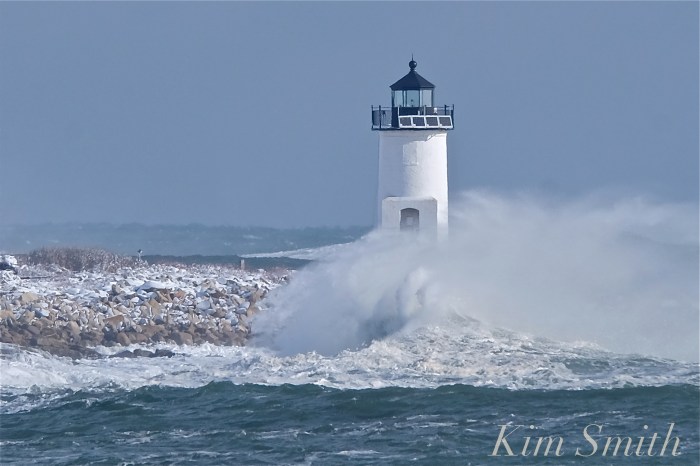
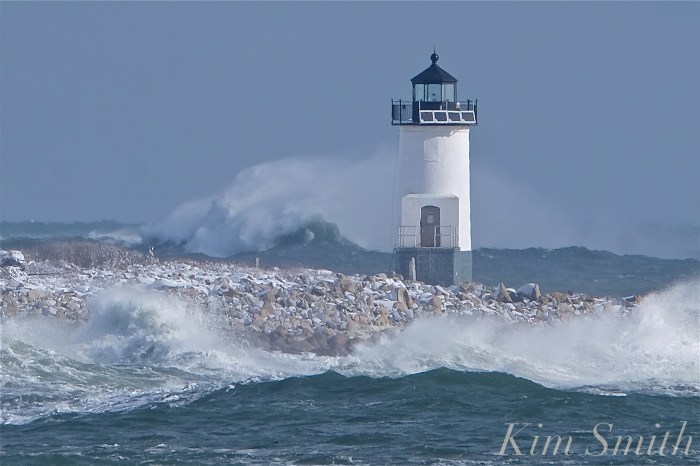
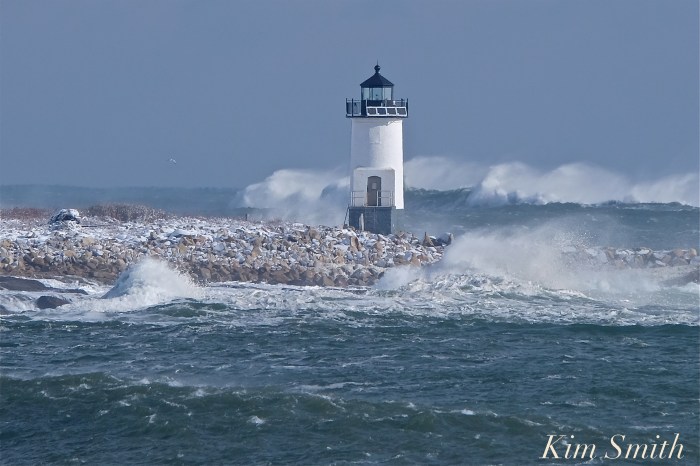
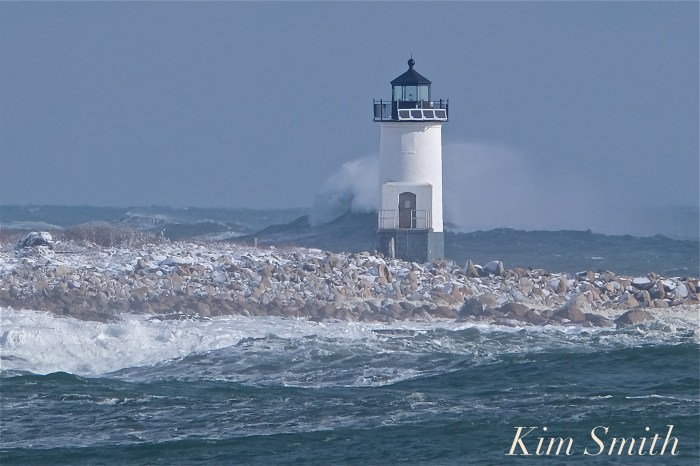
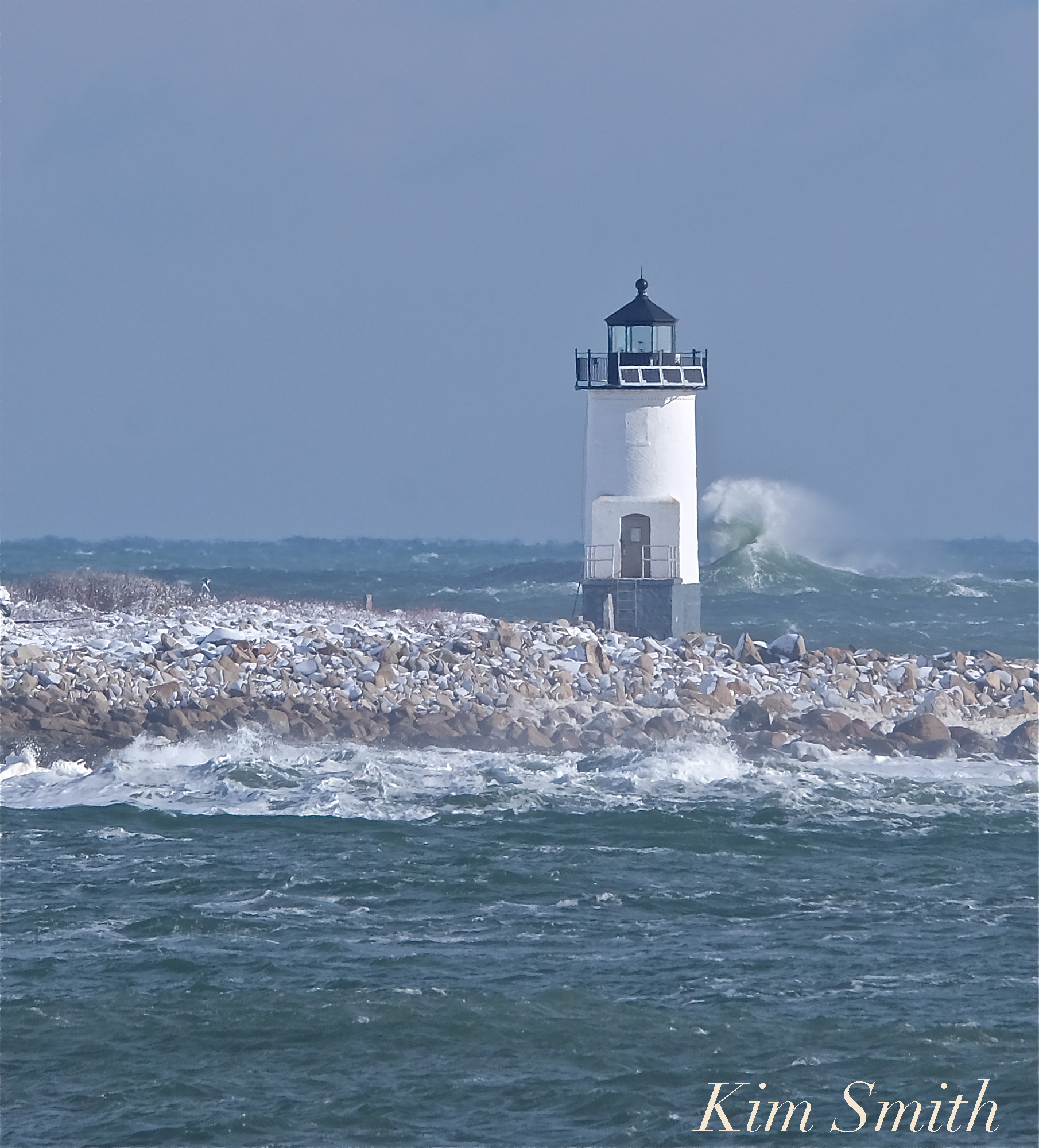
Straitsmouth Island pounding waves after March nor’easter

MOURNING DOVES CHILLING

Beautiful Mourning Doves hanging out in the semi-frozen bird bath wondering too if the temperatures are ever going to warm.

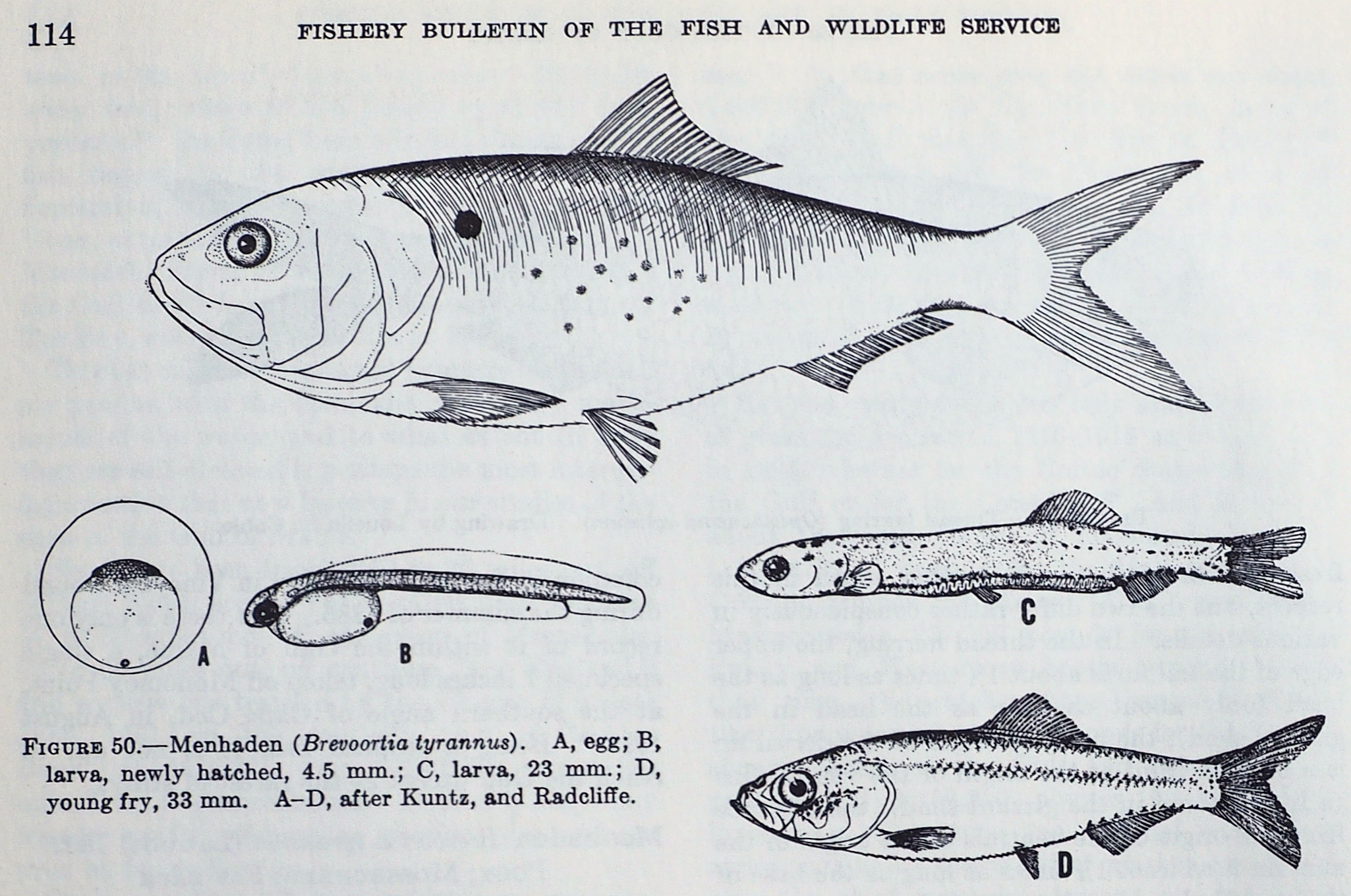
Beautiful Fish: Menhaden -By Al Bezanson


Menhaden: Pogy, Mossbunker, Fat Back, and 30 other common names.

The menhaden, like the herring, almost invariably travels in schools of hundreds or thousands of individuals, swimming closely side by side and tier above tier. In calm weather they often come to the surface where their identity can be recognized by the ripple they make, for pogies, like herring, make a much more compact disturbance than mackerel do, and “a much bluer and heavier commotion than herring, which hardly make more of a ripple than does a light breeze passing over the water,” as W. F. Clapp has stated to us. Also, pogies as they feed, frequently lift their snouts out of water, which we have never seen herring do, while they break the water with their dorsal fins, also with their tails. And the brassy hue of their sides catches the eye (as we have often seen), if one rows close to a school in calm weather.

No wonder the fat oily menhaden, swimming in schools of closely ranked individuals, helpless to protect itself, is the prey of every predaceous animal. Whales and porpoises devour them in large numbers; sharks are often seen following the pogy schools; pollock, cod, silver hake, and swordfish all take their toll in the Gulf of Maine, as do weakfish south of Cape Cod. Tuna also kill great numbers. But the worst enemy of all is the bluefish, and this is true even in the Gulf of Maine during periods when both bluefish and menhaden are plentiful there. Not only do these pirates devour millions of menhaden every summer, but they kill far more than they eat. Besides the toll taken by these natural enemies, menhaden often strand in myriads in shoal water, either in their attempt to escape their enemies or for other reasons, to perish and pollute the air for weeks with the stench of their decaying carcasses.

From Fishes of the Gulf of Maine by Bigelow and Schroeder (1953) online courtesy of MBL/WHOI http://www.gma.org/fogm/Brevoortia_tyrannus.htm


Currently, according to the Atlantic States Marine Fisheries Commission, based on the 2017 Stock Assessment Update, Atlantic menhaden are neither overfished nor experiencing overfishing.  More here on the commercial harvest for reduction to fishmeal and oil and the commercial and recreational bait fishery.

http://www.asmfc.org/species/atlantic-menhaden

Al Bezanson


ESSEX NATIONAL HERITAGE AREA ANNOUNCES ALL PARTNERSHIP GRANTS

Amesbury
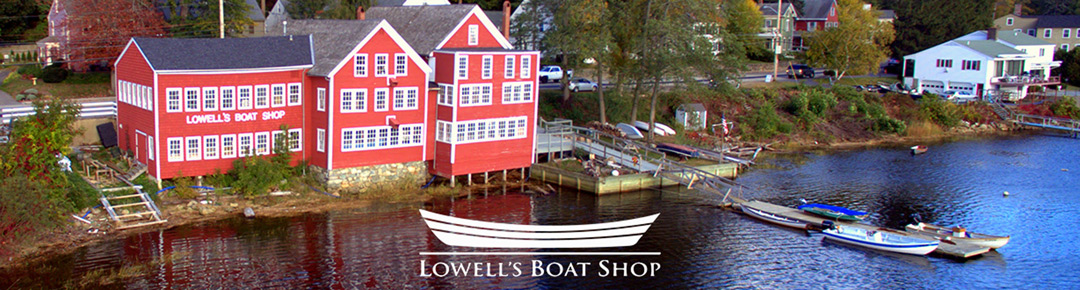
Lowell’s Boat Shop 

Lowell’s Boat Shop in Amesbury, will be carrying out urgent and emergency projects including the structural repair, stabilization, and shoring of facility footings and foundation piers, which are being eroded and causing the building to sag. Funding from the Essex Heritage grant program will enable Lowell’s Boat Shop to construct a proper footing that would mitigate erosion and allow them to slowly return the structure back to level and set it on a foundation pier that will be permanently stable.

Andover
Andover Historical Society

Based on a successful 2017 pilot program intended to augment a lack of local history in the school curriculum until 3rd grade or even high school, Andover Historical Society will be offering “Discovering my Neighborhood,” in which students will examine objects, photographs, and maps that tell the story of their neighborhood and the town. Students will be able to consider how Andover has changed, how it stayed the same, and how it might change in the future. The program will be tailored to each neighborhood, the historical development of Andover being reflected in its five school districts.

Lawrence
Bread and Roses Heritage Committee, Inc.

Taking place September 3rd in the historic Campagnone Common, Partnership Grant funding will be used to make possible The Bread and Roses Labor Day Heritage Festival, a unique event commemorating the Great Lawrence Textile Strike of 1912, now known world-wide as the Bread and Roses Strike. The free, family-oriented event that hosts the city’s many community organizations, educational workshops, and discussions on historical and contemporary issues aims to bridge the relationship between the immigrants of the past and present by revealing common struggle through music, theater, dance, food, art, historical tours, presentations, and family activities. Historical interpretation occurs through  guided trolley tours, walking tours, at talks and discussions at the Lawrence History Live! tent, and by exhibitors in our History and Labor area.

Marblehead
Marblehead Museum

With the goal of maintaining and protecting the 1768 Jeremiah Lee Mansion, the Marblehead Museum will be working to continue re-stabilizing the 20 front windows of the building using a durable putty to seal the glass to the frames and secure all framing members, effectively protecting the mansion and sealing out the elements. The two-to-four week long project will be carried out this summer, proactively preventing the glass from coming loose from the frames, and moisture being allowed to continue damaging the internal plaster and floors.

Middleton
Middleton Stream Team

The Middleton Stream Team with utilize their Essex Heritage grant in order to construct an unpaved walking path in the Henry Tragert Town Common, along which they will place unobtrusive interpretive signage displaying short narratives on the natural and historical significance of the area.

Newburyport
Historical Society of Old Newbury

The Historical Society of Old Newbury will use their partnership grant to update their current museum, which was last updated in 1995 and was victim to unfortunate water damage. Partnering with five local schools to offer new programming, the museum will be turning its focus to its collections and exhibits relating to the American Revolution and Civil War to provide deeper interpretation of these two major conflicts that figure prominently in local history. The update will also ensure that these events are well-represented by the museum’s collections, and align with the curricular interests of local school groups by paying special attention to the events effects on a local level.

Theater in the Open

Theater in the Open will utilize an Essex Heritage grant to engage a qualified contractor to repair the roof and help to replace the exterior shingles of the Maudslay Gatekeeper’s House garage and garden, designed by William Gibbons Rantoul and built in 1903. The garage and garden are both highly visible from the road, making a big impact on the appearance of the Gatekeeper’s House to all visitors to Maudslay State Park. This spring, visitors will also see a completely restored entrance porch to the main house and significant improvement to the grounds.

Peabody
Peabody Historical Society and Museum

Partnering with the City of Peabody and the Peabody Historical Commission in their efforts to improve Crystal Lake Park, the Peabody Historical Society will be implementing the “Witch Trials Legacy Trail of Peabody” by developing and providing three new interpretive displays clarifying witch trial history as it relates to Peabody as well as removing and re-placing two signs already at Crystal Lake Park to compliment the new design. In addition to the improved signage, the Peabody Historical Society will be developing an interactive audio tour, information for which will be displayed on the new signage.

Rockport
Thacher Island Association

Thacher Island Association will replace the original c. 1850, 220-foot granite and wooden timber walkway to provide safe and easy access for the public to visit the lighthouse. This walkway has been there since 1854 but was destroyed sometime in the 1930’s. Besides its usefulness it has also been an iconic signature of the island’s profile for over 80 years. The walkway provided access from the keepers house to the lighthouse, and the rebuilt walkway will serve the same function for visitors to the lighthouse once the island is reopened to the public next year.

Salem
Hamilton Hall

Arriving in Salem from Curacao in 1798, John Redmond took up living quarters in an apartment at Hamilton Hall, serving as its caretaker upon its completion in 1805. Working as a barber, caterer, and restauranteur, Redmond became the preferred caterer and provisioner for all social events at the Hall, and over time he came to be known as “principal restauranteur” in Salem, and his family went on to be active in the early abolitionist movement. Hamilton Hall will use their partnership grant to develop inclusive narrative content about John Redmond’s life and the role that he played in Salem and Hamilton Hall’s early history, complemented by visual interpretive aids to broaden their reach to better reflect the culture and population of Salem.

Topsfield
Topsfield Historical Society

Originally built in 1683 and largely unaltered, the wood frame edifice of the Parson Joseph Capen House is a well-known icon arguably ranking among the most architecturally significant structures in the Essex National Heritage Area and is considered by many authorities to be one the finest extant examples of Colonial Era architecture anywhere. The Topsfield Historical Society will use their Essex Heritage grant to replace deteriorating clapboarding of various materials – including oak, pine and cedar – and prevent damage to and decay of the structure caused by allowing moisture to penetrate the frame.

Wenham
Wenham Historical Association and Museum

As the Topsfield Fair marks its 200th anniversary, the Town of Wenham also celebrates its 375th anniversary and the Wenham Museum its 95th anniversary. To highlight an important and often overlooked facet of local history, the museum seeks to install this exhibition on Col. Timothy Pickering, whose legacy is common to all of these entities, this year. Using their partnership grant from Essex Heritage, the Wenham Museum will create an interactive exhibit devoted to Col. Timothy Pickering’s life in Wenham, his impact on agriculture, and his role in founding the Essex Agricultural Society, as well as improving the museum’s Pickering Library.In the exhibit, visitors will see historic Pickering Family textiles, such as a crest and wedding coat. Correspondence, reproductions of portraits, a family tree, visual interpretations of agricultural “best practices,” and text relating to the founding of the Essex Agricultural Society will also be included.

Congratulations to our 12 recipients, who will be working to implement a diverse range of educational, interpretive, and preservation projects throughout Boston’s North Shore and the Merrimack Valley over the next year!

CONGRATULATIONS TO MARY KAY TAYLOR AND LOWELL’S BOAT SHOP!

Rebecca Reynolds (MARS board president), Annie Harris (CEO Essex National Heritage Area) and Mary Kay Taylor (Lowell’s Boat Shop education/grants director)

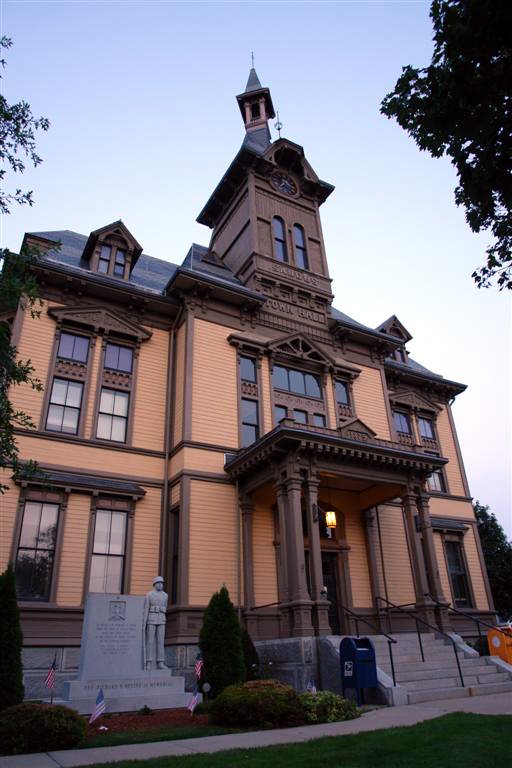
Today I attended the Essex National Heritage Area annual spring meeting as a recently appointed heritage commissioner. The meeting was held at the Saugus Town Hall, a magnificently maintained, predominately Gothic Revival style building, constructed in 1874-1877 and designed by architects Lord and Fuller. The East Lake inspired interior details and decoration were a treat to see and have been beautifully preserved.

It was a joy to see my friend Sarah Boucher, director of sales and marketing at Willowdale Estate and Briar Barn Inn, to meet Rebecca Reynolds, president of the Manship Artists Residency and Studios (MARS), and to see the always wonderful Mary Kay from Schooner Ardelle-Adventure-Lowell’s Boat Shop.

Today Mary Kay was wearing her Lowell’s Boat Shop and Museum hat, accepting the matching Essex National Heritage Area partnership grant. The grant will go towards the restoration of the Boat Shop. To learn more about Lowell’s Boat Shop and Museum, the oldest continuously operating boat shop in America, visit their website here.


Saugus Town Hall image courtesy wiki commons media

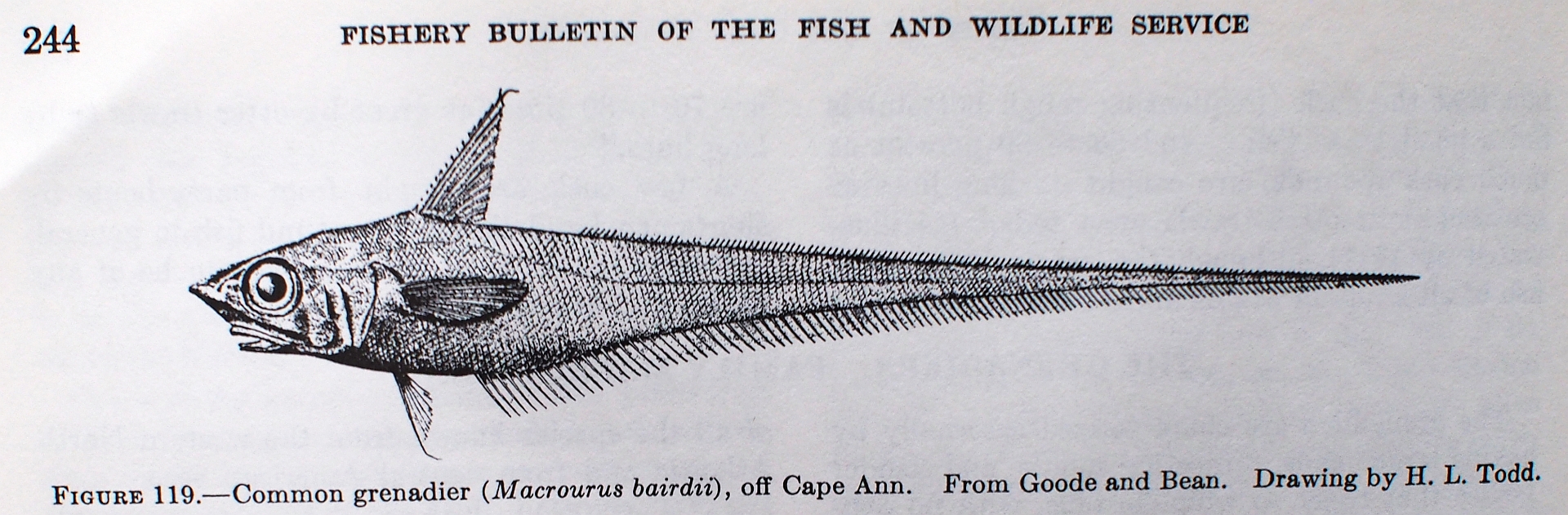
Beautiful Fish: Grenadier -By Al Bezanson


Common Grenadier, Rat-tail, Marlin Spike

Occurrence in the Gulf of Maine—

The common grenadier was formerly regarded as a rare stray in the inner parts of the Gulf of Maine for only two had been recorded there aside from the Eastport and Lubec specimens mentioned above, the  one from the western basin in 160 fathoms, the other from off Gloucester, both of them taken many years ago. But they must be rather common on the muddy bottoms of the deeper parts of the Gulf in 85 to 125 fathoms, for we have caught more than 100 of them at various localities on recent trawling trips. No doubt it is because few vessels ever fish on these grounds, which are not productive either of cod or of haddock, that the presence of grenadiers there has been overlooked. A grenadier, too, was reported from the slope of Jeffreys Ledge, in about 50 fathoms, during March 1934.  Usually about a foot long.


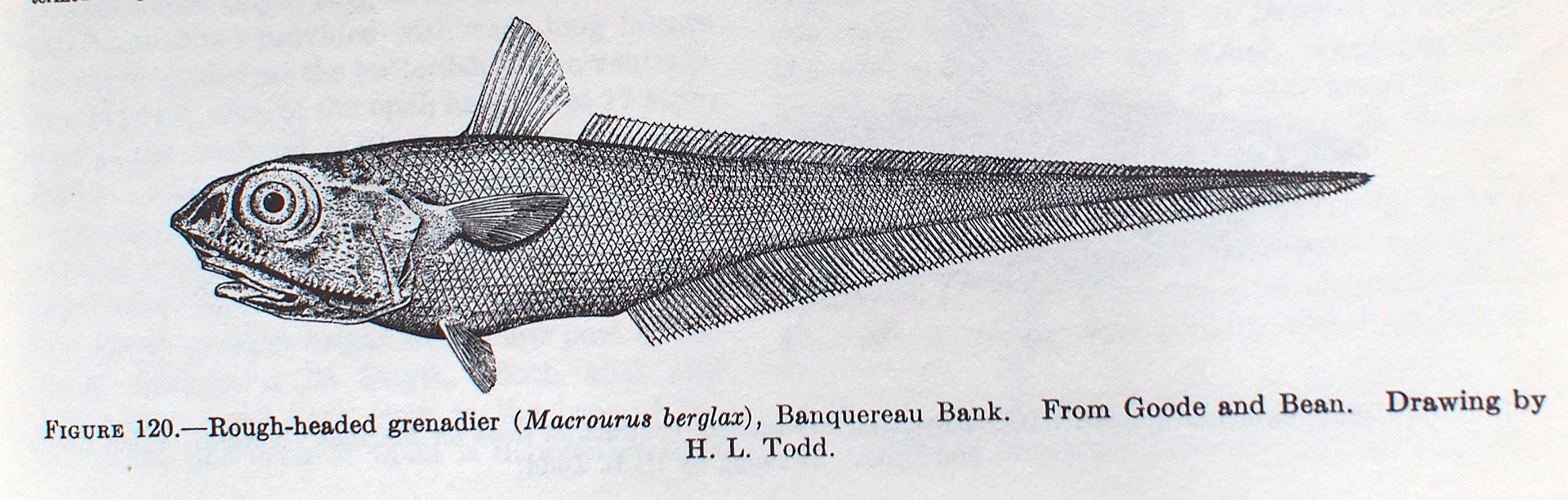
Rough-headed Grenadier, Rat-tail, One-eye

Occurrence in the Gulf of Maine—

Three quarters of a century ago, when halibut were more plentiful in the Gulf of Maine than they are today, and when vessels, long-lining from Gloucester, still resorted regularly to the deep channel between Georges Bank and Browns Bank as well as to the deep gullies that interrupt the Nova Scotian banks, large grenadiers were often hooked. Fishermen described them as common enough to be a nuisance, for they stole the baits meant for other fish and were of no commercial value themselves. It was on the strength of such reports that Goode[7] characterized them as “exceedingly abundant on all of our offshore banks.”   Maximum  length of 3 feet and a weight of 4 or 5 pounds

From Fishes of the Gulf of Maine by Bigelow and Schroeder (1953) online courtesy of MBL/WHOI

http://www.gma.org/fogm/Macrourus_bairdii.htm

http://www.gma.org/fogm/Macrourus_berglax.htm

GREAT HORNED OWL ATTACK -By Kim Smith

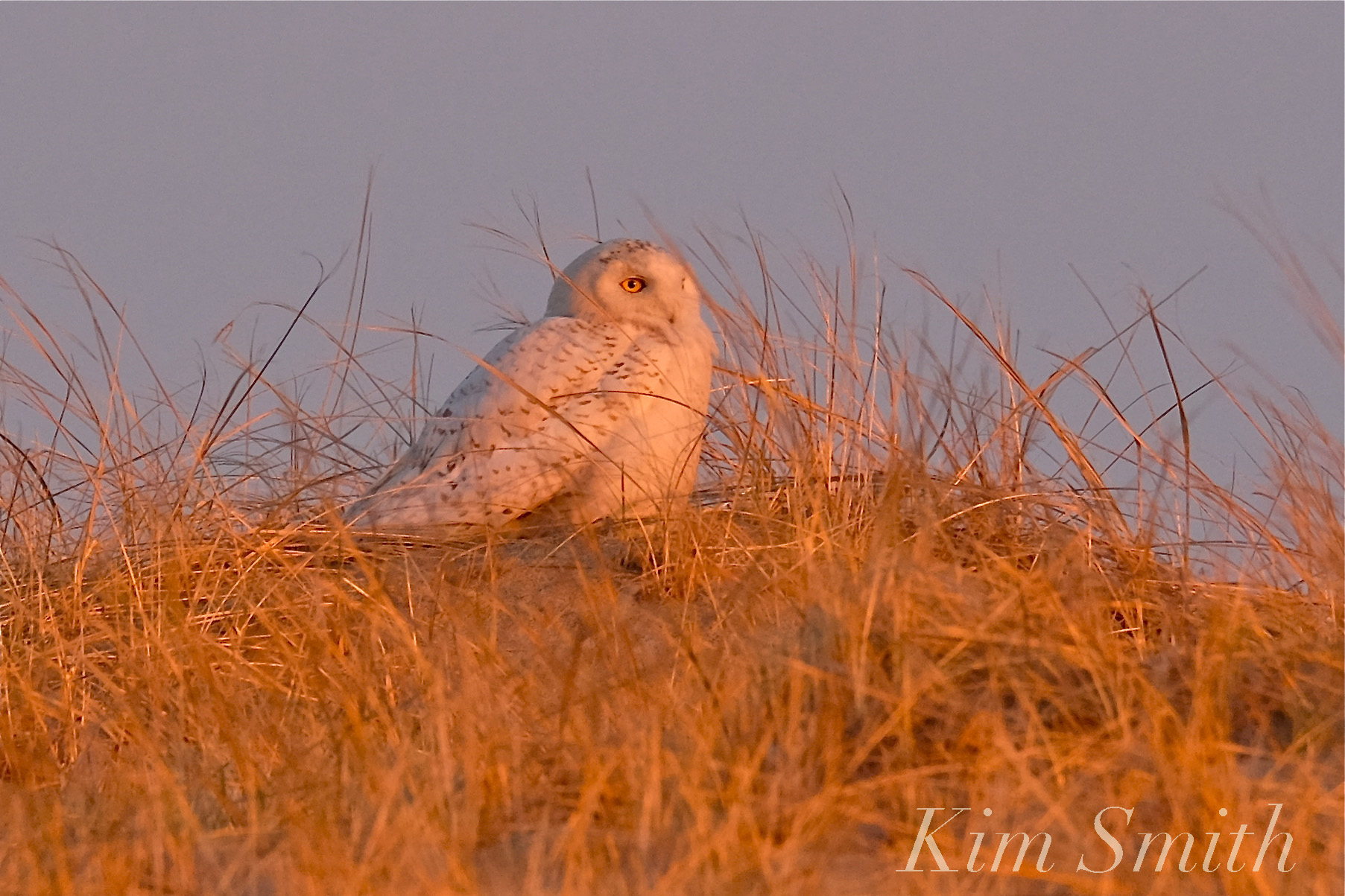
City Councilor Scott Memhard shared the following article about a Great Horned Owl attack from Sunday’s Boston Globe Magazine. Although an extremely, extremely rare occurrence, we thought our readers would be interested. The article about the attack begins after the Snowy Owl photo.

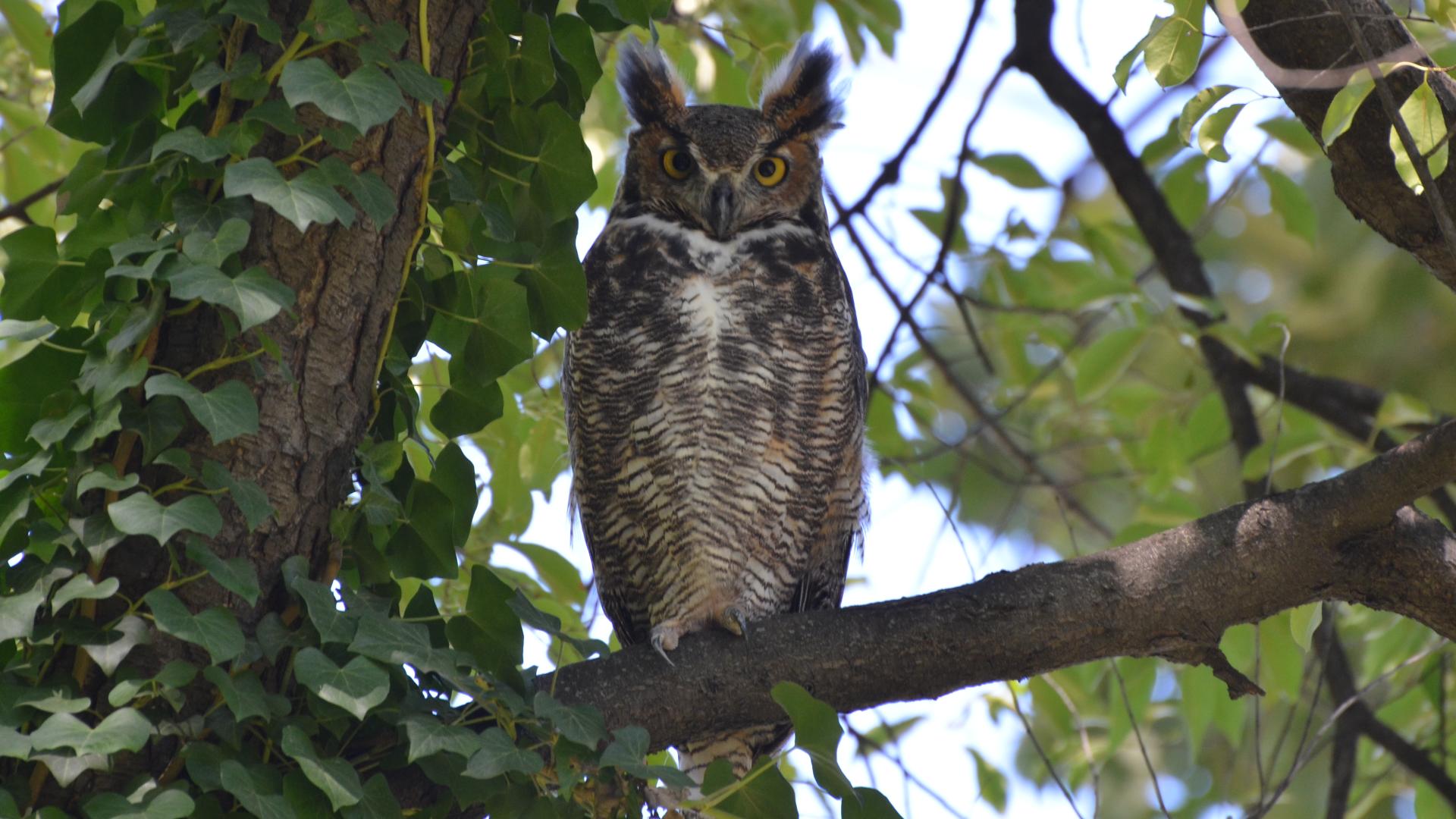
A photographer friend shares a story about a Great Horned Owl landing on his friend’s camera, and I, along with many fellow owl observers, have seen Snowy Owls fly directly toward a group of onlookers. Snowy Owls (Bubo scandiacus) and Great Horned Owls (Bubo virginianus) are close cousins, with many similar traits. Both will ferociously defend their nests. We’ll never see a Snowy Owl nest in Massachusetts because Snowies breed in the Arctic. Great Horned Owls on the other hand begin nesting early in the year in our region, usually laying eggs between mid-February up through the end of March. A Great Horned Owl will attack perceived threats to its nest and nesting territory.

The Great Horned Owl, also commonly called the Hoot Owl and the Tiger Owl, is found throughout North America and is common in Massachusetts. We most often hear the owl’s varied calls, screeches, and hoots during winter and up to the beginning of the nesting period. Great Horned Owls have the most diverse diet of all North American raptors, and like Snowy Owls, their extremely powerful impact upon striking typically kills prey instantly. I can imagine why the young boy in the article was concussed after being struck in the head by a Great Horned Owl.

Great Horned Owl perched n a stand of trees, its preferred habitat. Image courtesy wiki commons media

Snowy Owl hunting for dinner in the marsh.

Something attacked my son while he was sledding in the woods. But what?

By Mark Shanahan

My child went sledding alone and emerged from the trees bloody and dazed. He still can’t remember what happened.

THROUGH THE LIVING ROOM window, I see my son standing in the street in front of our house. He’s wearing a black ski parka and snow pants. A woman I don’t recognize has pulled her car over and is standing a few feet away, holding his hat. I open the front door.

“Beckett?” I call.

“I think something’s wrong,” the woman stammers.

As if in slow motion, my 12-year-old son turns his head and looks up at me.

“Jesus,” I cry.

Half of Beckett’s face is bloody and swollen. I race down the steps and crouch in front of him, my nose touching his. He stares at me blankly.

“What happened?” I ask.

“A bird,” he says softly. “It took Mommy and Julia away.”

Beckett had been sledding alone in the Middlesex Fells Reservation near our home in Medford. Had he hit a tree? The wound is terrifying. His cheek is ruptured, grotesquely inflamed, and there’s a lot of blood.

His mother and sister are fine, I tell him. What happened?

“I don’t know,” he murmurs, his lips so swollen he has trouble forming the words.

As we drive to the hospital, I watch Beckett in the rearview mirror. He’s clearly in shock. He doesn’t speak as he gazes at the falling snow. LINK TO FULL ARTICLE HERE.


Beautiful Fish: Stickfish (Part 2)


Stickfish; fish stick, fish finger

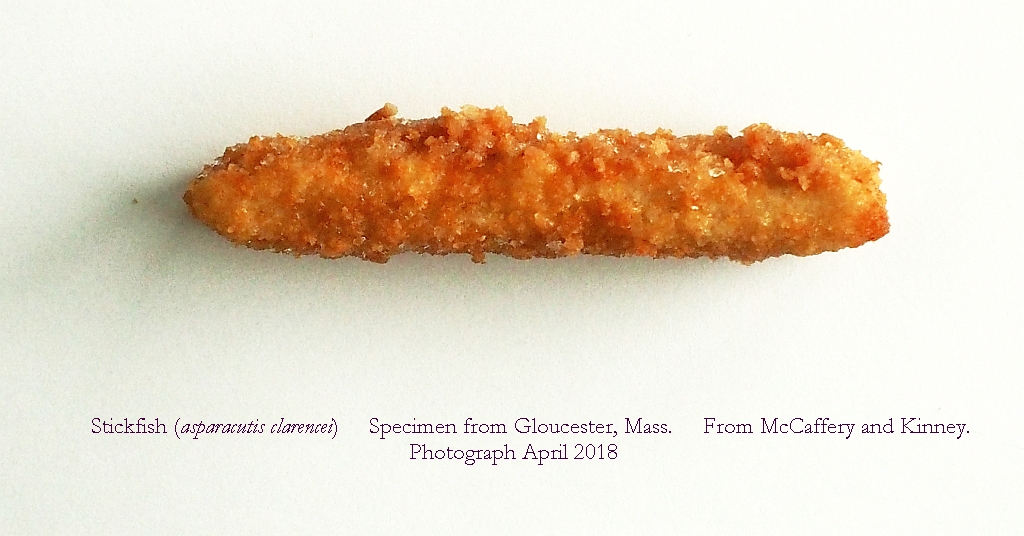
About the April 2nd post on Stickfish … It was intended to appear online April 1st, so with the delay, you might call it a red herring.   The fish stick in the photograph here was drawn for the previous post by P K Bezanson.

Embedded clues in the previous post:

(Asperacutis clarencei)  For Clarence Birdseye (1886-1956), who, right here in Gloucester,  developed the process for manufacturing frozen fish blocks.  Most fish sticks are cut from blocks.  Mark Kurlansky’s 2012 biography of this remarkable man is highly recommended.

Francis McCaffery (1921-2010)  Mechanical Engineering graduate of Columbia College, 1943.  Went immediately to work on the Manhattan Project, then after the war, to the Birdseye Division of General Foods.  In 1954 McCaffery cofounded Commodore Foods with plants in Lowell and Westford where he developed the machinery to manufacture fish sticks.

  1. Robert Kinney (1917-2013) Joined Gorton’s in the early 1950’s, becoming president in 1958.  Guided Gorton’s to lead in the production and marketing of fish sticks.  In 1968 General Mills acquired Gorton’s and Kinney moved to Minneapolis where he soon became CEO of General Mills.  From there he further strengthened Gorton’s earnings by deploying the considerable resources of General Mills Engineering Departments on the fish stick manufacturing practice.

[M.A.T.W]   Guy whose picture is on the yellow bag.  The fish stick in the photo is from this bag.

mean length 3.5 to 4 inches.  Largest specimen 6.4 inches.  Fish blocks are 19X10X2½ inches and there are only so many ways you can slice a block into sticks.  It takes some doing to cut the 19 into thirds and get it through the process intact.


I landed in the fish stick business in 1964 with Gorton’s engineering.  Fish sticks had only been around for about ten years at that time and I knew of three companies who each claimed to be first to market fish sticks.  After moving elsewhere, continued work on the manufacturing process back at Gorton’s and with other producers for a span of fifty years.  Trivia point … a modern fish stick processing line produces in under twenty years enough sticks, if they are place end to end,  to reach the moon.  This on a single shift basis with average down time.


PIPING PLOVERS AND SANDY POINT BEACH NEEDS HELP! -By Kim Smith

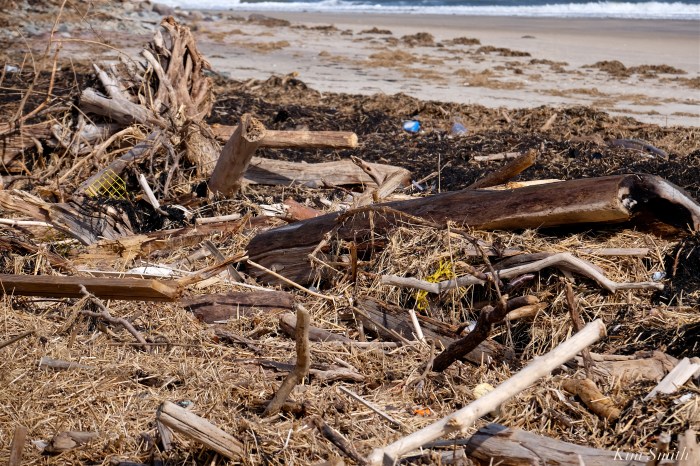
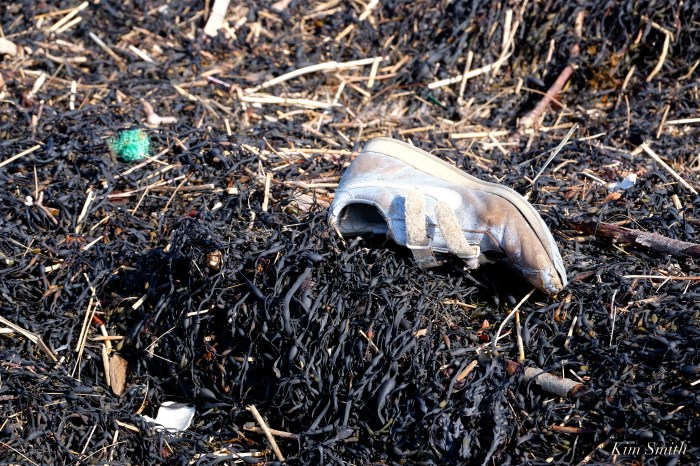
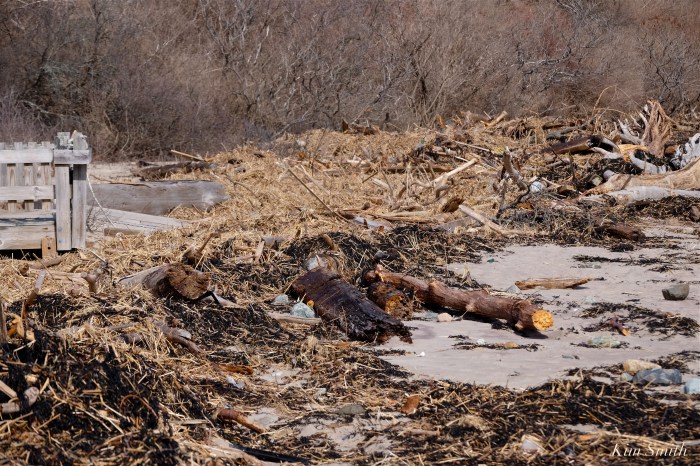
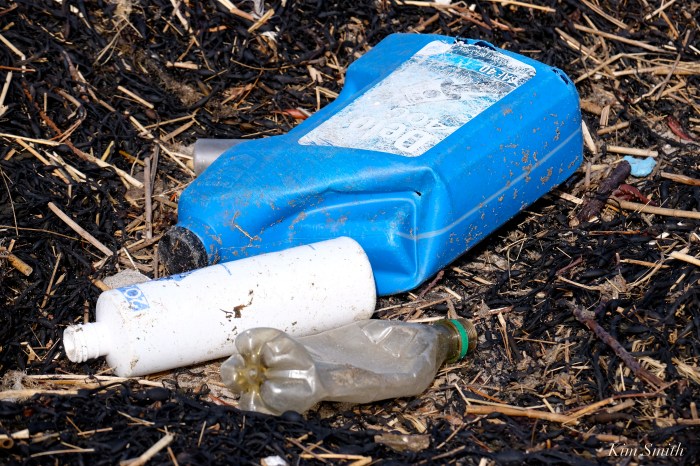
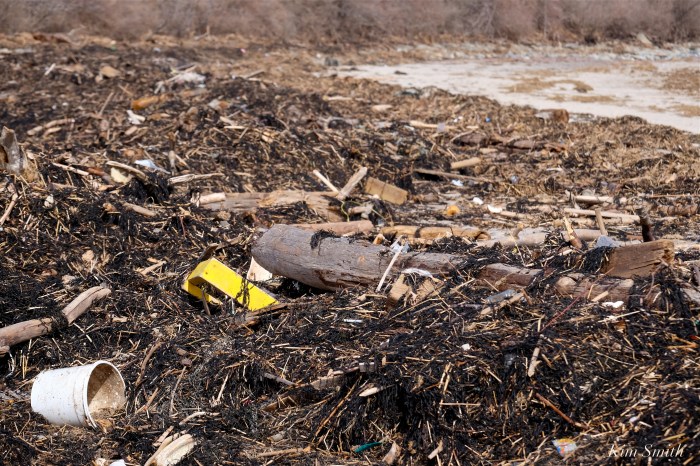
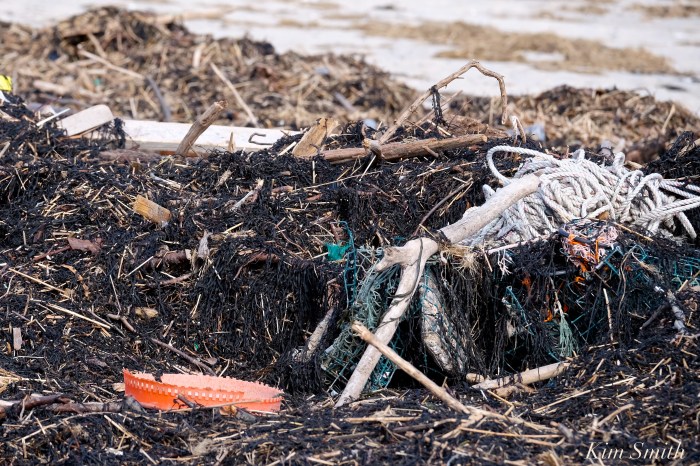
The storm devastation at Sandy Point Beach on Plum Island is alarming. The thing is, exactly where the debris pile-up is the densest, is precisely where the Piping Plovers nest. These photos were taken several weeks ago, and the mass of garbage has only grown greater with two subsequent storms. 

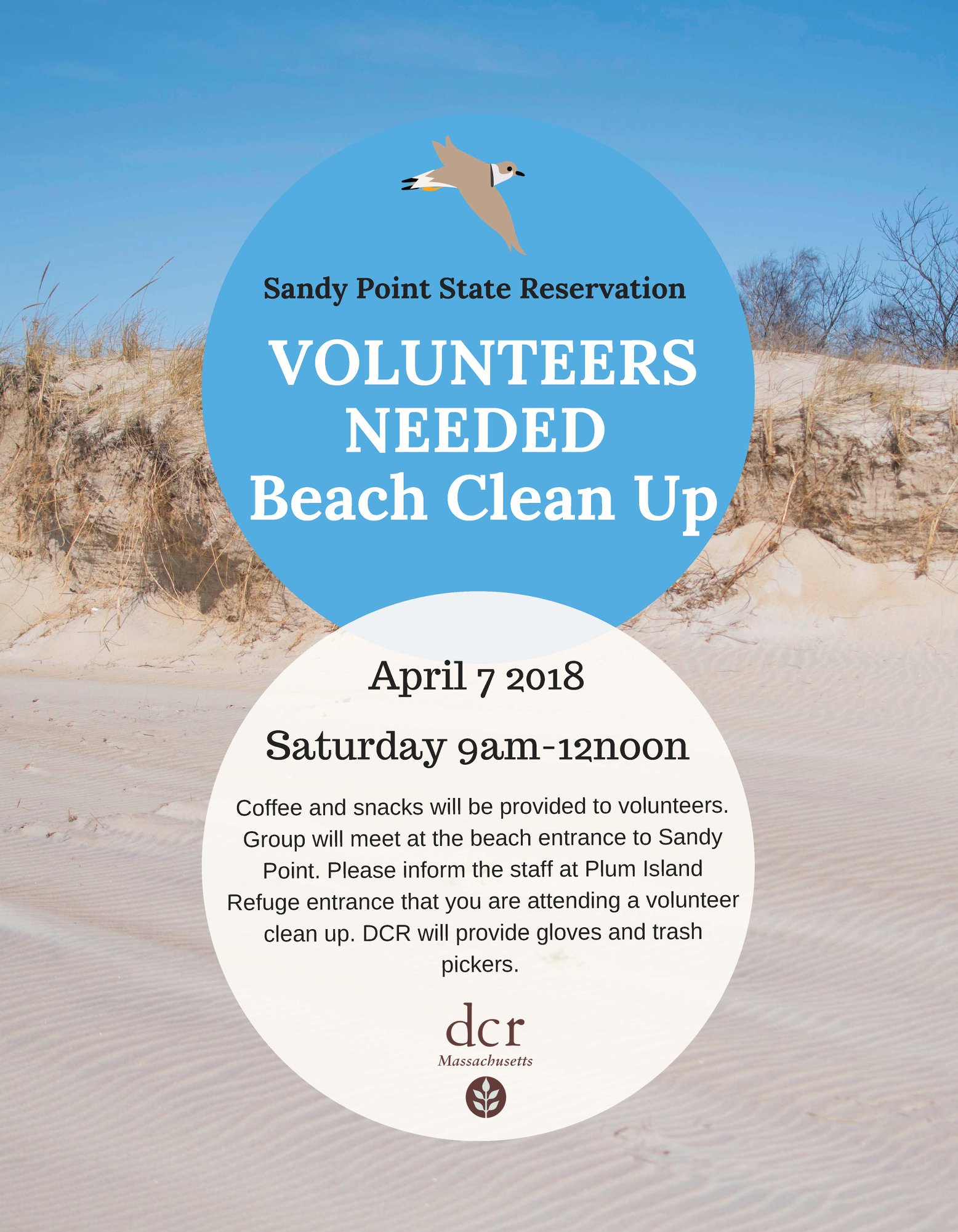
From PRNWR, “Although the refuge isn’t hosting a spring beach cleanup this year, Sandy Point State Reservation is! Join DCR on April 7th to clean up the southern tip of the island. Parking is limited, so carpooling from the refuge Visitor Center is encouraged.”

SPIFFY NEW LOT AT THE EASTERN POINT LIGHTHOUSE! -By Kim Smith

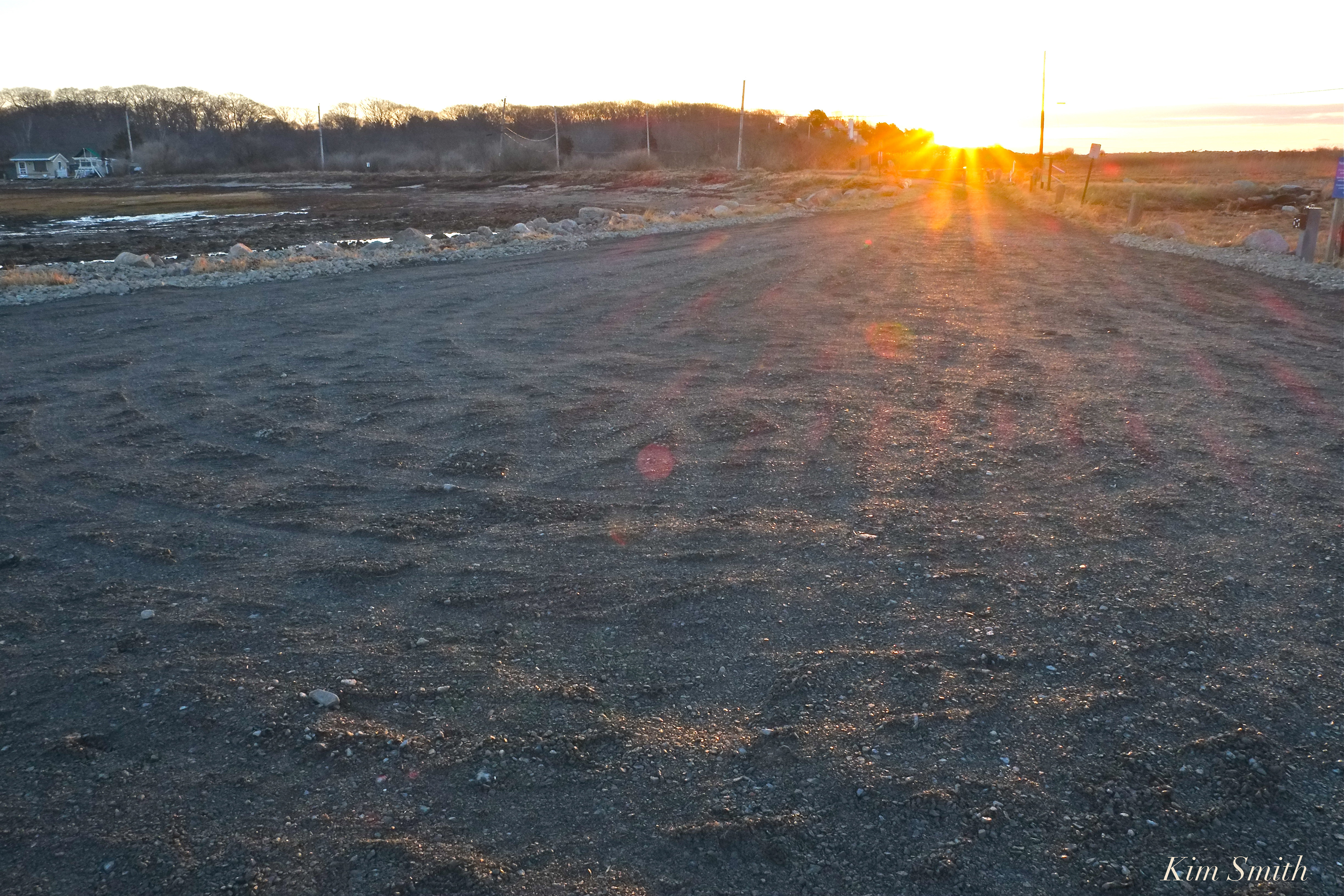
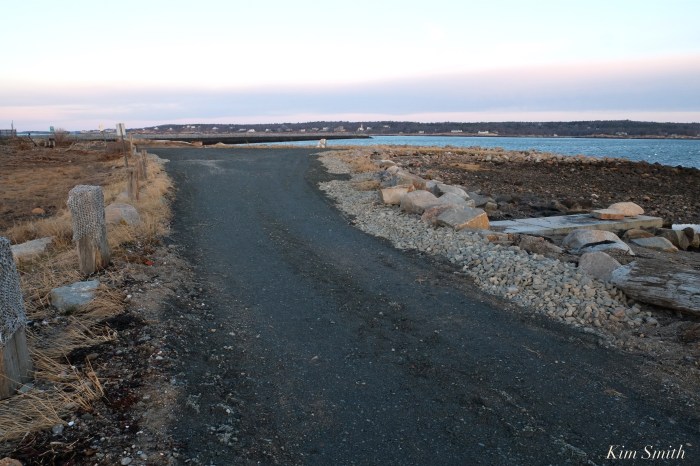
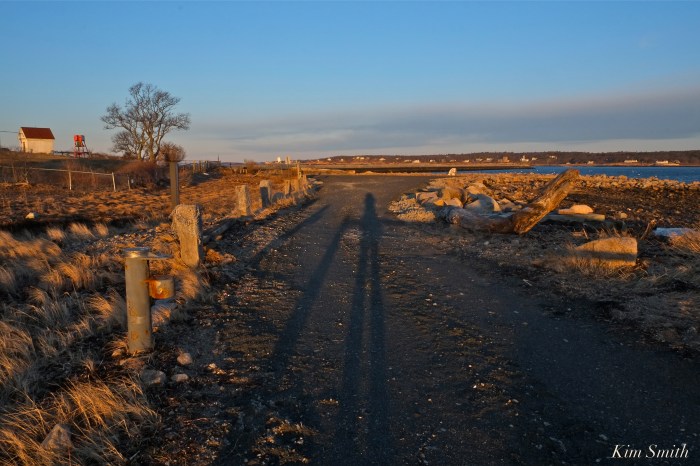
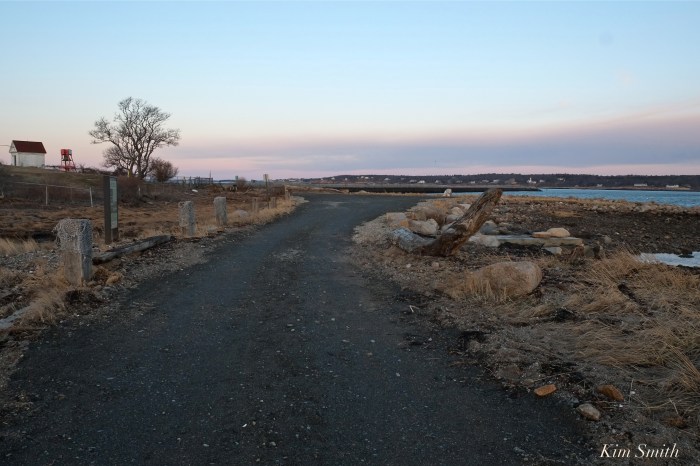
When writing “new parking lot,” I truly mean new. The old road and parking lot were completely destroyed after the second of our four march nor’easters.

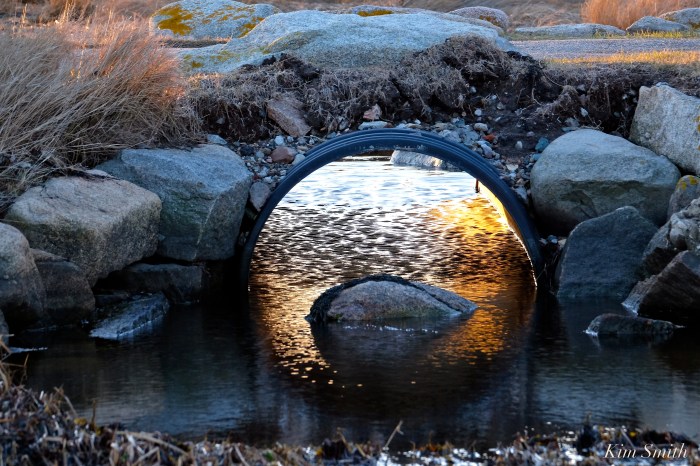
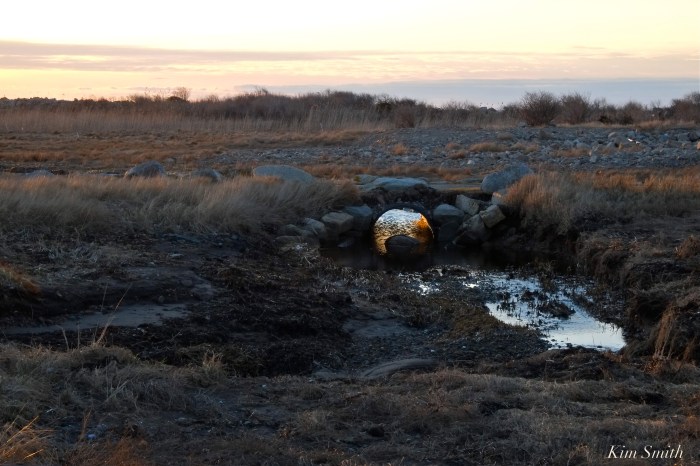
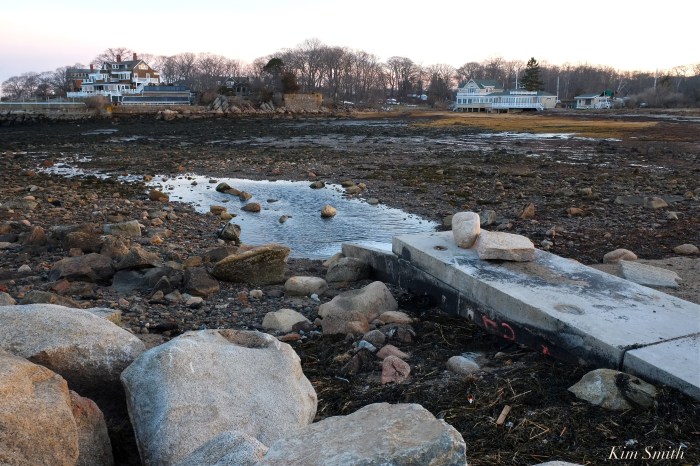
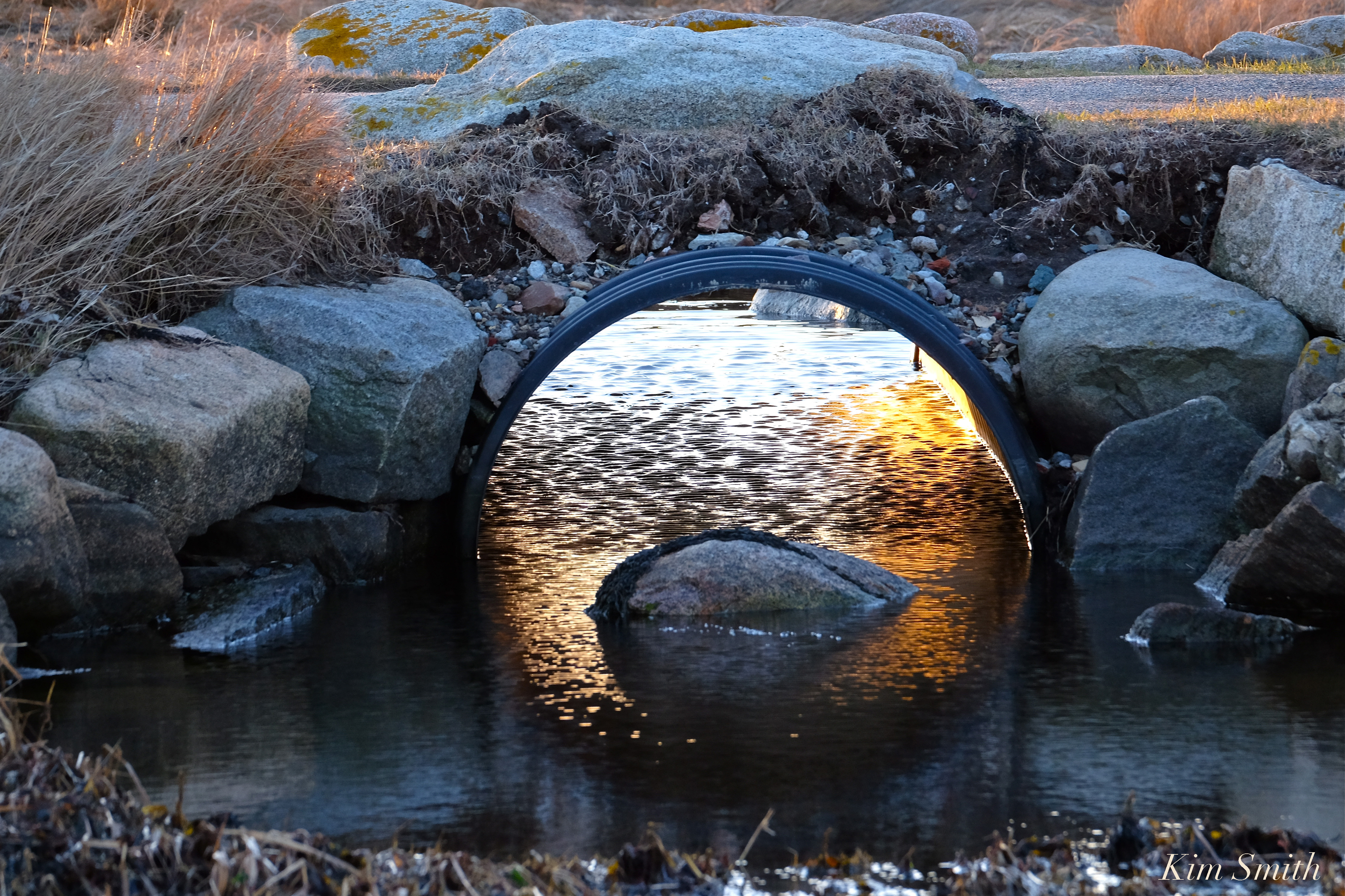
The culvert that allows marsh water to flow into the beach survived all four storms with flying colors, providing continual drainage. The culvert was restored by NOAA and has proven storm after storm to be a great success story.

ROCK ON GLOUCESTER’S DPW MICHAEL SILVA AND JOHN HARRIS -By Kim Smith

https://www.instagram.com/p/BhH0mbvlUwo/

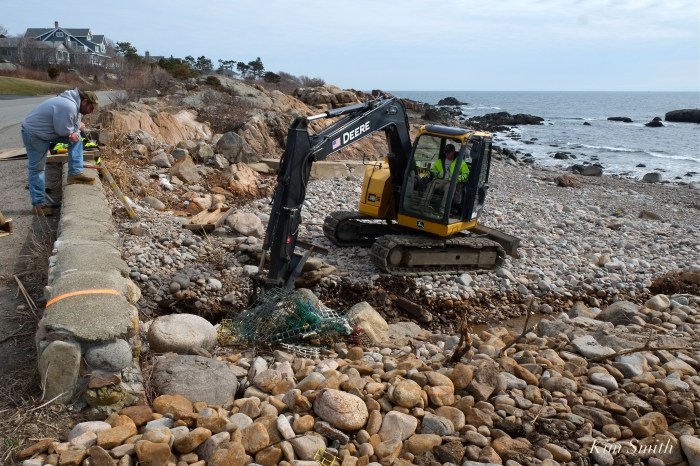
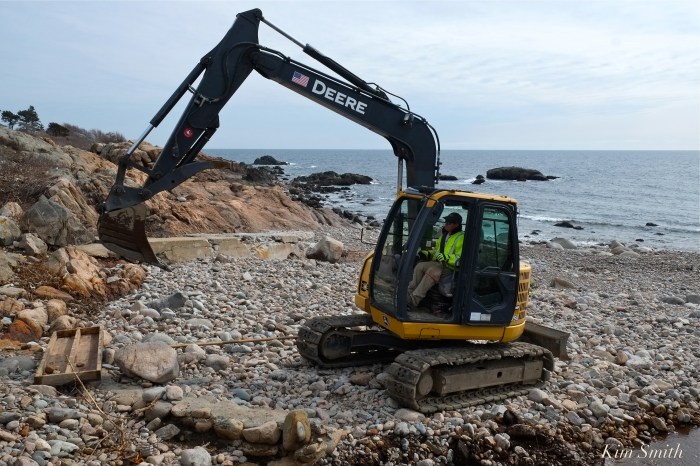
Shout out to Gloucester DPW’s Michael Silva and John Harris. This morning they removed all the rocks that were blocking the drainage pipe on Atlantic Road, near the Grapevine Road intersection. The rocks had been pushed into the drain by the March nor’easters.

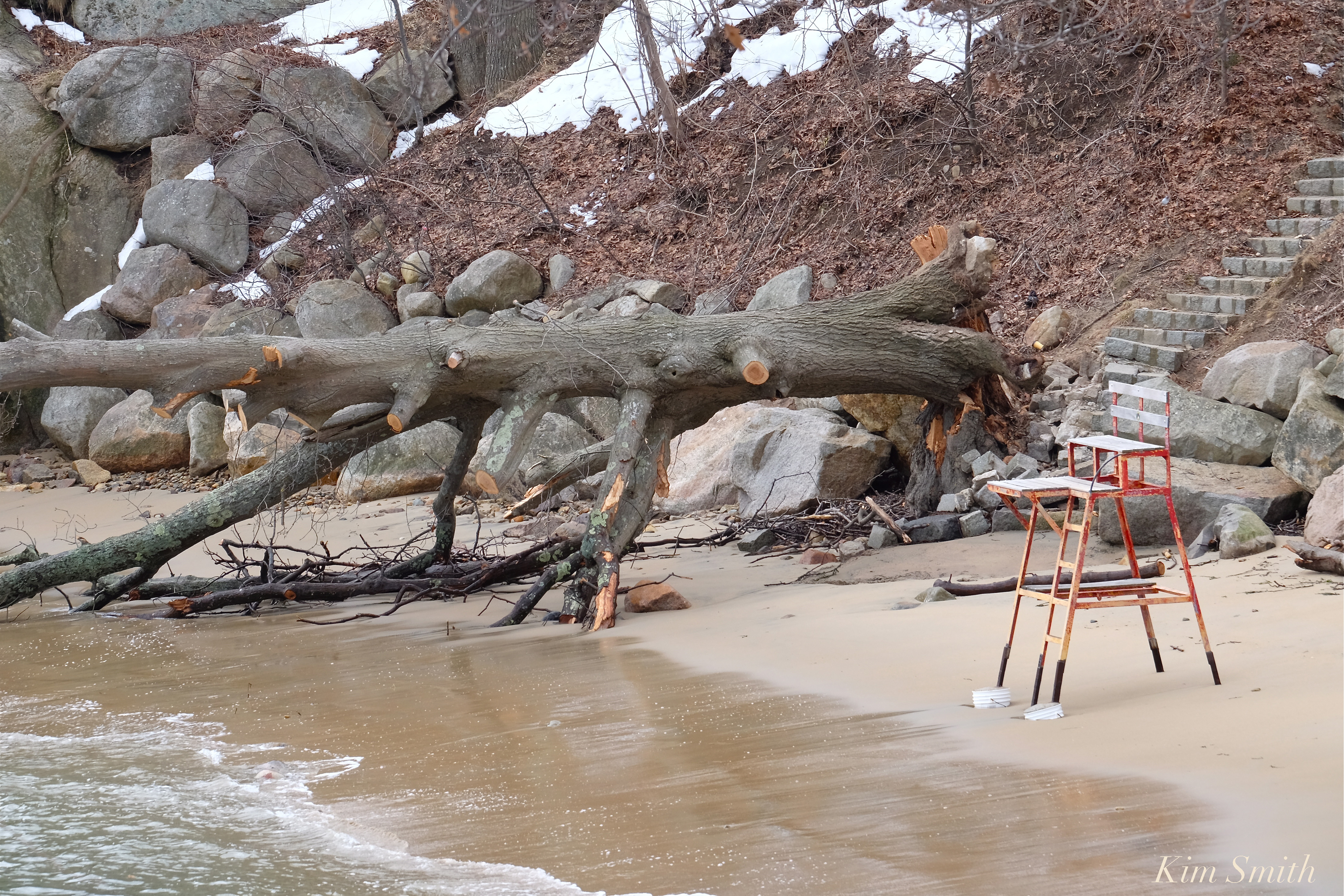
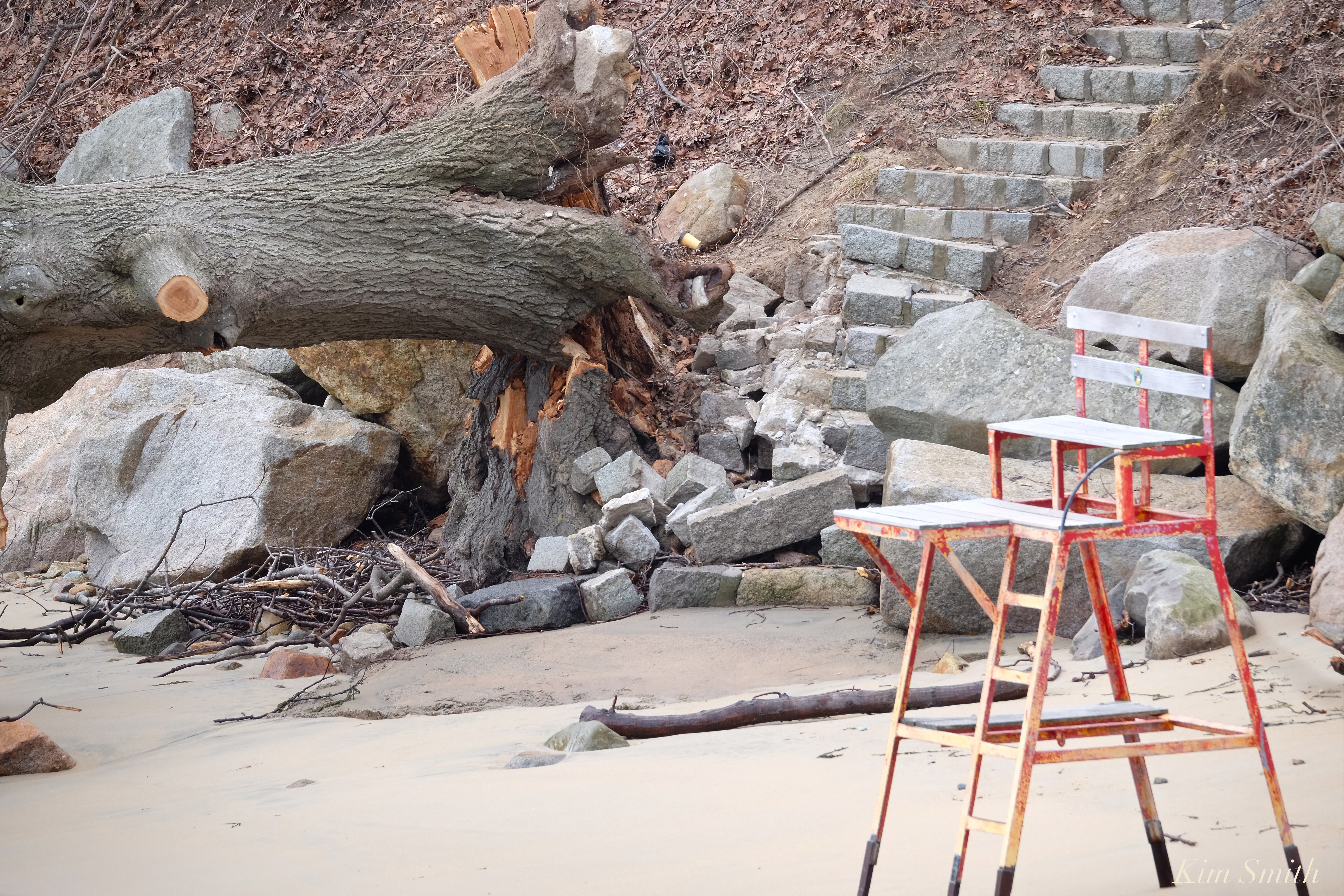
MAJESTIC OLD OAK TREE AT STAGE FORT’S HALF MOON BEACH DOWNED DURING STORM

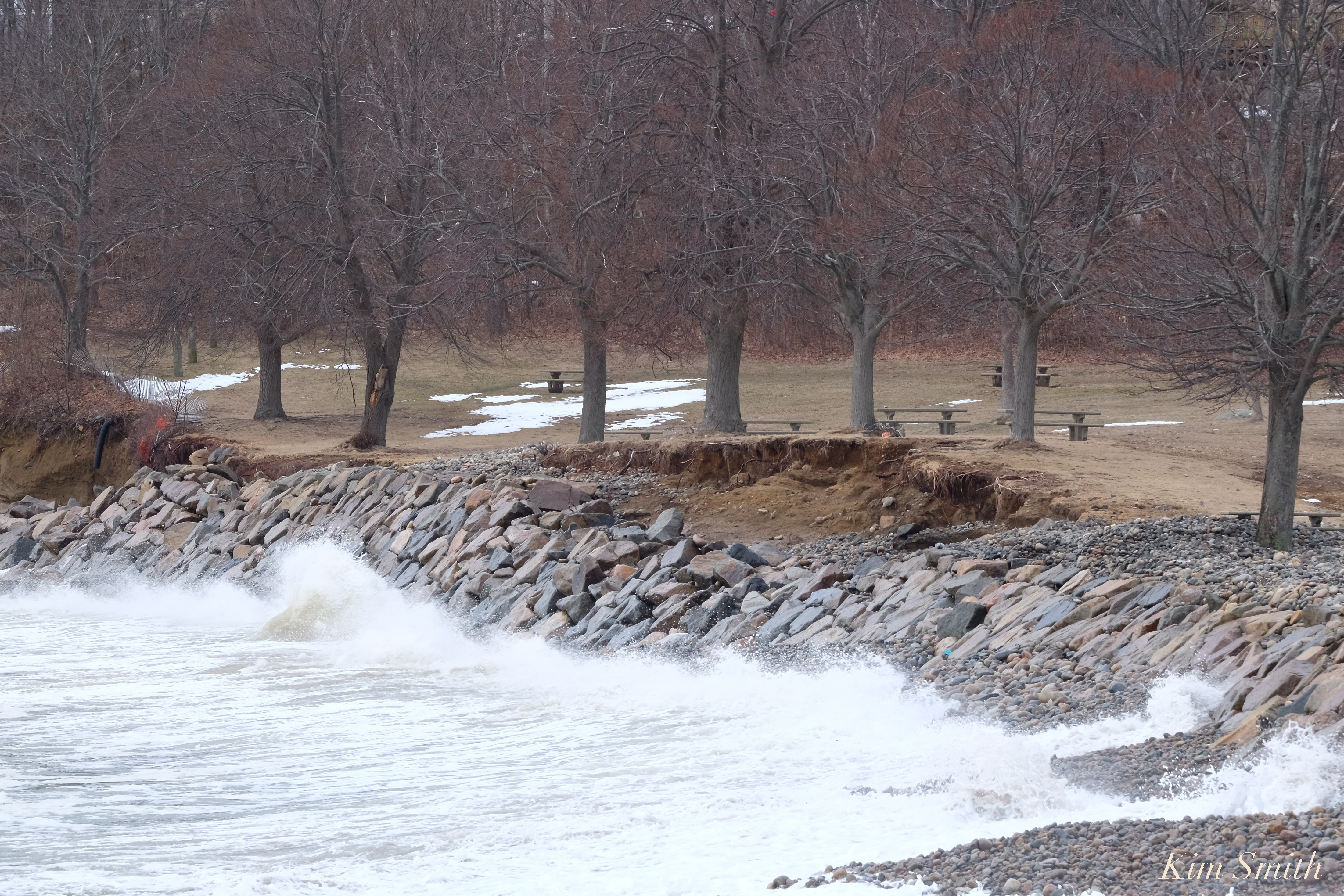
So very sorry to see the beautiful shade-providing old oak tree taken out by the nor’easters.Cressy’s beach was hit hard, too, with mountains of rocks displaced and the ramp leading to the beach severely damaged. Both Stage Fort beaches sustained quite a bit of erosion.