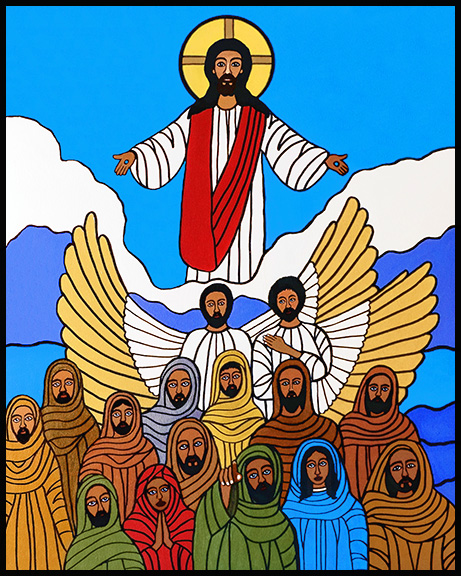
The Ascension (24×30 mixed media)
The Ascension doesn’t occur until 40 days after the resurrection of Jesus, during which time He appears to the Apostles and others.
Acts 1:6-11
So when they had come together, they asked him, “Lord, is this the time when you will restore the kingdom to Israel?” He replied, “It is not for you to know the times or periods that the Father has set by his own authority. But you will receive power when the Holy Spirit has come upon you; and you will be my witnesses in Jerusalem, in all Judea and Samaria, and to the ends of the earth.” When he had said this, as they were watching, he was lifted up, and a cloud took him out of their sight. While he was going and they were gazing up toward heaven, suddenly two men in white robes stood by them. They said, “Men of Galilee, why do you stand looking up toward heaven? This Jesus, who has been taken up from you into heaven, will come in the same way as you saw him go into heaven.”
Forty days after the resurrection, Jesus and His disciples went to Mount Olivet, near Jerusalem. There, Jesus promised His followers that they would soon receive the Holy Spirit, and He instructed them to remain in Jerusalem until the Spirit had come. Then Jesus blessed them, and as He gave the blessing, He began to ascend into heaven. The account of Jesus’ ascension is found above in Acts, and in Luke 24.
It is plain from Scripture that Jesus’ ascension was a literal, bodily return to heaven. He rose from the ground gradually and visibly, observed by many intent onlookers. As the disciples strained to catch a last glimpse of Jesus, a cloud hid Him from their view, and two angels appeared and promised Christ’s return “in the same way that you saw Him go” (Acts 1:11).
The Ascension of Jesus Christ is significant for several reasons:
1. It signaled the end of His earthly ministry. God the Father had lovingly sent His Son into the world, and now the Son was returning to the Father. The period of human limitation was at an end.
2. It signified success in His earthly work. All that He had come to do, He had accomplished.
3. It marked the return of His heavenly glory. Jesus’ glory had been veiled during His sojourn on earth, with one brief exception at the Transfiguration (Matthew 17:1-9).
4. It symbolized His exaltation by the Father (Ephesians 1:20-23). The One with whom the Father is well pleased (Matthew 17:5) was received up in honor and given a name above all names (Philippians 2:9).
5. It allowed Him to prepare a place for us (John 14:2).
6. It indicated the beginning of His new work as High Priest (Hebrews 4:14-16) and Mediator of the New Covenant (Hebrews 9:15).
7. It set the pattern for His return. When Jesus comes to set up the Kingdom, He will return just as He left — literally, bodily, and visibly in the clouds (Acts 1:11; Daniel 7:13-14; Matthew 24:30; Revelation 1:7). So do not be deceived by false reports of His return. When He comes, everyone will see Him, and rejoice or tremble, depending upon their relationship with him. Be one who will rejoice.
E.J. Lefavour
www.hobbithousestudio.com
Spread The GMG Love By Sharing With These Buttons:








































 Good Morning Gloucester