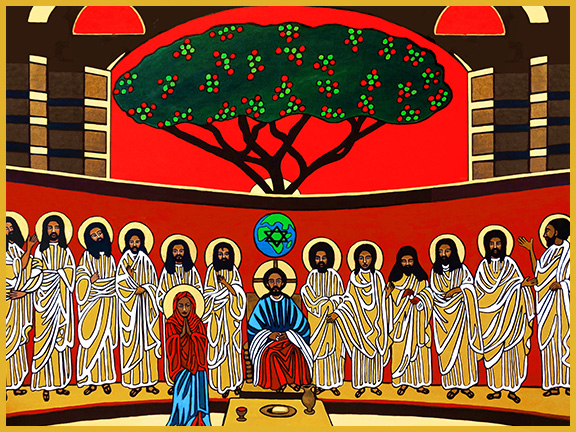
This is a non traditional Last Supper painting. The Apostles are standing and talking, having just arrived, rather than reclining or sitting at the long table which disappears out of the painting, and they are Jews, not Europeans. Mary Magdalene, who is sometimes but not always included, is in the front, and she is black, as she is believed to have come from Ethiopia. Mary loved Jesus dearly, and is the one He first appears to after His Resurrection, so she is given more prominence. Judas has no halo and his hands are red with the blood of his impending betrayal of Jesus to the Sanhedrin for the thirty silver coins in the satchel he is clutching. Jesus is seated at the head of the table, as on a throne. The table contains only a loaf of bread and a glass of wine, the most important elements of the Last Supper, and representing the sacrament of communion celebrated by His followers to this day. Above the halo of Jesus is Earth and the Star of David, representing the Line of David that Jesus came from as well the Jews He came as Messiah for, but they knew him not. The gentiles, however, did, and according to God’s plan from the beginning, salvation through faith in Christ was made available to the world. The setting sun, red sky and background represent evening Passover meal time, the sun setting on the earthly life and ministry of Jesus, and the red of His blood that would flow the next day. The tree outside the window is a fig tree, symbolizing the Nation of Israal, and the tree he would be nailed to.
Present are the apostles: Andrew, Bartholomew aka Nathanael, James the Elder, James the Lesser or Younger, John, Judas, Jude aka Thaddeus, Matthew aka Levi, Peter aka Simon Peter, Philip, Simon the Zealot, and Thomas.
Matthew 26:26-28
While they were eating, Jesus took bread, and when he had given thanks, he broke it and gave it to his disciples, saying, “Take and eat; this is my body.”
Then he took a cup, and when he had given thanks, he gave it to them, saying, “Drink from it, all of you. This is my blood of the covenant, which is poured out for many for the forgiveness of sins.
The Last Supper is what we call the last meal Jesus ate with His disciples before His betrayal and arrest. It was more than Jesus’ last meal; it was a Passover meal, as well. One of the important moments of the Last Supper is Jesus’ command to remember what He was about to do on behalf of all mankind: shed His blood on the cross thereby paying the debt of our sins (Luke 22:19).
In addition to predicting His suffering and death for our salvation (Luke 22:15–16), Jesus also used the Last Supper to imbue the Passover with new meaning, institute the New Covenant, establish an ordinance for the church, and foretell Peter’s denial of Him (Luke 22:34) and Judas Iscariot’s betrayal (Matthew 26:21–24).
The Last Supper brought the Old Testament observance of the Passover feast to its fulfillment. Passover was an especially holy event for the Jewish people in that it commemorated the time when God spared them from the plague of physical death and brought them out of slavery in Egypt (Exodus 11:1—13:16). During the Last Supper with His apostles, Jesus took two symbols associated with Passover and imbued them with fresh meaning as a way to remember His sacrifice, which saves us from spiritual death and delivers us from spiritual bondage: “After taking the cup, he gave thanks and said, ‘Take this and divide it among you. For I tell you I will not drink again from the fruit of the vine until the kingdom of God comes.’ And he took bread, gave thanks and broke it, and gave it to them, saying, ‘This is my body given for you; do this in remembrance of me.’ In the same way, after the supper he took the cup, saying, ‘This cup is the new covenant in my blood, which is poured out for you’” (Luke 22:17–20).
The Last Supper was rooted in the Old Covenant even as it heralded the New. Jeremiah 31:31 promised a New Covenant between God and Israel, in which God said, “I will put my law in their minds and write it on their hearts. I will be their God, and they will be my people” (Jeremiah 31:33). Jesus made a direct reference to this New Covenant during the Last Supper: “This cup is the new covenant in my blood” (Luke 22:20). A new dispensation was on the horizon. In God’s grace, the New Covenant applies to more than Israel; everyone who has faith in Christ will be saved (see Ephesians 2:12–14).
The Last Supper was a significant event and proclaimed a turning point in God’s plan for the world. In comparing the crucifixion of Jesus to the feast of Passover, we can readily see the redemptive nature of Christ’s death. As symbolized by the original Passover sacrifice in the Old Testament, Christ’s death atones for the sins of His people; His blood rescues us from death and saves us from slavery. Today, the Lord’s Supper is when believers reflect upon Christ’s perfect sacrifice and know that, through our faith in receiving Him, we will be with Him forever (Luke 22:18; Revelation 3:20). From http://www.gotquestions.org/Last-Supper.html


 Good Morning Gloucester
Thanks, E.J. I continue to appreciate and learn by your words and art. What a marvelous gift to me.
LikeLike
I’m glad to hear that Bob. I am also learning so much in the process of this project, which is a great gift to me, so I am happy to share it. Love to Ann.
LikeLike