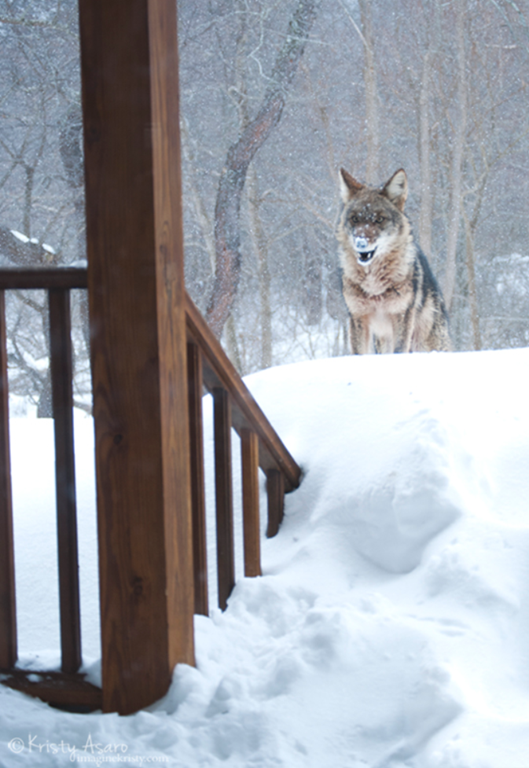
Check Out Way More Photos Of The Coyote Up Close And Personal (Click On The Photos On Her Site For The Larger Sized Versions)and Subscribe to Kristy’s Blog Here- http://www.imaginekristy.com/w2/coyote/
My View of Life on the Dock
Check Out Way More Photos Of The Coyote Up Close And Personal (Click On The Photos On Her Site For The Larger Sized Versions)and Subscribe to Kristy’s Blog Here- http://www.imaginekristy.com/w2/coyote/


 Good Morning Gloucester
Holy moley!
LikeLike
Great capture Kristy!
LikeLike
Could hear them all howling last night at my house in East Gloucester-Have had them in the yard before and I am worried about the dogs-We go out with them but the reports of them traveling in packs is disturbing-Don’t know how many I could fend off with my snow shovel.
LikeLiked by 1 person
Oh don’t be silly, nobody leaves unleashed dogs out in this weather! (Hint hint)
LikeLike
When the coyote had my cat in its jaws, I ran towards it wildly waving my arms and yelling loudly. I didn’t know it was our cat at the time because I thought our Cosmos was indoors. I think that the coyote was startled and that is the only reason why our cat is still alive because he dropped our cat from its mouth. I understand that you should make very loud noises, but not screaming sounds. Screaming would sound like an injured animal, which may make you more enticing.
The coyotes that are found in the northeast are approximately 9 percent wolf DNA and 9 percent dog DNA.
Coyotes are an invasive species; they are not native to this region. As they gradually moved further and further east during the past fifty odd years, some bred with dogs, which they usually kill, and an equal number, with wolves. The reason for the Western Coyotes eastward migration is because of land development and habitat loss in the coyote’s western range. The Western Coyote gained in size as it advanced further and further eastward, primarily because food is more plentiful in the eastern wilderness.
It is thought that coyotes are one of the primary reason why Lyme disease is on the rise. Fox, which are a native species, and which are the best hunters of chipmunks and white-footed mice (the prime transmitters of Lyme disease), are being out competed for habitat by the invasive coyotes. Coyotes are not as adept as are fox in hunting chipmunks and mice.
It is legal to hunt coyotes from the first Saturday after Columbus Day through the following March 8th.
LikeLike
Shoot, shovel and shut up.
LikeLiked by 1 person
I’m with you-they don’t belong here. If only I had a gun….
LikeLike
They look so pretty
LikeLike
I know they can be dangerous but they are handsome animals.
LikeLike
What we have here in Cape Ann are Coywolves, a naturally occurring Wolf Coyote hybrid that breeds true. They’re less aggressive than wolves, but not harmless, like coyote’s.
Wondering where Opie and Loki went?
http://www.pbs.org/wnet/nature/meet-the-coywolf-infographic-a-field-guide-to-the-coywolf-or-eastern-coyote/8663/
LikeLike
These photos are amazing!!
LikeLike
Great photos!
LikeLike
It’s hard to tell the scale…what do you guess this guy weighed? Thanks for posting these shots Kristy!
LikeLike
I love these creatures. I lived on Long Hill in Manchester by the Sea, behind the Essex County Club and had many, many face-to-face encounters with them. The large ones (wolf hybrids) especially. Very curious animals. We made sure not to leave food in trash bins and would see them on our property still continuously. One mother raised her pups at the foot of our hill. Yes, we had dogs, small ones at the time and were careful with them as one should always be. I am thankful to see the fauna back in Massachusetts. Of course if humans or pets are being threatened by a specific animal, I am all for that animal being removed, trapped or killed. A specific animal. Not a species or a pack just out of fear or ignorance
LikeLiked by 1 person
City/State should hire a trapper to exterminate them. There is not enough natural prey available for them to “control” so they are becoming opportunistic scavengers. +1 on Carol’s comment!
LikeLike
I read this in a publication I get out of Cambridge Mass wanted to share the PDF but ended up on Google to get the link this plan was a long time in the making. Dave
Coyote_Policy_Final_11-11-2014
http://www.google.com/url?sa=t&rct=j&q=&esrc=s&source=web&cd=1&cad=rja&uact=8&ved=0CB0QFjAA&url=http%3A%2F%2Fwww.riverside.il.us%2Fvertical%2FSites%2F%257BFF0B0056-4ACF-4890-985A-29B8374E9BEE%257D%2Fuploads%2FCoyote_Policy_Final_11-11-2014.pdf&ei=oT_oVOfLGorl8AWdk4K4Aw&usg=AFQjCNF5fGdDBHx_u_CCX-qGK026F2mPqw&bvm=bv.86475890,d.dGc
Riverside CA…
Residents’ knowledge and understanding of how coyotes behave and how such behavior can be managed with human safety as a priority. The focus of the policy is to change and adapt behavior of the coyotes to different forms of human interaction. The Coyote Policy for the Village of Riverside acknowledges that public safety is a primary concern. Given that concern, however, the Village of Riverside recognizes the environmental benefit of maintaining and encouraging natural wildlife populations, including coyotes, and will make every effort to maintain natural ecosystems. The Village’s Coyote Policy will provide guidelines as to the best known responses to live compatibly with coyotes.
The Village’s Coyote Policy is rooted in the most current understanding of coyote behavior and management. It was important in the development of the policy to review the latest urban coyote studies and literature. Fortunately, within the last 10 years, much has been learned about coyote behavior and management although there is still work to be done. The policy provides a summary of the latest coyote studies and literature and provides the foundation for specific courses of action outlined in the policy.
The understanding of coyote behavior and management is evolving as wildlife experts continue to study the coyote in the suburban environment. The Village’s policy will need to be flexible and reevaluated as necessary when new information and techniques become available.
This document provides a summary of coyote biology/behavior, defines nuisance coyote behavior, summarizes existing Illinois law affecting coyote management, examines education/public information tools, emphasizes the need for a coyote/human interaction monitoring and data collection program, and details coyote management responses that may be necessary given specific coyote/human interaction and conflicts.
LikeLike