Three very interesting articles were shared this past week by friends and GMG FOBs. Thank you!!! I love reading what you send and below are the links to share with readers. Again, thank you!

Frieda from Again and Again forwarded this from Nature:
“The monarch butterfly, Danaus plexippus, is famous for its spectacular annual migration across North America, recent worldwide dispersal, and orange warning colouration. Despite decades of study and broad public interest, we know little about the genetic basis of these hallmark traits. Here we uncover the history of the monarch’s evolutionary origin and global dispersal, characterize the genes and pathways associated with migratory behaviour, and identify the discrete genetic basis of warning colouration by sequencing 101 Danaus genomes from around the globe.” Link to Nature article.
* * *
Our Catherine Ryan forwards from the New York Times:
“Why Some Monarch Butterflies Are Marathoners”
Monarch butterflies can be found throughout the world, but only in North America do they make a spectacular mass migration, annually flying from as far north as Canada to winter in Mexico.
Now, by sequencing genomes of 90 monarch butterflies from around the world, researchers have discovered a gene that plays a critical role in determining whether monarchs are migratory, along with new details about their origins, migratory behavior and coloring.
* * *
Josh Dickinson from the University of Florida in Gainseville forwarded the following:
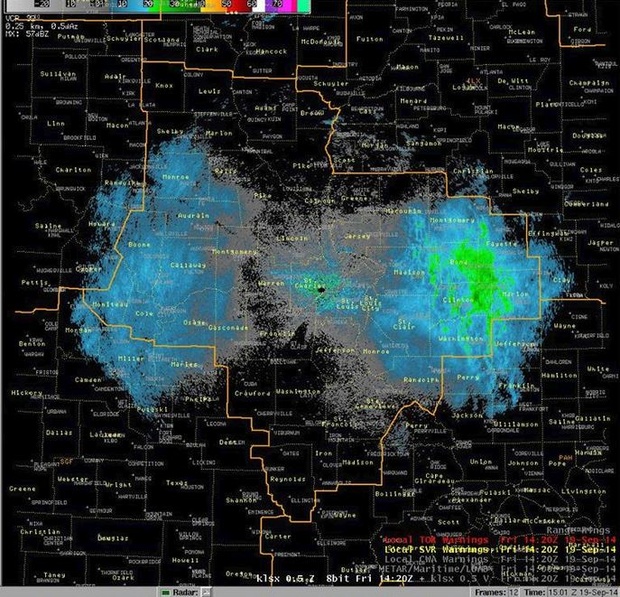
“A Strange Cloud Over St. Louis Turns Out to Be an Enormous Swarm of Butterflies”
Late last week, meteorologists in St. Louis noticed a cloud acting peculiarly: It was beating a path toward Mexico while changing into a variety of odd shapes. Was it a radar glitch? The debris signature of a south-moving tornado?
The answer was more heartening—and bizarre. After analyzing the reflections,the National Weather Service concluded they showed an immense swarm of Monarch butterflies migrating to their winter home in the Mexican mountains:
Here’s how it technically arrived at that conclusion, for the weather geeks out there:
Keen observers of our radar data probably noticed some fairly high returns moving south over southern Illinois and central Missouri. High differential reflectivity values as well as low correlation coefficient values indicate these are most likely biological targets. High differential reflectivity indicates these are oblate targets, and low correlation coefficient means the targets are changing shape. We think these targets are Monarch butterflies. A Monarch in flight would look oblate to the radar, and flapping wings would account for the changing shape! NWS St. Louis wishes good luck and a safe journey to these amazing little creatures on their long journey south!



 Good Morning Gloucester