What Do You Think?
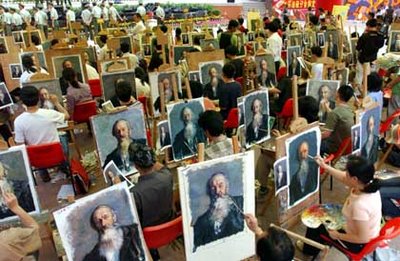
Mass Produced Art in China.
Published: July 15, 2005
SHENZHEN, China – Zhang Libing has painted more van Goghs than van Gogh ever did.
At 26, Mr. Zhang estimates that he has painted up to 20,000 copies of van Gogh’s works in a paint-spattered third-floor garret here where freshly washed socks and freshly painted canvases dry side-by-side on the balcony.

Chang W. Lee/The New York Times
Zhang Libing estimates that he has produced up to 20,000 copies of paintings by Van Gogh.
CLICK HERE TO CONTINUE READING THE FULL ARTICLE FROM THE NEW YORK TIMES


 Good Morning Gloucester
copying the same painting over and over and over, if it is a good painting, will teach a painter a lot. i wonder if these painters ever step outside of copyist to create their own work.
i copy Balthus, Matisse, Cezanne, Giacometti, Joan Mitchell Fra Angelico, Giotto, and others from time-to-time…just never thought to sell the copies…usually re-work them into a ‘debbie clarke’.
btw: the way one learns to write religious icons, is to copy one, a tradition going back centuries.
an artist has to eat, i have no problem with the selling of handmade copies of copyright free work, as long as it is a good copy of a great work.
best,
deb
LikeLike
one more tidbit: when i studied at The Art Institute of Boston i frequented Harvard’s Fogg Museum. i was allowed to set up in the gallery that had a Cezanne still life right next to Van Gogh’s self portrait with the mutilated ear and an acid green background. the requirements wer that i had to paint the work either larger or smaller than the original, use drop cloths, clean up after myself, then sign the work in lead white ‘copied after Cezanne’,
I looked at the Van Gogh a lot. got so close to the painting that I could smell the paint, which is what I imagined the man also smelled like. Decided that I appreciated his work, but would not have liked the man.
LikeLike
Great post, Paul. Unfortunately the mass produced art (and all sorts of other products) of China has probably had alot to do with the decline of sales of art (and other products – what is made in the US anymore?) created by US artists and workers, making it much more difficult for us all to make a living. I’ve long had difficulty with the mass production of art in China. It wouldn’t bother me if they were being individual artists in their own right – painting what they feel, see, experience, conceptualize and want to share or convey to the world; but to mass produce assembly line art the way they do demeans the artistic process/spirit and devalues art, at least for the masses who flock to the hotel art sales and the internet to get their $39.95 framed original oil paintings. Maybe artists will go the way of small farmers – we’ll be subsidized to paint and then all the paintings will be heaped in huge piles and set on fire, destroying the artistic spirit along with them. The artistic spirit is dangerous after all, as it does not respect the system – it just wants to live and let live and create.
I agree with Deb that repainting a master’s work is valid for the experience; but you do it once and then take that experience back to evolve your own personal style and technique.
LikeLike
This reminds me of a type of art called “appropriation”. This is where the artist incorporates some or all of another artists work in their own piece and calls it their own. My favorite is Marcel Duchamp’s Readymades from the Dada movement. (See below)
From Wikipedia, the free encyclopedia
http://en.wikipedia.org/wiki/Appropriation_%28art%29
Appropriation is a fundamental aspect in the history of the arts (literary, visual, musical). Appropriation can be understood as “the use of borrowed elements in the creation of a new work.”[1]
In the visual arts, to appropriate means to properly adopt, borrow, recycle or sample aspects (or the entire form) of man-made visual culture.Marcel Duchamp is credited with introducing the concept of the readymade, in which “industrially produced utilitarian objects…achieve the status of art merely through the process of selection and presentation.”[6] Duchamp explored this notion as early as 1913 when he mounted a stool with a bicycle wheel and again in 1915 when he purchased a snow shovel and humorously inscribed it “in advance of the broken arm, Marcel Duchamp.”[7][8] In 1917, Duchamp formally submitted a readymade into the Society of Independent Artists exhibition under the pseudonym, R. Mutt.[9] Entitled Fountain, it consisted of a porcelain urinal that was propped atop a pedestal and signed “R. Mutt 1917”. The work posed a direct challenge to traditional perceptions of fine art, ownership, originality and plagiarism, and was subsequently rejected by the exhibition committee.[10] Duchamp publicly defended Fountain, claiming “whether Mr.Mutt with his own hands made the fountain or not has no importance. He CHOSE it. He took an ordinary article of life, placed it so that its useful significance disappeared under the new title and point of view– and created a new thought for that object.”[11]
LikeLike
mass production/assembly line art is just a broader version of the Renaissance workshop. go to Venice, you will see copy after copy of the same painting by different art workshops…lots of ‘attributed to the school of.’. see them enough times, the masters start to stand out, which is why some Ascensions of the Virgin, Virgin by the Rock, Last Suppers, stand away from the crowd and we name these works/artists as the greats.
i have so many art ideas that i have thought a factory system to produce my work would be terrific. i could be the director! then go through and put my final touch to it.
now, if my copyrighted work ends up being mass produced without paying me, i will have a big gripe!
a long time ago i realized that folk that go to the $39.95 art sales, are not the folk that will buy my work. and i’m not in competition for those dollars. my only competition is myself, and sometimes i copy my own work just to see if i can do it again.
LikeLike
26 years old, say he started copying at 16. 10 years, 26,000 Van Goghs in 3,650 days.
He paints one vase of sunflowers every week. What a slacker. I bet he takes Saturday mornings off. ;-O
LikeLike
good perspective Paul. one could say he has developed a ‘practice’.
LikeLike