Happy to see Cape Ann included–thanks Cape Ann Chamber for putting up the flag.
Gloucester, Rockport, Manchester, and Essex are listed together under Cape Ann as a destination for plein air painting. I enjoyed reading and comparing. The first town listed, Jeffersonville, VT, has vivid detail. Cape Ann has history and scenery coming together at every turn.
I might have added that Cape Ann has been the home of the world class Cape Ann Museum, two renowned associations devoted to the advancement of art – the North Shore Art Association and the Rockport Art Association-, one of the country’s oldest continuously active and iconic art colonies on Rocky Neck, and scores of artists and galleries, because it is the number 1 place to paint.
I saw the BIRD SIGHTINGS call out in the Sunday Boston Globe and noted the Plum Island list. (Under ‘Miscellaneous’ there is one bird listed from Gloucester.) I have no idea if that is the MassAudubon customary geographic selection, randomly culled, or all that’s available at the time of publication. I suppose I was looking for a ‘Gloucester’, ‘North Shore’, or ‘Cape Ann’ heading. I am confident the region is represented because folks like Chris Leahy, Dave Rimmer, Essex Greenbelt, other experts, citizen scientists, and fans report from our communities.
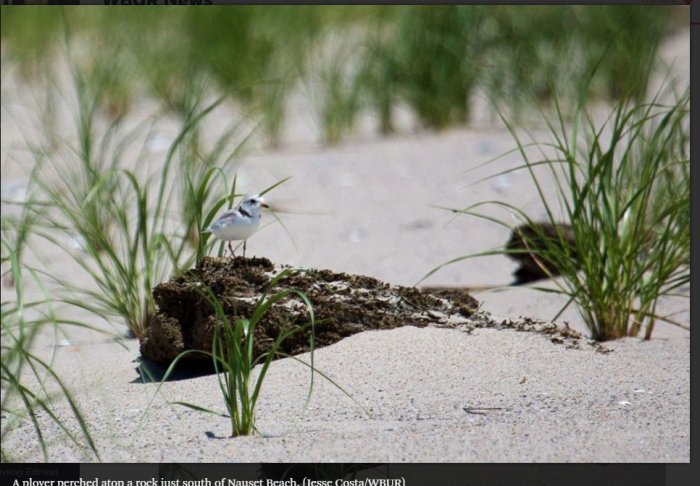
*This just in update: Dave Rimmer reports that the piping plover fencing at Good Harbor came down today.
GMG features many bird photographs, from FOBs and contributors especially Kim Smith and Donna Ardizzoni. Here’s an unofficial appreciator’s list with a few Gloucester sightings: ‘sandpipers’ on Long Beach last week. Piping plover (heard/saw),’plovers’ and ‘sandpipers’ on Good Harbor beach on July 25. One (dead) horseshoe crab and 1 sand dollar (alive) off Wingaersheek on July 26. Piping Plover (heard/saw) on Good Harbor this morning. What have you seen?
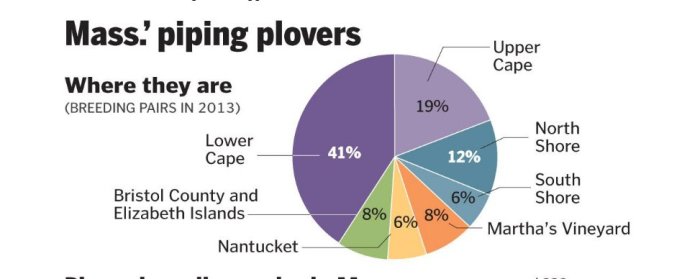
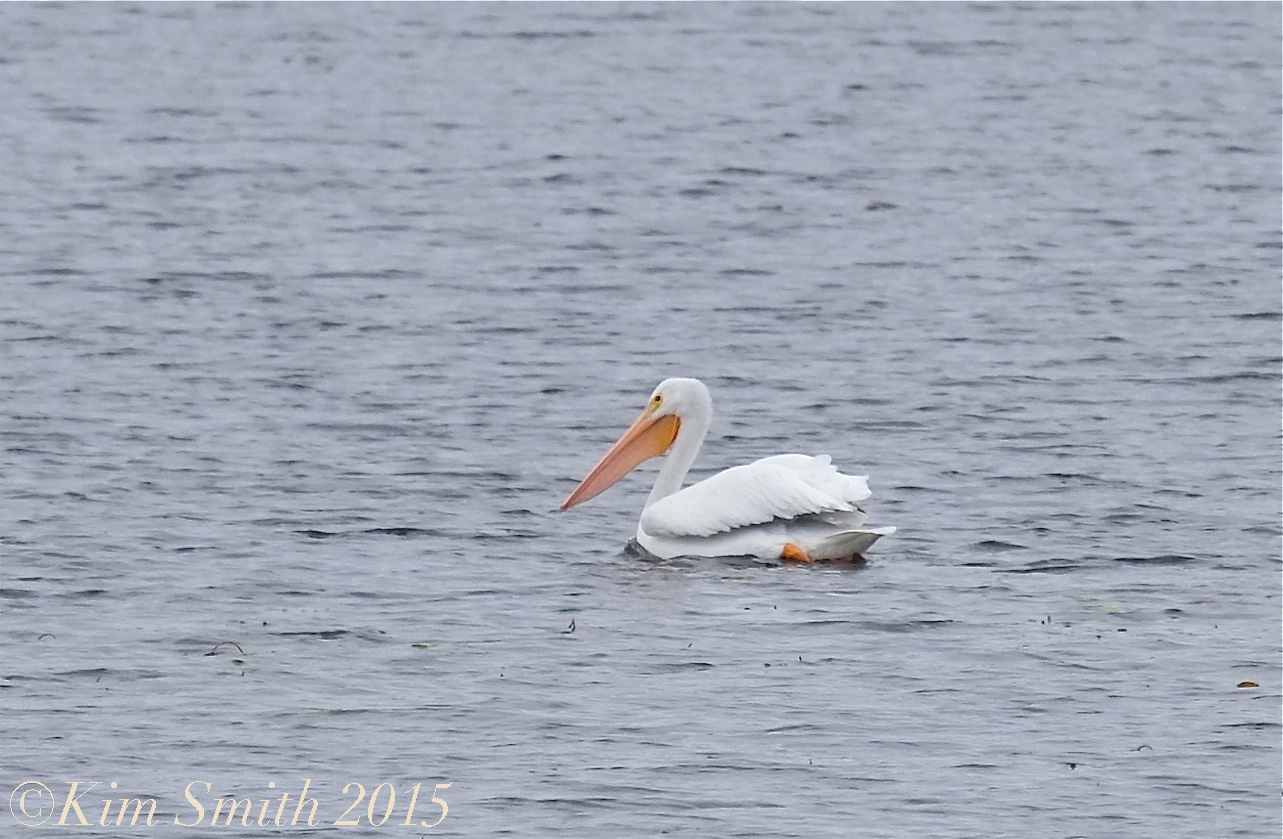
Thank you to the GMG reader who saw the news on TV, and wrote a comment on the Disney-Pixar post. Massachusetts may be the model for North America. The MA Wildlife report includes the conservation approach implemented in Cape Cod last year, home to 60+% of MA piping plover population. I don’t have the tv station’s coverage, but I included the WBUR wire pick, and piping plover reports from CT, NH, and ME. Kim Smith is covering the pair on Good Harbor Beach. Nesting Piping Plovers have been seen on Coffins Beach and Revere Beach.
Currently, the Atlantic coast population (North Carolina to Eastern Canada) of piping plovers continues to hold steady just under 2,000 pairs. The Massachusetts State Department of Fish and Wildlife targets maintaining 625 pairs with greater intervention should the population fall below 500 pairs.
YR 2013, State Department Fish and Wildlife
Piping plovers were not rare enough to be described as a ‘wild’ species in 1895 in Daniel Giraud Elliot’s North American Shore Birds. He wrote that where the species had been formerly ‘most abundant’ the piping plover was “found chiefly on the more retired parts of the cost where it was free from molestation…its acquaintance with man has caused it to be at the present time, in most places where it is found, a rather wary bird.” The fattened birds were “palatable, yet sometimes sedgy in flavor.” Skunks and other predators, influx in summer population, and loss of habitat were concerns. Plastic trash is a striking difference now. At least we don’t eat them.
CONNECTICUT
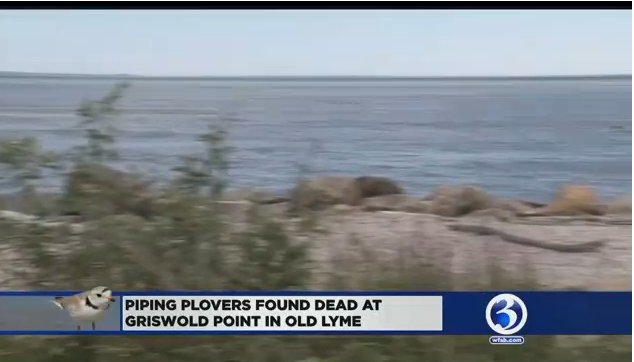
Three Piping Plovers were recently killed in their nesting habitat at Griswold Point in Old Lyme CT. It’s believed a fourth was intentionally stepped on in Bluff Point State Park in Groton, CT. “People ignore the signs.”
2 minute video
The Connecticut Department of Energy and Conservation monitors the piping plovers. The Connecticut Audubon Society doesn’t maintain piping plover information, however they do have an incredible osprey project to report. Tom Andersen told me that the CT Audubon Society has built up a network of more than 300 volunteers to find and monitor osprey. An intern has plotted the work of these citizen scientists on this Osprey Nation map. Nests have grown from 200 to 500. I think I’m inspired to do a map of the piping plovers if someone in MA or in the state office hasn’t done it already!
“In Orleans, after years of losing hundreds of thousands of dollars a year in fees for stickers to drive on town beaches, local officials independently sought and obtained a federal waiver last year to allow a limited number of vehicles back on the beach.”
“For Russ Hopping, who oversees about 27 miles of beaches from Ipswich to Nantucket for the Trustees of Reservations, a federal waiver would mean more than getting rid of some fences on their beaches. It would mean fewer headaches. With some 60 plover pairs on their beaches last summer, Hopping hopes new flexibility would translate into fewer complaints and greater protection for the birds.
“That we’ve reached the point that this opportunity even exists represents a conservation success story for Massachusetts,” he said.
The town of Duxbury canceled their annual 4th of July beach bonfire because piping plover pairs returned and were nesting year after year. “Most Duxbury residents said they understand the need to cancel the bonfire for the bird. Since the birds return every year, the committee said next year they’ll consider a new tradition of having the beach bonfire at another time.”
The Rachel Carson National Wildlife Refuge and Maine Audubon report Piping Plovers first sightings in 2016 on beaches at Kennebunkport, Kennebunk and Old Orchard Beach. They’re sending an estimate about nests.
MASSACHUSETTS- CAPE ANN- Gloucester
search for Kim Smith’s exceptional documentation and photographs on Good Morning Gloucester about the one nesting pair on Good Harbor Beach
“Fishing is going to be our heritage and first priority,” Mayor Sefatia Romeo Theken said. But she added, “We’re moving forward.”
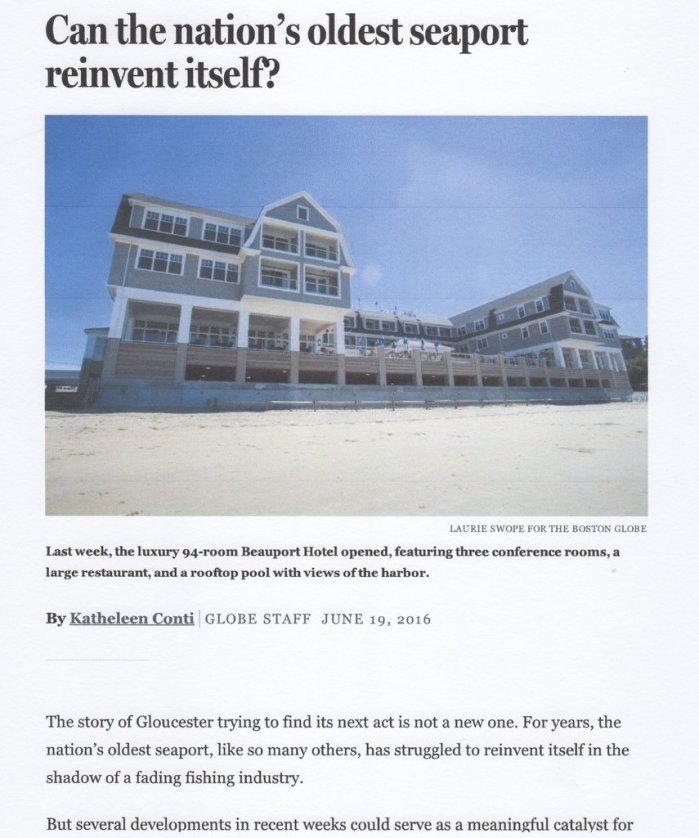
Kathleen Conti describes Gloucester Biotechnology Academy and Beauport Hotel as meaningful catalysts. In addition to the Mayor’s quote, there are comments and points of view shared by several: Sherri Zizik; Vito Giacalone; Gregory Verdine; Ken Riehl, Cape Ann Chamber of Commerce (nice quote); Lee Dellicker, Winhover Construction (Beauport); George Marsh (architect Gloucester Biotechnology). Oh, and the former Mayor of New Bedford, John Bullard. chimes in.
Other new businesses downtown beyond this article include goodlinens opening July 1, Jane Deering Gallery on Pleasant Street, the new bicycle rental shop, and Tonno restaurant. And there’s a new gallery coming to Rocky Neck. More on that later!
A draft of the coveted 10 year master arts and culture plan for the City of Boston dropped in May a dud, despite– or because of –its $1.2 million price tag. There’s a lot of pressure riding on Boston Creates final report, postponed until this coming Friday, June 17th. Boston is not alone in its struggles over funding and competing demands. Boston Creates and the ‘Art Czar’ fever did contribute to a climate of planning mana mania that found its way into Gloucester and other cities and towns. Boston Magazinewriter Patti Harrigan profiled the year of Boston Creates, warts– no all in the article, “Boston’s Creative Crisis”:
“Marty Walsh’s $1.4 million Boston Creates plan was supposed to turbocharge the city’s arts scene. A year after its launch, are we ever going to get anything other than a series of kumbaya sessions and generic platitudes?”
She does a good job covering some of the reasons. I can add more. Another perspective was an op-ed piece penned by Clara Wainwright for the Boston Globe. You may know her work with the celebrated 1998 quilt series: “Protecting the Oceans That God Has Created,” by Gloucester Fishermen’s Wives Association members including Lena Novello, Angela Sanfilippo, Fino Sanfilippo, and Nina Groppo. I am confident you have heard about another iconic project she established.
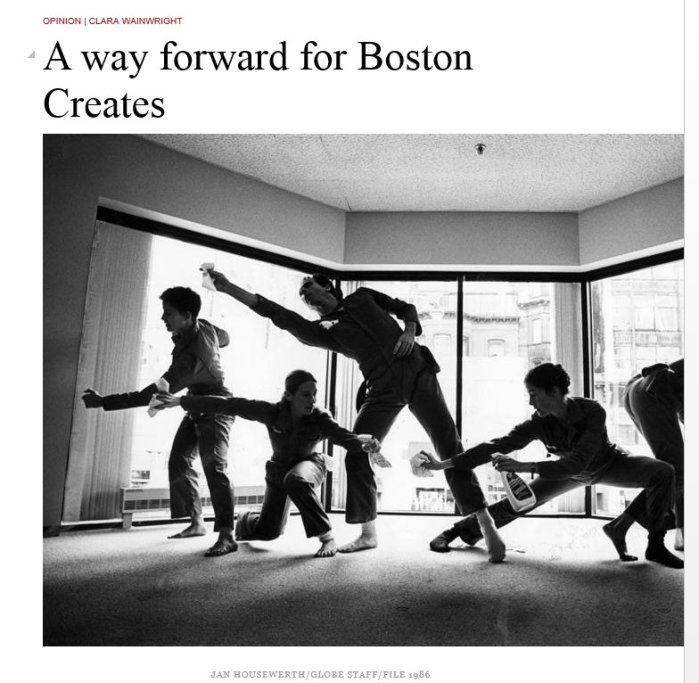
First Night founder and artist with Gloucester ties, Clara Wainwright, weighs in on Boston Creates. Her column “A Way Forward for Boston Creates” was published on June 2, 2016, excerpt below:
“Members of the arts community are praising Mayor Walsh’s Boston Creates, a 10-year master plan for the city’s cultural life, but are concerned about funding. The result of interviews with leaders of large and small arts organizations, and of community brainstorming in Boston’s neighborhoods, the Boston Creates report was directed by Julie Burros, the Mayor’s new cabinet-level chief of arts and culture. In presenting a draft of the report (the final is due to appear June 17), Burros pointed out the broad, rich scope of the plan, but warned that there was minimal funding to carry out some of its goals. I was again reminded of the recent Boston Foundation report that placed Boston last of 10 major cities’ support for the arts. Why such a sad warning, when Boston’s arts organizations and artists have been so clever and resourceful over the years?
In 1970 the Institute of Contemporary Arts invited city agencies and community organizations to come up with projects. The parks commissioner wanted a huge bell on Boston Common, which children could ring by swinging on its rope; a community health center wanted a mural for its waiting room. Artists were invited to choose one of many project ideas or submit a dream of their own. A large array of their ideas were exhibited in City Hall, which then had an art gallery. Mayor White’s Office of Cultural Affairs and the city’s financial community were encouraged to fund those selected. Boston Gas saw Corita Kent’s proposal for a billboard and commissioned her to paint a mural on one of its tanks.
Currently, Artists for Humanity provides instruction and small salaries to 200 high school students in a state-of-the-art building in South Boston. Zumix gives East Boston children musical instruction, the opportunity to perform, and a recording studio and a radio station. Both organizations were initiated by dynamic young women in the 1990s on minimal budgets. Some of their funding today comes from corporate commissions for murals, graphic work, and performances.
I’m in Worcester, MA, attending the 2016 Smart Growth Alliance conference (I was an invited speaker at a prior conference.) The conference brings city planners, transportation and civic innovators, real estate and housing professionals, business leaders, non-profits, architects, Great Neighborhood and gateway cities, and –well, let’s just say a wide range of (primarily) policy folk.
It’s surprisingly enjoyable.
This year, Lt. Governor Karyn Polito is the key note speaker and we’ll hear from Worcester the host city. Other headliners include Michael Hogan President & CEO of AD Makepeace Company; Mayor Donna Holaday of Newburyport; Dan Burden the ‘walkability guru’; Parris Glendening former MD Governor and President of Smart Growth America’s Leadership Inst; Veronica Eady, VP Conservation Law Foundation; and Monica Tibbits-Nutt, Executive Director 128 Business Council. There will be more than 70 speakers. Attendees often fan out in groups to cover more panels. I’ll report back where I’ve landed.
One topic that will swirl in the background concerns housing and a landmark bill S.122 proposing changes to planning, zoning and permitting. The organizers support this in a big way. Director Andre Leroux writes, “We believe that the (legislators) have done a thoughtful job balancing the needs of municipalities, developers, and the environment. “
“With two-thirds of Millennials desiring to live in walkable, transit-accessible places at the same time that seniors shift to apartment living, suburban communities have a real test before them. Communities like Newtonville need to decide between planned growth and unplanned growth. For its peers like West Concord village, Winchester Center, Andover and Newburyport, the future is already happening.” Quite a dishy prompt.
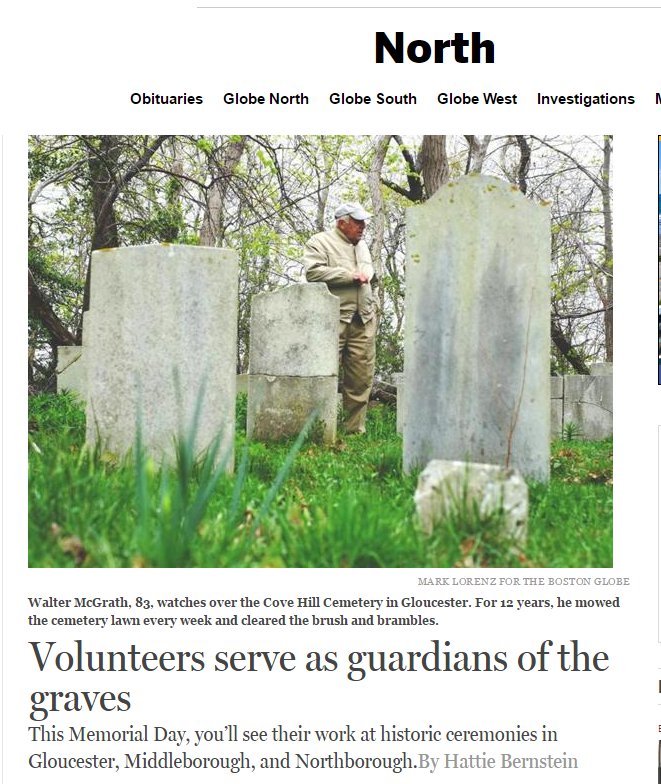
Great story by Hattie Bernstein in the Globe today gives a shout out to Walter McGrath in Gloucester.
“If you go to a cemetery on Memorial Day, you’ll see flowers and flags planted everywhere and a lot more visitors than usual.
What won’t be obvious on this holiday dedicated to military veterans who died fighting in wars are the efforts of Northborough’s Beth Finch McCarthy, 53, Gloucester’s Walter McGrath, 83, and Jordan Hurley, 15, who lives in Middleborough.
The three are among an uncounted battalion of volunteers across the region who share a common pursuit: maintaining their communities and ensuring that those buried there aren’t forgotten.
McGrath, a retired engineer with a long list of interests…
Gloucester Stage Company held its 37th Season Spring Celebration over the weekend, launching the new season in style with a silent auction, drinks, hors d’oeuvres, and music by Boston cabaret artist Brian Patton. Attendees at the event, hosted at the home of Tom Burger and Andree Robert, included Gloucester Stage managing director Jeff Zinn, artistic director Robert Walsh, and Elizabeth Neumeier, president of the theater company’s board of directors.
Before he was a Harvard spurner, a Veteran, a Gloucester Master Mariner, a sea tales chronicler and beloved writer, James Connolly (1868-1957) was one of 14 American athletes (5 were Bostonians) to compete in the international Games of the I Olympiad in Athens, Greece, 1896.Twenty percent of the international competitors were from the United States.
Connolly medalled. Twice. On the first final of the opening day, Connolly won what is now the triple jump and came in 2nd in the high jump. He sailed home a champion, the first Olympic medal winner in 1500 years. This recognition no doubt helped his byline and he rapidly gained a reputation as a fantastic writer. The Boston Globe published his first war correspondence, “Letters from the Front in Cuba” where he served with the Irish 9th Infantry of Massachusetts. His career soars after writing about Gloucestermen from his days working in Gloucester. I’ll let Connolly take it from here, it’s so good:
“While still twenty-five pounds underweight from tropic fever, I took a job as physical director of the Gloucester Athletic Club. I played football on the Athletic Club cleven, spent the fall and winter (1899-1900) there, chucked that job in the spring, took a steerage trip to England…participated in second Olympics (second place)…returned to US again…My next move was to make fishing trips with the captains I had come to know while in Gloucester with the Athletic Club. I had no intention of writing them up, but at this stage of my development I was able to appraise men fairly well. Here were great men, and all the greater because they did not know that they were great. I began by writing of actual experiences with the Gloucestermen, continued with them as the heroic men they were in short stories. My first stories were sent to Scribner’s Magazine, and immediately accepted. And the first half dozen stories were brought out in the volume, Out of Gloucester, by Charles Scribner’s Sons.”
James Connolly
James Brendan Connolly’s parents were Irish immigrants and his dad was a fisherman. Connolly was born in 1868 in southie, Boston, one of 12 children. He died in 1957. You can see the first ever modern Olympic medal at Colby, which was donated by his daughter, Brenda. Several Gloucester writers and notables mention him. TS Eliot wrote the introduction to Connolly’s 1928 Fisherman of the Banks. NC Wyeth illustrated some of his books. His sailing chops were envied.
In Gloucester, MA:
Today is the first day of track and field at O’Maley Innovation Middle School. On this 120th anniversary of the first day of the modern Olympics (thanks Google Doodle), may our student athletes be inspired by James Brendan Connolly. Check out a Connolly book from Sawyer Free or look for vintage editions at Main Street Antiques and Dogtown Book Shop.
Photo caption: The memorial to Connolly, dedicated in 1987 and designed by artist Thomas Haxo. The memorial was paid for through a grant by the Edward Ingersoll Browne Trust Fund. Rosso/Boston Globe
Spread The GMG Love By Sharing With These Buttons:
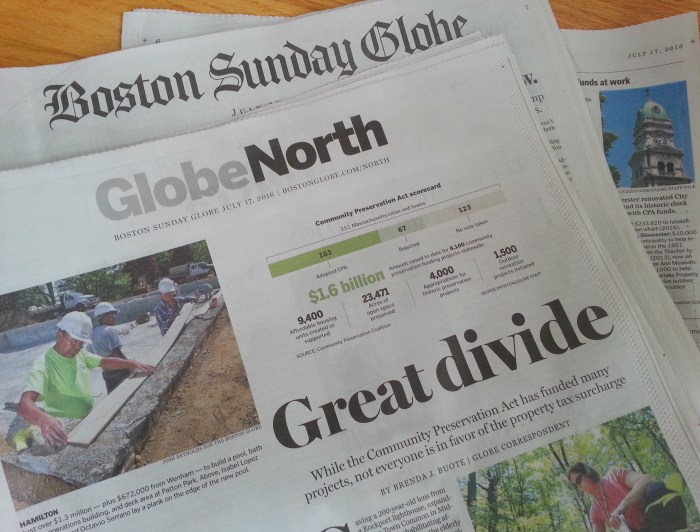
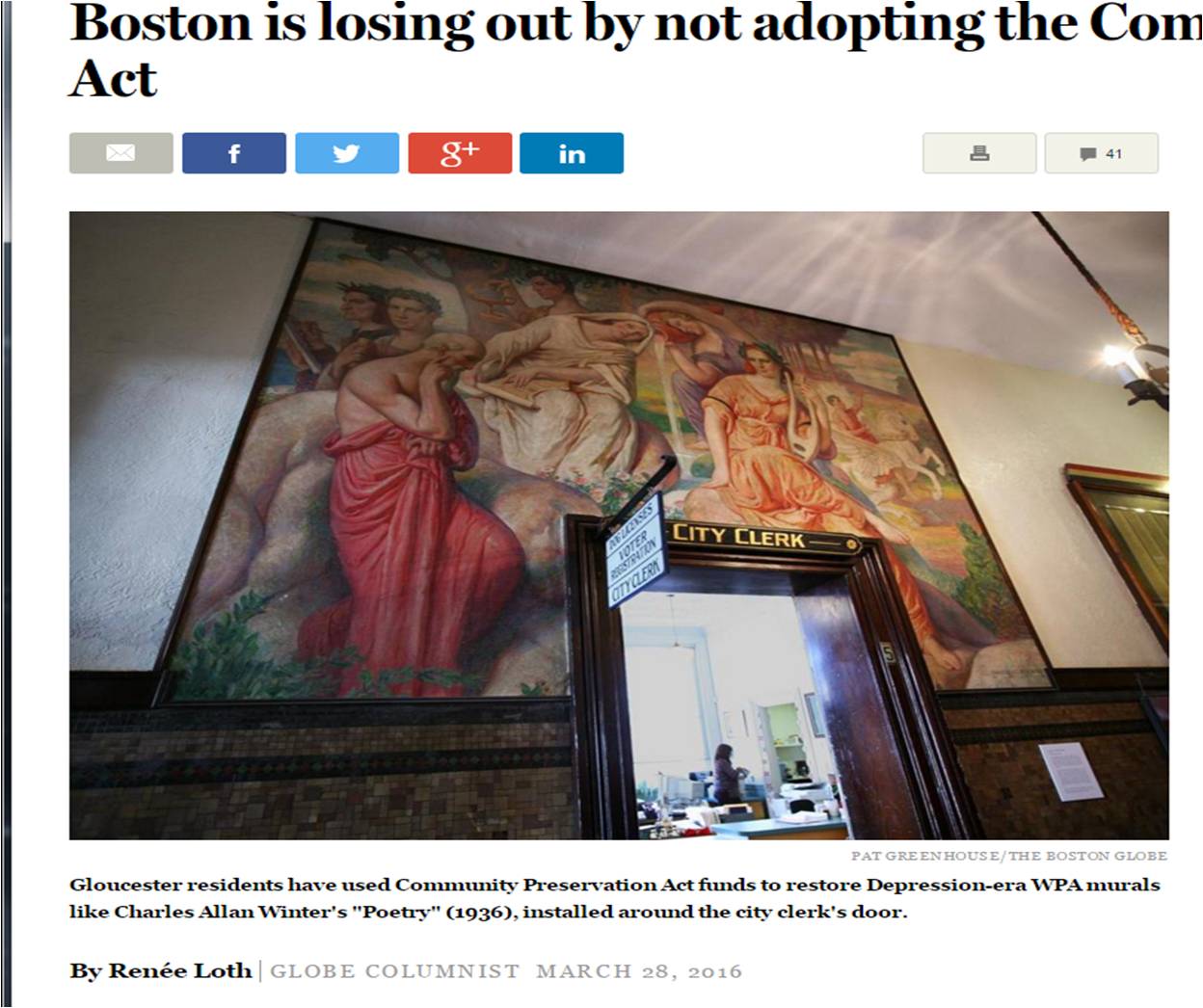
Did you see? Wonderful John McElhenny’s My View article to the Gloucester Daily Timesthanking great work by the CPA committee and residents? And more this week in the Boston Globe? Nice to be the successful model. “In Gloucester, residents have leveraged funding for 80 units of affordable elderly housing in an old grammar school, replaced historic lead glass windows at the Cape Ann Museum, and restored Depression-era WPA murals at City Hall.” Read more of the Boston Globe article here
Since April is National Poetry month it seems extra fitting to pause on the Charles Allan Winter mural–which by the way is notoriously difficult to photograph in that site. Nice job by photographer Pat Greenhouse / Boston Globe.
In 1931, he and his wife Alice Beach Winter, also a successful artist, came to live in Gloucester year round having spent summers since 1914 and building their Mt. Pleasant studio in 1922. Poetry was the third mural Winter completed in Gloucester.
After this spectacular article in the New York Times a couple of weeks ago, it’s nice to see this piece in the Boston Globe’s travel section listing 10 Ways to Spend Labor Day Weekend in New England.
Spread The GMG Love By Sharing With These Buttons:
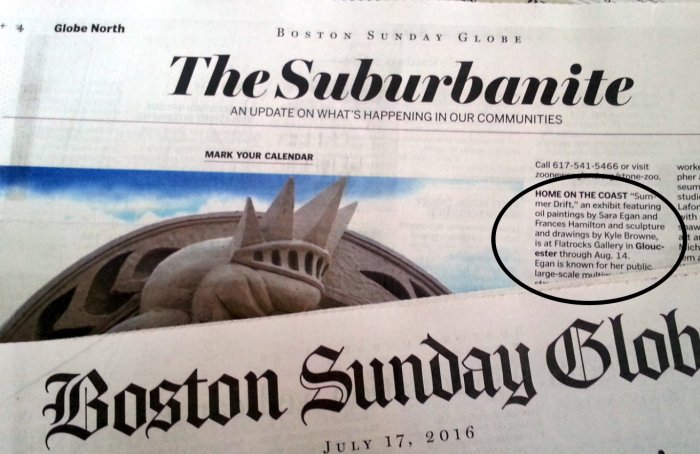
Boston Globe correspondent, Wendy Killeen, lists Berklee in Gloucester in her weekly Arts/Entertainment column that appeared in the Globe North today. Excerpt below:
JAZZ ON TAP: Berklee in Gloucester launches its season with a performance by The Jim Odgren Quintet at The Gloucester House on Thursday.
The series of concerts features professors from the Berklee College of Music in Boston and some of their top students. Proceeds benefit the Gloucester2Berklee Scholarship Fund, which helps send students from the city to the music college.
“Given all the Berklee students and alumni who live here, we feel that Berklee is somewhat responsible for Gloucester’s burgeoning music scene,” said Peter Van Ness of gimmeLIVE, producer of this season’s Berklee in Gloucester shows. “Normally, you’d only expect to see these concerts in a big city. You get to catch the best players in the world today as they train the best players of tomorrow.”
The jazz quintet is led by Berklee professors Jim Odgren on alto saxophone and Dave Santoro on acoustic bass. They are joined by Berklee student musicians Roberto Giaquinto on drums, Davis Whitfield on piano, and Lucian Gray on guitar.
The performance begins at 7:30 p.m. Tickets are $10 in advance; $15 (cash only) at the door. Call 978-525-9093 or visit gimmesound.com.
This town’s last national burst of buzz came from the movie version of “The Perfect Storm,” in which desperate fishermen going farther and farther out in search of dwindling stocks of swordfish were swept into the abyss by a hurricane. You may soon hear about Gloucester again, as visionary leaders chart out what they hope is a perfect scenario of renewal. There are still hundreds of working fishermen here, but officials now talk of Gloucester becoming a cluster for a much broader “marine economy.” Picture an aquatic Silicon Valley — a center of research on the “wired ocean” and a workshop for entrepreneurs developing products based on discoveries from the deep.
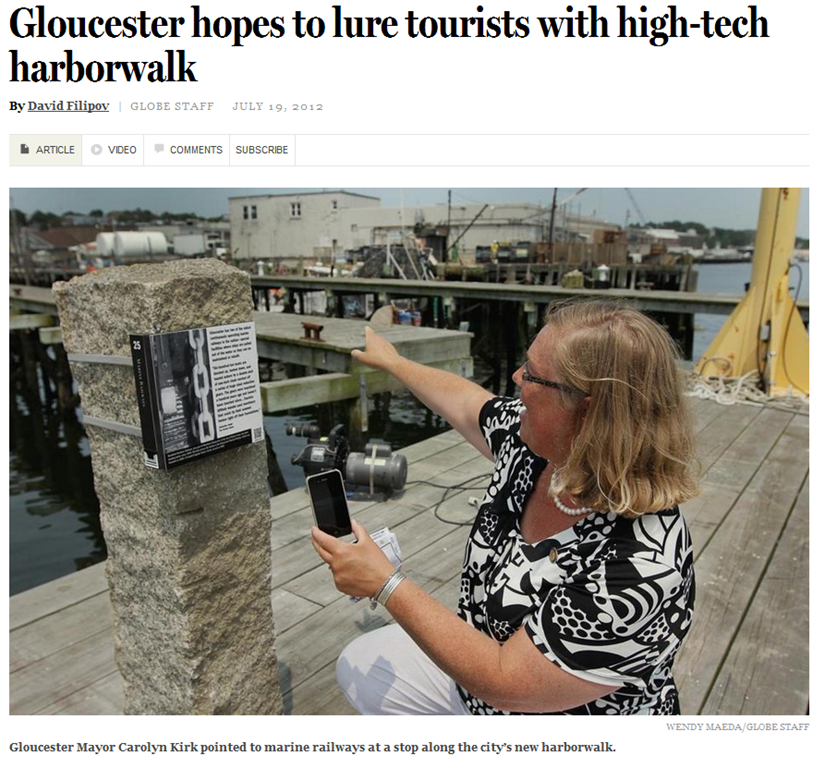
Wendy Maeda/Globe staff
Gloucester Mayor Carolyn Kirk demonstrates how QR codes enable an interactive smartphone tour along the city’s HarborWalk.
“This is what’s happening to the city, this is where we’re going,” vows Mayor Carolyn Kirk. “Come hell or high water, we’re going there.”
Touring the city this week, there was ample evidence that Gloucester can build on its seafaring heritage, even as it seeks to develop economic niches beyond fishing.
GLOUCESTER — Among the weathered docks and fishermen’s shacks of this renowned port lives another Gloucester: a world of sea serpents and seafaring stories, world-renowned artists and beloved cultural icons.
The problem has always been how to find it. The working waterfront that supplies the city’s lifeblood also presents a maze of piers and industrial lots that are as difficult for visitors to navigate as they are crucial to Gloucester’s economy.
Next month, the city hopes to solve that problem with the opening of Gloucester Harborwalk, a 1.2-mile loop that brings to light previously hard-to-find historical and cultural lore and reunites the city’s main streets and its seaport. It does so with a network of 42 markers that is accompanied by a virtual tour that can be downloaded onto a smartphone.
City officials see the Harborwalk as a way to lure visitors who stop by for lobster, whale watching, or a trip to the beach into longer stays that will help drive the local economy.
When most people visualize Gloucester, they imagine a fisherman casting his nets, or the white sands of Good Harbor Beach, or the excitement of spotting a whale as it rises from the ocean’s depths. Now, thanks to many active artists and art organizations, Gloucester is on its way to reestablishing its reputation as a center for the arts.
The city made the grade as a popular arts destination in an article appearing in the summer edition of AmericanStyle magazine. Gloucester was ranked third in the small-city category with other cities that had a population below 100,000. The top two spots were taken by Asheville, N.C., and Santa Fe, respectively.





















 Good Morning Gloucester