
Salisbury Beach Geology and Barrier Island Dynamics
The following is from the publicly released document “Salisbury Beach State Reservation Barrier Beach Management Plan 2008” Masschusetts DCR.
Pre barrier island past
Salisbury Beach is a barrier beach that is separated from the mainland by a large salt marsh which contains several tidal creeks. The physical area known as Salisbury Beach was created by the reworking of sediments deposited by glaciers as they melted and receded to the north 15,000 to 18,000 years ago. As it receded, the glacier left bedrock deposits which are present in small areas at the southern part of the Reservation, near the mouth of the Merrimack River. The source of the sand at the beach was historically a paleodelta deposited offshore as the glacier receded.
Barrier Island formation
The development of barrier beach/dune systems began approximately 6,300 years Before Present (B.P.). As previously described, prior to 10,500 B.P., the region was under an ice age load which caused a general subsidence. During the waning of the glacier, first the sea level rose significantly above coastal lowlands, and then the land rebounded and became elevated higher than average sea levels. As the sea rose, it eroded glacial deposits offshore which formed the foundation of a barrier beach/dune system. This underlying foundation consists of glacio-marine clay which is located at depths of 40 feet or more.
Sand and gravel carried along the shore by waves and currents subsequently accumulated on top of the clay to form a spit. The area between the spit and the mainland was mostly open water. Over time, sea-level rose and the spit continued to enlarge and migrate westward. The protected bay behind the spit filled in with sand, became shallow and developed into a salt marsh.
Barrier Island Dynamics
Beaches are always in a state a flux. Climate, the intensity of the winds and currents, storms, available sediment supply and land-use determine the profile of the beach. The sand that accumulates on beaches comes from northern mountain boulders (often transported by rivers) which were finely ground first through years of glaciation and water by erosion as a result of storms and frost. The littoral current which runs from north to south during north/northeast winds transports sand down the coastline. This current is powerful, and the undertows and rip currents act like huge conveyer belts carrying sand southward to replenish beaches further down the coastline. If the littoral current is obstructed by structures such as jetties and groins, the beach will balloon out to the north of the obstruction “damming up” the littoral drift which would have replenished the beach to the south. Similarly, transport of sand in the onshore or offshore direction (cross-shore transport) results in an adjustment of the beach toward an equilibrium profile. The major source of cross-shore sediment transport comes from the paleodelta located offshore of the Merrimack River. High waves and water levels during storms result in accelerated and modified longshore and cross-shore sediment (sand) transport processes.
Not only do dunes protect inland areas but they supply sand to the adjacent beach system, thereby increasing its ability to dissipate storm waves. By absorbing much of the force of the waves, dunes provide protection to landward areas from storm damage and flooding.
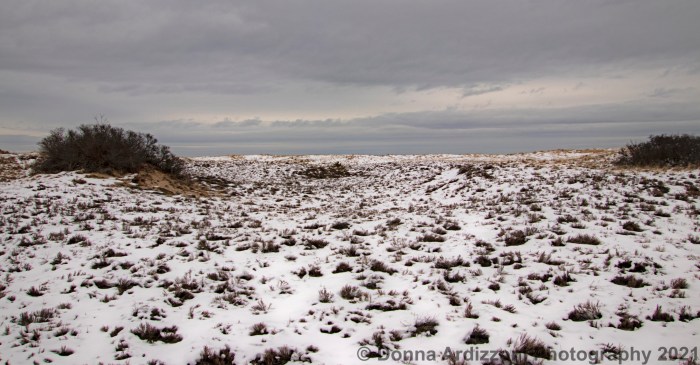
A healthy barrier beach system contains primary dunes and secondary dunes. If the sand dunes at Salisbury Beach were free from human interference, predictable geological processes would occur. High energy storm waves attack the beach and dune face. Sand is transported in an offshore direction to build sandbars. The decreased depth of the offshore area causes waves to break further offshore and away from the dune face. Less energetic waves, consequently, directly hit the beach and dunes. Vegetation on the dunes provide stability through its root system that holds the sand in place and by trapping windborne sand particles blown from the dry portion of the beach, increasing the volume of sand in the dune.
The dynamics of Salisbury Beach’s barrier island dunes and beaches.
The sand dunes at Salisbury Beach are moving westward with a motion similar to that of a bulldozer tread: a rolling, “going over itself” motion. Some natural factors, such as rising sea level, make this process inevitable, while others, such as littoral drift and dune vegetation, make it a relatively slow process. Storms can create changes very quickly. However, human activities also accelerate this process. People, with their desire to visit or live on the beach, often destroy the very resource that attracts them and the resources that provide storm buffering and flooding protection.A jetty located north of the Reservation in Hampton, New Hampshire, currently interrupts the flow of sand onto the northern section of Salisbury Beach. The beach is steeper south of this barrier. The jetty along the northern shore of the Merrimack River, provides protection to the navigation channel into and out of the Merrimack River and obstructs the flow of sand to the south towards Plum Island.
Beaches typically migrate landward due in large part to reduced sediment supply and rising sea-levels. The rate of relative sea level rise is currently about one foot per 100 years; however, the Intergovernmental Panel on Climate Change (IPCC) predicts that sea-level rise and its risk to coastal resources will accelerate over the next 100 years. Conservative projections of sea-level rise by the end of the century range from 4 to 21 inches, while projections given a higher emissions scenario range from 8 to 33 inches (CHC, 2007). Given on-going coastal issues and climate change, land mass forms in this dynamic system will constantly change over periods of time.







































 Good Morning Gloucester