Led by beloved children’s author Virginia Lee Burton, this group of mostly untrained women created immortal designs.
Atlas Obscura
By Cara Giaimo

One by one, the prints unfold before you. One shows sheep leaping in the grass, another, children on a tree-hung swing, the moon shifting above them. All are charming, sophisticated, and unbelievably detailed. They take the essence of everyday objects and activities, and unspool them into mesmerizing patterns. No matter how much you may want them, though, you can’t get these prints on Etsy. In fact, you can’t get them anywhere.
They live mere miles from where they were produced, at the Cape Ann Museum in Gloucester—the last bastion of the nearly forgotten Folly Cove Designers. Helmed by a children’s book illustrator and comprised of her previously untrained friends and neighbors, the Folly Cove Designers were hardworking, tight-knit, and sincere—so sincere, they eventually voted themselves into obscurity.
To children worldwide, Virginia Lee Burton is the beloved hand behind half a dozen classics, including Mike Mulligan and His Steam Shovel, Katy and the Big Snow, and The Little House, intricately illustrated tales of close-knit communities. But to her neighbors at Folly Cove, on the north shore of Massachusetts, she was Jinnee Demetrios. Jinnee and her husband, the sculptor George Demetrios, moved to the area in 1932 with their one-year-old son Aristides, who was soon followed by Mike. The couple quickly became community pillars, making art all day, and spending evenings gathering their friends and neighbors for raucous sheep roasts.
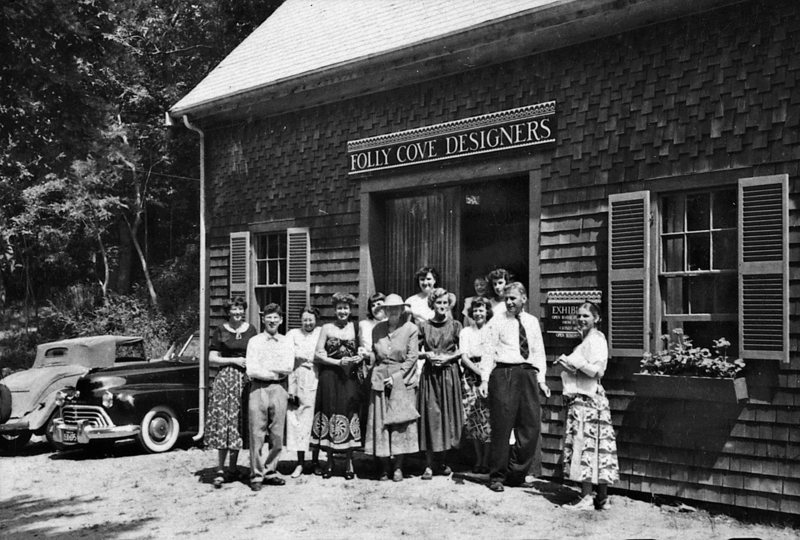 “Folly Cove gets its name because it would be folly to bring a ship in and turn it around,” says Christine Lundberg, producer of the film Virginia Lee Burton: A Sense of Place, as well as the upcoming Beautiful and Useful: The Art of the Folly Cove Designers. This ethos carried over into the rough-and-ready town life. “You couldn’t get pretty little things,” says Lundberg. “If you wanted them, you had to make them.” An artist through and through, Jinnee surrounded herself with homemade treasures, including, as the story goes, a particularly nice set of block-printed curtains. One of her neighbors, Aino Clarke, admired the curtains so much she wanted to make her own. Jinnee and Aino struck a deal: Jinnee would give Aino top-to-bottom design lessons if Aino, a member of the local orchestra, would teach Jinnee’s sons the violin. (A less legendary, but perhaps more truthful, version of this tale holds that Aino suggested Jinnee give design lessons to her neighbors in exchange for money to buy the necessary paper to illustrate her first book.)
Regardless of exactly how the two came together, Jinnee’s flint struck on Aino’s iron sparked an artistic movement. Within its rock-hard exterior, Folly Cove harbored a vein of artistic impulse that dated all the way back to the 1800s, when painters had flocked there to take advantage of the seashore’s distinct sunlight. (“If you spend time lying on the granite around here, you get creative powers,” one resident told Lundberg). As Jinnee and Aino dove into the lessons, other members of the community began joining them.
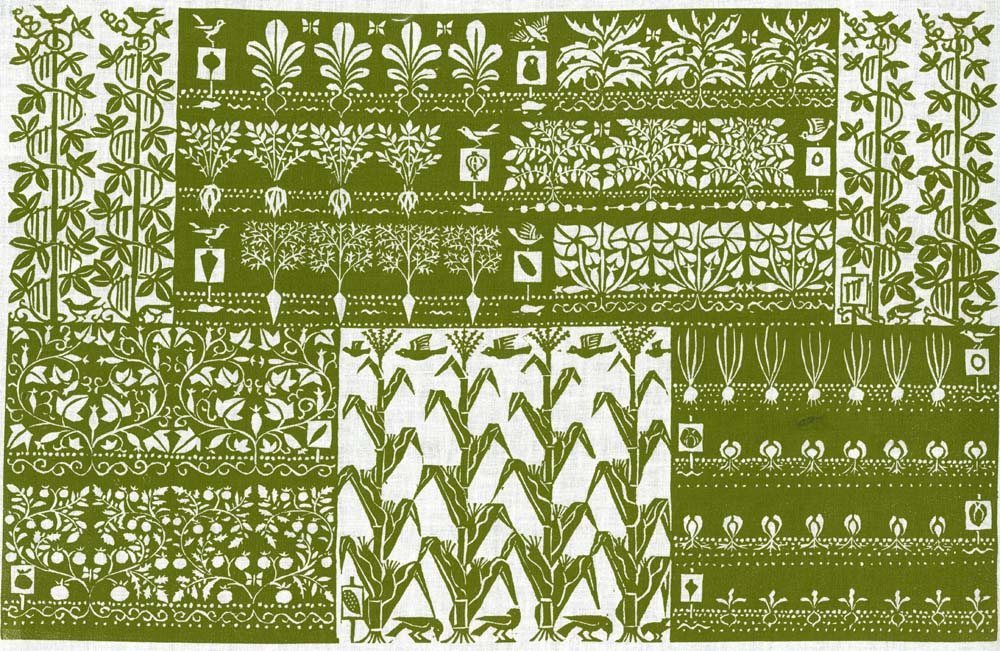
Thus began the Folly Cove Designers (FCD), a ragtag group of locals united by their desire to fill their lives and their minds with a particular form of well-thought-out beauty. Many members were, like Aino Clarke, the children of Finnish immigrants, and sought to combat the economic and emotional hardships of the Great Depression. Others were so-called “Yankees,” who had moved permanently to Folly Cove after vacationing there as children, and who wanted something new to do. Eino Natti, one of the group’s few male members, was an Army veteran and former quarryman—experiences he drew on for prints such as Polyphemus, of a granite-carting train, and PT, which shows near-identical soldiers in mid-squat. Elizabeth Holloran, the local children’s librarian, printed young people skiing and sugaring. “A majority of them were never artists,” says Cara White, director of the Cape Ann Museum’s Folly Cove gallery. “They were editors, architects, housewives, accountants.”
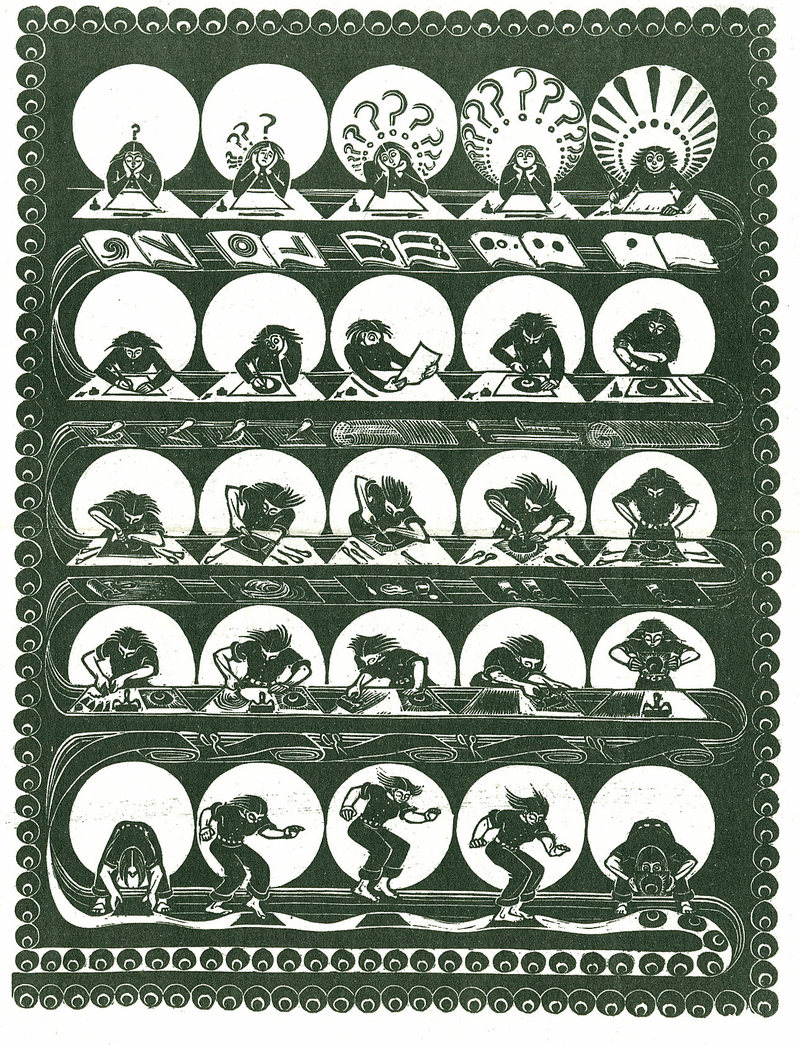 The Folly Cove Designers “diploma,” presented to each member by Jinnee upon their entrance to the guild. Cape Ann Museum.


 Good Morning Gloucester
My mother, Elizabeth Holloran, was one of the early members of the Folly Cove Designers. In contrast to some of the others, who began their artistic lives at the right hand of Jinnie, Mother was a graduate of the Vesper George School of Art in Boston, and had worked for an advertising agency after she got out of school. She was also quite an accomplished artist, working mainly in watercolor. She had taken lessons from Rockport artist Don Stone later on in life. As well as being one of the first of the Folly Cove Designers, she was also the last of the group to stop cutting linoleum blocks and printing them on cloth and paper. For many years she owned and operated the Sarah Elizabeth Shop at Whistlestop Mall in Rockport. After opening that shop, Eino Natti sold her the original Folly Cove “Acorn” press that is now in the O’Maley School. So much history.
LikeLiked by 2 people
Thank you Tim for writing, so very much appreciate your sharing about your Mom. I knew the shop well and was a a great admirer of your Mom’s work and how she kept the spirit of the designers alive long after the group had disbanded.
LikeLike
Kim,
Great update here and there are a lot of names in here that I knew when I was back that way and some school with if my memory serves me well! My understanding is the little house on point before will be added to the Lanesville Community Center property from what I read this year 2018 on Vulcan street (Live Long and Prosper). 🙂 Dave & Kim 🙂
LikeLiked by 1 person
I also know this is in the Manship land! 🙂 Dave
LikeLiked by 1 person
Thanks Dave for adding that 🙂
LikeLike
I knew I left something out but hey the click was too quick to bring back so had to add! I worked there at Manships, as young lad discipline, work ethic, and much need spending money for efforts plus had fun too!! 🙂 Dave
LikeLike
Thanks so much for sharing this!
LikeLike