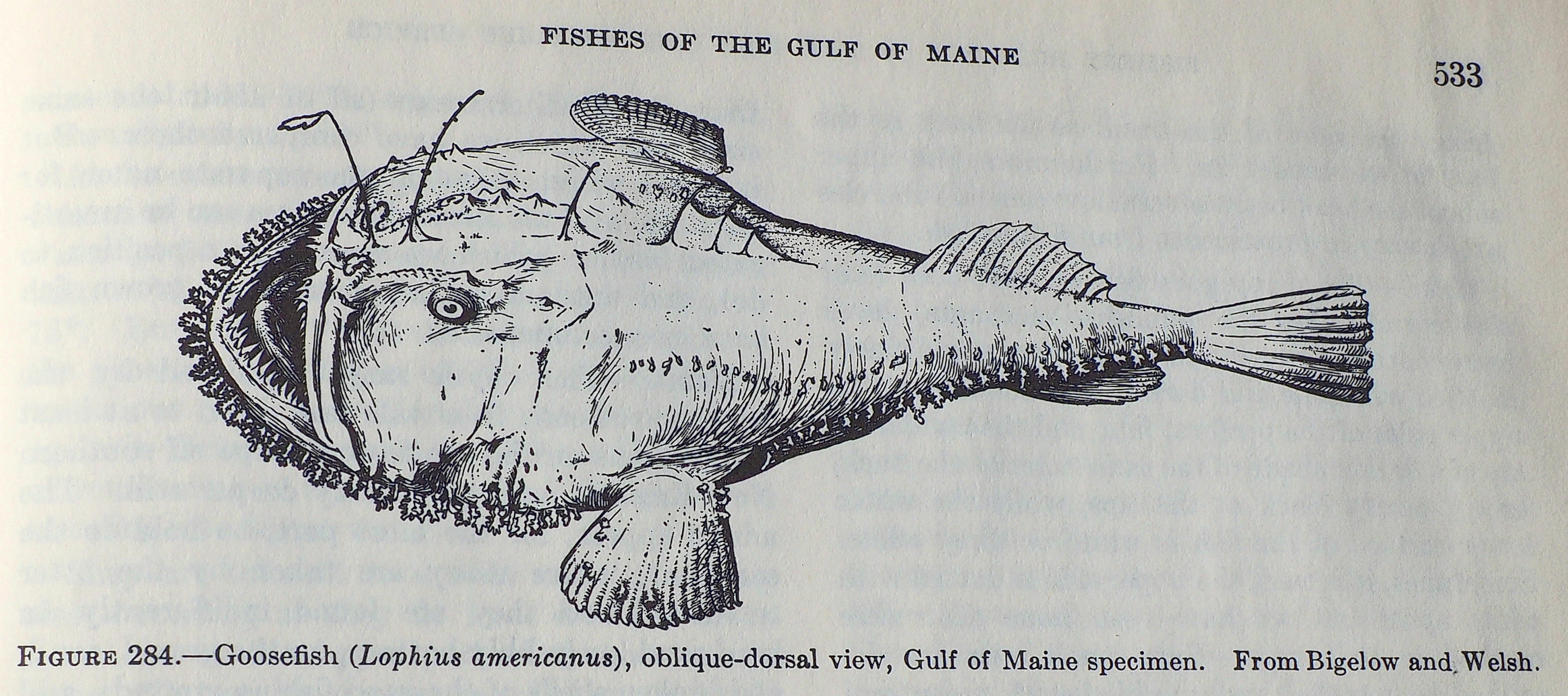
MONKFISH; ANGLER; ALLMOUTH; MOLLIGUT; FISHING FROG … The first spine bears an irregular leaflike flap of skin at its tip, which plays an important role in the daily life of the goosefish as a lure for its prey … Weighing up to 50 pounds … The goosefish has often been cited for its remarkable appetite. We read, for instance, of one that had made a meal of 21 flounders and 1 dogfish, all of marketable size; of half a pailful of cunners, tomcod, and sea bass in another; of 75 herring in a third; and of one that had taken 7 wild ducks at one meal. In fact it is nothing unusual for one to contain at one time a mass of food half as heavy as the fish itself. And with its enormous mouth (one 3½ feet long gapes about 9 inches horizontally and 8 inches vertically) it is able to swallow fish of almost its own size. Fulton, for instance, found a codling 23 inches long in a British goosefish of only 26 inches, while Field took a winter flounder almost as big as its captor from an American specimen. One that we once gaffed at the surface, on Nantucket Shoals, contained a haddock 31 inches long, weighing 12 pounds, while Captain Atwood long ago described seeing one attempting to swallow another as large as itself.
Importance—
No regular commercial use has been made of the goosefish in America up to the present time. But it is an excellent food fish, white-meated, free of bones, and of pleasant flavor.
From Fishes of the Gulf of Maine by Bigelow and Schroeder, 1953. Available free online courtesy of MBL/WHOI http://www.gma.org/fogm/Lophius_americanus.htm
If you were a goosefish you would say the “importance” situation has taken a bad turn since 1953. The 2002, third edition, of Fishes of the Gulf of Maine notes: Total landings remained at a low level until the mid-1970s, increasing from a few hundred metric tons to around 6,000 mt in 1978. Landings remained stable at between 8,000 and 10,000 mt until the late 1980s and then increased to a peak level of 26,800 mt in 1996. Usually only the tails are landed. There is also a lucrative market for goosefish livers.
In the 1960s the Bureau of Commercial Fisheries Technological Lab on Emerson Avenue in Gloucester was involved in marketing support for goosefish (monkfish), then considered an underutilized species. I worked there at that time and recall Julia Child and the Boston Globe’s food editor, Dorothy Crandall visiting the lab and providing enthusiastic support. Here’s a 1979 photo of Julia Child with a monkfish. https://www.nefsc.noaa.gov/read/popdy/monkfish/
Al Bezanson


 Good Morning Gloucester
I have to admit stepping one of these ground dwellers scared the daylights out of me in lanes cove in the good 1960’s… 🙂 Dave :-O
LikeLiked by 1 person
Years ago while paddling near Misery Island, we came across a large monkfish wallowing and in distress on the surface…. we somehow got it to the beach and pried open its mouth. To our astonishment, two legs and feet of a cormorant were sticking out from its gullet!!
It had attempted to swallow the large bird whole and was choking on it!! Apparently, they’ll go after anything!!??
LikeLiked by 1 person
Both jaws are armed with long, slender, curved teeth, all alike in form but of various sizes, and very sharp, and all the teeth point inward toward the gullet. Some of them may be as much as an inch long in a large fish. The teeth in the lower jaw are in 1 to 3 rows, mostly large, while in the upper jaw the few teeth in the middle (there is a toothless space in the midline) are largest, with a single row of smaller ones flanking them. And there are several rows of thorn-like teeth on the roof of the mouth.
Here’s what happens when a goosefish gets your hand:
LikeLike
Very painful and yes they are like a vacuum cleaner everything! My hand hurts just watching this video 🙂 Dave
LikeLiked by 1 person
Amazing that Dave lived to tell about his encounter.
LikeLike
Love the fish posts Al!
LikeLiked by 1 person