Lobster liver or pine tree, the mystery of the origins of the name Loblolly Cove is perhaps solved. Thank you to GMG reader “escape pod” for steering us in the direction of the blog Vintage Rockport and to Lois for her suggestion to read about pines during the Eemian interglacial period.
It would be challenging to learn whether the early colonists knew about Loblolly Pine trees in 1700 when the cove was first named by Welshman Peter Emmons. The word loblolly is a combination of lob referring to thick bubbling soup and lolly is from an old British dialect word for broth or soup. In the southeastern United States loblolly means mudhole or mire, in a sense relating to thick soup. Loblolly Pines generally (but not always) grow in the swampy lowlands of the southeast.
More plausible to the mystery of the naming of Loblolly Cove is the following account written by Frederic Sharon in 1939 and found on the Vintage Rockport blog. The article is fascinating, as is the website. The excerpt is pertinent to our mystery, and do read the full account. I loved learning that there was a little fish shack called Haskell’s Camp there at one time on Loblolly Cove. Recently I learned too that lobsters were so plentiful in the days of the early colonist and could be found in such great abundance on the beach amongst the seaweed that one needed only reach out their hand to take one home for dinner; no lobster traps needed!
“…The fame of these clambakes was spread by these men and soon summer visitors heard about them. They used to come up from the resorts in tally-ho’s and barges (that was before the automobile) and then they began demanding shore dinners for smaller parties and individuals. So began the business that made Loblolly Cove famous.
“Why Loblolly Cove?” I asked. “What does Loblolly mean?”

“The Camp” at Loblolly Cove, Rockport, where those wonderful
clambakes originate.
“That’s what I wanted to know, and I was a long time finding out. I found in the dictionary that ‘loblolly’ meant thick oatmeal gruel; another definition said it was a kind of tree. This didn’t suit me; I found that Peter Emmons, a Welshman, received a grant from the Commonwealth of Massachusetts about the year 1700 of this region. He named it Loblolly Cove. Now why. I wondered.
“Some years ago a Welshman had one of my shore dinners and after finishing his lobster remarked that that was as good a loblolly as he had ever eaten. I pounced on him at once. What did he mean by loblolly?”
“Why,” he replied in surprise, “don’t you know what loblolly is?”
“No,” I said eagerly. “What is it?”
Loblolly on Bread!
“Well, in my boyhood in Wales,” he replied, “we used to catch lobsters and cook them and the piece-de-resistance was the loblolly, the liver or fat of the lobster, you know that sort of greenish thing you see in a broiled lobster. Well that is the loblolly and we used to spread it on bread because we didn’t have much butter. So there you are. The loblolly is a lobster liver.”
“And then to clinch it, one day a lovely old lady from Salem was having a shore dinner and as she finished she said: ‘That was a lovely loblolly.’”
“So I tackled her and here is what she said: ‘Loblolly, why all my life I’ve known the liver or fat of the lobster as the loblolly.’
“‘But, why?’ I asked determined to find out further about this elusive word. ‘Why,’ she said, ‘when I was a girl we used to go to Nahant for our lobsters because there was a Welshman there who caught such wonderful ones, noted because of their delicious loblollies.’
“So that settled it. Peter Emmons was a Welshman, the lobsters he found in his cove had superior ‘loblollies,’ so he named his cove ‘Loblolly Cove’ and the lobsters to this day have kept alive the tradition.
“Well,” continued Haskell, “I was young and wanted to see the world, so I went to New York and entered business. After two companies I was with folded up I decided to come back here, especially as this business had grown and father needed me, so here I’ve been ever since.”
Read more (and learn how they cooked the lobsters) here:
A 1939 News Article About Haskell’s Camp and the Origin of the Name ‘Loblolly’
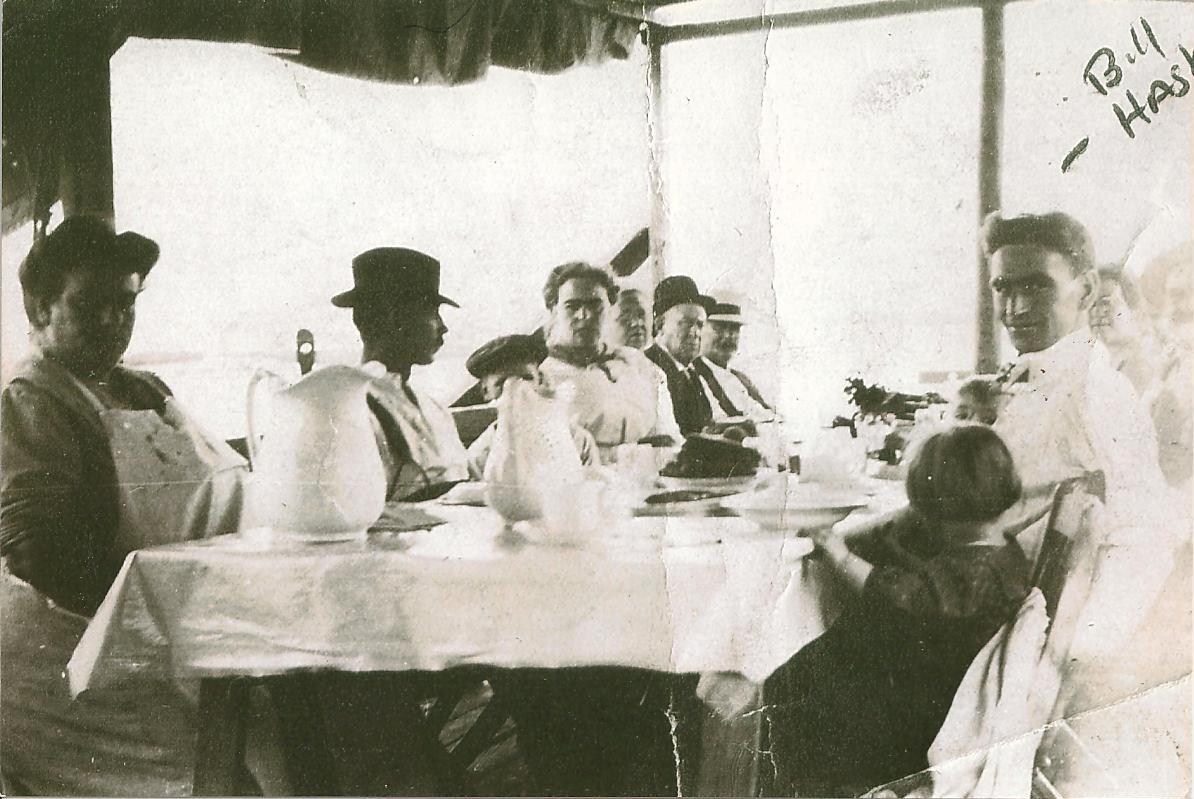
Haskell’s Camp Loblolly Cove from Vintage Rockport


 Good Morning Gloucester
I have photos of my family having a clambake on Loblolly beach in the 1950s…
LikeLiked by 1 person
We would love to post that Brenda!! If you can, please send a scan to me at kimsmithdesigns@hotmail.com.
LikeLike
Not sure if I buy this Kim…still lean toward interglacial OR I think this ‘tale’ is correct:
Amongst all the reports in Natural History publications–and affidavits–regarding the Cape Ann Seas monster, one is of note. A physican with a glass was observing the GIANT sea creature through a glass, he called his family down. His wife said: “Oh look at the humps–it just LOBS along.” His daughter said: “But, Daddy, his head looks just like a LOLLY.” THUS!!!!!
LikeLiked by 1 person
Great story Sybil! What year was this account written?
I think what would help give us a clue is to find the actual date of the cove’s earliest naming of Loblolly Cove, which i unfortunately do not have time to investigate at the moment. The article above states 1700. I believe the Ten Pound Island, and thereabouts, sea monster sightings were from the late 1800s, early 1900s.
I have a story about my experience with a “Cape Ann sea monster” from this past winter which I have been meaning to post. Coming soon.
LikeLike
Don’t tease us Kim, write the story !!!
LikeLiked by 1 person
Will try this weekend Allen!
LikeLike
Actually, I made the bit up re: Lob and Lolly–after ‘See how she Scoons’, the REAL story of how Schooners were named. The bit about the seeing glass, the Dr. and his family are true, and in the Natural History archives regarding the Cape Ann Sea Serpent. (See the books BUT ALSO facsimiles of the court/Natural History Society documents of the time. ((If you REALLY want them, I can check out proper references tomorrow!)
LikeLike
Oh, I made it uo today. HOWEVER, it is grounded in reality. (ish)
LikeLiked by 1 person
Very devilish Sybil 🙂
LikeLike
Mystery solved that’s always a good thing! 🙂 Dave & Kim 🙂
LikeLike
Love your article! We’ve said this for years- love the sound of the word Loblolly, and said it could be a kids’ mystery novel or the cute name of a boat. Great minds think alike! 🙂
LikeLike
according to Syd Wedmore…from WikiA loblolly boy on a warship was an assistant to the ship’s surgeon. In Tobias Smollett’s 1748 novel The Adventures of Roderick Random, the first to describe Royal Navy life in detail, the protagonist Random was made a loblolly boy upon entering the Royal Navy, and ultimately received his warrant as a surgeon’s mate. Loblolly boys also appear in C. S. Forester’s Horatio Hornblower novels, Alexander Kent’s “Midshipman Bolitho” novels, and Patrick O’Brian’s Aubrey-Maturin novels. Stephen Maturin’s loblolly boy, Padeen, features in several of O’Brian’s books.
Possibly because of such influential media representations, it is sometimes erroneously thought to be solely a Royal Navy rating, and surgeons’ assistants were so styled in the Royal Navy by 1597. The rating was also used in U.S. Navy warships from the late 18th century until 1861, when the name surgeon’s steward was introduced to reflect more stringent training requirements. The name was changed to apothecary in 1866, and again in the 1870s to bayman and then in the early 20th century to Hospital Corpsman. The Royal Navy name changed to sick berth attendant in 1833, with the nickname Sick Bay Tiffy (Tiffy being slang for Artificer) gaining popularity in the 1890s. Medical Assistant is the current term.
The name itself comes from the serving of loblolly—a thick porridge, sometimes enhanced with chunks of meat or vegetables—to sick or injured crewmembers to hasten their recovery. Loblolly, in turn, probably comes from the fusion of lob, a Yorkshire word meaning to boil or bubble, and lolly, an archaic English word for a stew or soup. Loblolly itself eventually came to mean anything viscous, such as a swamp or bog, and terms such as the Loblolly pine were coined from the muddy habitat of the tree rather than from any culinary use.
The loblolly boy’s duties included serving food to the sick, but also undertaking any medical tasks that the surgeon was too busy (or too high in station) to perform. These included restraining patients during surgery, obtaining and cleaning surgical instruments, disposing of amputated limbs, and emptying and cleaning toilet utensils. The loblolly boy also often managed stocks of herbs, medicines and medical supplies.
LikeLike