As reported on Monday, (here) the Coffins Beach Wreck has been undergoing a painstaking examination to determine its identity and history.
At the site on Monday, Harold Burnham speculated that the vessel might be a chebacco boat, named for the parish that predated the Town Of Essex. Chebacco boats were known to fish north-easterly to Newfoundland and were first constructed at about the time of the American Revolution. Most of these small schooners were destroyed by the British during the War of 1812. A modern replica of a variant of a chebacco boat is the Lewis H Story, flagship of the Essex Shipbuilding Museum. Carved in the heavy stem of the wreck are the figures VI, indicating a fully laden draft of 6 feet. Buried in the sand is a V, or 5 foot marking.
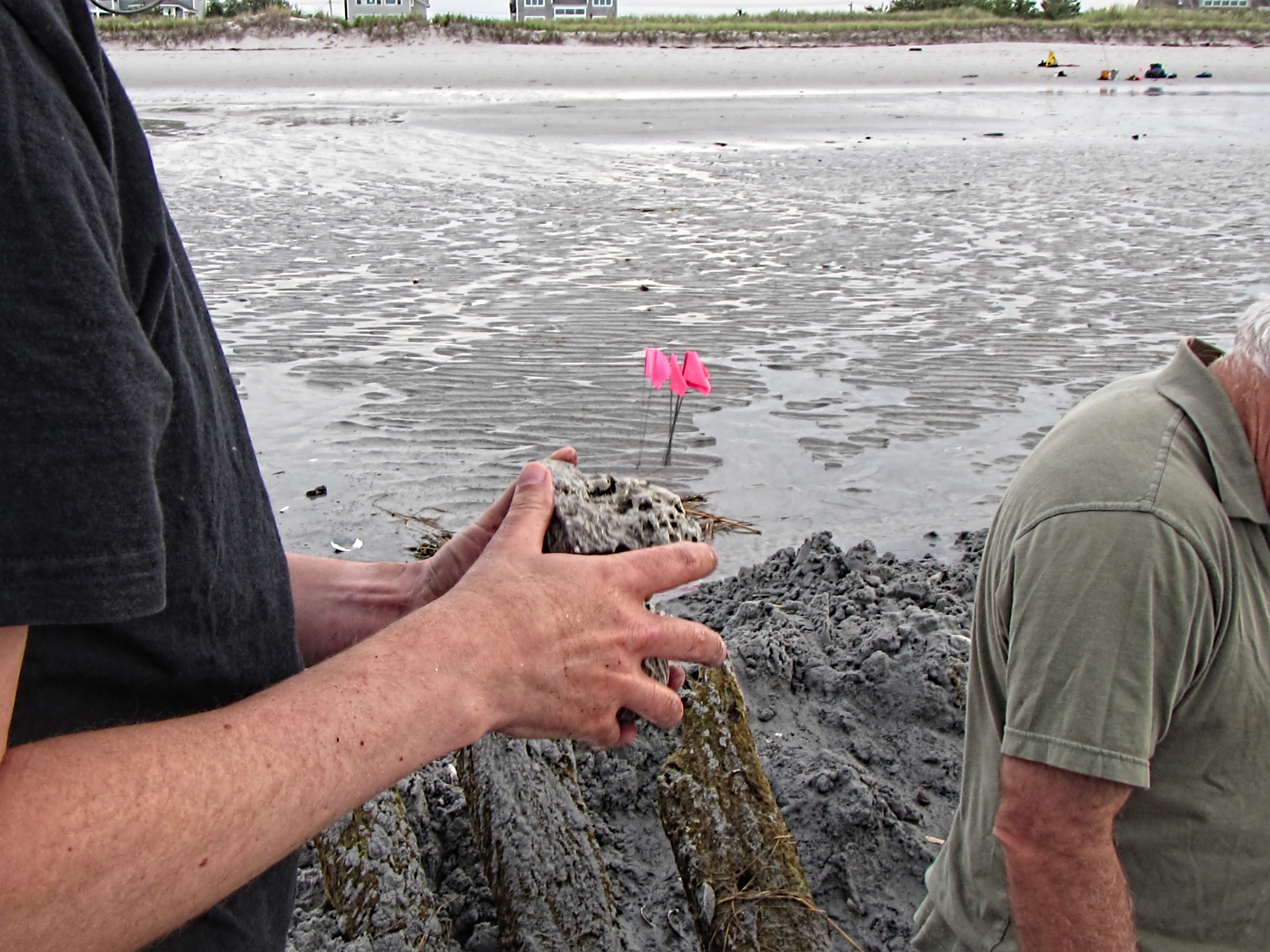 Adding to the mystery is this chunk of coral found among what is believed to be the ballast rocks discovered deep in the boat’s hull. What is a tropical specimen doing in a boat that presumably fished the Northeast coast?


 Good Morning Gloucester
This is such a great buried treasure mystery–love the photos and the story—thanks so much for sharing–eager for the next installment!
LikeLike
Great updates and so interesting.
LikeLike
Thanks.
The archaeologists removed several artifacts for more careful study. I hope to get their findings in due course. The team is not expected to return until the Spring. In the meantime, I hope visitors will respect the site and not remove or damage any part of the wreck. However, we can all let our imaginations go free as we ponder this visitor that has apparently been here for quite some time. It will be interesting to see if the winter covers her over once again, only to be rediscovered later on.
LikeLiked by 1 person
perhaps the coral was ballast obtained from a pile of ballast at another northern port where cargo was loaded and unloaded and ballast adjusted to compensate for cargo load.
LikeLiked by 1 person
Very interesting indeed keep the history 101 coming I enjoying it – A childhood friend of mine back in the 60’s found a revolutionary cannon ball up on days farm by creek guess it became un-earthed maybe when digging around for frogs, tadpoles or salamanders (tigers and reds)…Gloucester Daily times ran an article on this early to mid 60’s then many moons ago! 🙂 Dave & Kim:-)
LikeLiked by 1 person
That “V” in the first photo looks like it might actually be a “VI,” or six feet. Could be my eyes, though. I wonder if anyone is thinking of trying to excavate and remove the wreck for conservation and display — it would be a difficult job but a fine addition to the Cape Ann Museum.
LikeLiked by 1 person
Marty,
Thanks for posting this unique series. I’m looking forward to future installments.
From the picture above of the piece of coral ballast, it appears to be Coquina which is the bedrock of Florida and appears as far north as the Charleston, SC area. There is probably as much of it under the Southeast coast as there is granite under New England. Charleston or “Charles Town” was as busy a port as Gloucester was in those days. Many ships were ballasted with Coquina.
I grew up in Gloucester and lived most of my adult life on the northeast coast. As an avid student of early New England Seafaring History I never learned much about the south. For the last 8 years I’ve lived and painted in Florida and So. Carolina. I was amazed to learn the extent of coastal trade back even before the Revolutionary War. At one time in the early 1800s it was the most active seaport in America. Hard to believe but, I’m fascinated with the areas seafaring history. I’ve been sketching and painting the ships of S. Carolina and find it a natural adjunct to my earlier paintings of Gloucester and New England history.
Bill Hubbard
LikeLiked by 1 person
My family has a house at Coffin beach .We have spent the Summers there since the 1960’s when I was very young. Many summers this old reck would appear and then you would not see it again for a long time. I would be interested to find out what ship it was.
LikeLike