
This from Barry Nickerson, Founder of The Boston Nautical Heritage Group-
to subscribe to his newsletter check out the site
Labor Day finally arrived. While most of the summer has been on rain delay, the weather forecast is for a cool, clear, dry and hopefully breezy weekend. Is it enough to hold us through till next spring…. ?
After many years of trial & tribulation, we should return to our normal publication schedule next week. The Gloucester Schooner Race is a favorite event, and felt compelled to plug it. While the website will start to come together later this fall, we do have 2 images from past schooner races….. www.BostonNautical.com We have a book about the Fishermen’s Races & Gloucester in the works..
PASS THE WORD
——————————————————
Please feel free to pass this along to family & friends who may enjoy sailing & adventuring with us, and suggest that they can sign up for the best information on sailing aboard historic vessels anywhere in the world by sending an email to OnTheWind_Newsletter@BostonNautical.com with “subscribe” in the subject line. We’ll be happy to send along a copy of the newsletter directly to their email inbox, and feel free to print the contents out and pass it along….. and if you aren’t interested, please scroll to the end to unsubscribe.
25th annual Gloucester Schooner Festival, Gloucester, MA Saturday Sept. 6 – Sunday Sept. 7
=================================================
This is an event that should not be missed !
For centuries, Gloucester and Cape Ann fed the world by building, outfitting and crewing thousands of wooden schooners that sailed out in all weather to catch cod off the Northeast Coast. The waterfront was lined with shipbuilders and the services that supported the vessels and crews. Sailmakers, riggers and others competed with fish drying shacks and fish houses for space, all bent on harvesting the sea as often as possible, and turning boats around as quickly as possible for maximum return.
Skippers knew that the freshest fish brought the best price, so once the holds were full, they bent on all sails and made for port, often competing with other vessels to make it home first, regardless of season and weather. It’s entirely possible that a friendly wager or 2 was made on what Captain would bring his vessel home first…
In 1920 a group of Halifax, NS businessmen offered a challenge to the fishermen of Gloucester to a race, and the Gloucestermen responded with a victory aboard a 14 year old vessel hastily prepared after 2 months at sea, with a Captain that had never sailed aboard the vessel. She was the ESPERANTO, hence the name of the trophy awarded to the winning vessel in the larger schooner class, the Esperanto Cup. The series of races that took place in the following years drew more interest than the America’s Cup. New England publisher David R. Godine published a book about the International Fishermen’s Races, and it’s a great resource. http://www.godine.com/isbn.asp?isbn=1567923135
Today, the Gloucester Schooner Festival is recognized throughout the world as a significant historical events, and Captains bring their schooners from around North America & Bermuda to compete and pay tribute to a way of life often forgotten.
This year has special significance, as 2 icons of the Fisherman’s Series may come together at the Gloucester Maritime Heritage Center www.GloucesterMaritimeCenter.org 978.281.0470 on Saturday;
The Bluenose II, the faithful replica of the original Bluenose http://en.wikipedia.org/wiki/Bluenose & http://museum.gov.ns.ca/bluenose/index.htm will offer deck tours from 10 am to 5 pm on Saturday. She’s the schooner on the Canadian dime, postage and license plates. While she no longer “races”, she will likely sail the course on Sunday and shadow the fleet. She’s impressive dockside, but underway, she’s simply magnificent. The Nova Scotia archives has her rich history posted at http://www.gov.ns.ca/nsarm/virtual/bluenose/ch4.asp?SearchList1=4&Language=English
Recently acquired by the Gloucester Maritime Heritage Center is the Sir Thomas Lipton trophy – earned by the Gertrude L. Thebaud 79 years ago in a race with the pre-eminent Nova Scotia champion Bluenose – is back home and may possibly be on display. You might consider a donation to the Gloucester Maritime Heritage Center help support this acquisition and future articles of Gloucester heritage. In addition to the tours of Bluenose, the GMHC exhibits & aquarium are open free of charge from 10 am to 5 pm. The address is 23 Harbor Loop, Gloucester, MA.
If you’d like to see the schooners underway on Sunday, there are 2 opportunities;
From the shore:
All competing schooners will parade out of the harbor from 09:00 to 10:30, past a reviewing stand by the Fisherman’s Monument on Stacy Blvd. Famed Gloucester historians Joe Garland & Daisy Nell will broadcast a commentary on the history of the race and each vessel as they come past. It’s a great way for the family to see these vessels under sail, and for free (Although it’s a good idea to have a fresh cup of coffee from Dunkin Donuts, the major sponsor, in hand.) Get positioned early, and bring a lawn chair so you can cheer on the vessels.
From the sea:
Some of the competing vessels may have room for “extra hands” to come aboard for the race, pitch in hoisting and tuning sails and to experience racing aboard a schooner. Schedules and available change right up to the morning of the race, so the best way to sign aboard available schooners is to call my cell at 781.249.4348. It will be on 24/7, and we’ll know by Saturday evening what space may be available. If you do decide to come, bring an extra jacket, sweater, eye protection and a hat, pack a light lunch as well as a camera with extra film or memory cards. It’s an experience you won’t forget and want to share!
Beyond the schooner race, there’s a lot to see & do in Gloucester. Here are some favorites;
– If you are on the waterfront, take a short stroll up to Bodin Historic Photo at 82 Main St. in Gloucester, 978.283.2524 and catch a glimpse of what Gloucester was like….back then. Photographer Fred Bodin displays and sells prints from his collection of over 9,000 glass and film negatives that he has rescued from barns, garages and attics, preserving the images forever. Fred hand prints, sepia tones, and frames each photograph himself, using archival museum quality materials. Subjects include beaches, hotels, landscapes, people, and the famous sailing schooners of New England. http://www.bodinhistoricphoto.com/
– If in search of a good book, you might ask Greg Gibson about his selection of historical maritime books, charts & manuscripts at the Ten pound Island Book Company, www.tenpound.com Greg has a great selection, and his shop is open Labor Day weekend. He periodically publishes an online catalog of his inventory, and signing aboard for his newsletter is easy & worthwhile. The shop will be open all weekend from 12 to 5, and the address is 77 Langsford St., Gloucester, MA, 978 282 4569.
– Be sure to visit the Essex Shipbuilding Museum http://www.essexshipbuildingmuseum.com in Essex where many great schooners were born, and where great schooners continue to be built….and just down the street from Woodman’s, the birthplace of the fried clam http://www.woodmans.com The Museum is at 66 Main Street in Essex, MA 978.768.7541. Woodman’s is just down the street..just follow your nose.
– Want to be fascinated ? Visit the Cape Ann Museum at 27 Pleasant St. in downtown Gloucester. http://www.capeannhistoricalmuseum.org
Here are some additional links about the history of fishing in Gloucester, Bluenose and the International Fishermen’s Cup;
http://www.downtosea.com
http://openlibrary.org/b/OL12237059M/Caught-in-Irons
Thanks for being aboard, and we hope to sail with you soon. Enjoy the weekend, and travel safe.
Fair winds,
Barry L. Nickerson, President & Founder
BOSTON NAUTICAL HERITAGE GROUP
PO Box 379
Stoughton, MA 02072-0379 978.283.0455






![DSC_2052 [640x480]](https://goodmorninggloucester.com/wp-content/uploads/2009/07/dsc_2052-640x480.jpg?w=700 "DSC_2052 [640x480]")
![DSC_2056 [640x480]](https://goodmorninggloucester.com/wp-content/uploads/2009/07/dsc_2056-640x480.jpg?w=192&h=290 "DSC_2056 [640x480]")
![DSC_2058 [640x480]](https://goodmorninggloucester.com/wp-content/uploads/2009/07/dsc_2058-640x480.jpg?w=192&h=290 "DSC_2058 [640x480]")


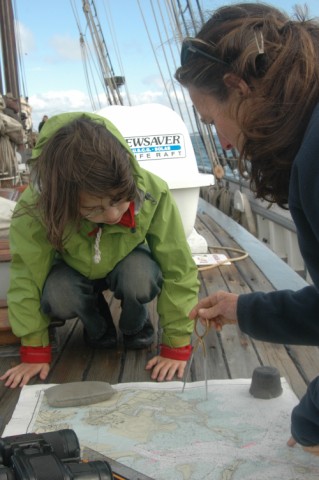

 Place one point of the dividers at position A and the other point at at position B. Then, maintaining the spread, measure the distance using the latitude scale. In this case, the distance is 15 minutes or 15 nautical miles. Always use the latitude scale located in the same horizontal region that you are measuring.


 from her grandmother, Sally, who was also on the Spirit trip. In the evening or when there was down time, Alice would make tiny fists and taught us how to make them.
 Good Morning Gloucester