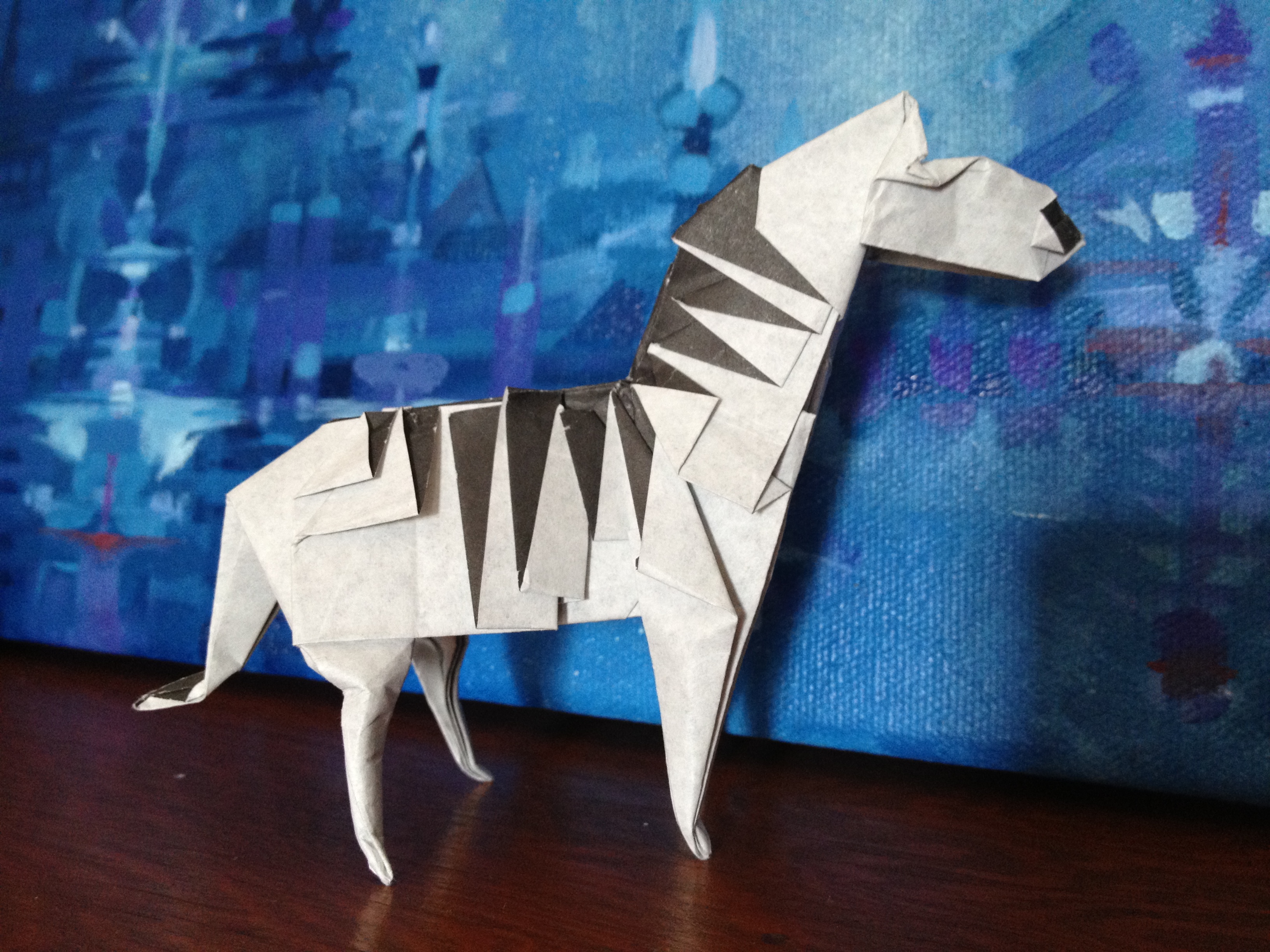
African Zebra in Gloucester

OK, not really, just an origami zebra.

This model is designed by John Montroll, to be folded from one square sheet of origami paper (as usual, no cutting or gluing).  It is a great example of how to take advantage of the fact that most origami paper has two colors: usually white on one side, and a solid color or a pattern on the other side. Here, Montroll has done a great job of designing the model so that the black paper only shows up in little stripes. I folded and left one of these in the Art Parlour at The Annie; it may still be there, on a windowsill.

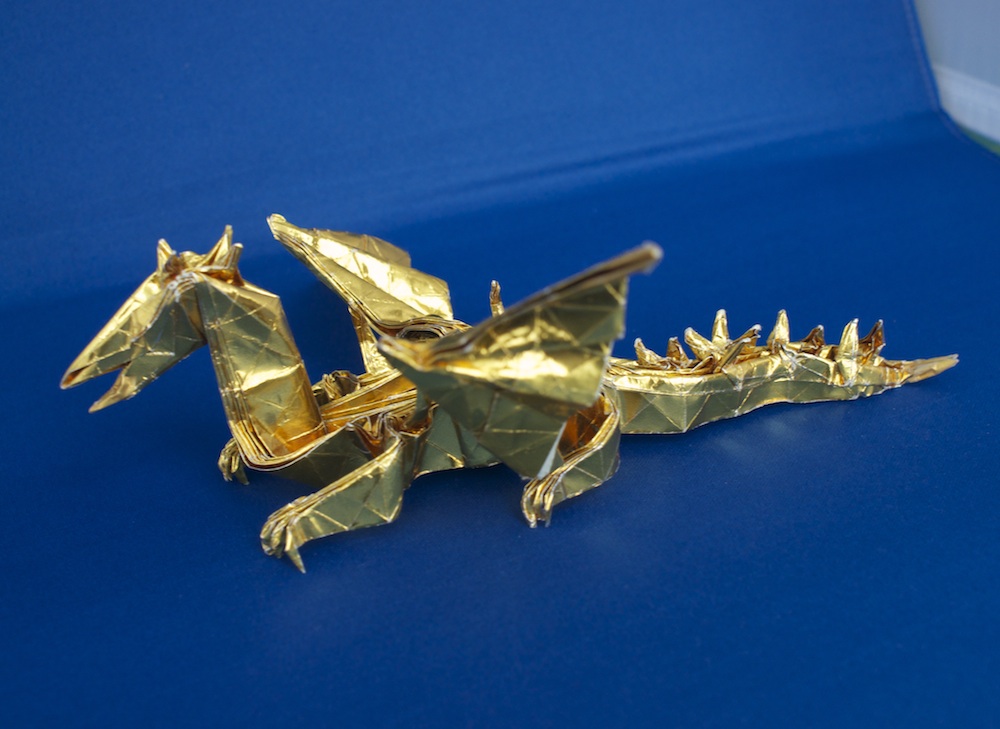
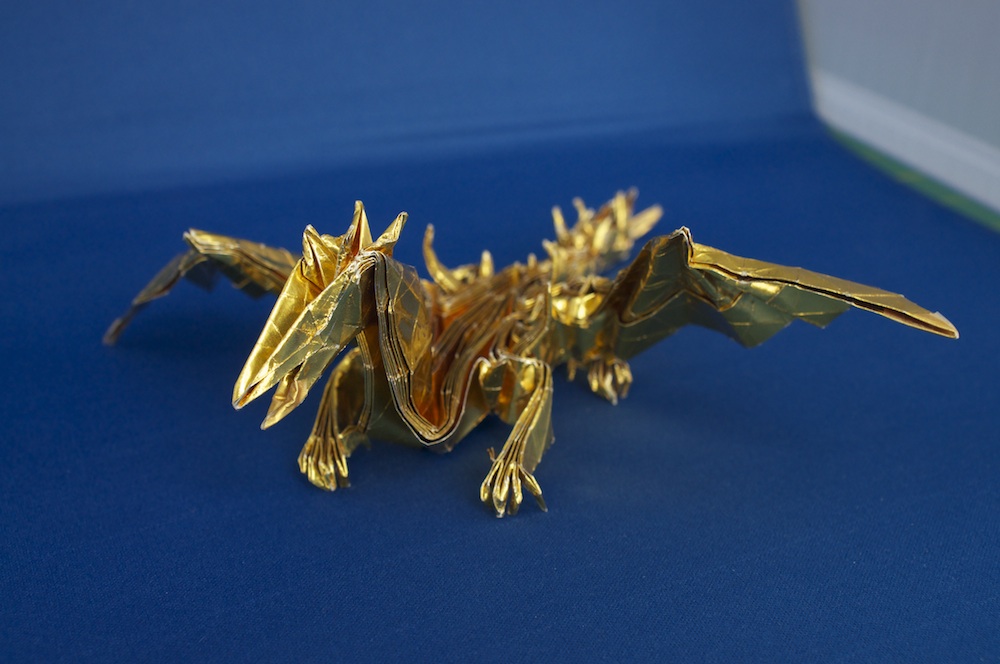
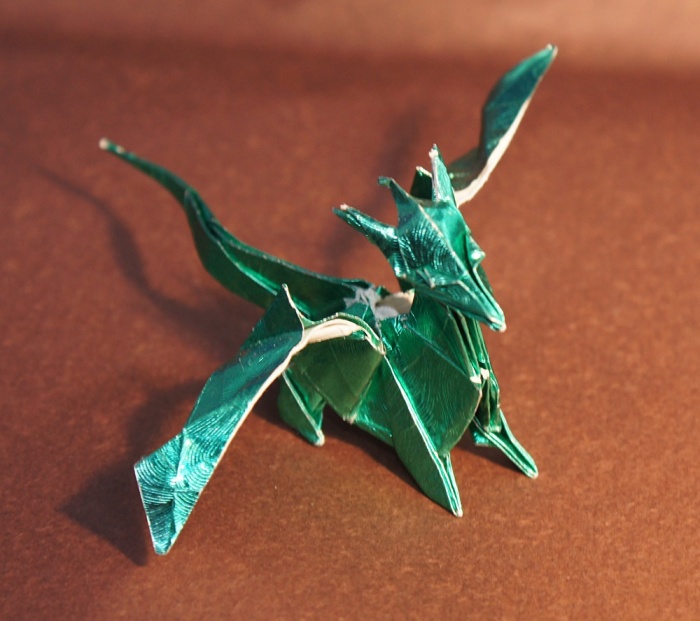
Year of the Dragon part 5

Here’s another entry (probably the last) in my series of origami dragons in honor of the Year of the Dragon. His name is Spike.

As with the others, he’s folded from one uncut square of paper, although this was 20″ square paper.  Designed and folded by me.

-Fr. Matthew Green

Year of the Dragon, part 4

As I mentioned in my previous posts on this topic, this is the Chinese year of the dragon (within the twelve-year cycle based on the Chinese zodiac). While I do not subscribe to any form of astrology, I like the idea of a “mascot” for the year. I am also particularly fond of dragons. So, as an origami artist in Gloucester, I decided to share a series of origami dragons that I have folded, either from my own designs or from others’ designs that I have modified to my own taste.

I’ve gotten a few responses to the idea of starting an origami group here on Cape Ann. Maybe to get started, if a few people would like to learn how to fold an origami dragon, I’d could to set up a time to teach a public class.   We just need to find a suitable date and venue. Which model I would teach would depend on the level of experience of the students.

Speaking of origami classes, the annual Origami USA convention in New York City is now open for registration! It’s a great event – I’m already signed up. Anyone else going?

Today’s dragon is my variation on Robert Neale’s design:

This is the simplest of the models I’ve presented so far, and represents perhaps the most “classic” species of dragon. It has an elegant simplicity that makes it one of my favorites.   This example is made from a 6″ square of uncut textured foil.  My contributions to this design are the horns and jaw on the head and the specific size and shape of the wings.

One can fold it without the horns and with slightly smaller wings in just a few minutes (as opposed to the other designs I have posted so far, which require more time to fold with any real precision).  That simpler form is the one that would be easiest to teach.

Year of the Dragon, 2

Continuing with origami dragons in honor of the Year of the Dragon, here is number 2:

This is a “mutation” of Wen’s Dragon. The original design was described by Sok Song in issue #7 of Creased magazine; this model shows some significant variations.

Folded from a single uncut 6″ square of textured foil; finished size is approximately 3″ head to tail.

Would you be interested in a monthly meeting or workshop in Gloucester for origami enthusiasts?  Do you have friends who might be? Contact me to let me know! If we get enough people interested, I would like to get something going.  I posted on this before and got one or two responses, but I’d like to expand that base.

-Fr. Matthew Green

Year of the Dragon 1

According to the Chinese calendar, we are in the year of the dragon! (As you may know, the Chinese have a 12-year cycle which assigns an animal to each year.)  I don’t lay any stock by astrology of any kind, Chinese or otherwise, but I like the idea of giving each year a “mascot”.

As it happens, I am particularly fond of dragons. So, in honor of the year of the dragon, I will post a series of photos and descriptions of varying “species” of origami dragons that I have folded.  These are either my own designs or, in two cases, fairly significantly modified by me but based on other people’s designs.

Here is today’s species: the Broadwing.
The dragon this model represents followed an evolutionary path leading to unusual proportions. It is small of body and had developed large wings that allow it to stay aloft for long periods of time. The hind legs are underdeveloped, because this dragon spends most of its time in the air. The front appendages, by contrast, have large, grasping claws, which the beast uses to snatch prey from the ground and kill it swiftly, eating while aloft.

Designed and folded by me, from a (single uncut) 6″ square of textured foil. The final model is 2″ from head to tail.

Easter still hanging around

Although the Easter Sunday has passed, in the church we are still celebrating – in fact, in the Catholic liturgical calendar, the Easter season lasts until May 27.  Independent of that, Easter is still hanging around my room, in the form of lots of candy, fudge, and other sweets, being watched over my origami rabbit I folded according to a design by the Japanese origami artist Jun Maekewa.

If you want to try your hand at folding one of these rabbits, someone published an instructional video here.

Gloucester Sea Serpent, in dollar bill origami

The infamous Gloucester Sea Serpent attacking some schooners.  In my dollar-bill-origami rendition, I further enhance the already fanciful descriptions of the sea monster, giving it four horns instead of just one…

No dollar bills were cut, glued, or otherwise damaged (beyond folding) in this production.  All models designed and folded by me.

Do you think I might have an overactive imagination?

More marine origami

Small fishing boat near a lighthouse

Should the lighthouse be taller? I tried to get the proportions from photos of Eastern Point lighthouse, more or less. It is probably not quite in the right proportion to the size of the fishing boat, but folding from dollar bills limits the range of size I can produce…

No dollar bills were damaged during this production… All three could be unfolded and put back in my wallet.

A camera made of money

All good cameras are expensive. This one is literally made of money (a single dollar bill, uncut of course).

Folded by me, from the great “Dollar Origami” book by Won Park.

More marine origami

I think some local businesses would get crabby if I tried to pay with folded money…

Dollar bill origami crab. Folded according to the design by Won Park.

(Folded by me, designed by Won Park)

More fishy money

My first attempt folding this great design by Won Park.   There were koi in a pond at the seminary where I used to teach, but I didn’t see them too often. Maybe they were trying to avoid being seen by the blue heron and other predators. Or maybe they were just being koi coy.

Fishy money

I got a book of dollar bill origami by Won Park. It includes some sea life models.  This shark is the first design I have tackled from the book.

The shark tank was one of my favorite parts of Seaworld, where I visited about ten days ago, but I’d rather hold a paper shark than get too close to a live one without lots of glass between us.

I hope to share more “fishy” money origami in the next few days.

GMG contributors at the Matz gallery (Sawyer Free Library)

Not to toot our own horn, but I want to share a couple of photos of the exhibit of photos, painting, pottery, and origami by GoodMorningGloucester contributors!  The exhibit started on New Years Day and runs through the month of January.

A panoramic overview of the exhibit

It was hard to take this panorama, because it required a series of photos, and the library is (thankfully) a busy place, with lots of people walking in and out!

Closeup of some of the non-photographic work

Stop in to see the work closer up for yourself!  The library is located across the street from City Hall.   Directions and hours (and more, of course!) are available on the library website.

Origami sea life

Guess who got a book on origami sea creatures for Christmas? Appropriate for someone living in a fishing port. I got folding right away.

Blue shark, designed by John Montroll, folded by me from 10" kami.
"Venus's comb" murex shell, designed by Robert Lang, folded by me from 10" kami.

These are both “first tries” for me with these models; I hope to do them better justice later using more specialized paper and wet-folding techniques.

The book, “Sea Creatures in Origami” by Robert Land and John Montroll, is one of two books on this topic by these authors. Lang and Montroll are master origami designers and have published many books, so the models are great and the diagrams are very clear – and they include some informative notes on species represented.

On the third day of Christmas, I saw THREE ships…

…come sailing in, on my Christmas tree!

Remember, it’s still Christmas until January 6th (you know, the 12 Days of Christmas…). I didn’t get three French hens, but at the suggestion of several people after my earlier post, I added a third ship to my tree.  (On the left is an origami snowflake folded from a hexagon.)

Reindeer!

Another decoration for my origami Christmas tree!

Designed by Peter Engel, folded by me, from one uncut 10" of foil.

What’s a Gloucester Christmas tree without a ship or two?

Some nautical decorations are necessary on a Christmas tree in a city like Gloucester, so I made these for my tree (which only has origami decorations).

Models designed by Martin Wall (rear ship) and Patricia Crawford (front ship),  and folded by me, each from one uncut sheet of 5″ square tissue foil.

Any other Cape Ann origami folders out there? Comment on this post if you’d like to get together to fold from time to time! Maybe we could start a Cape Ann origami group.  I’m willing to teach.

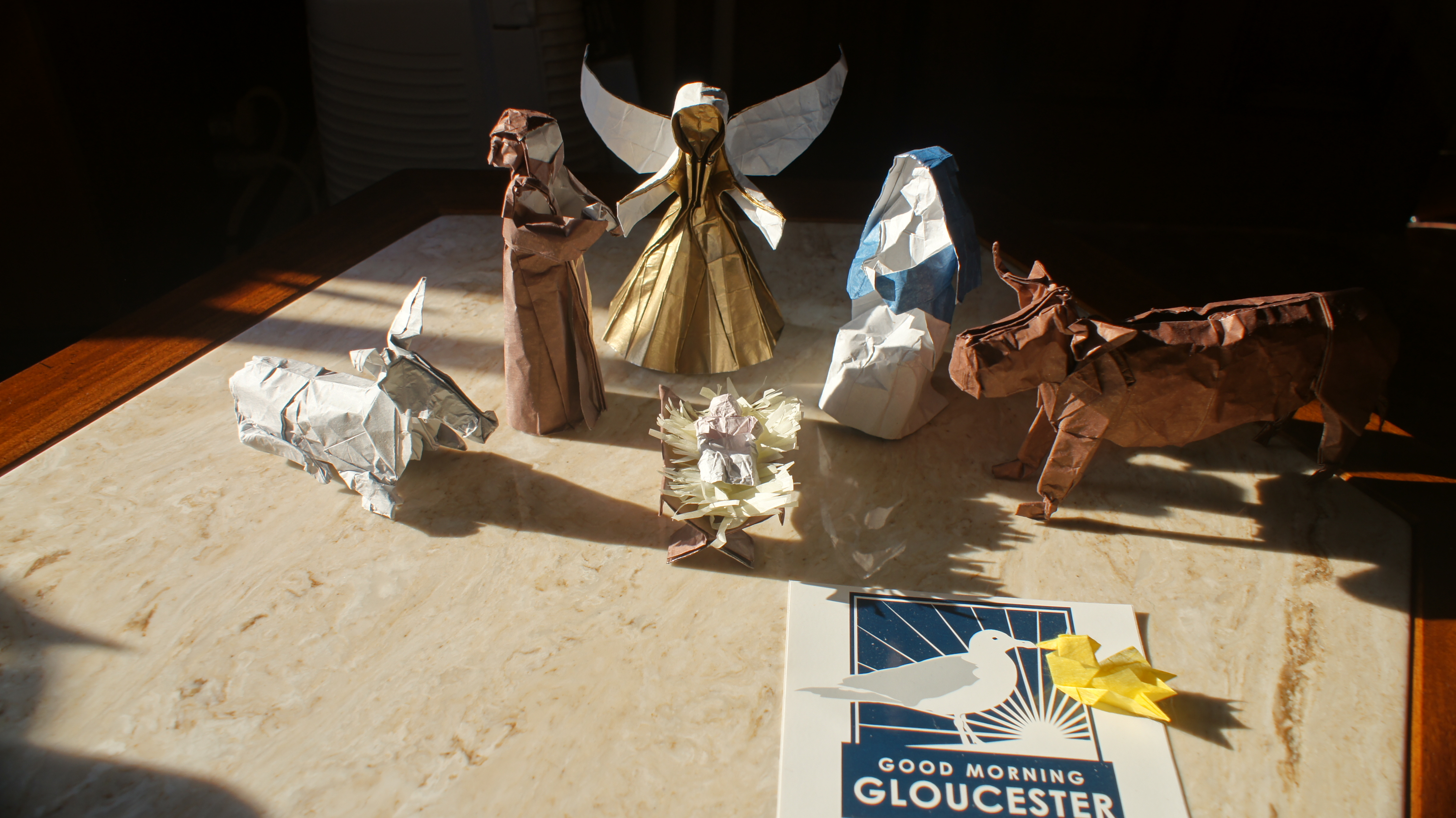
Origami rubber ducky represents in paperfolded Bethlehem

The nativity scene is folded from tissue foil using models of my own design.  Each model is folded from one rectangle.  The duck was folded my me, but designed by Gay Merrill Gross (diagrams in issue #5 of Creased magazine).

Are there any other Cape Ann origami artists out there who’d like to get together to fold? I’ve been thinking about starting a local origami group.   I don’t know how much interest there would be, nor how often we could meet. My parish schedule is pretty full, but a monthly meeting might be feasible.

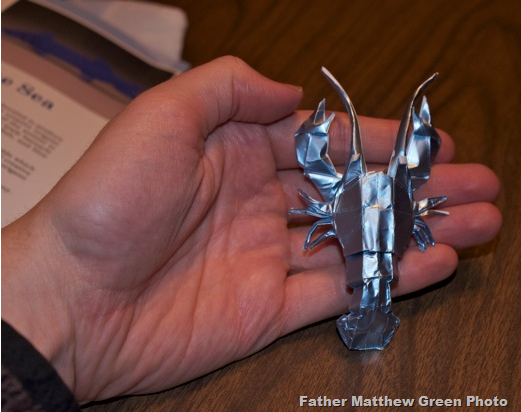
blue lobster… from Father Matthew Green

Father Green Writes-

Good evening, Joey!
I know you like to show photos of unusual lobsters on the blog.  If blue lobsters are rare, bue origami lobsters are probably even rarer. Here’s one I folded from a design by the great origami designer John Montroll.

image

Check out John Montroll’s wikipedia page here