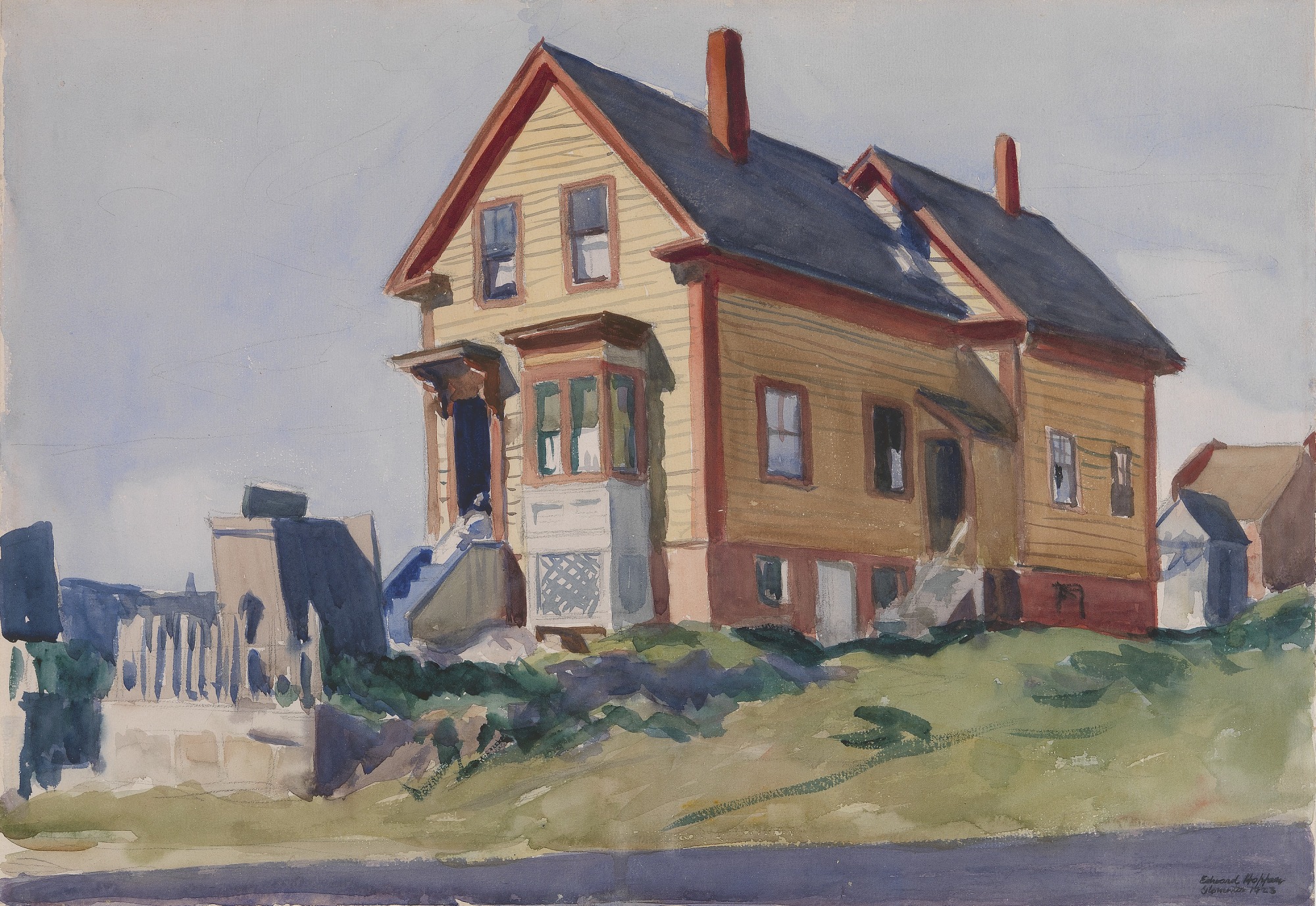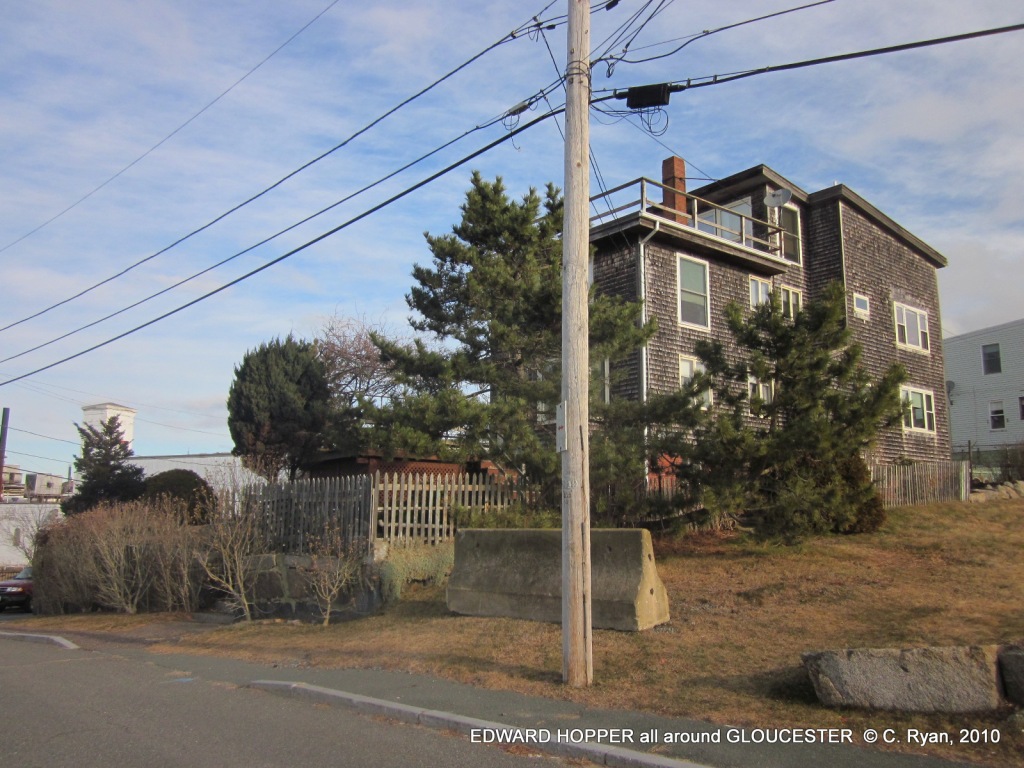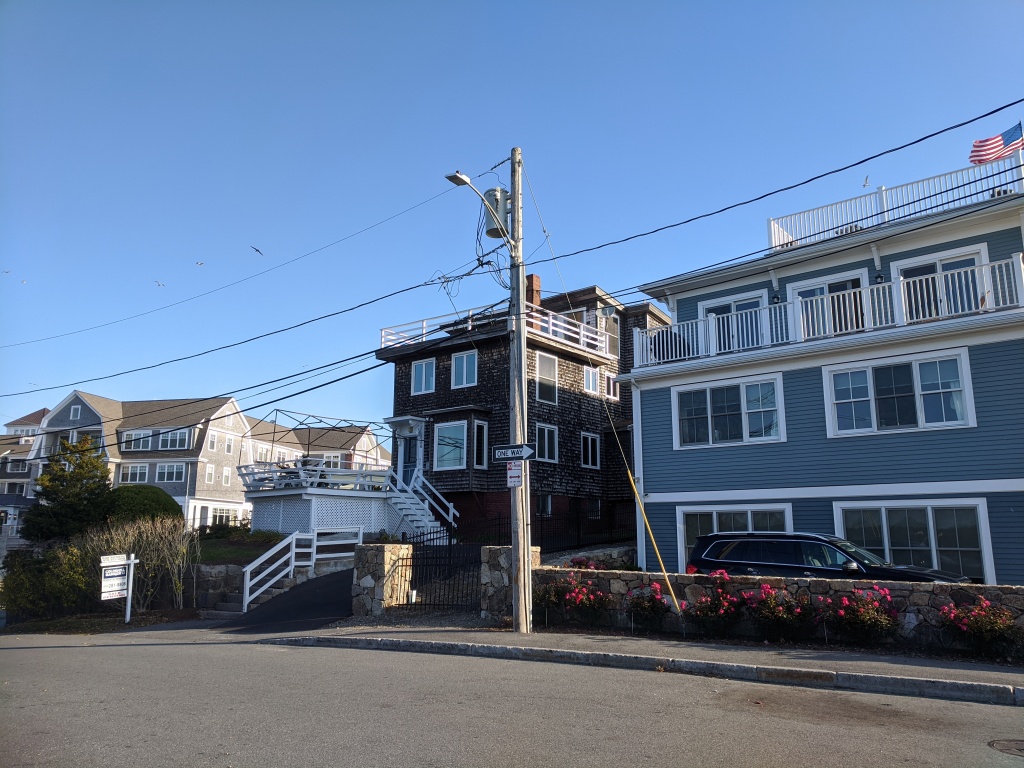
American sculptor Walker Hancock volunteered in many civic capacities while a Gloucester resident. While serving as the Chair of the city’s Art Committee in the 1950s, Hancock prepared a Master Plan that managed to forecast an array of evergreen topics: land use, zoning, preservation, open space, Main Street & downtown, public monuments, an arts commission, city improvements (like signage), beautification (trees and blooms), health & safety, tributes, and history– and all through a practical cultural and economic vision.
Robert F. Brown, Harold C. Dexter, Myron U. Lamb, Frederick H. Norton served on this committee with Walker Hancock.

As a World War Two Monuments Men leader, Hancock had overseen the prioritization, protection, and eventual inventorying of tens of thousands of cultural works of significance looted by Nazis. A decade later, cataloguing Gloucester’s plentiful assets was a rather small job for this talented committee–especially with Hancock serving as Chairperson! A brief few sentences from this amazing document allude to his expertise:
“During the Second World War the Allied Expeditionary Force acted under a directive signed by General Eisenhower which required them “To take all measures consistent with military necessity to avoid damage to all structures of cultural, artistic, or historical value, and to assist wherever practicable in securing them from deterioration consequent upon the processes of war”.
To implement the directive of the Supreme Commander, lists of “Protected Monuments” were prepared, designating buildings of sufficient importance to justify the efforts to preserve them even during military operations. Many private houses were included in these lists.
We owe it to ourselves and to the Nation to be at least as solicitous in regard to our own heritage of such structures and to secure them wherever possible from deterioration consequent upon lack of appreciation or neglect.
Attached is a list of structures in Gloucester considered of sufficient architectural value to warrant special effort to preserve them. It is not a complete list and does not include many of the charming houses the destruction or mutilation of which would be a loss to the city as a whole…”
Committee’s Master Plan report (Chairman, Walker Hancock, for Gloucester, Mass., 1958)
Flash forward decades, from 2000-2023, multiple arts ordinances, inventories, and drafts of master arts plan were crafted and/or attempted. (Prior to 2000–and prior to Hancock– there were wonderful asset inventories. Gloucester has amazing archives!) I served on multiple arts related groups and commissions (roughly 2010-2018), the downtown Cultural District, Tourism, and various downtown working groups. Numerous ideas and topics now were covered in this 1958 report, and would have been extremely helpful to reference.
With the upcoming 2023 Comprehensive plan underway and the first public meeting coming September 9th, I thought the writing from 1958 would be of great interest. Read through to see what suggestions have been realized or incorporated and which might be worthy of attention again.
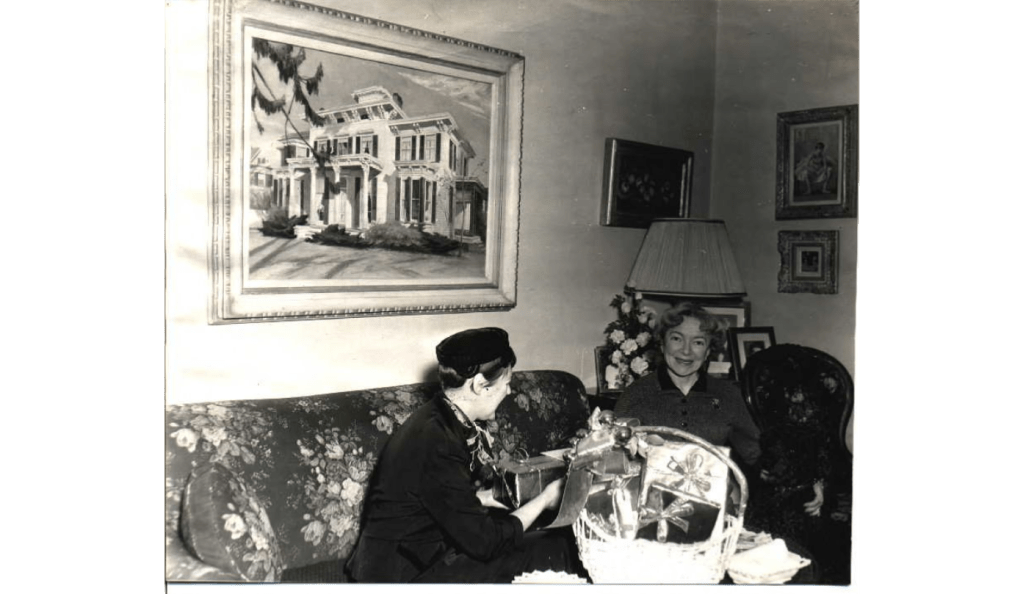
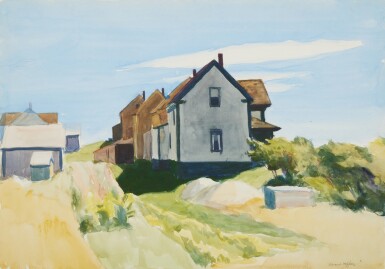
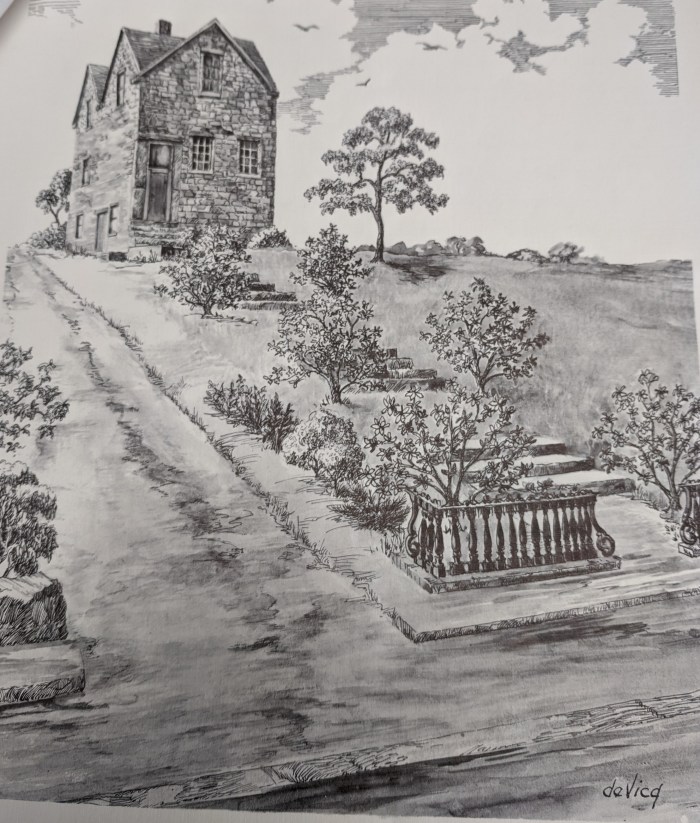
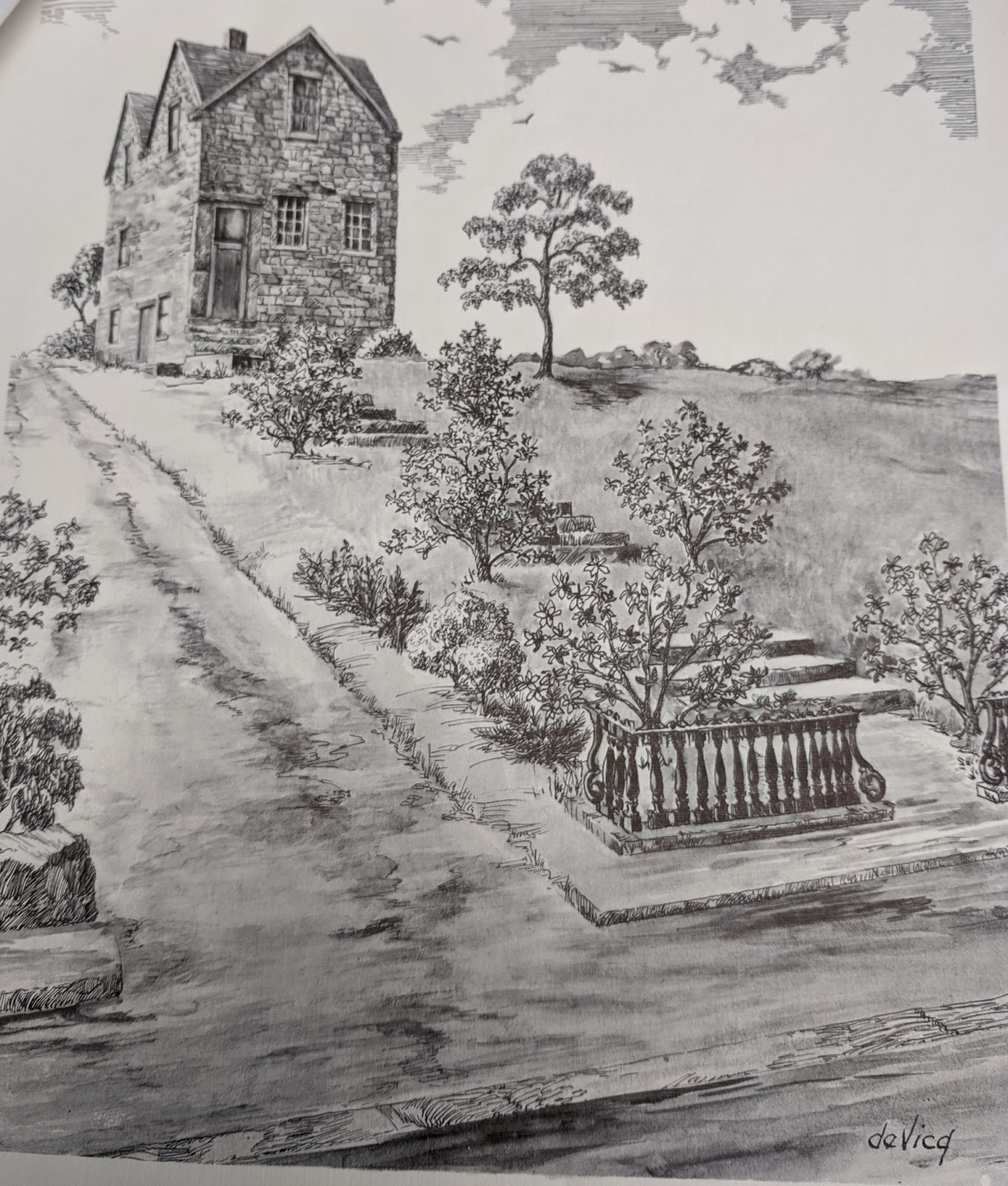
Image: For the 1958 report, artist Betty deVicq provided a rendering for a potential beautication of the Fitz Henry Lane House.
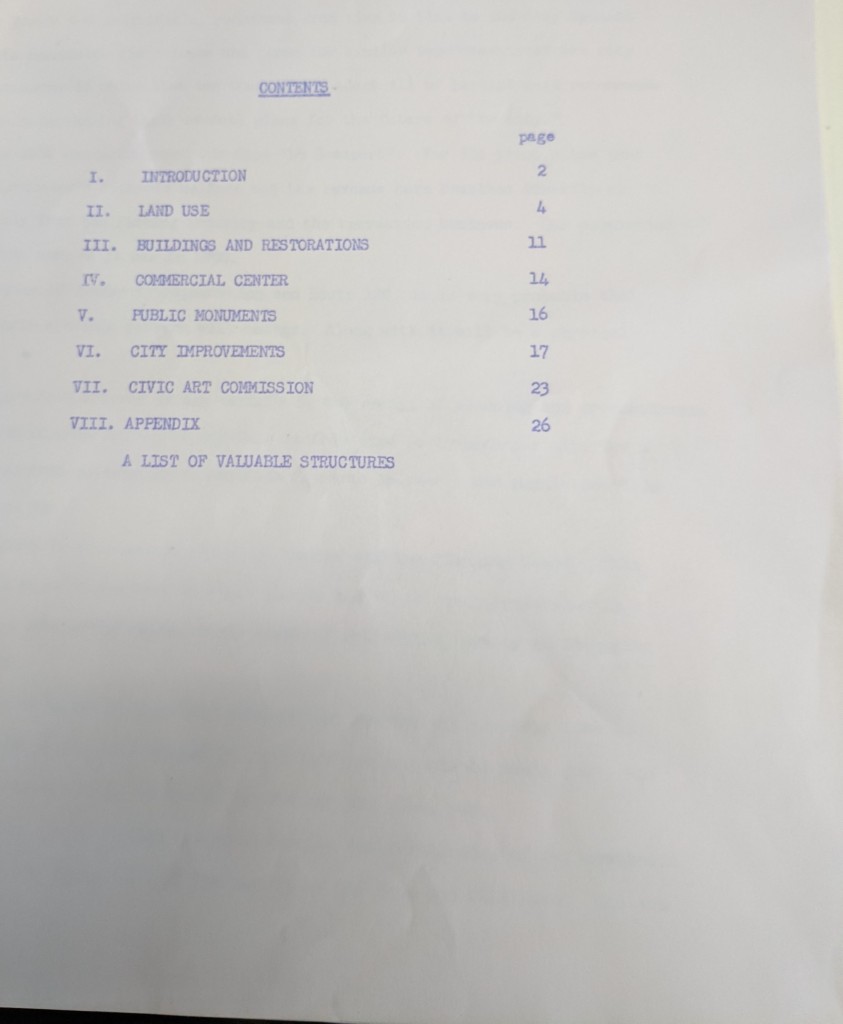
Contents
- INTRODUCTION
- LAND USE
- BUILDINGS AND RESTORATIONS
- COMMERCIAL CENTER
- PUBLIC MONUMENTS
- CITY IMPROVEMENTS
- CIVIC ART COMMISSION
- APPENDIX (selection of home street addresses)
- LIST OF VALUABLE STRUCTURES
1. Introduction
The following resolution was adopted on unanimous rising vote by the Municipal Council at its meeting in the White-Ellery House on August 1, 1957,
“Be it resolved that the Cape Ann Historical Association, together with other groups and individuals, recommend from time to time to the city Council and its successors their ideas and plans for similar improvements of the city of Gloucester in order that the Council may adopt all or part of said recommendations in furthering their overall plans for the future of the city.”
In 1606 Champlain named our Cape “Le Beauport”. For 334 years since that time Gloucester’s economic welfare and tax revenue have resulted directly or indirectly from the fishing industry and the recreation business. Our population now is the same as it was in 1890.
Because of modern transportation and Route 128, it is very probably that our historic economic pattern will change. Along with it will be a physical change.
The greatest success in any venture is the result of planning and preparedness. The most intelligent action we can take at this time is to plan our city for a changing economic pattern and a possible increase in year round population from 26,000 to 40,000.
Such plans revolve around the City Planner and the Planning Board. This report is to support the work of these people and to go one step further in a ld that is ordinarily beyond their scope of activities, but is an important adjunct to it.
Its purpose is to preserve and enhance the reasons why tourists come to Gloucester, why people will choose to live here and commute to their jobs, and many an industrialist would choose to locate his new plant here.
The subject can be called the preservation and furtherance of our aesthetic advantages, or the protection of the beauty we now have and will have. Its aim
is making the most of our natural beauties in contrast to the stereotyped and ugly procedures in other American communities.
The proposals contained in this report are based on two fundamentals: beauty and cost. Many can be adopted in the normal course of planning with no cost beyond that which would ordinarily be created, such as road signs. Others, such as a Recreation and Art Center, can be provided for as to location and adopted when cost permits. Some proposals can be adopted by the Council, some by private citizens.
2. LAND USE – 2
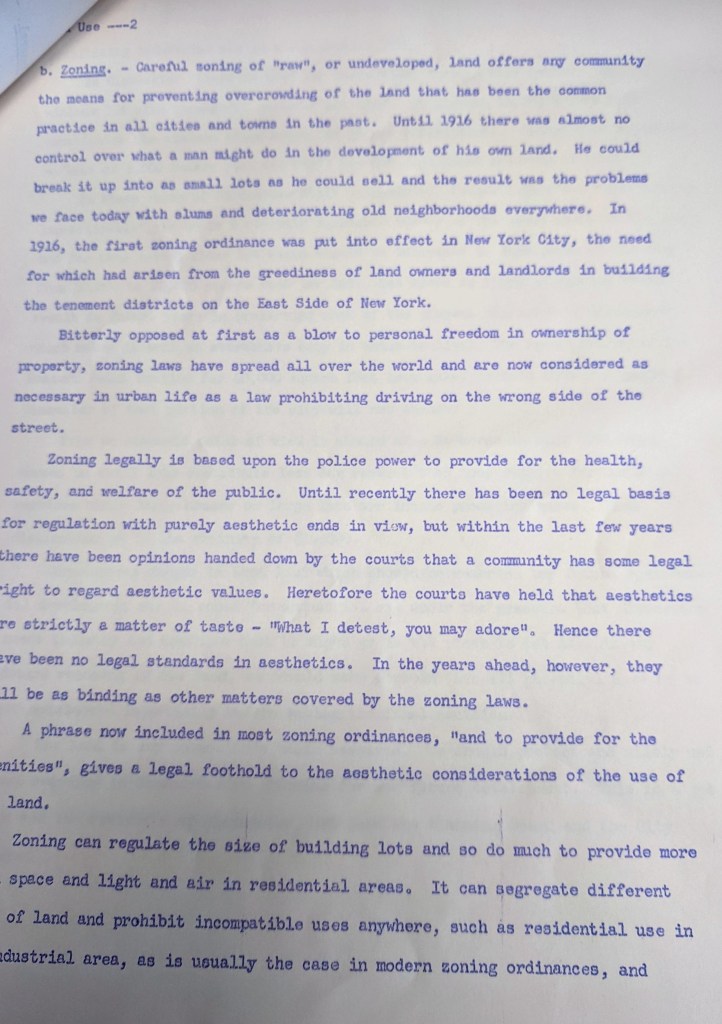
B. Zoning – Careful zoning of “raw”, or undeveloped, land offers any community the means for preventing overcrowding of the land that has been the common practice in all cities and towns in the past. Until 1916 there was almost no control over what a man might do in the development of his own land. He could break it up into as small lots as he could sell and the result was the problems we face today with slums and deteriorating old neighborhoods everywhere. In 1916, the first zoning ordinance was put into effect in New York City, the need for which had arisen from the greediness of land owners and landlords in building the tenement districts on the East Side of New York.
Bitterly opposed at first as a blow to personal freedom in ownership of property, zoning laws have spread all over the world and are now considered as necessary in urban life as a law prohibiting driving on the wrong side of the street.
Zoning legally is based upon the police power to provide for the health, safety, and welfare of the public. Until recently there has been no legal basis for regulation with purely aesthetic ends in view, but within the last few years there have been opinions handed down by the courts that a community has some legal right to regard aesthetic values. Heretofore the courts have held that aesthetics are strictly a matter of taste – “What I detest, you may adore”. Hence there have been no legal standards in aesthetics. In the years ahead, however, they will be as binding as other matters covered by zoning laws.
A phrase now included in most zoning ordinances, “and to provide for the communities”, gives a legal foothold to the aesthetic considerations of the use of land.
Zoning can regulate the size of building lots and so do much to provide more space and light and air in residential areas. It can segregate different use of land and prohibit incompatible uses anywhere, such as residential use in an industrial area, as is usually the case in modern zoning ordinances, and
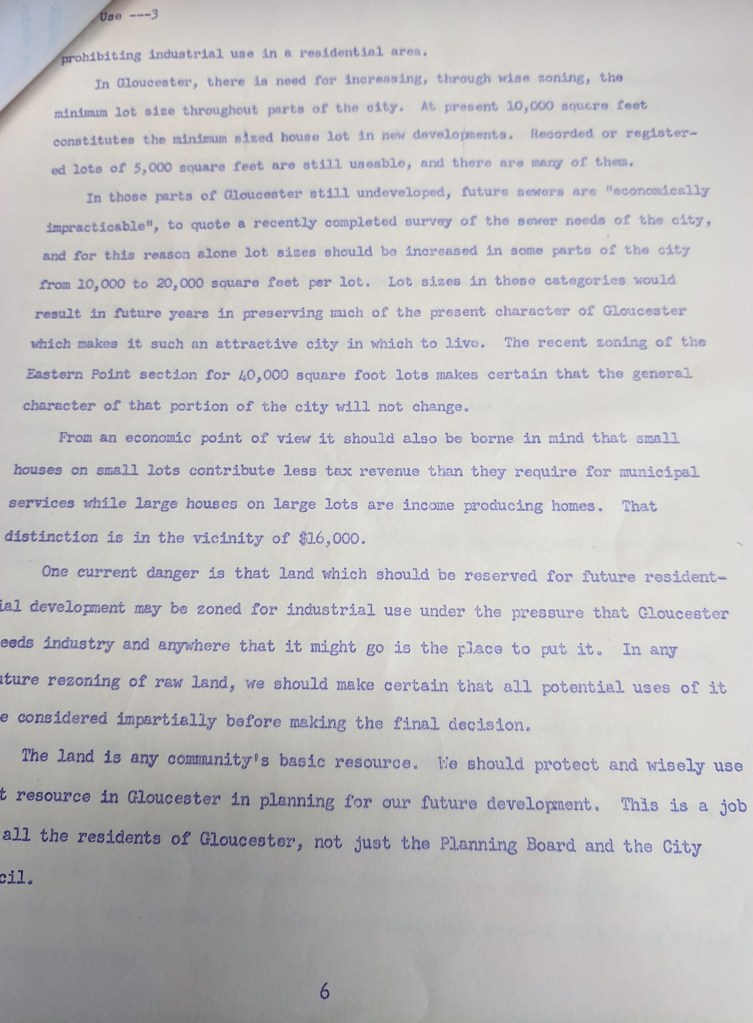
Land Use – 3
Prohibiting industrial use in a residential area.
In Gloucester, there is need for increasing, through wise zoning, the minimum lot size throughout parts of the city. At present 10,000 square feet constitute the minimum sized house lot in new developments. Recorded or registered lots of 5,000 square feet are still usable, and there are many of them.
In those parts of Gloucester still undeveloped, future sewers are “economically impracticable”, to quote a recently completed survey of the sewer needs of the city, and for this reason alone lot sizes should be increased in some parts of the city from 10,000 to 20,000 square feet per lot. Lot sizes in these categories would result in future years in preserving much of the present character of Gloucester which make it such an attractive city in which to live. The recent zoning of the Eastern Point section for 40,000 square foot lots makes certain that the general character of that portion of the city will not change.
From an economic point of view it should also be borne in mind that small houses on small lots contribute less tax revenue than they require for municipal services while large houses on large lots are income producing homes. That distinction is in the vicinity of $16,000.
One current danger is that land which should be reserved for future residential development may be zoned for industrial use under the pressure that Gloucester needs industry and anywhere that it might go is the place to put it. In any future rezoning of raw land,
“we should make certain that all potential uses of it are considered impartially before making the final decision. The land is any community’s basic resource. We should protect and wisely use that resource in Gloucester in planning our future development. This is a job for all the residents of Gloucester, not just the planning board and the city council.”
1958 Committee Report for Gloucester, MA, Chairman Walker Hancock
Land Use – 4
A Citizen’s Council for city planning should be organized to work in consultation with the planning board to insure that the city’s comprehensive plan is in keeping with the best interests of the community, and to support the Planning Board in carrying it out. This council should be composed of a cross section of the various interests represented among the tax-payers of Gloucester, such as merchants, industrialists, real estate agents, home owners, educators, etc. Such a group, which should be as small as possible, consistent with balanced representation, would provide a democratic safeguard against infringements upon the best public interest.
C. Reservations.– The attractions that have made Gloucester famous a summer resort are not merely places for swimming and boating and other amusements. The appeal to the summer vacationist, as well as to people seeking an all year-round residence, of large areas of unspoiled woods, moorland, and shore without artificial “tourist conveniences” can hardly be overestimated. The existence on Cape Ann of such features has brought to our city great numbers of people who prefer them to the kind of tourist amusements offered, for example, by Salisbury and Revere beach. Our good fortune in having an established community of this character should be recognized in time to preserve it.
Fortunately, Ravenswood Park, Stage Fort Park, the Magnolia Shore Reservation, and Mount Ann have been saved for the future. Mr. Roger Babson’s recent gift to the Cape Ann Historical Association promises possibilities of making the main entrance to the city impressive, handsome, and of unusual interest to the tourist. Start has been made at Plum Cove by the action of the Municipal Council in setting the area aside for future use as a school site and recreational area. But these reservations would be far from adequate even for a city the present size of Gloucester were it not for the other open areas that will soon be lost to us unless some action is taken.
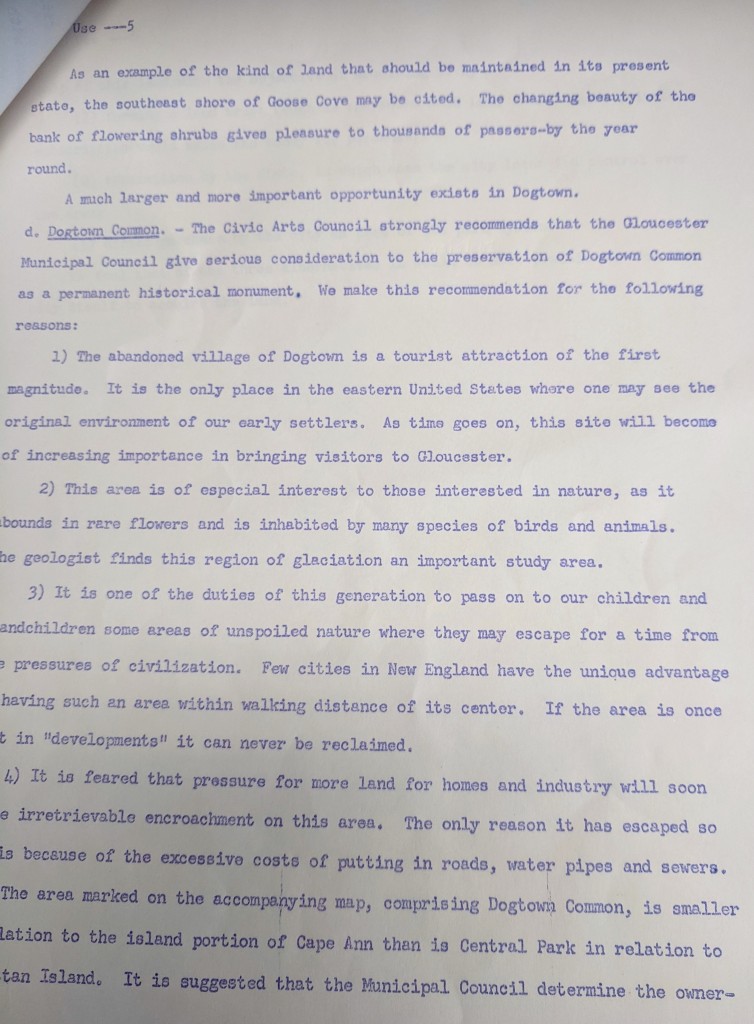
Land Use – 5
As an example of the kind of land that should be maintained in its present state, the southeast shore of Goose Cove may be cited. The changing beauty of the bank of flowering shrubs gives pleasure to thousands of passers-by the year round.
A much larger and more important opportunity exists in Dogtown.
D. Dogtown Common. – The Civic Arts Council strongly recommends that the Gloucester Municipal Council give serious consideration to the preservation of Dogtown Common as a permanent historical monument. We make this recommendation for the following reasons:
1)The abandoned village of Dogtown is a tourist attraction of the first magnitude. It is the only place in the eastern United States where one may see the original environment of our early settlers. As time goes on, this site will become of increasing importance in bringing visitors to Gloucester.
2)This area is of especial interest to those interested in nature, as it abounds in rare flowers and is inhabited by many species of birds and animals. The geologist finds this region of glaciation an important study area.
3)It is one of the duties of this generation to pass on to our children and grandchildren some areas of unspoiled nature where they may escape for a time from the pressures of civilization. Few cities in New England have the unique advantage of having such an areas within walking distance of its center. If the area is once in “developments” it can never be reclaimed.
4)It is feared that pressure for more land for homes and industry will soon irretrievable encroachment on this area. The only reason it has escaped so far is because of the excessive costs of putting in roads, water pipes and sewers. The area marked on the accompanying map, comprising Dogtown Common, is smaller in relation to the island portion of Cape Ann than is Central Park in relation to Staten Island. It is suggested that Municipal Council determine the owner-
Land Use – 6
ship of this land with the objective of acquiring it by
(1)forming a land trust (such as the Squam Rock Land Trust) where private subscription would raise the money for purchase;
(2) acquisition by the State, in which case the city loses its control over the area;
(3) direct purchase by the city as part of its park system
We feel that of the three alternatives it would be most practicable for the city itself to acquire the land.
3. BUILDINGS AND RESTORATIONS
During the Second World War the Allied Expeditionary Force acted under a directive signed by General Eisenhower which required them “To take all measures consistent with military necessity to avoid damage to all structures of cultural, artistic, or historical value, and to assist wherever practicable in securing them from deterioration consequent upon the processes of war”.
To implement the directive of the Supreme Commander, lists of “Protected Monuments” were prepared, designating buildings of sufficient importance to justify the efforts to preserve them even during military operations. Many private houses were included in these lists.
We owe it to ourselves and to the Nation to be at least as solicitous in regard to our own heritage of such structures and to secure them wherever possible from deterioration consequent upon lack of appreciation or neglect.
Attached is a list of structures in Gloucester considered of sufficient architectural value to warrant special effort to preserve them. It is not a complete list and does not include many of the charming houses the destruction or mutilation of which would be a loss to the city as a whole.
In the eyes of posterity the Universalist Church, the birthplace of Universalism, will undoubtedly be the most important monumental building that the city possesses. Its exceptionally fine proportions and detail and the great beauty of its tower make it one of the precious examples of American architecture of its period. The City Hall and the Church of Our Lady of the Good Voyage are both Gloucester landmarks of special significance–the former because of the impressiveness of its mass and dominant position which it occupies in the city, the latter because of its carillon, its twin towers, and celebrated statue. The towers of all three of these buildings have been made famous by countless paintings which are shown all over the country.
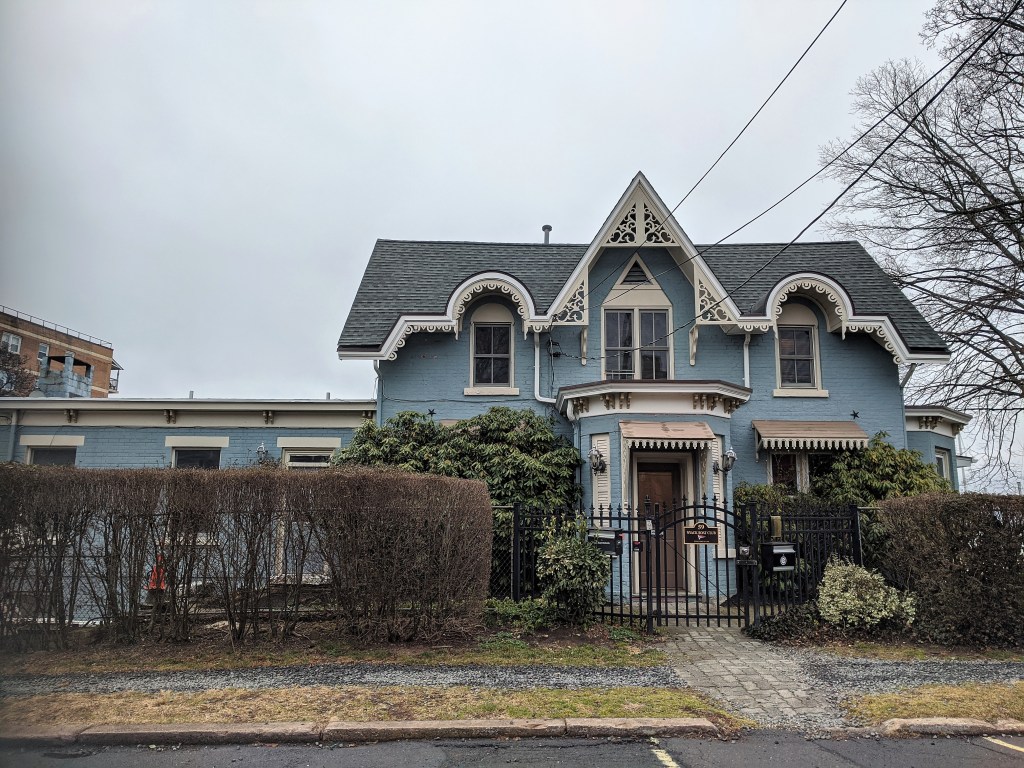
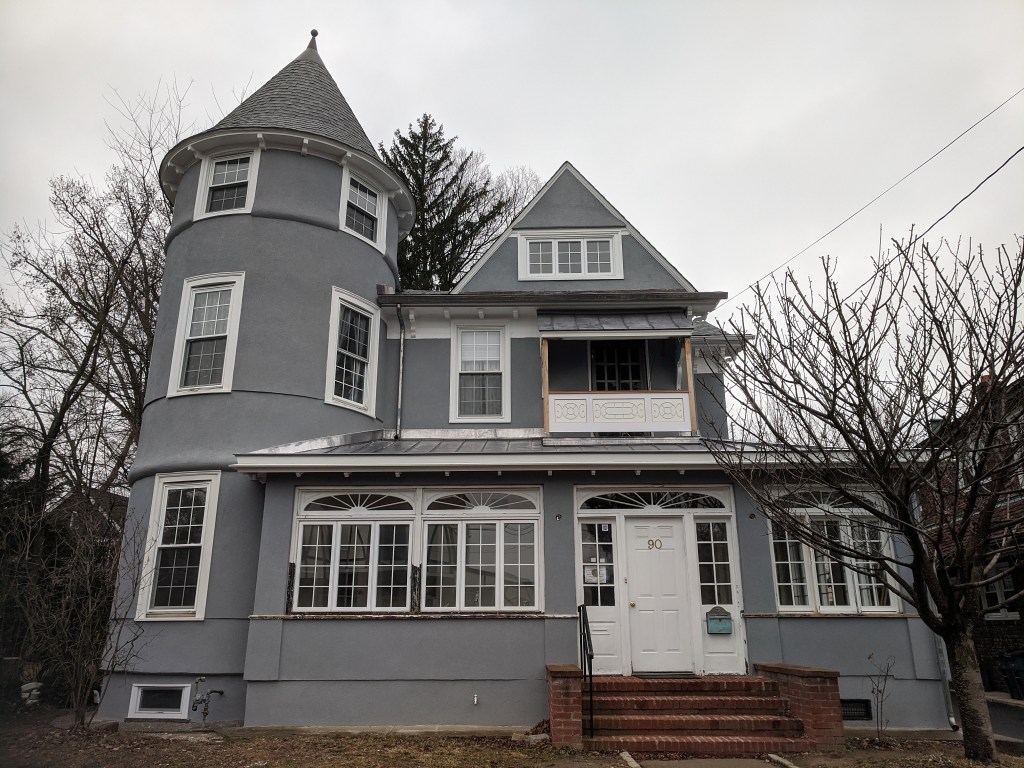
Gloucester has few residences of the architectural pretentious of many in Salem and Newburyport. Nevertheless, it contains many old houses that have a distinctive quality that contribute more than is generally realized to the
Buildings and restorations – 2
Character of the city . Many such houses have already been superficially spoiled. It would be possible to restore most of the houses that have been unwisely covered with substitute materials by the use of appropriate siding and painting. The Civic Art Committee holds itself ready to advise on the proposed alteration or restoration of any such building. The aid of this Committee is proffered in cases where community effort is needed to restore churches designated in the list by brining to the attention of citizens the importance of the project.
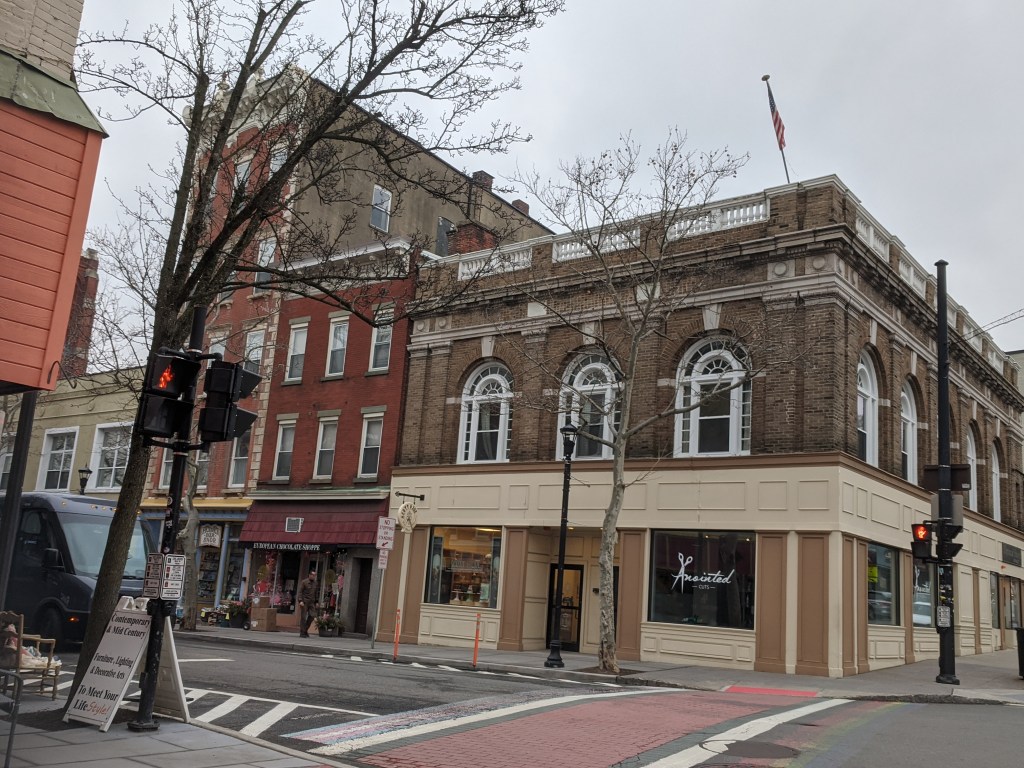
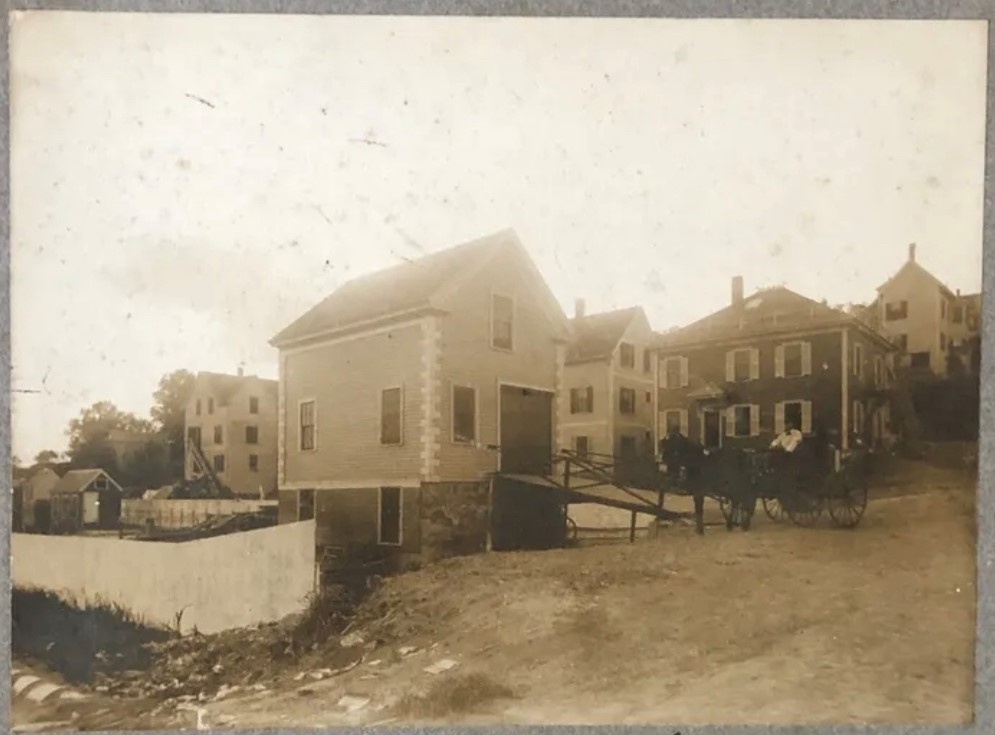
The west end of Main Street offers a remarkable opportunity for restoration that would give real distinction to the neighborhood near the Legion Hall and the Town Landing. The brick houses on the water side from Town Landing to the STrand Theater were built in 1832, the result of a friendly agreement between the families concerned to create an entire street front that should be harmonious. It would require only a similar public spirited move on the part of the present owners and a surprisingly small investment of money to put back street floor entrances and windows as they were originally and make the west end of Main Street an inviting section of the commercial district. If private initiative and means are lacking, some of the uses suggested for certain of these buildings are: a community art center, another club or meeting place, a fisheries museum – or the whole area might be revitalized as a shopping section. This is an opportunity that should not be wasted.
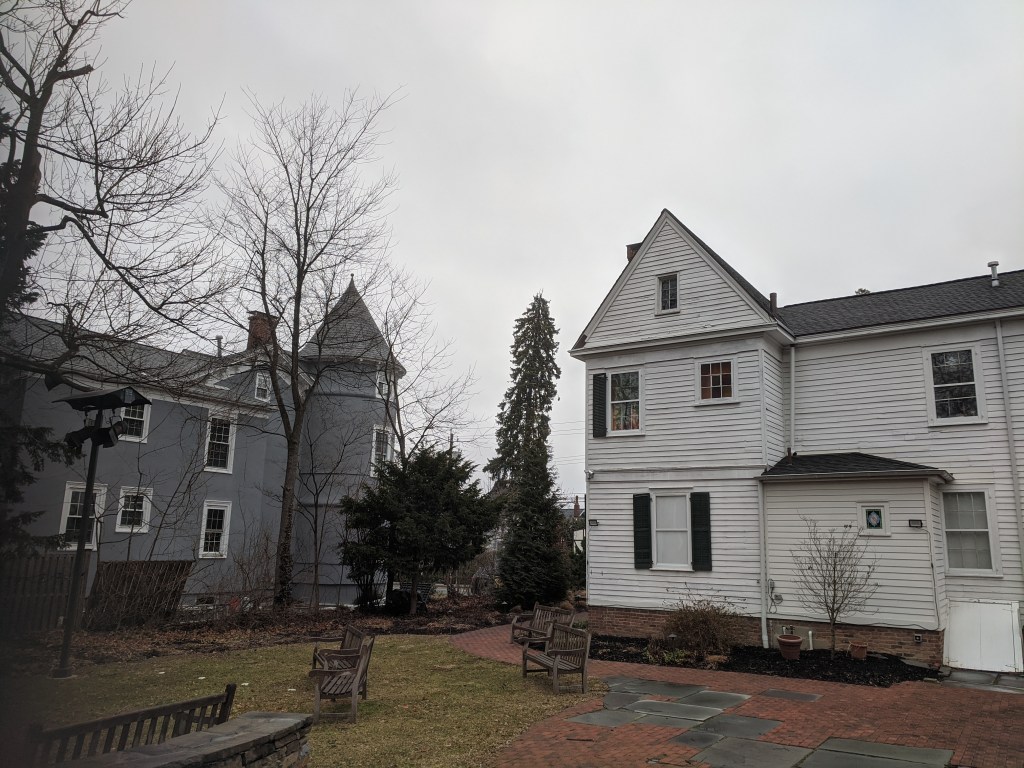
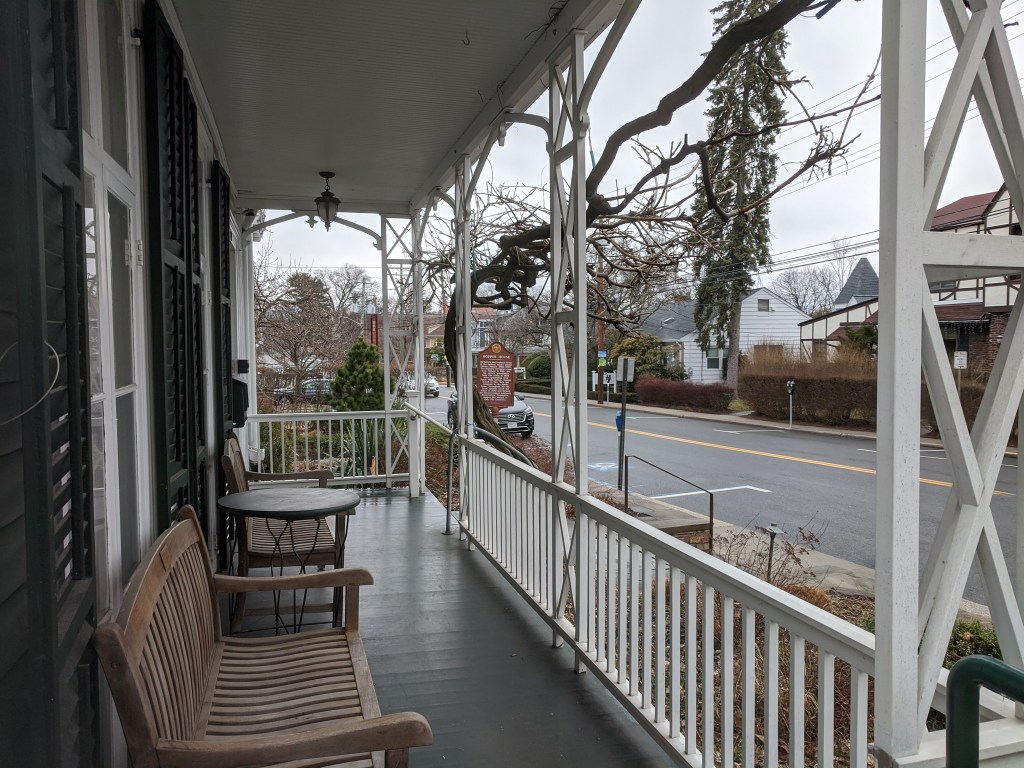
Enclosed is a sketch of the Fitz Hugh (sic) Lane House dominating a parking lot in the Locust Street area to show how the restoration of a historic site can be effectively combined with modern commerce.
Among the new buildings needed in Gloucester, a Recreation Center and an art Center are of prime importance. It is hoped that the sites, at least, for these projects can be determined in the near future with a view to arousing the necessary public interest to insure their eventual realization. Again, this committee stands ready to advise on the location or design of such buildings.
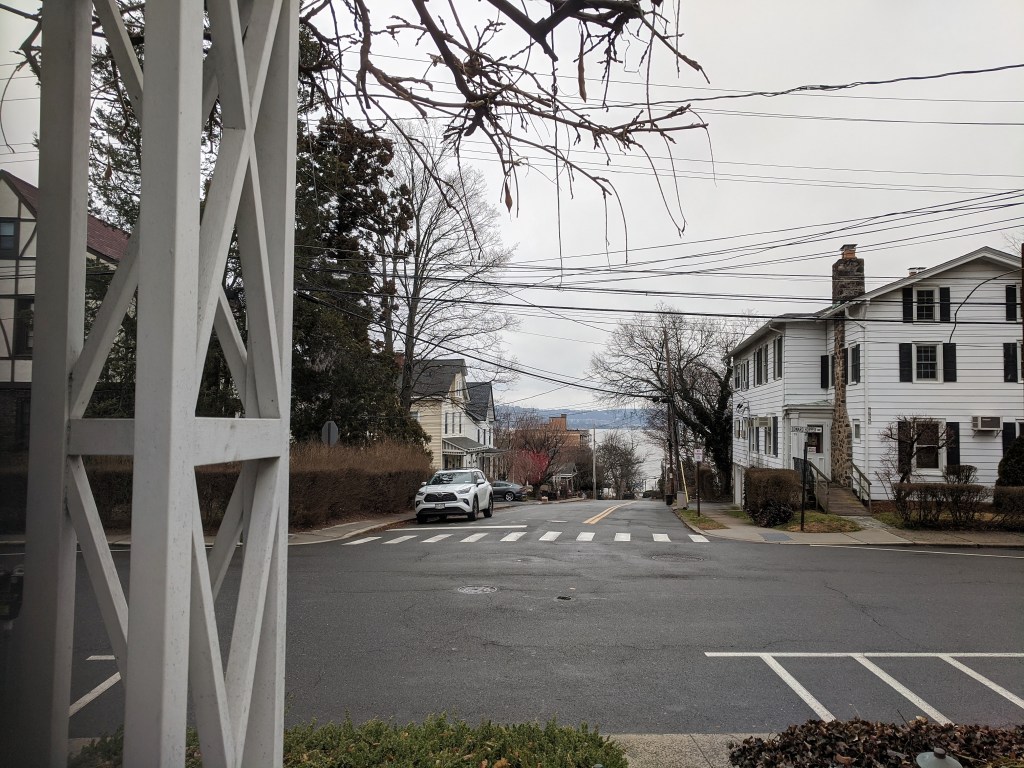
Illustration: Betty deVicq drawing circa 1958 [rendering of potential restoration of “Stone jug” on Ivy Court, overlooking Duncan street, the former home and studio of Fitz Henry Lane.]
IV. – The Commercial Center
The commercial center is of vital economic importance to Gloucester. It has already been pointed out that commerce and industry provide more tax income to the city than the municipal services they require while the opposite is true of residences. If the commercial center has the right combination of tangibles and apparent intangibles, it will cause more people to use Gloucester’s Main St. area than other shopping centers or areas, with the resulting financial benefit to the city itself.
Few cities in the country built their commercial centers after the invention of the automobile. Therefore, all cities are in some stage of tearing down buildings in their race to overcome the competition of spacious shopping centers. Our merchants and city government are making progress with the traffic flow and parking problems. We all realize there is more to be done. That is not the province of the Civic Art Committee, yet that group would not hesitate to suggest to the planners and the merchants a bold plan to consider.
There are more reasons than traffic, parking, merchandising and sales promotions which cause shopping in one city rather than another. A local citizen touring the country would observe the commercial centers of certain communities which create an impulse to stop while others created an impulse to hurry on through. That intangible element is usually carefully planned. It might be the limitation on height of all the buildings. The observer might notice that the store signs are limited in size or in color or that none of them blink. Perhaps the eye-appeal is due to set-backs from the sidewalk with grass and landscaping or cool shade trees. It might be harmonious store fronts.
The large shopping centers today with their circumferential parking have done their best with landscaping to create eye-appeal and pleasant shopping, yet that artificial attempt does not compare with natural beauty of our Middle Street, and its irreplaceable old buildings on one side of Main Street and the colorful
V. PUBLIC MONUMENTS
- General. – Public monuments–particularly those out of doors–are an immediate indication to the newcomer of the community’s pride in its history and the achievements of its citizens. Gloucester possesses a masterpiece of sculpture in the statue of Joan of Art by Anna Hyatt Huntington; and the Gloucester Fisherman’s Memorial by Leonard Craske, is sought out by tourists as one of the most interesting sights of the city. In addition, there are monuments of historic importance such as the Spanish War Memorial and the Civil War Memorial at the City Hall. These should be maintained by occasional cleaning.
- Maintenance. – The proper care of bronze and granite monuments is a simple matter if not neglected for too long a time. Bronze sculpture out of doors should be sprayed or washed occasionally with clear water to remove the dirt that gathers where the rain does not reach it. When the entire surface is exposed to the air it will be covered evenly with a natural green patina. Bronze tablets should be washed with clear water and, when dry, brushed with floor wax softened in naphtha. The bronze should never be lacquered. Granite can be cleaned with a mixture of saturated solutions of fluoride and oxalic acid, brushed on quickly and then flooded with clear water. It is necessary to remove all traces of the acids. Preparations for cleaning granite which will not harm the stone are available commercially.
- Locations. – From time to time new monuments may be erected, or it may be deemed advisable to change the location of existing monuments. These locations involve various considerations such as proper relation to the flow of traffic, scale in relation to surrounding buildings or open space, planting, material, and fitness of design. No decisions regarding the placing or design of public monuments should be reached without competent expert advice.
VI. CITY IMPROVEMENTS
a. Street Signs
- Directional Signs. The city of Gloucester at present employs a very competent sign painter. There is an opportunity, given a consistent policy and some proper direction, of making the necessary directional signs contribute to the attractiveness of the city instead of adding to the sense of disorder, as at present. Legibility is the first requisite of a good sign. The shape should be simple and the background color in harmony with its setting. The signs used on the state highways are successful because of the dark green background which blends with the surrounding country and the white letters which are easily legible from a distance. The simple Roman letter is the most easily read of any, and the better the proportions of the letters the more legible they are. The use of unnecessarily large signs with brilliant colors should be avoided.
Where commercial directional signs are required they should be painted under city supervision and placed by the city in locations designated by the Planning Board. They should not be scattered. Instead, they should be grouped together in tiers on sign boards or post specially constructed in order that changes or additions may easily be made. The color and type of lettering used should be established by the city. Uniformity in these would avoid confusion, contribute to the orderliness of the city, and give equal advantages to all concerned. The cost of these signs would be borne by the parties requiring them.
- Commercial Signs. Control of commercial signs in certain areas is within the province of zoning. They should be regulated according to size and construction.
Illuminated signs may become a great nuisance even at a distance. The utmost consideration should be given to the control of such signs; and even though they be located in commercial districts, they should not be placed as to be noticeable from residential areas.
Improvements–2
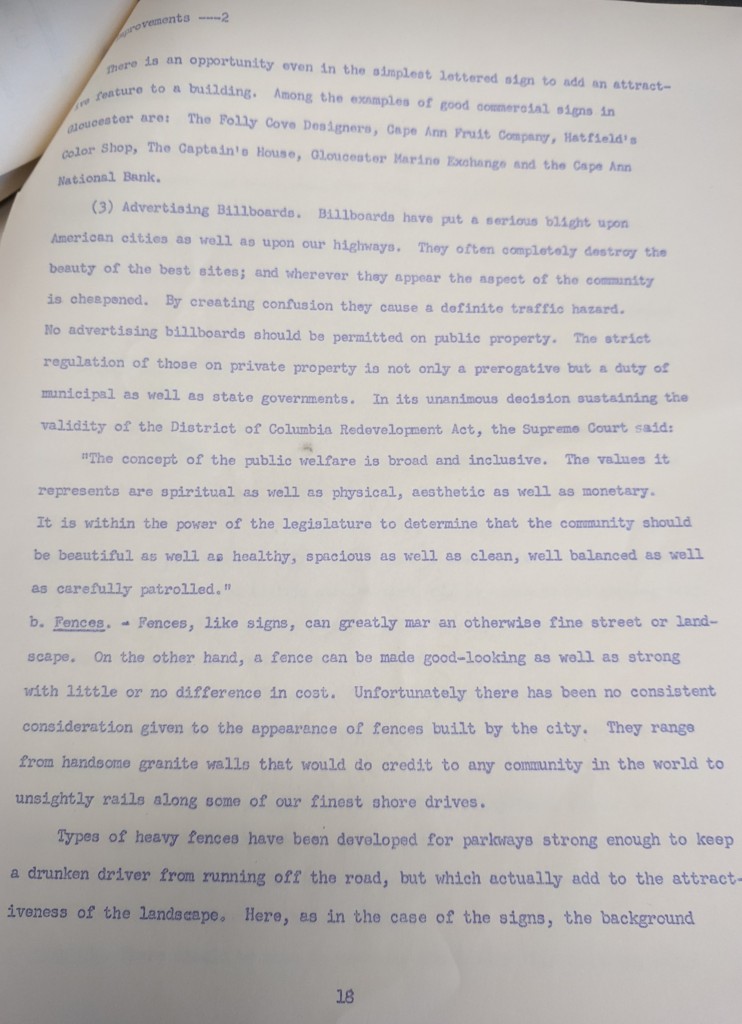
There is an opportunity even in the simplest lettered sign to add an attractive feature to a building. Among the examples of good commercial signs in Gloucester are: The Folly Cove Designers, Cape Ann Fruit Company, Hatfields Color Shop, the Captain’s House, Gloucester Marine Exchange, and the Cape Ann National Bank.
- Advertising Billboards. Billboards have put a serious blight upon American cities as well as upon our highways. They often completely destroy the beauty of the best cities; and wherever they appear the aspect of the community is cheapened. By creating confusion they cause a definite traffic hazard. No advertising billboards should be permitted on public property. The strict regulation of those on private property is not only a prerogative but a duty of municipal as well as state governments. In its unanimous decision sustaining the validity of the District of Columbia Redevelopment Act, the Supreme Court said:
“The concept of the public welfare is broad and inclusive. The values it
represents are spiritual as well as physical, aesthetic as well as monetary.
It is within the power of the legislature to determine that the community
should be beautiful as well as healthy, spacious as well as clean, well
balanced as well as carefully patrolled.”
b. Fences. – Fences, like signs, can greatly mar an otherwise fine street or landscape. On the other hand, a fence can be made good-looking as well as strong with little or no difference in cost. Unfortunately there has been no consistent consideration given to the appearance of fence built by the city. They range from handsome granite walls that would do credit to any community in the world to unsightly rails along some of our finest shore drives.
Types of heavy fences have been developed for parkways strong enough to keep a drunken driver from running off the road, but which actually add to the attractiveness of the landscape. Here, as in the case of signs, the background
Improvements –3
should be taken into consideration in selecting the appropriate type of construction.
c. Trash containers. It is hoped that an awakened city pride will result in some degree of care about the disposal of rubbish. Trash containers, strategically placed, will help as reminders as well as to provide the means of easy rubbish disposal. However, the trash containers themselves should not be unsightly. Sufficient attention can be directed to them without the use of garish colors. White lettering on dark backgrounds will generally be found preferable.
d. Cleaning and Policing of Roads. – Miles of gloucester’s scenic shore roads are constantly littered with rubbish. Strict enforcement of existing ordinances with some exemplary prosecutions, should go far toward correcting this situation.
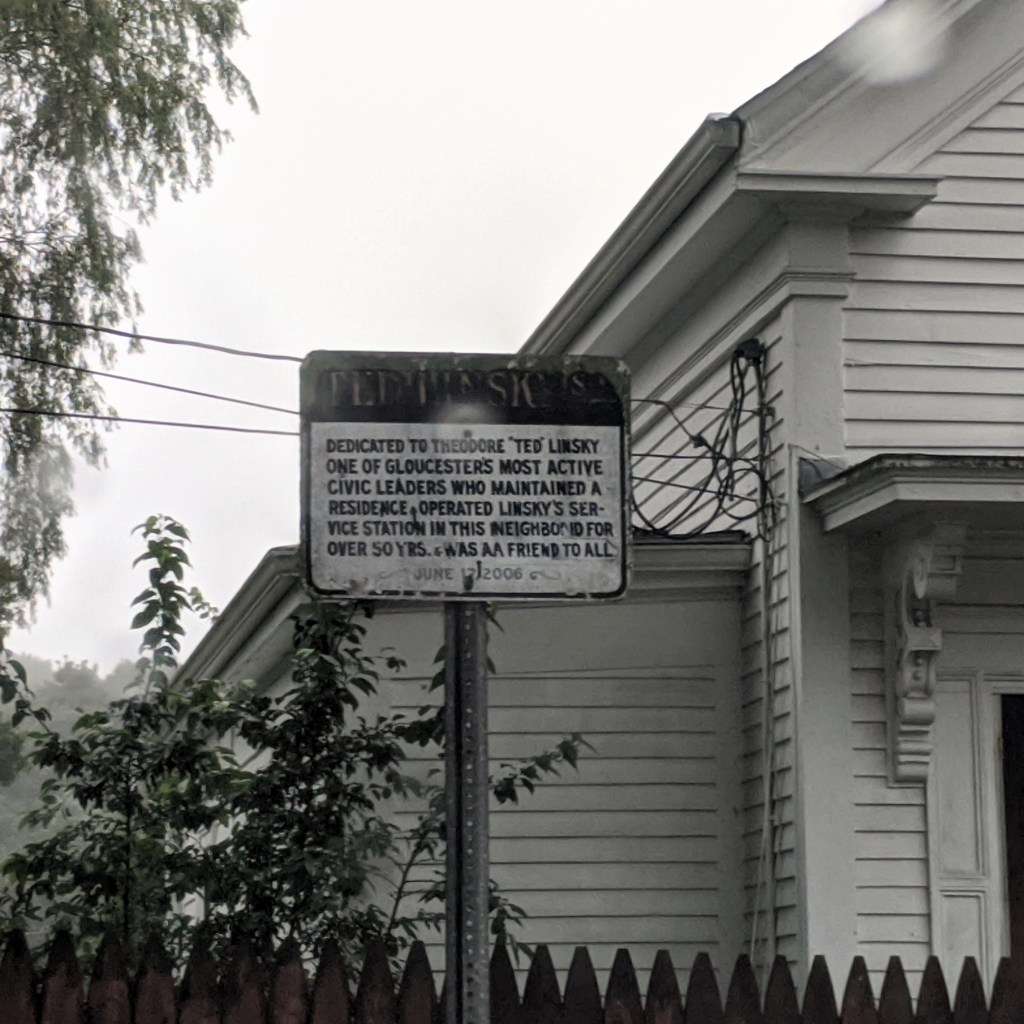
e. Place Names and Markers. – It is an important duty of the community to keep alive in the minds of its younger people the achievements of citizens who have brought honor to it in the past. Place names and monuments are a perpetual reminder of the example of courage and moral strength set by our forbears. As the names of Washington and Lincoln give inspiration to the nation, so should the names of Gloucester’s courageous sea faring men inspire this and future generations of our citizens. These men should be memorialized in the names of new streets, squares, and traffic circles that will be added to the growing city. In addition to the name, markers should recount briefly the heroic act for which each man is remembered. Among those who should be honored in this manner are Howard Blackburn, Marty Welch, Alfred Johnson, Clayton Morissey, Sol Jacobs, and Alden Geale; and there are other men still living who should be given the same recognition.
“The sites of the old shipyards, about a dozen altogether, should be appropriately marked, to include the names of the more famous schooners built at that location. Site marking should be carried to other locations of interest, such as the Steamboat Wharf at Duncan’s Point.”
This would have been great incorporated into the HarborWalk markers–and a wonderful Schooner Festival trail brochure.
f. Planting. There should be more to the city physically than building walls
City Improvements —4
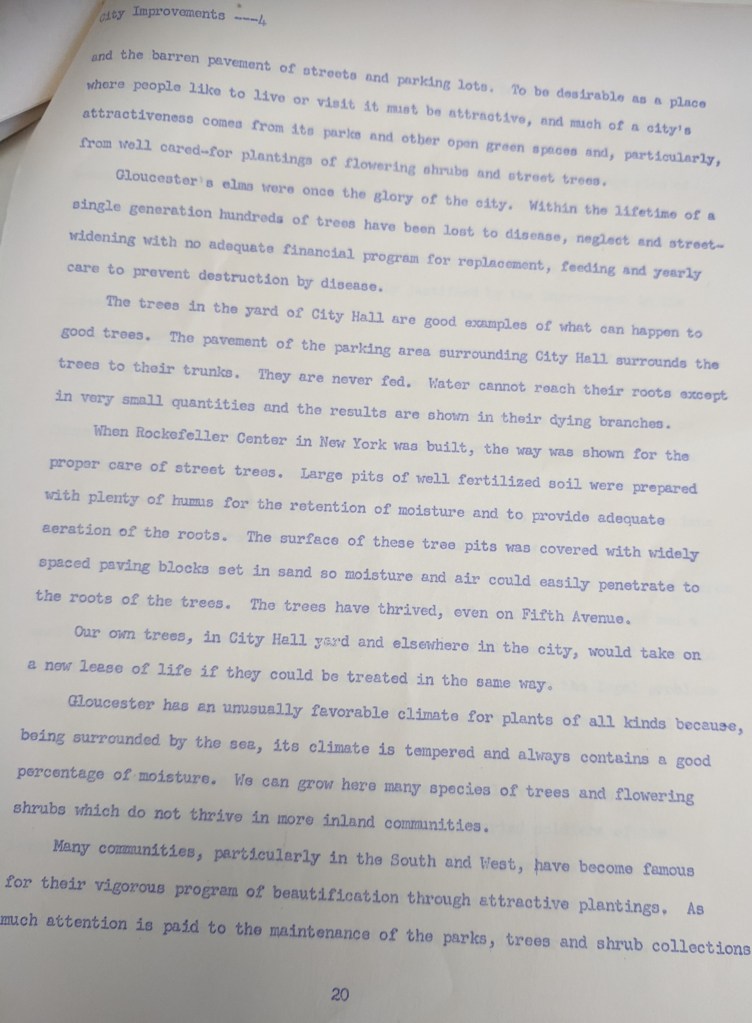
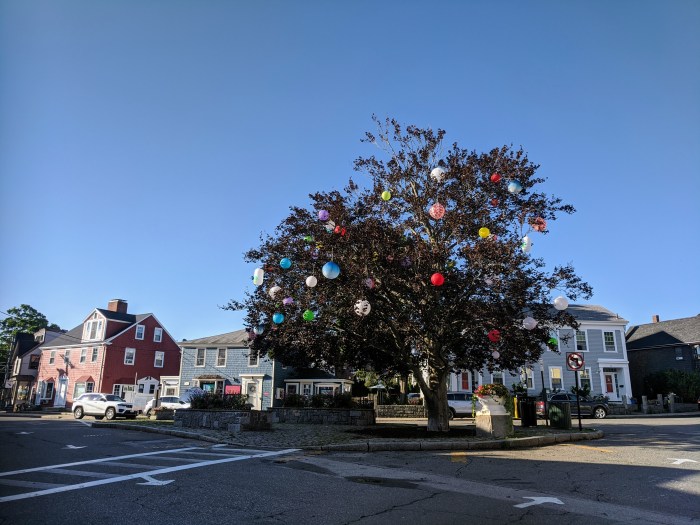
and the barren pavement of streets and parking lots. To be desirable as a place where people like to live or visit it must be attractive, and much of a city’s attractiveness comes from its parks and other open green spaces and, particularly, from well-cared for plantings of flowering shrubs and street trees.
Gloucester’s elms were once the glory of the city. Within the lifetime of single generation of hundreds of trees have been lost to disease, neglect and street-widening with no adequate financial program for replacement, feeding and yearly care to prevent destruction by disease.
The trees in the yard of City Hall are good examples of what can happen to good trees. The pavement of the parking area surrounding City Hall surrounds the trees to their trunks. They are never fed. Water cannot reach their roots except in very small quantities and the results are shown in their drying branches.
When Rockefeller Center in New York was built, the way was shown for the proper care of street trees. Large pits of well fertilized soil were prepared with plenty of humus for the retention of moisture and to provide adequate aeration of the roots. The surface of these tree pits was covered with widely spaced paving blocks set in sand so moisture and air could easily penetrate to the roots of the trees. The trees have thrived, even on Fifth Avenue.
Our own trees, in City Hall yard and elsewhere in the city, would take on a new lease of life if they could be treated in the same way.
Gloucester has an unusually favorable climate for plants of all kinds because, being surrounded by the sea, its climate is tempered and always contains a good percentage of moisture. We can grow here many species of trees and flowering shrubs which do not thrive in more inland communities.
Many communities, particularly in the South and West , have become famous for their vigorous program of beautification through attractive plantings. As much attention is paid to the maintenance of the parks, trees and shrub collections
City Improvements —5
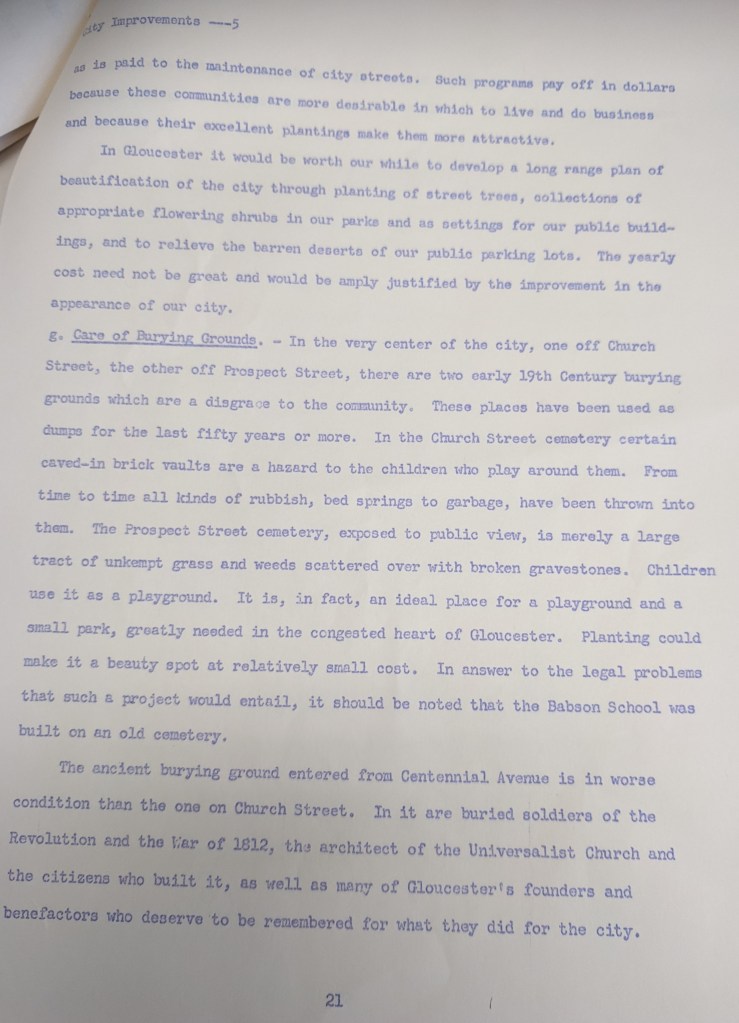
as is paid to the maintenance of city streets. Such programs pay off in dollars because these communities are more desirable in which to live and do business and because their excellent plantings make them more attractive.
In Gloucester it would be worth our while to develop a long range plan of beautification of the city through planting of street trees, collections of appropriate flowering shrubs in our parks and as settings for our public buildings, and to relieve the barren deserts of our public parking lots. The yearly cost need not be great and would be amply justified by the improvement in the appearance of our city.
e. Care of Burying Grounds – In the very center of the city, one off Church Street, the other off Prospect Street, there are two early 19th century burying grounds which are a disgrace to the community. These places have been used as dumps for the last fifty years or more. In the Church Street cemetery certain caved-in brick vaults are a hazard to the children who play around them. From time to time all kinds of rubbish, bed springs to garbage, have been thrown into them. The Prospect Street cemetery, exposed to public view, is merely a large tract of unkempt grass and weeds scattered over with broken gravestones. Children use it as a playground. It is, in fact, an ideal place for a playground and a small park, greatly needed in the congested heart of Gloucester. Planting could make it a beauty spot at relatively small cost. In answer to the legal problems that such a project would entail, it should be noted that the Babson School was built on an old cemetery.
The ancient burying ground entered from Centennial Avenue is in worse condition then the one on Church Street. In it are buried soldiers of the Revolution and the War of 1812, the architect of the Universalist Church, and the citizens who built it, as well as many of Gloucester’s founders and benefactors who deserve to be remembered for what they did for the city.
VII. CIVIC ART COMMISSIONS
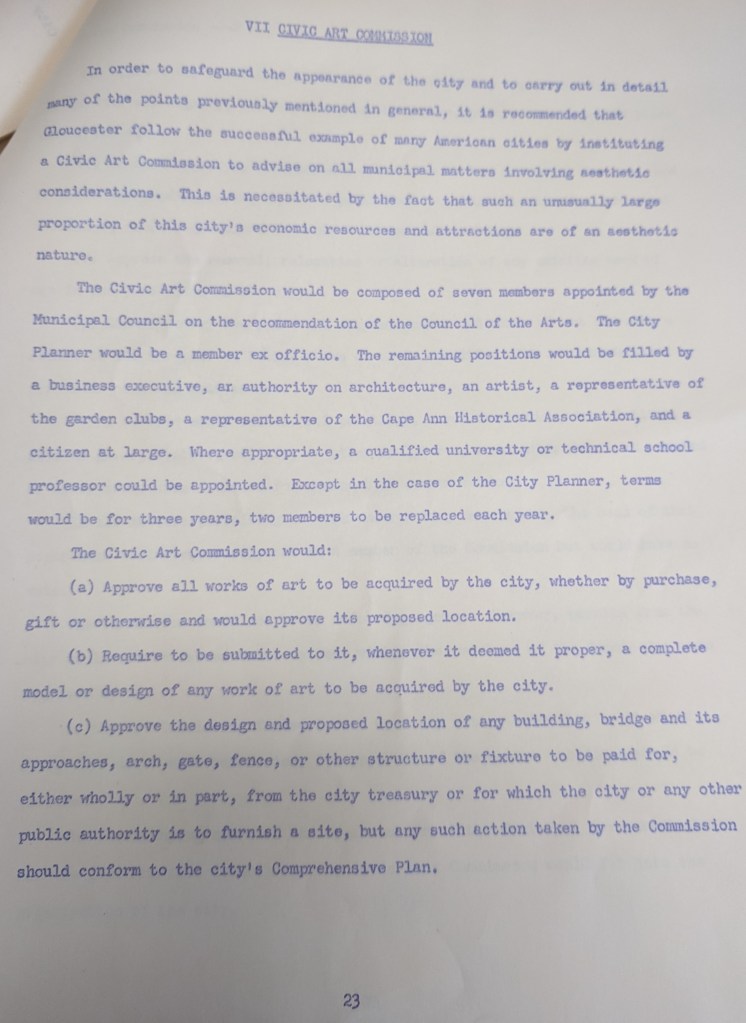
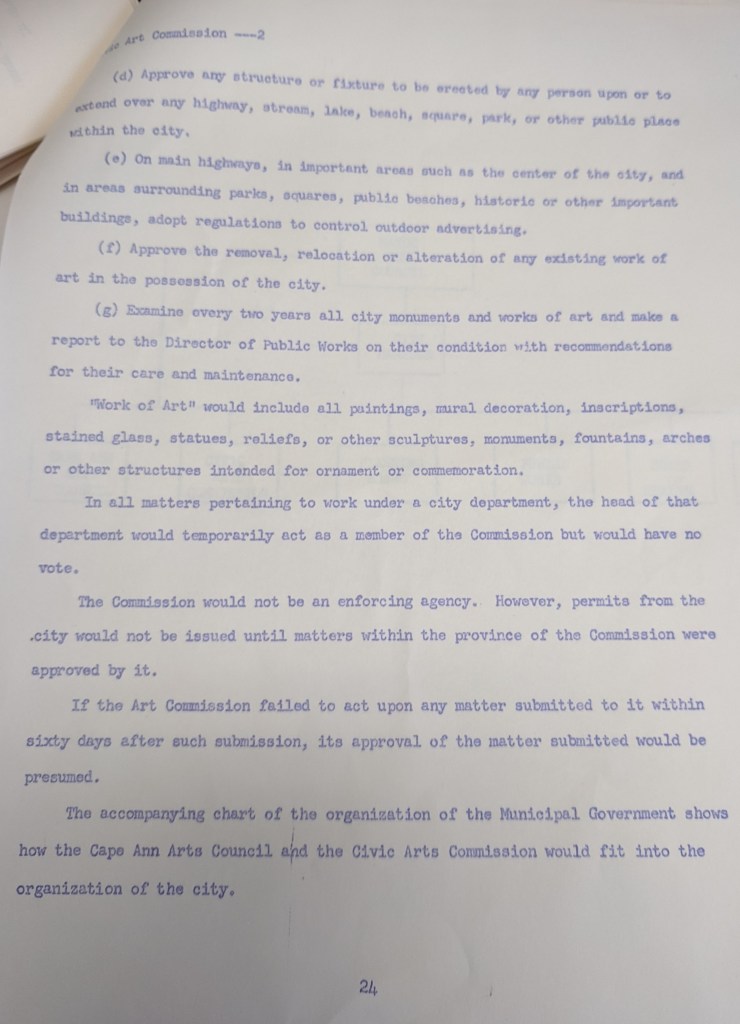
In order to safeguard the appearance of the city and to carry out in detail many of the points previously mentioned in general, it is recommended that Gloucester follow the successful example of many American cities by instituting a Civic Art Commission to advise on all municipal matters involving aesthetic considerations. This is necessitated by the fact that such an unusually large proportion of this city’s economic resources and attractions are of an aesthetic nature.
The Civic Art Commission would be composed of seven members appointed by the Municipal Council on the recommendation of the Council of the Arts. The City Planner would be a member ex officio. The remaining positions would be filled by a business executive, an authority on architecture, an artist, a representative of the garden clubs, a representative of the Cape Ann Historical Association, and a citizen at large. Where appropriate, a qualified university or technical school professor could be appointed. Except in the case of the City Planner, terms would be for three years, two members to be replaced each year.
The Civic Commission would:
- Approve all works of art to be acquired by the city, whether by purchase, gift or otherwise and would approve its proposed location
- Require to be submitted to it, whenever it deemed it proper, a complete model or design of any work of art to be acquired by the city.
- Approve the design and proposed location of any building, bridge and its approaches, arch, gate, fence or other structure or fixture to be paid for, either wholly or in part, from the city treasury or for which the city or any other public authority is to furnish a site, but any such action taken by the Commission should conform to the city’s Comprehensive Plan.
Public Art Commission —2
- Approve any structure or fixture to be erected by any person up0on or to extend over any highway, stream, lake, beach, square, park or other public place within the city
- On main highways, in important areas such as the center of the city, and in areas surrounding parks, squares, public beaches, historic or other important buildings, adopt regulations to c control outdoor advertising
- Approve the removal, relocation or alteration of any existing work of art in the possession of the city
- Examine every two years all city monuments and works of art and make a report to the Director of Public Works on their condition with recommendations for their care and maintenance
“Work of Art” would include all paintings, mural decoration, inscriptions, stained glass, statues, reliefs, or other sculptures, monuments, fountains, arches or other structures intended for ornament or commemoration.
In all matters pertaining to work under a city department, the head of that department would temporarily act as a member of the commission but would have not vote.
The Commission would not be an enforcing agency. However, permits from the city would not be issued until matters within the province of the Commission were approved by all.
“If the Art Commission failed to act upon any matter submitted to it within sixty days after such submission, its approval of the matter submitted would be presumed.“
Walker Hancock & Committee, 1958 (simple and easy sentence!)
The accompanying chart of the organization of the Municipal Government shows how the Cape Ann Arts Council and the Civic Arts Commission would fit into the organization of the city.

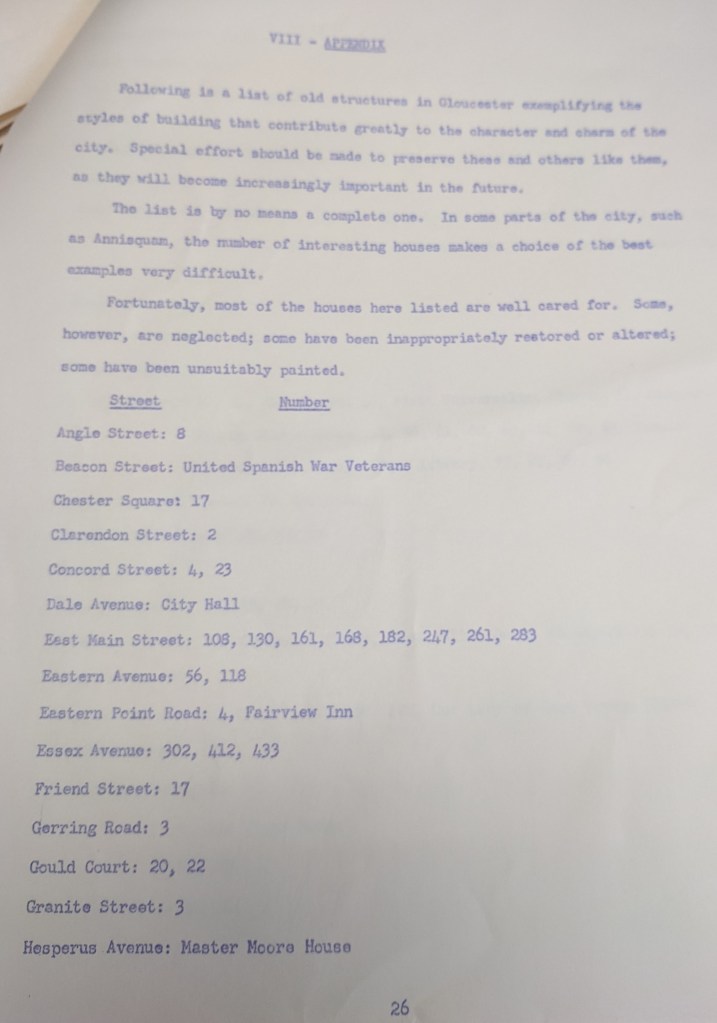
VIII Appendix
Following is a list of old structures in Gloucester exemplifying the styles of building that contribute greatly to the character and charm of the city. Special effort should be made to preserve these and others like them, as they will become increasingly important in the future.
The list is by no means a complete one. In some parts of the city, such as Annisquam, the number of interesting houses makes a choice of the best examples very difficult.
Fortunately, most of the houses here listed are well cared for. Some, however, are neglected; some have been inappropriately restored or altered; some have been unsuitably painted.
Street | Number
- Angle Street: 8
- Beacon Street: Unites Spanish War Veterans
- Chester Sq: 2
- Concord St.: 4, 23
- Dale Ave.: City Hall
- East Main St.: 108, 130, 161, 168, 182, 247, 261, 283
- Eastern Ave.: 56, 118
- Eastern Point Rd.: 4, Fairview Inn
- Essex Ave.: 302, 412, 433
- Friend St.: 17
- Gerring Rd: 3
- Gould Court: 20, 22
- Granite St.: 3
- Hesperus Ave.: Master Moore House
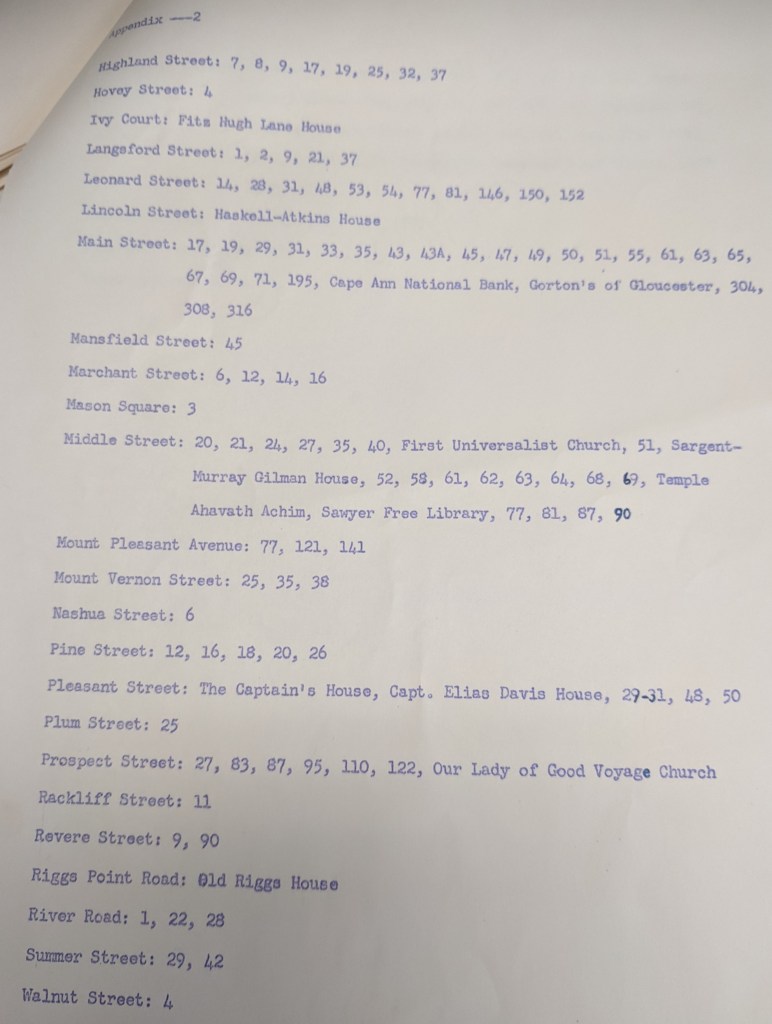
- Appendix – 2
- Highland St.: 7,8,9,17, 19, 25, 32, 37
- Hovey St.: 4
- Ivy Court: Fitz hugh Lane House
- Langsford St.: 1,2,9,21,37
- Leonard St.: 14,28,31,48,53,54,77,81,146,150,152
- Lincoln St.: Haskell-Atkins House
- Main St.: 17,19,29,31,33,35,43,43A,45,47,49,50,51,55,61,63,65,67,69,71,196, Cape Ann National Bank, Gorton’s of Gloucester, 304, 308, 316
- Mansfield St.: 45
- Marchant St.: 6,12,14,16
- Mason Sq.: 3
- Middle St.: 20,21,24,27,35,40,First Univ. Church, 51, Sargent-Murray Gilman House, 52, 58, 61, 62, 63, 68, 69, Temple Ahavath Achim, Sawyer Free Library, 77, 81, 87, 90
- Mt. Pleasant Ave.: 77,121, 141
- Mt. Vernon St.: 25, 35, 38
- Nashua St.: 6
- Pleasant St.: The Captain’s House, Capt. Elias Davis House, 29-31, 48, 50,
- Plum St.: 25
- Prospect St.: 27, 83,87, 95, 110, 122, Our Lady of Good Voyage Church
- Rackliff St.: 11
- Revere St.: 9, 90
- Riggs Point Road: Old Riggs House
- River Road: 1, 22, 28
- Summer St.: 29, 42
- Walnut St.: 4
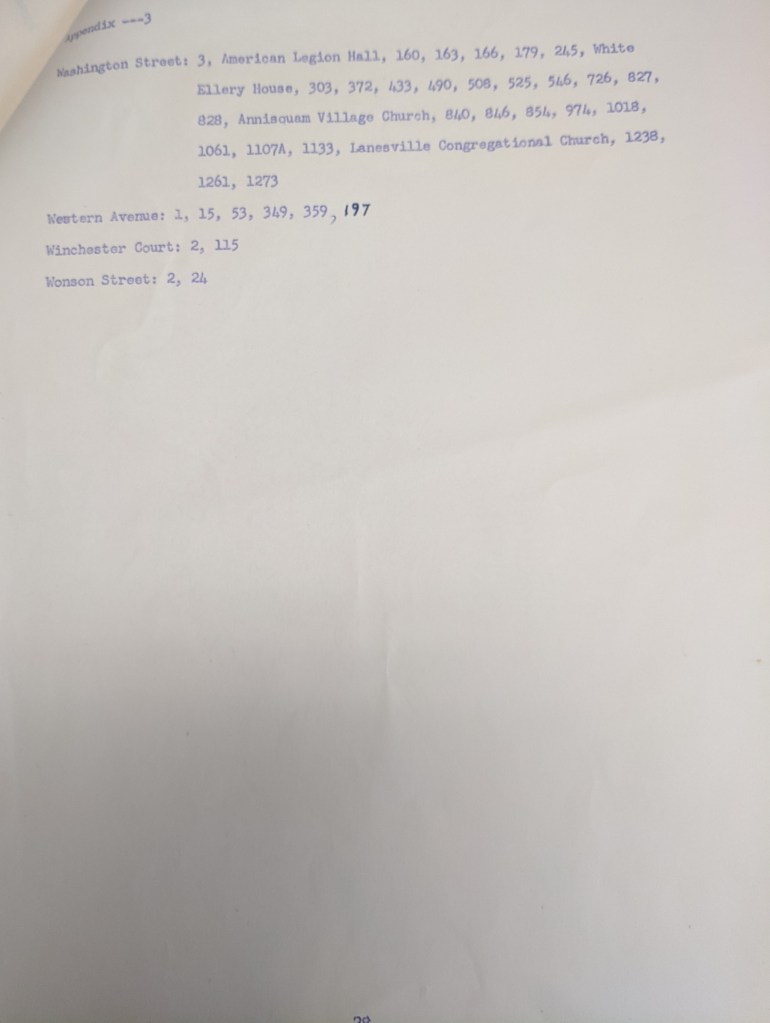
- Washington St.: 3, American Legion Hall, 160, 163, 166, 179, 245, White Ellery House, 303, 372, 433, 490, 508, 525, 546, 726, 827, 828, Annisquam Village Church, 840, 846, 854, 974, 1018, 1061, 1107A, 1133, Lanesville Congregational Church, 1238, 1261, 1273
- Western Ave.: 1, 15, 53, 349, 359, 197
- Winchester Court: 2, 115
- Wonson St.: 2, 24