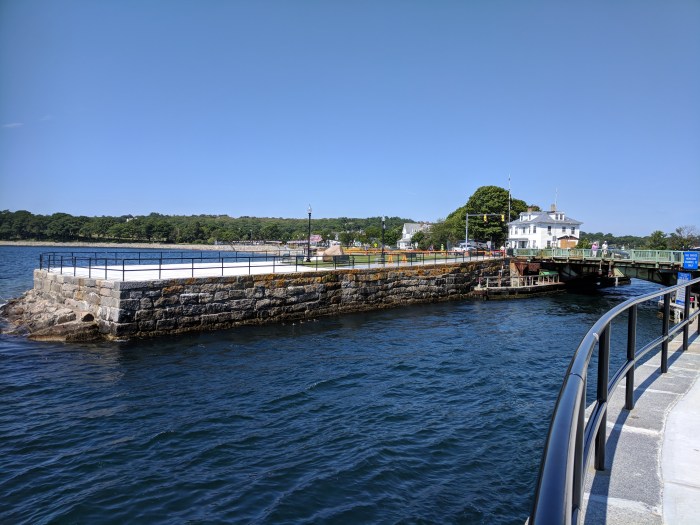
sweet ducklings navigate the current at the Cut alongside Gloucester DPW lovely storm repairs

It has been a long time since I’ve brought a tiny boat through the Cut from the Annisquam side (alert and praying I wouldn’t slam into the walls or another boat as the waters rush and pull).  How were ducks faring? They were  amusing and difficult to count for a few stolen moments on this glorious summer day. They’d dive to eat what I’m not sure, and pop up, sometimes a bit too far back. Once they were under so long I found myself crossing to the other side of the bridge to see if they were dragged back or catching a ride. Not a chance.

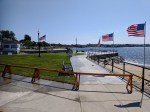
I found the completed winter storm repairs at the Cut equally beautiful and distracting.

Nice job Gloucester Department of Public Works (DPW)!

DPW completes winter storm repairs at Blynman The Cut _Department of Public Works _Gloucester MA _20180713_photo © c ryan (2)

VID (38 seconds) ducklings negotiate current at the Cut (wait for the cluster to pop up)


July 13 2018 – Gloucester Department of Public Works has completed winter storm repairs 


March 2017 (winter storm damage) Continue reading “sweet ducklings navigate the current at the Cut alongside Gloucester DPW lovely storm repairs”

@Glostaplover sharing updates from the piping plover volunteers

Thanks to city staff like Ken Whittaker, Gloucesters conservation agent, and  experts  like Kim Smith, volunteers have been inspired  to have some fun helping wildlife in our own backyard.  You can join in and follow their reports on Twitter

https://mobile.twitter.com/glostaplover?lang=en

The  2018 reports are also logged here goo.gl/DPygNw

No sign in required for either format. There’s a link for the 2017 records, too. Last year’s monitors were all ages and a few commuted from over the bridge. One mother daughter duo from the tri-state area  scheduled a volunteer vacation in Gloucester because of Kim Smith and the city’s outreach!

As I write, folks have an eye  on the plover pair in the Good Harbor Beach parking lot (still) incubating 4 eggs (still). Sign up with Ken Whittaker for a shift  kwhittaker@gloucester-ma.gov. Last year’s post about how to sign up. Everything ramps up for chicks.

(through the binoculars-  distraction dashing as crow went by )

Screenshot_20180608-153635~2.png

Deborah Cramer’s book The Narrow Edge galvanizes action to push biomedical rescue for horseshoe crabs and red knots! Revive and Restore convenes Eli Lilly to announce environmental breakthrough

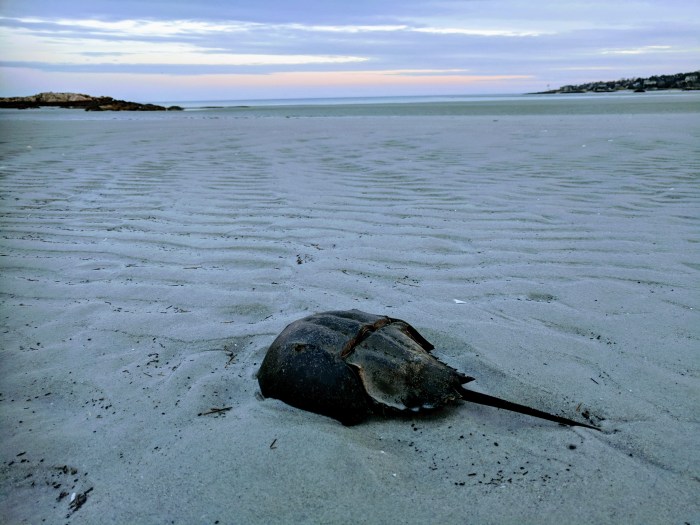
horseshoe crab wingaersheek beach low tide January 21 2018 ©c ryan

Biomedical Breakthrough is win-win for shorebirds and horseshoe crabs:  Deborah Cramer of The Narrow Edge spreads the word

“Jay Bolden, a senior biologist with pharma giant Eli Lilly, has spent the last five years proving a synthetic molecule works as well as horseshoe crab blood in a life-saving medical testIt took a dedicated birder to convince pharma giant Eli Lilly to use a synthetic compound instead of horseshoe crab blood in a mandatory medical test. Now, he hopes the rest of industry will follow…” – from National Audubon article published this March 11 2018  Inside the Biomedical Revolution to Save Horseshoe Crabs and the Shorebirds That Need Them, by Deborah Cramer with photographs by Timothy Fadek

Cramer explained that Ryan Phelan, Executive Director and Co-Founder of Revive and Restore contacted her “to see how this organization might help accelerate institutional and government exploration, acceptance of the synthetic endotoxin test to replace the use of horseshoe crabs…In the book, I’d portrayed how essential the energy rich horseshoe crab eggs are to shorebird migration, and how their numbers decline when they leave for the Arctic, hungry.  I’d described how every human family, and their pets, depend on the horseshoe crab blood test to detect potentially life-threatening endotoxin in vaccines, joint replacements, PET scans, heart stents, IV lines, etc.  And went on to tell the story of the development of the genetically engineered substitute, and the– at the time decade long–that had elapsed without it being accepted or adopted by regulators or the pharmaceutical industry.”  

Revive and Restore’s announcement in the NJ Audubon news this week has more information about these dedicated scientists and exciting news. Deborah Cramer is too modest to spell it out, so I will. Revive and Restore was inspired in part by Cramer’s book, The Narrow Edge, an award-winning read that’s smart and lyrical, and an environmental game changer. Have you read it yet?


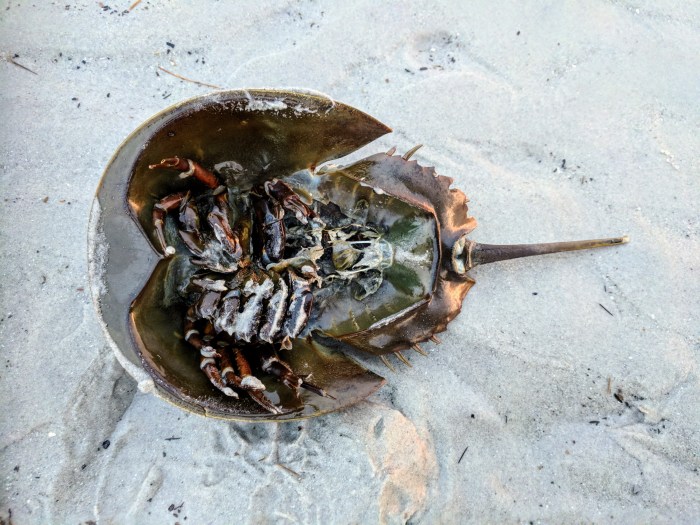
horseshoe crab verso © cryan wingaersheek beach gloucester mass 20180121_070721.jpg

Here was a substitute test that could leave hundreds of thousands of horseshoe crabs in the water every year, no one was using it.


The Narrow Edge reveals more unexpected alliances and consequences. Readers learn that hunters have done much to protect wildlife at the edge of the sea through the tax on guns and ammunition. The Federal Duck Stamp that’s required on hunting licenses  provides millions of dollars to support national wildlife refuges (and supports contemporary fine art). Memberships to organizations like National Audubon and donations from wildlife fans, photographers, and birders make a difference.

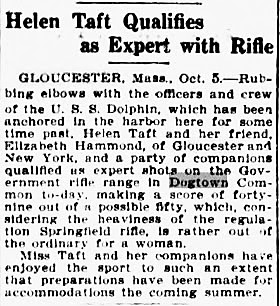
Cramer had to be trained how to handle a gun for necessary wild and remote travel research.  Gloucester, Cape Ann and North Shore readers: she took the course for her license to carry at Cape Ann Sportsman Club found along Dogtown’s edge where it’s been for over a century. (I’m not certain how Cramer rated there, but a president’s daughter was a good shot. In 1912, Helen Taft, qualified as an “Expert with a Rifle” when she visited the range with her Gloucester friend, Elizbeth Hammond.)

1912 Government rifle range in Dogtown Common

prior gmg post, June 2016Piping Plover Fans: Local author Deborah Cramer on sandpipers is a must read. Oh, and dogs vs.

To learn more about Deborah Cramer, go to www.deborahcramer.com

Continue reading “Deborah Cramer’s book The Narrow Edge galvanizes action to push biomedical rescue for horseshoe crabs and red knots! Revive and Restore convenes Eli Lilly to announce environmental breakthrough”

Kim Smith keynote and ‘Friend of the Earth’ award from Salem State University Earth Day 2018

Kim Smith - Amanda Madeira photo
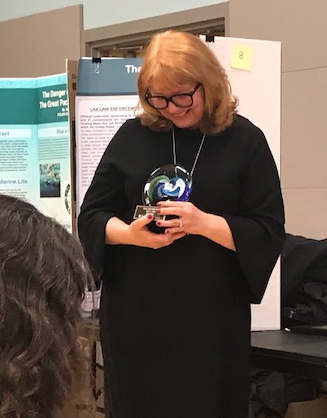
courtesy photo by Amanda Madeira: Kim Smith receiving Salem State University ‘Friend of the Earth Award’ April 12 2018

The 2018 week-long Earth Day events at Salem State University culminated with an evening awards ceremony on April 12th. Kim Smith was the invited 2018 Keynote Speaker, and Friend of the Earth Award recipient! It’s an extraordinary fit as Kim Smith’s life’s work across media –whether its her acclaimed and award-winning films, photography, landscape design, art, or writing– calls us to marvel and commune with nature. She’s a champion Friend of the Earth.

Kim Smith is henceforth included in this distinguished Salem State University Friend of the Earth list, an ambassador for the natural world, our region and Massachusetts!


Earth Days at Salem State University – Past Friend of the Earth Award Recipients:

*2001-2017 list- Compiled by Prof. John Hayes, Geography, and co-chair, Salem State University (SSU) Earth Day Planning Committee

  • 2018 – KIM SMITH award winning photographer, filmmaker, landscape designer, artist, and writer. Author of Oh Garden of Fresh Possibilities! Notes from a Gloucester Garden
  • 2017- 
  • 2016: Naomi Oreskes, Ph.D.—(Professor, Harvard Univ.), co-author, Merchants of Doubt, …….
    Bob Prescott—(Exec. Director, Wellfleet Ocean Sanctuary)…..
  • 2015: Larry Chretien—(Executive Director, Energy Consumers Alliance of New England and of Mass Energy – for his advocacy and leadership for over 20 years to champion the benefits of renewable energy alternatives in the New England region for our states, cities and towns, and our utility companies that provide us electricity and energy; as Executive Director of Mass Energy and the Energy Consumers Alliance of New England – he demonstrated how consumer-oriented non-profit organizations can lead the way in promoting affordable and environmentally
    sustainable energy resources.)
  • 2014: Gerard (Jerry) Bertrand (Environmental Adviser, Permian Global – for his enduring commitment to preservation of land and habitat; for his past service as head of international affairs for the U.S. Fish & Wildlife
    Service, his chairmanship of BirdLife International, his service as president of Massachusetts Audubon Society and cofounder of World Land Trust, and his service at Permian Global and its efforts to protect natural forests globally to
    sequester carbon, mitigate climate change, and preserve habitat through investment.)
  • 2013 Frances Moore Lappe – (co-founder of Small Planet Institute and author of 18 books including the landmark Diet for a Small Planet, World Hunger – Twelve Myths, Food First – Beyond the Myth of Scarcity, Hope’s Edge, and EcoMind – Changing the Way We Think, to Create the World We Want.) Marc Rodgers – (Communications Director, Cape Wind Associates – for his continuing efforts for more than ten years to communicate and educate about the proposed Cape Wind wind farm project on Nantucket Sound and for his efforts to help shepherd the project through the long-lived environmental review process.)

Continue reading “Kim Smith keynote and ‘Friend of the Earth’ award from Salem State University Earth Day 2018”

CAPE ANN WILDLIFE: A YEAR IN PICTURES 2017

CAPE ANN WILDLIFE: A YEAR IN PICTURES 2017

By Kim Smith

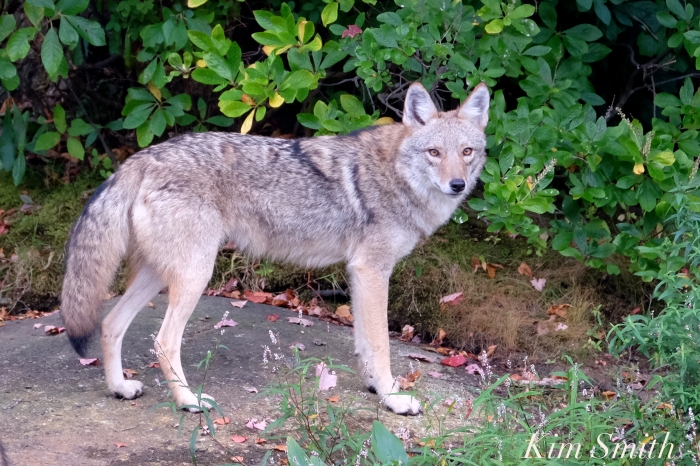
Cape Ann provides welcome habitat for a menagerie of creatures beautiful, from the tiniest winged wonder to our region’s top predator, the Eastern Coyote. Last year I posted a Cape Ann Wildlife Year in Pictures 2016 and I hope you will find the wildlife stories of 2017 equally as beautiful. Click on the image to find the name of each species.

WINTER

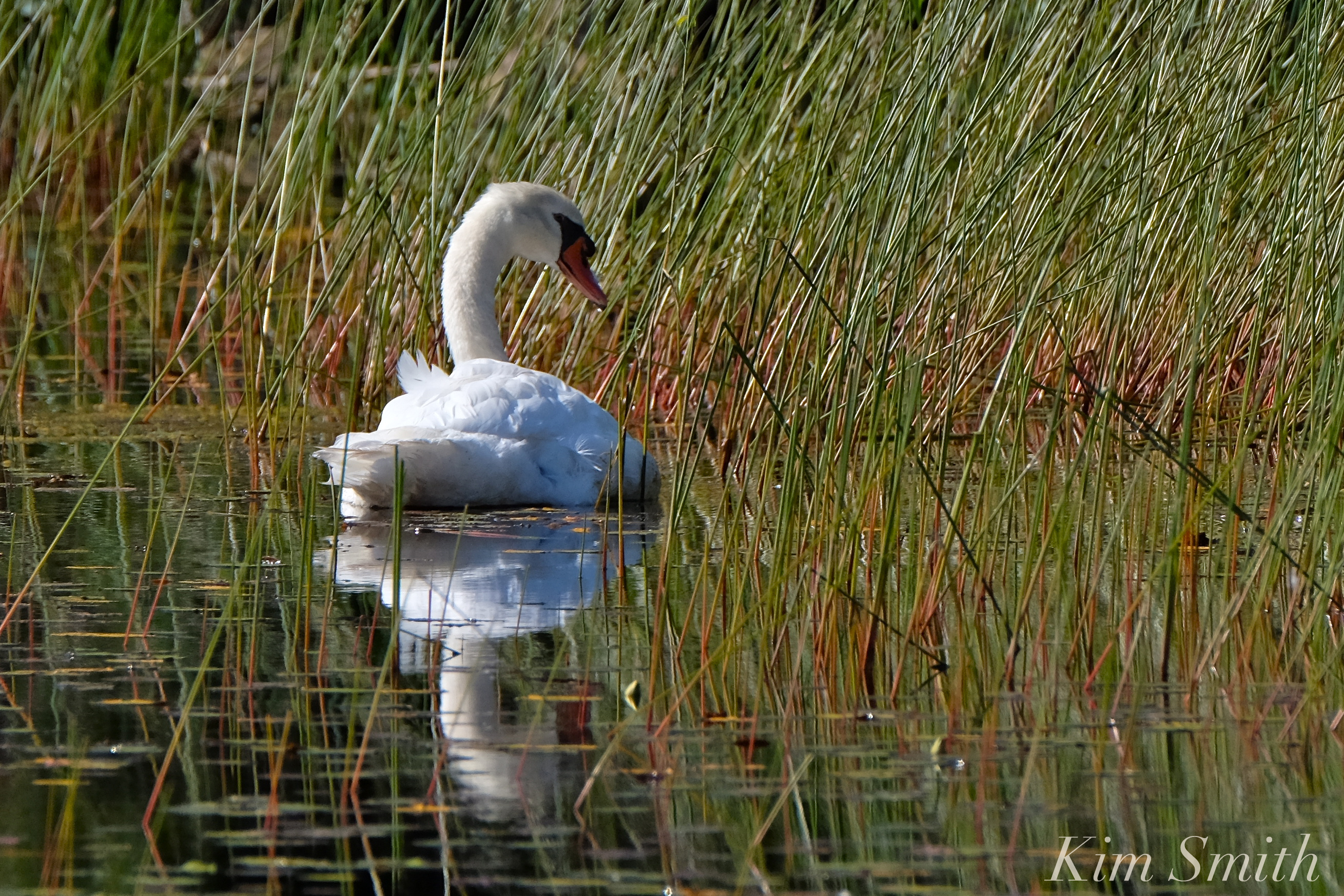
The only partially frozen ponds at the start of winter allowed for dabblers and divers such as Mallards, Mergansers, and Buffleheads to forage at the freshwater. Mr. Swan had his usual entourage of quwackers and daily heads to the other side of the pond to get away for his morning stretches. Sightings of Red-tailed Hawks and other raptors abounded. Although photographed in Newburyport, the owl photos are included because these species are found readily on Cape Ann. An Eastern Screech Owl (red-morph) was seen daily perched above a playground and Barred Owl sightings too were reported throughout the winter. Raptors live on Cape Ann all year round but are much easier to see in winter when the trees are bare of foliage.

The beautiful aqua green eyes of the juvenile Double-crested Cormorants were seen wintering at both Niles Pond and Rockport Harbor. And during a warm February day on a snowless marsh a turkey bromance shindig commenced.

SPRING

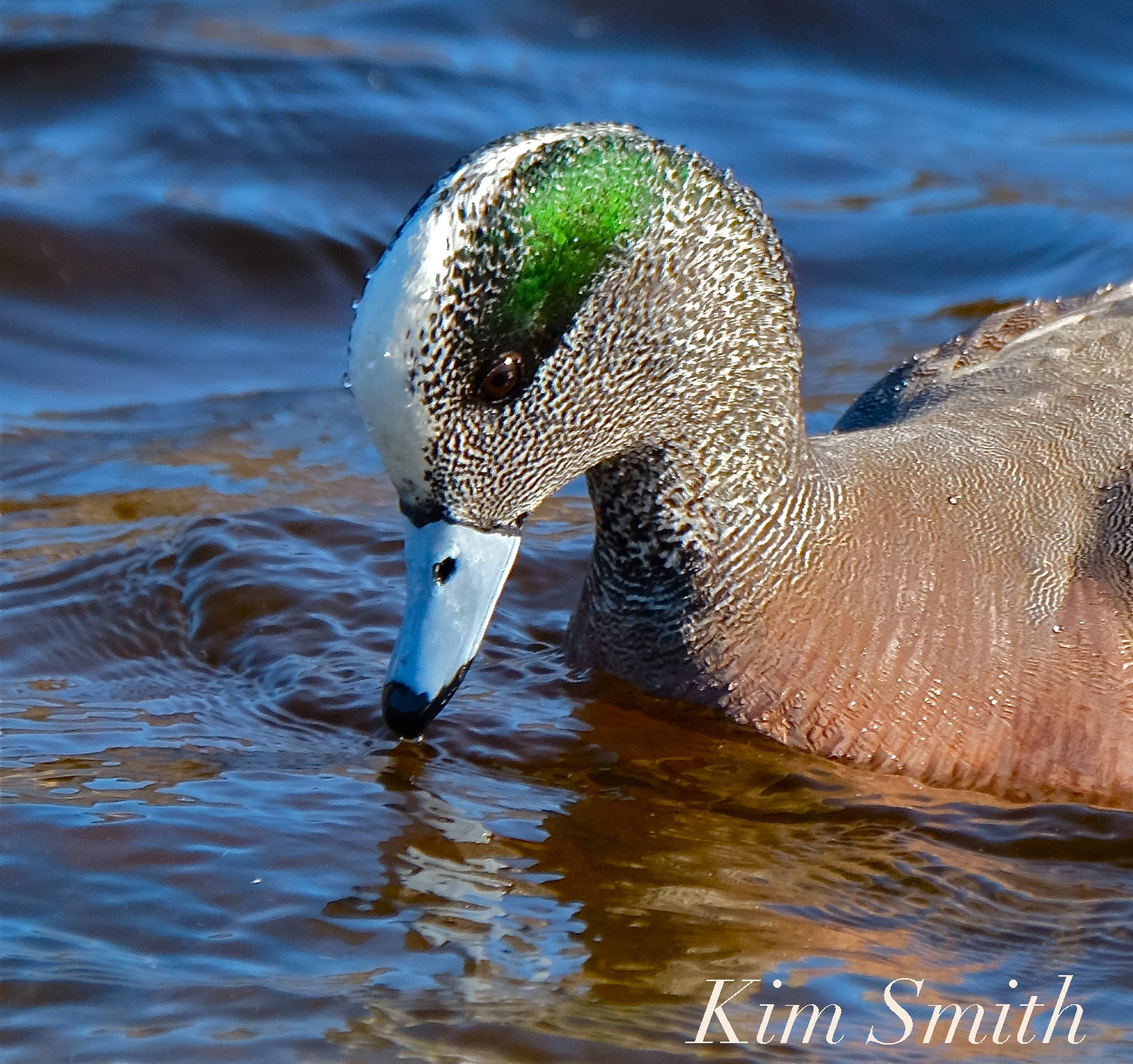
In early spring, a male and female American Wigeon arrived on the scene making local ponds their home for several weeks. In the right light the male’s electric green feathers at the top of his head shine brightly and both the male and female have baby blue bills.

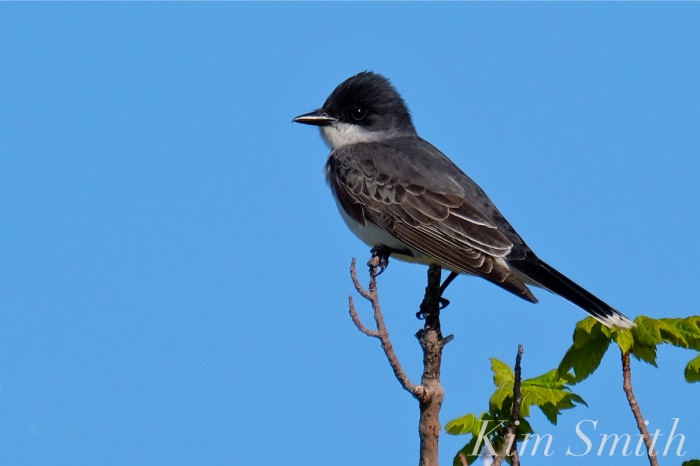
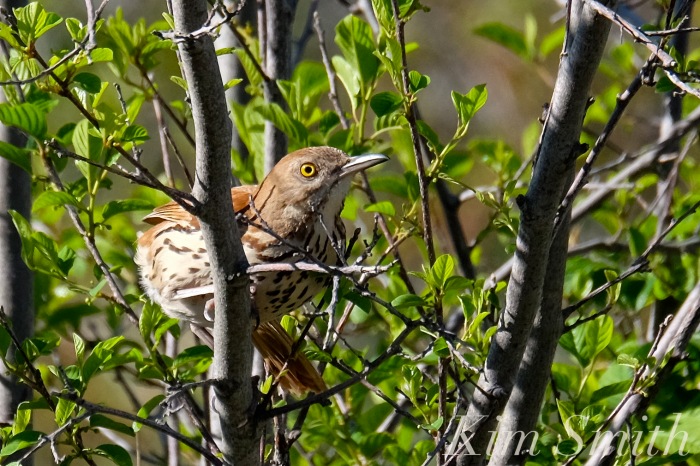
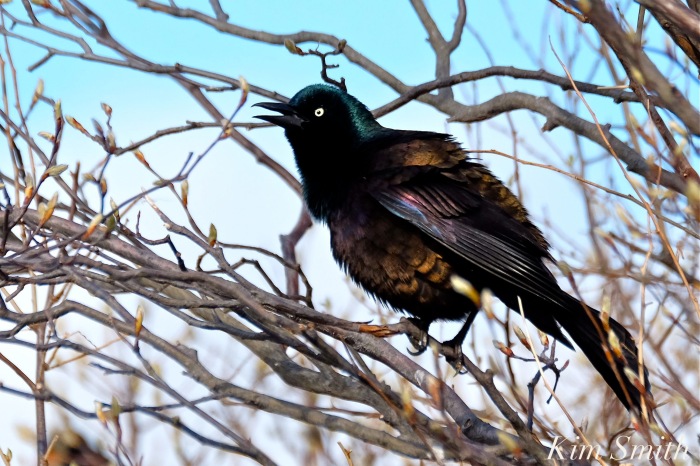
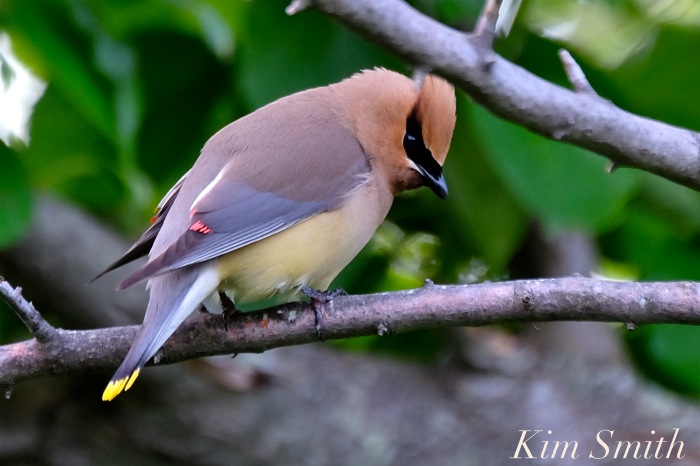
Meadow and marsh, dune and treetop were graced with the heralding harbingers of spring with photos of a Red-winged Blackbird, a pair of Cedar Waxwings, Northern Mockingbird, Brown Thrasher, Eastern Towhee, Eastern Kingbird, Tree Swallow, and Grackle included here.

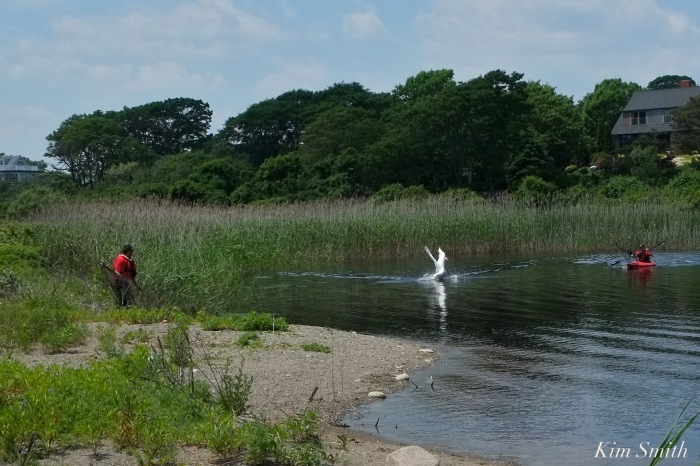
The Great Swan Escape story made headlines in Boston as Mr. Swan eluded captors for hours. He had re-injured his foot and someone took it upon themselves to call the animal rescuers, which would have surely meant death for our beloved 27-year old swan if he had been wrangled into captivity.

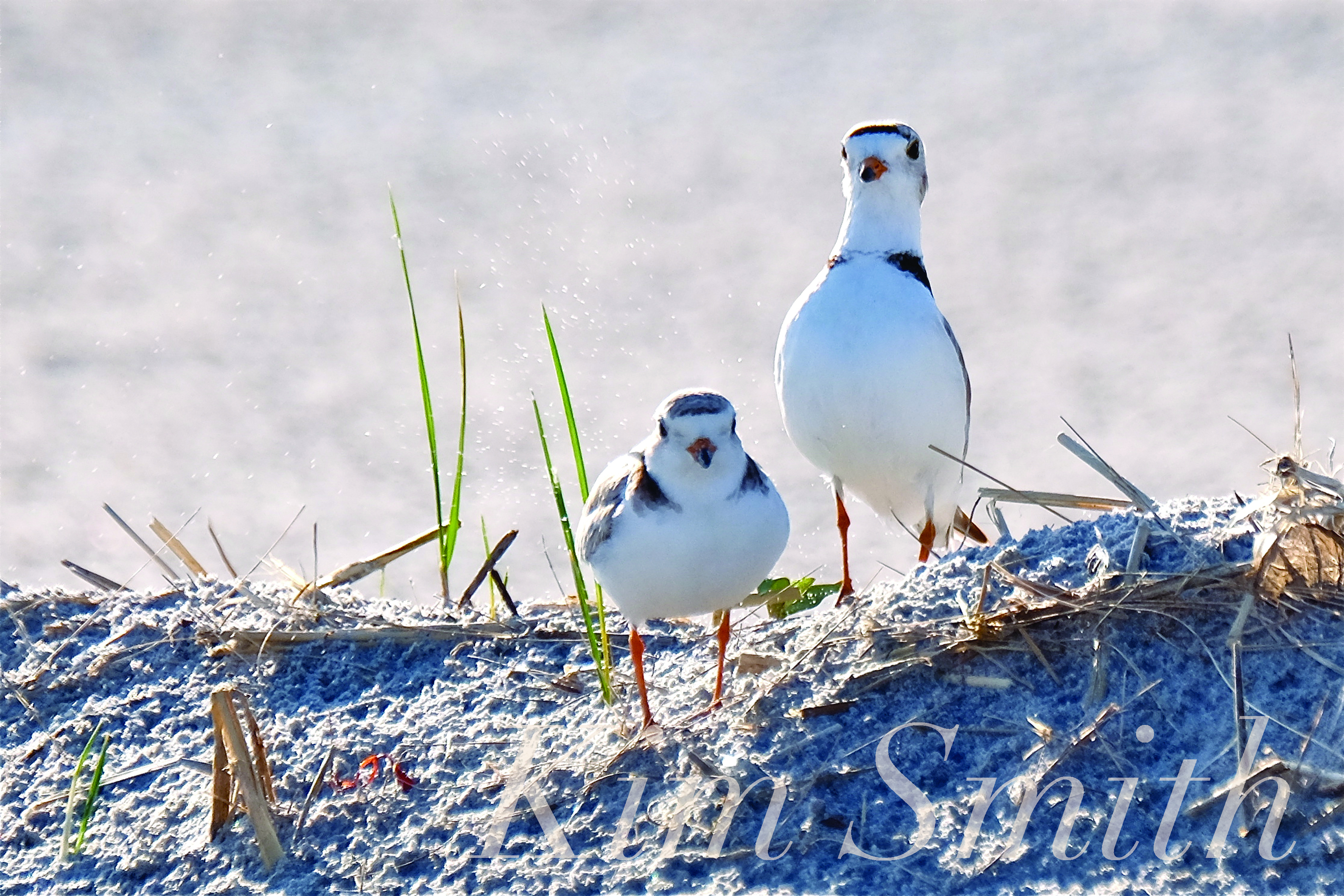
M is clearly for Migration through Massachusetts and the month-long arrivals and departures did not abate. Short-billed Dowitchers, winsome Willets, Yellow Legs, Brandt Geese, and Ruddy Turnstones are just some of the migrating birds spied on Cape Ann beaches and marshes. The best news in May was the return of the Piping Plovers. Of the five or six that camped at Good Harbor Beach to investigate potential nesting sites, one pair bonded and built their nest mere yards from the nesting pair of last year. Could it be the same pair? The nesting Piping Plover story took up much of the spring and by early summer four little Piping Plover chicks hatched over Fiesta weekend. Hundreds of photos and hours of film footage are in the process of being organized with a children’s book and documentary in progress.

Piping Plover Courtship Dance

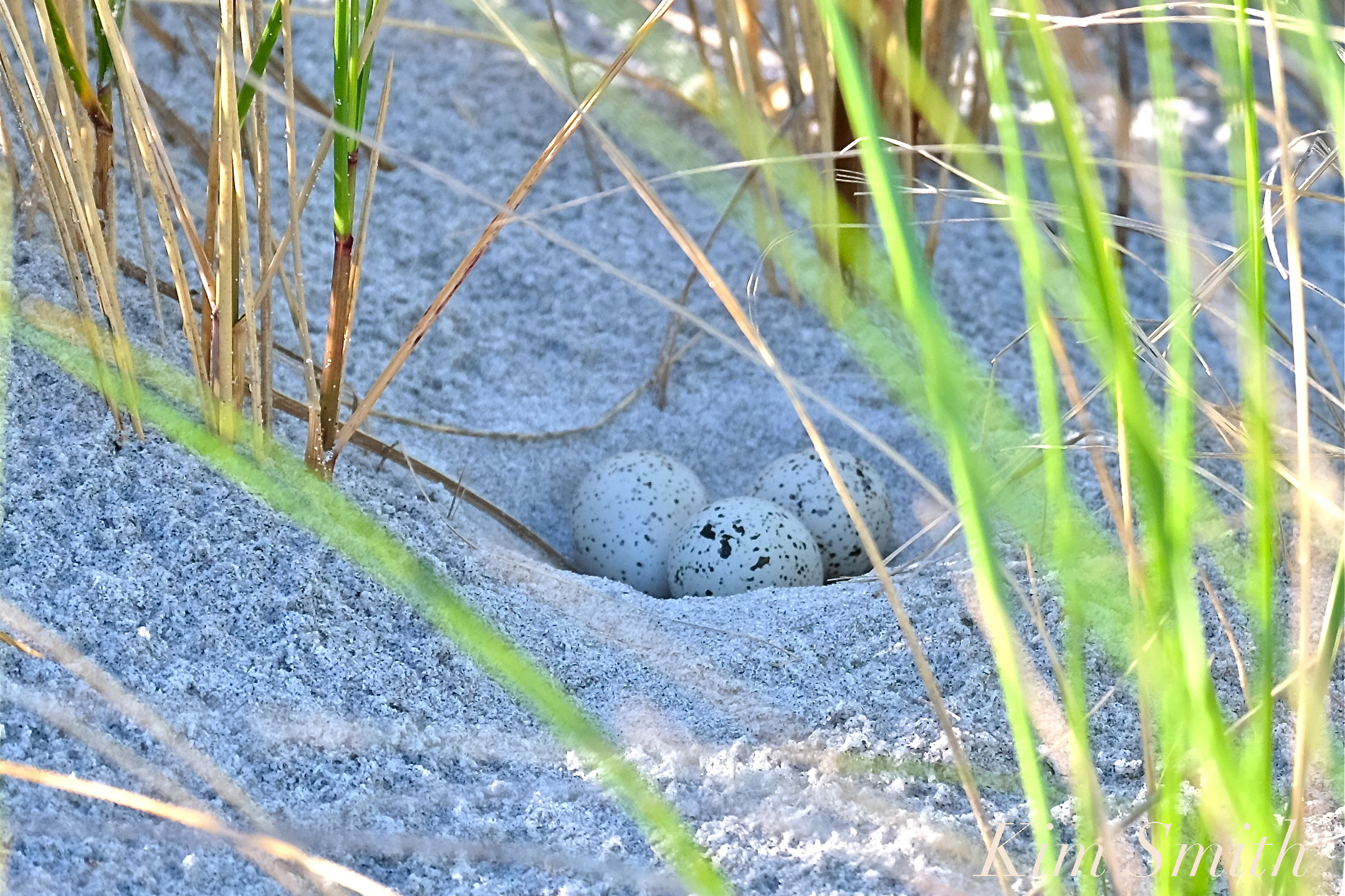
Piping Plover Nest

SUMMER

OctoPop

The survival of one Piping Plover chick was made possible by a wholesale community effort, with volunteers covering all hours of daylight, along with Mayor Sefatia and her team, Ken Whittaker from the conservation office, Chief McCarthy, and animal control officer Diane Corliss all lending a hand.

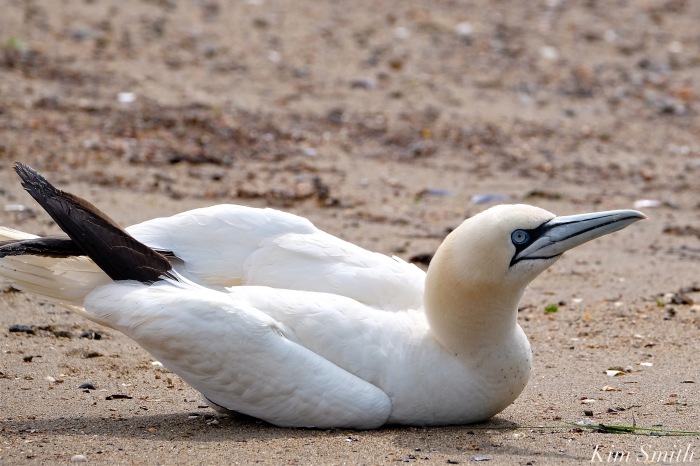
Sadly, several Northern Gannets came ashore to die on our Cape Ann beaches, struck by the same mysterious and deadly disease that is afflicting Northern Gannets in other coastal regions. During the summer season they are typically at their North American breeding grounds, which are six well-established colonies, three in the Gulf of St. Lawrence, Quebec, and three in the North Atlantic, off the coast of Newfoundland.
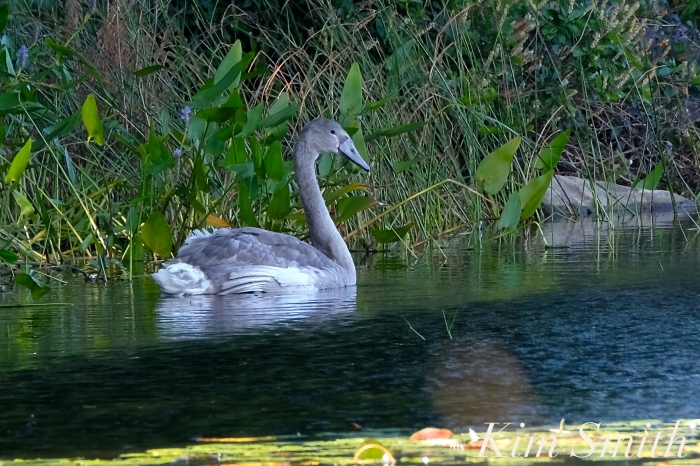
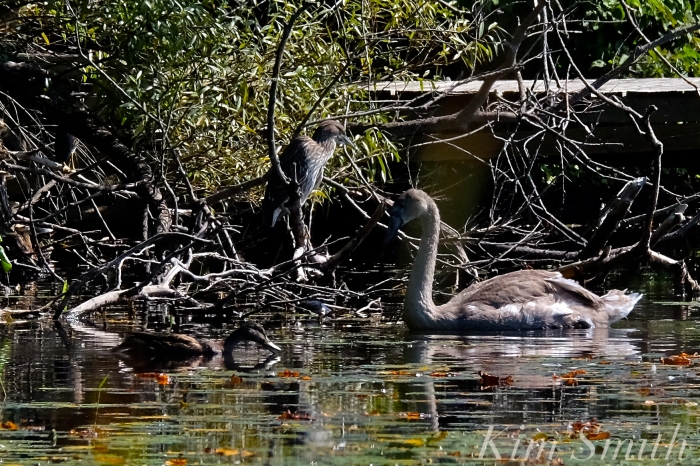
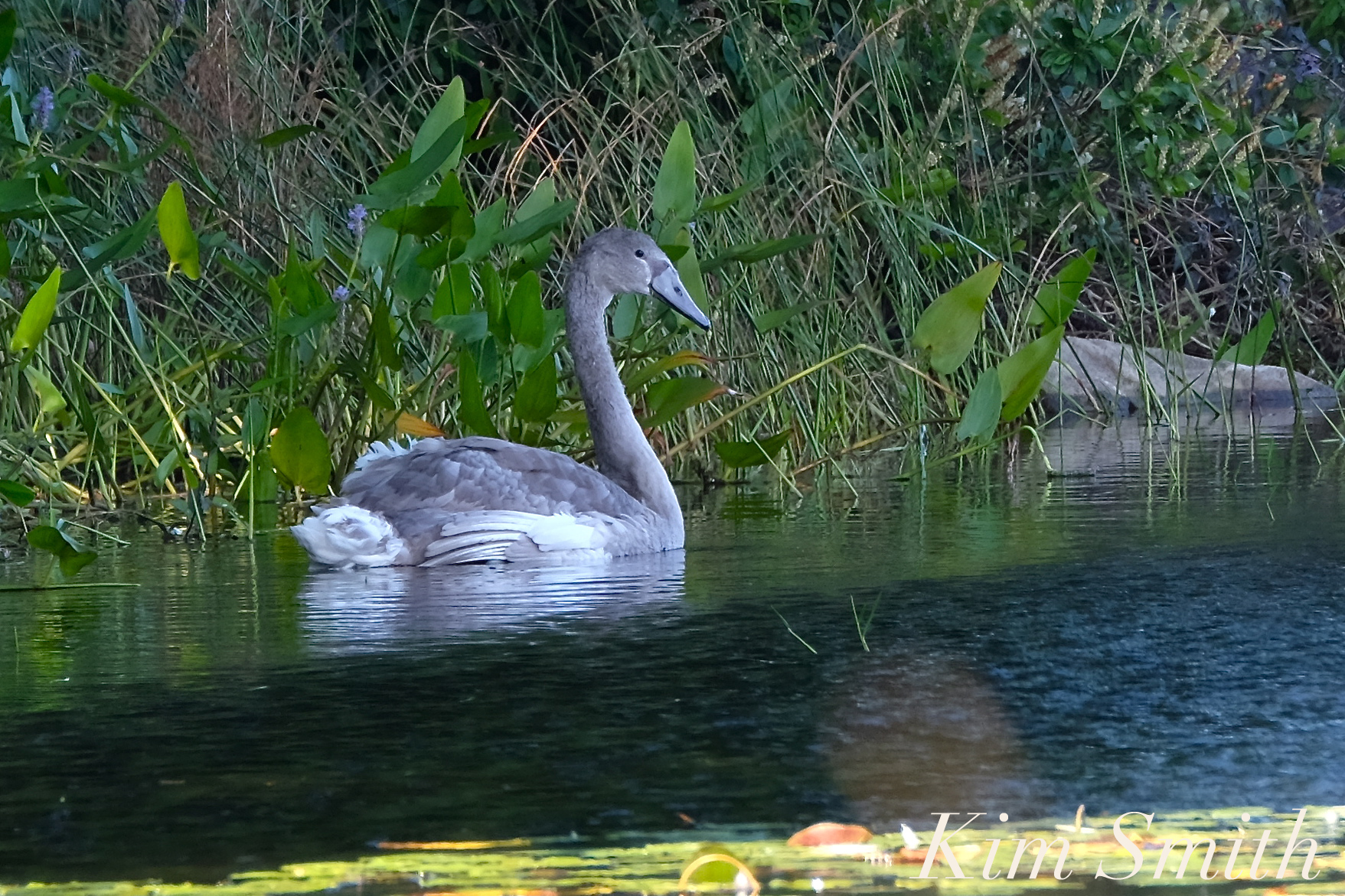
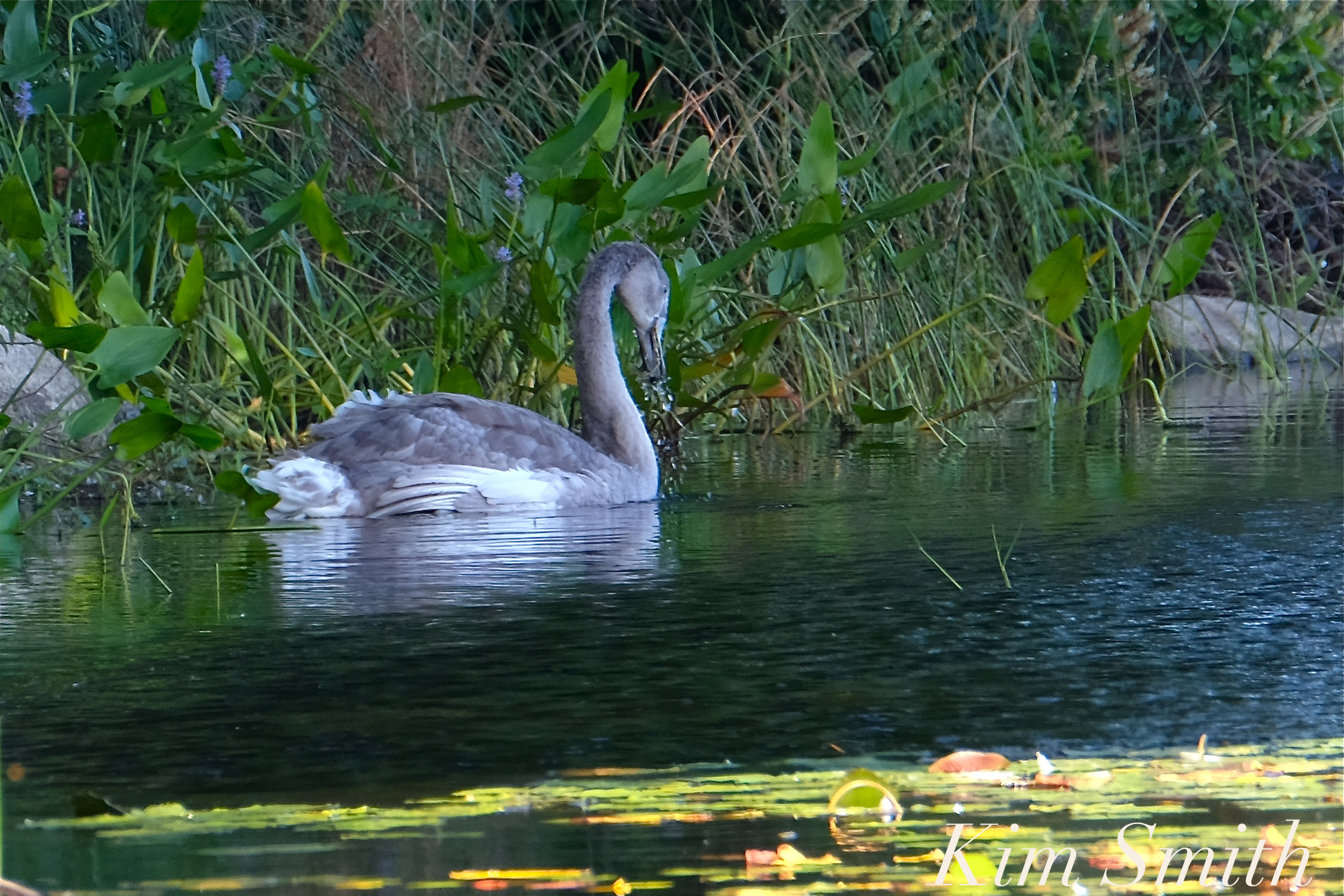
An orphaned swan was introduced to Niles Pond, much to the dismay of Mr. Swan. Eastern Point residents Skip and Lyn kept watch over the two while they reluctantly became acquainted.

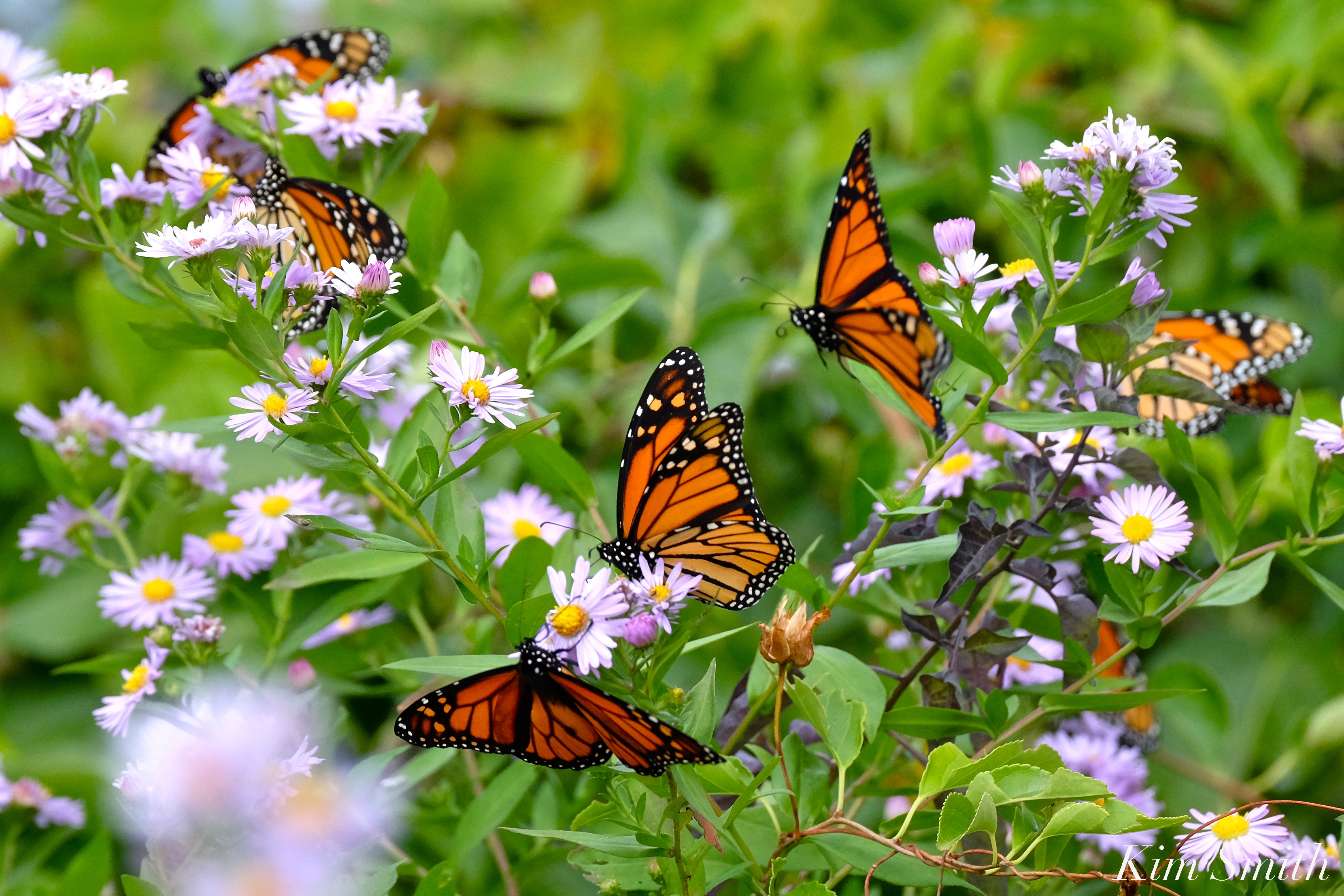
By mid-July many of us were seeing Monarchs in much greater numbers than recent years. Nearly every region within the continental United States experienced a fantastic Painted Lady irruption and butterflies of every stripe and polka dot were seen flitting about our meadows, fields, and gardens.
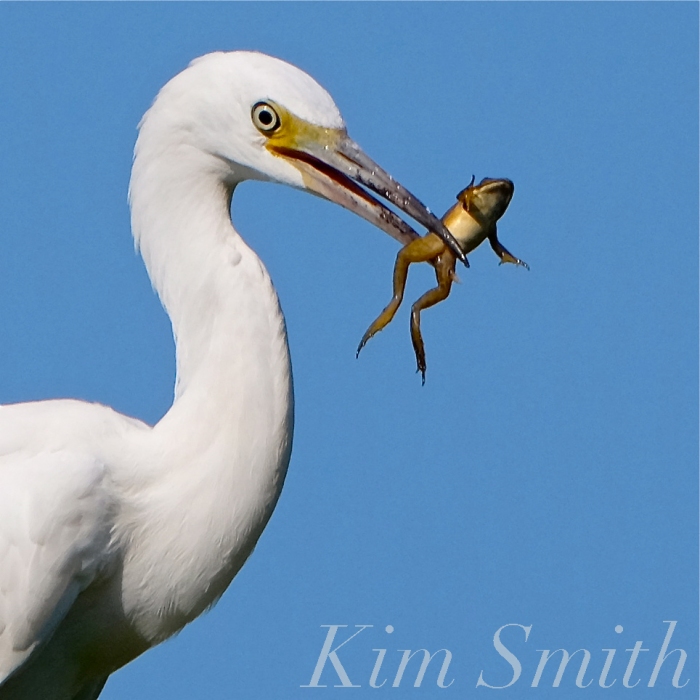
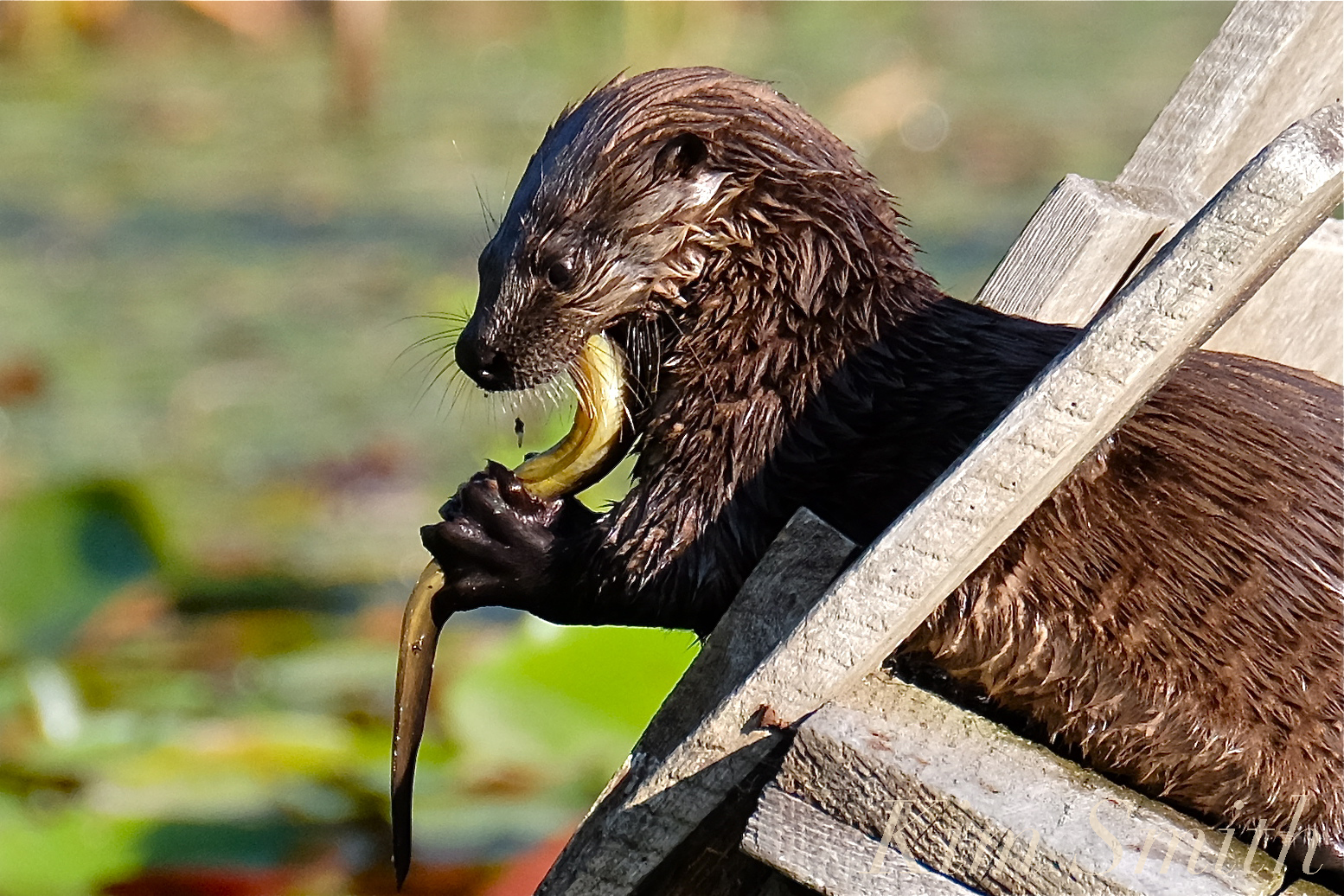
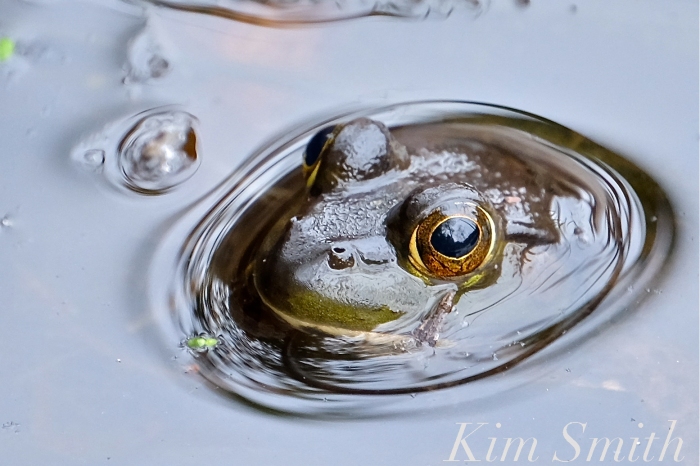
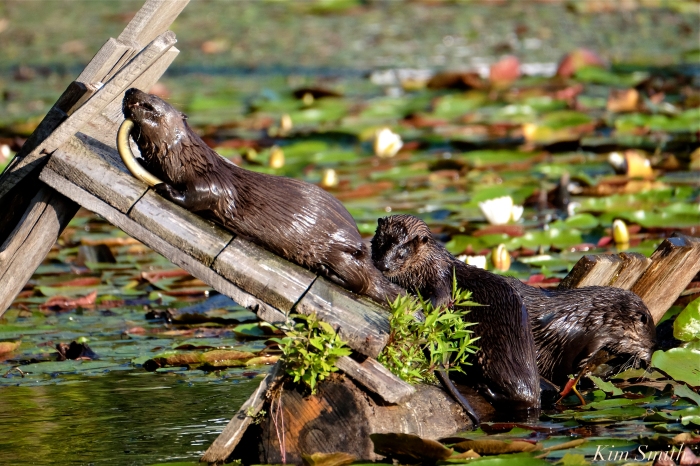
The tadpoles and froglets of American Bullfrogs and Green Frogs made for good eating for several families of resident otters, who are making their homes in abandoned beaver lodges. Little Blue Herons too, find plentiful frogs at our local ponds.

Tree Swallows Massing

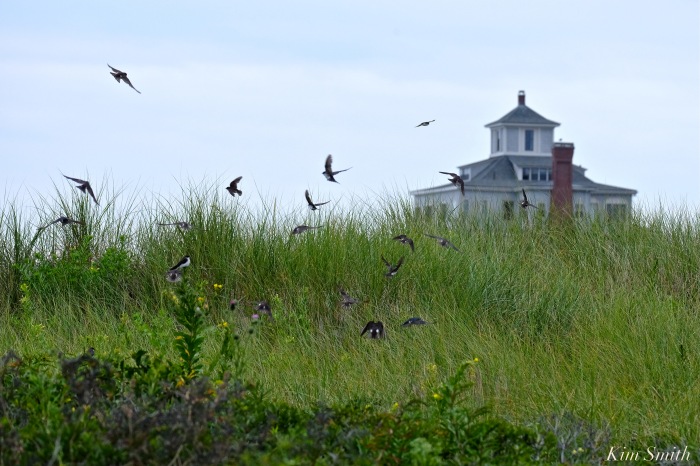
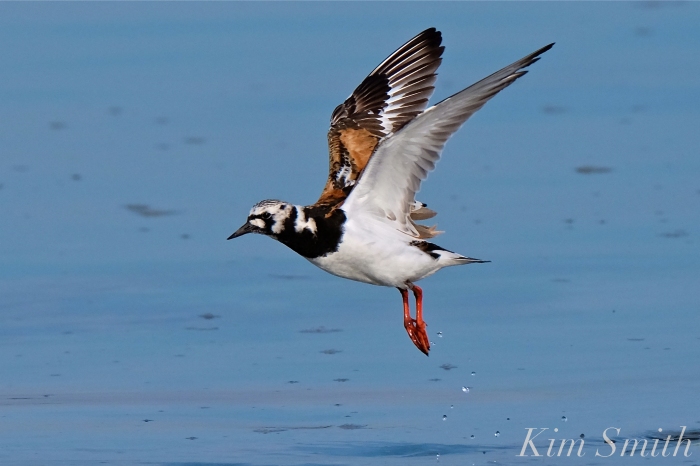
In early August we see the Tree Swallows begin to mass for their return migration. They find an abundance of fruits and insects in the dunes, headlands, and beaches. The Cedar Waxwings and Ruddy Trunstones were observed back again foraging on their southward journey, along with myriad species of songbirds, shorebirds, divers, and dabblers.

FALL

The Late Great Monarch Migration continued into fall as we were treated to a wonderfully warm autumn. Waves and waves of Monarchs came ashore and more butterflies arrived on the scene including new batches of Painted Ladies, Clouded Sulphurs and Common Buckeyes (nothing common about these beauties!).

A pair of Northern Pintails called Cape Ann ponds and coves home for nearly a month while we seem to be seeing more and more raptors such as Red-tailed Hawks, Osprey, Bald Eagles, and Peregrine Falcons. Juvenile herons of every species that breeds on Cape Ann lingered long into the fall—Black-crowned Night Herons, Yellow-crowned Herons, Great Blue Herons, Snowy Egrets, Great Egrets, and Green Herons.

Just as Mr. Swan and the Young Swan appeared to be warming to each other, the Young Swan, who has yet to learn to fly, became trapped in the ice at Niles Pond. He was rescued by caretakers Lyn and Dan and is now spending the winter at a cozy sanctuary built by Lyn and friends.


Heart Wings Monarch Butterfly

Thank you to all our readers for your kind comments of appreciation throughout the year for the beautiful wild creatures with which we share this gorgeous peninsula called Cape Ann. If you’d like to read more about a particular animal, type the name of the animal in the search box and the original post should come up

With its expansive marshes and dunes, bodies of fresh, clear water, saltwater coves and inlets, and geographic location within the Atlantic Flyway, 2017 has been a banner year for Cape Ann’s wild and wonderful creatures. I can’t wait to see what awaits in 2018!
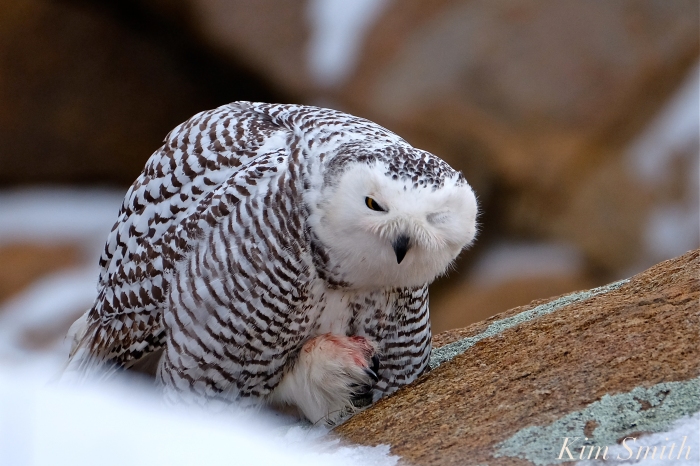
Snowy Owl “Hedwig” January 2018 Backshore Gloucester

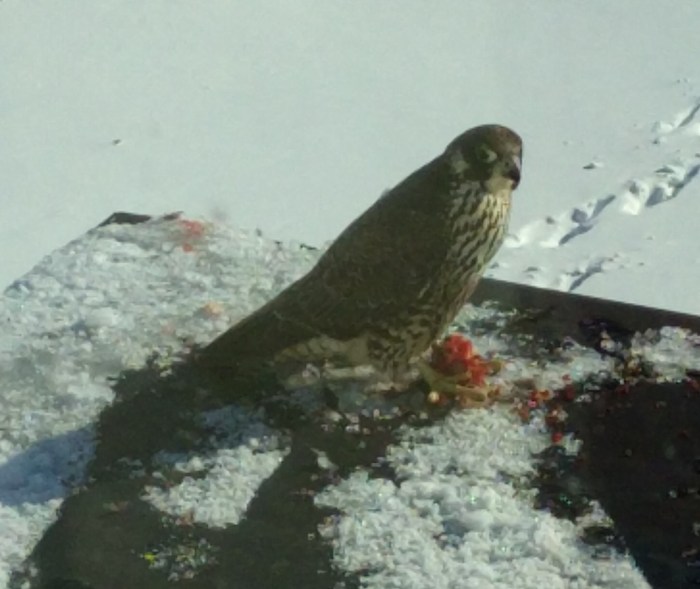
caption this! Hawk eating prey after the storm

Hawk eating an unfortunate bird on the roof of an office of Gloucester home by the boulevard

Post storm wildlife

How would you caption this scene outside your window? My friend shared this photograph of a hawk eating an unfortunate bird on a small roof at her house by the boulevard, Gloucester, MA, January 6 2018.

$34,900.00 RAISED FOR BEAUTY ON THE WING DOCUMENTARY! AND MONARCH BUTTERFLY MIGRATION UPDATE

$34,900.00!!! RAISED FOR BEAUTY ON THE WING DOCUMENTARY! THANK YOU GENEROUS DONORS!!!!!!!!!!!
WITH THE GREATEST APPRECIATION FOR OUR COMMUNITY OF FRIENDS AND SPONSORS, I AM OVERJOYED TO SHARE THAT TO DATE WE HAVE RAISED $34,900.00 FOR THE DOCUMENTARY FILM “BEAUTY ON THE WING” ONLINE FUNDRAISER, with a recent grant awarded in the amount of $10,000.00.

Friends of the Monarch Butterfly: If you would like to help towards the completion of the documentary film Beauty on the Wing: Life Story of the Monarch Butterfly, please consider making a tax deductible donation here:

DONATE HERE

Donors contributing over $5,000. will be listed in the credits as a film producer.

For more information, visit the film’s website here: Monarch Butterfly Film

For an overview of the film’s budget, please go here: Budget

Thank you so very much for your help.

With gratitude,

Kim

MY DEEPEST THANKS AND APPRECIATION TO LAUREN MERCADANTE (PRODUCER), SUSAN FREY (PRODUCER), NEW ENGLAND BIOLABS FOUNDATION, JOHN HAUCK FOUNDATION, BOB AND JAN CRANDALL, MARY WEISSBLUM, SHERMAN MORSS, PETE AND BOBBI KOVNER (ANNISQUAM AND LEXINGTON), CLAUDIA BERMUDEZ (LEXINGTON), JAY FEATHERSTONE, MIA NEHME (BEVERLY), CHICKI HOLLET, JUNI VANDYKE, ERIC HUTCHINSE, KAREN MASLOW, MARION F. (IPSWICH), ELAINE M., KIMBERLY MCGOVERN, MEGAN HOUSER (PRIDES CROSSING), JIM VANBUSKIRK (PITTSBURGH), NANCY MATTERN (ALBUQUERQUE), DONNA STOMAN, PEGGY O’MALLEY, JOEY C., CATHERINE RYAN, JOEANN HART, JANE PAZNIK BONDARIN (NEW YORK), ROBERT REDIS (NEW YORK), NUBAR ALEXANIAN, PETER VAN DEMARK, PATRICIA VAN DERPOOL, FRED FREDERICKS (CHELMSFORD), LESLIE HEFFRON, JIM MASCIARELLI, DAVE MOORE (KOREA), LILIAN AND CRAIG OLMSTEAD, JOHN STEIGER, PAT DALPIAZ, AMY KERR, BARBARA T. (JEWETT, NY), ROBERTA C. ((NY), MARIANNE G. (WINDHAM, NY), PAULA RYAN O’BRIEN (WALTON, NY), MARTHA SWANSON, KIM TEIGER, JUDITH FOLEY (WOBURN), PATTI SULLIVAN, RONN FARREN, SUSAN NADWORNY (MELROSE), DIANE LINDQUIST (MANCHESTER), HEIDI SHRIVER (PENNSYLVANIA), JENNIFER CULLEN, HOLLY NIPPERUS (BROOKLYN), HILDA SANTOS (SAUGUS), TOM HAUCK, AND ANONYMOUS PERSONS FOR THEIR GENEROUS HELP.

https://www.instagram.com/p/Bc5cXVcF2oA/

MONARCH MIGRATION UPDATE

The Monarch migration of 2017 was the latest ever recorded and the butterflies are continuing to arrive!

The region where the Monarchs spend the winter is confined to a narrow altitudinal band across twelve trans-volcanic mountaintops in central Mexico. This narrowest of overwintering habitat is only 73 miles wide. What allows the Monarchs to survive in these these twelve habitats? The sites are at a high elevation of 10,000 to 11,000 feet, where the temperature hovers around freezing at night and warms during the day to about 50 to 60 degrees. The towering cathedral-like Oyamel Pine Trees contribute to creating the perfect microclimate to meet the butterflies needs by providing shelter from harsh winds and when the Monarchs cluster together high up on the Oyamel boughs they maintain a cool temperature, which conserves the fat that they stored on their southward migration.

During the month of December, the all important work of counting the butterflies takes place. Several years ago a late migration occurred (not as late as this year’s) and the scientists counted the butterflies a bit too early. I hope they wait until much later in the month to begin the count.

If you would like to learn more about how to count Monarchs, go to this to link to an interview that I conducted with Thomas Emmel, the Director of the McGuire Center for Lepidoptera and Biodiversity at the Museum of Natural History of the University of Florida, Gainesville. Dr. Emmel is a butterfly population specialist and has been counting the Monarchs since 1980. The interview took place at Sierra Chincua Monarch Butterfly Biosphere Reserve in Angangueo, Mexico.

DAY TWO FOR THE RESCUE SWAN

Our Niles Pond rescue swan has survived her second night! She is still not venturing far from the reeds. Mr. Swan is definitely aware of her presence but is playing coy and for the most part, ignoring her. The good news, or great news I should say, is that he is not chasing and threatening her.

New Swan is continuing to feed on pond vegetation. I didn’t get a glimpse of her until around 11am when the light was very harsh, but here she is at the pond’s edge, photo bombed by a stealthy Green Heron.

BREAKING: A NEW COMPANION FOR MR. SWAN (HOPEFULLY!)

Cape Ann’s wildlife rehabilitation expert Jodi Swenson released a Mute Swan fledgling Saturday at Niles Pond. Jodi worked with Eastern Point resident Lyn Fonzo, where they set the young swan free from Lyn’s beach access to the pond’s edge. Lyn reports that the fledgling immediately headed to the reeds. Niles Pond is dense in vegetation, most notably at this time of year, and almost immediately, it was difficult to see her hiding, although easy to hear, as she moved through the phragmites and cattails.

Jodi, from Cape Ann Wildlife, shares that the Mute Swan baby has been in her care for several months. The cygnet came from Tufts and she/he appears to be about four months. Jodi raised the swan purposefully with minimal human contact so that the animal would remain wild. The now fledgling is very, very shy of humans, so please be respectful while the swan is becoming acclimated to her new environment. Cape Ann’s Mr. Swan is at least 27 years old and it is everyone’s greatest hope that he will “adopt” the new one, perhaps guiding her to maturity.

The above photo, although out of focus, is included here to show that the young one is foraging for food on her own. Look closely and you can see the pond vegetation dangling from her mouth. This is a great sign, that she can feed herself!!

Please visit Jodi’s website, Cape Ann Wildlife, Inc. I am sure we can all imagine how costly and time consuming it is to rehabilitate orphaned and injured wildlife. If so inclined, please think about making a tax deductible donation. Our deepest thanks and appreciation to Jodi for all the care and love she gives to Cape Ann’s most vulnerable animals. Until recently, Jodi was Cape Ann’s only wildlife rehabilitator. Jodi would like to give a shout out to Erinn Whitmore, who has been working with Jodi for many years, and who recently earned her state wildlife rehabilitator’s license. Erinn has founded GROWL: Gloucester Rehabilitation of Orphaned Wild Life, and will be specializing in caring for small mammals.

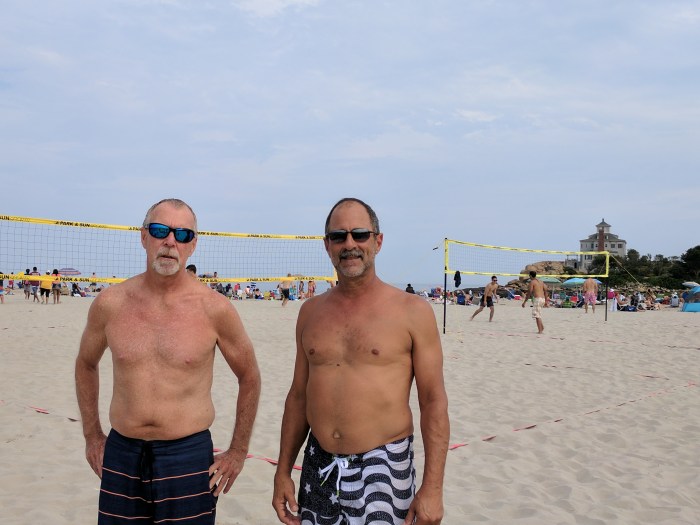
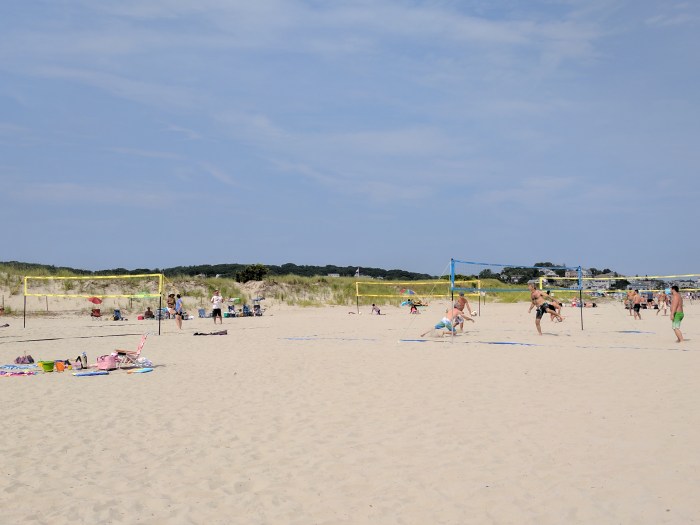
Good Harbor Beach volleyball players assist the piping plovers and

it’s not the first time! Love these stories. #sharetheshore

From Hazel, piping plover volunteer: I was round the bend (!) replacing signs a little later – one of the volleyball players said he had escorted both of them to the creek. I have been turning people back from playa del plover & maybe 1/2 hr ago a small boy spotted an adult as he (the boy) was leaving.

IMG_20170722_153405.jpg

Dave (whisperer) and Bill

IMG_20170722_153114.jpg

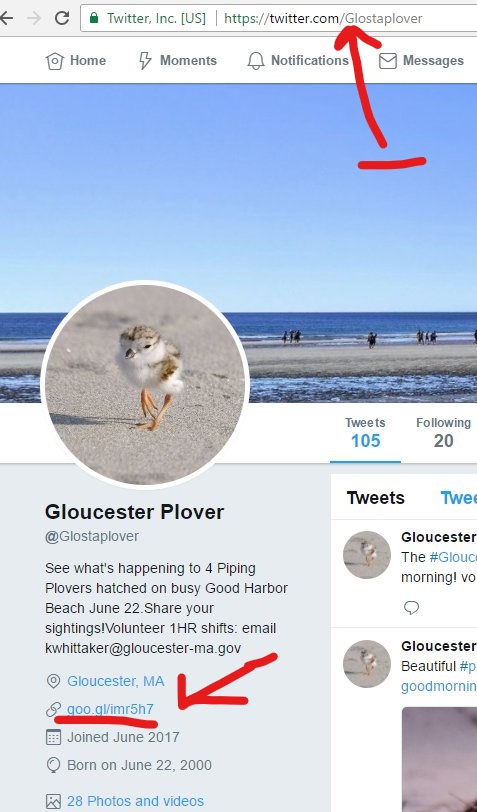
link to Gloucester Plover on twitter:  https://twitter.com/Glostaplover

link to Google docs Volunteer log 

#Glostaplover Twitter home page help.jpg

INJURED PIPING PLOVER UPDATE #2

4:20pm Update:
Catherine, George, and Charles drove our littlest chick to the Cummings School of Veterinary Medicine at Tufts. Thanks to Jodi, they were prepared and waiting for him. Little chick was assigned a case number and we were told to call after 3pm. As I am writing this report, Avery from the school just returned my phone call. She sounds terrific and was very helpful in explaining little chick’s injury and care. He has a traumatic brain injury, most likely caused by being stepped on. Little chick is being given supportive care, which includes pain medication, an anti-inflammatory, and fluids. He is also in an oxygen cage that allows him to breathe more easily. The vets are guarded in their prognosis as recovery from head trauma is very unpredictable.

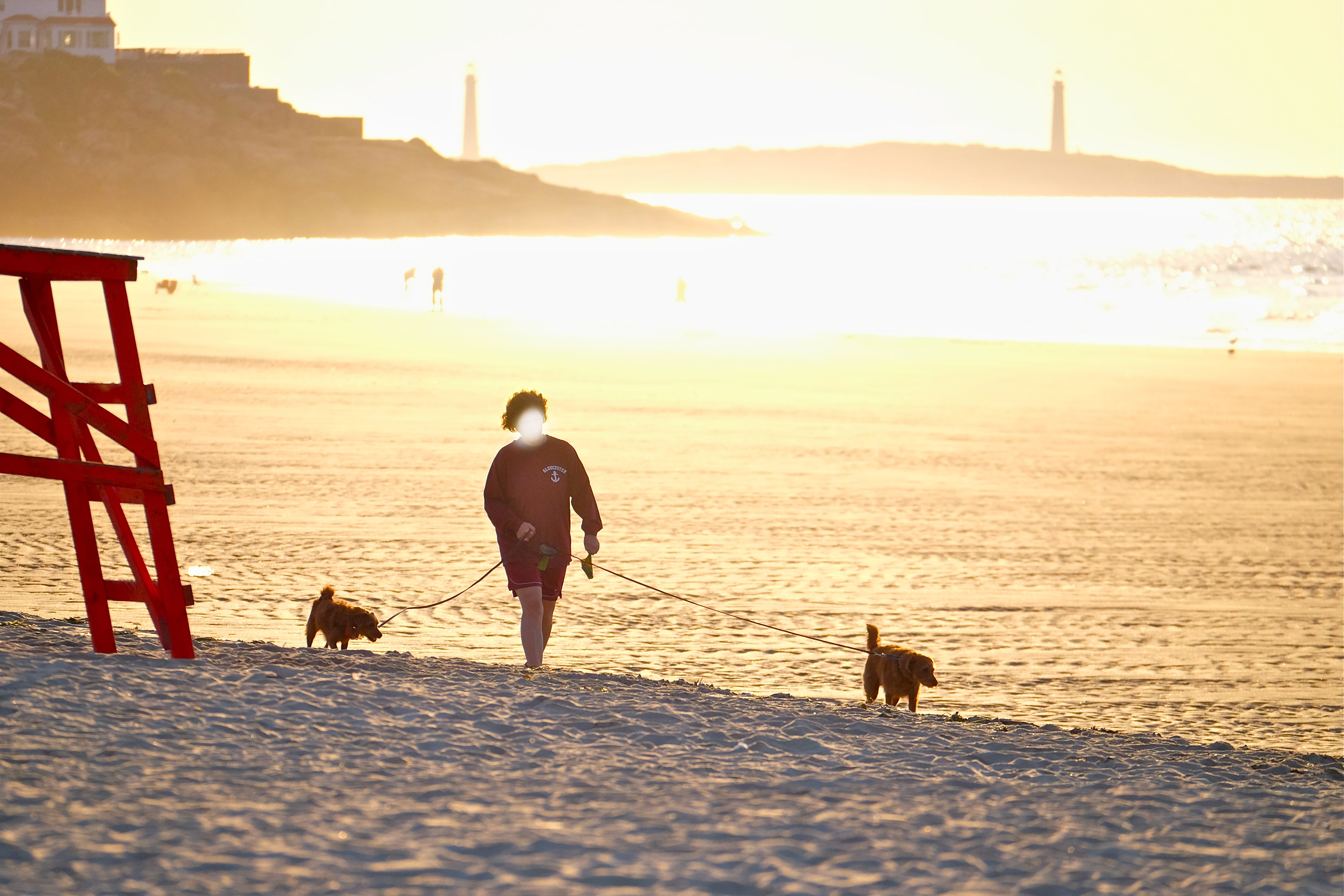
Very sadly, I have to report that dogs were running around the beach unleashed at the time of the injury. No one witnessed exactly what happened, but last year I saw a dog running over and instantly killing a chick, despite my very best efforts to get the owner to control his dog. This morning at 6am dogs were on the beach leashed, but the owner was obliviously walking her two dogs through the sanctuary area precisely where the chicks were darting about. Leashed or unleashed, irresponsible dog owners are one of the chick’s greatest threats. Please, please folks tell your friends and neighbors about the Plovers and why it is so important to follow the dog ordinances. It seems as though late in the day, after 5 and before sunset, the chicks are the most vulnerable. Perhaps folks think its okay to bring dogs to the beach after the life guards leave. Early evening is exactly the same time of day that the chick was killed last year.

Our two Good Harbor Beach siblings, this morning at fourteen days old.
Earlier this morning updates:
Catherine writes, “I called Kim who met me right away at the beach. Soon After 9pm Jodi was there getting the bird. Jodi implemented  ER incubator and hydration methods. By 11pm chick pooped which may be sign that he was reacting to rehydration. (She explained that body shuts down digestion quickly to protect brain and heart. Pooping could be things working.) One eye swollen may equal head injury or seizure. All was speculation and she hoped chick would make it through night.”
Volunteer Nancy, who found the chick wrote, “My daughter spotted the chick on the soft sand lying just off the wet sand of the creek bed near where we were this morning. My son in law carried the chick from creek bed to large enclosure. I held chick while giving it water and tried to keep it warm, then put it in the covered part of the enclosure on advice of Audubon woman, hoping its mom would be able to give care. We called every emergency number we could find but no one picked up. Thank you so much for responding as you did.”
Today at 6:15am–dog walking through the Plover’s sanctuary–leashed or unleashed, dogs (as well as people) unintentionally step on Plovers. Please be careful.

INJURED PIPING PLOVER UPDATE

Our littlest Piping Plover is on its way to Tufts with Catherine and her sons George and Charles.

Photo: Jodi Swenson, Cape Ann Wildlife. Jodi is Cape Ann’s resident bird rescue expert.

BREAKING: TWO CHICKS CELEBRATING TWO WEEK MILESTONE, ONE CHICK HANGING ON BY A THREAD

Mama and the two fourteen-day-old chicks this morning at daybreak.

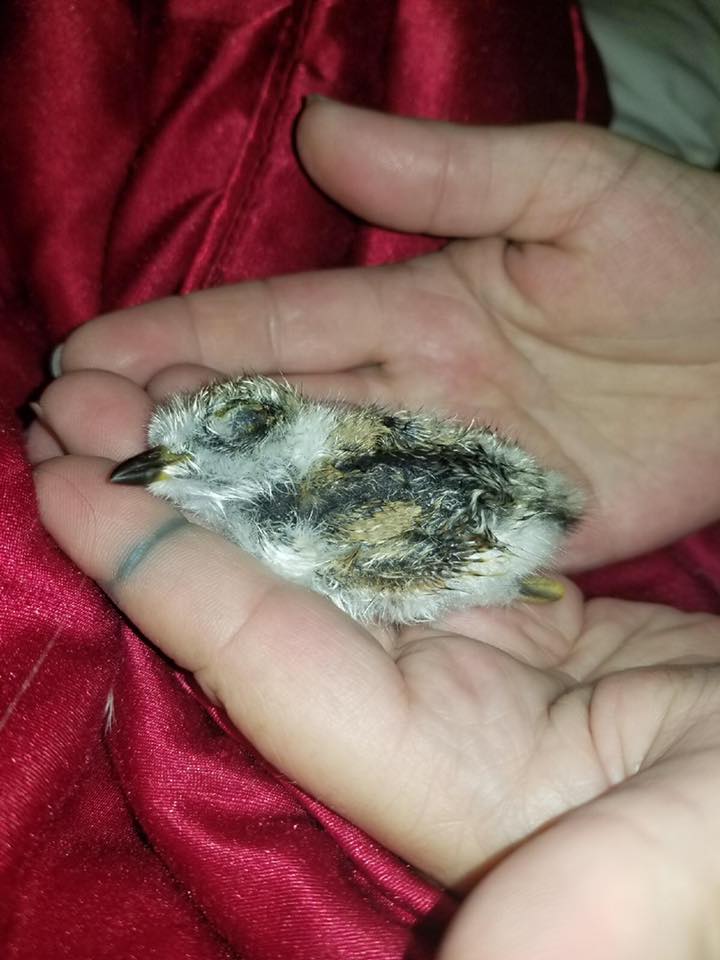
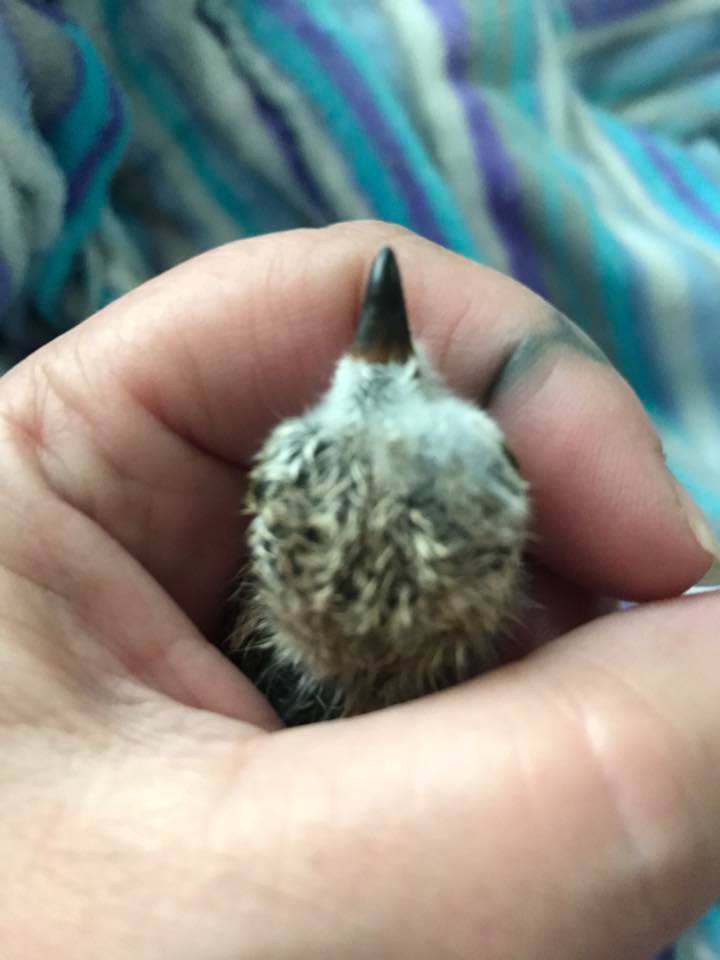
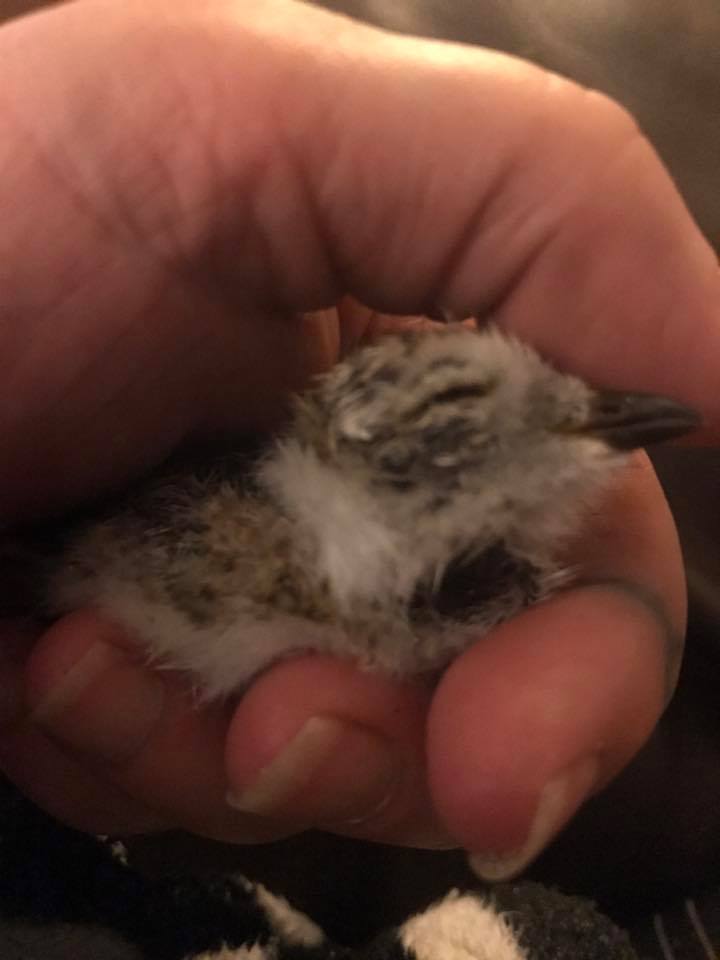
Two of our three Piping Plover chicks are doing beautifully, the third however is hanging on for dear life. The littlest chick was found limp and helpless by beach goers, on the dune edge near the creek. The chick was placed in the wire enclosure where Catherine Ryan and I found it at around nine pm. Jodi Swenson from Cape Ann Wildlife arrived shortly thereafter. She immediately tucked the chick into her shirt and has been keeping the chick in a warming nest. Jodi reports that the chick’s eye is swollen and that it is having neurological problems. More information to follow.Little Chick’s right eye is very swollen.
Jodi’s snapshot from last night.

If your deck chairs are missing…and you want to see a coyote

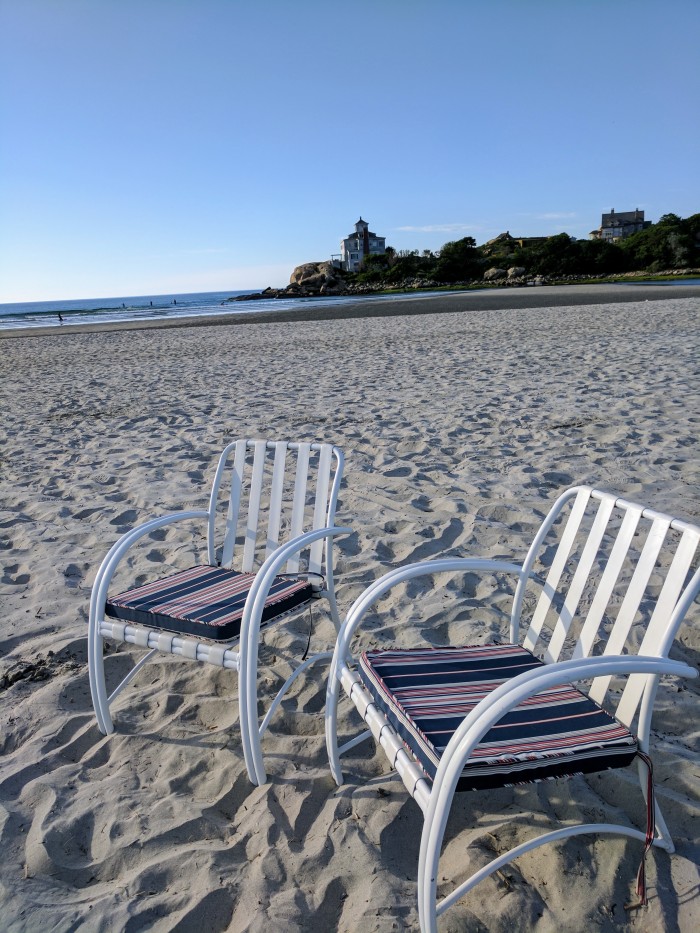
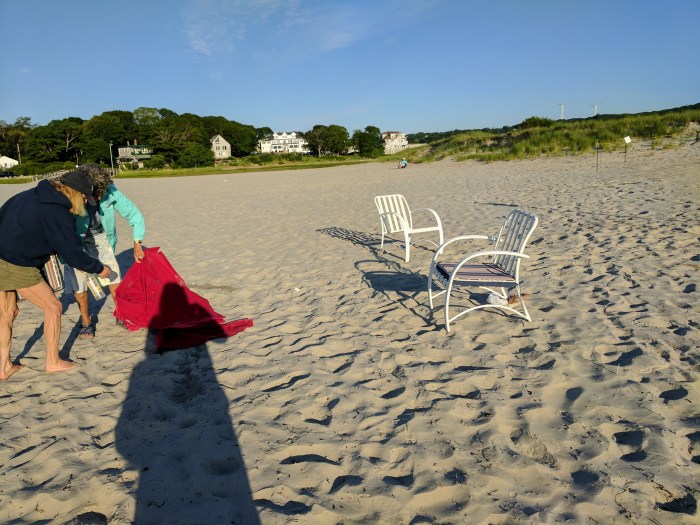
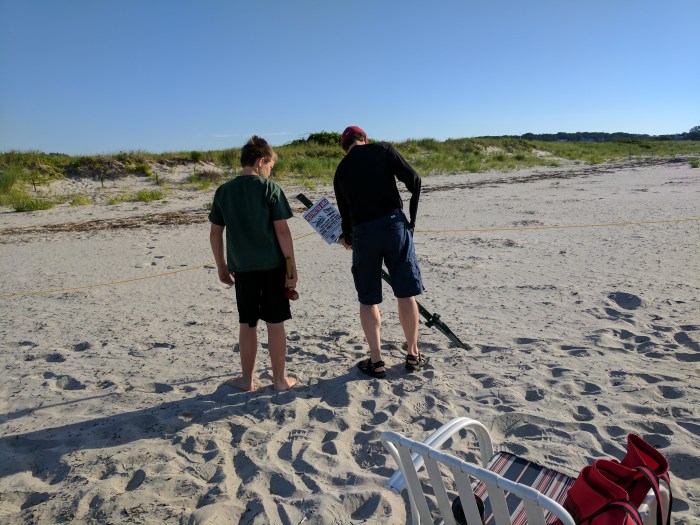
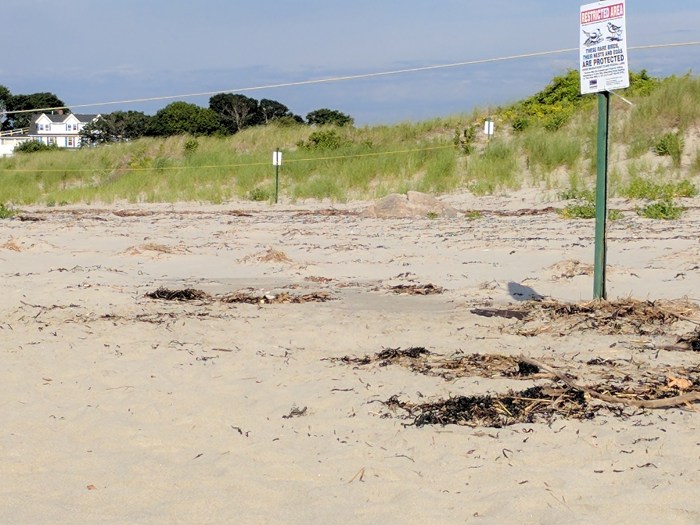
We found them at Good Harbor Beach, July 4 2017. The striped cushions are the right color! The pair were upended and cushions scattered along with various party remnants between the pedestrian bridge and the piping plover enclosure. We righted them and set them up for Piper Plover viewing.  Some folks vandalized the endangered species signs and littered, and others were picking up trash and repairing.  The coyote and birds were on the move.

IMG_20170704_070304

IMG_20170704_065601

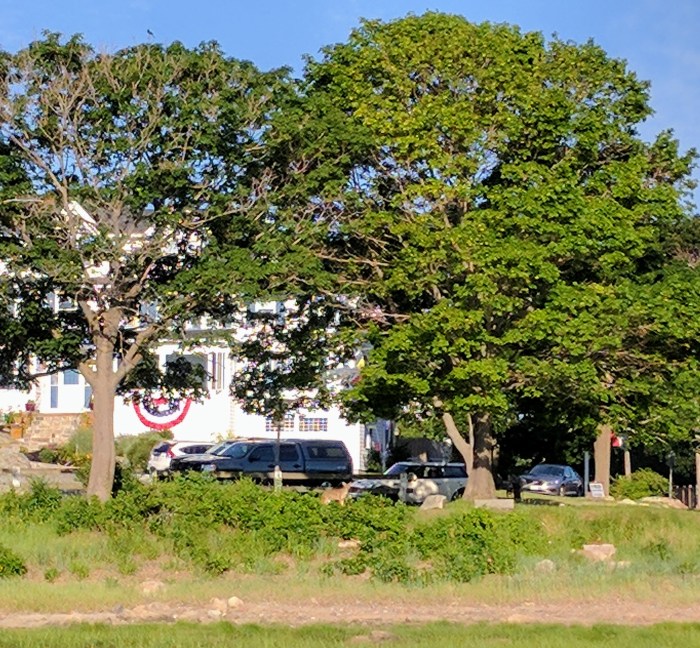
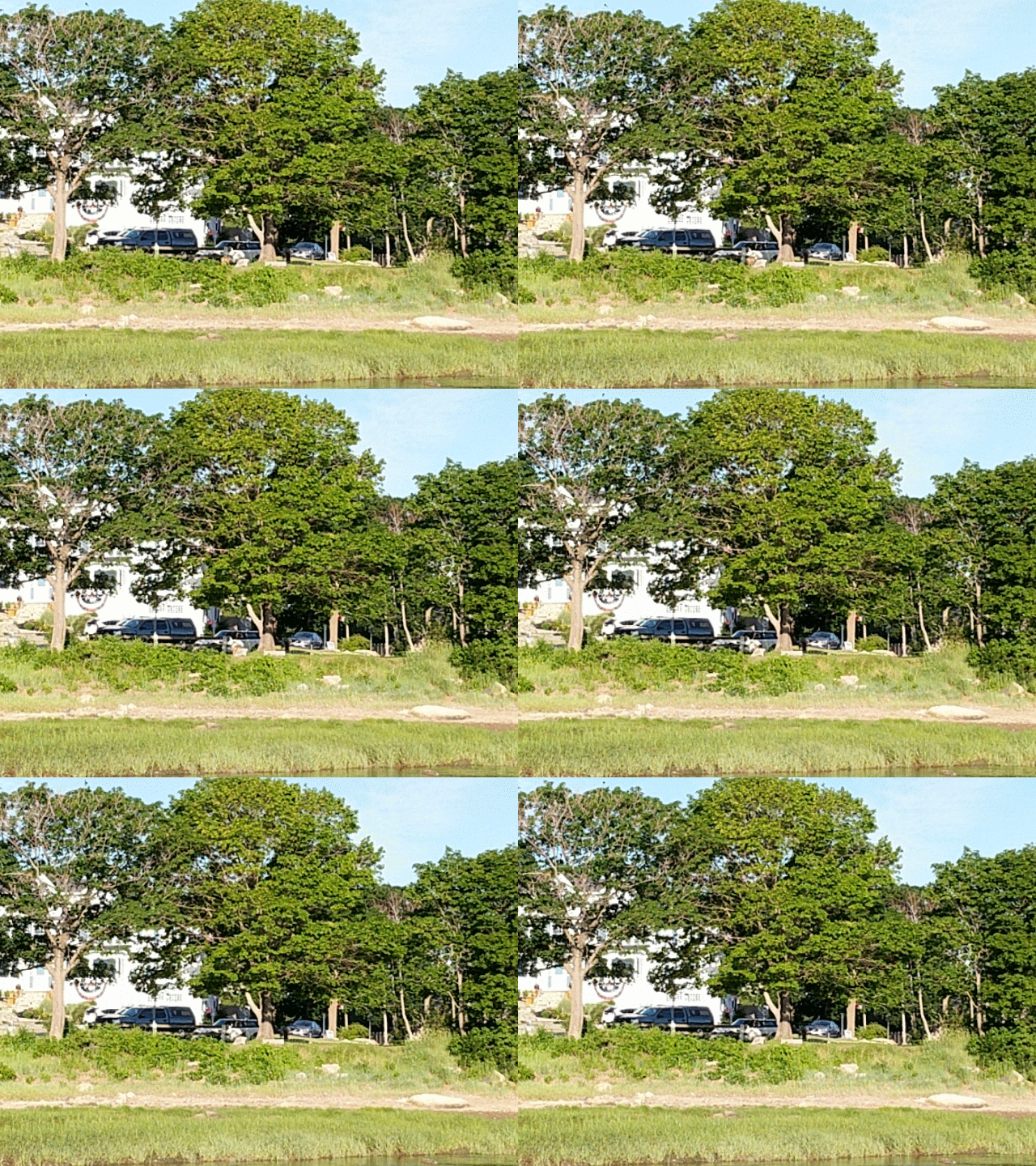
There was a great crow ruckus in the trees across from Blue Shutters Beachside Inn and out popped the coyote. Hung around the creek and then off down the road past http://www.blueshuttersbeachside.com/ 

Burst_Cover_GIF_Action_20170704065604 (1)

Patti Amaral July 4, 2017

IMG_20170704_063248

Peggy and Patty July 4, 2017– Peggy spotted the plover family of 5 this morning, Day 12. All are ok after an eventful Day 11 — see Kim Smith’s glorious photojournalism update 


IMG_20170704_064024

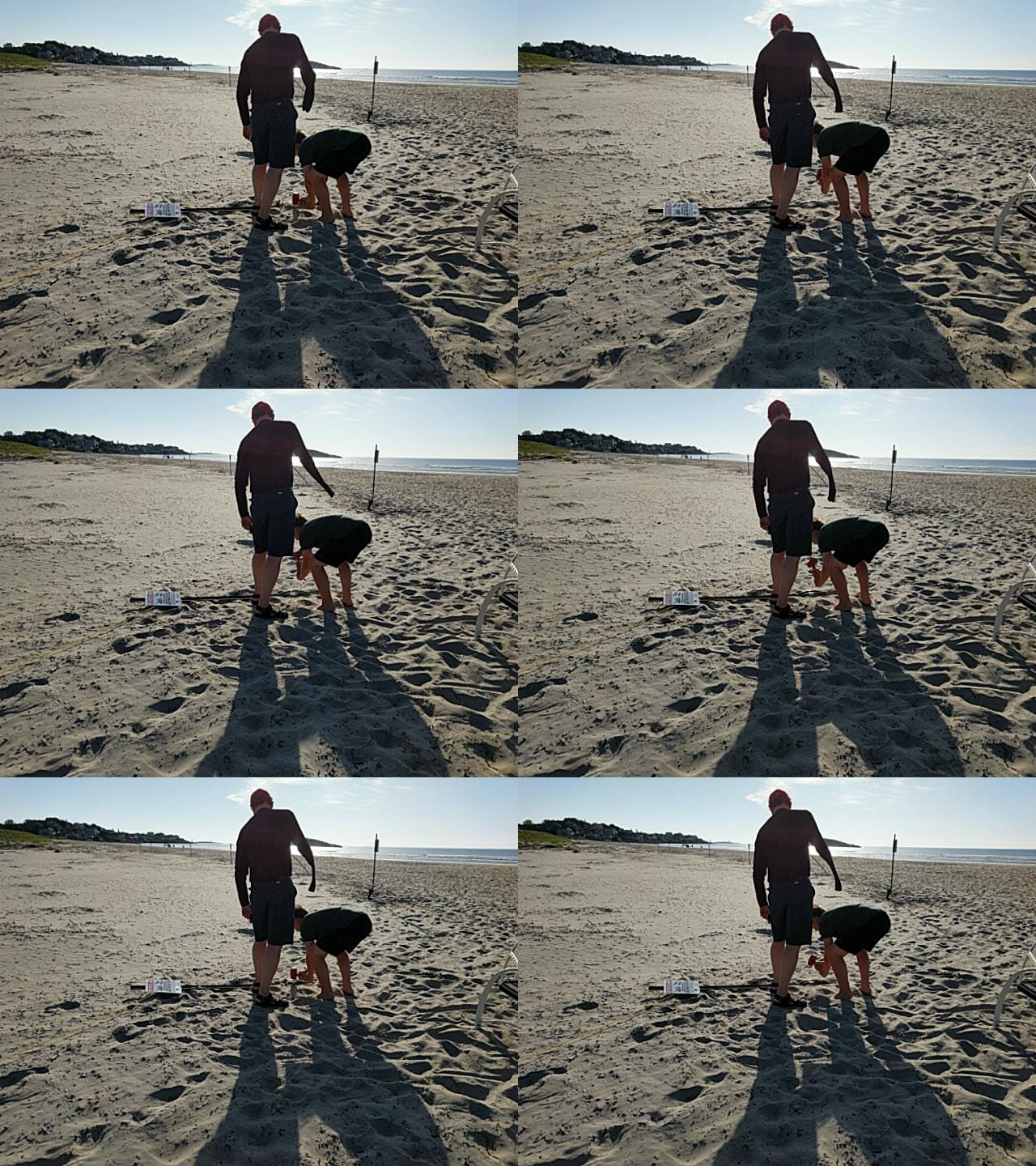
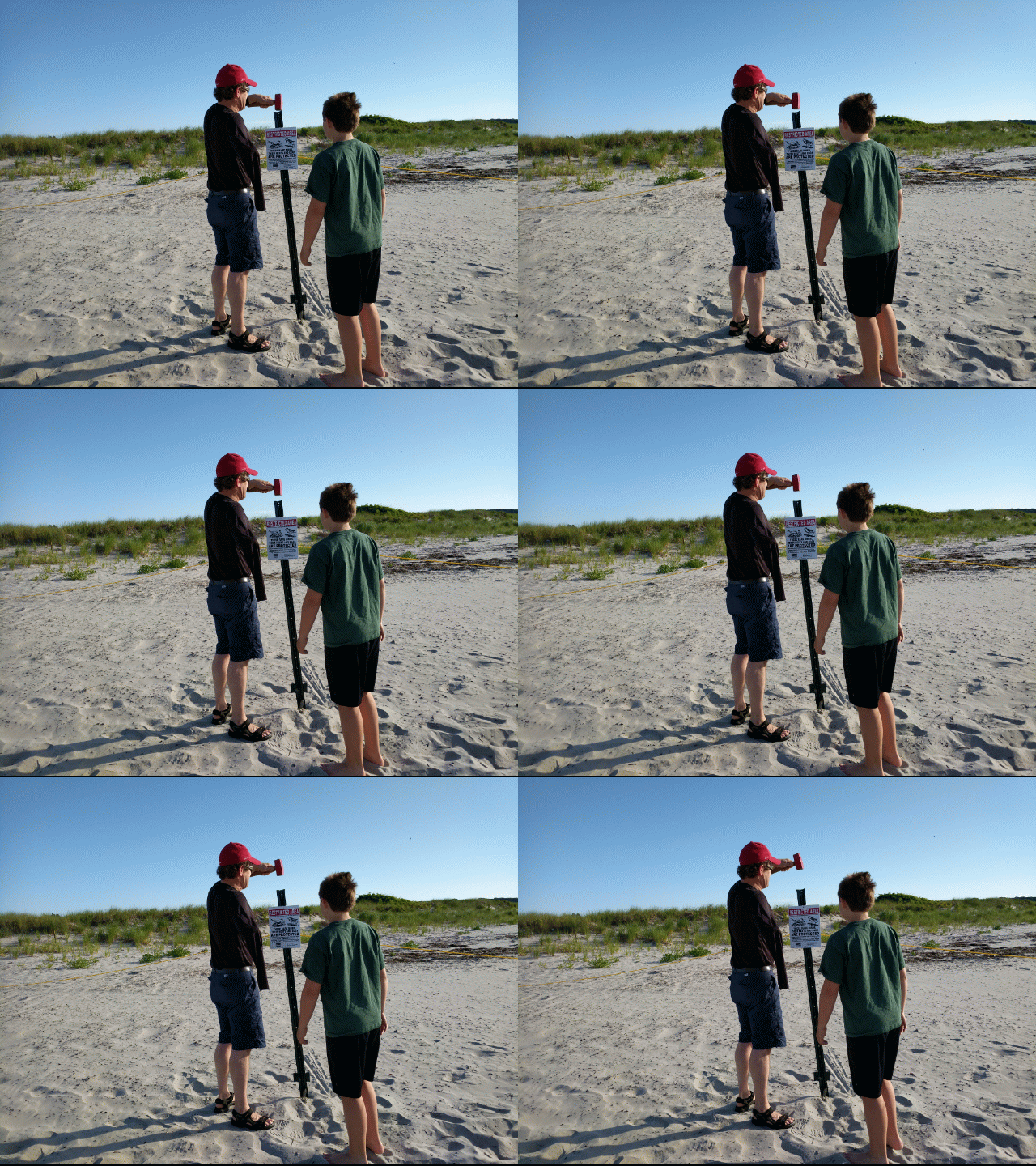
Piping plover 3rd shift brought a hammer

IMG_20170704_071159.jpg

Burst_Cover_GIF_Action_20170704071209 (1)

Burst_Cover_GIF_Action_20170704071339 (1)

Naked eye test | Share your piping plover sightings #Glostaplover

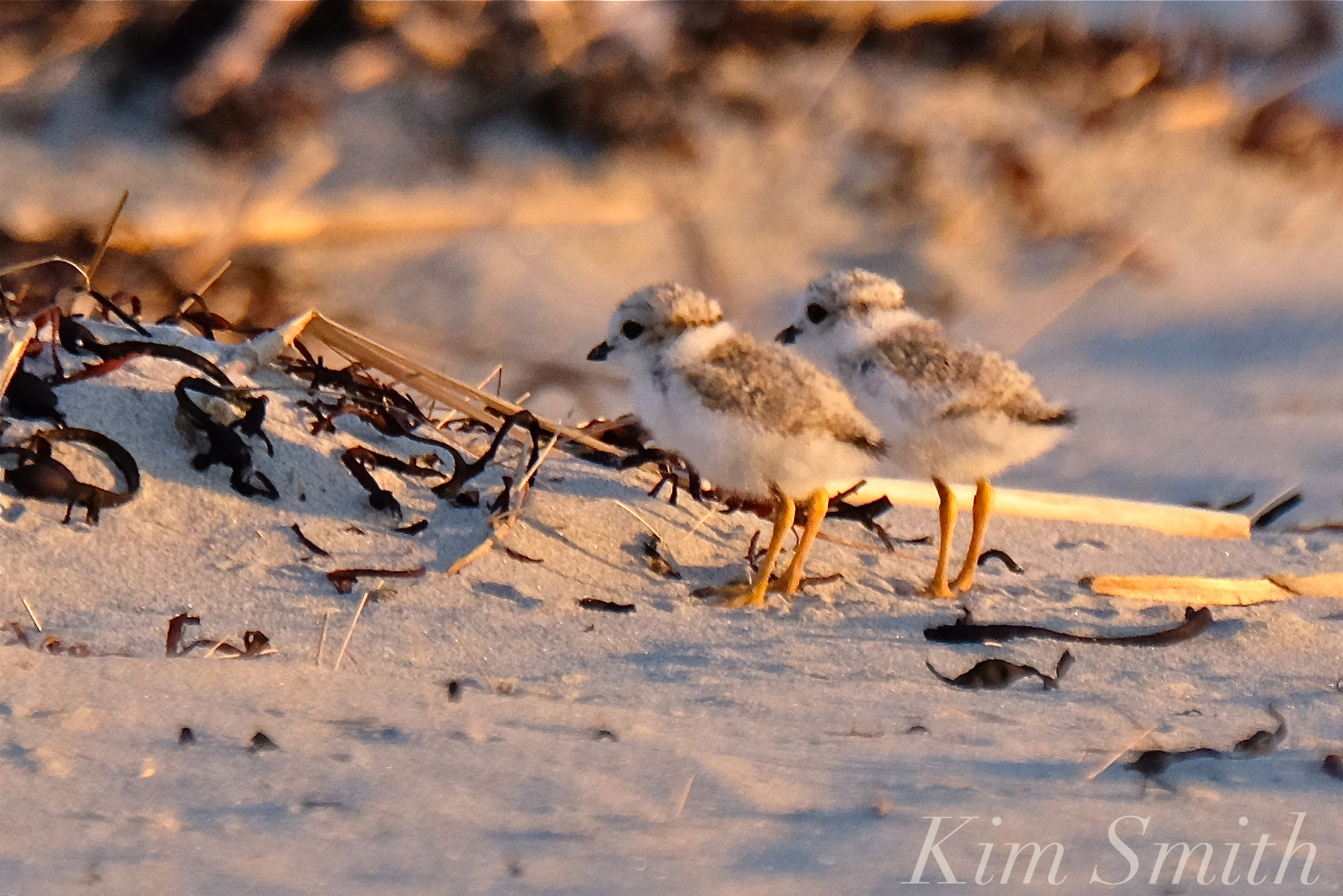
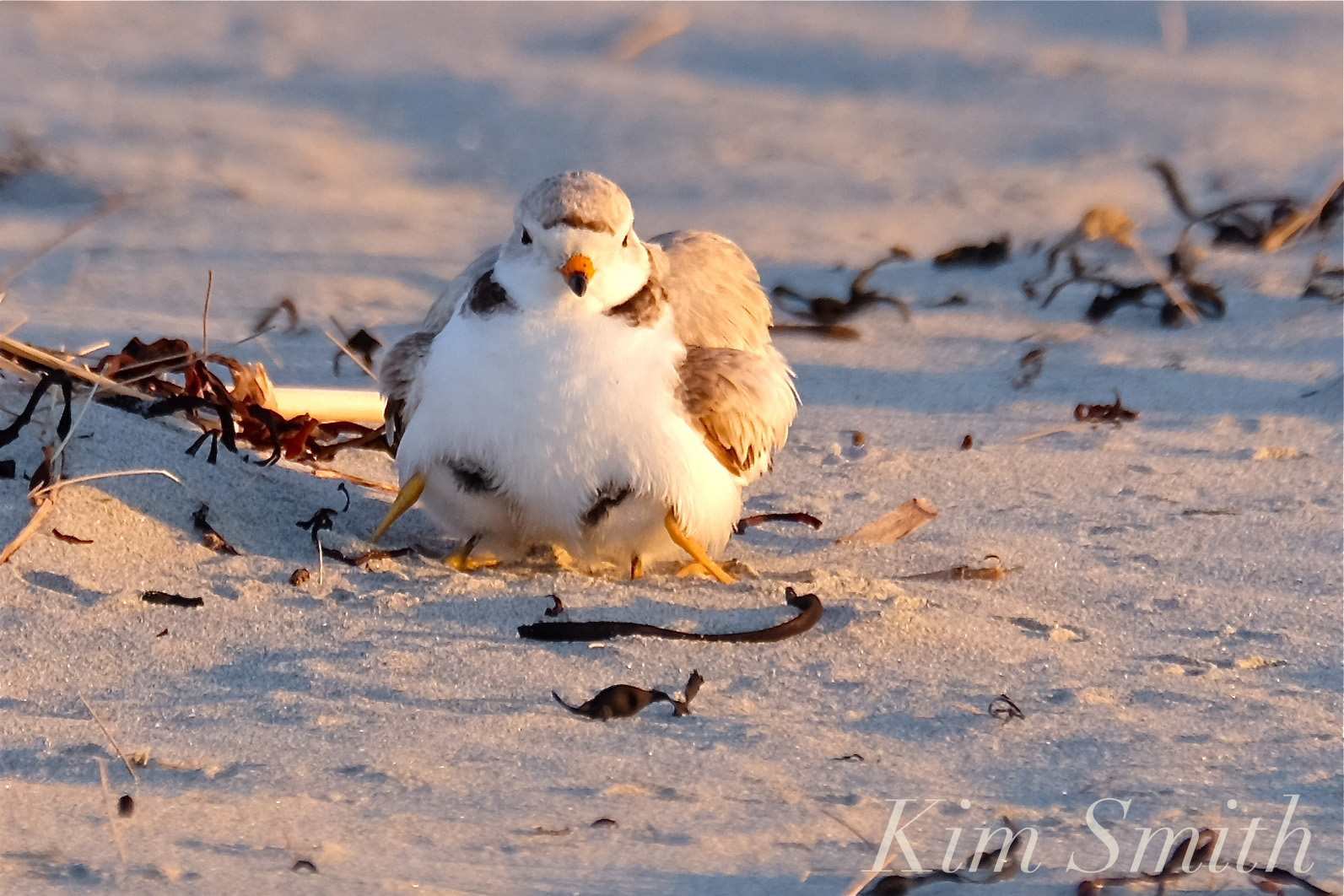
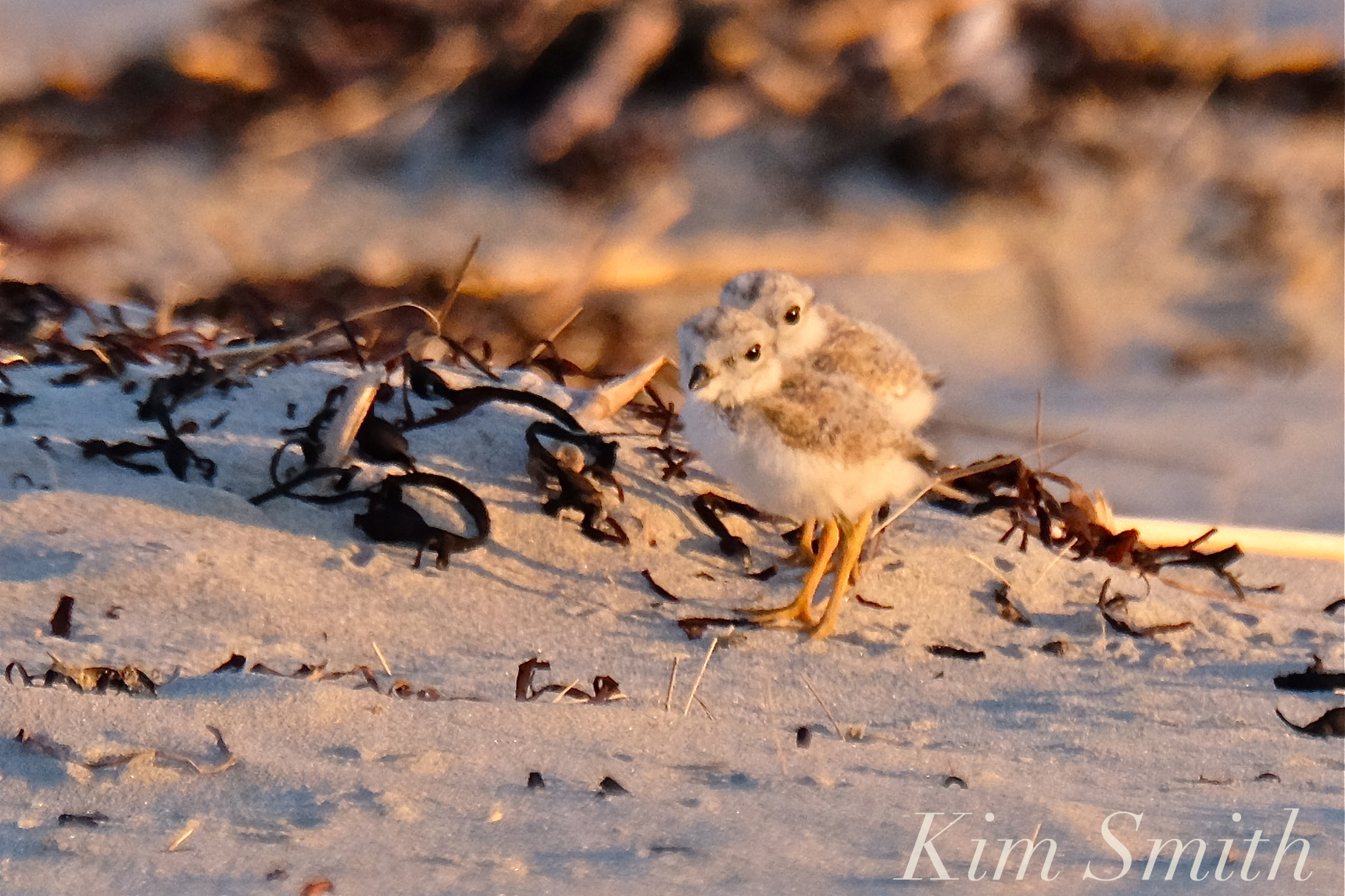
Can you spot a piping plover? Train your eyes to scan for movement–it’s the easiest way to spy the piping plover summer 2017 brood. They scuttle along dry seaweed patches back and forth to the wet sand and within the enclosure. Yesterday the baby chicks were still apt to topple over inside sand scallop depressions.  Their future wings are visibly growing out. Now 1 week old, their sweet piping chirps are clearly audible. The parents are much easier to find. We’re lucky we can see the birds close up in Kim Smith’s gorgeous art.

Phone in hand? Share your Good Harbor Beach piping plover photos and observations! tag #Glostaplover and follow Gloucester Plover at https://twitter.com/Glostaplover

Volunteers are needed for shifts over the upcoming holiday weekend. Contact Ken kwhittaker@gloucester-ma.gov

IMG_20170627_074530

Cool science at Good Harbor Beach | sign up for Piping plover watch

IMG_20170626_113221

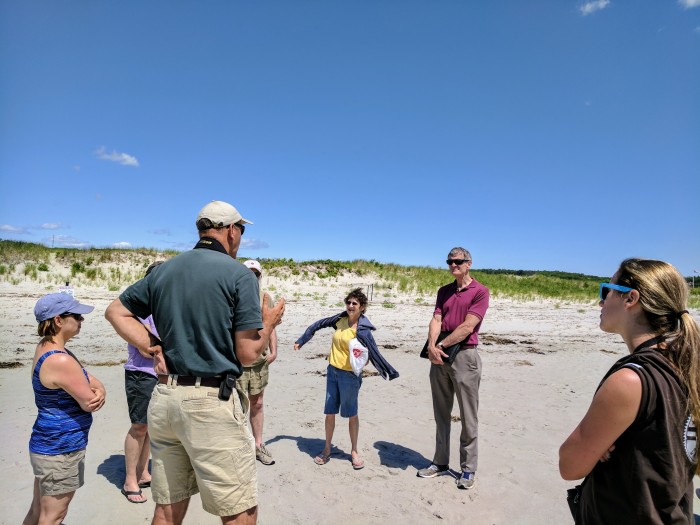
photo caption: Dave Rimmer, Director of Land Stewardship, Essex County Greenbelt (Left) with Ken Whittaker, City of Gloucester Conservation Agent (Right)

Contact: Ken Whittaker kwhittaker@gloucester-ma.gov

Ken Whittaker, City of Gloucester Conservation agent, put the word out seeking volunteers to help monitor the piping plovers (Gloucester Daily Times). Today was the first organizational meeting and informational session with Dave Rimmer, Essex County Greenbelt. Ken is coordinating the schedule, and there are plenty of open slots available. “We will take this a day at a time until I have the opportunity to put together a formal schedule.”  More than one volunteer is welcome on any shift, so please email if you’re interested in helping. Ken, Dave and other officials monitor the birds. When Kim Smith is there, she’s working on critical filming.

For those of you who could not make it, Ken Whittaker is holding a second meeting tomorrow evening about 4:30; Ken will be at Good Harbor Beach from about 3:30 to 5.

Piping Plover volunteers can receive free parking!

Planning on a beach day and can devote an hour of your time for observation? Email Ken to sign up for a shift and to learn more.

Volunteers are asked to bring binoculars and feel free to jot down some observations about the parents and the 2017 brood of 4. It’s simple. The birds need to be left alone and given wide berth when they’re on the move.  Don’t follow after them. Look but don’t touch. Maybe intercept trash tumbleweeds. What gets tricky is when the birds are going back and forth from the water to the enclosed area.

Thanks to the enclosure, it’s obvious to stay away from inside the protected area. What’s less obvious is where to put your towel outside the fence.  If you know your beach visit wouldn’t be complete without a vigorous paddle ball, can jam or football game, lining up your towels right outside the fencing is a little dicey. It happened today and the group was happy to move when Ken explained the situation. However, if you’re not one for major games and are happy to sit in your chaise for a long read and full day, you might want to think about doubling up as a piping plover volunteer for one hour. You’re there anyway. They are super cute and you’ll feel good helping out! Midday is low on sign ups.

You could make it a first class retreat: Good Harbor Beach rents umbrellas and cushy recliners. See “Good Harbor Beach Day: How To Pack Light”

Ken writes:
“I have been in contact with the animal control officer who says she has been monitoring the situation but will kick it up a notch.  Dogs are not allowed on the beach and you can remind scofflaws of this.  If this becomes an issue I suggest people immediately call 978-281-9746 – Diana Corliss is the animal control officer and she can guide you from there. (Note, three essentials for monitoring include cell phone, binoculars …. and sun screen!)”

IMG_20170626_111859

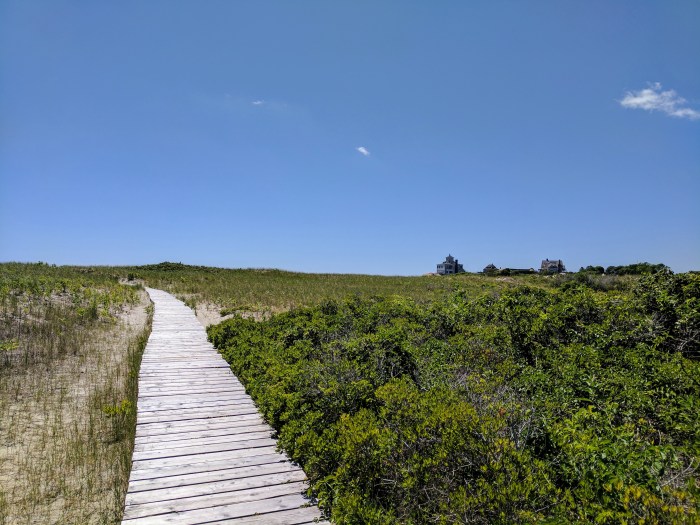
Essex County Greenbelt is responsible for the fencing of the protected area which is to the right of the boardwalk #3. They’ll tweak the fencing as needed. This year’s nest is within a close distance to last year’s nest.


IMG_20170626_111058
The piping plovers nested on the beach by the dune’s edge to the right of boardwalk 3 


What if…a section of Dogtown brush was cleared away? If you missed Chris Leahy at Sawyer Free Library last week come to a summit by Essex County Greenbelt & Mass Audubon at Cape Ann Museum March 4

“This Saturday morning forum is offered in collaboration with Essex County Greenbelt, Friends of Dogtown, Lanesville Community Center and Mass Audubon and held at Cape Ann Museum. The forum will be moderated by Ed Becker, President of the Essex County Greenbelt Association.”

Register here

UPDATE: Cape Ann TV is scheduled to film the event!
hopper-yale
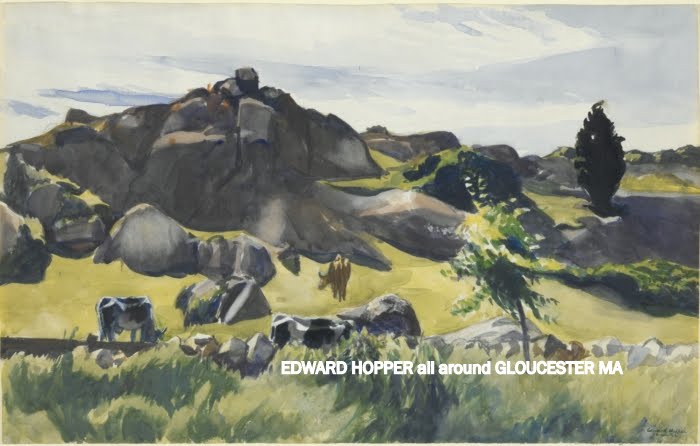
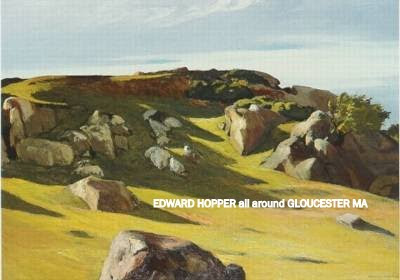
Edward Hopper Cape Ann Pasture watercolor drawing (ca.1928) was gifted to Yale University in 1930
2
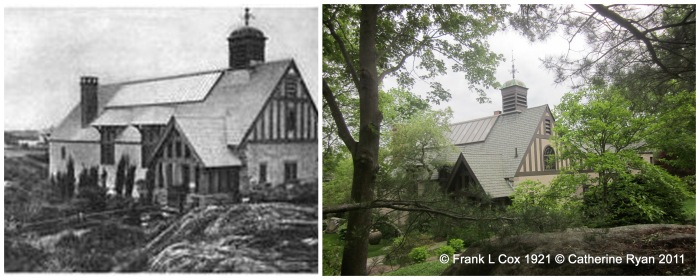
East Gloucester Atwood’s Gallery on the Moors as seen on the left in 1921–open vistas at that time


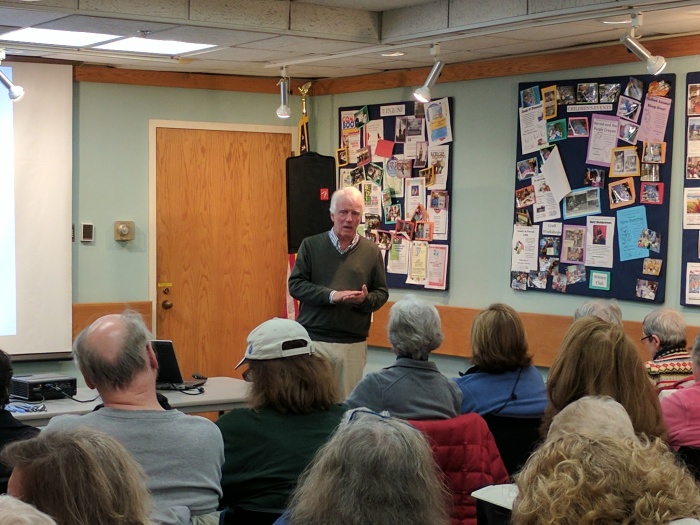
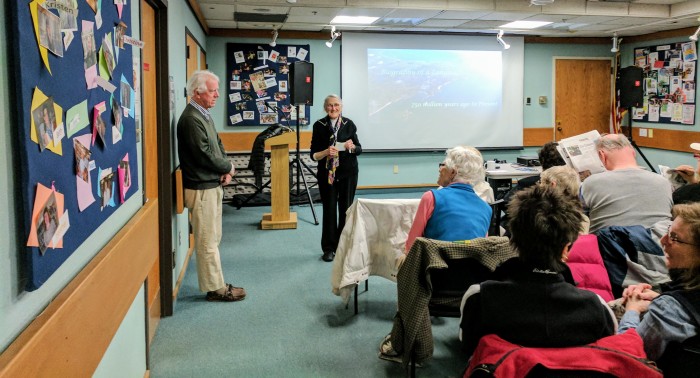
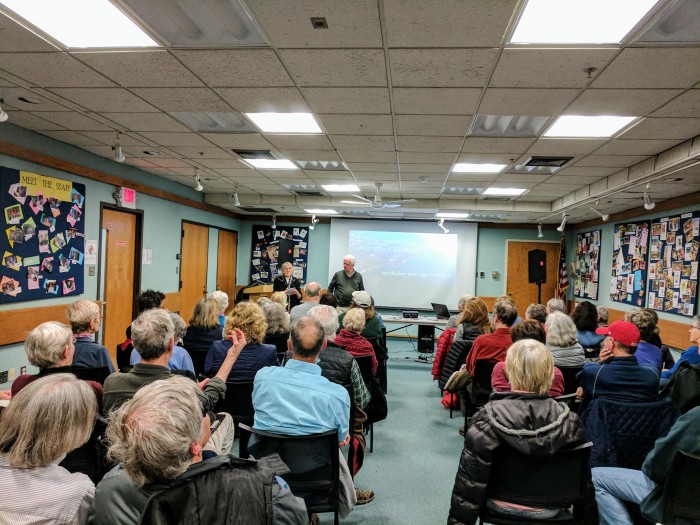
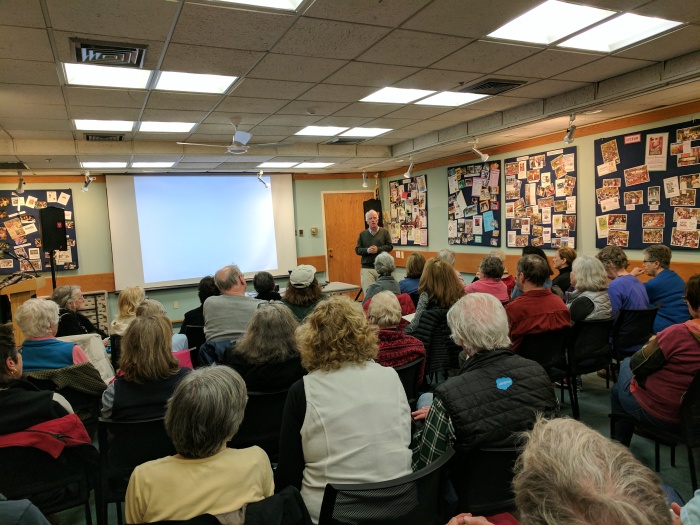
Chris Leahy gave a presentation at Gloucester Lyceum & Sawyer Free Library on February 23, 2017: Dogtown- the Biography of a Landscape: 750 Million Years Ago to the Present
A photographic history through slides presented by the Gloucester Lyceum and the Friends of the Library. Mary Weissblum opened the program.

Chris broadly covered the history of the local landscape from an ecological bent with a bias to birds and blueberry picking, naturally. New England is a patchwork of forested landscapes. He stressed the evolution of bio diversity and succession phenomenon when the earth and climate change. “Nature takes a lot of courses.” He focused on Dogtown, “a very special place”, and possible merits of land stewardship geared at fostering greater biodiversity. Perhaps some of the core acres could be coaxed to grasslands as when parts of Gloucester were described as moors? Characteristic wildlife, butterflies, and birds no longer present may swing back.  There were many philosophical takeaways and tips: he recommends visiting the dioramas “Changes in New England Landscape” display at Harvard Forest HQ in Petersham.

“Isolation of islands is a main driver of evolution”

“Broad Meadow Brook Wildlife Sanctuary in Worcester has the highest concentration* of native butterflies in all of Massachusetts because of secondary habitats.”  *of Mass Audubon’s c.40,000 acres of wildlife sanctuaries statewide. “The fact that Brook Meadow Brook is in greater Worcester, rather than a forested wilderness, underscores the value of secondary habitats.”

“1830– roughly the time of Thoreau (1817-1862)– was the maximum period of clearing thus the heyday for grasslands…As farmsteads were abandoned, stages of forests return.”

Below are photos from February 23, 2017. I added some images of art inspired by Dogtown. I also pulled out a photograph by Frank L Cox, David Cox’s father, of Gallery on the Moors  (then) compared with a photo of mine from 2011 to illustrate how the picturesque description wasn’t isolated to Dogtown.

img_20170223_200058img_20170223_190206img_20170223_190350img_20170223_200204

hopper-2
Edward Hopper, Cape Ann Granite, 1928, oil on canvas can we get this painting into the Cape Ann Museum collection?

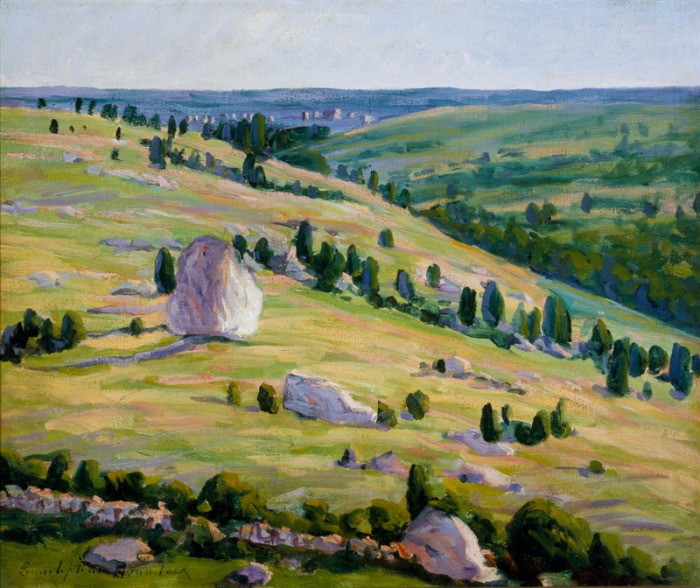
dogtown-cape-ann-massachuestts-by-louise-upton-brumback-o-c-vose-galleryLouise Upton Brumback (1867-1929), Dogtown- Cape Ann, 1920 oil on canvas

atwood-cox-gallery-on-the-moors-photo-1921

GloucesterCast 218 With Steve Douglass, Nichole Schrafft, Kim Smith and Joey Ciaramitaro Taped 2/19/17

gloucestercastsquare

GloucesterCast 218 With Steve Douglass, Nichole Schrafft, Kim Smith and Joey Ciaramitaro Taped 2/19/17

podcasticon1 subscribebutton

Topics Include:

www.capeannharbortours.com Stevie Douglass Breaking news left and right, also old Rocky Neck History, Susan Baker, Evie Parsons, Harbor Shuttle News and Deals
Rockport High School Seniors Hockey Game
Shirt’s Illustrated Henri and Julie Lopes Harborlight hat’s sold out and Nichole had a great experience with them. Vidalias.
Apple store at North Shore Shopping Center Suddenly Closed
Hey Heys– Brightly colored and boldly patterned tights for men
Wildlife Comeback Talk
YMCA Community Award Nominations
Lobster Pool can have their 96 seats.

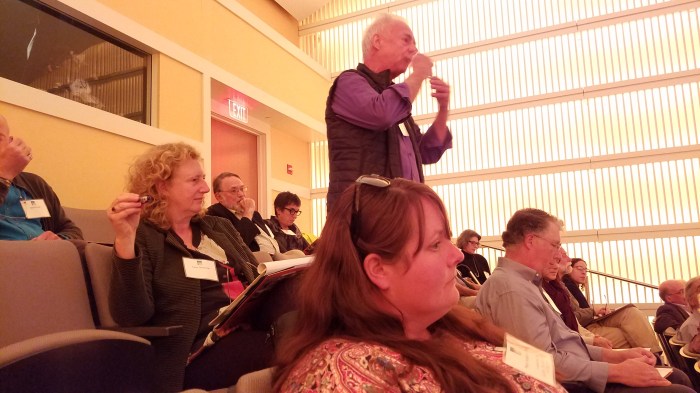
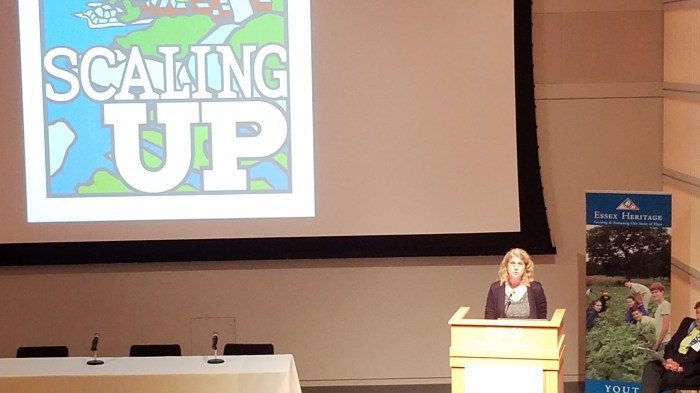
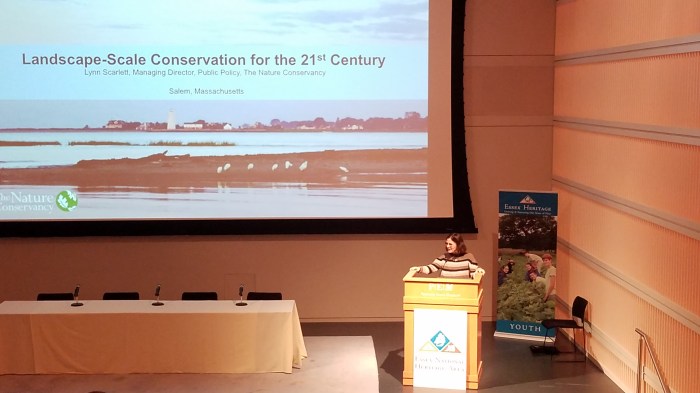
Live Blogging: Scaling Up conservation conference at Peabody Essex Museum

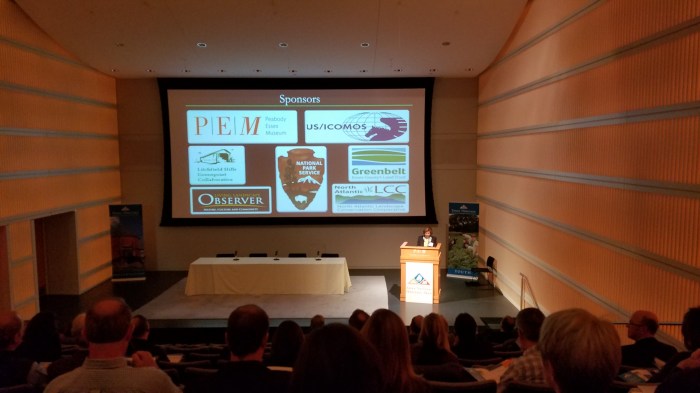
Annie Harris Essex National Heritage opens Scaling Up conference

20161007_090636

20161007_100025

Artists Leslie Bartlett and Susan Quateman on the program–their exhibit at the NPS Salem visitor center through the end of November). Local attendees include Essex Shipbuilding Museum, Patti Amaral Clean  City and Gloucester Cape Ann Trail Stewards.

More to come!

20161007_0922030

20161007_092716

About the conference

Beyond protected areas: sign up for Scaling Up! October 7th conservation conference at Peabody Essex Museum

For those interested in conservation right where people live, Essex Heritage and Peabody Essex Museum are co-hosting a daylong conference focused on the big topic of Scaling Up. Local, national and international experts interested in conservation planning and policy will have a chance to share, learn and network.  Register on line. The conference will take place on Friday October 7th from 8-5PM at the Peabody Essex Museum and will finish up at the Salem Visitor Center. Who will be there from your town?

Speakers and symposium participants include: Keynote P. Lynn Scarlett, Global Director Public Policy, Nature Conservancy; Bob McIntosh, National Park Service; Brent Mitchell, Atlantic Center for the Environment; Stephanie Toothman, National Park Service; Emily Bateson, Practicioners’ Network for Large Landscape Conservation; Ed Becker, Essex County Greenbelt; Amanda Babson, Coastal Landscape Adaptation, Northeast Region, National Park Service; Robert O’Connor, Director of Land and Forest Policy, MA Executive Office of Energy and Environmental Affairs; Janey Winchell, Sara Fraser Robbins Director, Dotty Brown Art & Nature Center, Peabody Essex Museum; Eric Hove, Metropolitan Area Planning council; Colin Novic, Greater Worcester Land Trust; Wayne Castonguay, Ipswich River Watershed Assoc; Kathy Abbott, President and CEO, Boston Harbor Now; Tim Abbott, Director Litchfield Hills Greenprint, Housatonic Valley; and Rebecca Stanfield McCown, Director, National Park Service Stewardship Institute.

Call to order, welcome, and/or moderating by: Annie Harris, CEO Essex National Heritage Commission; Mayor of Salem Kimberly Driscoll; Jay Finney of Peabody Essex Museum; and Jessica Brown, Executive Director for the New England Biolabs Foundation.

The snappy logo was created by George Courage of George Courage Creative www.georgecouragecreative.com. He also designed the scenic byway logo.

screenshot_100216_094242_am