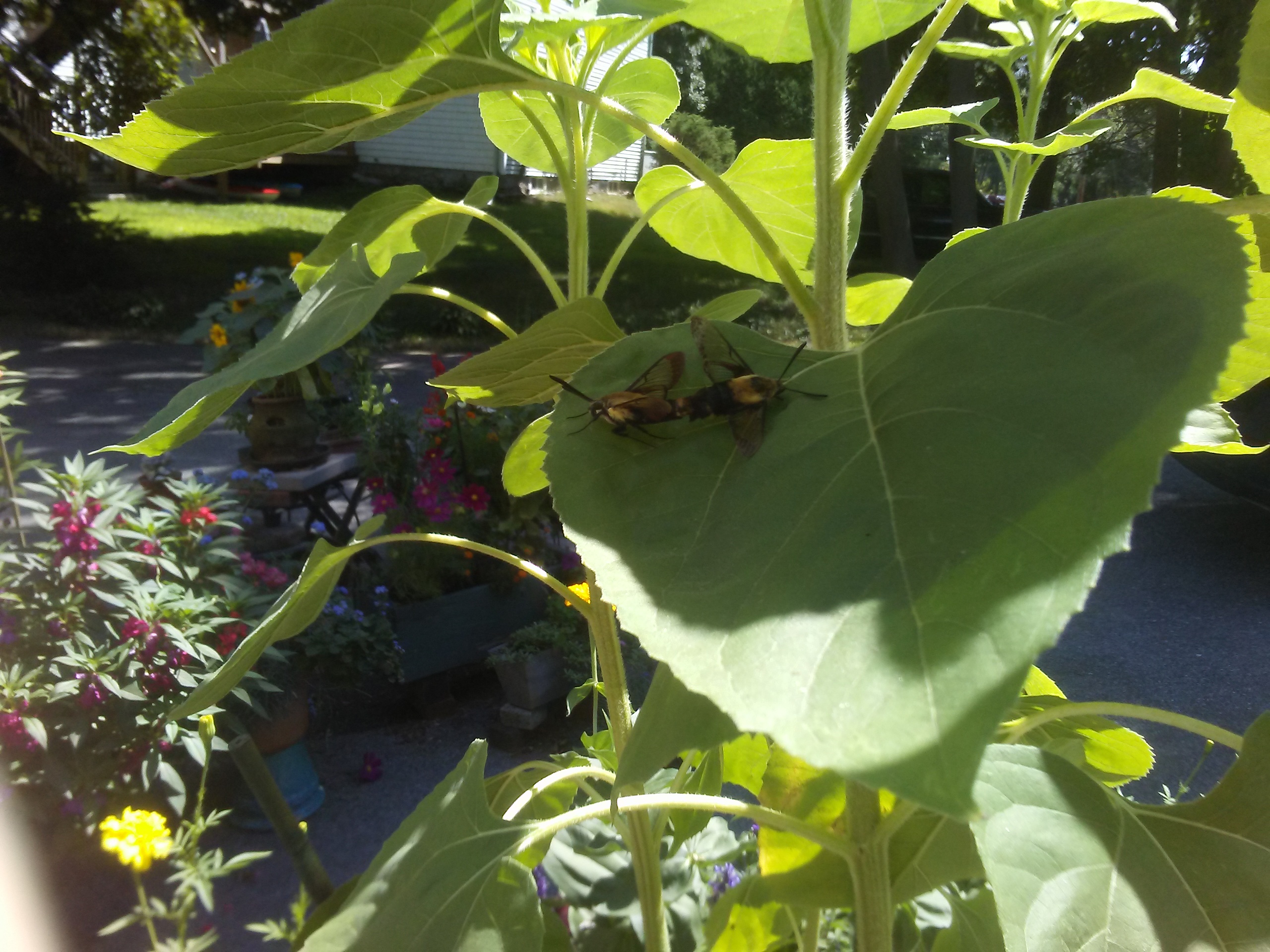
Reader DB sent in this terrific capture of a pair of Snowberry Clearwing Moths mating on her sunflowers.
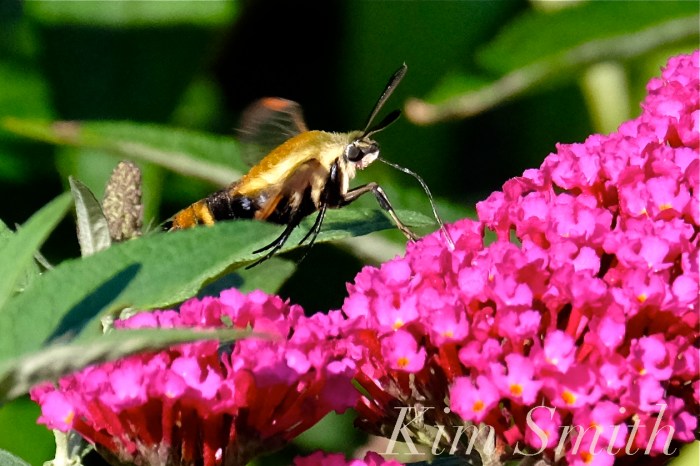
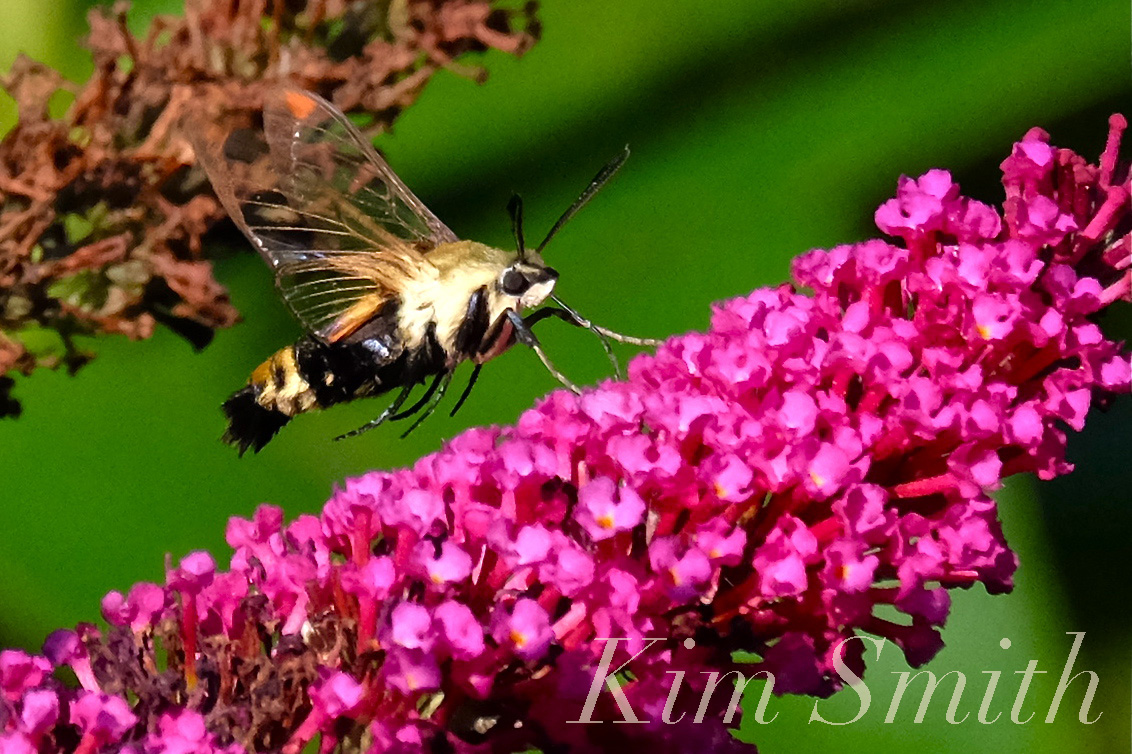
Another name for the Snowberry Clearwing Moth (Hemaris diffinis) is Bumblebee Moth. Snowberry Clearwings are in the same family as Hummingbird Clearwing Moths (Hemaris thysbe). Snowberry Moths have yellow and black colors similar to Bumblebees while Hummingbird Clearwings, which are reddish brown and green, look more like Ruby-throated Hummingbirds.
If you would like to attract clearwing moths to your garden, plant plenty of nectar-rich flowers that bloom in July especially. And even more importantly, plant the caterpillar food plants. The females deposit their eggs on honeysuckles, viburnums, blueberries, snowberry, and members of the rose family.
Another way to help clearwing moths is to NOT tidy up your garden in the fall. As is the case with so many species of Lepidoptera, and other insects, they overwinter in the leaf litter at the base of plants. Snowberry Clearwing Moths emerge in late spring and early summer from cocoons hidden in leaves.
Snowberry Clearwing Moth
Spread The GMG Love By Sharing With These Buttons:
Consideration of Dogtown for National Historic Register failed to pass last night 2 to 6 (and one recused). 1623 Studios (formerly Cape Ann TV) films city council meetings so if you missed the meeting you’ll be able to catch it there.
This just in from Lisa Smith: “1623 Studios recorded last night’s City Council Meeting, which had a hearing about Dogtown, and it will air on Channel 20 on Saturday at 1pm and 11:30 pm.” Once 1623 Studio edits, they’re uploaded to its youtube channel here.
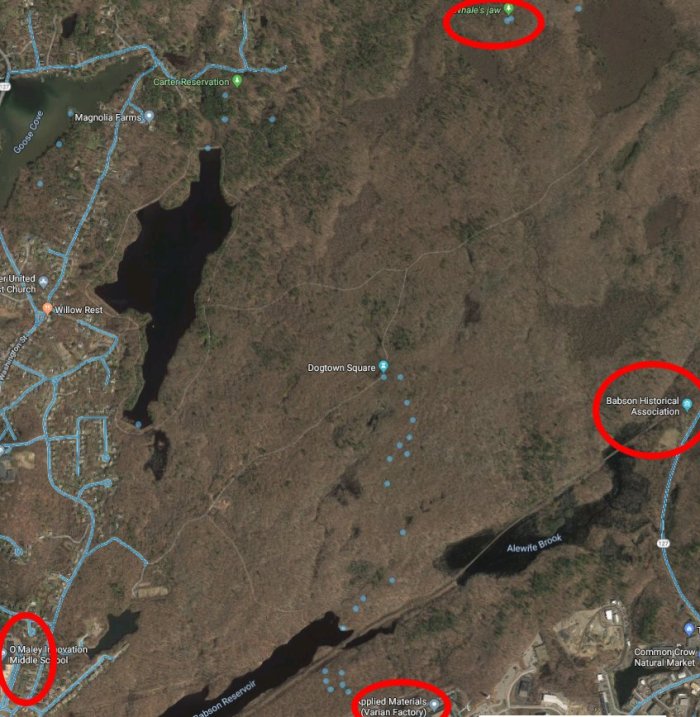
detail from satellite view Google maps – blue dots indicate photos for some Babson boulders relative to (red circles) O’Maley, Applied Materials, Babson museum, watersheds, whale’s jaw
Twentieth century gift to the city by Roger W. Babson
BABSON RESERVOIR AND SANCTUARY [eleven hundred and fifty acres] commemorative plaque 1931 “This reservoir, watershed and reservation are for the people of Gloucester, the land having been given in memory of my father and grandfather who roamed over these rocky hills. They had the vision that some day it should be conserved for the uses of the city and as an inspiration to all lovers of god and nature. Roger W. Babson”
Perhaps you didn’t think much of all the little baby squirrels running about your neighborhood this past summer. We had half a dozen nests on out street, and each nest appeared to have half a dozen babies. Early in the morning I would often see the young families playing in, around, and under our neighbors cars, scampering up and down trees, and leaping about the branches. I wasn’t paying too much attention, until we began to notice large toothy chunks missing from my unripe peaches. Half eaten peaches, still on the branch, along with disappearing fruit, plagued our little tree until by harvest time we had little more than a handful, when usually we have baskets full.
We found the culprit(s) mid-summer, brazenly scurrying and chomping through the peach tree. The squirrels ate all our blueberries, too, and most recently, have been depositing the large green balls of the Black Walnut tree fruits on our front porch.
Why the squirrelnado? During the 2017 growing season there was a bumper crop of acorns, which means many more adults went into winter with a full belly and an ample supply of acorns in their pantries. A greater number than usual survived the winter, which translates to many more baby squirrels in the spring of 2018. This year’s acorn crop has been smaller than average. The squirrels are desperately trying to stockpile food. Not only are they eating foods they don’t normally eat, but they are also exhibiting extremely at risk behavior. Driving along New England highways and byways, you may have observed a great many dead squirrels as both roadkill and laying alongside the road.
If a squirrel runs out in front of your car when traveling at high speed on the highway, it is best not to swerve. I know that sounds counterintuitive, but the squirrels look at the car as a large oncoming predator. By swerving, you confuse the critter, and run the risk of injuring yourself and/or another party.
With far fewer acorns, not as many squirrels will survive the winter. Will we see an upswing in Lyme disease next summer? I imagine so. White-footed Deer Mice and Eastern Chipmunks also feed heavily on acorns and they, along with squirrels, harbor Lyme. This year there are lots of small woodland mammals the ticks can attach themselves too. Next year, not so much. With far fewer wild mammals the ticks will be looking to people and furry pets for their next meal.
Chipmunks are also a Lyme disease vector.
Spread The GMG Love By Sharing With These Buttons:
CAPE ANN MUSEUM PROGRAM, SATURDAY, MAY 5, 2:00 p.m. – 4:00 p.m
“This program, presented by the Friends of Dogtown, offers an opportunity to remember the past and imagine the future of Dogtown. Free and open to the public.
Starting off with a presentation by local artists recalling Thoreau’s 1858 visit to Dogtown, Dogtown Days will present a collection of newly discovered historical photographs of the early 20th century landscape and will debut new poetry inspired by the “ghosts” of the old settlement. Members of the Gloucester Historical Commission will review the history of archaeological investigations, including the recent survey of Dogtown, and will explain the process and implications of its inclusion in the National Register of Historical Places. The City of Gloucester’s Dogtown Advisory Committee and privately-supported Cape Ann Trail Stewards will describe ongoing projects including site cleanup, trail maintenance, and the construction of a new footbridge at the site of Gloucester’s first mill. The program will conclude with a presentation by members of the Friends of Dogtown on a new project that is underway to restore key historical, ecological, and art landscapes in Dogtown.”
ENTRANCE TO DOGTOWN –RIBBON CUTTING – SUNDAY MAY 6th 10am-noon
“celebrating the new footbridge constructed by Gloucester High School students followed by tours of the art, ecological and historical landscapes described on Saturday.”
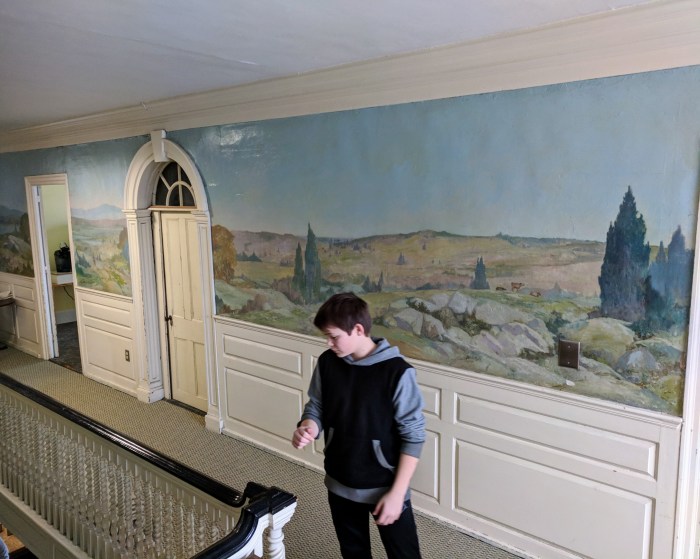
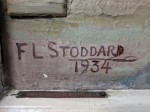
Dogtown has inspired artists working in all media. This photo shows some of the panels comprising the Dogtown Commons section of the Frederick L. Stoddard monumental “conventionalized treatment” (his favored descriptor) of Gloucester and the region — two story “mural fresco in situ, completed in 1934 for Saunders House, Gloucester Lyceum & Sawyer Free Public Library, under the auspices of the WPA. The city of Gloucester was awarded an impressive array of WPA-era pursuits- from creative expression in all media to civic construction projects.
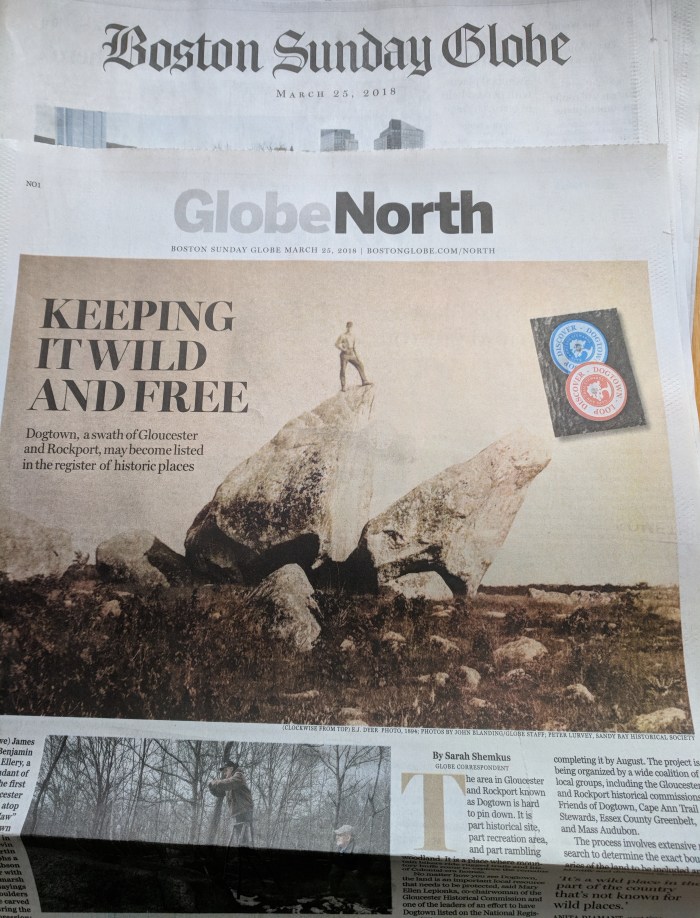
Reminder- Dogtown could be eligible for the National Register. A team of archaeologists began surveying and reviewing Dogtown the week of November 13. Come to a special public presentation TONIGHT – November 29th in Kyrouz Auditorium, Gloucester City Hall, 9 Dale Avenue, at 7pm.
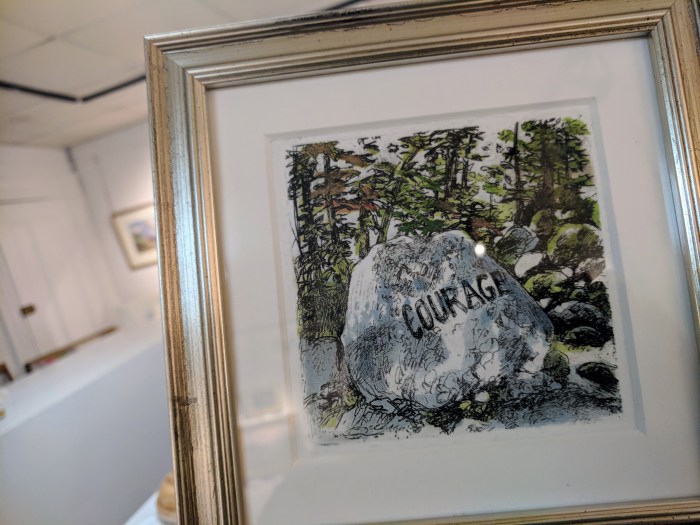
Artistic practice inspired by Dogtown takes on many forms across generations and centuries. I’ve shown examples of 20th century artists and writers connected to Dogtown. Here’s a 21st century one to note: Deborah Guertze, Babson Boulders # (Courage), original small and lovely hand colored etching, ed.50. This particular impression is currently for sale at Rockport Art Association.
“Presenters at City Hall on Nov 29th will include Betsy Friedberg from the Massachusetts Historical Commission, who will explain how the National Register program works and what it does and does not do, and Kristen Heitert from the PAL, who will present an initial plan for defining the boundaries of Dogtown as a National Register District. People attending the meeting will be asked to respond to that plan and to express their views about what makes Dogtown special. What should be the boundaries of the proposed National Register District, and what cultural features should be included in it? What would be the benefits of National Register status, and are there any drawbacks?”
Spread The GMG Love By Sharing With These Buttons:
Sharing press release from Mary Ellen Lepionka and Bill Remsen followed by a selection of visual arts, maps, and writing spotlighting Dogtown (1633-1961) by Catherine Ryan.
Nov 29th, 7PM, Public Meeting
Come to a special public presentation November 29th in Kyrouz Auditorium in Gloucester City Hall, 9 Dale Avenue, at 7pm.
Week of Nov 13
“During the week of November 13 a team of archaeologists from the Public Archaeology Laboratory (PAL) in Providence will be conducting fieldwork in Dogtown. They will begin mapping and describing an area to be nominated to the National Register of Historic Places, a National Park Service program to honor historically significant buildings and landscapes.
What do you think?
“Presenters at City Hall on Nov 29th will include Betsy Friedberg from the Massachusetts Historical Commission, who will explain how the National Register program works and what it does and does not do, and Kristen Heitert from the PAL, who will present an initial plan for defining the boundaries of Dogtown as a National Register District. People attending the meeting will be asked to respond to that plan and to express their views about what makes Dogtown special. What should be the boundaries of the proposed National Register District, and what cultural features should be included in it? What would be the benefits of National Register status, and are there any drawbacks?
Who all is involved?
“The Dogtown archaeological survey is funded through a matching grant from the Massachusetts Historical Commission and the Dusky Foundation and is financed by the City of Gloucester. The Gloucester Historical Commission applied for the grant and is coordinating the project in collaboration with the Rockport Historical Commission. The PAL team will also have the assistance of members of the Dogtown Advisory Committee, the Rockport Rights of Way Committee, the Cape Ann Trail Stewards, and the Friends of Dogtown.”
– Dogtown is eligible for the National Register. Will Gloucester earn another major district designation? Above excerpts from the press release for the Nov 29th event shared by Bill Remsen, local project coordinator, and Mary Ellen Lepionka, co-chair Gloucester Historical Commission, and some Dogtown maps and memorabilia 1633-1961
Dogtown Maps and memorabilia 1633-1961 selected by Catherine Ryan
Prior 2017 Dogtown public forums, lectures and meetings mentioned consideration of controlled burns to clear brush and return some land to a former moors state, with various potential benefits.
“Nature takes a lot of courses.” Chris Leahy said. He focused on Dogtown, “a very special place”, and possible merits of land stewardship geared at fostering greater biodiversity. Perhaps some of the core acres could be coaxed to grasslands as when parts of Gloucester were described as moors? Characteristic wildlife, butterflies, and birds no longer present may swing back.” March 4 2017 Dogtown Forum at Cape Ann Museumin collaboration with Essex County Greenbelt, Mass Audubon, and Friends of Dogtown group
February 23, 2017 Chris Leahy also gave a talk at Sawyer Free Library Dogtown- the Biography of a Landscape:750 Million Years Ago to the Present A photographic history through slides presented by the Gloucester Lyceum and the Friends of the Library
“Today the Hudson River Valley in upstate New York is gorgeous. The hills are covered with oak forests, and the valleys are patchworks of hayfields and farms. But Ostfeld says the area didn’t always look like this. When the Europeans came here hundreds of years ago, they clear-cut nearly all of the forests to plant crops and raise livestock. “They also cut down trees for commercial use,” Ostfeld says, “to make masts for ships, and for firewood.” Since then a lot of the forest has come back — but it’s not the same forest as before, he says. Today it’s all broken up into little pieces, with roads, farms and housing developments. For mice, this has been great news. “They tend to thrive in these degraded, fragmented landscapes,” Ostfeld says, because their predators need big forests to survive. Without as many foxes, hawks and owls to eat them, mice crank out babies. And we end up with forests packed with mice — mice that are chronically infected with Lyme and covered with ticks.”
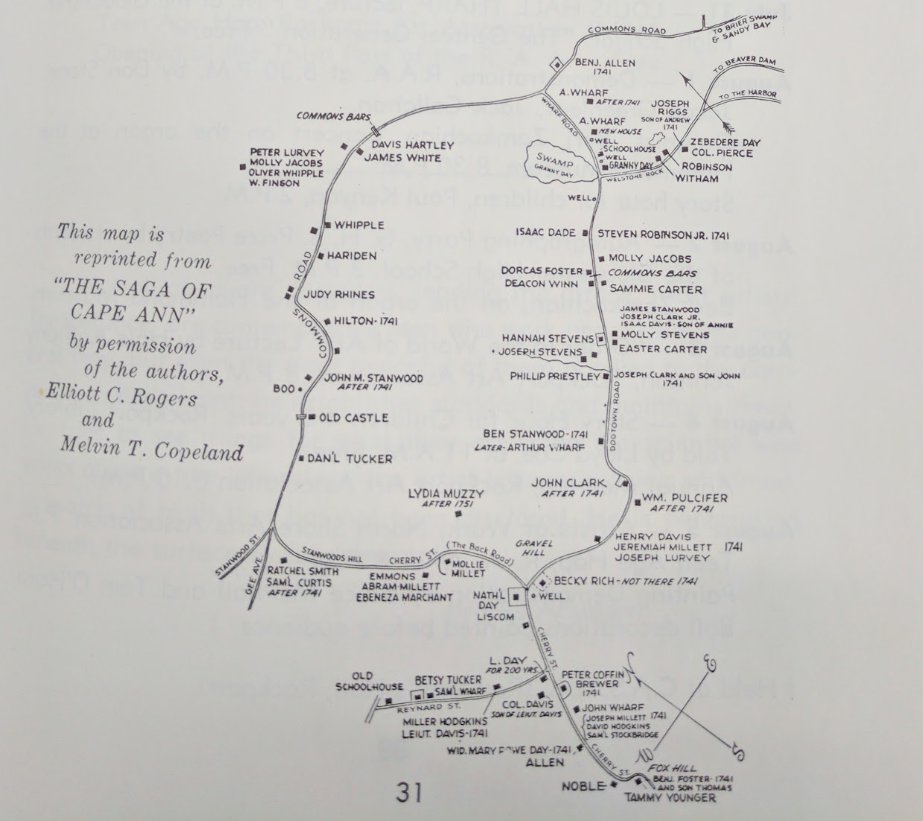
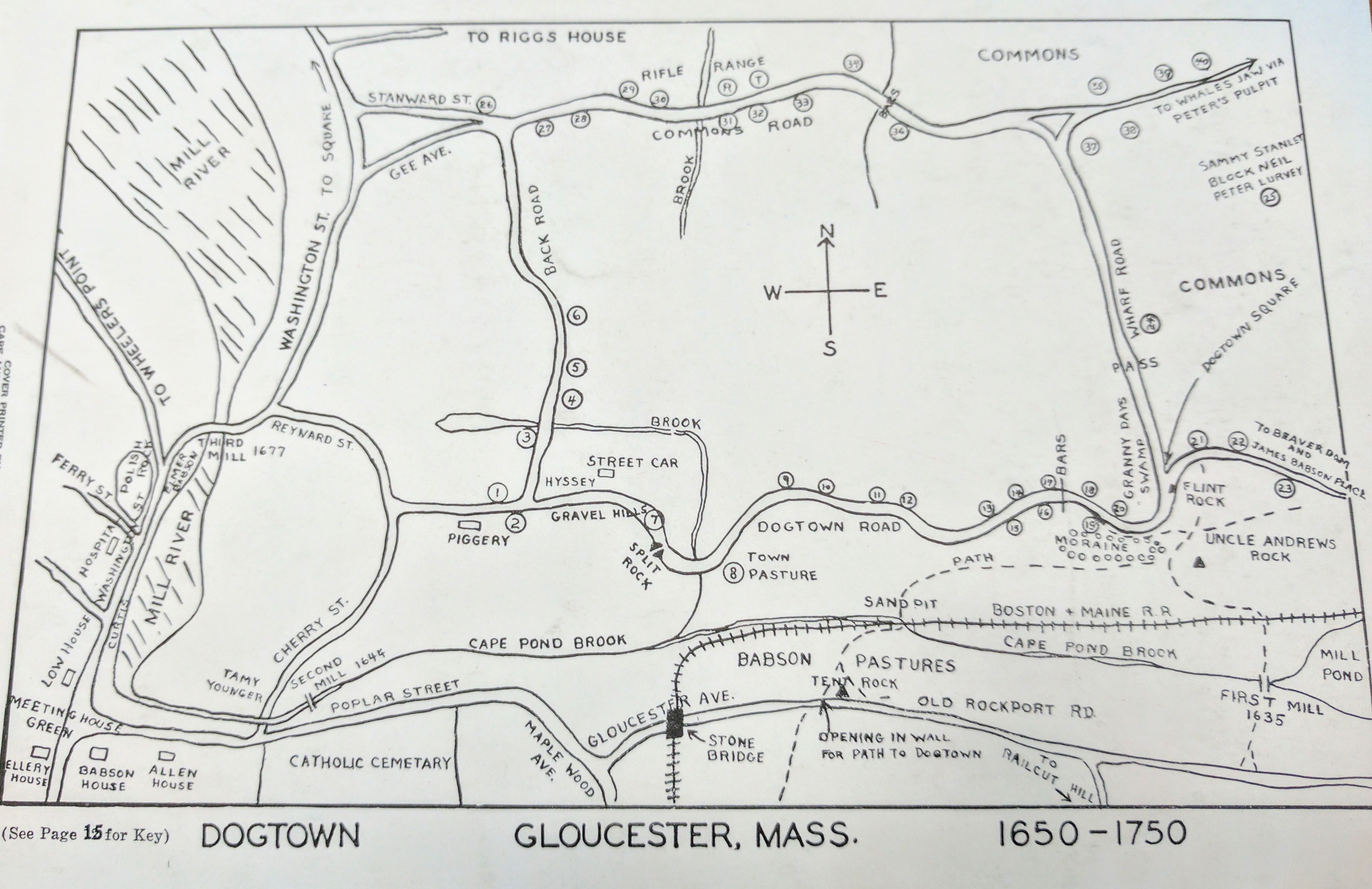
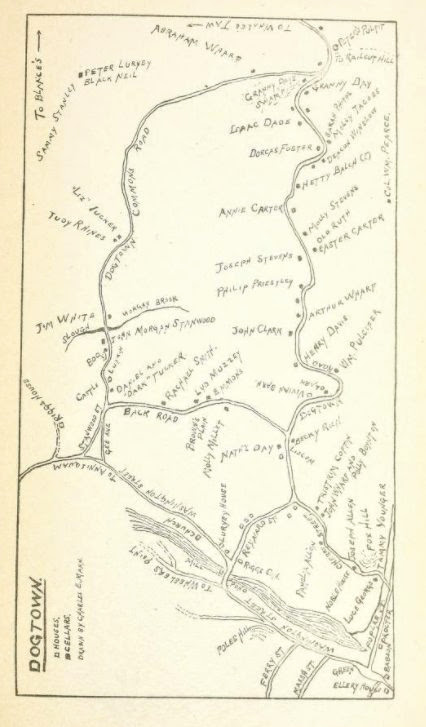
Selection of maps
from books, and memorabilia I’ve pulled on Dogtown (1634-1961):
1961
From Gloucester 1961 Cape Ann Festival of the Arts booklet
1954
From Gloucester 1954 Festival of the Arts booklet, prepared for the second of the Russel Crouse Prize Play, the Witch of Dogtown, by S. Foster Damon. “Each year it is hoped new plays dealing with the Gloucester or Cape Ann theme will be produced.”
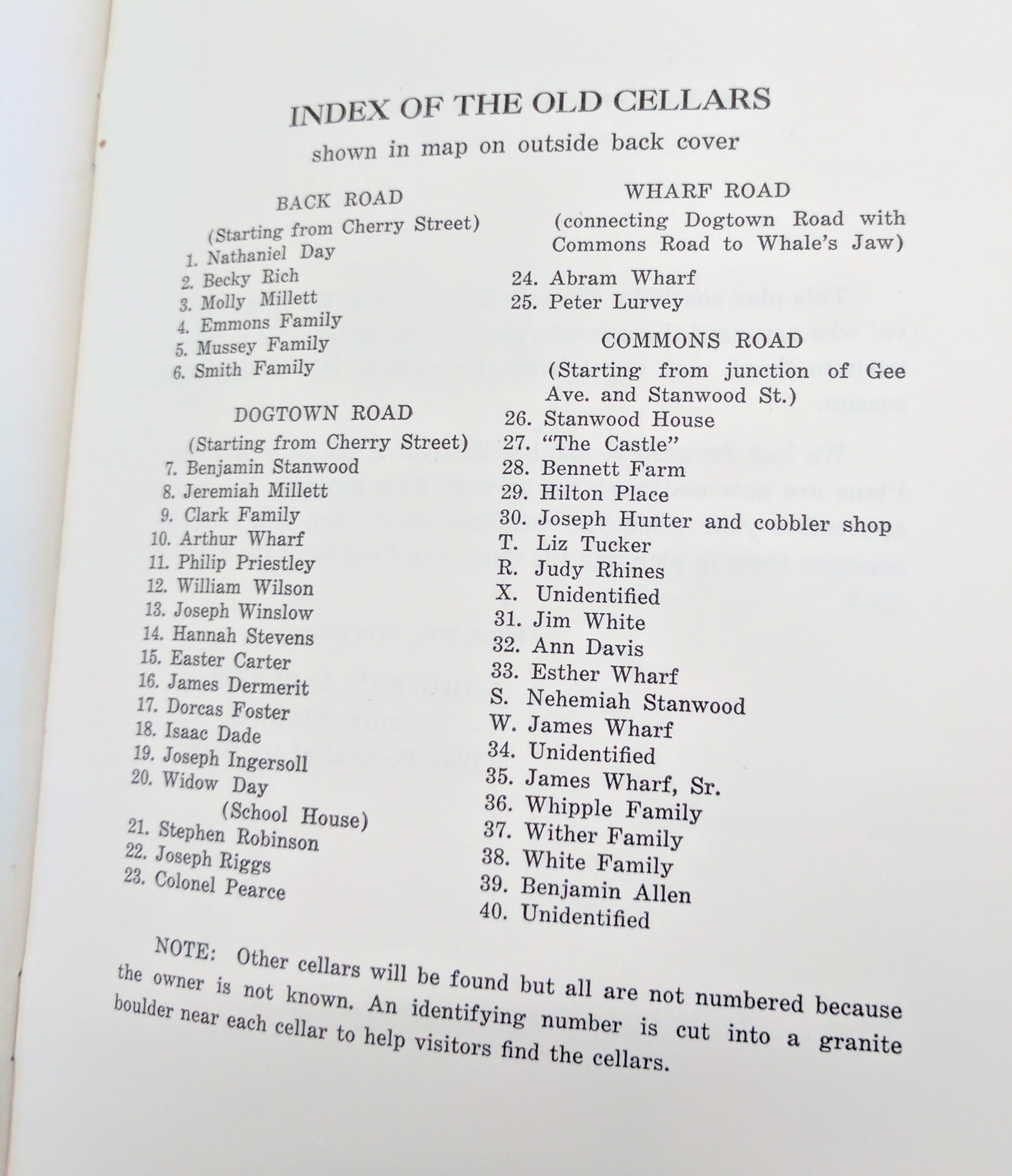
Joshua Batchelder 1741 survey map of “a good part of Dogtown common” printed and annotated for Gloucester’s 3rd Annual Cape Ann Festival of the Arts in 19541954 Index to annotated map
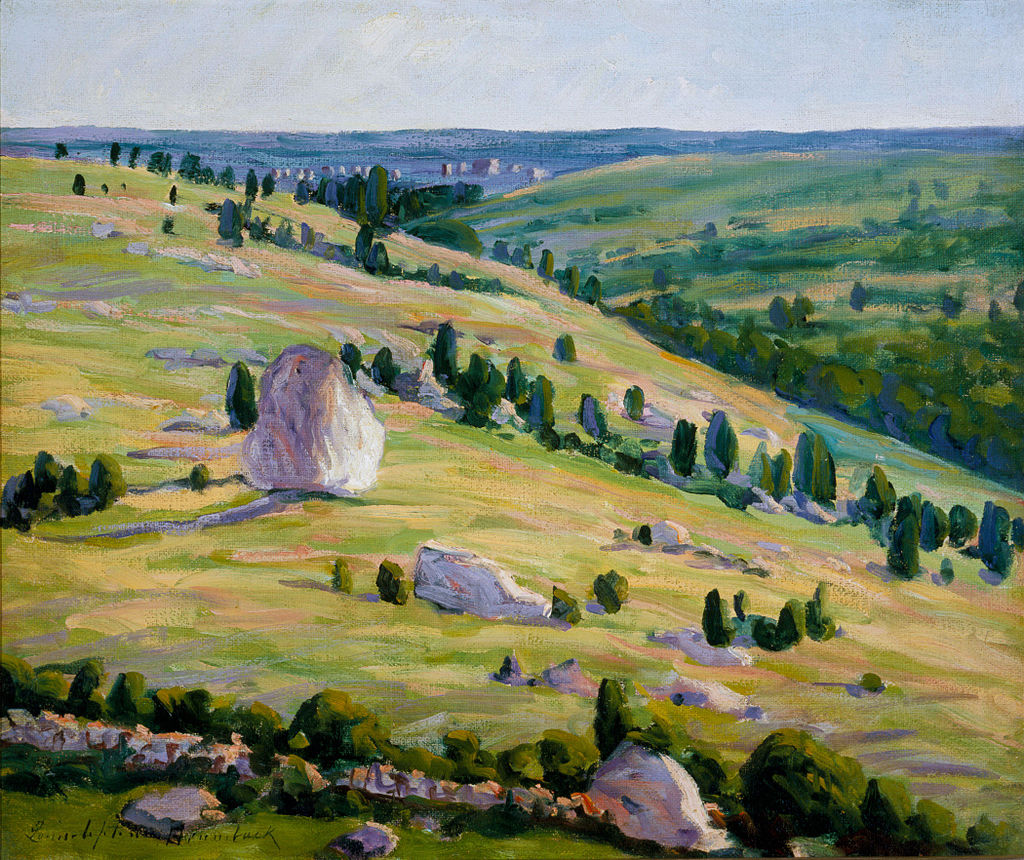
1923 Christian Science Monitor art review for Gloucester Society of Artists
“Dogtown Common, the now deserted hill home of the first settlers who 300 years ago braved the dangers of a hostile and Indian Annisquam, offers both romance and reality. It has remained for Louise Upton Brumback to interpret its clear contrasts, its far spaces, blue skies, white clouds and stiff green pointed cedars. Although the draftsmanship is crude in the extreme, the effect is rare and genuine. The old resident who passes through the gallery will shake his head dubiously at the false color creations of harbor and rock, but accepts this striking and bold visualization of Dogtown Common as the true spirit of Cape Ann…”
Inland among the lonely cedar dells Of Old Cape Ann, near Gloucester by the Sea, Still live the Dead–in homes that used to be. All day in dreamy spells They tattle low with sounds of tinkling cattle bells Or spirit tappings of some hollow tree And there, all night–out of the dark– They bark–and bark…
“Note: From a little volume, by Charles E. Mann, entitled “In the Heart of Cape Ann” Gloucester, Mass., The Proctor Bros. Co), the curious reader may learn more strange, half forgotten facts concerning the old Puritan life of that region. Among its singular New England characters, certain authentic and legendary figures have entered the theme of this poem. P.M-K. Miami University, Oxford, Ohio. March, 1921
Percy MacKaye (1875–1956) was an American dramatist and poet.
Harvard MacKaye papers: “History note: Percy Wallace MacKaye, author and dramatist, graduated from Harvard in 1897, wrote poetic dramas, operatic libretti, modern masques and spectacles, and was active in promoting community theatre. The collection includes his papers and those of his wife, Marion Homer Morse MacKaye, as well as material relating to the career of his father Steele MacKaye (1842-1894), an American theatrical designer, actor, dramatist, and inventor. The bulk of the collection consists of material pertaining to community drama; correspondence with literary and theatrical figures including Edgar Lee Masters, Edwin Arlington Robinson, George Pierce Baker, Theodore Dreiser, Amy Lowell, Upton Sinclair, Edward Gordon Craig, Louis Untermeyer and Thornton Wilder.”
Dartmouth: The MacKaye Family Papers “contain materials documenting the life and career of four generations of the family. They include a large amount of personal and professional correspondence as well as original manuscripts and typescripts of plays, prose, masques, pageants, poetry, essays and articles. Of note are manuscript materials for Benton MacKaye’s works on geotechnics entitled “Geotechnics of North America,” and “From Geography to Geotechnics,” as well as Percy MacKaye’s biography and works on his father Steele MacKaye and the MacKaye family, entitled respectively, “Epoch,” and “Annals of an Era.”
(Gloucester, Dogtown Common, is not on the MacKaye Wikipedia page)
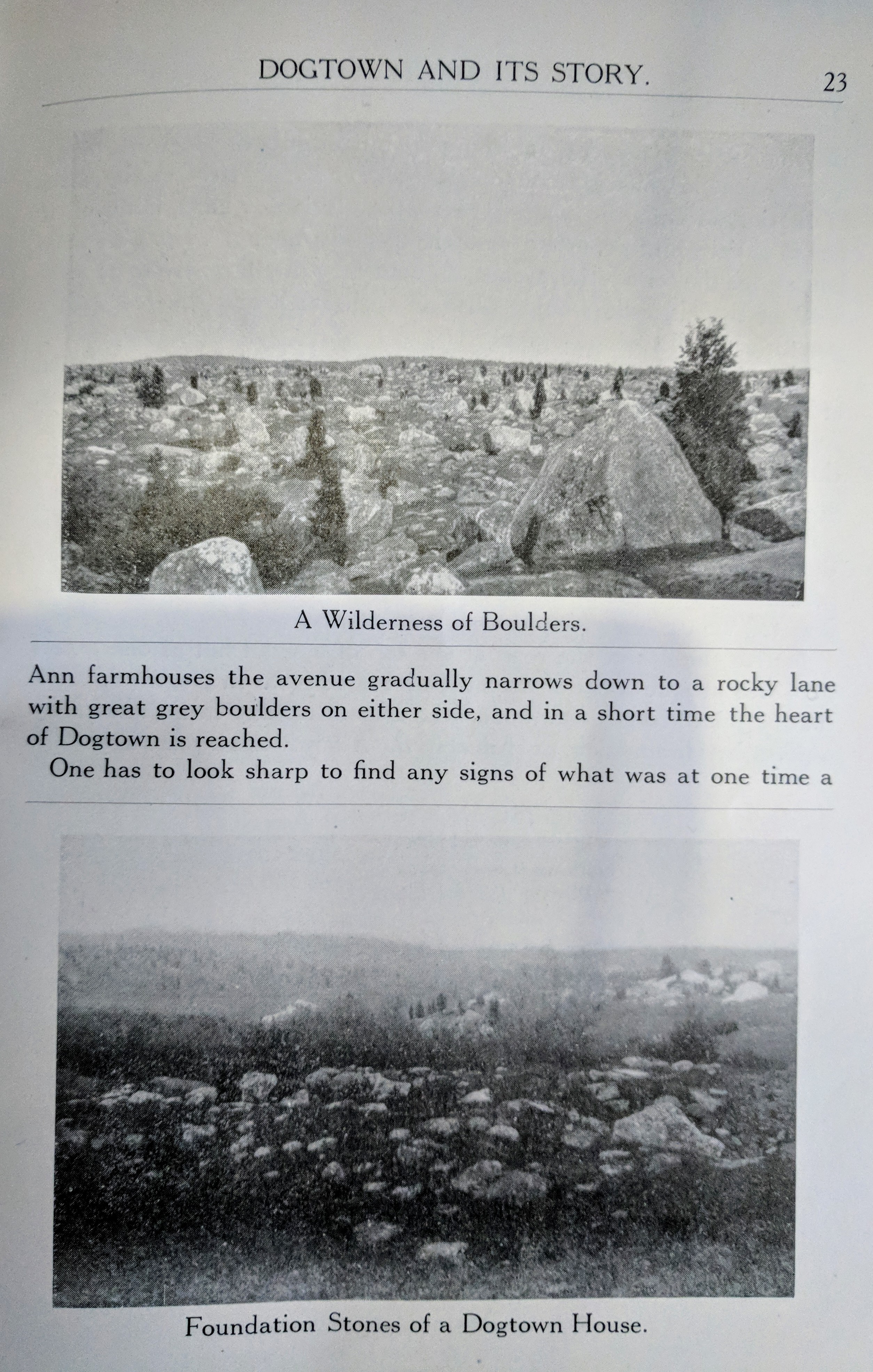
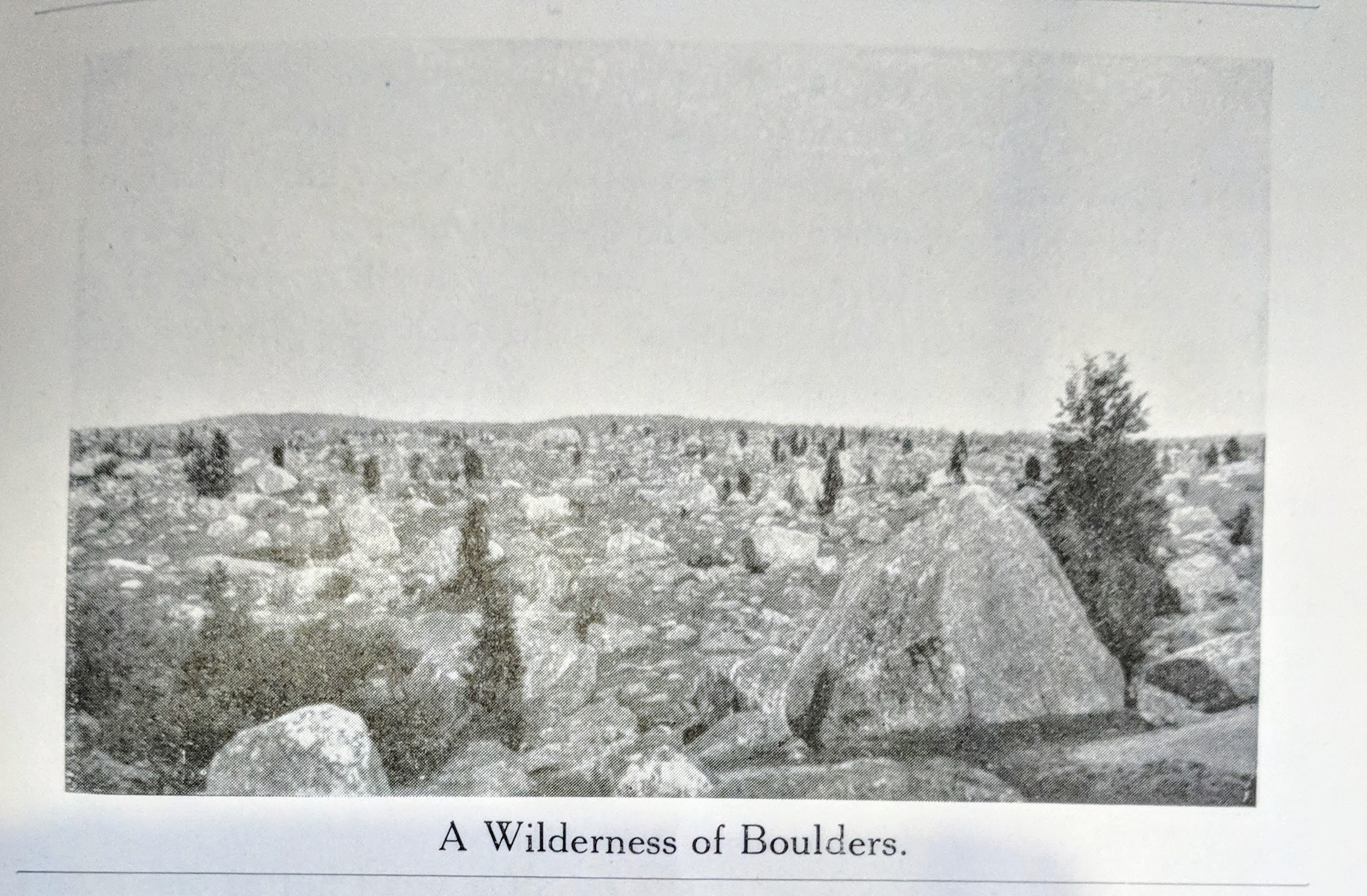
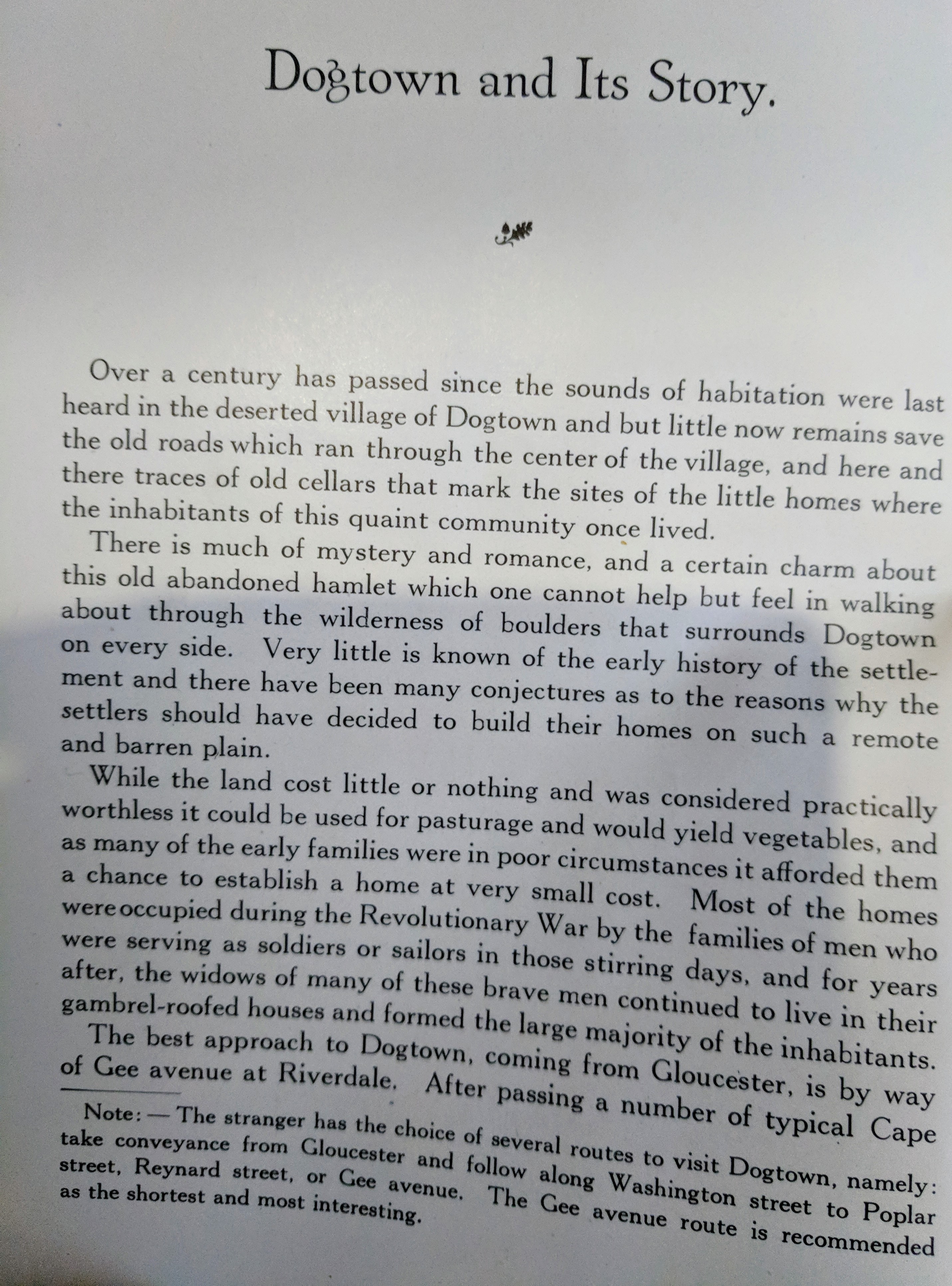
Great read p.22 from the Dogtown and Its Story chapter, in The Gloucester Book, by Frank L. Cox, 1921
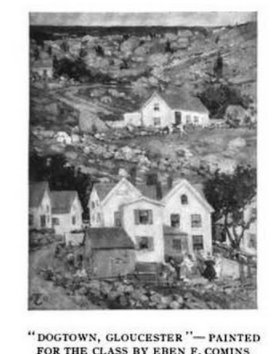
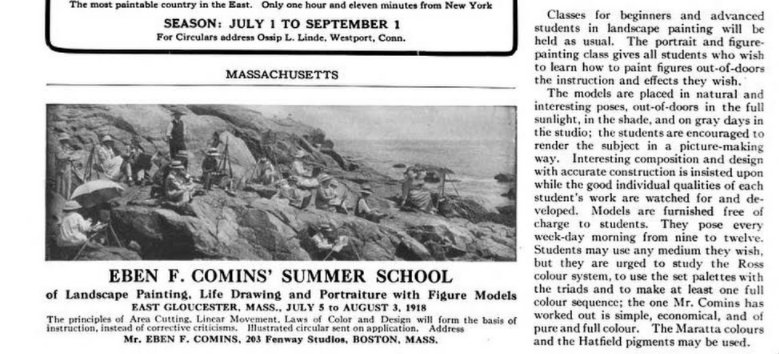
1918 Eben Comins painting
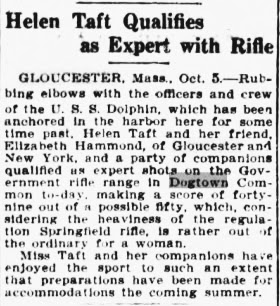
1912 government rifle range Dogtown
1904 (1742)
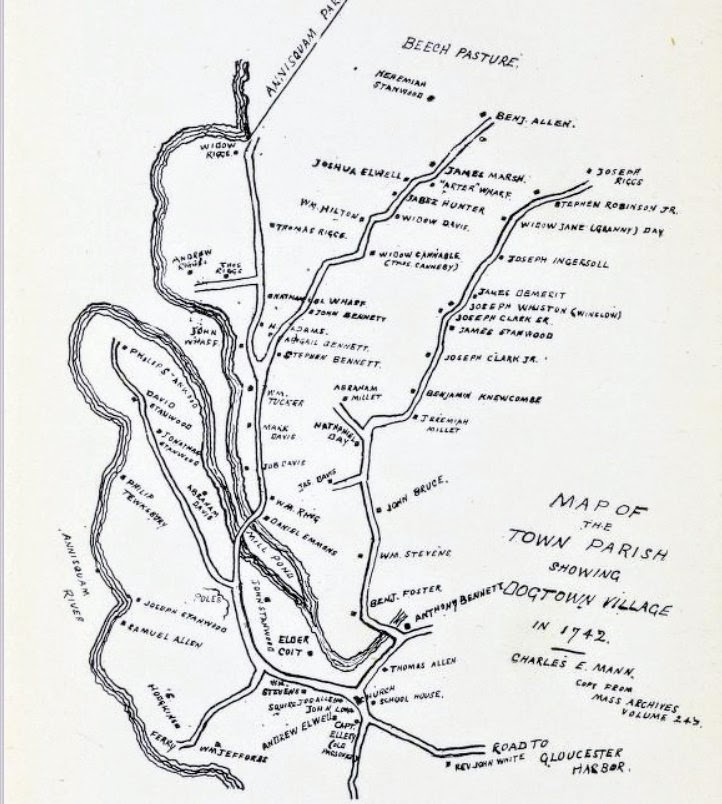
ca.1904 Charles E. Mann map copied from 1742 map in MA archives collectionMann
1877 Higginson
“Three miles inland, as I remember, we found the hearthstones of a vanished settlement; then we passed a swamp with cardinal flowers; then a cathedral of noble pines, topped with crow’s-nests. If we had not gone astray by this time, we presently emerged on Dogtown Common, an elevated table-land, over spread with great boulders as with houses, and encircled with a girdle of green woods and an outer girdle of blue sea. I know of nothing more wild than that gray waste of boulders..”
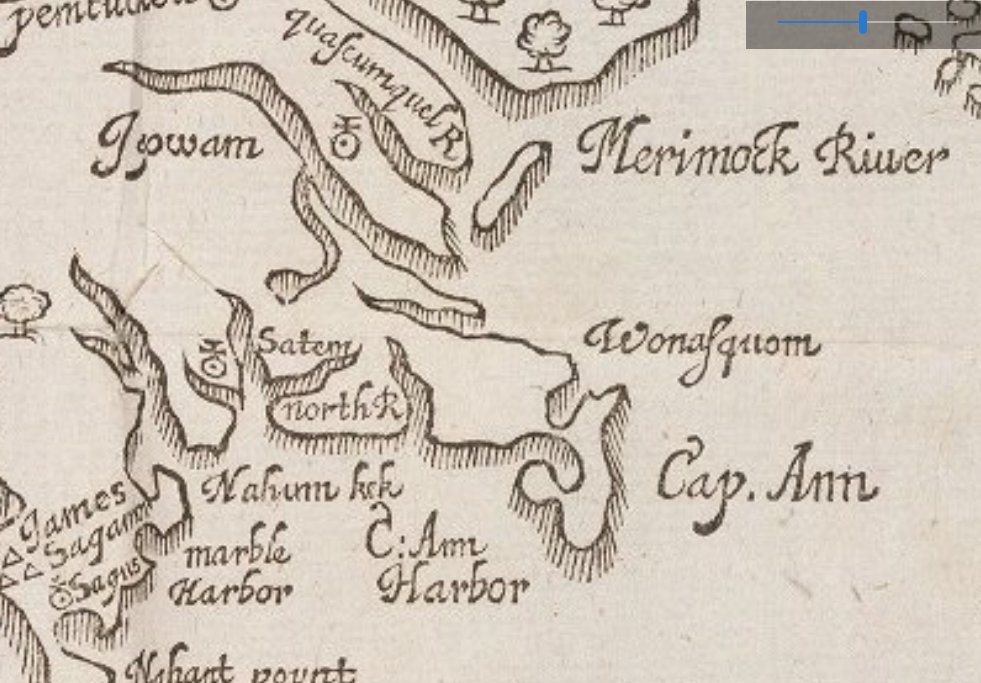
In 1855, Henry David Thoreau wrote in his journal: “I am [reading] William Wood’s “New England’s Prospect”… William Wood New Englands Prospect was originally published in 1634 in London. Here is a Wood excerpt concerning burning brush to clear land, a historical antecedent (and apt surname) to keep in mind when considering stewardship 2017 and beyond.
…The next commodity the land affords is good store of woods, and that not only such as may be needful for fuel but likewise for the building of ships and houses and mills and all manner of water-work about which wood is needful. The timber of the country grows straight and tall, some trees being twenty, some thirty foot high, before they spread forth their branches; generally the trees be not very thick, though there may be many that will serve for mill posts, some being three foot and a half over. And whereas it is generally conceived that the woods grow so thick that there is no more clear ground than is hewed out by labor of man, it is nothing so, in many places diverse acres being clear so that one may ride a hunting in most places of the land if he will venture himself for being lost. There is no underwood saving in swamps and low grounds that are wet, in which the English get Osiers and Hasles and such small wood as is for their use. Of these swamps, some be ten, some twenty, some thirty miles long, being preserved by the wetness of the soil wherein they grow; for it being the custom of the Indians to burn the wood in November when the grass is withered and leaves dried, it consumes all the underwood and rubbish which otherwise would overgrow the country, making it unpassable, and spoil their much affected hunting; so that by this means in those places where the Indians inhabit there is scarce a bush or bramble or any cumbersome underwood to be seen in the more champion ground. Small wood, growing in these places where the fire could not come, is preserved. In some places, where the Indians died of the plague some fourteen years ago, is much underwood, as in the midway betwixt Wessaguscus and Plimouth, because it hath not been burned. Certain rivers stopping the fire from coming to clear that place of the country hath made it unuseful and troublesome to travel thorow, in so much that it is called ragged plaine, because it teares and rents the cloathes of them that pass. Now because it may be necessary for mechanical Artificers to know what timber and wood of use is in the Country, I will recite the most useful as followeth*…” *see photos for Wood’s trees list
Thoreau was thinking along these lines, finding god in berries.
“From William Wood’s New England’s Prospect, printed about 1633, it would appear that strawberries were much more abundant and large here before they were impoverished or cornered up by cultivation. “Some,” as he says, “being two inches about, one may gather half a bushel in a forenoon.” They are the first blush of a country, its morning red, a sort of ambrosial food which grows only on Olympian soil.” -Thoreau’s Wild Fruit
“If you look closely you will find blueberry and huckleberry bushes under your feet, though they may be feeble and barren, throughout all our woods, the most persevering Native Americans, ready to shoot up into place and power at the next election among the plants, ready to reclothe the hills when man has laid them bare and feed all kinds of pensioners.”
photos: William Wood’s New Englands Prospect scanned from book in the University of CA collection. “Wonasquam” on map at Cape Ann
“Of their Custom in burning the Country, and the reason thereof” The Salvages are accustomed to set fire of the Country in all places where they come, and to burne it twice a year: at the Spring, and the fall of the leaf. The reason that moves them to do so, is because it would other wise be so overgrown with underweeds that it would be all a coppice wood, and the people would not be able in any wise to pass through the Country out of a beaten path… And this custom of firing the Country is the meanes to make it passable; and by that meanes the trees growe here and there as in our parks: and makes the Country very beautiful and commodious.”
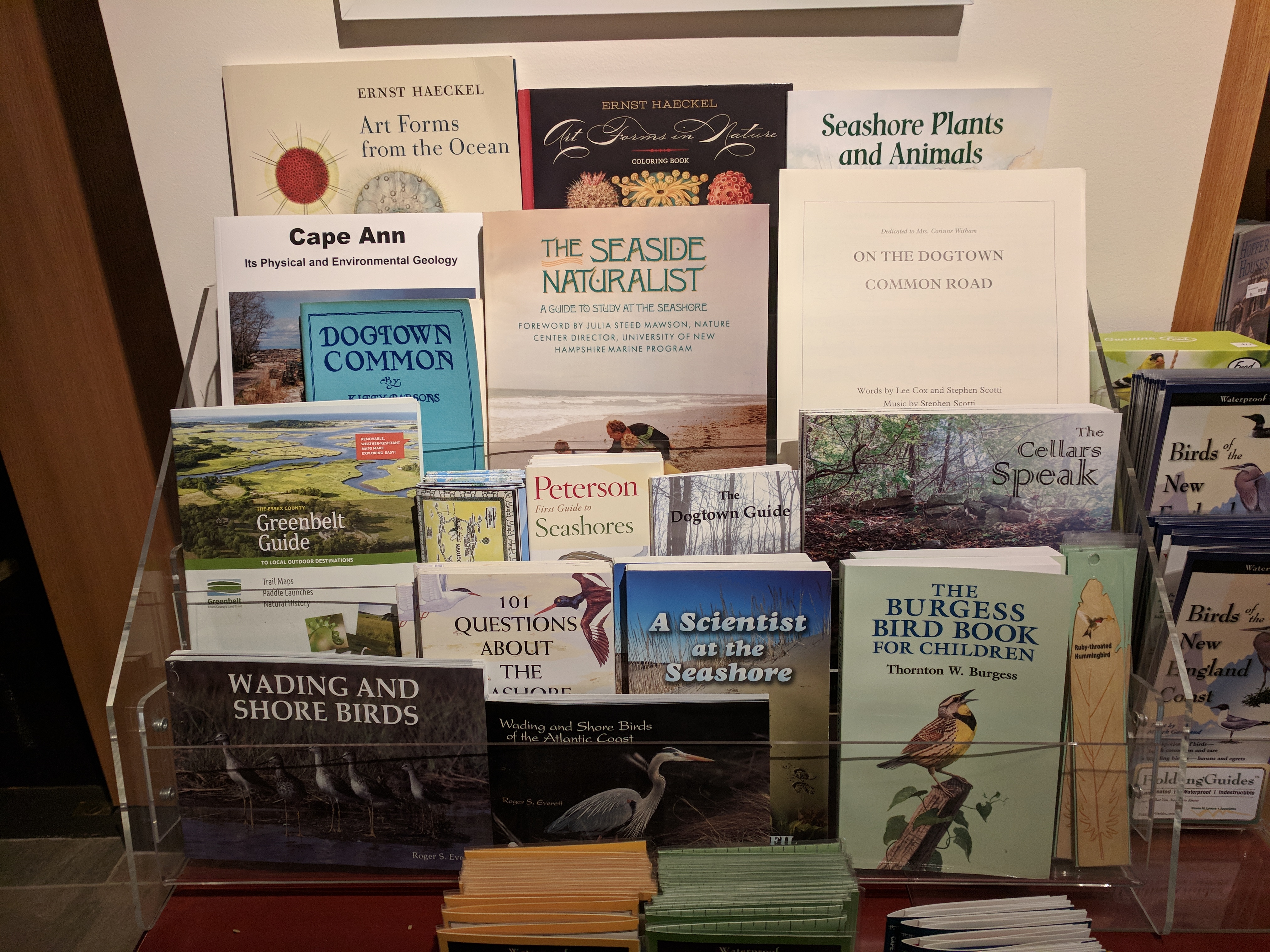
Cape Ann Museum book shop display October 2017
Spread The GMG Love By Sharing With These Buttons:
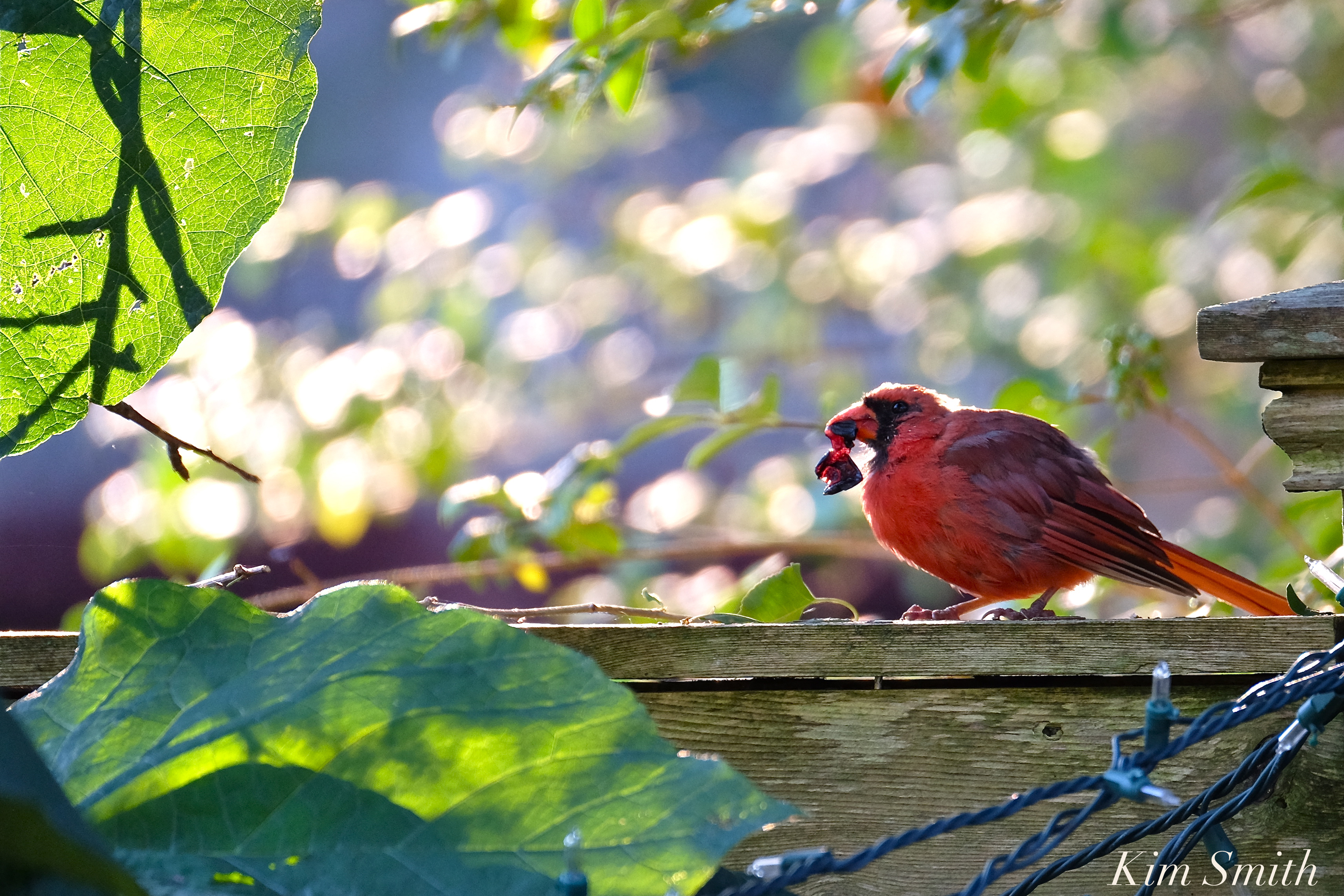
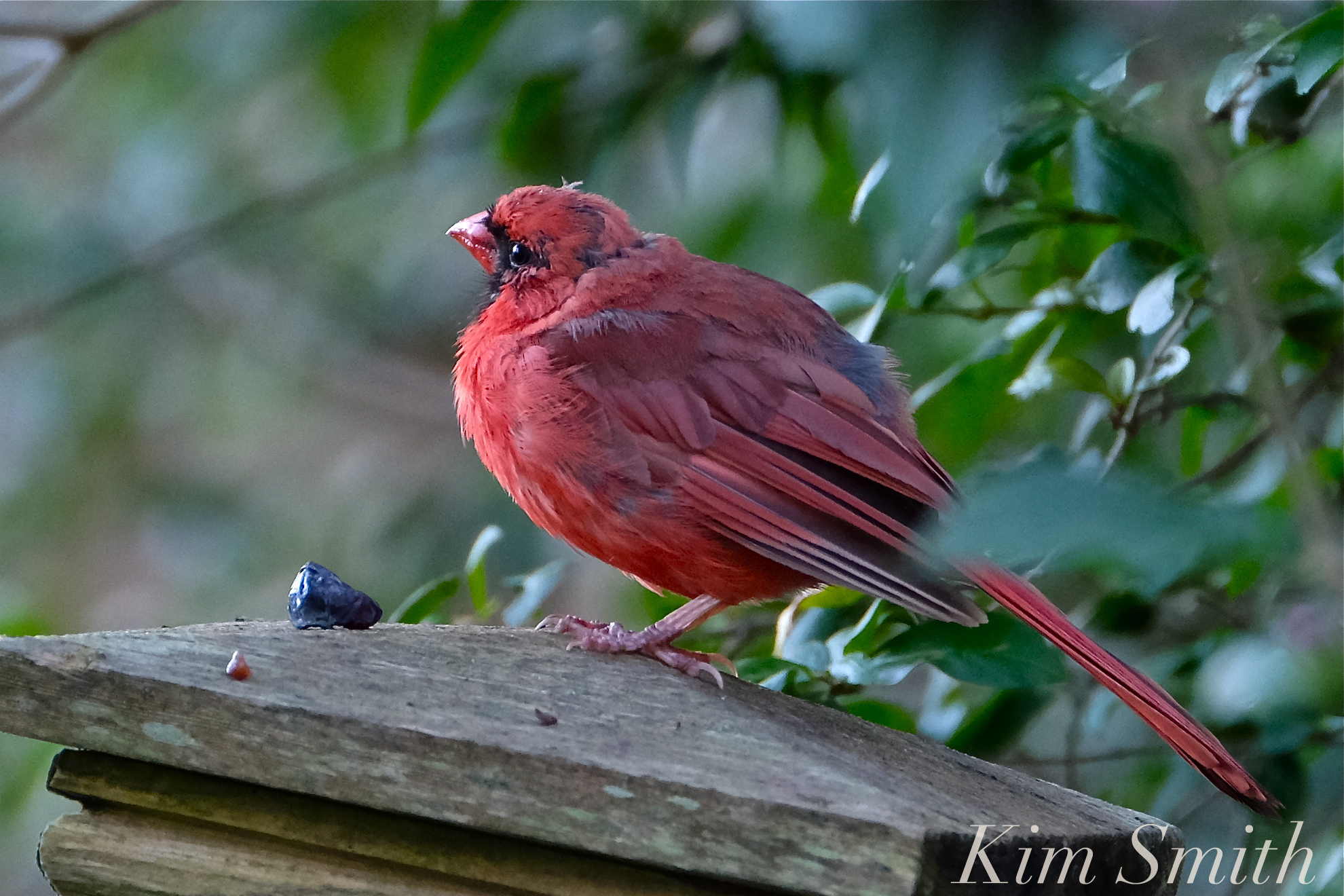
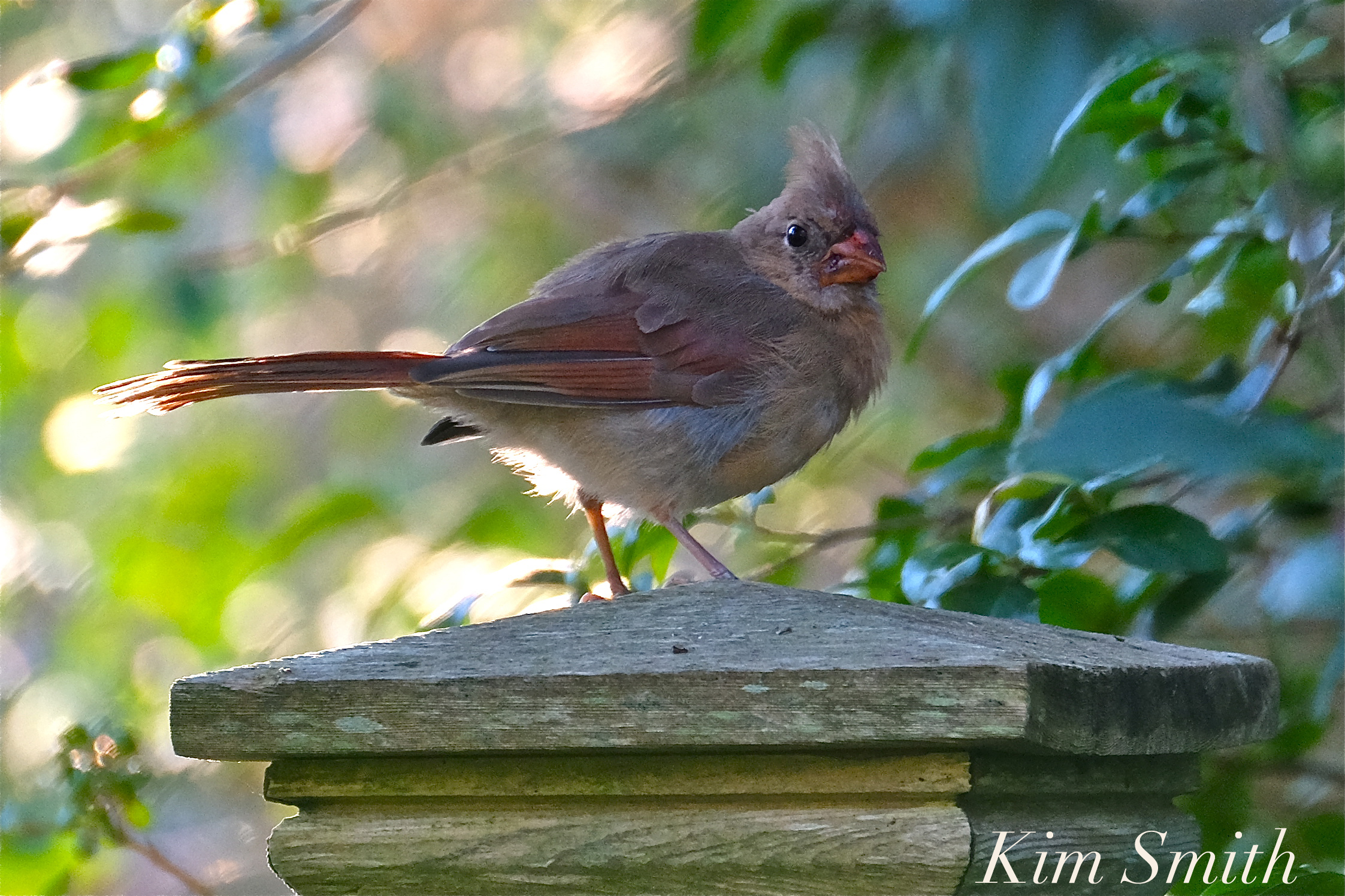
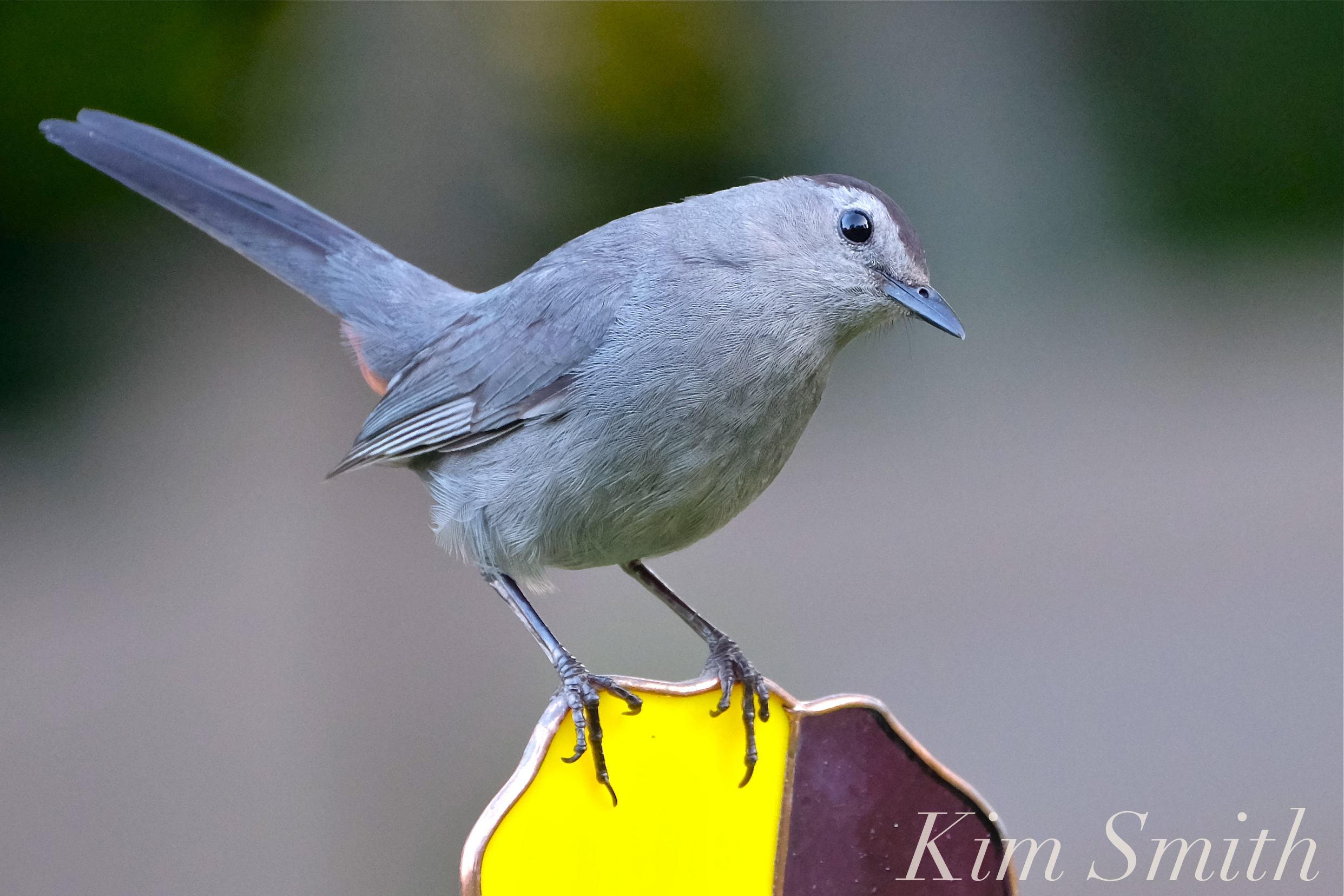
I’ve yet to meet a Catbird I don’t love! With big personalities and a repertoire of beautiful melodies they are no stranger to gardens planted with blueberry bushes.
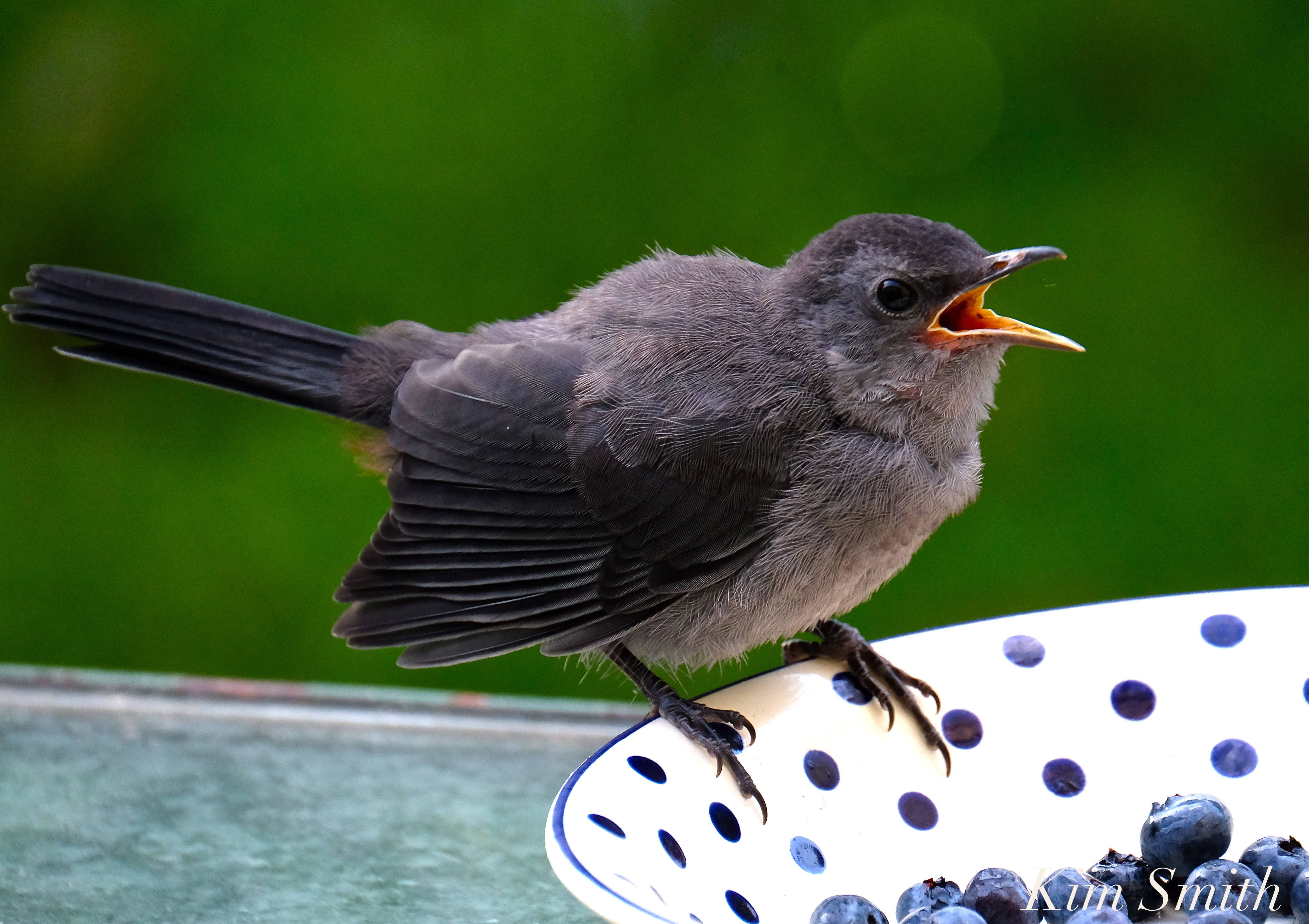
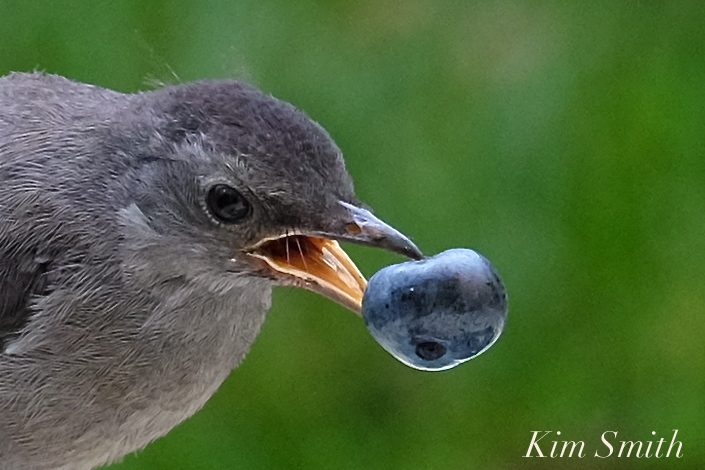
The first Gray Catbird to make an appearance in our garden arrived the day we planted blueberries. We don’t grow enough blueberries to provide all that we, and the Catbirds, would like to eat, so for the past several years I have been feeding the Catbirds handfuls at a time, the ones that come in the box that are smallish, and generally more sour tasting. If I forget to refill the bowl, the mom Catbird perches on a table just outside the kitchen window, calling and calling until the bowl is replenished. This summer she was joined by two fat little fledglings, also demanding of blueberries. The other day, both fledglings sat smack in the middle of the blueberry bowl and then proceeded to have a disagreement over the fruit!
Mature Gray Catbirds are mostly slate gray all over, with a little black cap, and when in flight, flash rufous red underneath. They belong to the same family of birds as do Northern Mockingbirds and Brown Thrashers, Mimidae, having that wonderful ability to copy the sounds of other songbirds and string them together to make their own music. During mating season, male Catbirds use their songs to establish their territory. The song may last up to ten minutes. This past spring, while walking along the wooded edge of a dune, I came upon a male singing his heart out. I didn’t have my tripod with me, but began recording him while singing. Boy, did my arms grow weary trying to capture the song in its entirety!
Catbird Egg
The oldest Gray Catbird was recorded to live 17 years. Catbirds are monogamous and if undisturbed, return to the same nesting site year after year. I love knowing that it’s quite possible that our current Catbird mama and papa may be the very same family that have been here for the past several years.
Patti Papows resident blueberry-eating Catbird
Note about the benefits of of planting blueberry bushes ~ Did you know that blueberries are native to North America? Fantastic for attracting songbirds to the garden, the foliage is also a caterpillar food plant for Spring and Summer Azure butterflies, and the blossoms provide nectar for myriad species of pollinating insects, including many species of native bees.
Spread The GMG Love By Sharing With These Buttons:
Please join me Thursday evening, August 10th, at 7:00pm, at the Peabody Institute Library, South Branch. I will be giving my talk about how to create a garden to benefit a host of pollinators and screening several short films. I hope to see you there!
The day we planted blueberries, is the day the Catbirds moved in. Many species of songbirds are pollinators, too!
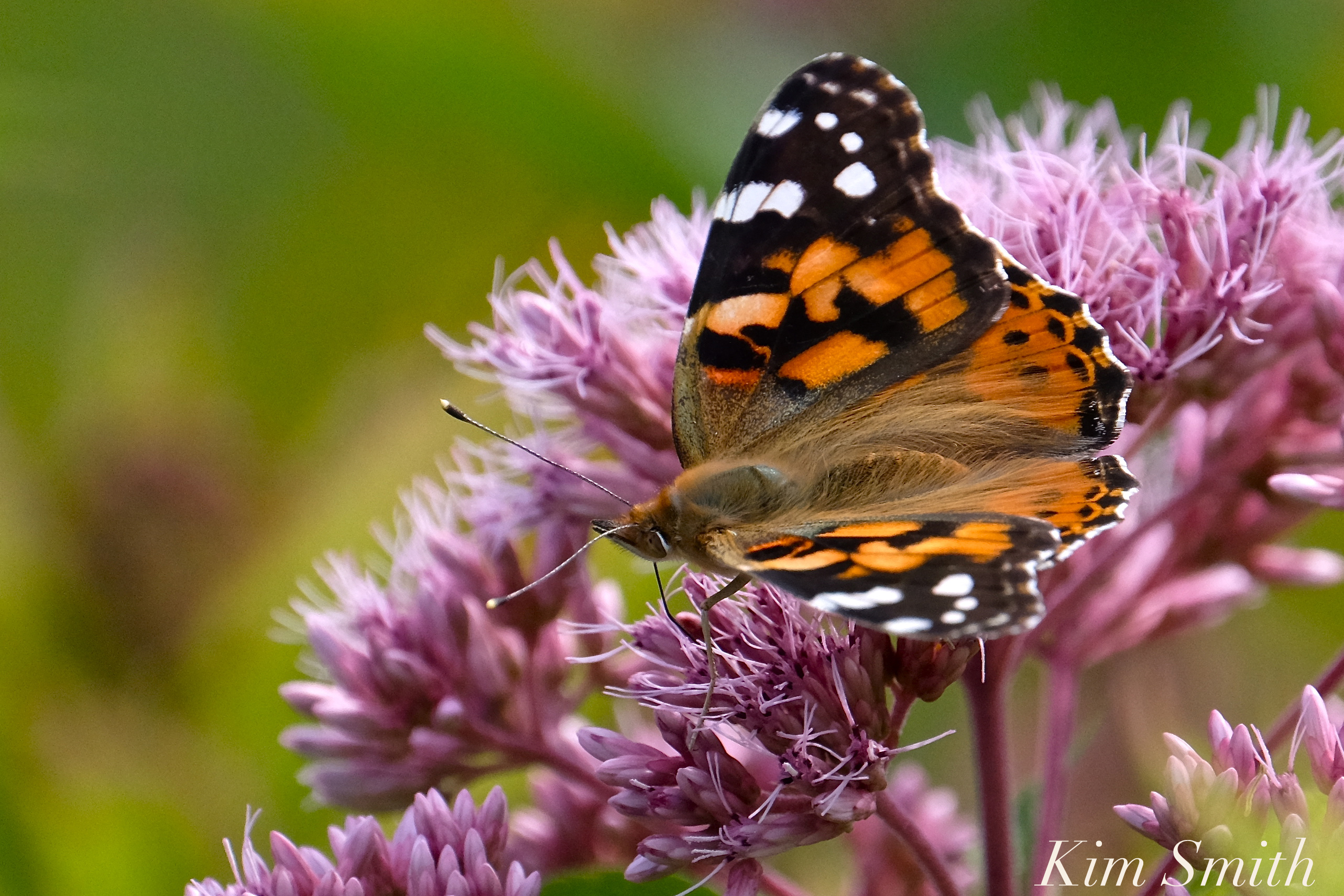
Painted Lady nectaring at wildflower Joe-pye, Good Harbor Beach
Over the past several months you may have noticed my GMG “Sista Dish” posts have been few and far between with the exception of my St. Joseph and St. Peter’s Fiesta posts. I’ve been crazy busy designing and uploading 900+ recipe posts and thousands of photos to my new www.sistafeliciaskitchen.com website with the help of my good friend and cookbook designer Cathy Kelly. Over the winter I realized it was time to make some major changes to better showcase the enormous archive of recipe content posted on GMG and other Social Media Outlets, in more organized and easily accessible fashion for my loyal followers. I’m super excited to take this next step and even more excited for what’s planned for the near future, and ask for your continued patience during this transition period over the next few months. I am working as fast as the computer will allow me to load. Every post uploaded fuels my determination to have this new Sista Felicia’s Kitchen website organized and running smoothly for your convenience by September. Lots of summer recipes are being added daily so be sure to take a peek before headed to the Farmers Market or Grocery store for some easy to prepare summertime dishes! Lots of yummy salad and grilling recipes are just a click away!
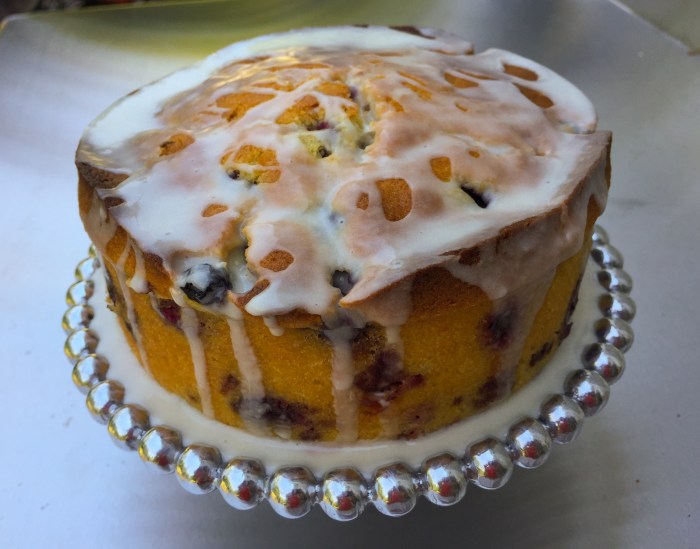
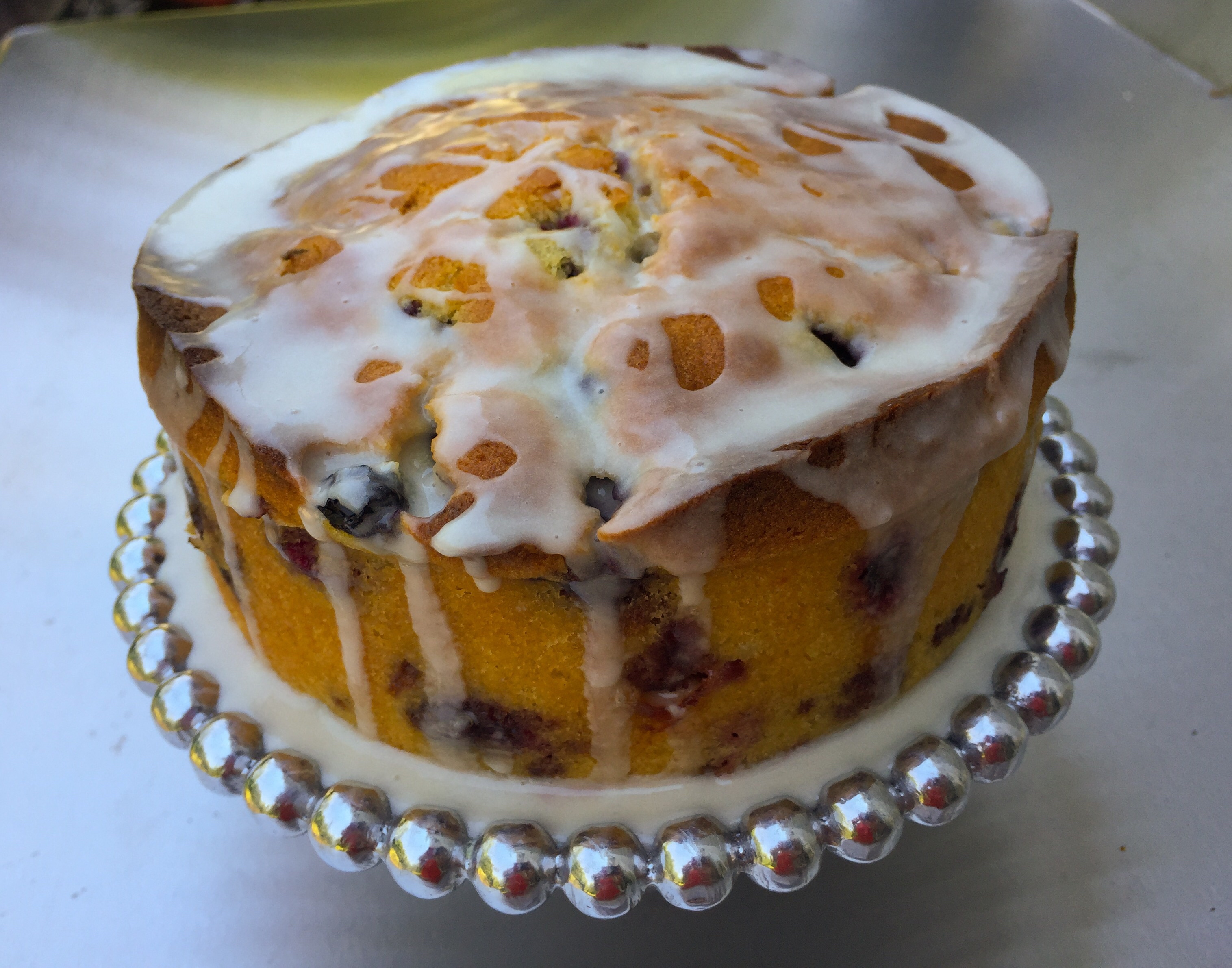
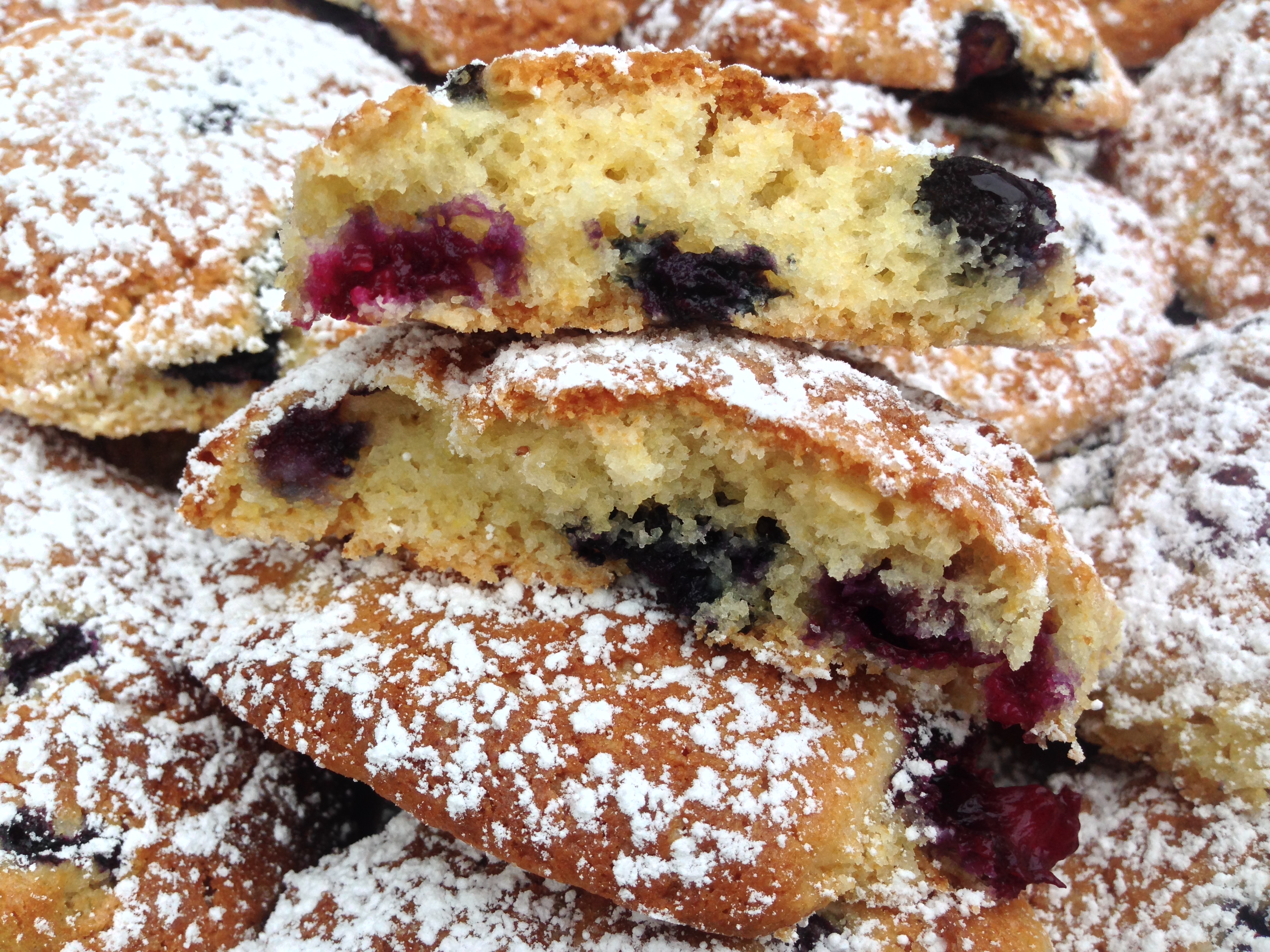
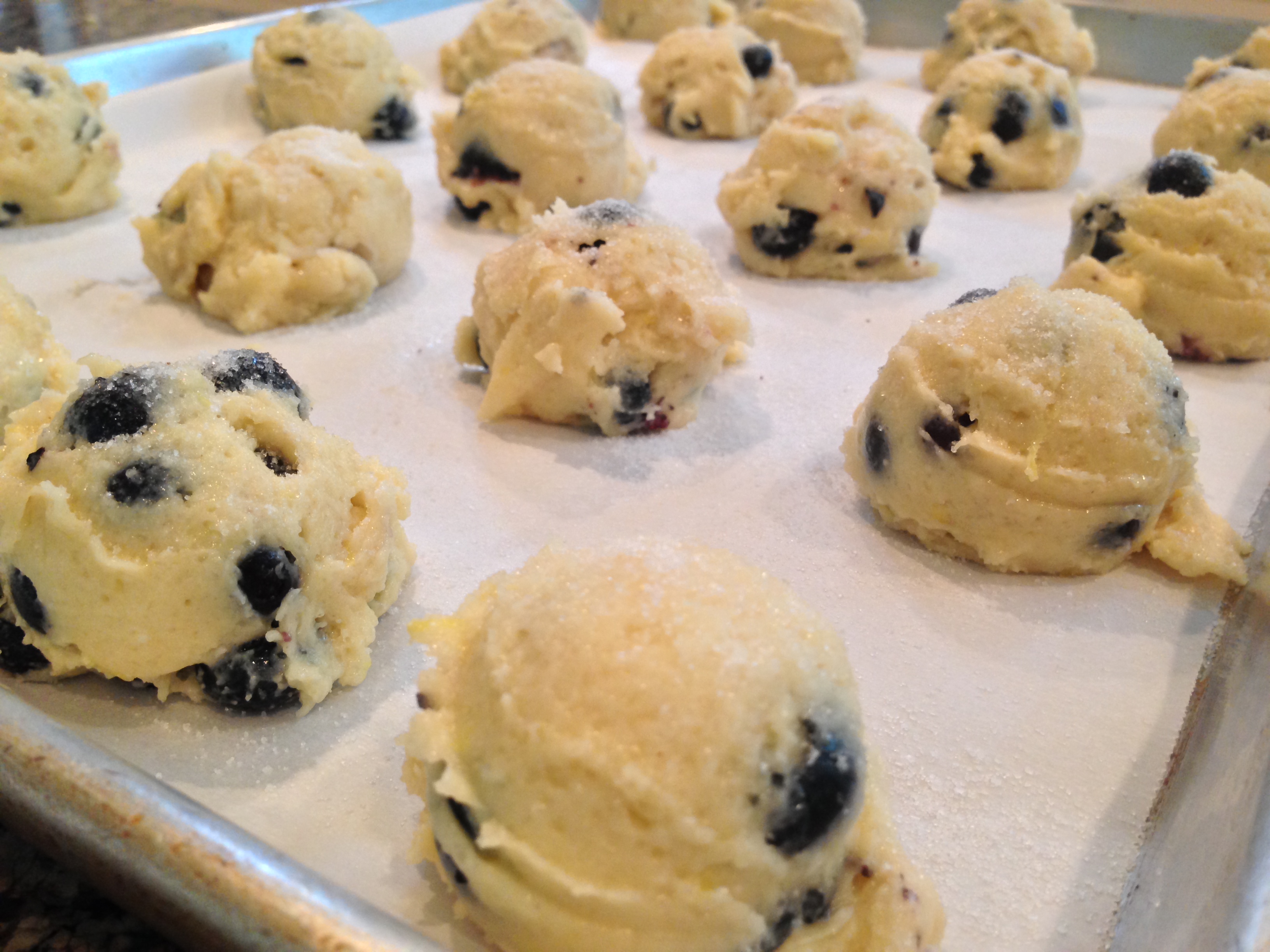
Last week I received a phone call from friends that were on their way to the Gloucester area, for the day and were planning to stop by for a quick visit. Excited for their arrival, I went straight to the panty to see what sweet confection I had to serve with Iced coffee. Remembering how fast and delicious the PB&J cookies recipe using a boxed cake mix is, ( PB&J a recipe I posted a few months back using boxed cake mix), I decide to get creative with a boxed white cake mix and a small container of fresh blueberries I had on hand. With fingers crossed and company expected to walk through he door in a few hours, I successfully created this yummy Blueberry Cake Cookie in less then and hour. I’m looking forward to trying it with fresh raspberries next time!
Fore Step-by-Step recipe details and photos click see more
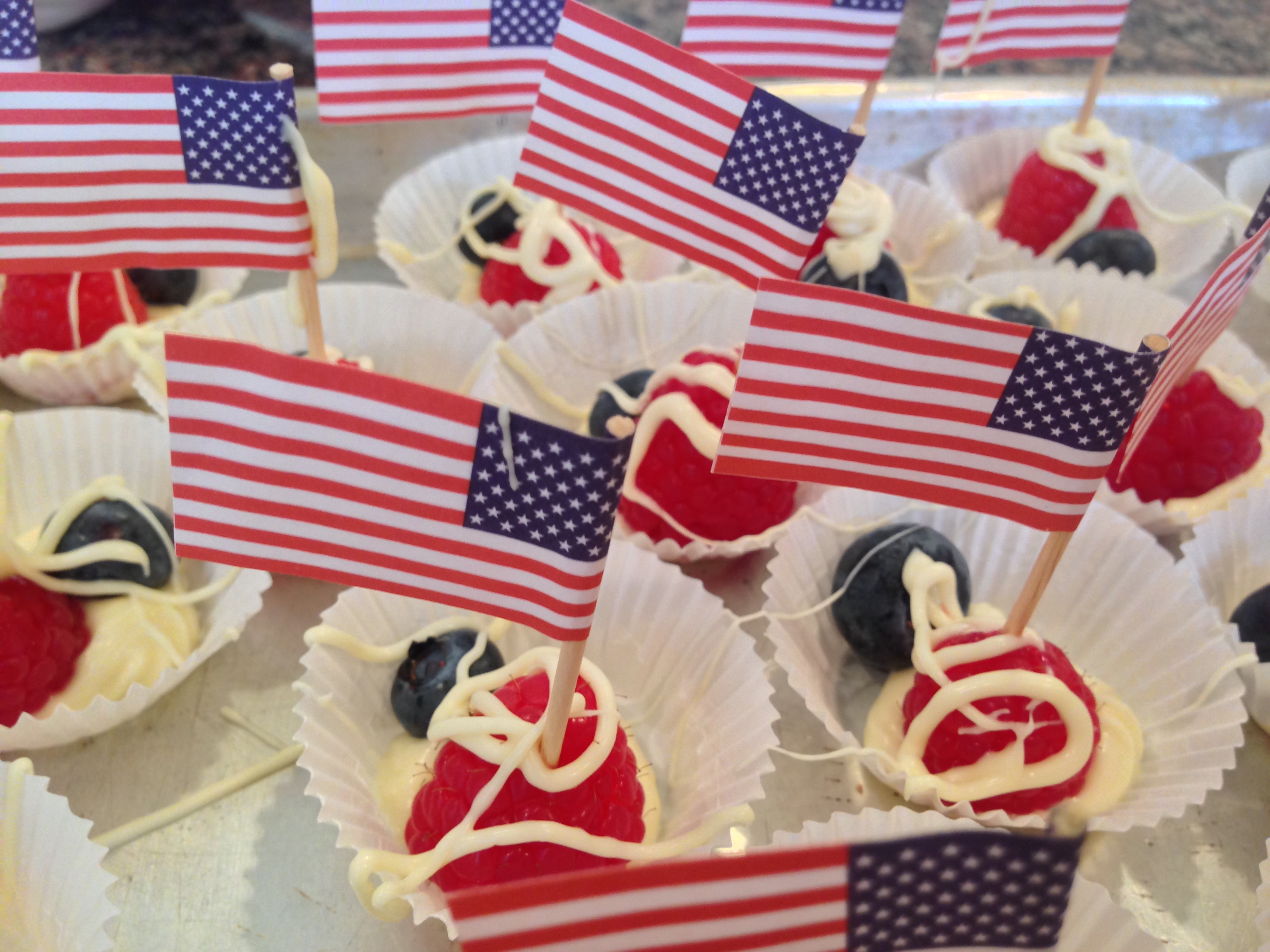
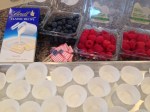
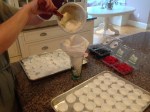
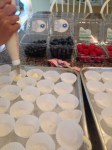
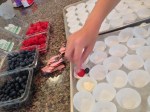
1 melt both bars white chocolate in double boiler pan; stir until completely melted; carefully transfer “hot” melted chocolate to pastry bag fitted with Wilton #5 or #18 pastry tip *Note~ I highly recommend wearing oven mitts when fixing 1/2 teaspoon hot chocolate into cups”
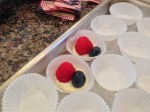
2 line cookie sheet with mini baking cups; fix ½ teaspoon melted chocolate into each cup; top with 1 blueberry and 1 raspberry; drizzle white chocolate over tops; chill till ready to serve
*Note~ will keep refrigerated 24 hours
Spread The GMG Love By Sharing With These Buttons:
































 Good Morning Gloucester