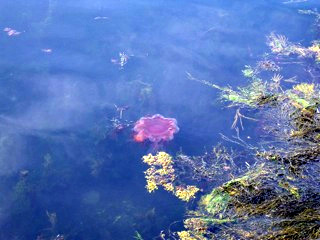
This photo of a Lion’s Mane Jellyfish was taken by Katherine Eyre at Eastern Point Yacht Club on Saturday, and was submitted by Violet Gray. It looks like a flower blossom.
The lion’s mane jellyfish (Cyanea capillata) is the largest known species of jellyfish. Its range is confined to cold, boreal waters of the Arctic, northern Atlantic, and northern Pacific Oceans, seldom found farther south than 42°N latitude. Similar jellyfish, which may be the same species, are known to inhabit seas near Australia and New Zealand. The largest recorded specimen found, washed up on the shore of Massachusetts Bay in 1870, had a bell (body) with a diameter of 7 feet 6 inches (2.29 m) and tentacles 120 feet (37 m) long.[1] Lion’s mane jellyfish have been observed below 42°N latitude for some time—specifically in the larger bays of the east coast of the United States.
Although capable of attaining a bell diameter of 2.5 metres (8.2 ft), these jellyfish can vary greatly in size, those found in lower latitudes are much smaller than their far northern counterparts with bells about 50 centimetres (20 in) in diameter. The tentacles of larger specimens may trail as long as 30 metres (98 ft) or more. These extremely sticky tentacles are grouped into eight clusters, each cluster containing over 100 tentacles,[2] arranged in a series of rows.
At 120 feet (37 m) in length, the largest known specimen was longer than a blue whale and is considered one of the longest known animals in the world.[1] In 1864, a Bootlace worm (Lineus longissimus) was found washed up on a Scottish shore that was 180 feet (55 m). But because bootlace worms can easily stretch to several times their natural length, it is possible the worm did not actually grow to be that length.
The bell is divided into eight lobes, giving it the appearance of an eight-pointed star. An ostentatiously tangled arrangement of colorful arms emanates from the centre of the bell, much shorter than the silvery, thin tentacles which emanate from the bell’s subumbrella.
Size also dictates coloration—larger specimens are a vivid crimson to dark purple while smaller specimens grade to a lighter orange or tan. These jellyfish are named for their showy, trailing tentacles reminiscent of a lion‘s mane.
The Lion’s mane jellyfish appears in the Sherlock Holmes short story The Adventure of the Lion’s Mane published in The Case-Book of Sherlock Holmes. Holmes discovers at the end of the story that the true killer of a school professor who died shortly after going swimming was actually this jellyfish. Suspicion was originally laid upon the professor’s rival in love, until the latter was similarly attacked (he survived, although badly stung). In the context of the story, it is only because the school professor has a weak heart that he succumbs, as is confirmed by the survival of the second victim.
Most encounters cause temporary pain and localized redness.[8] In normal circumstances, and in healthy individuals, their stings are not known to be fatal. Common remedies include: vinegar, isopropyl alcohol, and meat tenderizer.[9]
On July 21, 2010, around 150 people are thought to have been stung by the remains of a lion’s mane jellyfish that had broken up into countless pieces in Rye, New Hampshire in the United States. Considering the size of the species, it is possible that this mass incident was caused by a single specimen.[10]
Ouch! Hopefully there aren’t any more of these puppies floating around for people to get stung by.
E.J. Lefavour
www.khanstudiointernational.com
Spread The GMG Love By Sharing With These Buttons:














































































 Good Morning Gloucester