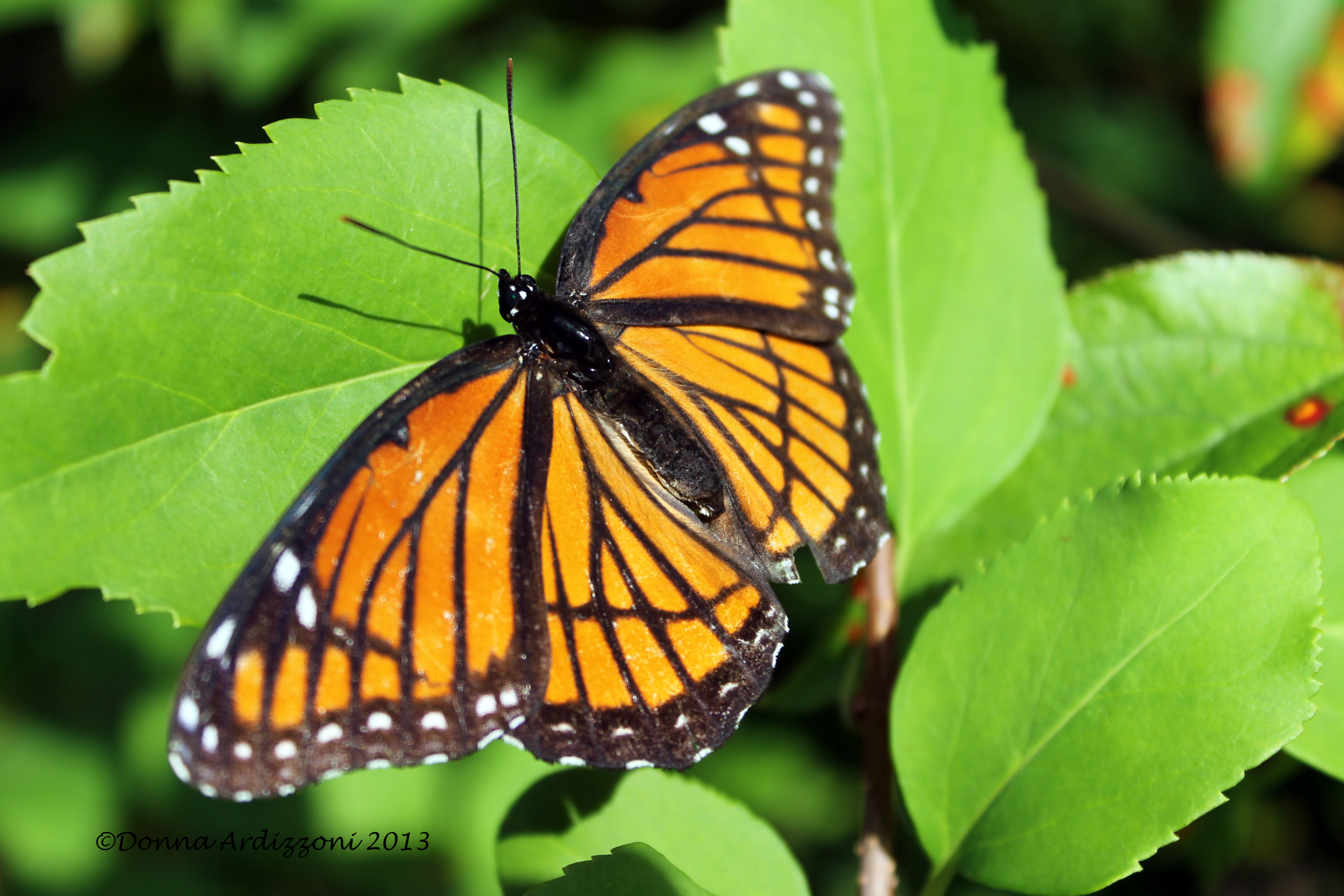
Where Are All the Monarchs?

Monarchs usually arrive in our region by the first week in July and go through several brood cycles. This year, barely any arrived. The Monarch’s sensitivity to temperature and dependence on milkweed make it vulnerable to environmental changes. Since 1994, U.S. and Mexican researchers have recorded a steady decline in the Monarch population in their overwintering grounds, with 2012-2013 being the lowest recorded to date.
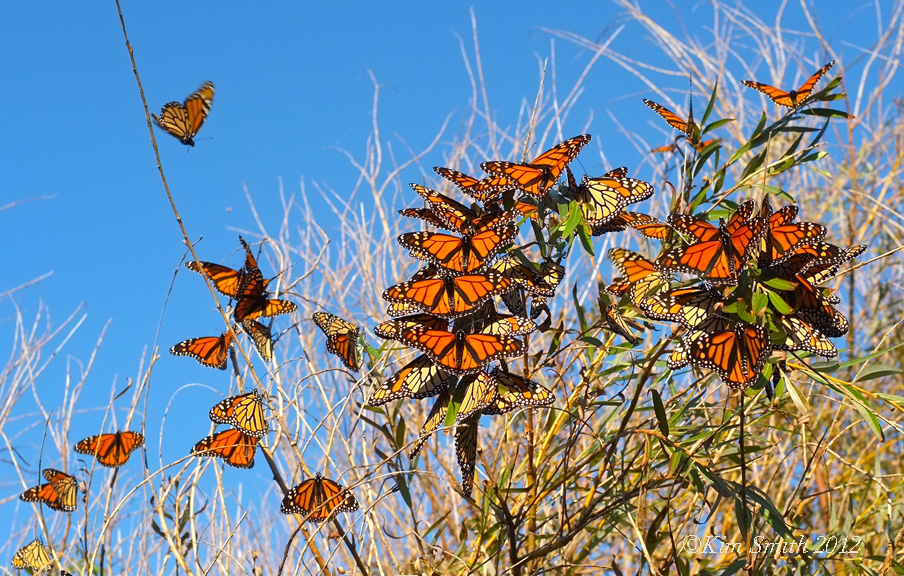
Monarch butterflies daybreak willow tree ©Kim Smith 2012

Temperature change and habitat loss affect breeding success and longevity. Dr. Chip Taylor, a leading Monarch researcher at the University of Kansas reports that the widespread adoption of GMO corn and soybean crops resistant to herbicides, along with with intensive herbicide use, coupled with the federal government’s incentivized expansion of corn and soy acreage for the production of biofuels have caused a significant drop in milkweed throughout the heart of the Monarch’s range. Lack of milkweed equals no Monarchs. “Monarch/milkweed habitat has declined significantly in parallel with the rapid adoption of glyphosate-tolerant corn and soybeans and, since 2006, the rapid expansion of corn and soy acreage to accommodate the production of biofuels,” Taylor wrote on May 29.
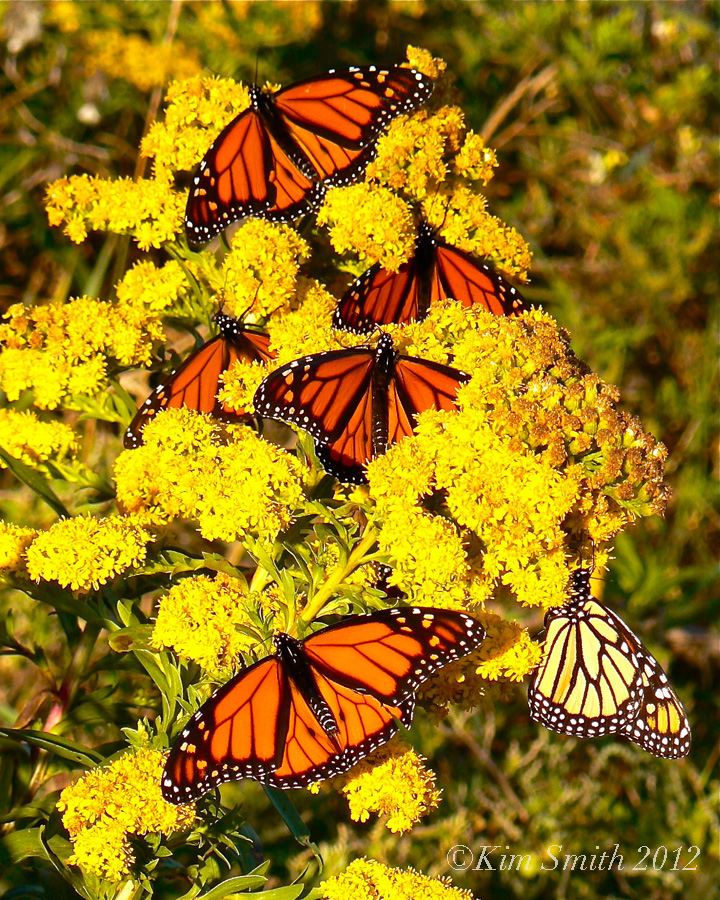
Monarch Butterfly Nectaring at Seaside Goldenrod ©Kim Smith 2011

Monarchs Nectaring at Seaside Goldenrod

What can we do? Encourage conservation organizations that conserve Monarch habitat, plant milkweed, plant nectar plants, and raise caterpillars. Hopefully the weather next spring and early summer will be more conducive to the Monarch’s northward migration and breeding success, and if and when the Monarchs arrive, they will find our milkweed plants.

Monarch Butterflies New england Aster ©Kim Smith 2012

Monarch Butterflies Nectaring at New England Asters

If anyone sees a Monarch, please email me at kimsmithdesigns@hotmail.com or leave a comment in the comment section.

Update #2: Reader Jude Writes the following ~

Hi Kim,

I have maybe 30milkweed plants in the front yard. I would be happy to harvest the seeds, are there places you know of that would be willing or have a large enough property to seed them? Can you harvest them as soon as the pods pop? I remember as a kid finding the most beautiful cocoon I have ever seen. I haven’t seen many butterflies at all and of the ones I have seen are not Monarchs.

My reponse:

Hi Jude, I am putting it out there in GMG Land that if anyone would like your milkweed seed pods to please contact me.

Yes, you can harvest immediately after the pods pop, as a matter of fact, I recommend doing just that and sowing your seeds in the fall. The easiest method is to lightly scratch the surface of the soil where you wish the milkweed to grow. Scatter the seeds and water. That’s it.

Thank you so much for writing. Hopefully, we’ll find a home for your milkweed seeds.

Update: For more information, see previous GMG posts on Monarchs and Milkweed:

How Exactly is Monsanto’s Roundup Ravaging the Monarch Butterfly Population?

News Release: MONARCH WATCH ANNOUNCES ‘BRING BACK THE MONARCHS’ CAMPAIGN

Cape Ann Milkweed Project

GloucesterCast Podcast 4/25/13 With Guest Kim Smith

Fields From Which Dreams Are Made

So many thanks to the Donovan Family for allowing me continued access to film and photograph B-roll for my Monarch film, at their beautiful…

Wildflower Field of Dreams

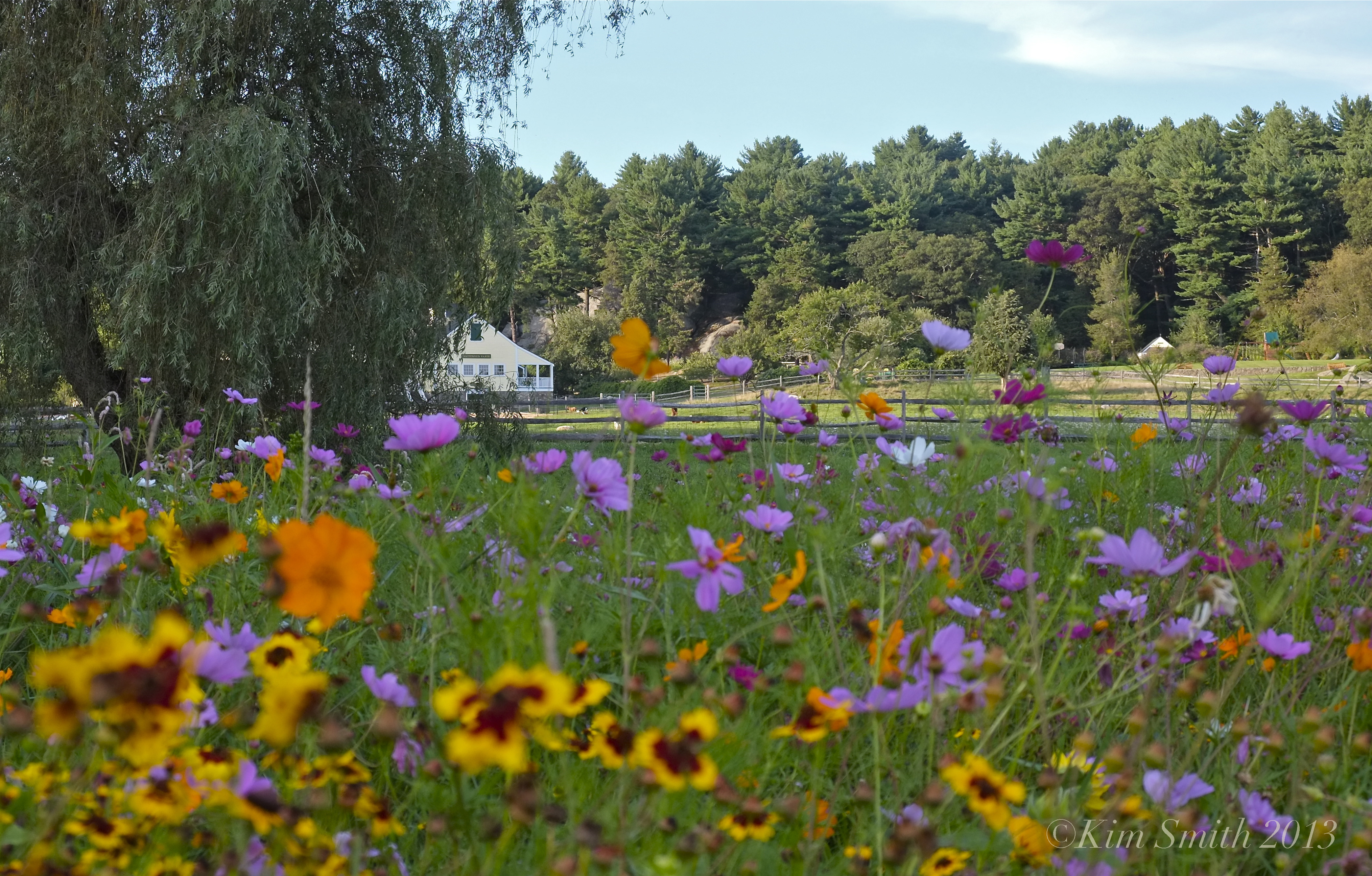
Donovan Wildflower Field & House ©Kim Smith 2013 copySkylar’s Field

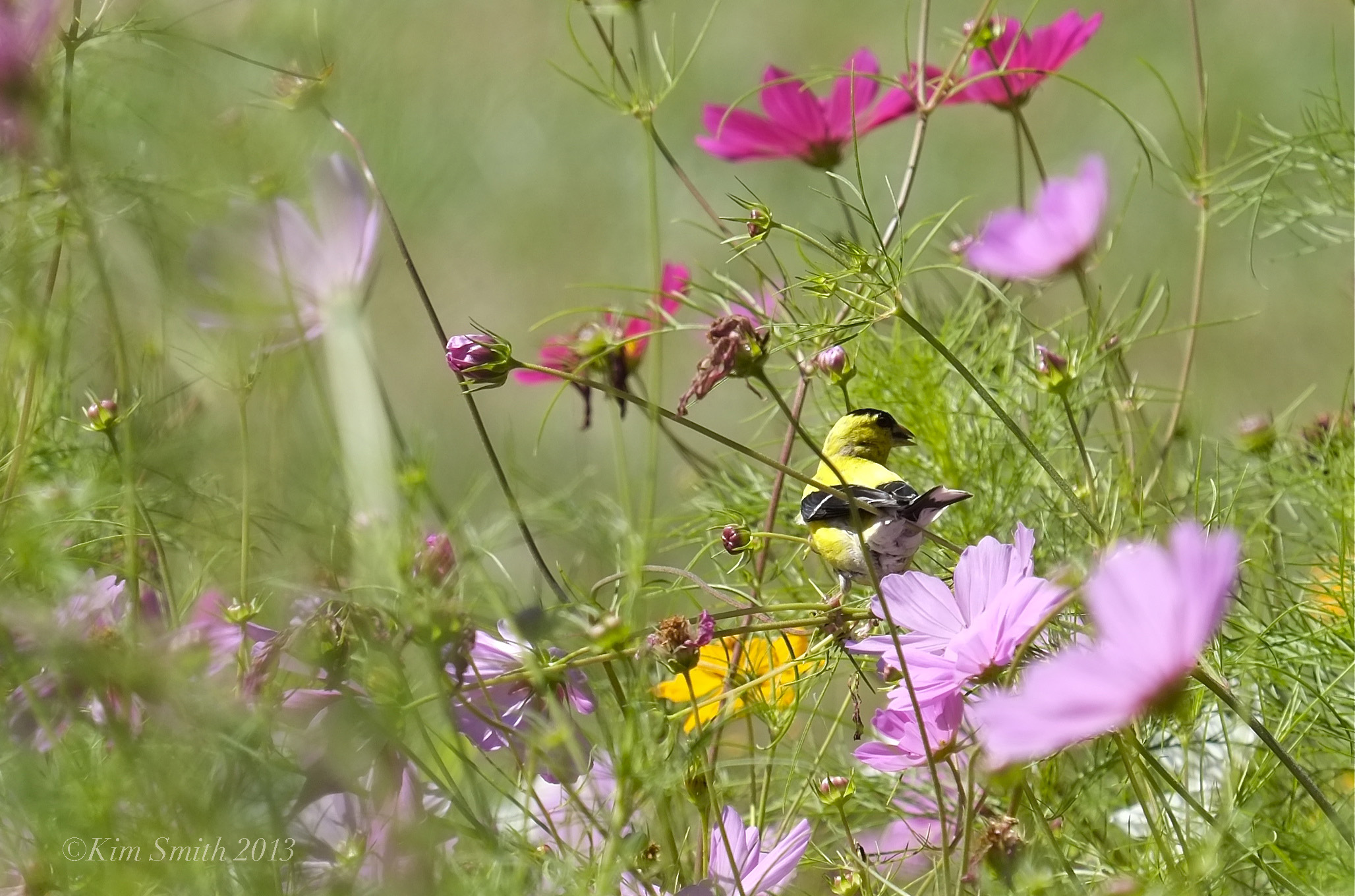
Male American Goldfinch and Cosmos ©Kim Smith 2013

Male American Goldfinch Eating Seed Heads ~ click to view larger

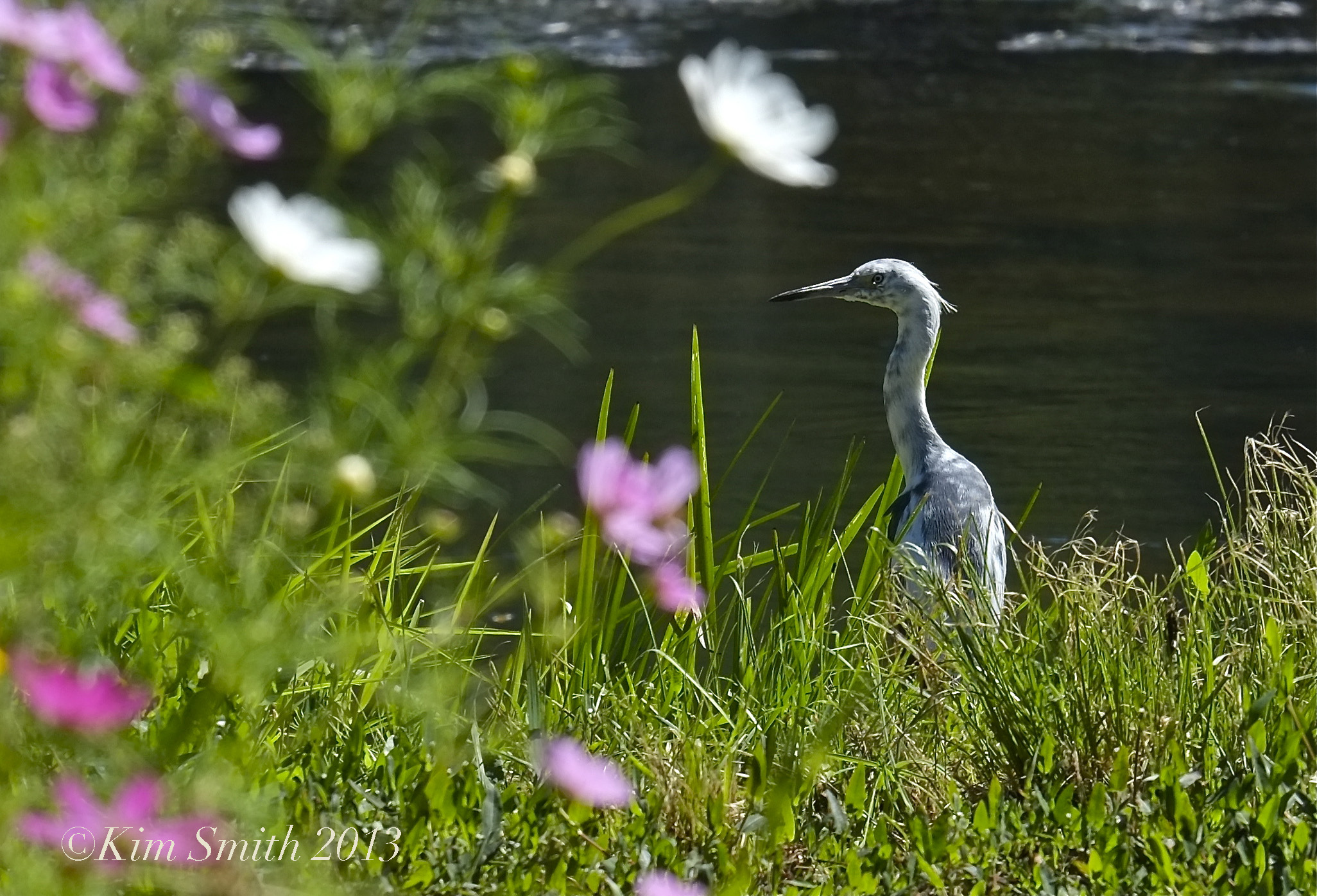
Juvenile Blue Heron & Cosmos Donovan ©Kim Smith 2013Juvenile Blue Heron

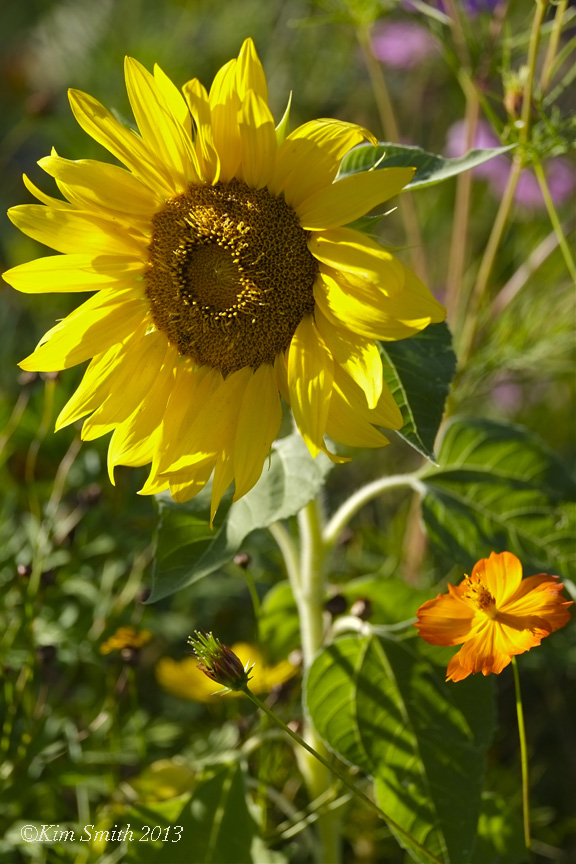
Sunflower Donovan Field ©Kim Smith 2013 copySunflower (Helianthus annuus)


The Beauty of Pollination

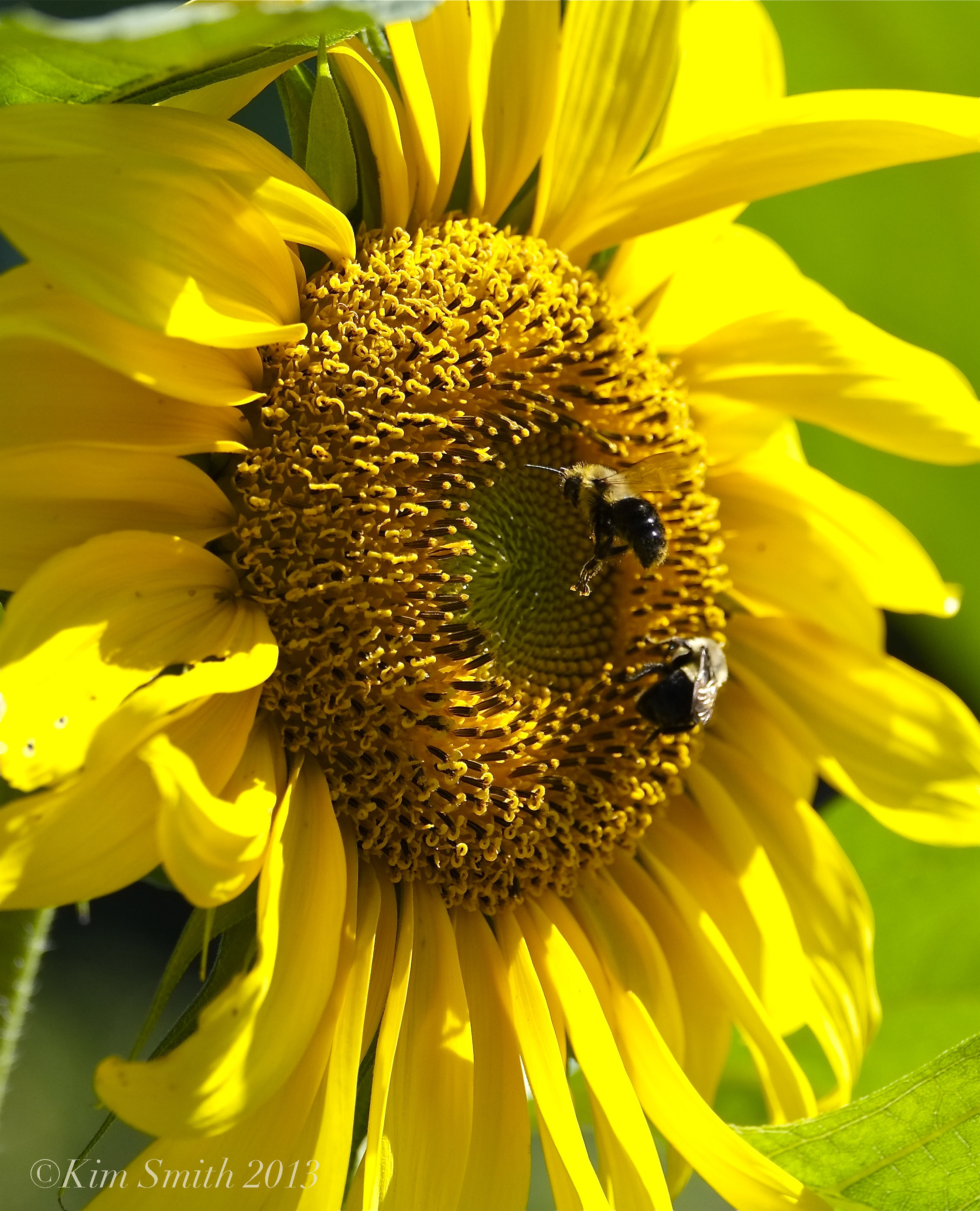
Sunflower and Bees ©Kim Smith 2013Bees Pollinating Sunflower

Friends and GMG readers share the most beautiful treasures, including the following film, sent in by Mary Weissbaum. Mary writes, “The hummingbird doing rolls chasing a bug is neat! Watch closely and check out the baby bat under its mama (@ ~2 min, 38 sec). Unreal !! If you never knew what goes on in the garden when you aren’t paying attention, watch this – some of the finest filmography you will ever see.” Thank you Mary!

I have posted this video before and think it is worth seeing again, and again!

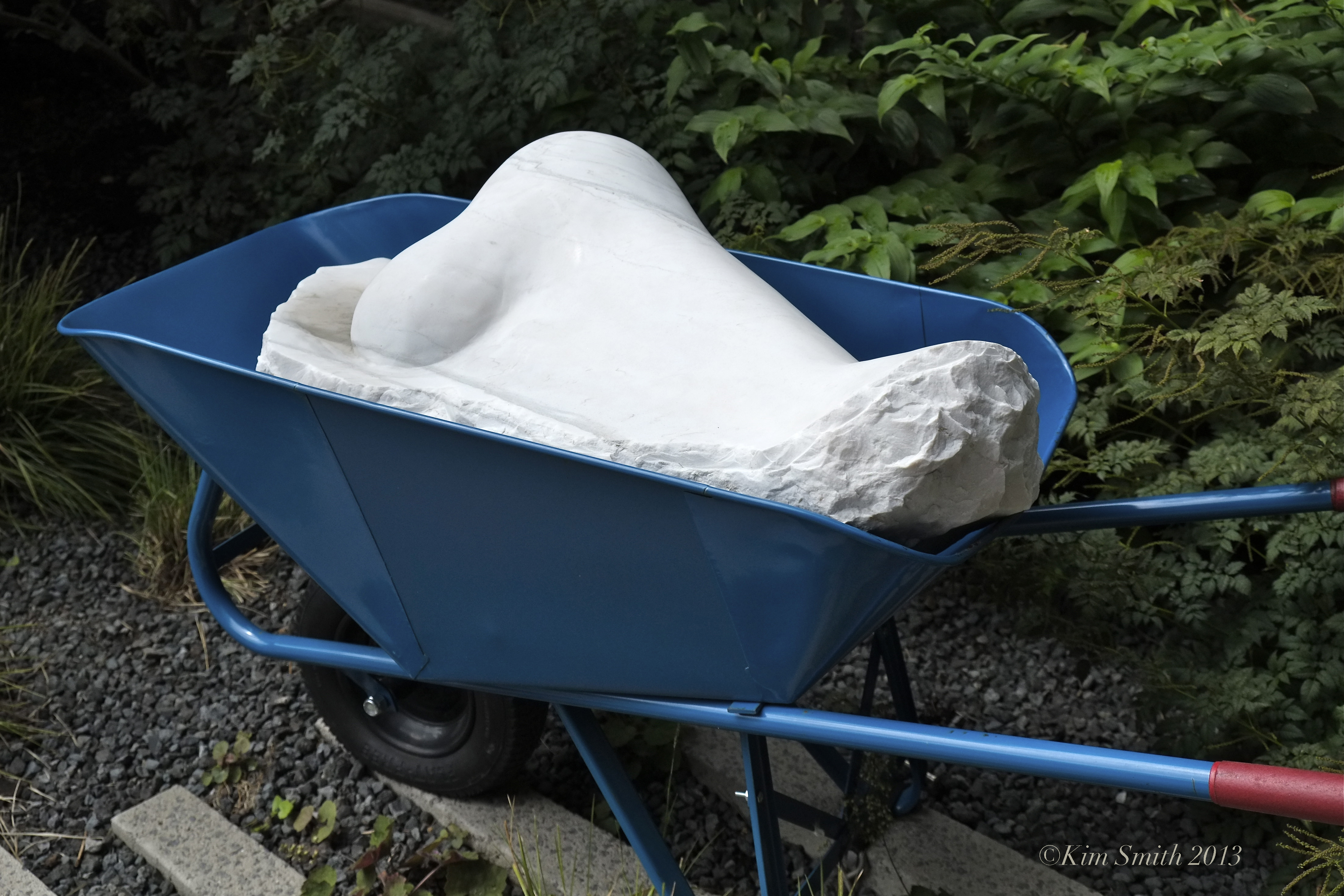
Nose in a Wheelbarrow

Nose in a Wheelbarrow HighLine NYC ©Kim Smith 2013

Nose in a Wheelbarrow ~ HighLine, NYC

I didn’t intend to create a theme about noses, but took this snapshot while visiting my daughter in NYC and couldn’t resist sharing.

Update: Read More About “Nose Job,” by New York-based artist Andra Ursuta’s, and the sculpture exhibit “Busted,” at the HighLine, from now through April 2014, at the HighLine website here.

Pick Your Own Flowers at Long Hill

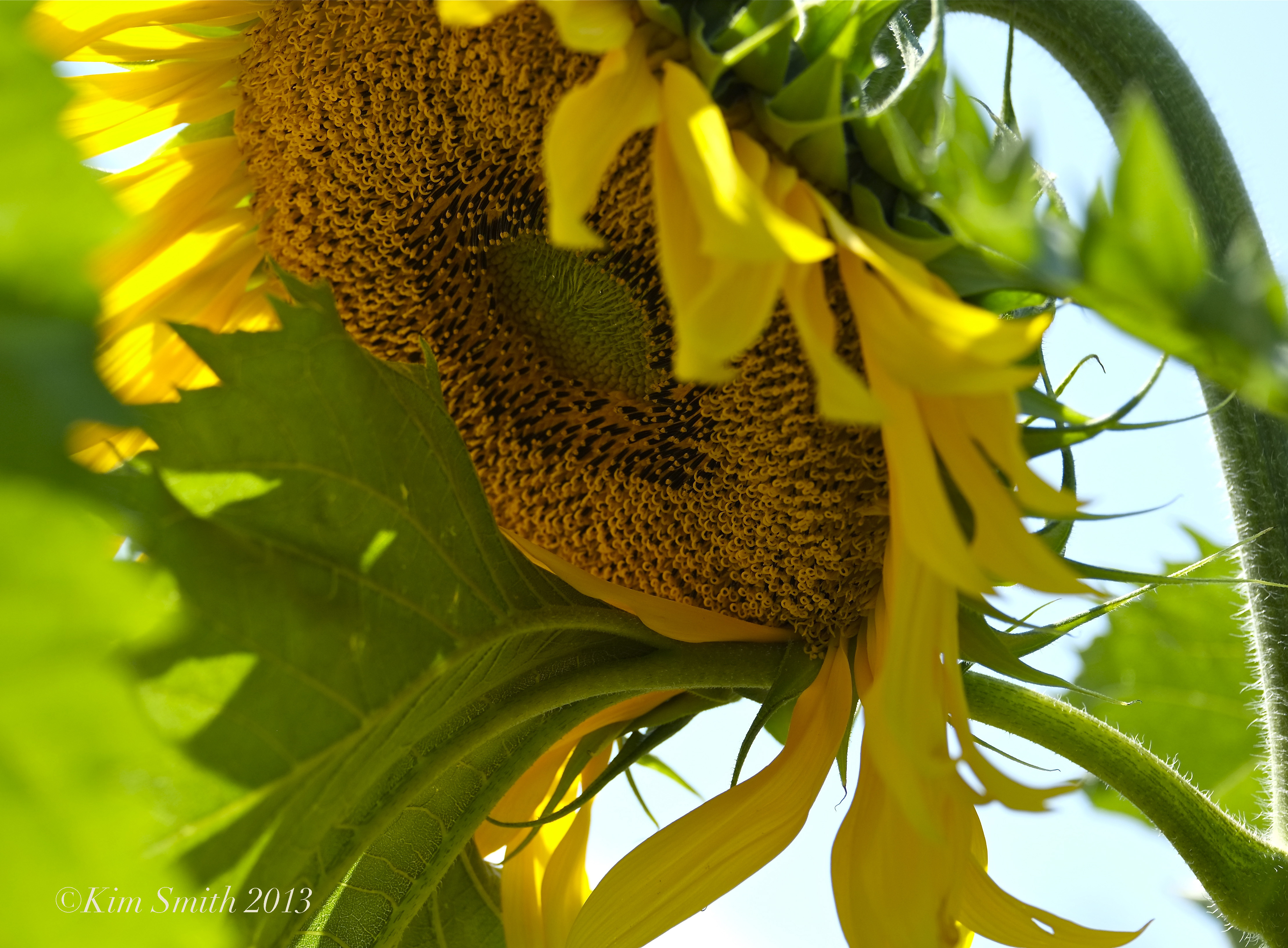
Sunflower ©Kim Smith 2013

Last Thursday I spent the day photographing gardens around the north shore and couldn’t resist stopping at Long Hill and Sedgwick Garden in Beverly to pick a bouquet.

Pick your Own Long Hill Beverly ©Kim Smith 2013

Annual Rudbeckia ©Kim Smith 2013Annual Rudbeckia

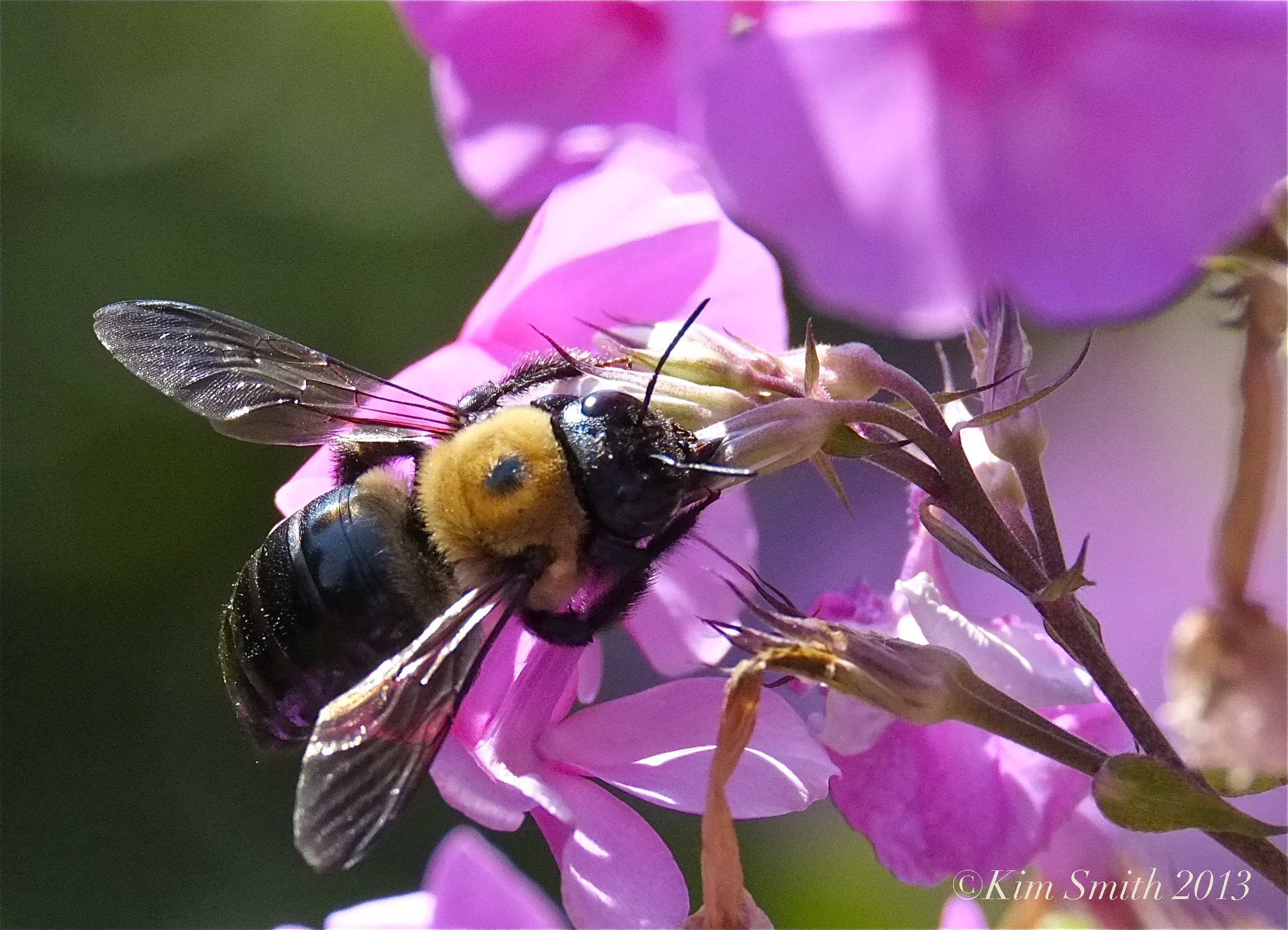
Bee and Phlox ©Kim Smith 2013JPGCarpenter Bee and Phlox

Seaside Garden Club 2013-2014 Speakers Schedule

Kate Wilwerth from the Seaside Garden Club writes ~

Don’t miss the Seaside Garden Club’s opening program on September 10th at the Manchester Community Center. Social time begins at 7:00 and program begins promptly at 7:30.  Light refreshments will be served.

Betty-SandersBetty Sanders 

Garden Design for Decades by Betty Sanders.  Gardens should never be a burden to us.  What we want in our 20’s and 30’s is not what the same as we want in later years.  You’ll learn how to keep your gardens as your needs and  abilities change.  It’s a matter of plant selection and design, and can pay dividends for decades.

We are thrilled to have Betty Sanders back to present this program. Betty is a Massachusetts Master Gardener with a degree in organic chemistry and a well-respected garden speaker. Currently serving as vice-president of the Bay State’s 150-member Master Gardener Association, she said she gives lectures that “combine my knowledge of gardening and chemistry” Betty is nationally accredited flower show judge. She has studied gardening everywhere from Arnold Arboretum to the New York Botanical Garden and the New England Wildflower Society.Visit Betty’s website:  http://www.bettyongardening.com/
We have a terrific line up of programs for this year!  If you haven’t joined yet, membership is only $25 for the year.  You can join at the September meeting. Guests are always welcome for $5. This year we have two terrific workshops! Note: Workshops have a supply fee and are limited to members only.  Don’t miss Bert Ford’s Home Decor Demonstration – we will be raffling off his creations!
Date Program
10/8/2013 Fall Into the Holidays: A Home Décor Demonstration and Raffle by Bert Ford of Ford’s Flowers.  Arrangements will be raffled!
11/12/2013 Clean & Green – Cleaning Product  Workshop presented by Rita Wollmering of The HERB FARMacy
12/10/2013 Yankee Swap hosted by Lisa Willwerth
2/11/2014 Bonsai Demonstration with Bob Downey
3/11/2014 The Well Decorated Garden by Fred Rice
4/15/2014 Mosaics for the Garden Workshop by Sheila Jones Schrank
5/13/2014 Auction and Plant Sale
6/10/2014 Ravenswood Park Guided Walk with  Ramona Latham followed by Pot Luck Dinner

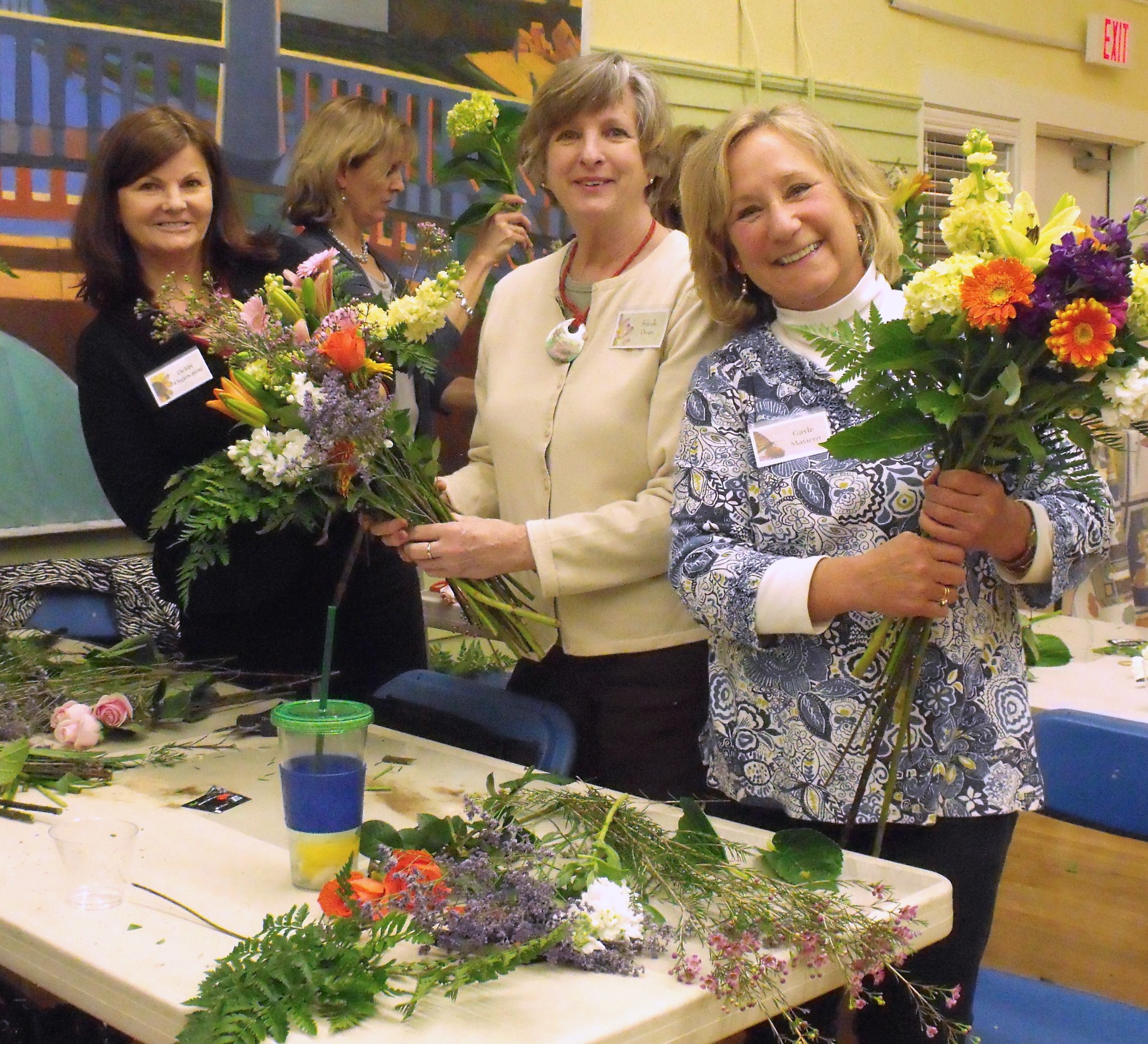
Debbie Sarah GayleDebbie DiGiovanni, Sarah Dean and Gayle Masiero

The Seaside Garden Club is a group of fun, active, civic-minded and hands-on gardeners.  We welcome all types of gardeners from beginners to experienced… there is always something to learn and share.  We invite you to become a member of our club and enjoy our monthly programs which feature interesting guest speakers and creative workshops.

The Seaside Garden Club meets the second Tuesday of every month (September through June) at 7:00 pm at the Community Center, Manchester-by-the-Sea.

Visit the Seaside Garden Club blog: http://seasidegardenclub.wordpress.com/

Sweet White-Fleshed Belle of Georgia Peaches

Ten quarts of ‘Belle of Georgia’ peaches from one little peach tree, peeled, blanched, and freezer-ready for yummy pies and smoothies during the winter months.

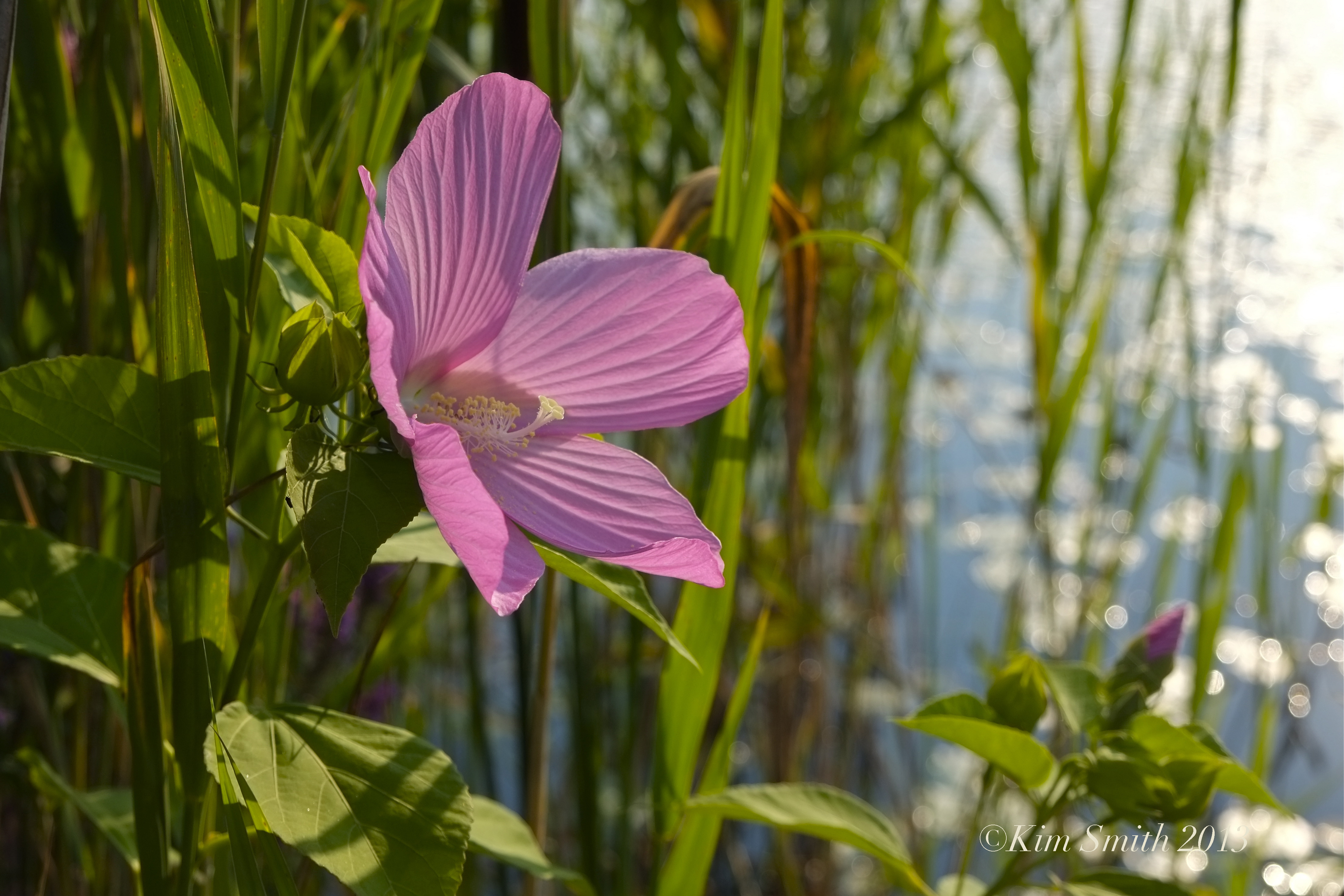
Crimson-eyed Rose Mallow Growing at Niles Pond

Rose Mallow Marsh Mallow ©Kim Smith 2013

Please Don’t Pick the Wildflowers ~ Thank you!

Hibiscus moscheutos, known by many common names including Swamp Rose Mallow, Swamp Mallow, Eastern Rose Mallow, and my favorite, Crimson-eyed Rose Mallow, is a wonderful perennial garden plant and when found in nature, is a wetland plant that can grow in great drifts. Hummingbirds and bees drink nectar from mallows. The flowers of Hibiscus moscheutos range is shades from pure white to deepest rose, and some have a brilliant magenta eye.

Rose Mallow was planted widely at the beginning of the previous centurey, when an awaresness developed about conserving our North American native wildflowers. You would be hard pressed perusing a home and garden publication from that era and not find a lovely illustration of Crimson-eyed Rose Mallow.

Rare Footage of a Luna Moth Taking Flight

 Beauty on the Wing ~ A Luna Moth takes Flight

My friend James, the facilities director at Willowdale Estate, sent a photo of a newly emerged moth on Sunday afternoon. He initially thought it was a paper napkin stuck to one of the lampposts, but upon inspection, discovered that it was a Luna Moth (Actias luna). With high hopes the moth would still be there, I dropped everything and raced over to Willowdale to photograph and film the moth. It is not that the moths are particularly rare, but that they are most often seen in flight at night.  Lucky me, to have had such a wonderful encounter with one of the most beautiful moths in all the world!

The Willowdale Luna Moth is a male of the species; you can tell by his bushy and feathery plumosa (or antennae). The female’s antennae are more thread-like. Notice too, just before he takes flight, how his body vibrates, which helps warm and energize the wings in preparation for flying.

Luna moths are members of the Saturniidae, subfamily Saturniinae. With a wingspan of typically up to four and a half inches, atypically up to seven inches, they are one of North America’s largest moths. Luna Moths are most often seen in the earlier part of summer in our region; this Luna Moth encounter took place on August 11, 2013. Luna Moths, like all members of the Saturn family of moths, eclose without mouthparts. They emerge solely to mate and deposit eggs of the next generation and live for only about one week.

Luna Moth larvae (caterpillars) feed on wide variety of broadleaf plants and different geological populations of Luna Moths are adapted to different hostplants. Northernmost populations most often feed on white birch (Betula papyrifera). More southerly populations feed on persimmon (Diospyros virginiana), sweet gum (Liquidambar styraciflua), hickories (Carya), walnuts (Juglans), and sumacs (Rhus).

The damage done by Luna Moth caterpillars on host trees is never significant enough to harm the host trees. Please don’t spray your trees with pesticides or herbicides!

Male Luna Moth Actias Luna ©Kim Smith 2013

A note about the music playing in the background ~

Ave Maria, Ellens Gesang III, D. 839, No 6, 1852, was composed by Franz Schubert in 1852 and is a setting of seven songs from Walter Scotts epic poem The Lady of the Lake. Performed by Barbara Bonney.

Read More: Continue reading “Rare Footage of a Luna Moth Taking Flight”

The Rare Karner Blue Butterfly is Making a Comeback!

male_karner_blue_lg

The rare Karner Blue Butterfly has been in the news lately, with a featured article in The Wall Street Journal, no less (thanks to Joey for alerting me, via twitter!). Although this diminutive beauty has become extirpated from Massachusetts, it has been successfully reintroduced to New Hampshire!

RecoveryMap1Historic Range of the Karner Blue

The New Hampshire Fish and Game Department says “good weather, coupled with help extending the butterfly’s unique habitat in Concord, have made a difference. A company called Praxair Surface Technology/TAFA created a 10-to-15 acre habitat to attract the brilliant blue butterflies, planting over 600 blue lupine and nectar plants in a matter of hours, the insect’s main source of food. The butterfly has been on the federal Endangered Species list since 1992. That year it also was named New Hampshire’s state butterfly, which has been working to restore their unique, savannah-like habitat, as legislators realized the numbers were dwindling.” (WSJ)

APBPC-Karner-blue-butterfly

The following is an excerpt from an article that I wrote nearly ten years ago, about New England native lupines, and briefly describing the plight of the Karner Blue. At the end of the excerpt you can read the entire article after Read More

Blued with Butterflies and Lupines ~ The Rare Karner Blue  and Sundial Lupines

By Kim Smith

Excerpt:

Lupinus perennis is the only larval food of the nearly extinct Karner Blue butterfly (Lycaeides melissa samuelis). The upper surface of the wings of the male of the diminutive Karner Blue, with a wingspan of just an inch, is a brilliant lapis lazuli blue with a thin margin of black, bordered by an outline of white. The female is a nearly similar celestial blue, but with a slightly more brownish, or grayish hue, with dark dots rimmed by orange crescent-shaped spots along the margins of the hindwings. The Karner Blue was identified little more than a hundred years ago in Karner, New York. It is just one of many butterflies that Vladimir Nabokov studied and it is also referred to as Nabokov Blue. Throughout much of its former range, including Massachusetts, the Karner Blue is now extirpated. The near-extinction of the Karner Blue has been widely studied and there are currently several programs underway to encourage its survival in its existing colonies (New York) and reestablish new colonies in its former range (Ohio, for example). To my knowledge, no such program, as of yet, exists in Massachusetts. The reasons for the near extinction of the Karner Blue are many-fold, chiefly: fragmentation and loss of habitat of Lupinus perennis through fire suppression and over-development (the very sites that are ideal growing conditions for L. perennis are also choice locations desirable for housing and industrial developments); the use of pesticides (namely BTK), which kills all instars of the Karner Blue; and the ability of L. perennis to freely cross-pollinate with the west coast Lupinus polyphyllus and its Russell cultivar, which makes the next generation unsuitable host plants for the Karner Blue.  Lupinus polyphyllus and its offspring, now seen growing freely along the coast of Maine, is an unfortunate example of how an ill-conceived introduction of another species, and its cultivars, whether it is from another region of our own country or beyond our borders, has widespread and negative repercussions.

Perhaps in our community we can once again be blued with lupines and Karner Blues. The symbiotic relationship of both blue beauties inspired me to order seeds in bulk to share with friends. I am hoping, with the ability of the Karner blue to travel as far as1600 miles, maybe we can connect to the remnant populations in New York or New Hampshire. Possibly you, too, have a sunny location in your garden, or even more grandly, an entire meadow that could be devoted to Lupinus perennis and compatible native New England wildflowers. If, in time, I cannot report back to you that there have been any sightings of the Karner Blues visiting our garden, Lupinus perennis is also a nectar source for a wide variety of beneficial insects and is a larval host plant for the dwindling Frosted Elfin (Callophyrs irus). The eggs of the Frosted Elfin are laid singly on the lupine buds. Larva bore into developing seedpods and the chrysalids hibernate in the leaf litter beneath the plant. For these reasons, thoughtful maintenance is required when cultivating Lupinus perennis.


All images courtesy Google image search.

Read the full article: Continue reading “The Rare Karner Blue Butterfly is Making a Comeback!”

Roomba Shark Cat, Hammerhead Sharky Ferocious Pit Bull, and Baby Duck

Although Shark Week is officially over, I can’t resist one more video featuring Shark Cat, Sharky the Ferocious Pit Bull, and a baby duck who appears to want to go for ride with Shark Cat on the roomba.

Vining Around the Garden

For readers not yet aware, Vine is a free downloadable app for your cell phone. Vine allows you to make six-second continuously looping videos, which you can share instantly to Twitter, FB, and Vine. I like Vine because it is so immediate, uncomplicated, and fun to use. Some people I follow on Vine are John McElhenny; his Vines are always interesting scenes taken in and around Gloucester, and also Amanda Mohan and Macklemore because their Vines are often super funny.

To read the caption, wave your cursor over the lower left-hand corner of each video.

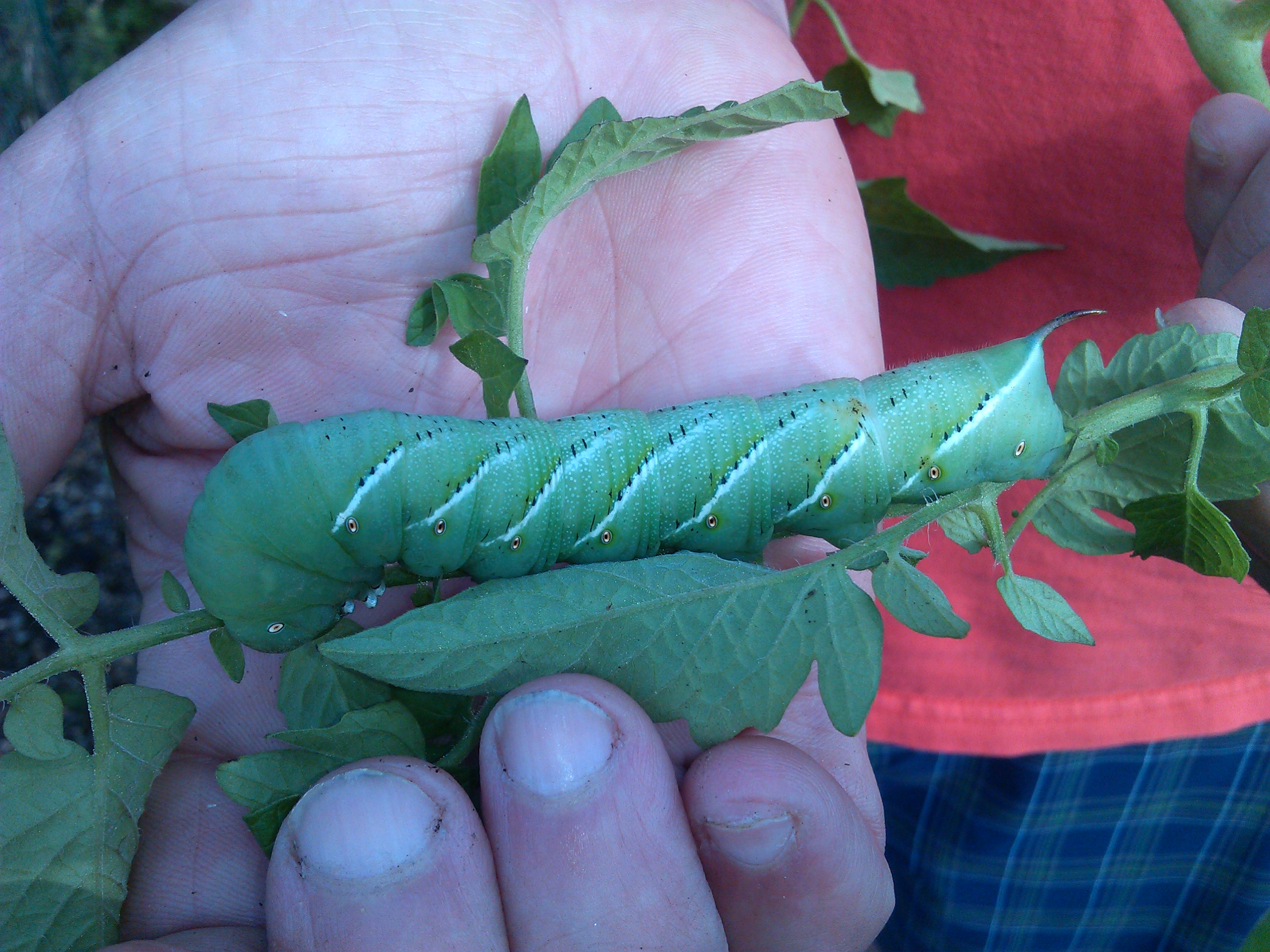
What is Eating My Tomato Plant?

FOBs Melissa and Bill Cox write in, “What is This?”

Tomaot Horn Worm

Hi Melissa and Bill,

You have a Tomato Hornworm, which is a a hawk moth member of the family Sphingidae. They have a voracious appetite and will completely defoliate your plant, including stems and immature fruit. Tomato Hornworms are fond of many members of the family Solanaceae, which includes moonflower, morning glory, pepper, eggplant, tobacco, and potato.

The caterpillar is probably ruining your plant but if you wanted to see it go through its life cycle, you could place the caterpillar in a terrarium and feed it the foliage of the plant that you found it munching on. Alternatively, the easiest way to kill the caterpillar is to drop it in a dish of soapy water.

tomato hornworm white worm parasitesTomato Hornworm covered with Beneficial Cocoons of the Braconid Wasps

Thanks Jennifer for the comment (see below).

SIX Black Swallowtail Pupae on One Fennel Plant!

One pupated last night and now their are a total of six chrysalides–five in the green form and one brown form.

To air on public television I need to lengthen slightly my Black Swallowtail film. My deepest thanks and appreciation to Kate Young and Wolf Hill Garden Center, who have been keeping me supplied in Black Swallowtails in every form, from eggs to chrysalides, for several months now! My film is going to be all the better for it and I am just so deeply appreciative of Kate’s and Wolf Hill’s interest and generosity.

Nicole Duckworth Rolls with Baby Jude

Jude Nicole Duckworth ©Kim Smith 2013

Beautiful working mother of three Nicole Duckworth knows how to rock and roll and get the job done with her adorable seven-month old, Jude.

Just look at that happy face!

Nicole Jude Duckworth © Kim Smith 2013Jude and Nicole Duckworth

Mimosa Tree

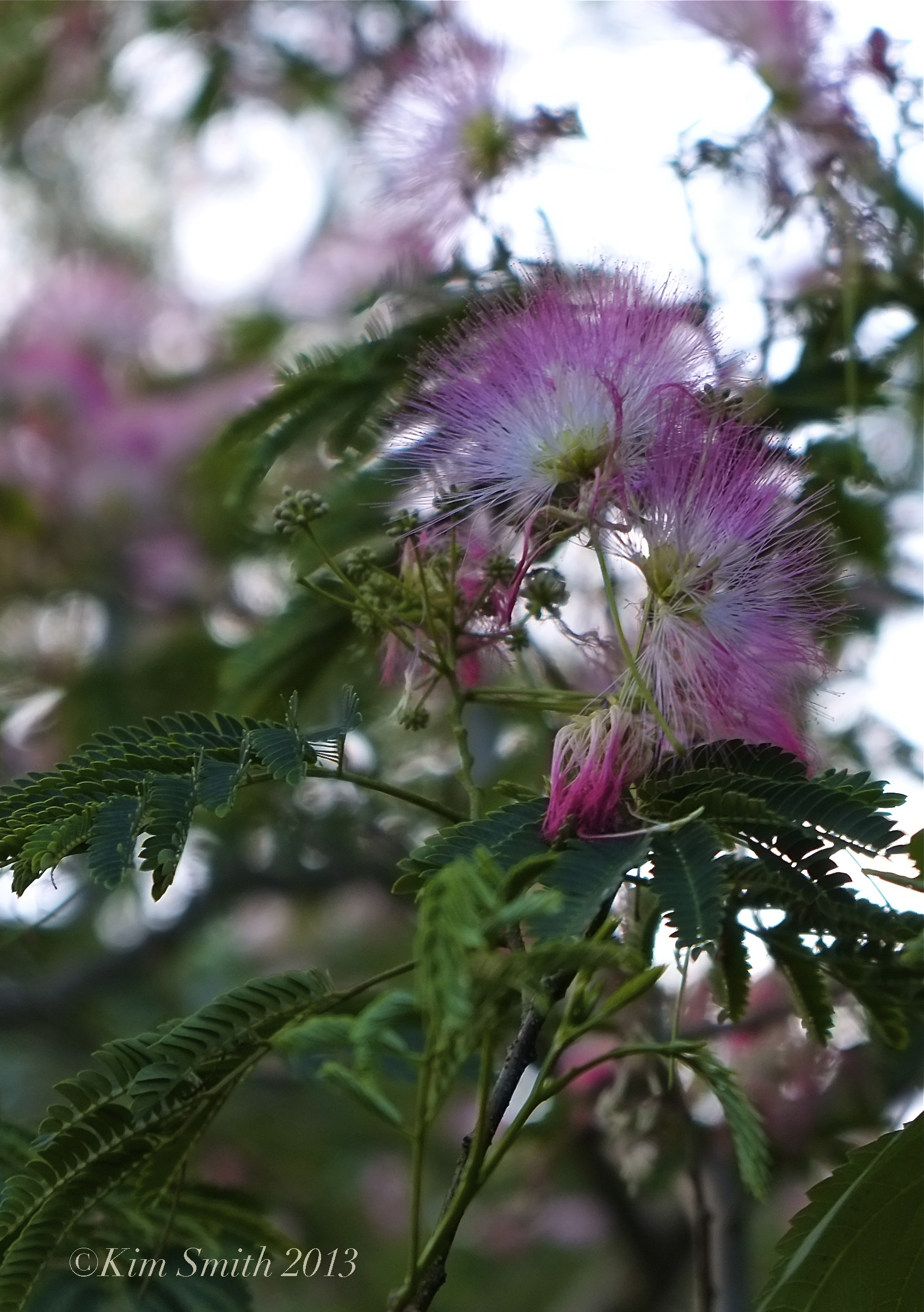
Wednesday I visited an extraordinary garden in Marblehead. Amongst the many specimens of unusual trees that are not widely grown in our region, which are growing in this sheltering tree-garden, was one of my very favorites, the stunning Mimosa Tree (Albizia julibrissin f. rosea). Although the Mimosa Tree is not indigenous (it is native to southwestern and eastern Asia), the blossoms are a rich source of nectar for Ruby-throated Hummingbirds and several species of swallowtails.

Mimosa Tree ©Kim Smith 2013

Mimosa Tree ~ Albizia julibrissin f. rosea