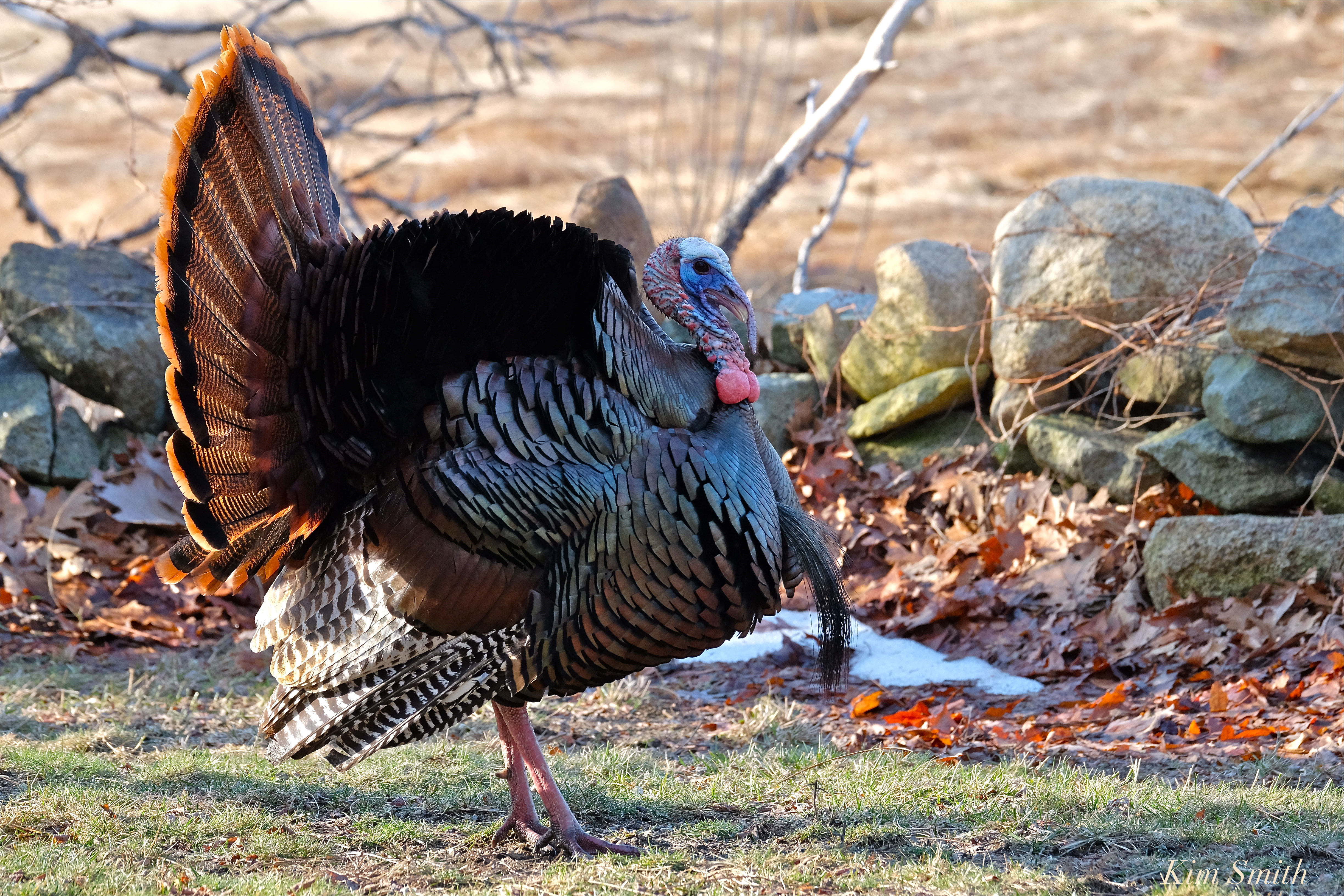
 GMG Reader Dave wrote recently saying that he did not recall seeing turkeys on Cape Ann when he was growing up. Although the Eastern Wild Turkey is native to Massachusetts, it was rarely seen after 1800 and was completely extirpated by 1851.
The Wild Turkey reintroduction to Massachusetts is a fantastic conservation success story and a tremendous example of why departments of conservation and protection are so vital to our quality of life.
Massachusetts was recently ranked the number one state by U.S. News and World Report and conservation stories like the following are shining examples of just one of the many zillion reasons why (healthcare and education are the top reasons, but conservation IMO is equally as important).
Reposted from the Wild Turkey FAQ page of the office of the Energy and Environmental Affairs website.
“At the time of Colonial settlement, wild turkeys were found nearly throughout Massachusetts. They were probably absent from Martha’s Vineyard and Nantucket, and perhaps the higher mountain areas in the northwest part of the state. As settlement progressed and land was cleared for buildings and agriculture, turkey populations diminished. By 1800, turkeys were quite rare in Massachusetts, and by 1851 they had disappeared.
Between 1911 and 1967 at least 9 attempts in 5 counties were undertaken to restore turkeys to Massachusetts. Eight failed (probably because of the use of pen-raised stock; and one established a very marginal population which persisted only with supplemental feeding.
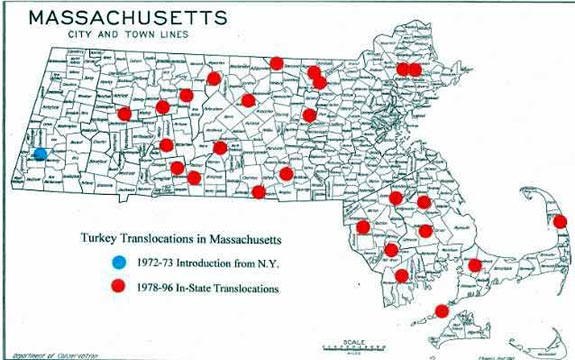
In 1972-73, with the cooperation of the New York State Department of Environmental Conservation, MassWildlife personnel live-trapped 37 turkeys in southwestern New York and released them in Beartown State Forest in southern Berkshire County. By 1976, these birds had successfully established themselves and by 1978 this restoration effort was declared a success.
Beginning in 1978, MassWildlife began live-trapping turkeys from the Berkshires and releasing them in other suitable habitat statewide. Between 1979 and 1996, a total of 26 releases involving 561 turkeys (192 males, 369 females) were made in 10 counties (see the following Table and the accompanying map).
| Turkey Transplants within Massachusetts 1979-1996 |
||||
|---|---|---|---|---|
| Location | Town | County | Year | Number (Sex) |
| Hubbardston State Forest | Hubbardston | Worcester | 1979, 1981 | 22 (10M, 12F) |
| D.A.R. State Forest | Goshen | Hampshire | 1981-82 | 14 (6M, 8F) |
| Mt. Toby State Forest | Sunderland | Franklin | 1982 | 22 (7M, 15F) |
| Holyoke Range | Granby | Hampshire | 1982 | 24 (8M, 16F) |
| West Brookfield State Forest | West Brookfield | Worcester | 1982-83 | 24 (12M, 12F) |
| Miller’s River Wildlife Management Area | Athol | Worcester | 1982-83 | 24 (11M, 13F) |
| Koebke Road | Dudley | Worcester | 1983 | 25 (7M, 18F) |
| Groton Fire Tower | Groton | Middlesex | 1984 | 21 (10M, 11F) |
| Rocky Gutter Wildlife Management Area | Middleborough | Plymouth | 1985-86 | 25 (12M, 13F) |
| Bolton Flats Wildlife Management Area | Bolton | Worcester | 1986-87 | 24 (8M, 16F) |
| Naushon Island | Gosnold | Dukes | 1987 | 22 (6M, 16F) |
| John C. Phillips Wildlife Sanctuary | Boxford | Essex | 1988 | 21 (9M, 12F) |
| Fall River-Freetown State Forest | Fall River | Bristol | 1988 | 24 (11M, 13F) |
| Baralock Hill | Groton | Middlesex | 1988 | 16 (5M, 11F) |
| Camp Edwards Army Base | Bourne/Sandwich | Barnstable | 1989 | 18 (6M, 12F) |
| Jones Hill | Ashby | Middlesex | 1990 | 20 (7M, 13F) |
| Whittier Hill | Sutton | Worcester | 1990 | 22 (9M, 13F) |
| Conant Brook Reservoir | Monson | Hampden | 1991 | 27 (3M, 24F) |
| Bradley Palmer State Park | Topsfield | Essex | 1991 | 18 (1M, 17F) |
| Hockomock Swamp and Erwin Wilder WMA | West Bridgewater | Plymouth | 1992-93 | 24 (5M, 19F) |
| Slade’s Corner | Dartmouth | Bristol | 1993 | 23 (10M, 13F) |
| Wendell State Forest | Wendell | Franklin | 1993 | 19 (4M, 15F) |
| Facing Rock Wildlife Management Area | Ludlow | Hampden | 1994 | 8 (1M, 7F) |
| Peterson Swamp Wildlife Management Area | Halifax | Plymouth . | 1994 | 26 (11M, 15F) |
| Cape Cod National Seashore | Wellfleet | Barnstable | 1995-96 | 28 (5M, 23F) |
| Terrybrooke Farm | Rehoboth | Bristol | 1996 | 20 (8M, 12F) |
| Totals | 561; (192M, 369F) | |||
By 1996, turkeys were found in Massachusetts about everywhere from Worcester County westward, except in the immediate vicinity of Springfield and Worcester. Good populations are also now found in suitable, but more fragmented, habitats in Bristol, Essex, Middlesex, and Plymouth Counties. On Cape Cod, Barnstable County, turkeys may be found on and near the Massachusetts Military Reservation and the Cape Cod National Seashore. These birds have also moved northward from releases in Plymouth County into southern Norfolk County. On Martha’s Vineyard, wild-strain birds are absent; however, feral pen-raised birds may be found over much of the island. Turkeys are absent from Nantucket and Suffolk Counties. The average statewide fall turkey population is about 18,000-20,000 birds.
Land-use changes have historically influenced the population and distribution of the wild turkey and other wildlife. Such changes will continue to affect the natural environment. For a historical perspective, see the references by Cardoza (1976) and Cronon (1983).”


 Good Morning Gloucester
Thanks Kim!! BTW these turkeys in your other post look really good too! The feathers and all very healthy!!! I was in the woods all the time lot’s of wildlife but it may also be that during those formative years (5-6 to13 we were not always the most observant like you are when you slow a bit, that came just as we in the final year of 1968 taking the views for travel across country memories, take it all in speaking for only myself of course! Thanks for the details I will share with my younger brother.
And 100% spot on this “fantastic conservation success story.” Based on the results today! 🙂
🙂 Dave
LikeLiked by 1 person
I agree, they look gorgeous!!
LikeLike
Thank you Kim for this research and info. Having grown up in E. Gloucester, we saw lots of pheasant but ne’er a gobbler. Now in NW Vermont, we have seen the turkey restored throughout this state, as well.
We owe a lot to the New York State Department of Environmental Conservation and MassWildlife personnel for seeing and undertaking this worthwhile effort.
Love your photography and research articles, helping me keep tabs with Gloucester!
LikeLiked by 1 person
I had read about Vermont as well, it’s so exciting isn’t it, when you experience first hand these success stories!
I’ve only see one pheasant, a Ring-necked Pheasant, when I was filming at Good Harbor Beach, about five years ago. He was in the dunes and was simply gorgeous. I wonder if there are fewer pheasants than when you were growing up, or that they are adept at staying well hidden.
Thank you Bobby for your good words.
LikeLike
We had a lot of pheasant from time to time up on Beacon Hill; (up above Marble Road and Goose Pond,) the habitat was perfect. The foxes would occasionally wipe them out, but they seemed to recover over time.
The circle of life, as it were!
Your photography keeps me subscribed to GMG, although I admit, I like to try to recognize some of the older folks. My cousin, JD, is usually the only one I recognize.
LikeLike