 Face to face
When out filming for projects, I’d often thought about what my reaction would be if ever again I came eye to eye with a coyote. Many have crossed my path, but too quickly and too unexpectedly to capture. I don’t bring my dog with me any longer because one brazen one had a go at her two winters ago and it’s just not a good idea to tempt fate. I hoped that calmness would prevail, allowing for a non-blurry photo, or two.
Well, I didn’t panic and got some great footage, and when the coyote was too far out of range for my movie camera, took a few snapshots.
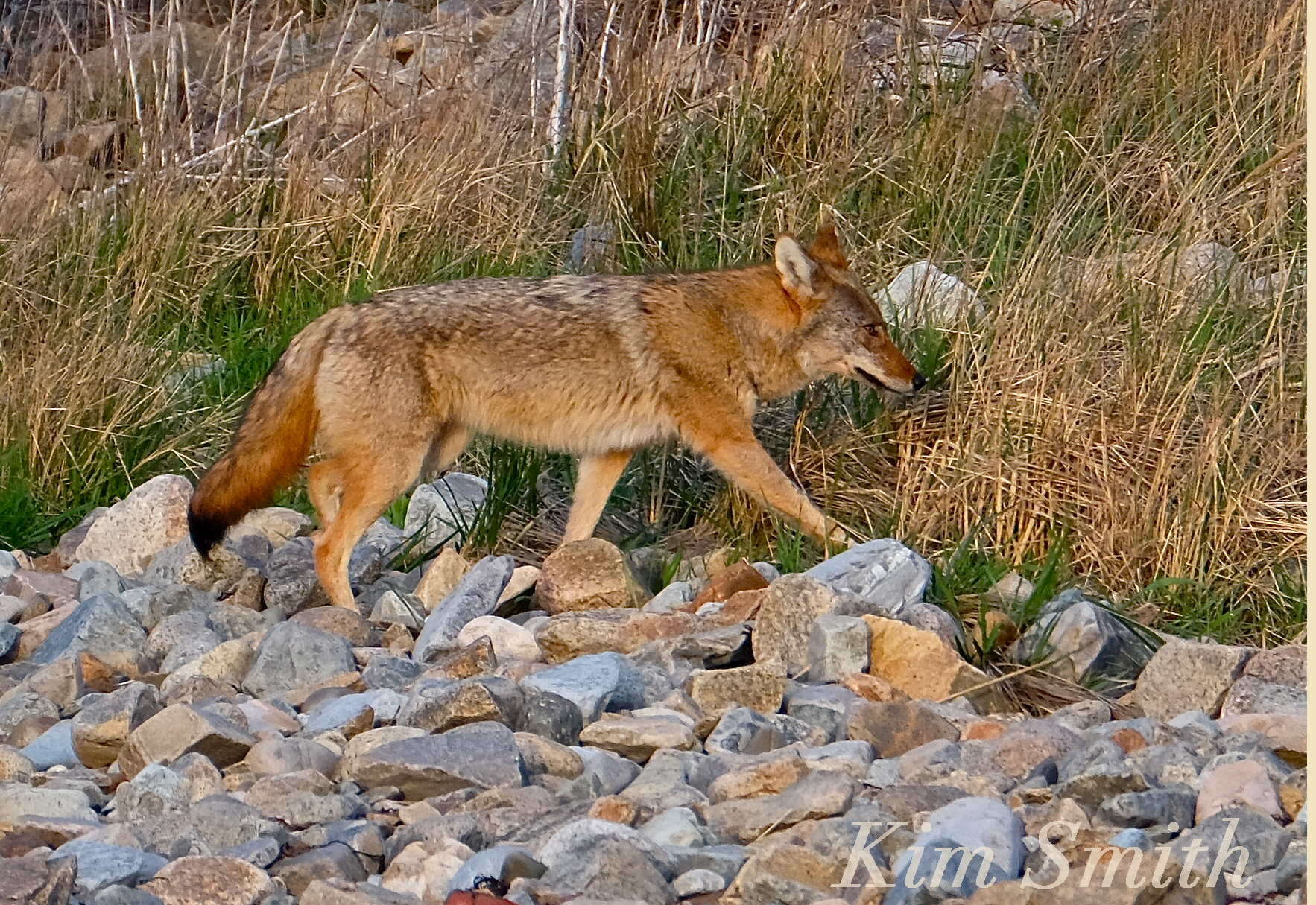
This one appears smaller than what I have typically encountered, perhaps it is only a year or two old, or possibly coyotes are not as plump after the winter months. He/she was very intent upon scavenging in a bed of seaweed that had washed ashore and think it must have been quite hungry to allow me to get so close. He reluctantly left his meal as I moved toward him and then watched me for some time from under cover of beach grass. His shining eyes were easily seen in the fading low light. Mistakenly, I thought that was the end of our meeting and went back to filming B-roll.
Beach grass provides excellent camouflage
I was losing the light and decided to call it a day. Packing up cameras and turning to go, there he was, a hundred yards away, staring at me. Deftly traveling through the tall reeds he had circled around. I don’t think he had me in mind for his next meal, but I was halfway between him and the scavanged dinner from which he had so rudely been interrupted. Plans on how to weaponize my tripod and camera bag quickly came to mind. He trotted leisurely towards me, changed his mind, and then trotted in the opposite direction. A car came down the road and he again turned toward my direction, making his way along the beach until slipping back into the grass.
If ever you have a close encounter with a coyote, be sure to remind yourself of this story and know that they may indeed still be very close by.


 Good Morning Gloucester
What school were you on? That’s way too scary for pets and small children!
LikeLiked by 1 person
That was suppose to be beach!! Sorry
LikeLiked by 1 person
Hi cammygrammy,
Coyotes are on every beach on Cape Ann, without doubt. A large percentage of the diet of coyotes found along the coastline is comprised of food scavenged on the beach, dead birds mostly. This evening, I found the coyote remains of very large dead crow.
I have seen coyotes at Good Harbor Beach, Wingaersheek Beach, Brace Cove, Lighthouse Beach, Niles Pond, Henry’s Pond and Pebble Beach. They have crossed my path many early mornings on my way to and from filming, both on foot and in the car.
LikeLike
Yikes. Thanks.
LikeLike
Kim,
I talked with all family mom grew up in cape since 1931- 1968 and myself running around since 5-6 years old part of the little rascals crew I do not recall the seeing coyotes. I did see foxes however and I am not saying coyotes were not present but if they were kept a very low profile and well hidden. But back in those days we also had a lot more dogs roaming the streets and about which of course does not happen today may have kept them at bay.
The first issue with coyotes I know of and found was this headline (1998)…
by Bruce Mohl, Globe Staff July 31, 1998
SANDWICH, MA – A coyote sprang from the woods
Dave
LikeLiked by 1 person
thank you
LikeLiked by 1 person
what beach???????????
LikeLiked by 2 people
I run into them at Winga all the time. It gets the adrenaline running lol!
LikeLiked by 1 person
One practically ran across my toes on a path at Wingaersheek on the way to filming sunrise. I’ll say, about that adrenaline!
LikeLiked by 1 person
Hi-what beach were you on? I often walk the beaches with my Jack Russell who would definitely chase this coyote – would like to avoid that!
LikeLiked by 2 people
Such a beautiful creature… We are so fortunate to be able to peacefully coexist with them on Cape Ann.
LikeLiked by 1 person
I agree, Karen. Great shots of a gorgeous creature, Kim!
LikeLiked by 1 person
There is a Coyote Vest you can get for dogs that is made of kevlar and has spikes in it to protect a dog.
LikeLiked by 1 person
http://www.coyotevest.com/collections/coyotevest-starter-pack/products/coyotevest-starter-pack-xsmall
Comes in different sizes
LikeLiked by 2 people
This coyote vest appears very well designed. Judging from the way a coyote tried to kill our cat, which was to clamp on his head, with teeth going down through his brain and up through his jaw and throat, the spikes on the coat look well placed.
LikeLike
It would seem that there is a Live and Let Live attitude among the coyotes toward human kind. As long as we do not threaten, corner , or act aggressively toward them, we and they can co exist. I, too, encounter them on Eastern POINT. They’re not going away any time soon. . We need to learn share this earth with all living things. There is no other choice.
LikeLiked by 1 person
Great pictures. I still can’t get my mind off of the one with the ducklings and their mother you posted recently.
LikeLiked by 1 person
Thank you northshorehc for your kind comments.
I found them again, at least I think it was the same family, but they were across the pond. Happy to see that the family was all together and swimming along with Mom.
LikeLike
Hi Kim: I’m glad that all turned out well. Most of us are animal lovers, but one can’t be too careful. We may not be aware of the fact that they are staring at us for a reason i.e. their babies are nearby or we are blocking their path to food. They are beautiful animals, but they are still wild. So glad you are smart and that you weren’t hurt.
LikeLiked by 1 person
Thanks so much Terry. I agree, they are wild and unpredictable. Next time I see one I will definitely remain on alert, including after they have departed.
LikeLike
Beautiful pictures!!!
LikeLiked by 1 person
Thanks so much Kathleen 🙂
LikeLike
I had no idea they frequented so many of the beaches on Cape Ann; I never saw one as a child growing up in the ’50’s, either. I’m glad your “Encounters of the several times” have ended well, Kim.
LikeLike
For Dave and Leslie,
Coyotes were never in Massachusetts until the late 1950s, and at that time, the only confirmed sightings were in the Berkshires. It took another 40 to 50 years for the coyotes to populate every region of Massachusetts (except, I believe, the Islands).
As the western coyote population grew, it was forced to move further east. Biologist think several generations ago, around the upper Great Lakes area, a few coyotes hybridized with red wolves, which created a genetically hardier coyote. From this cross breeding generations ago, DNA now shows that the Eastern Coyote is about 10 percent wolf, 10 percent domestic dog and 80 percent coyote.
The range of the coyote has expanded considerably over the past century. They are now common in Central America. Coyotes are highly adaptable and well suited to suburban habitats (think garbage, small wild creatures, bird food (which attracts critters), and house pets). It is thought that it won’t be long before the coyote will begin to populate South America.
LikeLike
Although the coyote was never native to Massachusetts the wolf was. Better genomic DNA sequencing of this eastern coyote shows that 30% of wolf genome is present. (The previous sequencing was done only on mitochondrial DNA SNP panels which could give lower numbers because it was only tracing female DNA. More complete genomic sequencing will give a much clearer picture of how and when did the hybridization occur.)
So in a sense, this animal is not an invasive species to the eastern United States but the wolf genome coming back to territory it roamed centuries before the pilgrims started exterminating it. (Nature and Darwinian evolution abhorring a vacuum.) With 30% DNA the animal should really not be called a coyote but a coywolf.
LikeLike
Hi Paul, I hope you’ll take the time to read this thoughtfully written and factual article by Roland Keys, Research Associate Professor of Wildlife and Scientist at NC Museum of Natural Sciences, North Carolina State University
“Yes, eastern coyotes are hybrids, but the ‘coywolf’ is not a thing”
Talk of “coywolves” – a blend of coyote and wolf – is everywhere. There is a PBS special called Meet the Coywolf, a recent article in the Economist, and it is now trending on Facebook. The media really love this new animal name.
There is no doubt that there is a hybrid canid living in the eastern US, and that it is the result of an amazing evolution story unfolding right underneath our noses.
However, this is not a new species – at least not yet – and I don’t think we should start calling it a “coywolf.”
Genetic swapping
What creature are we talking about? In the last century, a predator – I prefer the name “eastern coyote” – has colonized the forests of eastern North America, from Florida to Labrador.
New genetic tests [http://genome.cshlp.org/content/21/8/1294.short] show that all eastern coyotes are actually a mix of three species: coyote, wolf and dog. The percentages vary, dependent upon exactly which test [http://onlinelibrary.wiley.com/doi/10.1111/mec.12570/full] is applied and the geographic location of the canine.
Coyotes in the Northeast are mostly (60%-84%) coyote, with lesser amounts of wolf (8%-25%) and dog (8%-11%). Start moving south or east and this mixture slowly changes. Virginia animals average more dog than wolf (85%:2%:13% coyote:wolf:dog) while coyotes from the Deep South had just a dash of wolf and dog genes mixed in (91%:4%:5% coyote:wolf:dog). Tests show that there are no animals that are just coyote and wolf (that is, a coywolf), and some eastern coyotes that have almost no wolf at all.
In other words, there is no single new genetic entity that should be considered a unique species. Instead, we are finding a large intermixing population of coyotes across the continent, with a smattering of noncoyote DNA mixed in to varying degrees along the eastern edge. The coywolf is not a thing.
All eastern coyotes show some evidence of past hybridization, but there is no sign that they are still actively mating with dogs or wolves. The coyote, wolf and dog are three separate species that would very much prefer not to breed with each other. However, biologically speaking, they are similar enough that interbreeding is possible.
This genetic swapping has happened more than once in their history; one study showed that the gene for black coat color found in North American wolves and coyotes today (but not in Old World wolves) originated in dogs brought to the continent by the earliest Native Americans. Some prehistoric hybridization event transferred the dog gene into wild wolves and coyotes.
The eastern coyote is born
We can estimate the date of the most recent hybridization events that created eastern coyotes by analyzing their genetic structure. Their DNA show that about 100 years ago, coyotes mated with wolves, and about 50 years ago with dogs. A century ago, wolf populations in the Great Lakes were at their nadir, living at such low density that some reproductive animals probably couldn’t find another wolf mate, and had to settle with a coyote.
The more recent date for the dog hybridization likely results from a cross-species breeding event at the very leading edge of the wave of colonizing coyotes in the east, possibly after a few females first spanned the St Lawrence seaway into upstate New York, where they would have encountered abundant feral dogs, but no other coyotes.
Nowadays, eastern coyotes have no problem finding a coyote mate. Their populations continue to grow throughout their new forested range, and they seem more likely to kill a dog than breed with it. Wolf populations in the Great Lakes have also recovered, and the wolf is once again the worst enemy of the coyote, rather than its last-chance prom date.
Coyotes have also expanded north into Alaska, although there is no sign of hybridization in that range extension. In Central America, they have expanded out of Mexico’s deserts, working their way south past the Panama Canal in the last decade, apparently bound for South America.
No genetic studies have looked at Central American coyotes, but photographs of doglike animals suggest that coyotes might be mixing it up across species lines along the leading edge of this southward expansion as well.
Coywolfdog evolution
Hybridization across species is a natural evolutionary phenomenon. The old notion that an inability to breed should define what a species is has been abandoned by zoologists (with a resounding “I told you so” from botanists). Even modern humans are hybrids, with traces of Neanderthal and Denisovan genes mixed into our genome.
The first requirement for evolution is variation, and mixing genes from two species creates all sorts of new variations for evolution to act on. Most of these probably die, being a compromise between two longstanding species that were already well-adapted to their own niches.
However, in today’s rapidly changing world, new variations might actually do better than the old types. Some of these genetic mixes will survive better than others – this is natural selection.
The coyote with a bit of wolf genes to make it slightly larger was probably better able to handle deer, which are overabundant in eastern forests, but still wily enough to live in a landscape full of people. These animals thrived, dispersed east and thrived again, becoming the eastern coyote.
Exactly which dog and wolf genes are surviving natural selection in today’s eastern coyote is an area of active research.
Coyotes with odd coat colors or hair types are probably the most conspicuous sign of dog genes in action, while their slightly larger size might come from wolf genes. Some of these genes will help an animal survive and breed; others will make them less fit. Natural selection is still sorting this out, and we are witnessing the evolution of a new type of coyote right under our noses, one that is very good at living there.
Western coyotes adapt locally to their environments, with limited gene flow between populations (called “ecotypes”) living in different habitats, presumably reflecting local specialization.
Will eastern coyotes specialize locally as well? How will dog and wolf genes sort out across cities and wildernesses of the east?
Expect some really cool science in the next few years as researchers use modern genetic tools to sniff out the details of this story.
Evolution still in progress
There are many examples of bad animal names that cause a lot of confusion.
The fisher is a large type of weasel that does not eat fish (it prefers porcupines). The mountain beaver of the Pacific Northwest is not a beaver and does not live in the mountains. And then there’s the sperm whale…
We don’t get many opportunities to name new animals in the 21st century. We shouldn’t let the media mess up this one by declaring it a new species called the coywolf. Yes, there are wolf genes in some populations, but there are also eastern coyotes with almost no wolf genes, and others that have as much dog mixed in as they do wolf. “Coywolf” is an inaccurate name that causes confusion.
The coyote has not evolved into a new species over the last century. Hybridization and expansion have created a host of new coyote variations in the east, and evolution is still sorting these out. Gene flow continues in all directions, keeping things mixed up, and leading to continual variation over their range, with no discrete boundaries.
Could evolution eventually lead to a coyote so specialized for eastern forests that they would be considered a unique species? Yes, but for this to happen, they would have to cut off gene flow with nonhybrid animals, leading to distinct types of coyotes that (almost) never interbreed. I think we are a long way from this possibility.
For now, we have the eastern coyote, an exciting new type of coyote in the midst of an amazing evolutionary transition. Call it a distinct “subspecies,” call it an “ecomorph,” or call it by its scientific name Canis latrans var. But don’t call it a new species, and please, don’t call it the coywolf.
http://theconversation.com/us
LikeLike
Holy cow! That’s a lot of information, Kim, but very informative. Thanks for the clarification.
LikeLiked by 1 person
It’s all very interesting Leslie. Roland Keyes writes with clarity, open mindedness, and without a predetermined agenda–the coyote is an “amazing evolutionary transition.”
LikeLike