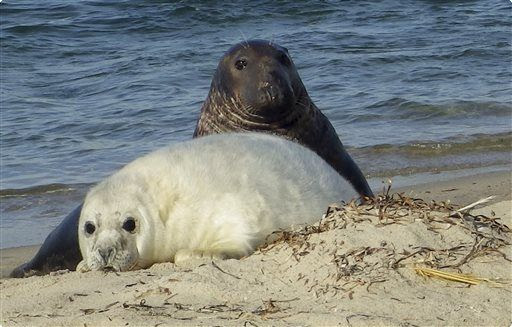
 It’s Gray Seal Pupping Season
From December through February, gray seals give birth on islands and shoreline areas in Maine, New Hampshire, and Massachusetts. It’s not uncommon to see a mother and pup or a lone pup on a beach. Gray seal pups are born with a white, fluffy coat, known as lanugo, and nurse from the mother for approximately 16 to 17 days.
“A mother seal may be off feeding when someone comes across a seal pup on the beach,” says Mendy Garron, marine mammal stranding program coordinator for NOAA Fisheries Greater Atlantic Region. “The best thing you can do is keep people and pets away from the seal pup, so the mother has a chance to return.”
Gray seal pups are very vocal, and can sound like a baby crying, but this is normal behavior and doesn’t necessarily mean that the pup is in distress. This vocalization helps the mother find the pup when she returns from foraging.
NOAA Fisheries reminds members of the public to respect wildlife by maintaining a safe distance of at least 150 feet from seals.
Seal pups are often higher up on the beach, near the high tide line or even in the dunes, for protection while the mother is away. Sometimes pups do wander far from the beach, ending up in unusual places. If you suspect an animal may be in trouble, please take the following actions:
- Call your local Marine Mammal Stranding Network Member or the NOAA Fisheries Greater Atlantic Regional 24-hour hotline 866-755-NOAA (6622).
- Always maintain a safe distance, at least 150 feet, from the animal to avoid injury to yourself or to the animal.
- Do not touch the seal! They are wild animals. They will bite, and can transmit disease.
- Keep your pets on leashes, and remove them from the area. Pets can further stress seals, provoking defensive behaviors. Seals can attack pets if they feel threatened, and they can transmit diseases to pets.
- Never feed seals. This can make the animal sick or dependent on people for food.
- Do not move or push the animal back into the water. Seals need time to rest and regulate their body temperatures, which is why they “haul out” on land.
- If you see someone harassing a marine mammal, please contact our Office of Law Enforcement at 800-853-1964.
NOAA Fisheries is the federal agency responsible for monitoring marine mammal populations in the United States. In this region, NOAA Fisheries relies on a team of dedicated, trained personnel from Maine to Virginia to assist the agency in carrying out its mission.Marine Mammal Stranding Network has been in existence for several decades and is comprised of organizations from the wildlife rescue community, academic institutions, zoo/aquarium facilities, and federal state or local government agencies. The Marine Mammal Health and Stranding Response Program (MMHSRP) was officially formalized in 1992 under the Marine Protection Act of 1972 after numerous mass strandings and unusual mortality events occurred around the country.
Get more information on NOAA Fisheries Greater Atlantic Region’s Stranding Program (covering the coastlines of Maine to Virginia).
Find out about our gray seal research on Muskeget and Monomoy Islands.






















 Good Morning Gloucester