For additional reading, the following is a link to an interesting article that explains clearly why coyotes are thought to be the canid soup that they are, from Earth Sky: “Eastern Coyote is a Hybrid, But Coywolf is Not a Thing”
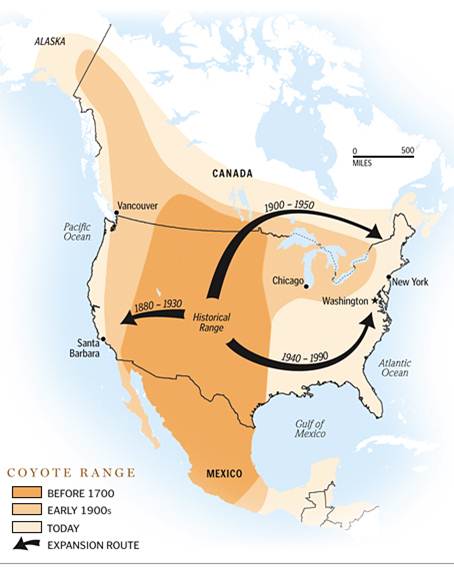
This map shows the movement of coyotes across North America and Mexico. It is now in Panama and will undoubtedly make its way south and across the canal. The animal is so adaptable I imagine it won’t be long before it colonizes Colombia as well.
Link to Cape Ann TV coverage of the coyote meeting:
http://vp.telvue.com/preview?id=T01896&video=261352
Spread The GMG Love By Sharing With These Buttons:
Related
Published by Kimsmithdesigns
Documentary filmmaker, photographer, landscape designer, author, and illustrator. "Beauty on the Wing: Life Story of the Monarch Butterfly" currently airing on PBS. Current film projects include Piping Plovers, Gloucester's Feast of St. Joseph, and Saint Peter's Fiesta. Visit my websites for more information about film and design projects at kimsmithdesigns.com, monarchbutterflyfilm.com, and pipingploverproject.org. Author/illustrator "Oh Garden of Fresh Possibilities! Notes from a Gloucester Garden."
View all posts by Kimsmithdesigns


 Good Morning Gloucester
To be fair, when you read the entire article, it says a coywolf isn’t a distinct species, at least not YET…but it does say it is a subspecies or an ecomorph (but they prefer to call it the Eastern Coyote as there is coyote/wolf and dog hybridization in there)…and when you look at the differences mainly in size and coat (winter coat notwithstanding) of the Eastern Coyote compared to the Panama coyote there is clearly a huge difference. Thanks for sharing, interesting stuff!
LikeLike
People like to put words on things. A lot of us do not understand the meaning of species, sub-species, race, hybrid. When I see of those, I call it coywolf to make it simpler and explain if anybody cares to learn. When looking at the skull of Canidae, you have wolf dentition for about a third of the specimens, the coyote`s for a third, and the others are un-identifiable i.e. with morphologic trait of both species. Those observations are from animal skulls trapped in the northeast US and eastern Canada.
LikeLike