 Male Common Eider (center) with Male Buffleheads
Last week a reader wrote asking how to tell the difference between Buffleheads and Common Eiders. Both males of the species are black and white and both frequent our shores during the winter months. The easiest difference is that the Eiders are much larger, about 25 to 27 inches, while Buffleheads are about half the size of an Eider, only measuring 11-15 inches in length. Common Eiders are the largest diving duck in North America; the Bufflehead the smallest diving duck.
 Eiders have a long sloping bill and move rather slowly.

Male and Female (right) Buffleheads
Buffleheads are sprightly and butterball shaped. From a distance the male Bufflehead looks striking, appearing black and white. Up close, the head feathers are a stunning iridescent purple and green. Both Eiders and Buffleheads can be seen feeding all along the Massachusetts coastline during the winter months. Buffleheads inhabit fresh water ponds and salt water whereas Common Eiders are sea ducks. During the summer breeding season, Common Eiders are found across Alaska and Canada all the way south to our region, whereas Buffleheads breed in the boreal forests and aspen parklands of Canada and Alaska.
I am sure you’ve heard of eiderdown pillows and quilts. The eiderdown, plucked from the female’s breast to line the nest, can be collected sustainably and safely after the ducklings leave the nest. Eiderdown has been largely replaced by down from farm raised geese.
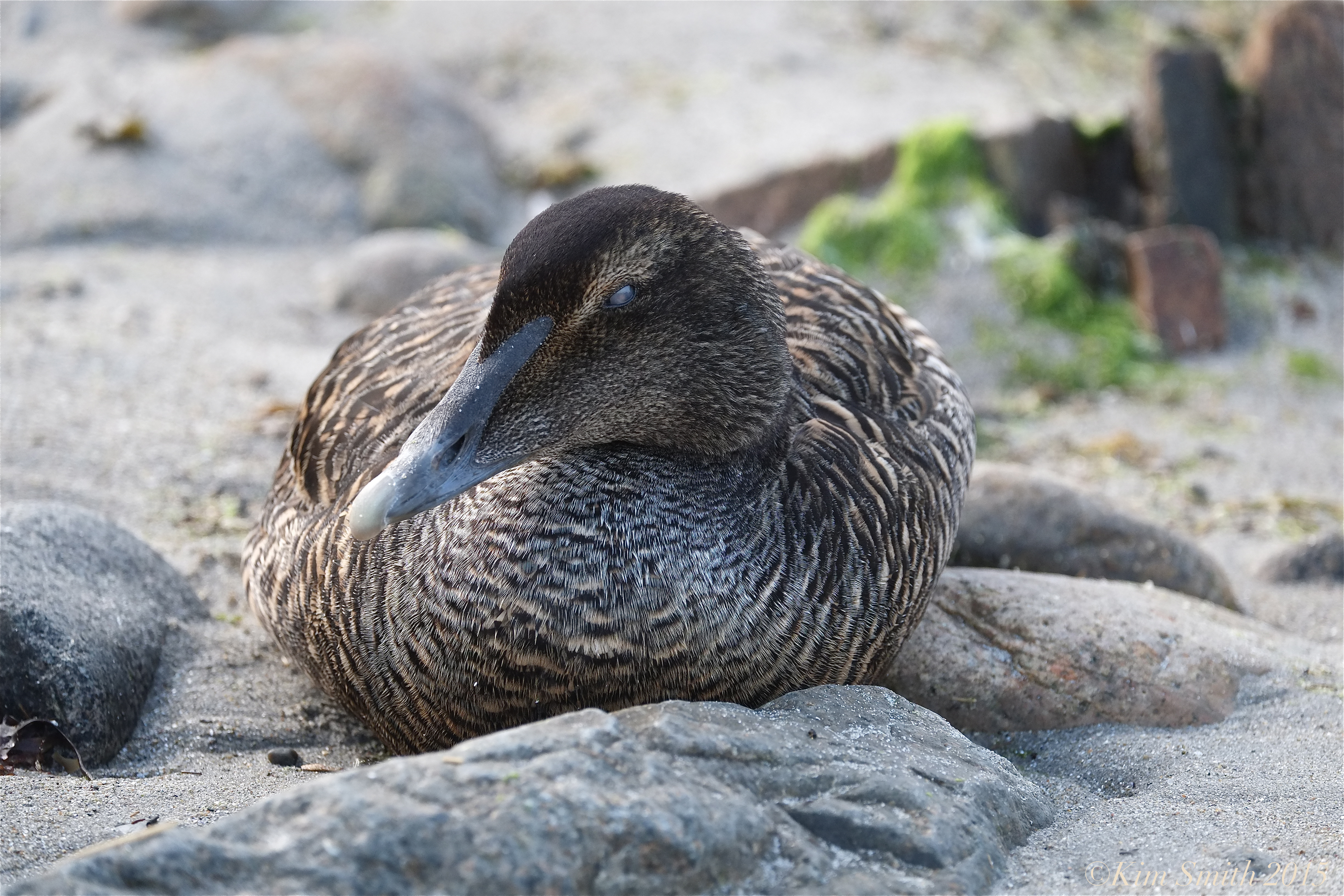 Female Common Eider


 Good Morning Gloucester
Along the winter shore in Manchester I am always surprised to see the flocks of 2-3 dozen female eiders without a male in sight, and then to walk along Gloucester harbor from the Boulevard to Stagefort Park and count the dozen or so male eiders without a single female. Must be nature’s way of keeping the population down!
LikeLiked by 1 person
I’ve see that in the spring too Tom and wondered why. Male Eiders do not reach breeding age until they are three years old, females at two years of age. I’ve read they are monogamous during the season, but not monogamous for life. Good to learn more about it!
LikeLike
Along the winter shore in Manchester I am always surprised to see the flocks of 2-3 dozen female eiders without a male in sight, and then to walk along Gloucester harbor from the Boulevard to Stagefort Park and count the dozen or so male eiders without a single female. Must be nature’s way of keeping the population down!
LikeLike
Along the winter shore in Manchester I am always surprised to see the flocks of 2-3 dozen female eiders without a male in sight, and then to walk along Gloucester harbor from the Boulevard to Stagefort Park and count the dozen or so male eiders without a single female. Must be nature’s way of keeping the population down!
LikeLike
These periodic updates on local wildlife identification are extremely helpful to me. I have never been good at this and could not tell a cod from a haddock if they were not carefully color coded. Students in the sailing program, particularly visiting racers from inland towns, often ask me what this or that bird or animal is. If our consultant and sailing instructor Hilary is not present, I often have to shrug or ask one of the Cape Ann kids to help. With your help, I am getting a little better at it.
LikeLiked by 1 person
Thanks so much Damon. I am very glad to know this. I worry sometimes that it is TMI about our local wildlife.
Please feel free to send in any photos of interesting creatures that you encounter. It sounds as though you are out on a boat? There are all sorts of terrific fold out pocket guides that are also laminated, which might be a great thing to have readily on hand. Thanks so much again for writing.
LikeLike