Recently a design colleague wrote inquiring as to the best time to mow her client’s fields as she was concerned about disrupting the breeding cycle of the Monarch butterfly. I am often asked this question and it is well worth considering, not only for the sake of the Monarchs, but for the survival of the myriad species of butterflies, bees, and other pollinating and beneficial insects that find food and shelter in untilled fields.

Newly Emerged Monarch
Dear Laurel,
I generally advise my readers and design clients that own similar untilled fields to alternately mow in stages–-half a field at a time. The Monarch is a large, charismatic butterfly with an easily observed life cycle. The typical field comprised of native (and introduced) wildflowers and grasses creates a rich biodiversity, supporting innumerable species of butterflies and beneficial insects. It is hard to know when exactly to mow for each different species and when to mow for even one single species because, from year to year, depending on many variables including temperature and air currents, the insects breeding times are somewhat variable. For example, this year I have had three broods each of both Monarchs and Black Swallowtails, when in a more typical year I may only have two broods.
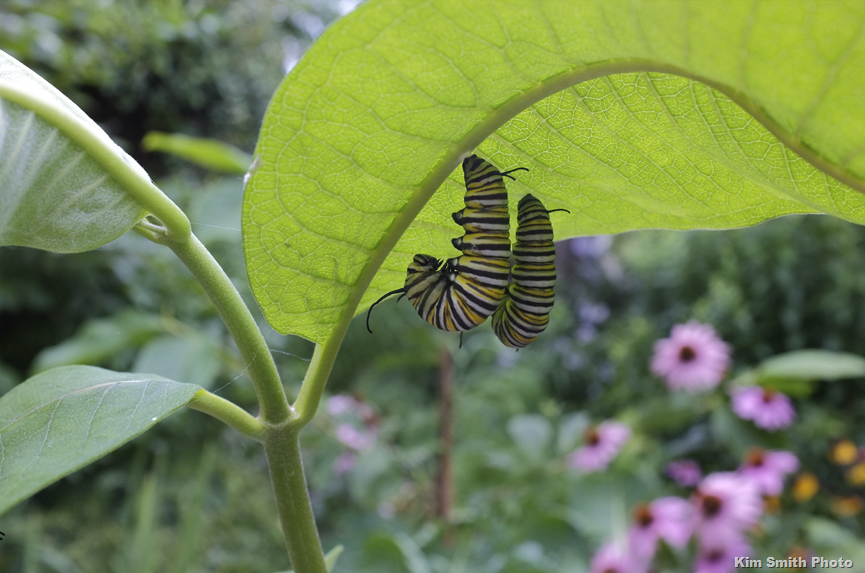
Monarch Caterpillars Attached to Milkweed Leaf (Asclepias syriaca)
I think of not too long ago when we were primarily an agrarian society. Farmers then would have mowed different fields at different times during the growing season. A woman in our community, whose field is rife with common milkweed, always mows in late June or early July. Initially I thought that this was perhaps not good practice for the Monarchs, but the thing with Common Milkweed (Asclepias syriaca) is that when mown to the ground in early summer, it shoots right back up again. By the time the late July, early August Monarchs have arrived and are breeding in our region,her milkweed has re-sprouted, grown at least a foot, is lush and green, and flowering.
That your client is interested in caring for the flora and fauna that abounds in her fields is wonderful! We want weeds (wildflowers) growing in our fields–they provide food and shelter for benefiel insects and wildlife and also help retain moisture in the soil.
The single greatest threat to the Monarch butterfly is the use of Monsanto’s Roundup Ready genetically modified corn and soy bean seed, which are designed to tolerate potent does of Monsanto’s herbicide Roundup, however, Roundup kills all other surrounding plants and all beneficials insects and their larvae. Additional threats include the extreme weather condiitons caused by climate change, overdevelopment in the US, which has led to loss of habitat, and lastly, the unrelenting poverty in rural Mexican villages, which is leading to the deforestation of the butterflies habitat in Michoacán.
To Read the rest of Kim’s Post Check Out Her Blog Here-


 Good Morning Gloucester