
PHOTO BLOCK: program; Emcee Vionette “Vee” Chipperini, Dir. Cape Ann Veterans Services; Cata trolley; lining up for the parade to the Joan of Arc monument and Captain Lester S. Wass Post 3 American Legion following the beautiful Veterans Day Ceremony 2023 at Gloucester High School


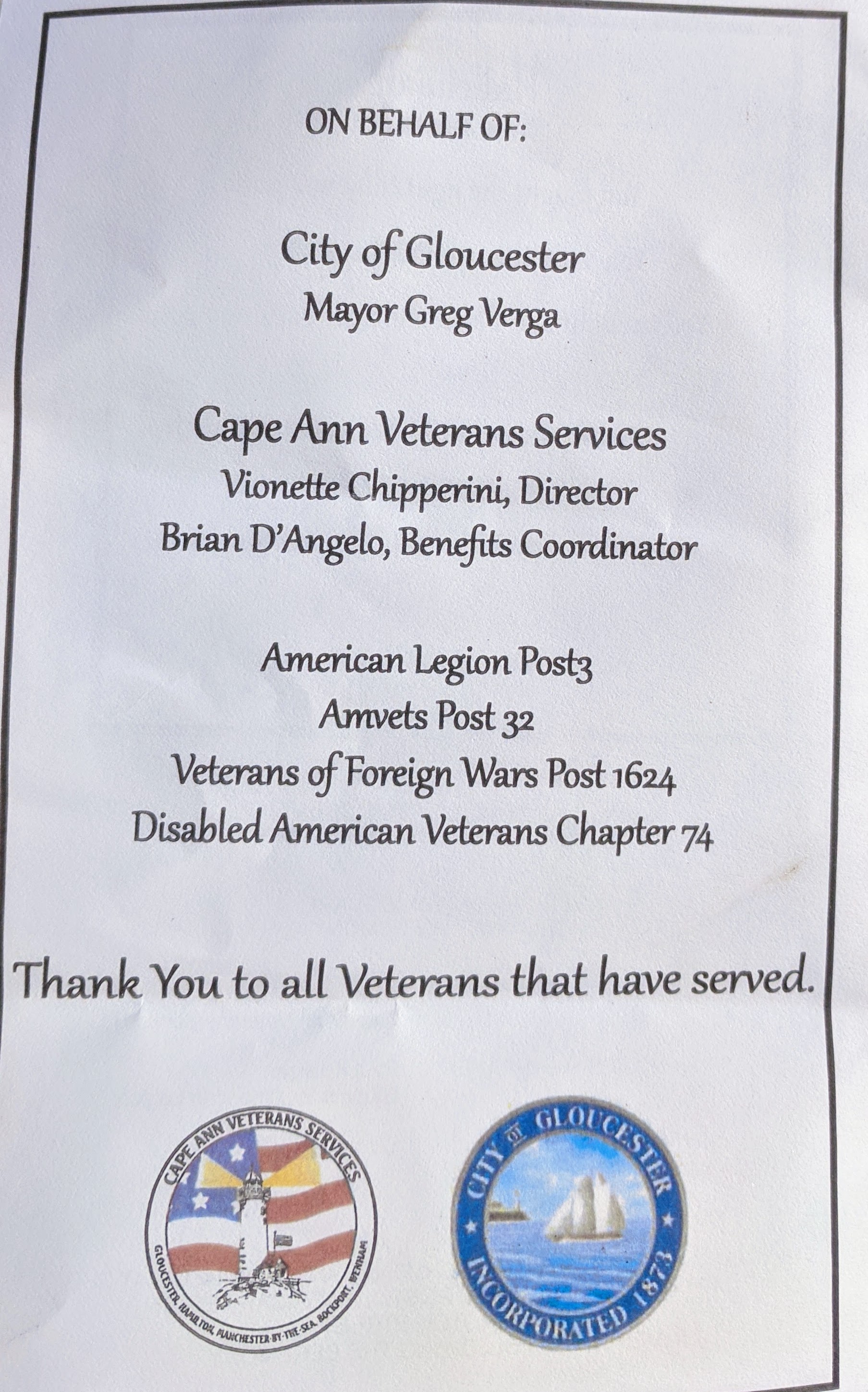
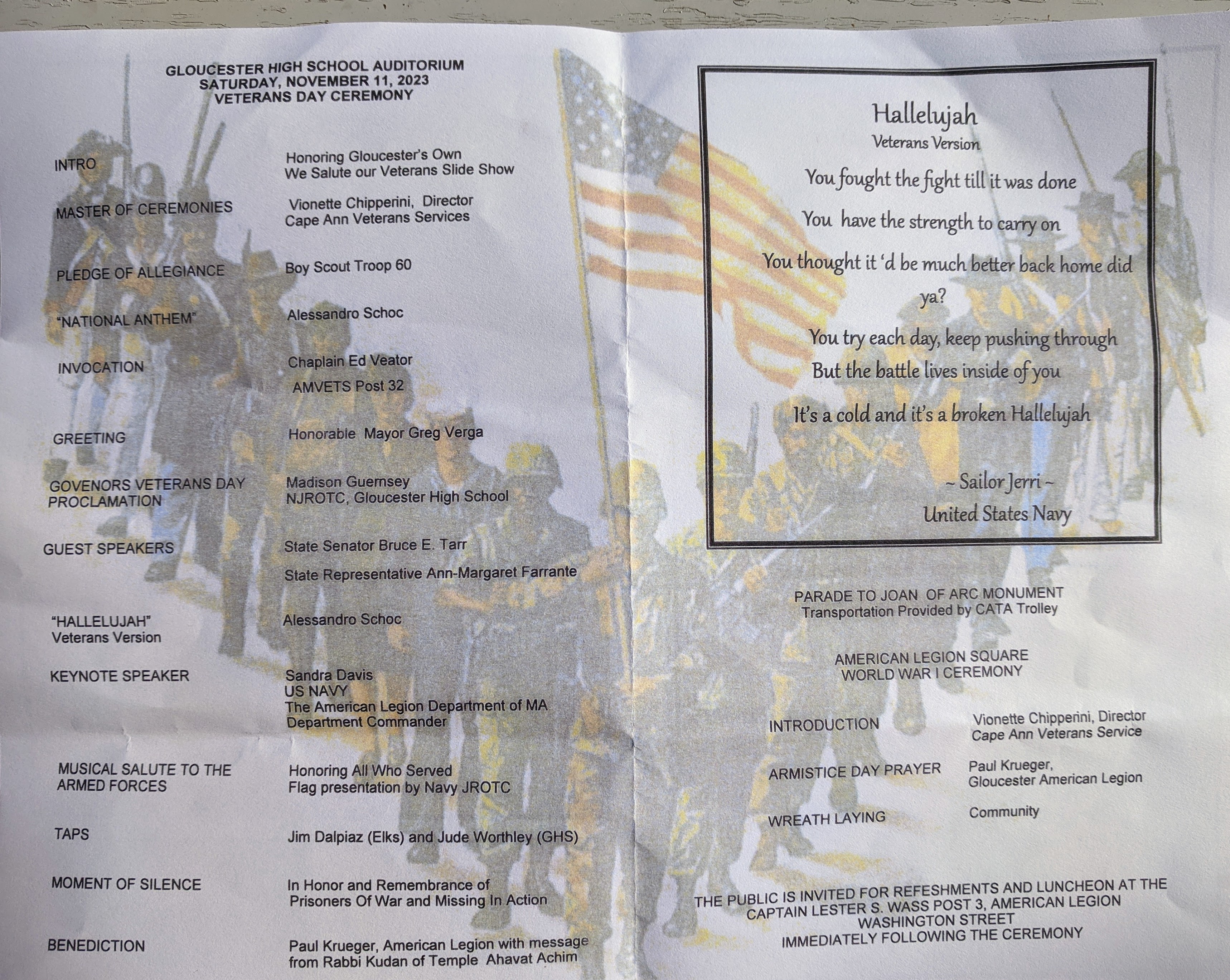

PHOTO BLOCK: Gloucester’s Civil War Era Coat
As a result of the pandemic and lobby enhancements at GHS, Gloucester Civil War era coat was covered and stashed in the hallway. The temporary sign with an introduction to the display will soon be replaced by four permanent labels designed for this case. The BEFORE photographs were taken in 2015 by Kim Mimnaugh who after noticing disrepair and mold, sought care of the coat & case, and its forgotten history. A community restoration fundraising effort expanded in order to display the coat in full view. Valerie Marino shared news about possible funding through the Massachusetts State Historical Records Advisory Board (MA SHRAB) which was applied for and awarded in 2018 and 2019.


“I’m proud of our city volunteers, students and residents who came together to help raise awareness of this American artifact that has history to our country and to our local community,” said Mayor Sefatia Romeo Theken. “With this SHRAB grant, as well as Awesome Gloucester and online fundraising monies, the education and heritage will live on for years to come.”…The SHRAB program is an extension of grants awarded by the Massachusetts Sesquicentennial Commission of the American Civil War with supporting services from the Secretary of the Commonwealth William F. Galvin and Massachusetts Archives Department, which features a rigorous and competitive qualifying process. The program reviewed hundreds of applications across the Commonwealth, but the ten-page application overview designed by two young activists, …was “enthusiastically” selected by Commonwealth Archivist Dr. John Warner and his committee.”
Gloucester’s Civil War-Era Coat
This exhibit tells the story about a noble coat and its cultural significance to Gloucester and American history.
- Title: Gloucester’s Civil War-era Coat
- Designer: Unknown
- Date: American 19th century, about 1860
- Owner: ______ (wearer once known)
- Media: ¾ length coat: linsey-woolsey (linen and wool mix), buttons, repairs & patches
- Dimensions: about 27” x 12” x 49” on the stand
- Credit line: City of Gloucester, Massachusetts. Gift of Roger W. Babson (1875-1967) 1934 and dedicated May 30-31, 1935, GHS; Bequeathed to Babson by Albert W. Bacheler (1842-1929); Gift of wearer(s) once known, enslaved person(s), to Bacheler, December 1864.
Introduction label. Four permanent panels coming soon. Albert Bacheler (1842 Balasore, India -1929 Melrose, MA) was a Gloucester resident, GHS Principal, and community leader for 30 years beginning in 1884 until he retired in 1914. Under Bacheler, GHS acquired accreditation status to provide equal and higher educational opportunities for boys and girls, as well as athletic and extracurricular activities. He used the coat to inspire generations of students. Bacheler graduated from Dartmouth in 1871 where he also played baseball. Bacheler was a Civil War Veteran, New Hampshire 12th Regiment, Company E and POW. He enlisted August 12, 1862 and fought in every battle albeit Cold Harbor including Gettysburg. He was captured and imprisoned in Libby Prison, Richmond, Virginia. He escaped and received help from enslaved families–including this textile–as he traveled north. The coat afforded Bacheler warmth and camouflage to escape recapture as he made his way. Bacheler eventually reached safety, meeting up with the Eight United States Colored Cavalry. What happened to the people who helped him and the wearer of this coat is unknown. This exhibit honors their agency and Bacheler’s, educators, education, veterans, service and community.
Bacheler established the forerunner of what became the JROTC. I’m republishing this great read by educator Dr. Erik Anderson, a former GHS Principal himself.
JROTC FASCINATING HISTORY AT GHS
read excerpts from The Junior Reserve Officer Training Corps at Gloucester High School: An Interdisciplinary Study of Community Leadership Development Amidst Societal Change by Dr. Erik M. Anderson, ©2015
A lengthy list of former GHS students and JROTC members, mentors, veterans, notables, businesses and organizations mentioned is incredible! Among them are: Leo Alper, Roger W. Babson, Albert Bacheler, Sargeant Barbosa, Melvin Bernstein, Kellogg G. Birdseye, Harry F. Bray, John Buckley, R. Wesley Burnham, Frank T. Chance, Roger Conant, Stephen Dexter, George Dolliver, Donald H. Emero, Saul Feldman, Charles Foster, Major Galbraith, Peter Garrisi, Jane Garrisi, Anthony Gentile, Ron Gilson, William Goodwin, Debbie Goodwin, David Greer, John F. Grillo Sr., Henry Hurwitz, Leslie O. Johnson, Arthur Jones, Benedict Karr, Mark Kennefick, Hilton Kramer, Phil Kramer, Clovis LaFond, Col. McBride, Captain McNerney, Thomas Morris, Morris Pett, David Pistenmaa, William Poirier, Herb Pomeroy, Kendrick Rattray, Henry Rosen, Levi Rudolph, Bob Ryan, Frank C. Shepherd, J. Raymond Silva, Richard R. Silva, Warren Silva, Benjamin A. Smith III, Robert Smith, Roy Spittle, William B. Squillace, Bob Stevenson, Oliver H. Story, Sgt. Tucker, Dick Wilson; and West Point and so many colleges and universities; extensive bibliography, newspapers, city archives and Sarah Dunlap.
**PLEASE NOTE THE EXCERPTS ARE INCOMPLETE & MAY NOT INCLUDE NAMES LISTED ABOVE. I WILL ADD THE FULL PDF LATER.**
“…as far as I’m concerned, it belongs to Gloucester and there is much, much more that could be researched and written.”
Dr. Erik Anderson. Anderson is an educator and former principal at Gloucester High School, Gloucester, MA, and White Mountains Regional High School, Whitefield, NH.










 Good Morning Gloucester